
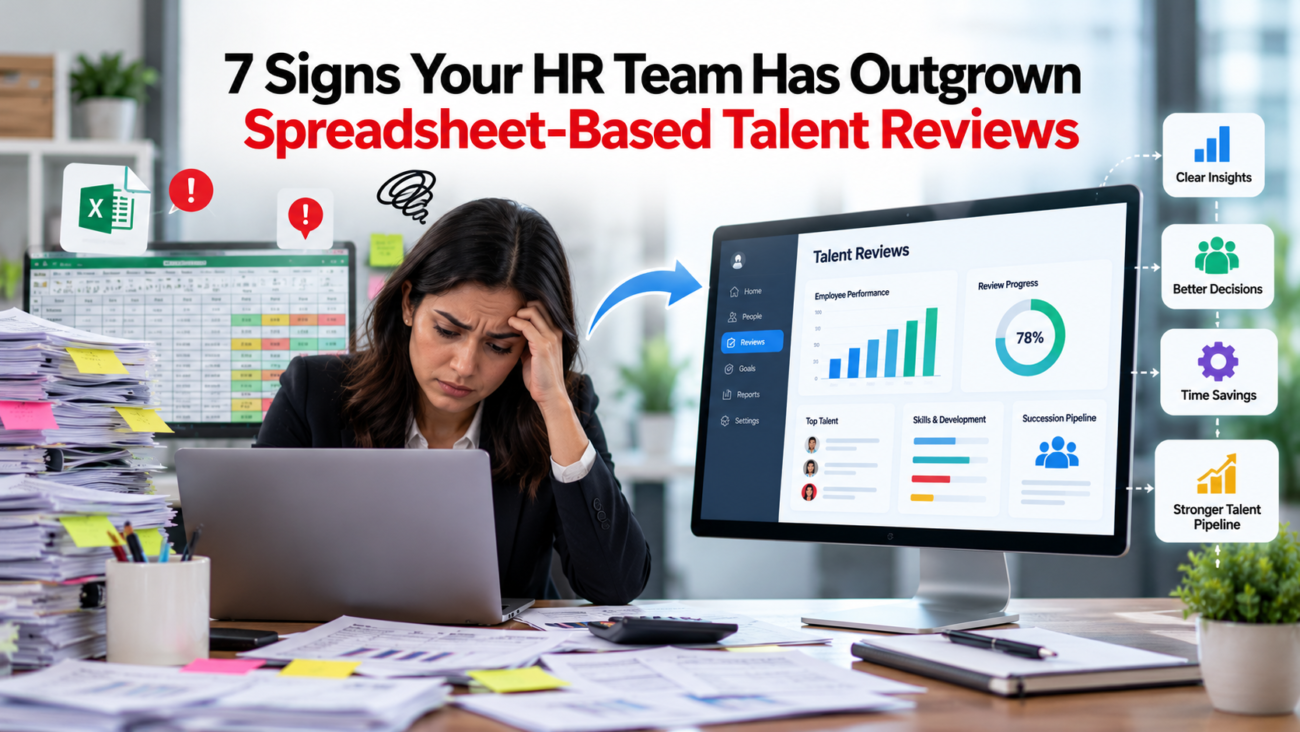
A talent review can look orderly until the leadership meeting starts. HR has collected ratings from every manager. The spreadsheet has tabs for each department. Yet someone asks why 2 employees with similar results landed in different categories, and nobody can trace the decision without opening old emails. Another leader wants a list of successors for a role that may be vacant next quarter. That answer takes another round of manual checks.
These problems matter because talent reviews guide decisions about employee growth, leadership coverage, and sometimes promotion. When records are hard to trust, the conversation shifts from what the organization should do to which file is correct. Spreadsheet-based talent reviews often reach this point gradually. Teams add columns, attach notes, and create new versions to handle each cycle. Eventually, those fixes take more effort than the original review.
The question isn’t whether spreadsheets are useful. They are. The question is whether the talent review process has become too complex for a collection of files to support safely and consistently. The following 7 signs help HR leaders identify that point, measure its impact, and decide what needs to change.
TL;DR
Spreadsheet-based talent reviews become a problem when managers work from conflicting records, rating standards vary, calibration decisions go missing, employee development commitments aren’t followed through, succession data becomes stale, sensitive information spreads beyond approved reviewers, or HR spends more time combining files than discussing talent. A larger workforce alone doesn’t prove a new system is needed. Check the frequency and cost of these failures first. Stronger review rules may fix some issues; others call for a shared workflow with permissions, decision history, and follow-up tracking. The goal is to make talent decisions explainable and useful long after the review meeting ends.
Why Spreadsheets Stop Working for Talent Reviews
Spreadsheet-based talent reviews work well when a small group uses the same definitions, knows the employees under discussion, and can resolve questions directly. A simple grid may be enough for an annual conversation involving 1 leadership team. It lets HR sort performance ratings, compare manager comments, and prepare meeting materials without a long setup process.
The limits appear when the work starts to depend on links between people, decisions, and future actions. A row may show an employee’s performance score but omit the evidence that supported it. A manager may update the assessment after calibration without recording why. A later reviewer may not know which value was final. Files can store the information, but people must create the rules and enforce them on every copy.
The CIPD performance guidance explains why valid measures and clear expectations matter when assessing employees. That principle applies whether ratings live in a workbook or an application. Software can make common rules easier to follow, but it can’t repair weak definitions or replace a manager’s judgment.
It helps to separate performance reviews from talent reviews. A performance review examines work already done and expectations for the role. A talent review brings together evidence about current contribution, future interests, ability to take on new responsibilities, and organizational needs. Its outputs may include development assignments or possible successors. As the number of managers and decisions grows, the talent review process needs a dependable way to connect those outputs.
Sign 1: Nobody Knows Which Talent Review File Is Final
Version confusion usually starts with reasonable requests. A business leader wants an extra field for mobility. A manager corrects a rating after the submission deadline. HR exports the master sheet to prepare a meeting. By the time the meeting begins, several copies contain slightly different information, and each owner believes their copy is current.
The most serious cost is uncertainty at the point of decision. If an employee appears as “ready now” in one file and “ready in 2 years” in another, the difference affects hiring and succession discussions. A late edit can also overwrite an earlier judgment without making the change visible. The person reviewing the workbook can’t easily tell whether the difference reflects new evidence or a copying mistake.
A useful test is to take 10 employee records from the last cycle and ask HR to identify the final rating, the person who approved it, and the date it changed. Record how long the team needs and how often it consults email or meeting notes. If the answers depend on someone’s memory, spreadsheet-based talent reviews have begun to lose their value as a dependable record.
The OPM performance roadmap advises managers to document discussions with specific examples and use systems that support consistency and audit trails. That guidance gives HR a practical standard: a reviewer should be able to understand the final decision without reconstructing a chain of attachments.
What This Looks Like in Practice
The first fix is a clear owner for each record, a submission cutoff, and a single controlled master. Protect key fields and record approved changes. These steps can extend the life of a spreadsheet process. If departments still need simultaneous edits, several approval stages, and a visible change history, a shared review platform becomes more practical. It can give reviewers a shared record and preserve what changed during the cycle, subject to the product’s actual features and setup.
Sign 2: Ratings Mean Different Things Across Departments
A performance rating loses meaning when each manager uses a different standard. One department reserves its highest score for rare results. Another awards that score to anyone who meets stretch goals. A leader who looks only at the combined spreadsheet may assume those scores are comparable, even though the teams used different rules.
This creates a problem in performance calibration. Managers need to compare assessments against the same definitions and supporting evidence. Without that discipline, confident presenters can influence outcomes more than quieter managers with equally strong employees. A polished spreadsheet doesn’t remove the mismatch. It can even hide it by making every value look equally precise.
Research discussed in a SHRM review analysis describes how unstructured evaluation discussions may reward some employees more than others. The lesson for HR is to standardize what managers must explain. Requiring the same evidence categories can reveal disagreements before they become final decisions.
Build a Shared Rating Standard
For a consistent talent review process, define each rating in terms of observable work. Specify the time period, role expectations, and evidence needed for unusual scores. If managers assess future potential, define that separately from current performance. Potential should reflect relevant evidence and opportunities, not vague impressions such as executive presence or cultural fit.
During a calibration meeting, show the proposed score, the reason for it, and any material change made after discussion. Managers should be able to challenge an assessment respectfully. HR should record the final reason, especially when the change affects an employee’s opportunity. This makes performance calibration easier to review later.
Watch for rating patterns by department and job family. Large differences aren’t automatic proof of bias because work and performance can differ. They are a reason to ask whether the standards were applied in the same way. The aim is fair comparison, not forcing every department into an identical score distribution.
Sign 3: Calibration Decisions Disappear After the Meeting
Talent review meetings often produce valuable context that never reaches the official record. A manager explains that an employee’s project results were affected by a temporary assignment. Another leader describes readiness for a different role. The group agrees on a revised assessment, then moves to the next person. When HR later checks the workbook, only the final number remains.
Missing reasoning weakens the talent review process in several ways. New leaders can’t understand past choices. HR can’t distinguish a genuine change in performance from a change in the reviewer’s opinion. Employees may receive development feedback that doesn’t match the reasons leaders discussed behind closed doors. The meeting becomes a one-time event instead of a source of useful decisions.
The CIPD review factsheet explains the continuing role of structured reviews alongside regular feedback. A formal discussion has more value when its outcome connects to the conversations and evidence that came before it. HR therefore needs a record of decisions that is useful for follow-up, while still respecting what information should remain confidential.
A decision record doesn’t need a transcript. For each material change, capture the previous assessment, approved outcome, relevant evidence, decision owner, and effective date. Add a short explanation that another authorized reviewer could understand. Avoid gossip, speculative personal judgments, or information that isn’t needed for the decision.
Separate Discussion Notes From Final Records
Some meeting comments should never appear in an employee-facing summary. HR should define which notes support internal decisions, which statements managers should share with employees, and which sensitive items should be excluded. Keeping all discussion in an unrestricted comments column creates avoidable risks.
For the next cycle, select 5 employees whose ratings changed during performance calibration. Ask a different HR partner to explain each change using only the approved records. If that person can’t do so, the documentation standard needs attention. Where multiple reviewers must approve changes, a review platform may support a more orderly process through defined stages and permissions.
Sign 4: Development Plans Stay in the Review Workbook
An employee may leave a talent review with a promising label and no practical next step. The spreadsheet says “leadership potential,” but it doesn’t identify the assignment needed to test that judgment. Six months later, the same comment appears again. HR has completed the review cycle, yet the employee’s situation hasn’t changed.
This is an execution problem. A talent discussion should result in a decision about who will do what and when progress will be checked. For one employee, that may be experience leading a larger project. For another, it may be coaching on a specific skill or exposure to a new function. The action must fit the person and the role. Generic training recommendations are easy to record but hard to assess.
Gallup’s reporting on meaningful employee feedback shows the value of timely, relevant conversations. A development plan shouldn’t depend on the next annual meeting to receive attention. Employees and managers need a reasonable cadence for discussing work, barriers, and progress.
Track Actions Instead of Labels
Within the talent review process, every approved development action should include an owner, a due date, and evidence of completion. A goal such as “improve communication” isn’t specific enough to guide a follow-up. A more useful action might ask the employee to lead a project update and receive feedback from the project sponsor after 60 days. The outcome can then be discussed against a real assignment.
Spreadsheet-based talent reviews can still capture these actions, but managing them becomes difficult when the workbook is archived immediately after the review. Managers return to their daily tools and HR must send reminders manually. A connected development workflow can help keep assignments visible without making employees wait for another formal cycle.
A useful measure is the share of development actions completed or meaningfully updated by their target dates. Review the reasons for missed actions. A low completion rate may signal that plans were unrealistic, managers lacked time, or nobody had clear ownership. Changing software alone won’t solve those causes, but it can make the breakdown easier to see.
Sign 5: Succession Planning Lists Become Outdated Before Leaders Use Them
A succession list is only useful when it reflects current roles and current people. Yet many HR teams refresh successor names during an annual talent review and leave them untouched for the rest of the year. Someone on the list may leave the company, decline relocation, or move into a different role. The vacancy arrives, and the supposed backup is no longer available.
The CIPD succession guidance describes succession planning as identifying and developing people for leadership and business-critical positions. That means readiness is a changing assessment rather than a permanent label. It also means HR should examine the roles that matter most, rather than treating every position as equally urgent.
Strong succession planning distinguishes possible successors from employees who are prepared and willing to step into a role under defined conditions. Someone may have the skills but lack an important experience. Another person may be ready but not interested in the location. Both facts affect the decision. A spreadsheet row containing only a name and a readiness category leaves too much unsaid.
Test the Actual Bench
Start with a small set of critical positions. For each, ask whether the role has a current successor, what evidence supports readiness, what development remains, and when the information was last confirmed. Include the employee’s interests only where they have been discussed appropriately. Don’t imply a promotion promise when the organization has identified a possible future fit.
A GAO succession assessment found gaps in planning for critical roles in a large federal organization and emphasized monitoring whether succession efforts work. The case concerns government operations, so its workforce figures shouldn’t be applied to private firms. The broader practice is still useful: review bench coverage as conditions change and check whether development plans produce credible candidates.
Spreadsheet-based talent reviews may remain adequate for a short, closely managed list. They struggle when HR must compare several successors across roles, business units, and time periods. Talent review software can help connect role requirements with current assessments, provided those records are kept fresh. Succession planning remains a management responsibility even when the recordkeeping improves.
Sign 6: Sensitive Talent Data Travels Far Beyond HR
Talent files may contain performance concerns, potential ratings, manager comments, mobility information, and succession choices. These records deserve careful handling because an accidental disclosure can affect trust and expose personal details. An emailed workbook or open shared folder may give more people access than the review requires.
Security questions often become visible only after an incident. A former manager may still have a copy of the file. A meeting attachment may include rows for people outside the recipient’s department. A reviewer may download a spreadsheet to an unmanaged device. None of these outcomes is inevitable, but each deserves a clear policy and a way to check whether the policy is followed.
The UK’s ICO employment guidance calls for access to employment records to be limited to authorized people and for information to remain accurate and recoverable. The exact legal duties depend on location and applicable law. The practical lesson extends beyond one jurisdiction: reviewers need access to the records required for their role, with a plan for handling changes in responsibility.
Map Who Can View and Change Records
List each reviewer type and the information they require. A line manager may need to edit assessments for direct reports. A business-unit leader may need read access to a broader group before calibration. HR may need to approve changes, while a senior committee sees only information relevant to its decisions. Restricting access by role reduces needless exposure.
The NIST cybersecurity framework offers an approach to managing organizational security risks. It doesn’t require every HR team to purchase a separate talent application. It does support asking whether access permissions, record protection, and response plans match the sensitivity of the information.
A protected workbook can be safe for some uses when sharing controls are enforced and access is reviewed. But when spreadsheet-based talent reviews rely on forwarded copies, HR may lose practical control over distribution. A review platform can offer more precise permissions and activity history, though buyers must verify those features rather than assume every product includes them.
Sign 7: HR Spends More Time Building Reports Than Discussing Talent
Manual work can quietly consume the time intended for better decisions. HR partners chase late forms, copy values into a master sheet, repair inconsistent categories, and rebuild charts for executives. A revised leadership question may require another round of exports. The underlying records exist, but turning them into an answer takes too long.
This becomes costly when the delay affects a real decision. A business leader may need to know which teams have thin leadership coverage. HR may want to see whether development actions are progressing across locations. If the team can’t answer without days of preparation, spreadsheet-based talent reviews are limiting the value of the information already collected.
The CIPD people analytics guide recommends starting with a business question and examining data quality before drawing conclusions. That order matters. Faster reporting has little value if job codes, rating definitions, or employee records are inconsistent. HR should fix the source of unreliable information as part of any system change.
Measure the Work Nobody Sees
Track preparation hours for 1 complete review cycle. Include manager follow-ups, data cleaning, meeting preparation, corrections, reporting, and action tracking. Record the number of times HR must reconcile conflicting entries. Separate necessary judgment work from avoidable administrative work, since a good talent discussion should still take time.
Consider a purely illustrative calculation: 6 HR partners each spend 18 hours cleaning files during a cycle. That’s 108 hours. At an assumed loaded labor cost of $55 per hour, the modeled effort is $5,940 for that cycle. This is an example, not a measured industry average or a claim about any employer. Replace every input with internal figures before using it in a funding request.
The U.S. Bureau of Labor Statistics reported that private industry compensation averaged $46.89 per hour worked in June 2026. That is a broad national figure, not a rate for HR professionals. It illustrates why an honest cost model should use job-specific internal compensation, including benefits, rather than treating every hour saved as free.
How to Tell a Process Problem From a Technology Problem
A weak review can remain weak after it moves online. Before replacing spreadsheet-based talent reviews, HR should determine whether the main failure is unclear policy, inconsistent manager behavior, or a missing technical capability. These causes may overlap, but the fix and cost differ.
Take inconsistent performance calibration as an example. If reviewers disagree because nobody defined the ratings, software won’t settle the argument. HR must write the definitions and train reviewers. If managers understand the definitions but can’t view the evidence or record an approved change during the meeting, a shared workflow may address the bottleneck.
A practical way to separate the causes is to review a small sample of disputed decisions and ask where the breakdown occurred. Did managers have the right information? Was there a clear rule? Could they follow it using the available tools? Was someone responsible for the final record? Fix the earliest cause first, then test whether later errors still occur.
The EEOC complaint guidance offers a useful reminder that employers may need to examine the evidence and consistency behind an evaluation when a concern is raised. A review system should make that examination possible. A database with no reliable reasons for its decisions doesn’t meet the need any better than a poorly maintained workbook.
Use the following distinction when planning changes:
| Observed Problem | Likely Process Fix | Possible System Need |
| Managers use different rating meanings | Define criteria and run reviewer training | Required fields and common rating scales |
| Final decisions lack explanations | Set decision-note and approval rules | Change history and approval workflow |
| Development actions stall | Assign owners and review dates | Reminders and progress views |
| Files spread to broad audiences | Set access policy and retention rules | Role-based access and activity records |
| Executive reporting takes days | Agree on key measures and data owners | Shared reporting and connected records |
A Practical Readiness Check Before Replacing Spreadsheets
HR can assess its talent review process without committing to a vendor search. Run a short diagnostic using the latest completed review cycle. Include HR partners, a sample of managers, an executive who used the results, and someone responsible for employee-data security. Ask each person to describe what failed, how often it happened, and what consequence followed.
Rate each of the 7 warning signs on a simple 0-to-2 scale. A 0 means the issue rarely occurs and existing controls work. A 1 means it recurs but has a manageable workaround. A 2 means it regularly delays decisions, weakens records, or creates material exposure. The resulting score is a discussion aid, not a validated maturity model or purchasing rule.
A combined score of 0 to 4 may point toward small process repairs. A score of 5 to 9 suggests testing stronger controls and a shared workflow. A score of 10 to 14 calls for a closer assessment of systems and risks. These ranges are proposed screening thresholds, not research-backed industry cutoffs. A single serious privacy or fairness failure may justify action regardless of the total.
Ask 5 direct questions during this assessment:
· Can an authorized reviewer identify the final assessment and its supporting reason without consulting a meeting attendee?
· Do managers use the same rating definitions and show evidence for unusual assessments?
· Can HR see which approved development actions remain unfinished?
· Are successor assessments current enough for an unexpected vacancy?
· Can HR explain who had access to sensitive records and why?
What to Look for in Talent Review Software
Choose a system based on the failures you have measured. A long feature list can distract HR from the jobs the tool must perform: collect assessments, support fair discussion, preserve decisions, and connect those decisions to later work. Different products support those jobs in different ways, so evaluate demonstrations against real scenarios.
Start with the record. Talent review software should let authorized users find the current assessment and enough background to understand it. Ask how proposed ratings differ from final ones, who can approve changes, and what happens when an employee changes manager. Test whether imported information keeps a stable employee identifier. Without that, a system can create another version of the matching problem HR already has.
Check the Outputs Before the Dashboards
If the organization cares about employee development, test whether a decision can become an assigned action with a later progress update. If succession planning is the main concern, test how the tool connects role requirements to possible successors. The CIPD talent guidance treats talent management as an ongoing set of activities involving development and deployment. A tool that ends at a completed grid may support the meeting but leave the larger work unfinished.
Evaluate permissions using real reviewer roles. Ask whether managers can see employees outside their area, whether exports are restricted, and how access changes when someone moves jobs. Confirm what the audit record includes. Also ask how data can be retrieved if the organization leaves the product. A polished demonstration isn’t evidence of acceptable security or an easy exit.
For organizations using a 9-box grid, review the assumptions behind the axes before testing the visual. A SHRM 9-box discussion questions whether the familiar matrix captures enough context for modern talent decisions. In succession planning, the response isn’t to abandon every grid. It’s to avoid treating placement as a complete judgment about a person. Require supporting evidence and record uncertainty where it matters.
How to Move From Spreadsheets Without Losing Review History
Replacing spreadsheet-based talent reviews should begin with decisions about what data deserves to survive. Old workbooks often contain duplicate employee entries, unclear abbreviations, ratings from different scales, and comments written for temporary discussions. Importing everything without review can move old problems into a new system.
First, inventory the files that HR has used for recent cycles. Identify the official record for each period and note the rating scheme that was in effect. Mark which fields are essential for continuity, which can be retained in a controlled archive, and which no longer serve a valid purpose. Work with the people responsible for privacy and retention before deciding what to keep.
Second, clean the employee identifiers and role information. Confirm who owns each data field and how changes from the core HR system will reach the review workflow. Avoid building a second employee directory that managers must maintain by hand. If the new application and the HR system disagree about who reports to whom, the review will start with the same disputes as before.
Third, test the full cycle with a limited group. Include managers with different review volumes and at least 1 leader who participates in performance calibration. Compare the results with the existing process. Confirm that previous decisions remain accessible to approved users and that no employee is assigned an incorrect assessment during migration.
Finally, set a date to review the new process. Measure preparation time, completeness of decision records, overdue development actions, and user mistakes. Don’t declare success solely because the first cycle finished on schedule. The value of talent review software appears when HR can return to the records months later and use them with confidence.
The Decision Comes Down to Trust in the Review
Spreadsheets remain a reasonable option when the group is small, access is controlled, and reviewers can explain decisions without rebuilding the past. They become a liability when the same gaps return every cycle and affect important employee or leadership decisions. The 7 signs point to that loss of control from different angles: record accuracy, rating consistency, decision history, development follow-through, bench readiness, privacy, and reporting effort.
Before changing tools, name the failure and measure its consequences. Fix rules that are unclear. Keep the review judgments in human hands. Then decide whether a shared system would make the process easier to follow and easier to check. The value of moving beyond spreadsheet-based talent reviews is a review record that leaders can understand and act on when circumstances change.
Frequently Asked Questions
What Are Spreadsheet-Based Talent Reviews?
Spreadsheet-based talent reviews are employee assessment processes managed mainly through workbooks. HR uses them to collect ratings, compare people across teams, and record possible development or succession decisions. They can work for a limited group when the files are controlled and everyone follows the same rules.
When Should HR Stop Using Spreadsheets for Talent Reviews?
Consider a change when version disputes, missing decisions, manual consolidation, or access risks repeatedly affect the outcome. Workforce size alone isn’t a reliable trigger. Review the frequency and impact of failures before choosing a new system.
How Are Talent Reviews Different From Performance Reviews?
Performance reviews focus on work against current role expectations. Talent reviews also consider future responsibilities, development needs, and business-critical roles. A talent review may use performance evidence, but it shouldn’t assume strong current results prove readiness for every future role.
What Is Performance Calibration in a Talent Review?
Performance calibration is a structured discussion in which reviewers compare assessments against shared criteria. The talent review process checks evidence and resolves rating differences. HR should record material changes and the reasons behind them so decisions remain understandable afterward.
Can a 9-Box Grid Still Be Used With Talent Review Software?
Yes. A 9-box grid can help structure a discussion about performance and potential if the criteria are defined. It shouldn’t become the only record of a person’s abilities or career interests. Supporting evidence and development actions matter more than placement alone.
What Data Should HR Collect During a Talent Review?
Collect information needed for the decision, such as role, review period, performance evidence, agreed potential criteria, development needs, and approved outcomes. Limit sensitive notes and set access rules. Avoid collecting personal details simply because the software has an available field.
How Often Should Talent Reviews Take Place?
The formal cycle should fit how quickly roles and business needs change. An annual review may work for broad planning, while critical-role changes and development actions need more frequent updates. Follow-up shouldn’t wait for the next full meeting when an important fact changes.
How Can HR Make Talent Ratings More Consistent?
Define ratings using observable criteria and give managers examples. Require evidence for unusual assessments. Use calibration discussions to check differences across teams and record approved changes. Review rating patterns for issues that need further examination.
Do Spreadsheet Talent Reviews Create Compliance Risks?
They can if sensitive information is widely shared, records are inaccurate, or employers can’t explain consequential decisions. The specific obligations depend on applicable employment and privacy laws. Good access rules and sound documentation matter with any technology.
How Does Talent Review Software Help Succession Planning?
It may connect current talent assessments to critical roles, successor readiness, and development actions. That can reduce the effort of keeping lists current. HR still needs managers to check availability, interest, and real evidence before treating someone as a credible successor.
Can Small Companies Keep Using Excel for Talent Reviews?
Yes. A small company may manage reviews effectively with 1 controlled workbook, clear criteria, limited access, and assigned follow-up owners. Problems arise when several copies become authoritative or decisions can’t be traced. Process quality matters more than headcount alone.
What Should HR Measure Before Buying Software?
Measure hours spent collecting and correcting files, the number of record conflicts, missed development actions, and how long it takes to answer leadership questions. Include access failures and unexplained rating changes. These figures give a more useful starting point than a generic return estimate.
How Long Does It Take to Replace Spreadsheet Reviews?
The timeline depends on the number of data sources, the quality of existing records, approval rules, integrations, and training needs. A narrow pilot may be easier than a company-wide rollout. HR should test a complete review cycle before committing to a firm deadline.
What Is the Biggest Mistake in Talent Review Migration?
Moving old spreadsheets into a new system without agreeing on rating meanings and data ownership is a major mistake. It can preserve duplicates and inconsistent judgments. Clean the records and define the workflow before import, then test the final results with actual reviewers.
Does Talent Review Software Remove Manager Bias?
No. Software may make standards, evidence, and decision changes easier to inspect, but managers still make judgments. HR needs training, fair criteria, and regular checks for inconsistent outcomes. Technology supports accountability; it can’t guarantee fair decisions by itself.
