
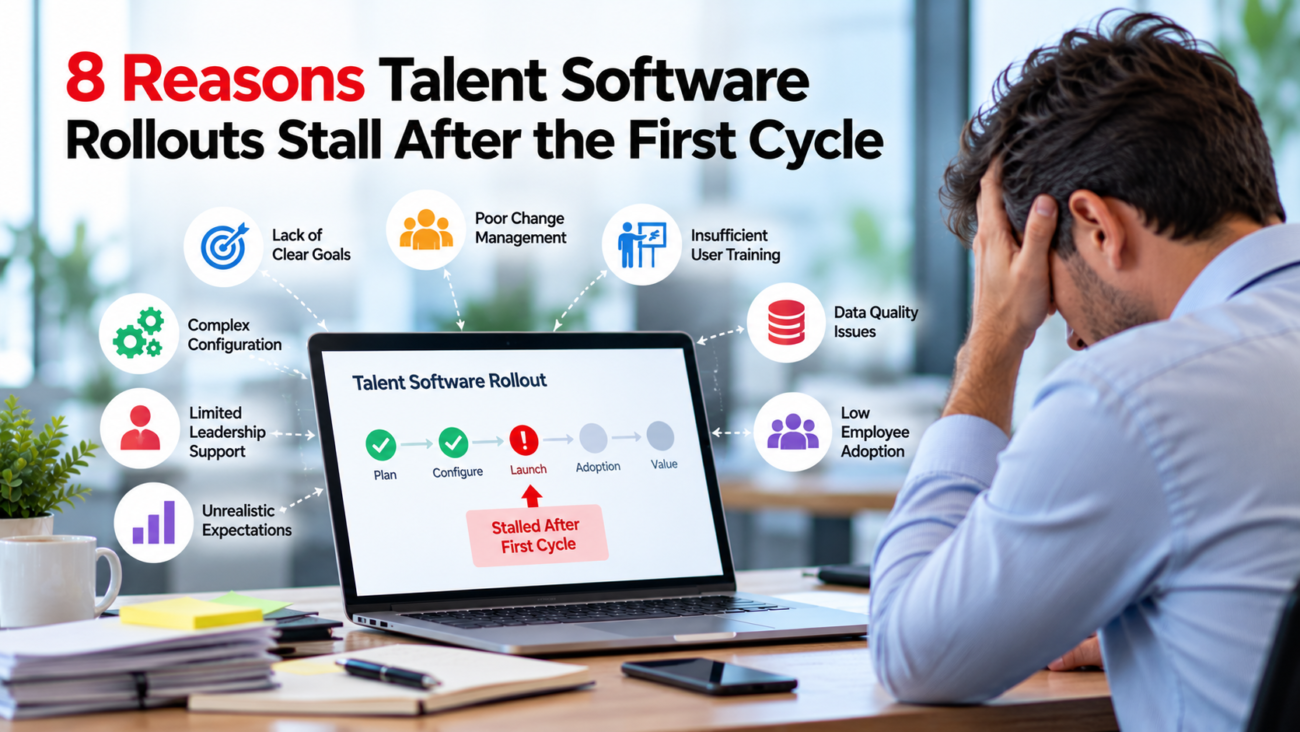
Most talent software launches look fine on paper. The first review or goal cycle runs with a project team on hand and the vendor’s consultants still on call. Completion rates come in close to target, and the steering group signs off. Then the second cycle opens with normal staffing and a normal calendar, and the numbers slip. Managers submit late, and side spreadsheets quietly come back.
That second cycle is the real test of HR software adoption, because it shows what happens once the launch energy is gone. This guide covers the 8 most common reasons talent management software stalls after cycle 1, with a fix for each one. It then shows how to measure adoption beyond logins and how to run a recovery plan before cycle 2 closes.
TL;DR
Talent software rollouts usually stall in cycle 2 because launch support ends without a clear owner, and the old process was moved online with its flaws intact. Overloaded managers, fading training, drifting HR data, unanswered feedback, aging configuration and competing changes all add to the drop. The fix starts with naming post-launch owners for every module. From there, measure HR software adoption by completion quality instead of logins, and sequence the repairs before the second cycle ends. It also helps to treat every HR technology implementation as a series of cycles.
What a Stall After the First Cycle Looks Like
A stall is a drop in how well people use the system once launch support fades. It shows up as lower or later completion in cycle 2, shorter and vaguer entries, more reminder emails from HR and offline steps running in parallel. Hypothetical: a company finishes its first goal cycle on time, but in cycle 2 half the managers copy last cycle’s goals and HR spends the final week chasing late submissions. Nothing in the system is broken, yet HR software adoption has clearly gone backward.
This pattern matches what research finds about change programs in general. In McKinsey’s 2021 survey of 1,034 respondents, fewer than a third said their change effort improved performance and then sustained the gains. The same research found 55% of lost value happens during and after implementation, and 20% happens after initiatives are fully executed. That last figure describes the cycle 2 problem closely. The launch can be complete while the value is still leaking away.
HR technology has its own version of this gap. According to Gartner’s 2024 HR survey, only 24% of HR employees say their function gets maximum value from its HR tech. Just 35% of HR leaders felt confident their technology approach helps meet business objectives, and 69% of employees hit at least 1 barrier using HR tech in the prior 12 months. Those barriers rarely stop a first cycle, because extra support hides them. They show up when that support goes away.
You’ll often see a broader claim that 70% of change programs fail. BCG’s 2020 research found 70% of digital change efforts fell short of their objectives, based on data from 70 companies and a survey of 825 executives. A 2011 review in the Journal of Change Management, though, found no valid empirical evidence for the general “70% of change fails” claim. The safer approach is to measure your own talent management software cycle by cycle and judge the rollout on that evidence.
Support and Ownership Vanish When Hypercare Ends
The first cause of a stall is simple: the people who made cycle 1 work leave. Hypercare is a temporary, highly focused support phase after a system goes live. In North Carolina’s state HR system project, for example, hypercare lasted about 1 month after an October 8, 2025 go-live. After that, an application management team took over defect handling, as described in the state’s December 2025 final project report. That handoff is normal and sensible for fixing bugs.
The trouble is that defects get an owner while the process often doesn’t. Nobody is clearly responsible for setting cycle dates or answering a manager who can’t find last cycle’s notes. The Prosci ADKAR model puts Reinforcement as its final stage, which covers sustaining a change and preventing a return to old habits. Most HR technology implementation plans fund the early stages well and leave reinforcement to whoever happens to be around. Strong rollouts give that last stage a budget and a named person.
The fix is to assign ownership before hypercare ends. Each module needs these roles:
• A business process owner in HR who decides how the cycle should work
• An HRIS administrator with protected time in the weeks around each cycle
• A cycle calendar owner who sets dates and coordinates with other launches
• A single intake route for manager questions, so issues reach the right person
Set hypercare exit criteria around critical defects, a documented support path, and handoff to named owners. End hypercare when critical defects have a support path and named owners have accepted responsibility. Schedule separate support for cycle 2. A fixed date on the project plan is a weaker trigger, because it says nothing about whether the system is ready to run without extra help.
The Old Process Got Digitized, Flaws and All
Many rollouts move an existing process into new software without asking whether that process worked. Performance reviews are the clearest case. Gallup’s review research found only 14% of employees strongly agree their reviews inspire them to improve. Just 29% strongly agree their reviews are fair, and 26% say they’re accurate. Putting that process into performance management software makes it faster to complete, and the results stay just as weak.
HR leaders know the process itself is often the weak point. In Gartner’s performance management research from 2019, fewer than one-fifth of HR leaders said their performance management achieves its primary objective, and 81% were changing it or experimenting. Harvard Business Review reported in 2015 that Deloitte was spending close to 2 million hours a year on performance management. A 2018 McKinsey survey of 1,761 respondents found only 38% rated their system effective. When cycle 1 exposes these problems, people lose faith in the tool along with the process.
| Carried-Over Habit | What Happens in Cycle 2 | Fix |
| Annual-only review form | Managers rebuild a year of notes from memory | Add short check-ins between cycles |
| Rating scale with no shared definitions | Ratings drift and calibration takes longer | Publish what each rating means |
| Approval chain copied from paper routing | Reviews sit in queues for days | Remove approvers who add no decision |
| Long form kept from the old system | Entries get shorter and vaguer | Cut questions nobody uses in decisions |
Be careful with the urge to simply cut everything. The same Gartner research warned that cutting effort can drop workforce performance by more than 16%, so the goal is to remove low-value steps while protecting the conversations. Before cycle 2, review each step in your performance management software and ask what decision it feeds. Keep the steps that inform pay or promotion decisions, and redesign the rest. A cleaner process gives HR software adoption a better base for the cycles that follow.
Managers Have No Room for Another Cycle
Talent software depends on managers, and most managers are already stretched. Their capacity is often the deciding factor in cycle 2. Gartner’s manager research found the average manager has 51% more responsibilities than they can effectively manage. It also found process hurdles can raise manager fatigue by up to 42%. A review cycle that adds steps lands on people who were already behind before it opened.
Team sizes are growing too. Gallup reported in January 2026 that the average team size for managers rose from 10.9 direct reports in 2024 to 12.1 in 2025, up from 8.2 in 2013, while the median stayed at 5 to 6. The median manager also spends 40% of their time on individual-contributor work. For a manager with a large team, a cycle that takes 1 hour per report becomes a multi-day task on top of a full workload.
Other research points the same way. In a 2024 Gartner survey of 1,403 HR leaders, 75% said managers are overwhelmed by their expanded responsibilities. Gallup’s latest State of the Global Workplace data shows manager engagement fell from 27% in 2024 to 22% in 2025. Deloitte’s 2025 Human Capital Trends research found managers spend nearly 40% of their time on administrative work and current problems, with only 13% left for developing people. Calibration meetings add more time on top of that, which a 2018 study at a multinational company confirmed.
The fix is to size each cycle’s workload per manager before it opens. Stagger due dates for managers with large teams, so they aren’t writing 15 reviews in the same week as everyone else. If your performance management software supports different due dates by group, use that setting. Prefill anything the system already knows, such as goals and prior ratings. Remove any step that asks managers to retype information from another screen. Each saved step matters more for HR software adoption than another reminder email.
Training Fades Before the Next Cycle Starts
Launch training happens once, close to go-live, and the next cycle can be months away. Managers may lose familiarity with steps they have not used since launch.
Why Know-How Decays Between Cycles
People forget unused skills quickly, and that pattern is well documented. A forgetting curve replication published in PLOS ONE in 2015 reproduced Ebbinghaus’s classic findings at intervals from 20 minutes to 31 days. That study tested recall of memorized syllables over days, not HR software workflows over months. Managers may forget steps they haven’t used since launch, so refreshers should happen shortly before cycle 2. Performance management software that’s used twice a year never gets the repetition that builds habits.
Research on newer tools shows the same training gap. BCG’s AI at Work 2025 study of more than 10,600 workers found regular AI use among frontline staff stalled at 51%, compared with 72% overall. Only 36% of workers felt adequately trained. The tools differ, but the lesson carries over: usage levels off when training stops at launch.
The Fix: Train to the Cycle Calendar
Schedule short refreshers just before each cycle opens, when people actually need them. Add in-tool guidance at the specific steps where cycle 1 support tickets clustered. If your HR technology implementation plan only budgeted for launch training, give refreshers their own line item. Give managers a 10-minute walkthrough of what changed since the last cycle, since small updates can confuse people who only log in twice a year. This targets the Knowledge and Ability stages of ADKAR at the moment of use. Training that’s timed to the cycle calendar keeps HR software adoption from resetting to zero each time.
HR Data Drifts Between Cycles
Cycle 1 usually runs on freshly cleaned data. Between cycles, reorgs, manager changes, job moves, new hires and exits pile up. If nobody updates the records, cycle 2 sends reviews to the wrong managers and skips new employees. Data quality problems are common even in normal operations. In an HBR data quality study from 2017, 47% of newly created records had at least 1 critical error, and only 3% of the scores met an acceptable standard. HR records face the same pressures, and every error turns into a bad experience for a manager.
Public sector payroll projects show how cycle errors can repeat once they start. California’s MyCalPAYS pilot covered about 1,500 employees from June 2012, according to the state’s Legislative Analyst’s Office. Errors appeared in the first payroll cycle and continued through the next 7 monthly cycles. Of the 1,542 employees paid, 267 were underpaid and 541 were overpaid. The state ended the contract in February 2013 after spending $262 million of a $373 million project. Payroll differs from talent software, but the lesson about errors that repeat from cycle to cycle applies to any HR technology implementation.
Canada’s Phoenix pay system is another warning. The Auditor General’s 2018 report called it an incomprehensible failure of project management and oversight. It affected about 290,000 public servants, and a February 2016 Gartner recommendation for a gradual rollout wasn’t considered before go-live. The fix for talent management software is a standing data check before every cycle opens. Check these items each time:
• Reporting lines and manager assignments
• Eligibility rules, including new hires and people on leave
• Job titles and levels used in forms and calibration
• Leavers who still appear in review or feedback lists
• Open assignments carried over from the last cycle
Make this check a named task on the cycle calendar, with an owner and a deadline. Run it early enough to fix what it finds before invitations go out. Teams that skip it usually hear about errors from frustrated managers in the first week of the cycle, and HR software adoption takes the hit.
Employees Stop Seeing Results From What They Enter
People keep putting effort into a system only when they see something come from it. If cycle 1 input disappears into a database, cycle 2 input gets thinner. This is most visible with surveys. McKinsey’s research on survey fatigue reviewed more than 20 academic articles and found the top driver is the belief that the organization won’t act on results. Survey length and frequency mattered less than that belief.
Acting on results makes a measurable difference. Gallup research from 2006 found that workgroups in the top quartile on the statement “action plans from the last survey have had a positive impact” raised engagement by an average of 10%. Workgroups in the bottom quartile saw engagement fall by an average of 3%. The research is older, but the pattern fits what HR teams see in cycle 2 today. Employees judge the next request by what happened to the last one.
The same thing happens with goals and feedback. Hypothetical: an employee writes detailed goals and a thoughtful self-review in cycle 1. Their manager never mentions either in later conversations, and the rating seems unrelated to what they wrote. In cycle 2, that employee copies last cycle’s text and clicks submit. The system recorded both cycles as complete, but the second one has little value for HR software adoption or for the employee.
The fix is to close the loop before cycle 2 opens. Tell people what changed because of their survey answers or feedback, even if the changes are small. Ask managers to reference cycle 1 entries in their check-ins, so employees can see their input being used. When people can trace a decision back to what they entered, they’re far more likely to enter something useful the next time.
Launch Configuration Stops Fitting the Business
Every rollout makes configuration choices for launch day. Over time the business changes, while the forms and workflows stay frozen. This is configuration debt, and it pushes people toward workarounds. Gartner’s 2025 survey of 2,986 employees found 41% work around formal workplace processes, a broader finding rather than a talent software statistic. Repeated workarounds within talent software may indicate that its configured workflows no longer match the way employees work.
HR leaders see the same gap from their side. In Gartner’s 2024 survey of HR leaders, 55% said their current HR technology doesn’t cover current and future needs, and 46% said it hinders the employee experience instead of improving it. Some of that reflects product limits. Much of it comes from settings that made sense at launch and were never revisited after the HR technology implementation team moved on. Watch for these signals of configuration debt:
• Side spreadsheets that track steps the system should handle
• Approvals happening over email instead of in the workflow
• Admins rebuilding templates by hand at the start of each cycle
• Fields that nobody fills in, or that duplicate other fields
• Hard-coded dates, names or org units that no longer exist
Run a short configuration review between every cycle. Retire fields that don’t feed a decision, and fix the workflows that produced the most workarounds. Keep a change log, so the next admin knows why each setting exists and who approved it. Small cleanups like these often do more for HR software adoption than a new feature request.
Change Fatigue Buries the Rollout
Cycle 2 rarely runs on its own. It competes with reorgs, new tools, policy updates and other projects, and employees have less tolerance for change than they used to. Research published in HBR in 2023 found employee willingness to support change fell from 74% in 2016 to 43% in 2022. The average employee went through 10 planned enterprise changes in 2022, compared with 2 in 2016. A review cycle that lands in the middle of that load gets less attention than it deserves.
Tool overload adds to the problem. Gartner’s 2024 survey found 73% of HR leaders say employees are fatigued from change. Separate Gartner research from 2023 found the average desk worker uses 11 applications, up from 6 in 2019, and 47% struggle to find the information they need. Talent software becomes one more login in a crowded day.
The fix is to plan cycle 2 as one change among many. Good change management puts it on a shared change calendar with every other launch that affects the same people. Use these questions to plan the timing:
| Change Load Question | Why It Matters for Cycle 2 |
| What else launches in the same window? | Overlapping deadlines split attention and lower completion |
| Which groups face more than 1 change at once? | Those teams are the most likely to submit late |
| Can any cycle step move to a quieter week? | Small timing shifts can protect completion |
| Which message should go out first? | Clear order keeps the cycle from getting lost |
Timing decisions like these cost little and protect HR software adoption during busy quarters. Share the change calendar with HR business partners and IT, so they can flag clashes early. If a major reorg lands in the same month as cycle 2, consider moving the cycle by a few weeks. A short delay usually costs less than a cycle that runs late across the whole company.
How to Spot an HR Software Adoption Stall Before Cycle 2 Ends
Login counts are a poor guide to adoption. A manager who logs in 5 times to chase a broken workflow looks highly engaged on a usage report. Gartner data from 2022, cited by SHRM in 2025, found the average HRIS was used by only 32% of employees. That figure is a useful baseline, but logins alone can’t tell you whether people are completing cycles well. Measuring HR software adoption properly means looking at what people do in the system and how well they do it.
Prosci’s research on project returns describes 3 adoption factors: how quickly people start using a change, how many end up using it, and how well they perform with it compared with the expected level. Those factors translate well to talent software. The table below turns them into metrics you can track during a cycle.
| Metric | What It Shows | Stall Signal |
| On-time completion by manager | Whether managers can fit the cycle into their week | Late completion grows from cycle 1 to cycle 2 |
| Completion by team size | Whether workload is the blocker | Large teams finish much later than small ones |
| Entry depth | Quality of goals, reviews and feedback | More blank or one-line entries |
| Activity between cycles | Whether the system is part of normal work | Logins only appear near deadlines |
| Offline workaround reports | Whether the official path still fits | More side spreadsheets and email approvals |
| Support tickets by type | Where people get stuck | The same how-to questions return each cycle |
| Survey action plans logged | Whether results lead to action | Few or no plans after the survey closes |
Compare cycle 2 against cycle 1 at the cycle’s midpoint, by team and by manager. A company-wide average can hide a stall in 1 large division. Checking at the midpoint leaves time to act before the deadline. For talent management software with several modules, track each one separately, since performance management software might stall while learning holds steady.
A Second-Cycle Recovery Plan
Recovery works best as a short, ordered sequence. Structured support around a change pays off. Prosci’s project success research, based on more than 2,600 practitioners, found 88% of projects with excellent change management met or exceeded objectives. Only 13% of projects with poor change management did the same. The steps below put that discipline around cycle 2.
1. Run a cycle 1 retrospective. Bring managers and HRIS admins together within weeks of cycle 1 closing. Ask what slowed them down and what they worked around. Capture specific steps and screens, since general complaints are hard to act on.
2. Name the top 2 causes. Use the metrics from the previous section to see which of the 8 reasons is doing the most damage. Fixing 2 causes well beats spreading effort across all 8 at once.
3. Reset the cycle 2 scope. Decide which steps, fields and approvals stay in this cycle. Remove anything that doesn’t feed a decision, and confirm owners for every module before dates are set.
4. Set adoption targets. Define goals for on-time completion, entry depth and post-survey action plans. Base the targets on cycle 1 results, so they’re realistic and easy to explain.
5. Tell people what changed. Before cycle 2 opens, share what you fixed and what happened because of cycle 1 input. Keep the message short and send it through managers where possible.
6. Check in at the midpoint. Review the metrics halfway through the cycle and act on lagging teams. Log every fix, and treat that log as the starting plan for cycle 3.
This plan treats every HR technology implementation as a series of cycles instead of a single launch. Each cycle gets a review, a set of fixes and a target, which keeps HR software adoption from slipping quietly.
Keeping HR Software Adoption Moving After Cycle 2
Cycle 2 is where talent software proves its value, because it runs without launch support. The 8 causes covered here rarely appear alone. A manager with too many reports and a long form will stall even if the system works perfectly. That’s why the best first step is diagnosis. Buying another tool or switching vendors won’t help if the problem sits in ownership or process.
Treat each cycle as its own release, with an owner, a data check, a configuration review and a short retrospective. Teams that run their talent management software this way catch problems while they’re still small. Over time, the cycles get easier, and good change management becomes part of how HR runs the system every year.
Frequently Asked Questions
How long should hypercare last after an HR technology implementation?
There’s no single standard length. North Carolina’s state HR system project, for example, ran hypercare for about 1 month after go-live. A better approach is to tie the end of hypercare to criteria such as a smoothly running second cycle and named owners for each module. Ending support on a fixed date often leaves gaps.
Is low completion in cycle 2 always a software problem?
Usually the cause sits outside the software. Late or thin submissions often trace back to process design or manager workload. Look at completion patterns by team size and by manager before blaming the tool. If small teams finish on time and large teams don’t, workload is the likely cause.
What adoption rate is normal for an HRIS?
There’s no universal benchmark. Gartner data from 2022, cited by SHRM, found the average HRIS was used by only 32% of employees. That number is a rough reference point. Set your own baseline for each module after cycle 1, and track how completion and entry quality change from there.
Should we cut steps from reviews in our performance management software?
Cut steps that don’t feed a decision, and keep the ones that matter. Gartner research warned that cutting effort without care can reduce workforce performance by more than 16%. Review each field and approval, ask what decision it supports, and remove only the ones that add work without adding value.
How often should managers get refresher training?
Plan a short refresher just before each cycle opens, when managers actually need the skills. Add in-tool guidance at the steps that caused the most support tickets last time. A brief note on what changed since the previous cycle helps too, since managers who use the system twice a year forget details quickly.
Who should own talent software after go-live?
Each module needs an HR business process owner who decides how the cycle should work. An HRIS administrator should have protected time around each cycle for configuration and data checks. A defect support team alone isn’t enough, because it fixes bugs but doesn’t own cycle design or manager questions.
Why do employees stop answering pulse surveys?
The main reason is a belief that nothing will happen with their answers. McKinsey’s review of academic research found that belief matters more than survey length or frequency. Share what changed after each survey before sending the next one, even when the changes are small, so people can see their input used.
What is configuration debt in talent management software?
Configuration debt is the buildup of launch-day settings that no longer fit the business. It includes unused fields, outdated workflows, hard-coded dates and templates that admins rebuild by hand each cycle. It pushes people toward spreadsheets and email approvals. A short review between cycles keeps it under control.
Does calibration slow down performance management software cycles?
Calibration does add time. A 2018 study at a multinational company found calibration committees made ratings more consistent and were seen as fairer. They also lowered ratings more often than they raised them and reduced the spread between top and low performers. Plan calibration time into the cycle calendar from the start.
How can we tell if managers are overloaded?
Look for late completion that clusters among managers with large teams. Gallup found the average number of direct reports rose to 12.1 in 2025. Compare completion dates by team size, and check whether the same managers fall behind in every cycle. Those patterns point to workload more than to training.
When should we audit HR data before a cycle?
Run the audit early enough to fix problems before invitations go out. Check reporting lines, eligibility rules, job levels, leavers and open assignments. Make the audit a named task on the cycle calendar with an owner. Errors found by managers during the cycle damage trust far more than errors fixed beforehand.
Can we launch a new module while another is still settling?
You can, but check the change load first. HBR research found the average employee faced 10 planned enterprise changes in 2022, up from 2 in 2016. Map which groups would face both launches at once. Sequencing the second module after the first one’s next cycle usually protects both.
How does change management affect HR software adoption?
It has a large effect. Prosci research found 88% of projects with excellent change management met or exceeded their objectives, compared with 13% of projects with poor change management. For talent software, that means planning for ownership and reinforcement well past go-live and into every later cycle.
Should we switch vendors if cycle 2 stalls?
Diagnose the cause before deciding. Many stalls come from ownership gaps or data drift, and a new vendor won’t fix those. Product fit gaps are real too, since Gartner found 55% of HR leaders say their HR tech doesn’t cover current and future needs. Rule out the other causes first.
What’s the difference between usage and adoption?
Usage counts activity, such as logins or page views. Adoption measures whether people complete the process well and on time. A manager can log in often while struggling with a broken step. Track completion timing and entry quality to get a true picture of adoption.
