
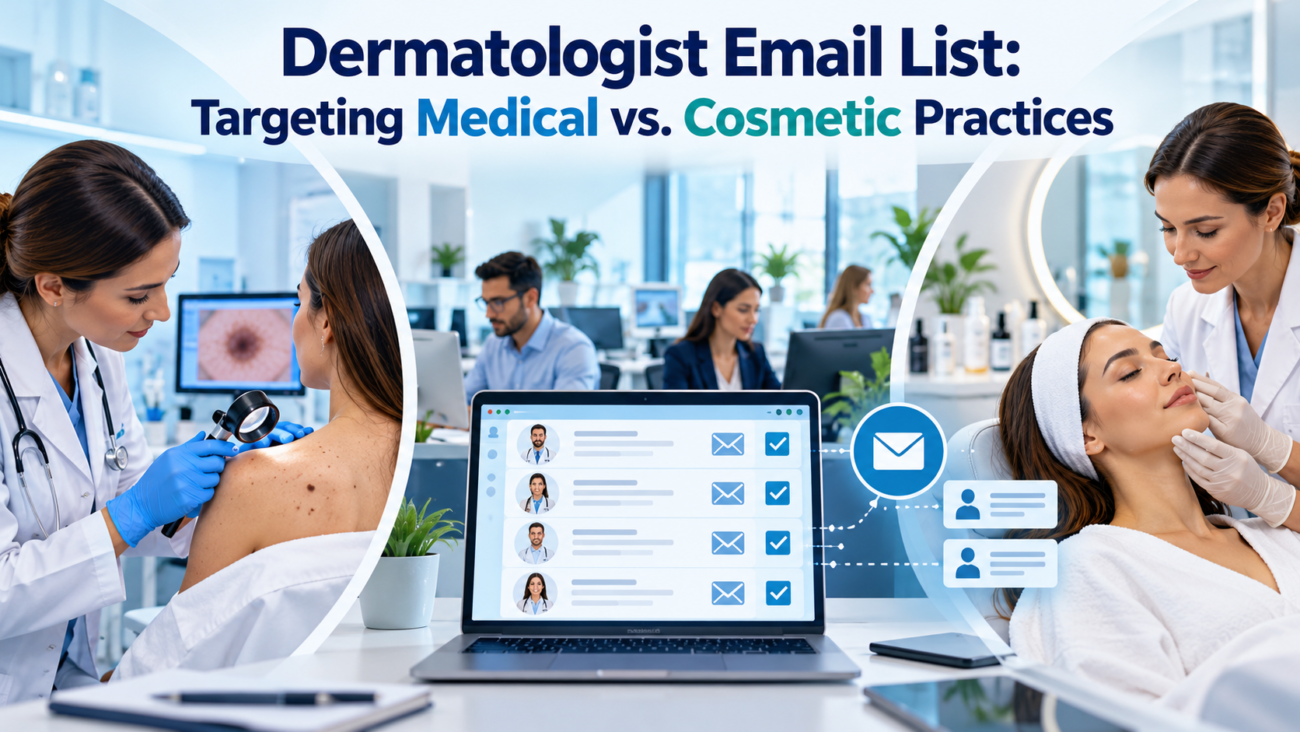
A dermatologist email list can identify thousands of physicians and still miss the practices that matter to a campaign. A company selling skin cancer diagnostic tools needs a different audience from a supplier of cosmetic laser equipment. Both might search for dermatologists, but the services offered at each clinic determine whether the message fits.
The harder part is that medical and cosmetic dermatology often share the same office. A physician may treat psoriasis in the morning and perform injectable treatments later that day. A useful contact list has to reflect that overlap, identify the right person at each practice, and show where its classifications came from. This guide explains how to make those decisions before spending money on contacts or sending email.
TL;DR:
Separate dermatology contacts by the services their practices provide, then check whether each contact has a role in evaluating or buying your product. Medical-focused clinics often need tools tied to diagnosis, treatment, and insurance-based workflows. Cosmetic-focused clinics may be more relevant for aesthetic devices, treatment supplies, and elective-care software. Many practices do both, so a mixed category is essential. Use NPI records to confirm specialty, practice websites to assess services, and documented checks to establish contact quality. Follow the email and privacy rules that apply to every market you contact.
What a Dermatologist Email List Should Actually Identify
A Dermatologist Email List is a collection of professional contact records for dermatologists and related practice staff. Depending on the source, it may contain names, business email addresses, phone numbers, practice locations, specialties, and organization details. Some records may also include NPI numbers or known practice services. Those fields aren’t interchangeable. A physician’s specialty tells you about training and professional classification; a practice’s service menu tells you more about the work done at a given location.
A basic list answers who might work in dermatology. A useful Dermatologist Email Database goes further: it establishes which organization the person belongs to, whether the person still works there, and why that contact belongs in a specific audience group. If the list can’t show how it reached a medical or cosmetic label, treat the label as unverified until you can confirm it.
The American Academy of Dermatology describes dermatologists as physicians who diagnose and treat conditions affecting the skin, hair, and nails, while also addressing cosmetic concerns. That range explains why specialty alone gives marketers a broad starting point rather than a finished audience. A single dermatology credential doesn’t reveal a practice’s share of medical visits, cosmetic procedures, or purchasing authority.
Medical vs. Cosmetic Dermatology: The Working Difference
Medical dermatology addresses diseases and other health problems involving the skin, hair, and nails. Clinics may evaluate acne, dermatitis, psoriasis, infections, suspicious lesions, or skin cancer. Their work can involve examination, lab testing, prescriptions, procedures, and follow-up visits. Some treatments are billed to insurance when medically necessary, although coverage depends on the plan and service.
For instance, the AAD’s skin cancer guidance describes the role of skin examination and biopsy in diagnosis. A supplier of dermatoscopes or biopsy equipment could reasonably investigate practices providing those services. That evidence is more meaningful than targeting every contact with the word “dermatologist” in a job title.
Cosmetic dermatology focuses on changes patients seek in their appearance, such as reducing wrinkles, treating certain scars, improving skin texture, or removing unwanted hair. Common offerings include botulinum toxin injections, fillers, chemical peels, and certain laser treatments. Elective cosmetic procedures are usually paid for directly by patients, though individual coverage and clinical circumstances vary.
The AAD’s cosmetic treatment information also makes clear that these procedures require medical judgment. A cosmetic-focused physician remains a medical professional, and a cosmetic procedure isn’t automatically low risk. Product messaging should account for training, indications, patient safety, and the clinician’s actual scope of practice.
| Question | Medical-Focused Practice | Cosmetic-Focused Practice |
| Main patient need | Evaluation and treatment of health conditions | Elective appearance-related treatment |
| Common services | Skin cancer care, acne treatment, psoriasis care | Injectables, resurfacing, aesthetic lasers |
| Payment mix | Often includes insurance billing | Often includes direct patient payment |
| Likely vendor fit | Diagnostic tools, clinical supplies, billing systems | Aesthetic devices, treatment supplies, booking systems |
| Useful qualification signal | Documented medical procedures and care programs | Advertised cosmetic procedures and clinician credentials |
This table describes typical patterns, not rules for every office. A dermatology group may offer Mohs surgery, acne care, fillers, and laser procedures under one roof. A Medical Dermatologist Email List should therefore be grounded in clinical services, and a Cosmetic Dermatologist Email List should be grounded in documented aesthetic services. Labels based only on a physician’s title can send both campaigns in the wrong direction.
Why Mixed Practices Need Their Own Segment
A single medical or cosmetic label hides mixed practices. A location that confirms Mohs surgery and laser resurfacing can qualify for both clinical and aesthetic outreach. Keep both service tags. Assign 1 primary practice category from the verified services: mixed when both types are confirmed, medical-focused or cosmetic-focused when only 1 type is confirmed, and unconfirmed when neither is. The primary label supports reporting without hiding other services.
Apply 4 categories consistently. Use medical-focused when reviewed sources confirm clinical care but no cosmetic service is verified; use cosmetic-focused when they confirm an aesthetic service but no clinical service is verified; and use mixed when both are verified at the same location. Mark unconfirmed when neither service type can be established. An unlisted service remains unknown, not absent. These are campaign categories, not estimates of revenue or the full treatment mix of a Dermatology Practice Contact List.
Recent consumer research adds context without settling the question of practice mix. In its 2025 survey, the American Society for Dermatologic Surgery reported that 70% of respondents were considering a cosmetic procedure, based on responses from more than 3,500 consumers. The ASDS survey findings reflect consumer attitudes in that survey; they don’t measure the percentage of dermatology clinics offering cosmetic care or the size of an addressable email list.
For a mixed practice, store service tags at the location level when possible. One group’s downtown office might provide Mohs surgery while another office handles laser treatments. Tagging the parent organization as a whole can send a representative to the wrong facility. This is especially important for device demonstrations, on-site training, and territory assignments.
Identify Medical Dermatology Practices by Clinical Work
The best indicator of a medical-focused clinic is evidence of the care it provides. Begin with current service pages, physician biographies, and practice locations. Look for evaluation and treatment of chronic skin diseases, skin cancer screening, biopsies, Mohs surgery, patch testing, phototherapy, or pediatric dermatology. Each service can support a more specific audience than the broad category alone.
A Medical Dermatologist Email List becomes more useful when it distinguishes general medical offices from practices offering named procedures. A supplier serving Mohs surgery teams, for example, shouldn’t treat every office mentioning skin cancer screening as a confirmed Mohs center. Screening, biopsy, and Mohs surgery are different activities. Verify the procedure before applying the tag. A psoriasis care tag signals treatment relevance, but says nothing about prescriptions, supplier contracts, or purchase plans.
Service evidence may appear on a clinic’s own site, a hospital department page, or a physician’s official profile. Check whether the named dermatologist works at the specific location in your record. An old directory entry can remain visible after a physician moves, and a multi-location group may not provide every service at every address. Record the location tied to the service rather than inferring system-wide availability.
A Dermatologist Email Database should record which branch offers each confirmed service and the source checked. Leave unverified supplier relationships and purchasing plans blank.
Identify Cosmetic Dermatology Practices by Procedures
Cosmetic audience building should start with the treatments being offered, not with branding words such as “beauty,” “skin,” or “aesthetic.” A practice website may list injectable consultations, resurfacing, laser hair removal, scar treatments, or device-based services. Check the page date where available and look for evidence that the treatment belongs to the location and clinician in the record.
A Cosmetic Dermatologist Email List should distinguish dermatologists who perform the relevant procedures from clinics that only market related skincare services. A skincare retail business, a general wellness center, and a physician-led cosmetic dermatology office can use similar language online while having different staffing and purchasing needs. Their inclusion rules should reflect the campaign’s product and any licensing requirements.
For device vendors, the exact treatment matters. The FDA explains that aesthetic medical devices can carry risks and may be regulated based on intended use. A company selling equipment used in aesthetic procedures should first establish whether the practice offers the relevant kind of treatment. It should then verify appropriate users and purchase responsibilities instead of relying on a broad cosmetic label.
Cosmetic service pages can also be incomplete. A physician may offer injectables without advertising every brand. A group might promote laser resurfacing but keep equipment details private. You can classify the service as present while leaving equipment ownership or brand use unknown. Unknown is an acceptable data value; speculation isn’t.
Medical spas need a separate check when building a Cosmetic Dermatologist Email List. A medical spa and a dermatology practice aren’t necessarily the same organization. Some medical spas have physicians involved, but the title “medical spa” doesn’t establish that a board-certified dermatologist is on staff. Conversely, some dermatology groups operate separate aesthetic centers. Match names and credentials to the proper legal entity and site before merging these contacts into a physician-focused list.
Build the Contact Database From Reliable Sources
Start with a source that identifies physicians, then add the evidence needed for practice classification. In the United States, the Centers for Medicare & Medicaid Services publishes the NPI Registry, which provides public information such as provider names, taxonomy descriptions, and practice addresses. An NPI is useful for matching records, but it isn’t proof that a provider is licensed, credentialed, or currently offering a particular service.
The National Uniform Claim Committee maintains the provider taxonomy code set, which includes dermatology and related areas such as dermatopathology, pediatric dermatology, Mohs micrographic surgery, and procedural dermatology. These codes are selected to describe professional classification. They aren’t a record of every procedure a physician performs. There isn’t a separate standard cosmetic dermatology taxonomy that can reliably split all medical and aesthetic clinics for marketing.
For larger datasets, CMS supplies downloadable NPI files and updates. Its October 2026 files use the current version 2 structure, and the page also explains that an NPI doesn’t validate a license or credentials. Bulk records still require cleaning, location matching, and separate email sourcing. The files shouldn’t be presented as a ready-made marketing email list.
Practice websites and official group directories can establish service offerings and workplace affiliation. Independent professional directories can help cross-check facts, but data licenses and usage restrictions matter. A public page being viewable doesn’t automatically grant permission to scrape, republish, or market to every person listed. Evaluate the source terms and applicable privacy rules before collecting contact information.
Build the file in order: find physicians through an authorized specialty source; match each person to a current practice and branch; check the practice website for named services; record the evidence URL and review date; obtain business emails through lawful sources; then check employment, email status, duplicates, and opt-outs. Don’t copy a branch service tag to the entire group. Keep specialty verified, service confirmed, and email checked as separate statuses so each claim can be updated without losing the others.
Choose the Right Physicians and Practice Decision-Makers
Contact selection depends on the decision being made. A physician may judge whether a clinical product is suitable while an administrator handles quotes and contracts. In a small owner-operated clinic, the same person may perform several roles. Larger groups may centralize purchasing, leaving local physicians with influence over product selection but limited authority to sign.
A Dermatology Practice Contact List should identify people by responsibility rather than assuming the most senior medical title is the best commercial contact. For a billing service, the practice administrator or revenue-cycle leader may be the first useful person. For an instrument that changes a procedure, a treating dermatologist or medical director will likely need to review clinical fit. The actual buying path still needs confirmation.
Credentials are another area where databases can mislead. NPI registration and a claimed specialty aren’t the same as board certification. The American Board of Medical Specialties explains that its public certification information service is intended for personal use and that professional verification has separate requirements. Don’t assume a free public lookup authorizes commercial reuse or serves as formal verification for a business.
For a Medical Dermatologist Email List, relevant roles might include treating dermatologists, Mohs surgeons, clinical directors, office managers, or purchasing staff. For a Cosmetic Dermatologist Email List, the relevant people could be cosmetic-service physicians, practice owners, aesthetic department managers, or administrators responsible for equipment evaluation. These are role hypotheses, not proof that each named person decides purchases.
Set Segmentation Fields That Reflect Buying Needs
Segmenting a Dermatologist Email List starts with fields that can be checked and acted on. Practice type alone isn’t enough. Add the service relevant to the offer, verified location, organizational relationship, and contact role. Also record how recently the facts were checked and whether the source supports the claim directly or only suggests it.
The following fields support a Dermatologist Email List without profiling every detail of a clinic. For example, if a current practice page lists eczema care and fractional laser resurfacing at the same office, the practice is mixed. Store both service tags and that office’s evidence URLs. The manager’s buying role remains unconfirmed until checked. For a Medical Dermatologist Email List, the evidence must show the clinical service that qualifies the office.
| Field | What It Answers | Verification Note |
| Person and title | Who is being contacted? | Confirm current employment |
| Business email | Where can the message be sent? | Check source and delivery status |
| Practice and site | Which office does the person represent? | Match current address and domain |
| NPI and taxonomy | What is the registered specialty? | Don’t infer treatment mix |
| Practice focus | Medical, cosmetic, mixed, or unconfirmed? | Explain the assigned label |
| Service tags | Does the office offer the relevant procedure? | Cite a current service source |
| Buying role | Who may evaluate or approve the product? | Mark uncertain roles as unconfirmed |
| Source and review date | Can the record be checked again? | Keep evidence with the field |
| Suppression status | May the recipient be contacted? | Apply current opt-out rules |
Geography matters beyond basic territory coverage. A physician may have an NPI practice address in one city while treating patients at several branches. If the offer involves equipment setup or in-person training, the correct facility determines logistics. A Dermatology Practice Contact List must therefore distinguish locations. Assign city and state at the location level, then associate each professional with the locations where they actually work.
For mixed practices, use multiple service tags instead of duplicating the same person into several disconnected lists. A common contact record linked to 2 campaign segments helps prevent repeat messages and preserves opt-out status. This matters when separate teams work with clinical and aesthetic products at the same time.
Set inclusion and exclusion rules for each campaign. For a dermatologist-only laser resurfacing offer, include sites with verified laser resurfacing services and a named dermatologist. Exclude offices listing only skin checks, and spas with no verified dermatologist. Hold uncertain service or location records for review. This makes a Dermatology Practice Contact List repeatable.
Verify Data Quality Before Sending Email
Checking a Dermatologist Email List raises 3 separate questions: Is the person correctly identified? Is the practice classification current? Is the email address suitable for outreach? A vendor can perform well on one measure and poorly on another. A working mailbox doesn’t prove the recipient still has the listed role, and a correct NPI match doesn’t prove that the email reaches the physician.
Check a small random sample from each segment before sending. For a Medical Dermatologist Email List, reopen the saved source and confirm that the named clinical procedure still appears at the recorded branch. For a Cosmetic Dermatologist Email List, do the same for the aesthetic treatment. Record the review date; move missing or conflicting evidence to an unconfirmed queue for manual review. A working email alone can’t fix a wrong service tag.
Email verification within a Dermatologist Email Database should include syntax checks, domain checks, authorized verification methods, and records of hard bounces. No tool can guarantee that every message reaches an inbox or is read. A deliverability percentage needs a defined sample, time period, and measurement method before it can support a purchasing claim.
Keep a suppression list across the entire Dermatologist Email Database. A recipient who opted out of one team’s sales emails shouldn’t quietly return when another team imports a fresh copy of the database. Store the opt-out event separately from the contact’s service tags. It should remain effective even if the person appears again under a second practice record.
A useful quality report includes the share of records with confirmed employers, the share with current service evidence, and the rate of invalid or undeliverable email responses. Report these independently rather than combining them into one vague “accuracy” number. If a provider claims near-perfect verification, ask exactly what was tested and when.
Match Offers and Messaging to Each Practice Type
The product should determine the segment. A vendor selling psoriasis-related clinical supplies might start with medical practices that specifically treat psoriasis. A supplier of resurfacing equipment should investigate cosmetic practices advertising that treatment. A patient scheduling platform may fit both groups, but the reason to buy can differ by workflow.
For medical contacts, explain how the product relates to a named clinical activity and avoid implying that a practice uses a certain drug or sees a certain number of patients without evidence. In a Medical Dermatologist Email List campaign, messages can address documented operations such as biopsy workflows or referral scheduling. The content should still be reviewed for medical accuracy and any rules governing promotion of regulated products.
For aesthetic contacts, link the product to the service confirmed in the record. A Cosmetic Dermatologist Email List campaign focused on laser equipment may discuss eligible procedure types, training considerations, and service support. Avoid claims about treatment results, device clearance, or patient outcomes unless reliable product-specific documentation supports them.
| Offer | Initial Practice Filter | Likely Reviewer |
| Biopsy supplies | Offices performing skin biopsies | Clinical lead or purchasing manager |
| Mohs instruments | Confirmed Mohs surgery locations | Mohs surgeon and operations team |
| Psoriasis care tools | Practices treating psoriasis | Treating clinician or medical director |
| Aesthetic laser device | Offices offering relevant laser procedures | Qualified clinician and practice owner |
| Cosmetic booking software | Offices with elective consultations | Practice manager or operations lead |
| General billing software | Offices with relevant billing workflows | Administrator or revenue-cycle manager |
A Dermatology Practice Contact List should handle mixed practices as a separate category. If the product works across both medical and cosmetic scheduling, one message about the shared workflow may be useful. If it serves only injectable treatments, target the location and decision-maker responsible for those services. Don’t send both a medical and cosmetic campaign to the same person merely because the record qualifies for both segments.
Strong messages are specific without pretending to know private business facts. “Your website lists laser resurfacing” can be checked. “You’re planning to replace your current laser” is speculation unless the practice has said so. Match the level of certainty in the language to the quality of the underlying data.
Plan a Targeted Campaign Without Guessing Demand
A campaign using a Dermatologist Email List should begin with a narrow use case, a defined audience, and a way to judge results. Choose the product category and the specific practice activity it serves. Then identify the likely review role. Only after that should you set location limits, select contacts, and draft messages. Starting with the maximum number of available emails reverses the process.
Consider a supplier promoting equipment for fractional laser skin resurfacing. It selects offices whose current treatment pages confirm laser resurfacing at a named location, then checks for an appropriate clinician or purchasing contact there. A clinic advertising only acne treatment stays outside that procedure-specific segment. Unclear records enter a research queue. This hypothetical example shows selection logic, not evidence of buying intent or likely response rates.
A Dermatologist Email List can be divided into small test groups based on one meaningful difference, such as medical-focused versus mixed practices. Keep the offer and measurement method stable enough to see whether the distinction helps. Measure valid deliveries, replies from relevant roles, and qualified discussions separately. Opens alone are a weak indicator because email clients can change how open events are recorded.
Follow Email, Privacy, and Delivery Rules
In the United States, commercial B2B email is covered by CAN-SPAM. The FTC’s CAN-SPAM compliance guide explains that messages need accurate sender information, honest subject lines, a valid physical postal address, suitable advertising identification, and a functioning opt-out method. Opt-out requests must be honored within 10 business days. Buying a list doesn’t transfer these duties to the list seller.
A physician’s business contact information isn’t automatically patient health information. Still, dermatology marketers should avoid any dataset sourced from patient charts, appointment histories, or diagnoses unless a lawful basis clearly permits the intended use. HHS HIPAA marketing guidance explains strict limits on using or disclosing protected health information for outside marketing, including selling patient lists without required authorization. Professional contact research should remain separate from patient information.
International campaigns need country-specific review. In the UK, the Information Commissioner’s Office explains in its B2B marketing guidance that rules differ for corporate subscribers and sole traders, while UK GDPR still applies when personal data is processed. Whether an address appears on a public website doesn’t remove those duties.
Canada has different consent requirements. The Canadian regulator’s CASL consent guidance describes express and implied consent, identification requirements, and unsubscribe obligations for commercial electronic messages. Don’t apply a US-only email rule to an international export simply because every record concerns a medical professional.
Technical delivery is a separate issue from lawful use of contact data. Google’s email sender guidelines describe authentication and message requirements for mail to personal Gmail accounts, with added requirements at higher daily sending volumes. Meeting those guidelines doesn’t create permission to send commercial email, and legal compliance doesn’t guarantee inbox placement.
How to Assess a List Before Purchase
Evaluate a Dermatologist Email List seller by the evidence behind its records. Ask for a data dictionary and a sample matching the proposed campaign. For example, request 10 medical records with current biopsy or Mohs service pages and 10 cosmetic records with current laser resurfacing pages, all within the intended state. Each sample row should include the practice location, contact role, email status, evidence URL, and review date. Ask how mixed practices are counted. A generic sample won’t test these filters.
When reviewing a Dermatologist Email Database, check what the provider means by “verified.” Does that refer to email syntax, mailbox response, employment, NPI matching, or practice services? What proportion of records has a directly confirmed medical or cosmetic focus? When were those service labels reviewed? A Dermatologist Email List should be evaluated on the fields your campaign will use, not only its total contact count.
Ask whether the Dermatology Practice Contact List includes multiple contacts at the same office and whether those contacts are linked to one organization. Confirm how group headquarters, branch offices, and individual physicians are represented. A single clinician working at 3 offices may produce 3 location relationships but shouldn’t silently become 3 different physicians.
A Cosmetic Dermatologist Email List sample should contain evidence that named practices provide the procedures claimed. A Medical Dermatologist Email List sample should show how medical service claims were established. For either list, inspect missing values rather than assuming that empty cells will be filled after purchase.
List sellers may charge per contact, quote a one-time export fee, or offer a subscription that includes access and refreshes. The amount depends on selected fields, location scope, licensing terms, and update frequency. Compare what each quote permits, including record replacement, repeat use, redistribution, and opt-out handling. There’s no reliable single market price across those models. A cheap per-row quote can be poor value if service tags can’t be checked.
A Practice-First Approach to Dermatology Outreach
A Dermatology Practice Contact List works better when it starts with actual clinical and cosmetic services. Specialty codes help identify the profession, but practice websites and verified location details explain more about where a product might fit. The contact’s role then determines who should receive the message.
A useful Dermatologist Email List has records whose services, locations, and contact permissions can be rechecked as practices change. Those checks give each campaign a clear reason for selecting its recipients.
Frequently Asked Questions
What Is a Dermatologist Email List?
A Dermatologist Email List is a set of professional contact records for dermatologists and, where relevant, people who manage their practices. Fields may include business email addresses, practice names, job titles, specialties, locations, and NPI details. The value depends on whether those fields are accurate and suitable for a specific campaign.
What Is the Difference Between Medical and Cosmetic Dermatology?
Medical dermatology focuses on diagnosing and treating skin, hair, and nail conditions. Cosmetic dermatology focuses on procedures that address appearance-related concerns. Many dermatologists provide both kinds of care, so the categories describe services rather than separate types of medical license.
Can a Practice Belong to Both Targeting Segments?
Yes. A practice offering acne treatment and laser resurfacing may fit medical and cosmetic campaigns. Keep the practice in a mixed category and add service tags at the relevant location. That allows accurate targeting without creating duplicate physician records.
How Do I Identify Medical Dermatology Practices?
Check current practice service pages for clinical activities such as skin cancer examinations, biopsy, eczema care, psoriasis treatment, and Mohs surgery. Confirm the service at the location being targeted. Specialty information alone doesn’t establish which procedures the clinic provides.
How Do I Identify Cosmetic Dermatology Practices?
Look for current offerings such as injectable treatments, chemical peels, laser procedures, or resurfacing. Check who provides the services and whether the practice employs dermatologists. Don’t assume every medical spa is a dermatologist-led practice.
Is There a Separate NPI Code for Cosmetic Dermatology?
No standard taxonomy category cleanly identifies every cosmetic dermatology practice. NPI taxonomy codes describe professional specialties or related areas rather than the full treatment menu of an office. Verify cosmetic services separately from the taxonomy record.
What Does a Dermatologist Email Database Usually Include?
A Dermatologist Email Database may include names, professional email addresses, phone numbers, practice addresses, NPI values, specialties, and organization information. More detailed datasets may add procedures or roles, but those fields should have their own evidence and review dates.
Which Contacts Matter for Medical Dermatology Products?
The treating dermatologist or medical director may assess clinical suitability, while a practice administrator or purchasing team may manage commercial terms. The correct recipient depends on the product and how the organization buys. Confirm roles rather than assuming every physician signs contracts.
Which Contacts Matter for Cosmetic Dermatology Products?
Physicians performing the relevant procedure may assess a product’s clinical fit. Owners and practice managers may review costs or coordinate purchasing. For groups with several locations, determine whether equipment decisions are made locally or by a central team.
How Often Should Dermatologist Contacts Be Checked?
There is no universal refresh interval that makes every field reliable. Verify key details before a campaign and update them when a person changes jobs, a service disappears, an email bounces, or an opt-out is received. Record when each important field was last checked.
Are Dermatologist Email Lists Legal for B2B Marketing?
They can be used for lawful B2B outreach when the sourcing, processing, and messages follow applicable rules. In the United States, commercial B2B email must comply with CAN-SPAM. Other countries may impose consent or additional personal-data requirements. Buying a list doesn’t remove the sender’s duties.
Does HIPAA Apply to Dermatologist Contact Lists?
Professional business contact details aren’t automatically protected patient health information. HIPAA becomes a major concern when a dataset uses or discloses protected patient information. Keep physician contact research separate from patient lists, diagnoses, and clinical records.
Can I Use NPI Data to Verify an Email Address?
An NPI record can help match a physician’s identity, specialty, and practice address. It doesn’t confirm that a separately sourced email is active, reaches the intended person, or may lawfully be used for marketing. Email verification requires its own checks.
What Should I Check Before Buying a Dermatology Contact List?
Review a relevant sample, field definitions, source information, update dates, service classification methods, and licensing terms. Ask how the seller handles invalid addresses and duplicate contacts. Check that the medical or cosmetic tags actually support the product you plan to promote.
Is a Larger Dermatology Mailing List Always Better?
No. A larger file may contain practices that don’t provide the service your product supports, along with duplicate records or outdated contacts. A smaller audience with confirmed services and relevant decision-makers can make campaign planning more accurate and easier to manage.
