
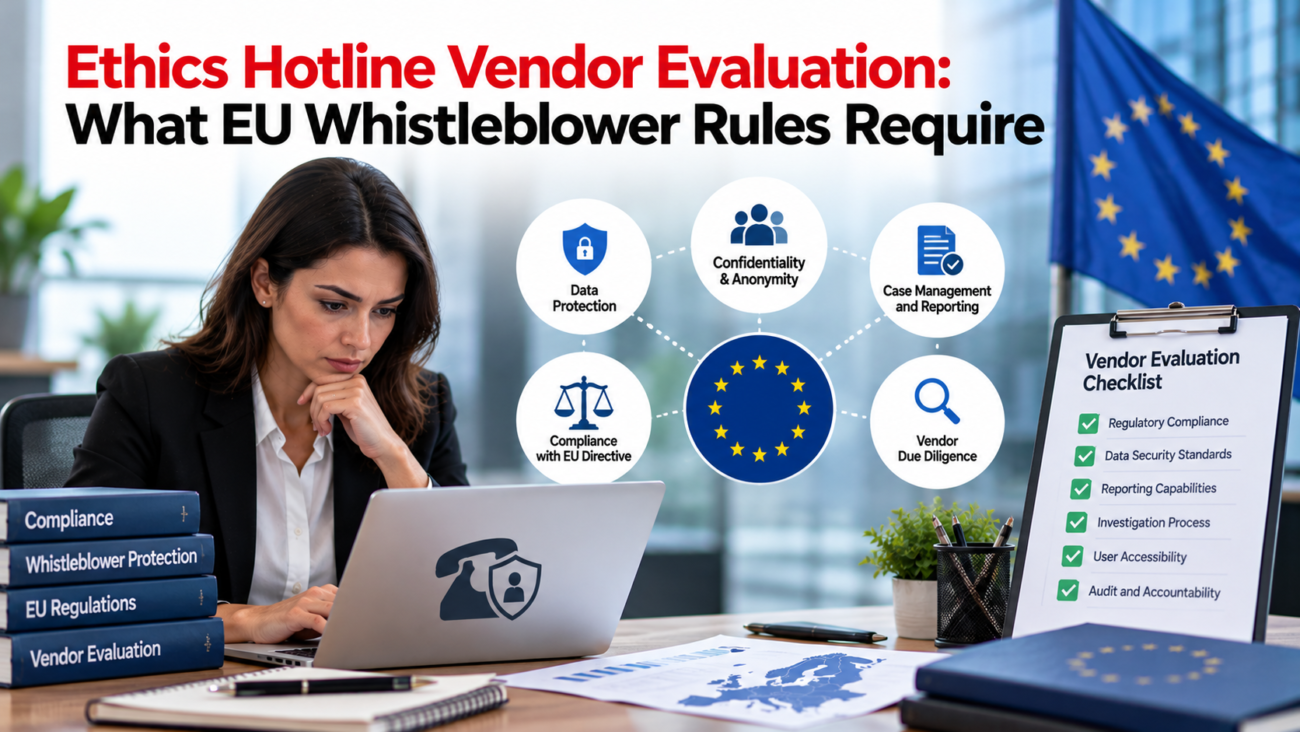
An employee reports suspected procurement fraud through a company hotline. The platform confirms submission, but the compliance team discovers that the case was routed to a manager named in the allegation. The reporter doesn’t receive an acknowledgment, and nobody can explain who read the original message. A working form has produced an unsafe reporting process.
An ethics hotline vendor evaluation should catch these failures before an organization signs a contract. For EU operations, the decision must account for Directive (EU) 2019/1937, national whistleblower laws, and personal-data rules. A promising product demo can’t establish legal compliance by itself. Buyers need to test how people report concerns, who can see those reports, and whether the organization can act within the required deadlines.
TL;DR
EU whistleblower rules require many employers to maintain secure internal reporting channels, protect a reporter’s identity, arrange impartial follow-up, acknowledge receipt within 7 days, and provide feedback within the applicable 3-month period. Article 9(2) permits internal reporting channels to accept reports in writing, orally, or both. It specifies telephone or other voice messaging systems for oral reporting and a physical meeting on request within a reasonable timeframe. National laws may impose wider duties, including how anonymous complaints are accepted. During an ethics hotline vendor evaluation, test reporter access, confidential case routing, deadline calculation, data handling, investigation records, local language coverage, and the exit process. A third-party hotline can support the process, but the organization remains responsible for meeting its legal obligations.
What EU Whistleblower Rules Actually Require
The starting point for EU whistleblower rules is Directive (EU) 2019/1937. It sets minimum protection standards for people who report certain breaches of EU law learned through work. It covers areas including public procurement, financial services, product safety, environmental protection, and personal-data protection. An ordinary dispute about workload won’t always qualify under the Directive, although national laws or company policy may allow that complaint through the same channel.
The European Commission’s whistleblower protection overview explains the central obligations around confidential reporting, suitable follow-up, and protection against retaliation. Buyers should translate those duties into testable requirements rather than ask a provider whether it is simply “EU compliant.” That label tells a procurement team very little about the actual service.
The EU Directive text is especially important for Articles 8, 9, 16, 17, and 18, which address internal channels, procedures, confidentiality, personal data, and recordkeeping. The Directive concerns the whole reporting process. Software might collect a message securely and still leave the employer without an independent handler or a defensible follow-up procedure.
An EU whistleblowing directive compliance review should separate mandatory legal outcomes from software preferences. Case tags, dashboard designs, and branded portals can be useful. The fundamental questions are whether a person can make a report safely and whether the organization can receive, assess, and respond to it under the governing law. Providers may support those duties in different ways.
Directive requirements are minimum standards. The Commission’s 2024 implementation report identified gaps in national transposition despite broad adoption of the central rules. Some laws also protect more reporters or types of wrongdoing. That makes a generic EU settings switch an unreliable procurement shortcut. A buyer needs a legal requirements matrix for the countries where the channel operates, including the business entities that fall within scope.
Identify Which Entities Need Reporting Channels
For most private-sector legal entities with 50 or more workers, the Directive requires internal reporting channels. Some sectors have duties regardless of size, including activities covered by specified EU rules on financial services, money laundering, and transport safety. Public-sector coverage has its own provisions and possible national exceptions. The buyer must check the actual legal entity, workforce count, and sector before planning the deployment.
EU whistleblower rules allowed a later implementation date, 17 December 2023, for private entities with 50 to 249 workers. That transition has already passed. A group cannot use it as a reason to postpone a decision in 2026. Legal teams should also check whether the channel must be available to contractors, trainees, former workers, job applicants, or other people within national protections.
Germany’s Whistleblower Protection Act generally requires internal reporting offices for employers with at least 50 workers and addresses ways to appoint third parties and share resources in certain situations. Those rules illustrate why the legal team must examine local organizational duties before assuming central case management satisfies every subsidiary’s obligations. The parent company’s subscription agreement doesn’t decide legal responsibility.
An ethics hotline vendor evaluation should therefore start with an entity inventory. Include registered entity, country, activity, worker count, reporting population, responsible officer, and the law to apply. Record whether a shared resource is permitted and which local person retains authority to investigate and correct wrongdoing. This inventory determines licenses, permissions, intake pages, and escalation paths.
Don’t confuse a common portal with an identical procedure. One entry page may give reporters a country or employer choice and route the report securely to the appropriate handling team. The design is acceptable only if it meets each applicable law and preserves confidentiality. Test an allegation against a local director and check whether corporate or local personnel can still see it improperly.
Define Report Scope and Who Can Use the Channel
An ethics hotline vendor evaluation should test whether a reporting form tells people what they can raise without forcing them to classify a complex allegation correctly. The Directive protects reports about certain breaches of EU law; local rules and internal ethics policies may cover a wider range of wrongdoing. A report about harassment, financial misconduct, or serious safety risks might fall under different procedures depending on jurisdiction and facts.
Prepare an intake policy that distinguishes legal whistleblower reports, general ethics concerns, and ordinary HR service requests. The employee shouldn’t have to understand legal categories to submit a credible concern. The case team can classify it after receipt. Ethics hotline software should allow reassignment under controlled rules while preserving the original submission date and confidential attachments.
Spain’s Law 2/2023 illustrates the need to review country rules carefully. It establishes an internal information system for relevant organizations, addresses the people who may report, and requires anonymity within the internal channel. It also assigns governance duties that aren’t fulfilled merely by buying a web form. A Spanish entity may need a defined system officer and a documented procedure.
A usable whistleblower reporting software interface should ask for the circumstances, people involved, and available evidence while keeping sensitive fields optional where possible. It should explain what happens next and where the reporter can find information about external reporting. Avoid language that wrongly suggests employees must report internally before approaching a competent authority. EU protection can apply to qualifying external reports under the legal conditions.
Access should extend beyond people with company email accounts when required. Former employees may have lost their credentials. Contractors might never have held an internal login. A secure external web page or equivalent access route is often more practical than a portal hidden behind the workforce identity system. Test the entry process from a personal device without an employee account.
Test Written and Oral Reporting Routes
Whistleblower reporting software can provide an effective digital form for written reports, especially where the reporter can attach documents and return for updates. It cannot automatically satisfy the Directive’s oral reporting requirements. Article 9(2) allows internal reporting channels to receive reports in writing, orally, or both. Where oral reporting is used, the Directive specifies telephone or other voice messaging systems. It also provides for a physical meeting at the reporter’s request within a reasonable timeframe. Employers must check whether national law requires additional reporting options or a particular procedure.
An ethics hotline vendor evaluation should verify the actual national requirement and how the entire reporting arrangement meets it. Under EU whistleblower rules, an employer can use a combination of services; a single vendor doesn’t necessarily have to supply every route. The procurement document should say which party answers calls, arranges meetings, records them lawfully, and transfers information into the case file securely.
Ireland’s employer obligations guidance explains practical duties for covered employers, including secure channels, a designated follow-up function, and communication to the reporter. It also confirms that outsourcing a channel is possible. An organization should still check how its appointed third party and internal officers divide responsibility.
A useful whistleblower reporting software demo tests a written report from an external browser and an oral report from someone unable to use the portal. Ask how the caller receives a case reference without exposing their identity. If a telephone conversation is recorded, check consent and the reporter’s opportunity to review or correct the record where applicable. The Directive contains specific documentation provisions for recorded and unrecorded calls.
Make sure the hotline can handle an interrupted call, a reporter who declines to provide a name, and a request for a meeting. The service must explain what language support exists for the relevant workforce. Advertised around-the-clock availability needs verification: some providers offer 24-hour web intake but only limited hours for live telephone operators or interpreters.
A whistleblower reporting software review should also examine the file upload path. Large attachments may fail; scanned documents can contain metadata naming the sender. Ask the vendor to demonstrate warning messages, malware screening, and how files are stored. The reporter must understand whether uploads can reveal information even when the form itself doesn’t ask for a name.
Protect Confidentiality Without Confusing It With Anonymity
Whistleblower protection requires that identifying information be restricted to authorized people, subject to narrowly defined legal exceptions. Anonymous reporting means a reporter doesn’t disclose their identity through the chosen route. These concepts can overlap, but they place different demands on the service. Whistleblower protection also requires strong confidentiality safeguards for named reporters, while an anonymous reporter needs a safe way to continue communicating.
EU whistleblower rules protect the reporter’s identity and information from which that identity could be deduced. Access must be limited to authorized people competent to receive or follow up. The software should support restricted investigator groups, separate attachments, and exceptions where the allegation involves someone who would normally have case access. A general administrator’s ability to see every file needs careful scrutiny.
The French data authority’s professional alerts guidance addresses the handling of personal information in workplace reporting systems and refers organizations to its detailed framework. It underscores the need to protect information about reporters and people named in allegations. A platform’s confidentiality claim still needs tests of permissions and stored data.
Anonymous intake deserves a direct technical test. The CNIL’s alerts FAQ discusses practical data-handling questions that apply to such systems. Ask whether the product records IP addresses, browser identifiers, analytics events, email addresses, or identifying details in server logs. Do not accept “anonymous mode” as proof that those traces are absent. A vendor may legitimately retain security logs, but it must explain whether they can identify a reporter and under what conditions they can be accessed.
For anonymous two-way communication, test a randomly generated case number or other secure return method. The reporter should be able to read questions and answer without creating a personal account or revealing contact details. Check recovery procedures when the reporter loses the code. Security and anonymity sometimes require making lost access unrecoverable rather than linking the account to a phone number.
Verify Acknowledgment and Feedback Deadlines
The Directive’s internal reporting procedure includes acknowledgment of receipt within 7 days. It also sets a reasonable feedback period that cannot exceed 3 months from acknowledgment, or, if no acknowledgment was sent, from the end of the 7-day acknowledgment period. National rules can add steps or define procedural detail. A dashboard should calculate the correct date rather than show a generic 90-day countdown for every case.
Acknowledgment tells the reporter that the organization received the concern. Feedback means information on action planned or taken as follow-up and the grounds for it. Feedback does not always mean the investigation has finished or that confidential personnel details may be disclosed. Case teams must communicate within legal boundaries and avoid making promises about outcomes they cannot control.
A useful ethics hotline vendor evaluation includes a report submitted late on a Friday, a report during a public holiday, and an anonymous report with no email address. Check which date the system uses, whether it records successful delivery, and how the reporter retrieves a reply. Timezone errors can change displayed dates, and silent message failures can create a false impression that the obligation was met.
Escalation should be tied to a responsible person, not simply to an automated email. A case approaching its due date must appear in an authorized team’s workload even if its assigned investigator is on leave. The system should support reassignment without exposing the identity to an unauthorized supervisor. A missed deadline needs a documented exception and prompt corrective action.
Check Investigator Independence and Case Workflow
Whistleblower protection depends on effective case handling, and an ethics hotline vendor supplies infrastructure; the organization must appoint people who can assess reports fairly and arrange follow-up. The Directive expects the designated person or department to be impartial and able to maintain communication with reporters. If the normal compliance lead is the subject of a complaint, the process must provide an alternate route with sufficient authority.
A practical case workflow begins with intake and a conflict check. The handler decides whether the report falls within the procedure, preserves necessary evidence, and assigns an investigator under a restricted access rule. Later stages cover findings, corrective measures, feedback, and defensible closure. These activities should leave appropriate records without requiring personal information that doesn’t serve the case.
The published ISO 37002 guidance offers a useful structure for receiving, assessing, addressing, and concluding reports. It is management-system guidance, not an automatic certificate that a software product meets Directive 2019/1937. The value for buyers is a clear way to evaluate how the employer’s procedures work after a message arrives.
Ethics hotline software must preserve decisions and reasons, not merely status changes. A vague label such as “closed” doesn’t establish that a report was assessed. Whistleblower reporting software should provide space for evidence handling, interviews, approvals, referral decisions, and the basis for closing the matter. Preserve protections for the person concerned, including fair treatment and appropriate limits on who sees untested allegations.
A whistleblower reporting software demo should include a report alleging wrongdoing by someone on the normal review panel. The vendor should show how to remove that person from the case, appoint a substitute, and document the change. Ask whether administrators can override the restriction and whether the override is logged and reviewed. This is a stronger test than seeing a colorful case dashboard.
Outsourced investigations require a separate decision. A software subscription might include technical support only, while a managed hotline provider may receive messages and make initial assessments. Define who has authority to investigate, who can contact the reporter, and who approves disclosures to regulators or law enforcement. Responsibility should never disappear between the vendor’s service desk and the employer’s compliance team.
Examine GDPR Duties and International Data Transfers
Whistleblower case files can contain serious allegations, names of witnesses, health information, and documents obtained in the workplace. The GDPR may apply to both the reporter and the people mentioned in a report. A buyer should decide who is the controller, which providers act as processors, and whether any processing requires additional safeguards. These roles follow what parties actually do, not the labels printed on the sales order.
The European Data Protection Board’s controller-processor guidance explains how to identify responsibility and structure the relationship. Buyers should ask for a data processing agreement describing instructions, confidentiality, security, subprocessors, assistance with rights requests, and deletion or return of data. The employer remains accountable for its lawful purposes and choices.
Under the GDPR regulation, Articles 5, 28, 32, and 35 are relevant to data minimization, processing contracts, security, and risk assessment. Article 18 of the Whistleblower Directive separately requires records to be kept no longer than necessary and proportionate under applicable obligations. There is no single EU-wide number of years that a vendor can safely apply to every whistleblower case.
Ask for configurable retention by jurisdiction and record category. Case details may need a different schedule from technical logs, transcripts, or rejected attachments. The organization must be able to preserve records when litigation or investigation creates a valid hold. Test a deletion workflow in a sandbox and inspect what remains in backups, exported files, and vendor support systems.
EU data hosting may make procurement easier, but the Directive does not itself impose a universal EU-only hosting rule for hotline software. Hosting location also doesn’t settle whether data is transferred to another country through support access or subprocessors. Ask who can access production data from outside the EEA and which legal mechanism applies if a restricted transfer takes place.
The Commission’s SCC guidance explains the distinction between contractual terms for controller-processor relationships and clauses used for international transfers. Where required, the organization may need a transfer impact assessment and other safeguards. A provider claiming “GDPR certified” should identify the precise certification or assessment and its scope rather than rely on a general badge.
An ethics hotline vendor evaluation should also ask how data subject requests are reviewed without exposing a whistleblower’s protected identity or prejudicing a lawful investigation. The right response depends on the applicable exceptions and legal duties. The product should support controlled review and redaction rather than grant automatic access to every person named in a case.
Inspect Security Controls and Audit Evidence
Sensitive reporting data demands access controls that survive ordinary staffing changes. Require multifactor authentication for case handlers where supported, strong encryption, restricted administrator permissions, and a record of privileged access. Ask how the vendor detects unusual downloads and how quickly it informs the organization about security incidents affecting its information.
The EU cybersecurity agency’s security design playbook describes how secure defaults and tested controls can be built into products. For whistleblower systems, buyers should apply that thinking to exposed web forms, attachment handling, session timeouts, and permissions. A public reporting page must remain accessible without exposing submitted reports.
Review the assurance documents the vendor actually holds. The EDPB’s endorsed DPIA guidance can help teams examine processing that may create high risks to people. A recent penetration-test summary, security audit, or relevant certification can support a decision. Ask what product and hosting environment the document covers and whether major findings were resolved. A certificate for a parent company doesn’t prove that every subcontracted hotline component was tested.
Case audit trails should record who viewed a file, changed access, exported material, edited a case status, or sent a message. Ethics hotline software should make unauthorized alteration difficult, but “immutable” must be explained. Find out whether a privileged vendor administrator can change or delete logs, how long they remain available, and how the organization can obtain them for a lawful audit.
An ethics hotline vendor evaluation should include a simulated mistake: an investigator tries to export the wrong case or send a reply to the wrong contact. Observe how the platform warns the user, blocks access, and records the attempt. Test backup restoration and downtime messaging as well. A system that operates securely on normal days still needs a safe failure procedure.
Manage National Differences and Multinational Groups
The Directive’s common baseline doesn’t remove national variation. The scope of covered wrongdoing, anonymous-report obligations, role appointments, retention rules, and available external channels can differ. A multinational should identify the law of each relevant entity and the people who may use the service. A country dropdown is useful only if the configured process behind it is correct.
France’s privacy regulator has issued detailed guidance on workplace alert systems, while Germany and Spain specify important elements in their national rules. Ireland has further provisions for worker communication and follow-up. These differences affect the legal notice, intake choices, case routing, and policy supplied with the software. Updating only the website language leaves those deeper issues unresolved.
For an ethics hotline vendor evaluation, use a country matrix with columns for legal entity, local rule, covered users, anonymous intake, oral arrangements, assigned handler, acknowledgment procedure, feedback rule, and retention schedule. Record what is common across the group and what must remain local. The matrix should be approved by people familiar with the applicable laws, rather than automatically generated from a supplier’s country list.
An EU whistleblowing directive compliance assessment also needs a shared-resource decision. Some employers with 50 to 249 workers may share resources under the Directive and national laws, but this does not transfer every duty to a central team. Larger group companies may face different limits on centralized handling. Ask counsel to examine the organizational model before signing for a group-wide investigation queue.
Ethics hotline software language support is operational. Staff may need to report in a language they can use confidently, and handlers may need accurate translation before assessing the allegation. Ask whether translation uses external services or AI, what data those services receive, and whether a human can review serious passages. Reporters must not be misled by an automatic translation that changes the allegation’s meaning.
Compare Contracts, Pricing, and Exit Rights
Ethics hotline software subscriptions may exclude the support needed to operate a lawful channel. Request a written quote covering employee or entity counts, telephone intake, languages, storage, case-handler seats, secure messaging, and initial setup. Include translation, legal configuration, security reviews, and any charge for historical records. Compare like-for-like scope instead of headline monthly rates.
A useful ethics hotline vendor evaluation uses a 3-year total cost calculation based on the actual contract. Include implementation labor, training, administrator time, renewal terms, expected case volume, and service changes. Avoid invented market averages; quotes depend on the number of entities, supported countries, and the service model. A simple system may cost more to administer if its intake and case functions are disconnected.
Contract terms matter as much as features. Confirm incident notification duties, subprocessors, availability commitments, change notices, and support response times. The vendor should identify whether it answers reporters’ calls, provides technical infrastructure, or performs any case-management services. Include an agreed process for complaints about the vendor’s own personnel.
Exit rights should cover case histories, attachments, communications, access logs, and retention metadata in a usable format. A download of case titles alone is insufficient if the new system needs to retain the evidence behind decisions. Ask whether the vendor helps transfer open cases and whether a terminated contract triggers immediate loss of reporter message access.
The contract should also state how data is returned or deleted, how deletion is confirmed, and which backups follow a separate schedule. Check whether the vendor can preserve material under a lawful hold. These provisions should be settled before procurement, when the organization still has a practical choice of supplier.
Run a Realistic Vendor Demo and Score the Evidence
An ethics hotline vendor evaluation should follow the same demonstration scenarios for every shortlisted provider. Prepare a fictional case involving a procurement concern, a manager named in the report, and an anonymous reporter who returns to answer questions. Don’t submit real employee allegations into a demonstration system. Record what each provider performed during the session and what remained an unsupported promise.
Use a weighted scorecard, but begin with mandatory pass-or-fail conditions. A product that cannot support a required oral channel through the planned service arrangement or cannot restrict access to a conflicted handler should not win because its interface is easy to use. Optional features can be scored after the legal and security requirements are addressed.
| Test Area | Evidence To Request | Result To Record |
| Reporter intake | Written and oral journeys for actual countries | Pass, gap, or workaround |
| Confidentiality | Case-routing and conflict test | Who could see the report |
| Communication | Acknowledgment and feedback timestamps | Dates and delivery proof |
| Case handling | Reassignment and closure history | Named accountable owner |
| Data protection | Processing terms and retention demonstration | Approved controls and gaps |
| Security | Permission test and audit export | Log coverage and limits |
| Exit | Complete sample case export | Usability of exported file |
In the review meeting, make the vendor explain each workaround. A manual action may be acceptable when it has a named owner and can reliably meet the obligation. It isn’t acceptable to mark a missing function as passed simply because a future release might add it. Assign procurement, legal, privacy, security, and case-handling owners to sign off on the requirements relevant to them.
Choose a Process the Organization Can Defend
Strong whistleblower protection begins when a secure ethics channel gives someone a safe way to disclose a serious concern and gives the organization a controlled way to respond. The platform matters, but the law also expects assigned responsibility, confidentiality, timely communication, and meaningful follow-up. Buying the software without those arrangements leaves the central risk unresolved.
A successful ethics hotline vendor evaluation produces evidence: tested reporting routes, reliable deadline records, appropriate access boundaries, workable country settings, and a usable export process. An ethics hotline vendor evaluation should show how a report moves from receipt to closure, including what happens when the normal handler is implicated. That explanation is more useful than a general compliance claim on a vendor website.
Frequently Asked Questions
What Is an Ethics Hotline Vendor Evaluation?
It is a structured review of the software and services an organization may use to receive and handle reports of wrongdoing. Buyers test legal fit, confidentiality, reporter access, case handling, data protection, and cost. The review should produce recorded evidence rather than rely only on sales claims about ethics hotline software.
Which EU Law Covers Corporate Whistleblower Hotlines?
Directive (EU) 2019/1937 sets minimum EU standards for reporting certain breaches of EU law and providing whistleblower protection to eligible reporters. Member States implement those standards through national laws, which may add duties. Companies must review the rules covering each relevant entity.
Do All EU Businesses Need an Internal Reporting Channel?
No. The Directive generally covers private legal entities with 50 or more workers, with exceptions that can require channels regardless of size in certain sectors. Public-sector rules differ. National law may extend coverage, so headcount alone is insufficient.
What Are the 7-Day and 3-Month Rules?
Internal channels generally must acknowledge a report within 7 days. Feedback must follow within the applicable period of no more than 3 months, calculated from acknowledgment or the end of the acknowledgment window if no acknowledgment was sent. National requirements should also be checked.
Must an EU Hotline Accept Anonymous Reports?
The Directive leaves the general obligation to accept and follow up anonymous reports to Member States, subject to relevant EU sector rules. Some national laws, including Spain’s, require anonymous reporting. A buyer should test the jurisdictions where the service will operate.
Is a Web Form Enough Under the Directive?
A web form can support written reporting under Article 9(2), but the reporting arrangement must also meet the physical-meeting requirement and any stricter national rules. If oral reporting is offered or locally required, procurement should document who receives calls and arranges meetings.
Can a Company Outsource Its Whistleblowing Hotline?
Yes, outsourcing can be permitted under the Directive and national rules. The employer retains relevant legal duties, and national law may control the operating model. The contract must specify who receives reports, follows up, and communicates with reporters.
Does the Hotline Need to Be Hosted in the EU?
The Directive does not impose a universal EU-only hosting requirement. GDPR rules and country-specific provisions may affect hosting and international access. Buyers must investigate subprocessors, support locations, and transfer safeguards rather than treat the data center’s address as the complete answer.
What Is the Difference Between Anonymous and Confidential Reporting?
With ethics hotline software, an anonymous reporter doesn’t disclose an identity through the selected route. A confidential reporter may be identified, but that information is restricted to authorized people and protected by legal rules. Whistleblower reporting software should support appropriate controls for both situations.
Who Should Be Allowed to See a Whistleblower Report?
Access should be restricted to people authorized and competent to receive or follow up the report. Investigators with conflicts should be excluded. Any identity disclosure beyond that group must follow the narrow conditions allowed by applicable law.
How Long Should Whistleblower Records Be Kept?
The Directive requires records to be retained only for as long as necessary and proportionate under applicable obligations. National laws and legal holds can affect the schedule. A vendor shouldn’t impose one universal retention period without a legal review.
Can AI Translate or Summarize Whistleblower Complaints?
It may be possible, but the organization should assess privacy risks, accuracy, confidentiality, and applicable AI rules before use. Ask which provider receives report content, whether outputs are reviewed by people, and how sensitive data is retained. Automated output shouldn’t substitute for an investigator’s judgment.
Do Group Companies Need Separate Hotlines?
A group may use common technology, but its legal entities can have distinct duties for operating channels and following up reports. Some smaller entities may share resources under applicable rules. The group should confirm local responsibility and permissions before centralizing cases.
What Evidence Should Vendors Provide Before Contracting?
Ask for a working demonstration, permission tests, written service scope, data processing terms, security evidence, retention controls, and a complete export example. Require the provider to identify unsupported functions and country-specific limitations. Keep those findings in the procurement decision.
How Should a Company Compare Ethics Hotline Prices?
Compare the full cost of the required service, including intake channels, languages, entities, support, training, and contract exit. Prices vary by deployment and service scope. The least expensive quote may leave substantial manual work for internal teams.
