
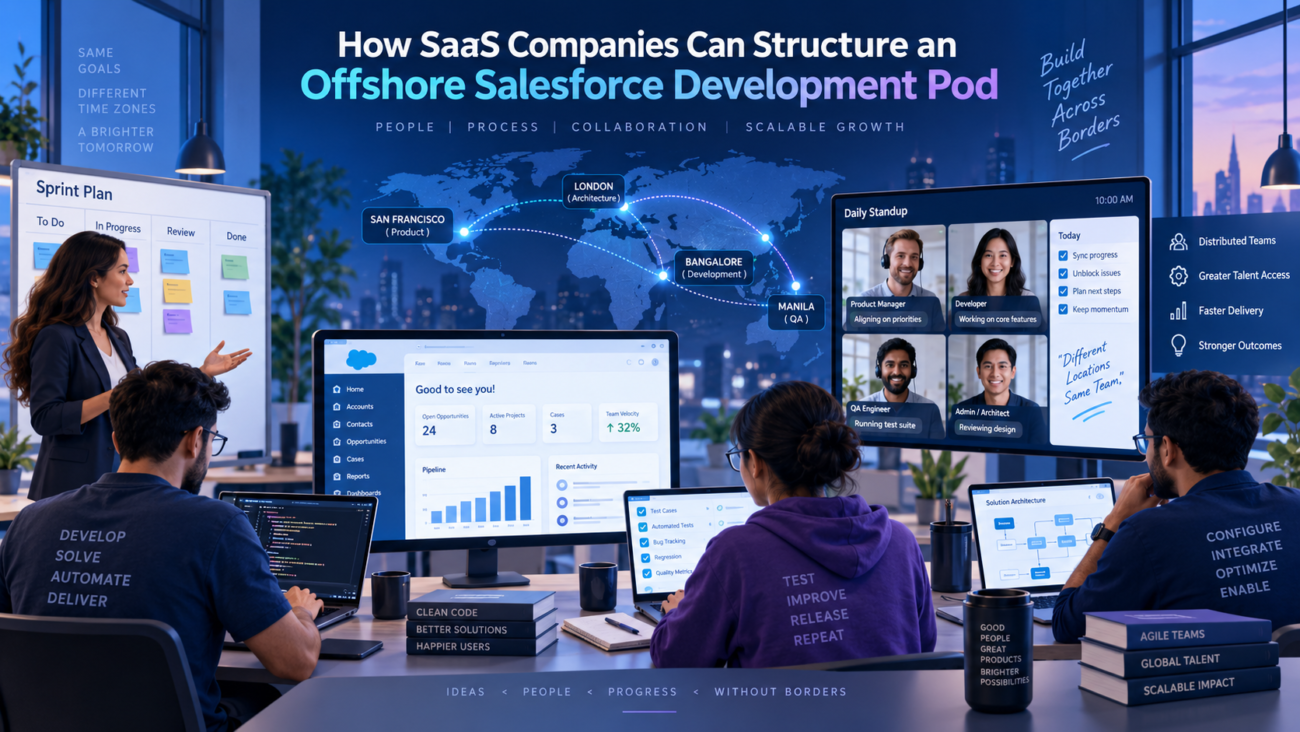
SaaS companies rarely run out of Salesforce work. New products change sales processes, pricing updates affect opportunity logic, and customer success teams ask for better account views. Finance may need cleaner subscription records while product teams add integrations that send more customer activity into Salesforce. The backlog keeps moving because the SaaS business itself keeps changing.
That makes offshore Salesforce development different from a short implementation project. A SaaS company may need Salesforce engineering every month even when the type of work changes from sprint to sprint. Hiring separate contractors for each requirement can scatter technical ownership, while building a large permanent internal team may not fit changing demand.
A pod gives the company another option by creating a small delivery unit with defined responsibilities. Advayan’s Salesforce implementation services include offshore development pods within a broader delivery framework that covers governance and DevOps practices. The model gives SaaS companies a way to add engineering capacity while keeping delivery rules and platform ownership clear.
The structure matters more than the location of the developers. A good Salesforce development pod knows what it owns, how work enters the backlog, who can make architecture decisions, and what has to happen before a release reaches production. It also works inside the same engineering system as the SaaS company’s internal team rather than operating as a separate group with different tools and rules.
TL;DR
A SaaS company should build an offshore Salesforce development pod as a delivery unit rather than a collection of individual contractors. The pod normally needs technical leadership, Salesforce developers, QA coverage, DevOps ownership, and access to business analysis when requirements are complex. The exact mix should follow the backlog instead of using a fixed staffing ratio.
The internal SaaS team should continue to own product priorities, security policy, business acceptance, and major architecture decisions. The pod can own technical delivery within those boundaries and should have enough authority to handle normal engineering decisions without waiting for approval on every ticket. Clear ownership keeps delivery moving while protecting business and platform decisions that belong with the client.
A sound Salesforce development team structure also needs separate development and test environments, Git-based source control, peer review, automated checks, and release gates. The offshore Salesforce developers should work from the same backlog and coding rules used by the internal team. Offshore delivery works better when location changes staffing capacity without creating a second engineering process.
A Salesforce DevOps team or named DevOps owner should control how changes move from development through testing and into production. Delivery should be measured through release quality, lead time, incident recovery, backlog health, and business outcomes. Hours worked can still be tracked, but they shouldn’t be the main measure of whether the pod is performing well.
What an Offshore Salesforce Development Pod Actually Is
An offshore pod is a small team assigned to a defined area of Salesforce delivery over an ongoing period. It works with the SaaS company’s internal product, engineering, RevOps, IT, or CRM teams while retaining clear responsibility for an agreed part of the backlog. The pod may own one Salesforce cloud, a collection of integrations, a business process, or a group of platform services.
That makes the model different from basic staff augmentation. Staff augmentation often starts with a request for a certain number of developers, while a Salesforce development pod starts with a defined unit of work that the team should be able to own. That difference affects the skills, authority, processes, and supporting roles needed around the developers.
Ownership also changes the team design. The pod may need Salesforce developers, QA coverage, technical leadership, release skills, and business analysis support instead of several developers working independently. Advayan’s Salesforce development services cover Apex, Lightning, third-party integration, AppExchange work, migration, testing, and DevOps, which reflects the range of technical work that can appear inside a long-running Salesforce pod.
A pod is also different from handing the entire Salesforce estate to a third party. Internal leaders still set business direction and retain control over security policy, budgets, major architecture decisions, and final acceptance. The offshore team owns delivery inside clearly stated technical and operational limits.
This distinction matters for SaaS companies because Salesforce often sits between several business systems. It may connect sales, billing, product usage, customer support, marketing, partner operations, and finance. A change that looks small inside Salesforce can affect several applications, so the pod needs enough context to understand the wider SaaS technology environment.
Why the Pod Model Fits Ongoing SaaS Salesforce Work
SaaS businesses change frequently, which creates recurring Salesforce work. Packaging changes can affect quoting, new customer segments can change sales stages, and new subscription models may require different account or opportunity logic. Customer onboarding, renewals, support processes, and partner workflows also change as the company grows.
This pattern makes offshore Salesforce development a good fit when a company needs steady technical capacity rather than a temporary implementation team. A pod can stay close to the Salesforce org, learn why earlier decisions were made, and carry that knowledge into later sprints. Long-term familiarity is valuable because Salesforce environments often contain years of automation, custom code, permissions, integrations, and exceptions.
Continuity also reduces repeated discovery work. The offshore Salesforce developers should understand existing Apex code, Flow automation, object relationships, integration patterns, permission models, deployment rules, and known technical debt. When the same people keep working with the org, they spend less time rediscovering context before making each change.
A pod can also change its role mix as demand shifts. One quarter may contain heavy custom development, while another may require more integration work, testing, release support, or technical cleanup. The operating model can stay stable even when the staffing mix changes.
That flexibility only works when the underlying Salesforce development team structure is clear. Adding more developers to a team with weak ownership can increase review queues and communication overhead instead of increasing usable output. Capacity helps most when work, authority, and quality controls are already defined.
Decide Which Salesforce Work Belongs in the Pod
The first pod design decision should be scope rather than headcount. A team works better when it owns a coherent part of the Salesforce backlog and can build knowledge around that area. Random tickets from every department make ownership harder and prevent the pod from learning the business context behind recurring work.
Good candidates for an offshore Salesforce development pod include ongoing Apex work, Lightning Web Components, Flow development, platform configuration, integration changes, data jobs, regression fixes, technical debt, test automation, and release preparation. These activities benefit from continuity because each change can depend on earlier code or automation. A stable pod can keep that context across sprints.
Integration work deserves particular attention inside SaaS companies. Salesforce may exchange customer, subscription, support, usage, invoice, entitlement, or partner information with several external systems. Advayan’s Salesforce integration services cover Salesforce connections with other business applications, and the same integration discipline applies when Salesforce is one part of a larger SaaS application stack.
A Salesforce development pod can also own a business capability rather than a technical category. One pod might focus on lead-to-opportunity work, while another manages onboarding and customer success workflows. Larger Salesforce estates may separate core CRM changes from platform integration or release engineering work.
The company should also define what the offshore team doesn’t own. Enterprise security policy, final production approval, major licensing decisions, business prioritisation, and changes with legal implications usually need internal accountability. Pod members can provide technical input, but the responsible business or technology owner should remain clear.
SaaS companies that build products for the Salesforce ecosystem need another boundary. Their pod may develop managed packages rather than supporting only an internal CRM environment. Advayan’s Salesforce AppExchange services cover custom app development and Security Review preparation, so an AppExchange-focused team may need package architecture and subscriber-org knowledge that an internal CRM pod doesn’t require.
The final scope should be written down in a simple pod charter. It should state the business area supported, systems that may be changed, production rights, architecture rules, release authority, documentation duties, and support expectations. A written boundary reduces confusion as the backlog changes over time.
Build the Right Salesforce Development Team Structure
The right Salesforce development team structure depends on the work that appears repeatedly. A small SaaS company may begin with 4 or 5 pod members, while a Salesforce estate with several products and integrations may need more. Team size should follow workload and risk instead of using a fixed industry formula.
A good starting point is to identify the functions the pod must cover every sprint. Design decisions need an owner, development work needs enough engineering capacity, completed work must be tested, and releases need controlled movement through environments. Some of those functions can be shared across several pods when a full-time specialist isn’t needed.
| Role | Main Responsibility | Typical Ownership |
| Product owner | Business priorities and acceptance | Client |
| Salesforce architect or technical lead | Design decisions and technical review | Shared or pod |
| Pod lead | Sprint delivery and coordination | Pod |
| Salesforce developers | Apex, LWC, Flow, configuration, integrations | Pod |
| QA engineer | Functional testing and regression coverage | Pod |
| DevOps or release engineer | Git, pipelines, environments, deployments | Pod or shared |
| Business analyst | Requirements, stories, process detail | Shared |
| Security or platform owner | Access policy and production authority | Client |
A Salesforce development pod doesn’t need every specialist as a permanent full-time member. An architect may support several delivery teams, while a business analyst may spend more time during discovery than during stable sprint delivery. Release engineering can also be centralised if several Salesforce teams use one controlled deployment process.
Technical leadership becomes more important when several offshore Salesforce developers change related parts of the org. Someone needs to decide whether a requirement belongs in Flow or Apex, whether an existing component can be reused, and whether a proposed integration fits the current API design. Without that role, several individually reasonable changes can create an inconsistent platform.
Developers need enough range to handle the normal backlog without depending on specialists for every ticket. In many SaaS environments, that means declarative configuration, Apex, LWC, APIs, permissions, testing, and deployment work. Additional specialists can join when CPQ, Data Cloud, Experience Cloud, Marketing Cloud, MuleSoft, or managed-package work becomes a regular requirement.
Integration-heavy pods may need middleware experience as part of the team. When Salesforce exchanges data with product, finance, identity, or support systems, understanding only the CRM side can leave gaps in error handling and API lifecycle decisions. Advayan’s MuleSoft development services cover API development, integration, API management, and CI/CD, which can support a pod whose Salesforce backlog contains a large integration surface.
The Salesforce DevOps team role can start as part of the technical lead’s responsibilities. That arrangement becomes harder as the number of developers and release paths grows because repositories, branches, credentials, environments, and deployment logs need regular ownership. A named release owner reduces confusion when several changes are being prepared at the same time.
The resulting Salesforce development team structure should also avoid single points of failure. More than 1 person should understand important integrations, release steps, and critical areas of custom code. Cross-knowledge helps the pod keep moving when someone is unavailable and makes future staffing changes easier to absorb.
Divide Ownership Between the SaaS Company and Offshore Pod
Offshore delivery becomes slow when both sides think the other side owns a decision. Product questions sit unanswered, technical decisions wait for approval, and developers spend time chasing context. A clear ownership model prevents that delay before the first sprint begins.
The internal team should normally own business priorities. Product owners, RevOps leaders, platform owners, or business managers decide which problems should be solved first and whether the delivered change meets the intended business outcome. They also remain accountable for policy decisions that affect security, compliance, and production access.
The pod should own the technical execution it accepts. That includes estimating stories, proposing designs, writing code, reviewing changes, running tests, documenting decisions, preparing deployments, and reporting blockers. The pod needs enough authority to make routine engineering choices without waiting for a senior internal stakeholder every day.
Architecture may be shared between internal and offshore leaders. Advayan’s Salesforce consulting services cover architecture, requirements, platform decisions, testing, version control, and security considerations, which reflects how technical direction crosses the boundary between planning and development. Major design choices can therefore remain jointly reviewed while ordinary implementation choices stay with the pod.
| Decision | Client | Pod |
| Product priority | Accountable | Consulted |
| Story estimate | Consulted | Accountable |
| Technical design | Approves major changes | Creates and reviews |
| Coding standards | Approves | Follows |
| UAT acceptance | Accountable | Supports |
| Production approval | Accountable | Prepares |
| Incident diagnosis | Shared | Responsible |
| Security policy | Accountable | Follows |
This division gives offshore Salesforce developers enough freedom to work while keeping high-impact business decisions with the SaaS company. It also gives everyone a clear path when a ticket crosses the normal boundary. Escalation becomes a defined process instead of an emergency conversation.
Set Up Development and Testing Environments
A pod shouldn’t develop directly in production or depend on one uncontrolled shared sandbox. Separate environments reduce the chance that unfinished work affects other developers or business testers. They also make it easier to trace which change is being tested at each stage.
Salesforce guidance allows development work to happen in source-tracked development environments while later pipeline stages can use environments for integration testing, UAT, and staging. Its DevOps Center environment guidance also discusses assigning team members suitable development environments. That gives a Salesforce development pod a sound basis for separating active coding from business testing and final release preparation.
A common environment path looks like this:
Development → Integration → UAT → Staging → Production
The exact number of stages should match the risk and complexity of the Salesforce estate. A small SaaS company may use fewer environments than a large regulated company, but it still needs a clear boundary between unfinished development and final business acceptance. Each environment should have a stated purpose so developers don’t use whichever sandbox happens to be available.
The Salesforce development team structure should also assign environment ownership. Developers need to know who refreshes sandboxes, how test records are prepared, who manages integration endpoints, and when UAT can be reset. The same ownership should cover environment-specific credentials and configuration.
Test data needs similar rules because production customer information may contain sensitive business or personal records. Offshore team members may not need real production data to test most stories. Masked or synthetic records can give developers useful scenarios while reducing unnecessary exposure.
Environment design is therefore part of offshore Salesforce development, not just an administrator task. A disciplined team can still create release problems if several developers make unrelated changes in one shared environment. Clear separation makes testing and deployment easier to control.
Make Source Control and CI/CD the Delivery Backbone
Every meaningful Salesforce change should have a traceable path from requirement to repository to deployment. The repository should show what changed, who changed it, and which work item caused the change. That record becomes especially useful when offshore and internal developers are working at different times.
Salesforce describes source control as the shared record for project changes. Its source control guidance explains how commits preserve version history and support review across the team. The same practice helps offshore Salesforce developers work from one technical record instead of depending on sandbox state or chat history.
A practical delivery flow can follow these steps:
- A work item enters the sprint with clear acceptance conditions.
- The developer works in an assigned environment.
- Changes are committed to an agreed branch.
- Another qualified person reviews the work.
- Automated checks run before promotion.
- The change moves into integration testing.
- UAT confirms the business behaviour.
- Approved work enters the production release process.
The Salesforce DevOps team should define what must pass before a change moves to the next stage. Required checks may include automated tests, code review, dependency validation, security checks, and deployment validation. The rules should be known before development begins so release quality doesn’t depend on whoever happens to manage the deployment.
Salesforce’s release pipeline guidance describes movement through development and later testing stages before production. A SaaS company can adjust the exact stages to fit its environment, but changes should still move through a visible and repeatable path. That consistency matters when several developers are contributing to the same release.
Release frequency should fit business needs and platform risk. Some SaaS teams can ship Salesforce changes several times a week, while others may prefer a weekly or biweekly release train. Offshore Salesforce development shouldn’t create a second release calendar that conflicts with the company’s internal engineering process.
The Salesforce DevOps team should also plan for failed changes. Deployment validation, post-release checks, named incident owners, and a documented response path should exist before a problem occurs. Salesforce rollbacks can involve configuration, metadata, automation, and data changes, so recovery planning needs more thought than simply reversing one code file.
Set Governance, Security, and Production Access Rules
Governance tells the pod who can decide, who can approve, and what evidence is required before a change moves forward. Without those rules, delivery can slow because every unusual ticket starts a new discussion about ownership. Governance should therefore be defined before the pod begins handling a large production backlog.
Salesforce architecture guidance connects weak governance with conflicting work, inconsistent approvals, and release problems. Its governance guidance supports the need for clear decision rights across Salesforce delivery. For offshore Salesforce development, those rules should be strict enough to protect production without turning ordinary changes into long approval chains.
The governance model should cover backlog entry, architecture review thresholds, coding rules, documentation, release authority, emergency changes, and production incidents. It should also state who owns the solution after deployment and who responds when a new feature creates an operational problem. Clear ownership prevents defects from being passed between the pod and internal teams.
Production access should be narrower than development access. NIST defines least privilege as limiting users and processes to the permissions needed to perform assigned work. Using the NIST least privilege definition as a baseline, SaaS companies can decide which roles actually need production rights and which tasks should go through controlled deployment mechanisms.
The same principle applies to source repositories, deployment tools, integration credentials, and secrets. The Salesforce DevOps team may need production deployment rights while ordinary developers work through approved pipelines. Access should follow job responsibility rather than location or seniority alone.
OWASP also warns against storing secrets in source repositories or pipeline configuration. Its CI/CD security guidance recommends limiting access to pipeline identities and protecting credentials used by automated systems. These practices give distributed Salesforce teams a useful baseline for controlling one of the most sensitive parts of the delivery chain.
Individual accounts, required reviews, deployment logs, restricted production roles, and regular access checks should be normal pod controls. Access should also be removed quickly when someone changes roles or leaves the team. Shared production credentials make both security and audit work harder.
A Salesforce development pod also needs a defined emergency process. Production incidents sometimes require faster action than a normal sprint, but speed shouldn’t remove all control. The company should state who can declare an emergency, who approves a hotfix, which checks remain mandatory, and how the change will be reviewed afterward.
Design the Working Rhythm Across Time Zones
Time-zone separation can help delivery when the handoff is designed well. It can also create a daily delay when requirements or technical questions remain unanswered until the next overlap period. The pod needs a working rhythm that reduces waiting without forcing everyone into long meeting schedules.
A fixed overlap window is usually more useful than trying to make the offshore team copy the client’s full working day. The overlap should cover backlog questions, design decisions, defect triage, and release discussions. Work that doesn’t require immediate discussion can continue outside that period.
Written communication becomes more important as overlap decreases. Every work item should state the problem, expected behaviour, acceptance conditions, dependencies, and useful technical context. Offshore Salesforce developers shouldn’t have to reconstruct important requirements from scattered email or chat threads.
A clear Salesforce development team structure also improves handoffs. Developers can leave logs, test results, blockers, attempted fixes, and a recommended next action before ending their day. Internal staff can then review that information without waiting for another meeting.
Meetings should have a defined purpose. Daily standups can cover blockers, while backlog refinement and architecture review can happen on a planned schedule. The time difference shouldn’t become an excuse to add meetings that could have been replaced by clear written work.
Measure Pod Performance With Delivery Outcomes
Hours worked don’t tell a SaaS company whether the pod is healthy. A team can record full utilisation while defects rise or approved work waits several weeks for production. Performance measures should therefore follow what happens to work after it enters the delivery system.
DORA’s software delivery measures include deployment frequency, lead time for changes, change failure rate, and recovery measures. The DORA delivery metrics guidance provides a useful starting point for a Salesforce DevOps team that wants to measure delivery outcomes. Salesforce programs can then add measures around UAT, backlog health, and platform incidents.
A practical pod scorecard can track:
- Lead time from accepted story to production
- Deployment frequency
- Change failure rate
- Recovery time after failed changes
- Escaped defects
- Reopened tickets
- Sprint commitment reliability
- Age of the ready backlog
- UAT rejection rate
- Production incident volume
The company should also connect technical work to business outcomes where the link is clear. A renewal workflow may reduce manual work, while a support automation may shorten handling time. An integration fix may reduce failed customer syncs or remove repeated manual corrections.
These measures encourage the Salesforce development pod to care about what happens after a ticket leaves development. They also prevent management from rewarding raw ticket volume when those tickets later create rework. Quality and delivery speed should be viewed together.
For offshore Salesforce development, the central question is whether the team can deliver accepted changes at a steady pace without increasing production risk. Cost still matters because the operating model must make commercial sense. It should be reviewed alongside delivery quality rather than used as the only success measure.
Grow the Pod Without Losing Control
Add people when the backlog shows a real capacity problem. More developers won’t solve a bottleneck if completed work is already waiting for QA, architecture review, or deployment. The next role should address the point where work is actually getting stuck.
If development work waits while QA has capacity, another developer may help. If completed stories build up before testing, the pod probably needs more QA coverage instead. When developers repeatedly wait for technical decisions, stronger architecture support may improve delivery more than another coder.
The Salesforce development team structure should therefore change according to bottlenecks rather than fixed staffing ratios. Regular capacity reviews can show whether work is waiting for development, testing, review, release, or business acceptance. That makes staffing decisions easier to defend.
Specialist demand should be handled the same way. Integration work may justify a dedicated API engineer, while a busy release calendar may require more support from the Salesforce DevOps team. AppExchange development may need managed-package experience that wasn’t required when the pod focused only on an internal CRM environment.
Advayan’s service model also includes continuing Salesforce support. Its Salesforce maintenance and support services cover ongoing administration, development, release work, and issue handling, which provides a useful reference for separating platform support from new feature delivery. A SaaS company can decide whether those activities remain in one pod or move into separate workstreams as volume grows.
Growth should preserve the same backlog rules, repositories, release gates, and ownership model. A larger team shouldn’t create a second delivery system inside the Salesforce program. Scale works better when the operating rules remain stable while capacity changes around them.
Avoid the Common Offshore Pod Failure Patterns
The first failure pattern is hiring developers before defining ownership. The company gains more engineering capacity, but every decision still waits for an internal architect or manager. That creates the appearance of a larger team without giving the new team enough authority to move work forward.
Another problem is treating offshore Salesforce developers as a ticket factory. They receive narrow instructions with little product context, complete the stated change, and move to the next ticket. This can produce local fixes that meet the ticket wording while creating new problems elsewhere in the Salesforce design.
Missing QA ownership creates another common failure. Developers test their own changes, but nobody owns regression coverage across related business processes. Problems then appear in UAT or after release because each ticket was checked in isolation.
Weak release ownership creates a similar risk. If nobody manages branches, deployment order, environment state, credentials, and release evidence, the Salesforce DevOps team exists only as a label. Release work becomes dependent on individual memory instead of a repeatable process.
Shared production credentials are another warning sign. They weaken access control and make it harder to identify who performed a sensitive action. Individual accounts and defined production roles provide clearer accountability.
The final common mistake is judging the relationship mainly through utilisation. A pod can report that every person is busy while backlog age rises and release quality falls. Delivery outcomes provide a better view of whether the team is actually helping the SaaS company ship Salesforce changes safely.
Launch the Pod With a 90-Day Plan
A SaaS company doesn’t need to hand a new offshore team the entire Salesforce estate on day 1. A staged launch gives the team time to learn the platform while giving internal stakeholders time to test the operating model. The first 90 days should therefore focus on knowledge, controlled delivery, and gradual ownership.
Days 1 to 30: Establish the Operating Model
Start by mapping the Salesforce org, connected systems, active backlog, environments, source repositories, release process, security rules, and key business owners. The team should also review existing custom code, Flow automation, known incidents, and major technical debt. This work gives the pod enough context to begin making changes without guessing how the platform is supposed to behave.
The Salesforce development team structure should be documented during this period. The first month should produce a pod charter, ownership matrix, coding rules, environment map, access matrix, escalation path, and release process. These documents don’t need to become large manuals, but they need enough detail to guide day-to-day decisions.
The first delivery scope should stay controlled while the team learns the org. Choose useful work that exercises the development and review process without requiring complete knowledge of every business process. Early delivery should test whether the operating model works as much as it tests developer skill.
Days 31 to 60: Run Full Delivery Cycles
The second phase should take real stories through the complete engineering process. The offshore Salesforce developers should handle development, review, testing, UAT support, release preparation, and post-release checks within the ownership limits already defined. Running full cycles exposes weak handoffs that aren’t visible during initial discovery.
Review where work spends time waiting. Requirements may lack enough detail, architecture reviews may take too long, or test environments may not contain suitable data. These delays should be treated as delivery-system problems instead of being blamed automatically on developer capacity.
The Salesforce DevOps team should also prove that releases can move through the agreed pipeline with traceable commits and clear approvals. Deployment credentials, test evidence, and release ownership should work the same way for offshore and internal contributors. By the end of this phase, the team should no longer depend on informal deployment knowledge.
Days 61 to 90: Expand Pod Ownership
The final phase should move the offshore group from assisted delivery toward ownership of a bounded workstream. The Salesforce development pod might take responsibility for sales automation, customer onboarding, integrations, technical debt, or another area with a steady backlog. Giving the team a coherent area makes performance easier to measure than distributing unrelated tickets across the org.
Review delivery measures from the first 2 months before increasing the scope. Look at lead time, defects, failed releases, UAT rejection, backlog age, and incident recovery. Those results can show whether the next change should involve staffing, process, environments, or decision rights.
By day 90, the company should have an offshore Salesforce development model that can operate without constant intervention from senior managers. Team boundaries should be understood, internal owners should know when their decisions are required, and every change should have a visible path toward production. The pod can then expand based on evidence from actual delivery.
Conclusion
A strong offshore pod is built around ownership rather than headcount. The SaaS company keeps control of product direction, business acceptance, security policy, and major platform decisions. The offshore team takes responsibility for agreed engineering work within those boundaries and follows the same technical rules as internal contributors.
A working offshore Salesforce development model also needs one engineering system. Shared backlog rules, controlled environments, source control, testing, release gates, and delivery measures give the pod a stable way to operate. These controls reduce the chance that offshore delivery turns into a disconnected development stream.
The Salesforce development pod should be able to grow as workload changes without rebuilding its operating model each time. Clear responsibilities and release ownership make that possible while keeping daily work predictable. When those foundations are defined early, an offshore pod can become a dependable part of the SaaS company’s Salesforce engineering function.
FAQs
What Is an Offshore Salesforce Development Pod?
An offshore Salesforce development pod is a small cross-functional team based outside the client’s main operating location and assigned to continuing Salesforce engineering work. The team can include technical leadership, developers, QA coverage, release support, and business analysis capacity. It works against defined ownership boundaries so the SaaS company knows what the team can decide and what still requires internal approval.
How Many People Should a Salesforce Development Pod Have?
There isn’t one correct pod size because the answer depends on backlog size and technical complexity. A small Salesforce development pod may begin with 4 or 5 people, while a larger Salesforce estate may need more engineering and testing capacity. The company should add roles according to delivery bottlenecks rather than copying a fixed developer-to-QA ratio.
Which Roles Should Be Included in a Salesforce Development Team Structure?
A typical Salesforce development team structure includes a client-side product owner, Salesforce technical leadership, developers, QA coverage, and DevOps ownership. Business analysts and specialist architects can be shared when they aren’t needed on every sprint. The final role mix should reflect the types of work that appear regularly in the Salesforce backlog.
Should Offshore Salesforce Developers Have Production Access?
Production access should follow the company’s security policy and the principle of least privilege. Offshore Salesforce developers don’t automatically need permanent production rights because many development and deployment tasks can be separated. The company should grant production access only to named roles whose responsibilities require it and should review that access regularly.
How Should a Salesforce DevOps Team Support an Offshore Pod?
The Salesforce DevOps team should define repository rules, branching, automated checks, environment movement, deployment authority, and credential handling. It should give every change a repeatable path from development through testing and into production. Release logs and approval records should remain visible to both offshore and internal teams so deployment responsibility never becomes unclear.
What Work Is Best Suited to Offshore Salesforce Development?
Offshore Salesforce development works well for recurring platform changes such as Apex development, LWC work, Flow automation, integrations, testing, technical debt, and release preparation. The company should begin with a bounded workstream that allows the pod to build business and technical context over time. Random tickets from unrelated departments are usually harder for a new pod to own well.
How Should SaaS Companies Manage Time-Zone Differences With an Offshore Pod?
SaaS companies should establish a fixed overlap period for discussions that require real-time decisions. The rest of the workday can depend on written stories, technical notes, test results, and handoff updates so progress doesn’t stop when one team signs off. A good handoff process allows internal and offshore staff to continue work without waiting for another full meeting cycle.
How Should Salesforce Work Be Divided Between Internal and Offshore Teams?
The internal SaaS team should normally retain ownership of business priorities, security policy, final acceptance, and major platform decisions. The offshore pod can own design proposals, development, testing, documentation, and release preparation within approved boundaries. Writing these responsibilities into a pod charter helps both teams understand where decisions should be made.
How Can a SaaS Company Measure the Performance of an Offshore Salesforce Pod?
A SaaS company can measure lead time, deployment frequency, failed changes, production defects, UAT rejection, backlog age, and incident recovery. These measures show whether work is moving through the delivery system and whether releases remain stable. Business measures can also be added when a Salesforce change has a clear connection to manual workload, customer operations, or another measurable process.
When Should a SaaS Company Expand Its Salesforce Development Pod?
The pod should grow when delivery evidence shows a persistent capacity constraint. If development is the bottleneck, another developer may help, while a growing testing queue may point to a need for more QA coverage. The company should review where work is waiting before adding people so new capacity addresses the real cause of delay.
