
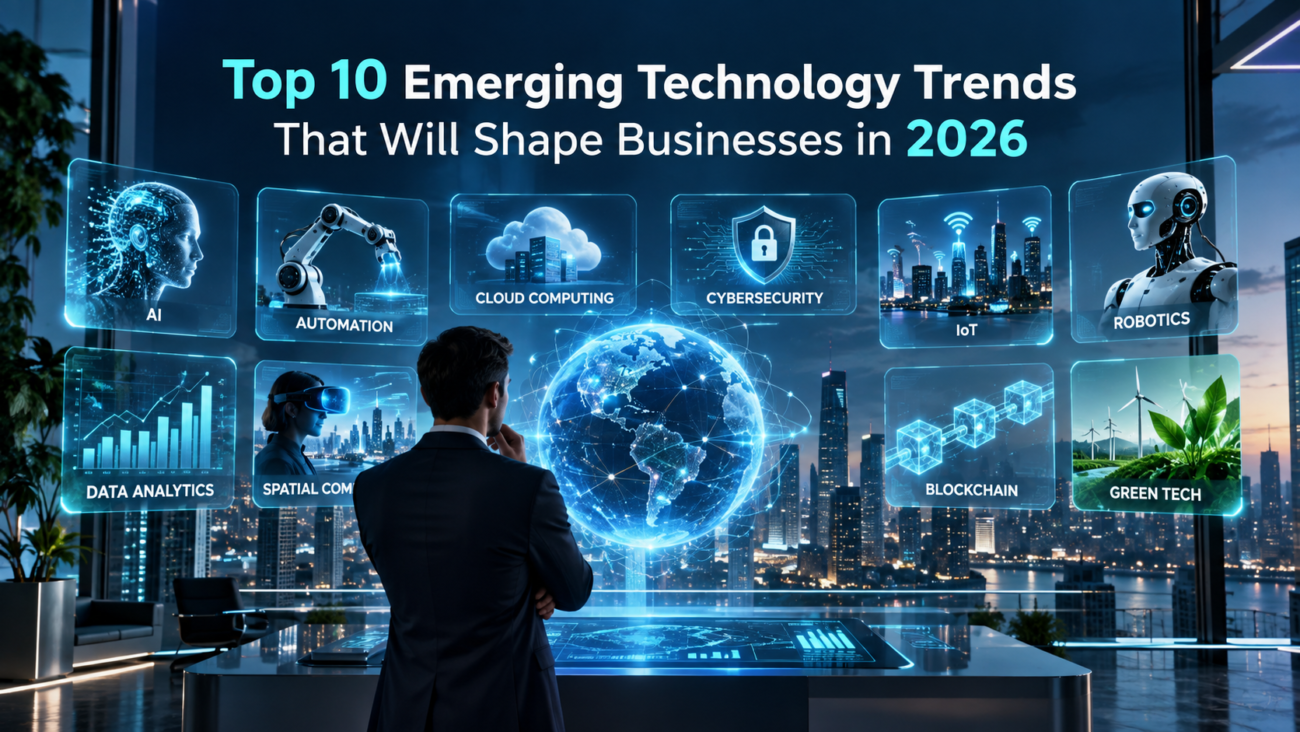
Technology spending in 2026 is facing a tougher test than it did during the early generative AI rush. Business leaders now want proof that a new system can reduce operating friction, improve decisions, protect margins, or create a source of revenue. That change is visible in current executive research. The Accenture Pulse of Change research published in July 2026 found continued commitment to AI investment even as leaders became more cautious about the wider economy. The discussion has moved deeper into day-to-day work, infrastructure, security, and workforce design. AI remains at the center, but businesses are also dealing with physical AI, edge computing, quantum preparation, confidential computing, new security models, and a growing need for cleaner enterprise data. The important question for a company isn’t which technology attracts the most attention. It’s which technology can change the economics or quality of a real business process.
That makes 2026 a practical year for technology strategy. Several technologies that spent years in labs, pilot programs, or isolated departments are moving into working business systems. The Deloitte Tech Trends 2026 report points to physical AI, agent-based work, changing AI infrastructure economics, new technology operating models, and AI security as connected business issues rather than separate experiments. Specialist firms such as VALiNTRY360, HyphenX Solutions, and Advayan are working closer to the application and platform layer, while Accenture and Deloitte remain important at the larger enterprise program level. Microsoft, NVIDIA, AWS, IBM, Google Cloud, Intel, and other technology companies are pushing the underlying platforms forward. The result is a market where business value will come from choosing the right combination rather than buying every new capability that appears.
TL;DR
The strongest technology trends in 2026 share a common theme: software is gaining more authority to act, while computing is moving closer to the place where decisions happen. AI agents can now carry out multi-step work. Edge systems can make decisions without sending every request to a distant cloud. Robots are gaining stronger perception and reasoning. Digital twins are giving companies live representations of physical operations. Security teams are preparing for AI identities and future quantum threats. At the same time, the cost of running AI is forcing businesses to think harder about infrastructure and data quality.
The practical priorities are:
· Agentic AI is moving into finance, sales, service, HR, IT, and operational workflows.
· AI-native business applications are changing how CRM and enterprise software work.
· Physical AI is bringing stronger machine reasoning into factories, warehouses, healthcare settings, and field operations.
· Edge AI is making local processing more useful where speed, privacy, or connectivity matters.
· Digital twins are giving companies a live model of physical assets and operating environments.
· AI infrastructure cost is becoming an architectural issue rather than a cloud billing detail.
· AI agents are creating a new class of machine identities that security teams must control.
· Confidential computing is giving businesses another way to protect sensitive AI workloads.
· Quantum preparation is moving into current security planning through post-quantum cryptography.
· AI-ready enterprise data is becoming the difference between useful agents and unreliable ones.
1. Agentic AI moves from assistant to operator
Generative AI changed how people create and search for information. Agentic AI is changing what software can do after it receives that information. An agent can interpret a goal, break work into steps, use approved tools, read business context, and take an action. That makes it useful in workflows where employees currently move between several systems to finish a task. Microsoft’s 2026 Work Trend Index research examined workplace AI use across 10 markets and found agents spreading across industries, with the depth of use varying by how deeply organizations have embedded them into work. Finance teams can use agents to investigate routine exceptions. Service teams can have an agent gather account history before an employee reviews a case. IT teams can use agents to classify requests or prepare a change for approval. The business value comes from shortening the path between intent and completed work.
The difficult part begins once an agent can act. Businesses need clear permissions, reliable business data, logs, approval points, and ownership when something goes wrong. AWS now treats agent deployment as an enterprise architecture problem rather than a model-selection exercise. Its AWS agentic AI guidance covers architecture, trust, operating models, and measures for business value. This is why 2026 will probably separate useful agent programs from expensive demonstrations. An agent that drafts a summary is easy to test. An agent that changes a customer record, creates a refund request, checks inventory, or triggers another system needs much stronger controls. The companies making progress will start with narrow authority, measure outcomes, and expand access only when the system earns it.
Where businesses should focus
· Choose workflows with clear inputs, rules, owners, and measurable outcomes.
· Give each agent the minimum system access needed for its assigned work.
· Log agent actions so employees can trace what happened after an error.
· Keep human approval for financial, legal, safety, and high-impact customer decisions.
2. AI-native enterprise applications change business operations
AI is moving from a feature inside enterprise software to an operating layer across CRM, finance, service, HR, and other business applications. These systems can interpret context, prepare actions, and complete approved steps inside the same environment employees already use. CRM is one of the clearest examples because customer records, workflows, permissions, and performance measures already sit in a shared system. In Salesforce, that shift is visible through Agentforce, Data 360, Einstein capabilities, and related workflow tools. The current VALiNTRY360 Salesforce AI services page shows one application of the trend: connecting customer data, AI recommendations, approved actions, permissions, and performance measurement inside Salesforce rather than treating AI as a separate add-on.
The same pattern is spreading beyond CRM. Finance systems can surface exceptions before a close task is reviewed. Service platforms can summarize cases and prepare next steps. HR and procurement tools can use policy context to guide routine work. The value still depends on the quality of the records, permissions, and workflows underneath the application. Poor data, duplicate records, unclear ownership, and disconnected systems limit what an AI feature or agent can safely do. Salesforce provides a visible example, and VALiNTRY360 is one partner working at that application layer, but the broader trend applies across enterprise software.
Enterprise application changes to watch
· AI agents will handle more context gathering before employees open a task or record.
· Data quality inside core business applications will become part of AI project budgets.
· Employees will expect AI actions inside the systems they already use.
· Performance will be measured against business outcomes, adoption, and error rates.
3. Physical AI brings reasoning into machines
Physical AI connects machine intelligence with the physical world. A robot or autonomous machine needs to perceive an environment, understand what is happening, choose an action, and respond while conditions change. That demands more than traditional industrial automation based on fixed routines. NVIDIA has made physical AI a major part of its 2026 strategy. Its NVIDIA physical AI ecosystem now includes robotics companies and industrial technology providers such as ABB Robotics, FANUC, KUKA, Universal Robots, YASKAWA, Agility, Figure, and Medtronic. The business implication is broader than humanoid robots. Physical AI applies to warehouse movement, inspection, autonomous vehicles, surgical equipment, manufacturing cells, industrial vision, and machines that must respond to a changing environment.
The economics are also changing because businesses can train and test some physical systems in simulation before sending them into an actual workplace. Synthetic environments can expose a robot to rare events without repeatedly creating those conditions in a factory or warehouse. NVIDIA’s 2026 physical AI work connects simulation, synthetic data, robotics models, and edge hardware into the same development path. That could lower part of the testing burden, though production safety remains a serious constraint. Companies should expect adoption to begin where labor shortages, repetitive physical tasks, inspection requirements, or dangerous working conditions make the return easier to defend. A warehouse doesn’t need a human-shaped robot for every activity. It may gain far more from a narrower autonomous system that handles a repetitive movement accurately for thousands of cycles.
Practical physical AI use cases
· Visual inspection in manufacturing environments with frequent product variation.
· Autonomous material movement where routes or conditions change during the day.
· Machine assistance in healthcare and other settings where precision matters.
· Site monitoring where sending employees into the environment carries added risk.
4. Edge AI moves decisions closer to the source
Cloud computing remains central to enterprise technology, but sending every AI request to a distant data center doesn’t make sense for every workload. Edge AI runs inference closer to the device, machine, camera, store, plant, vehicle, or local operating environment where the information is created. That can cut response delay and reduce the amount of raw information that must travel across a network. It can also help in locations where connectivity changes throughout the day. NVIDIA, Intel, and Qualcomm are all investing heavily in this area. The NVIDIA enterprise edge AI platform targets industrial, medical, robotics, and other real-time applications where local AI reasoning matters. In March 2026, NVIDIA also introduced IGX Thor hardware aimed at industrial, medical, and robotics edge workloads.
Businesses should view edge AI as a placement decision rather than a replacement for cloud AI. Some work belongs in a central environment because it needs large models, broad enterprise context, or heavy computing resources. Other work needs an immediate local response. A retail camera identifying a safety issue, a factory system checking a moving component, or a medical device interpreting a sensor signal may have little tolerance for round trips to a distant region. Qualcomm’s industrial edge AI work in 2026 also reflects demand for on-premises and embedded AI across business environments. Companies that decide carefully where models should run can improve response time while keeping central systems for governance, training, and broader analysis.
Edge AI decision factors
· Use local inference where milliseconds or network reliability affect the outcome.
· Keep sensitive raw information local when the business case supports it.
· Plan how models will receive updates after deployment across many devices.
· Separate workloads that need central context from work that can happen locally.
5. Digital twins become working models of the business
A digital twin is a software representation of a physical asset, environment, process, or connected system. The idea has existed for years, but AI, IoT sensors, cheaper compute, and better 3D tools are giving it more practical business value. Microsoft’s Azure Digital Twins platform supports models that connect assets and operating environments with live data. A manufacturer can map machines and production relationships. A property operator can represent buildings, energy systems, equipment, and environmental conditions. A logistics business can model parts of a facility and examine how changes might affect movement. The important shift is that the twin can become part of ongoing operations rather than a static visual model built for a presentation.
Digital twins also connect naturally with physical AI. A business can use a simulated environment to test a change before applying it to real equipment. A warehouse might examine routing changes before adjusting traffic on the floor. A factory might study how a new robotic process affects nearby equipment. Facilities teams can compare current sensor readings with expected operating states. Microsoft’s documentation describes twin architectures that connect IoT devices, business systems, graph relationships, and historical changes. NVIDIA is taking a related approach through Omniverse and robotics simulation. The combination matters because AI needs context about relationships in the physical world. A sensor value becomes more useful when the system knows which machine produced it, what sits upstream, and what business process may be affected if that machine fails.
Strong digital twin starting points
· Equipment with expensive downtime and enough sensor information to explain its state.
· Facilities where energy, occupancy, or maintenance decisions interact.
· Warehouses and factories where layout changes affect throughput or safety.
· Physical AI projects that need a realistic environment for repeated testing.
6. AI infrastructure economics changes cloud strategy
AI spending is forcing companies to think differently about infrastructure. Traditional cloud discussions often center on storage, application hosting, database capacity, and predictable compute demand. AI introduces heavier inference use, specialized accelerators, model choice, local processing, and sudden demand created by agents working continuously. Deloitte’s Tech Trends 2026 infrastructure discussion describes an “AI infrastructure reckoning” in which lower model costs can be offset by much higher usage. A company might reduce the price of an individual inference and still watch its total bill climb because hundreds of agents begin making model requests throughout the day. Infrastructure economics therefore becomes part of product design.
The likely answer for many enterprises is a mixed computing model. Cloud infrastructure remains useful when demand changes quickly or a team needs access to large AI resources. On-premises systems can make sense for stable workloads, sensitive information, or equipment already tied to a facility. Edge infrastructure matters when local response is essential. AWS is already documenting distributed agentic AI workloads that spread work across cloud and local environments. This will push technology leaders to understand cost per completed business task rather than cost per token or cost per server alone. A cheaper model that produces more errors can increase total process cost. A more expensive model may be justified for a narrow high-value decision. The architecture must follow the economics of the work.
Costs that deserve attention
· Inference volume generated by agents that operate throughout the working day.
· Network and storage costs created by moving large datasets between environments.
· Hardware use rates for expensive AI accelerators and local systems.
· Human review costs when lower-cost models produce more uncertain results.
7. AI agent identity becomes a cybersecurity priority
AI agents create a security problem that looks familiar at first and then gets harder. Businesses already control employee accounts, application identities, service accounts, API keys, and machine credentials. An agent adds something different because it can receive a goal and choose a sequence of actions while using those permissions. That means security teams need to know which agent exists, who owns it, what it can access, which tools it can invoke, and whether its behavior still matches its assigned purpose. NIST launched an AI Agent Standards Initiative in February 2026, with security and identity among its areas of attention. NIST’s later analysis of industry input found broad agreement that existing cybersecurity practices still matter but need adaptation for agent systems.
Microsoft is treating agent identity as a separate enterprise control layer. Its Microsoft agent security guidance describes controls for agent visibility, identity, sensitive data, and AI-related threats. Microsoft Entra now includes agent identities designed specifically for AI systems. This direction will affect any business deploying agents, even when the company uses another vendor’s AI model. A poorly governed agent can become an overpowered service account with reasoning ability. Security teams will need agent inventories, access reviews, behavioral monitoring, and removal procedures when an agent is retired. Buying an agent platform without planning its identity lifecycle can create a security debt that becomes harder to unwind as more departments create their own agents.
Controls to put in place early
· Assign an accountable business and technical owner to each production agent.
· Give agents their own identities rather than sharing employee credentials.
· Review permissions when the agent’s assigned work changes.
· Keep records of agent actions for investigation, audit, and incident response.
8. Confidential computing gives sensitive AI another path
AI creates a difficult privacy question because useful models often need access to valuable business information. Encryption already protects information while it’s stored and while it travels across networks. Confidential computing extends protection to information while a workload is processing it inside a protected hardware environment. That has become more relevant as companies consider AI for financial records, healthcare information, intellectual property, internal analytics, and cross-company collaboration. Google Cloud expanded its Google Cloud Confidential Computing work again in 2026, including support aimed at cloud AI deployments. The technology won’t remove the need for access rules, model controls, or good data handling, but it gives architecture teams another option when data exposure during processing is a major concern.
The business case becomes stronger when multiple parties want to compute against sensitive information without giving every participant unrestricted access to the underlying data. Google describes confidential environments for joint analytics, machine learning work, and privacy-focused AI processing. This could matter in healthcare collaborations, financial services, supply-chain analysis, advertising measurement, and research partnerships. Current Confidential Computing documentation describes encryption in use as the remaining part of end-to-end encryption coverage. Companies shouldn’t assume every AI workload needs this level of isolation. They should identify which information has the highest exposure cost and decide whether a protected execution environment is justified for those workloads.
Where confidential computing fits
· AI workloads processing commercially sensitive or regulated information.
· Joint analysis where organizations need to limit access to each other’s raw data.
· Private model inference involving valuable internal knowledge or intellectual property.
· Cloud workloads where protection of information during processing is a stated requirement.
9. Quantum readiness becomes a current security project
Quantum computing still isn’t a normal enterprise computing platform, but 2026 is an important year in its development. IBM’s IBM quantum computing roadmap lists 2026 as the year it intends to enable early examples of quantum advantage using quantum systems alongside high-performance computing. The roadmap continues toward fault-tolerant systems later in the decade. Businesses shouldn’t interpret this as a signal to replace classical computing. Quantum systems are aimed at selected classes of difficult problems where their architecture may eventually provide an advantage. Chemistry, materials work, certain mathematical problems, and selected forms of computation are common areas of interest. For most companies, the near-term work is learning where quantum could eventually matter rather than creating a large production program today.
The more immediate business issue is post-quantum security. NIST has already finalized post-quantum cryptography standards that organizations can begin implementing. Its NIST post-quantum cryptography guidance says 3 standards are already available for protecting electronic information, while the NCCoE is working on migration guidance. This matters because cryptographic changes can take years across applications, devices, vendors, certificates, and old systems. Businesses also need to consider information that must remain private for a long time. An attacker can potentially capture encrypted information now and wait for future computing capability to improve. That makes cryptographic inventory and migration planning a 2026 concern even for companies that won’t run a quantum workload themselves.
Quantum work that makes sense now
· Inventory public-key cryptography across important applications and infrastructure.
· Identify information that must remain confidential for many years.
· Ask technology vendors about their post-quantum migration plans.
· Run focused quantum experiments only where the business problem could justify them.
10. AI-ready enterprise data becomes core infrastructure
Most AI problems eventually become data problems. An agent can have a strong model and still make poor decisions when customer records conflict, product information is outdated, policies sit in disconnected repositories, or system permissions hide the context required for a task. This is why vector search, retrieval systems, metadata, semantic layers, knowledge graphs, real-time data, and stronger data governance are moving closer to the center of enterprise AI work. IBM’s 2026 AI announcements include a focus on a real-time information foundation that gives agents governed enterprise context. Microsoft is linking agents with Fabric and other business data services. Salesforce is making Data 360 central to its AI direction. The model receives the attention, but enterprise context determines whether that model can produce an answer the business can actually use.
Vector databases are part of that shift because they help systems retrieve information based on meaning rather than exact keyword matches. Retrieval-augmented generation can then give a model selected business context before it answers or acts. The same practical problem appears across enterprise AI projects: AI systems need access to the right business knowledge while maintaining permissions and trust boundaries. Businesses should resist the temptation to pour every internal document into a retrieval system and assume the problem is solved. Ownership, freshness, duplication, access control, and source quality still matter. In 2026, the winning data architecture is likely to be the one that gives each AI system enough trusted context for its assigned work without creating a new uncontrolled copy of the enterprise.
Data work that pays off across AI projects
· Define authoritative sources for customers, products, policies, and operational records.
· Track document freshness so agents don’t rely on outdated instructions.
· Carry existing access permissions into AI retrieval and agent workflows.
· Measure retrieval quality separately from the quality of the language model.
What these trends mean for business leaders
The 10 trends point toward a business environment where technology decisions are becoming more connected. Agentic AI depends on enterprise data and identity controls. Physical AI depends on edge computing and simulation. Digital twins become more useful when real-time information is reliable. Confidential computing becomes relevant when AI processes sensitive information. Quantum preparation affects today’s security architecture even though useful quantum computing remains early. Cloud strategy is changing because every one of these systems has a different mix of computing cost, response time, privacy, and availability requirements.
This also changes how businesses should evaluate technology partners. Large consulting organizations such as Accenture and Deloitte can make sense when a program crosses many business units and needs broad organizational work. A specialist can make more sense when the work centers on a specific enterprise platform, a smaller set of workflows, or an operating problem that needs direct implementation attention. For Salesforce-heavy organizations, firms such as VALiNTRY360 and HyphenX Solutions sit closer to that platform layer. Advayan brings Salesforce and SAP work into the mix. The right choice depends on the problem, existing systems, internal team, and amount of change involved rather than the size of the vendor’s brand.
The safest 2026 technology roadmap starts with business constraints. Identify where work is slow, where decisions lack context, where employees repeat the same digital steps, or where physical operations create avoidable risk. Then match technology to that specific problem. An agent may be the answer in one process. Better CRM architecture may solve another without adding a new model. Edge AI may help a factory while adding little value to a back-office workflow. That discipline protects companies from spending heavily on technology that looks impressive during a demonstration but struggles to earn a permanent place in operations.
CTA: Turn 2026 technology plans into working systems
The strongest technology plan for 2026 is one that reaches production and survives daily use. For Salesforce-heavy businesses, a focused partner such as VALiNTRY360 can help connect AI work to the customer and operating processes already inside the platform.
Start with 1 business process that has a clear owner and an outcome the company already measures. Fix the underlying data and access rules. Then test whether AI or another emerging technology improves that result enough to justify expansion. That approach keeps the technology decision tied to the business instead of letting the technology become the project.
Frequently asked questions
What is the biggest technology trend for businesses in 2026?
Agentic AI has the broadest near-term effect because it changes software from a system employees operate into a system that can perform assigned steps on their behalf. Its reach extends across sales, customer service, finance, HR, software work, IT operations, and other functions. The technology still needs boundaries because an agent with business-system access can create financial, security, or customer risk when its permissions exceed its purpose. Companies should focus on agents that have a narrow job, clear data sources, clear ownership, and an outcome that can be measured. Microsoft, AWS, IBM, Salesforce, and other enterprise technology providers are all investing in this direction, which gives the trend more staying power than a single product cycle.
How will AI agents affect employees in 2026?
AI agents will take over parts of jobs before they replace complete roles. Employees may spend less time gathering account history, preparing routine summaries, moving information between systems, checking standard exceptions, or performing other repeatable digital tasks. Their work can shift toward review, judgment, customer interaction, exception handling, and decisions that need accountability. Accenture’s July 2026 research found that 57% of employees surveyed said their roles had already changed because of AI implementation, while 78% of leaders expected employee roles to change over the following 12 months. That gap shows why workforce planning needs to happen while the systems are being introduced rather than after deployment.
Is quantum computing ready for normal business use in 2026?
Quantum computing is still early for normal enterprise workloads. IBM’s roadmap targets initial examples of quantum advantage during 2026 and continued development toward fault-tolerant systems later in the decade. Most businesses therefore don’t need a large quantum computing program today. They can study selected use cases and build internal understanding where there is a credible future fit. Security preparation is more urgent. NIST has already released post-quantum cryptography standards, which means companies can begin identifying vulnerable cryptography and planning migration before a cryptographically relevant quantum machine exists. Organizations with information that must stay private for many years have a stronger reason to start that work now.
Why is edge AI becoming important?
Edge AI matters because some business decisions need to happen close to the device or physical environment producing the information. Sending every camera frame, sensor reading, or machine event to a distant cloud can add delay, consume network capacity, and create unnecessary data movement. Local AI systems can interpret selected information where it’s produced, then send only the result or required records to central systems. Industrial equipment, retail environments, medical devices, robotics, security systems, and infrastructure monitoring are strong examples. NVIDIA, Intel, and Qualcomm all expanded their edge AI work during 2026, which indicates that local inference is becoming a standard part of AI architecture rather than a niche embedded-computing topic.
How should a business decide which 2026 technology trend to invest in?
Start with the operating problem and the cost of leaving it unchanged. A company dealing with repetitive digital work may benefit from agents. A manufacturer with expensive equipment downtime may gain more from digital twins, edge AI, or physical AI. A regulated company processing sensitive information may place confidential computing and stronger identity controls higher on the list. An organization with years of valuable encrypted information should begin post-quantum planning. Existing technology also matters. Businesses deeply invested in Salesforce, for example, may get faster business value by improving CRM data and adding carefully controlled AI actions inside Salesforce rather than starting with a separate AI platform. Technology selection should follow the economics and risk of the work it needs to improve.
