
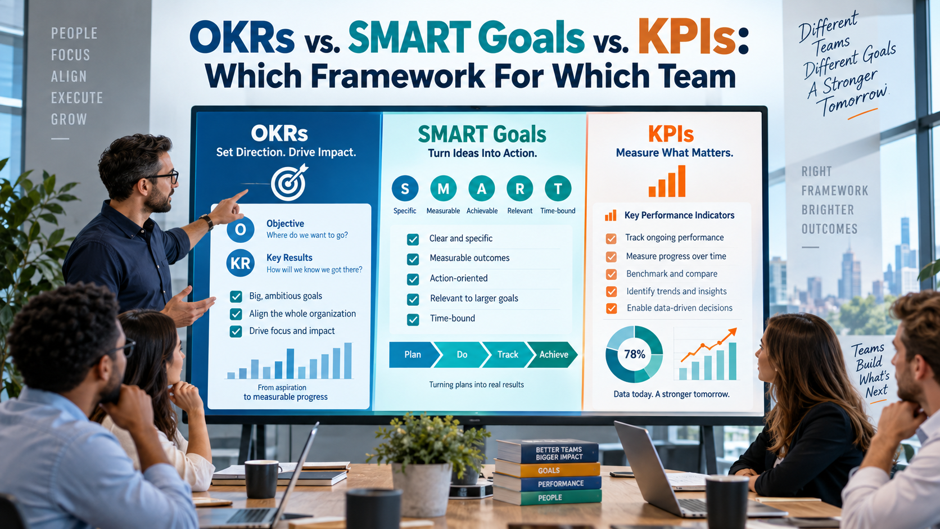
Every performance conversation eventually runs into the same wall: 3 acronyms that sound similar enough to be confused and different enough to cause real damage when misapplied. A team leader sits in a meeting where OKRs, SMART goals, and KPIs get used interchangeably, nods along, and walks away applying the wrong framework to the wrong problem. The result is predictable. A sales team tracking OKRs when what they actually need is a KPI dashboard. An engineering team writing SMART goals for a discovery-stage project that has no fixed scope. A leadership team debating which framework is objectively superior when the honest answer is that all 3 solve different problems and most organisations need more than one running simultaneously.
TL;DR
| Framework | What it is | Best fit |
| OKRs | Objectives and Key Results: a qualitative objective paired with measurable key results; OKRs can be committed or aspirational | Cross-functional strategic alignment; teams that need direction more than task precision |
| SMART Goals | Specific, Measurable, Achievable, Relevant, Time-bound criteria for writing individual or team goals | Individual performance plans; contained work where one person or team owns the outcome |
| KPIs | Key Performance Indicators: ongoing measures that can use targets, thresholds, or acceptable ranges | Operational monitoring and ongoing performance tracking |
None of these 3 frameworks replaces the other 2. KPIs are ongoing performance measures and may use targets or thresholds. SMART goals define a specific target and deadline. OKRs connect an Objective with measurable Key Results and can be committed or aspirational. Organisations can use all 3 where they fit the work.
What Each Framework Actually Measures
The confusion between these 3 frameworks starts with a category error: treating them as competing options for the same job when they operate at different altitudes of the organisation and answer different questions.
OKRs: Direction and Alignment
OKRs pair a qualitative Objective with 3 to 5 quantitative Key Results that define measurable outcomes. OKRs can be committed or aspirational. Committed OKRs are expected to be fully achieved, while aspirational OKRs are intentionally harder. For an aspirational OKR, attainment around 70% can represent strong stretch performance. That guidance does not apply to every OKR.
A typical OKR reads as follows. Objective: turn our best customers into loyal brand ambassadors. Key Result 1: increase Net Promoter Score from 42 to 60. Key Result 2: grow customer referral volume by 35%. Key Result 3: launch a customer advocacy program with 200 active participants. The objective sets direction. The key results define what success measurably looks like, and none of them is a task; they are outcomes.
SMART Goals: Precision and Predictability
SMART goals provide a structured method for writing a single, well-defined goal: Specific Measurable, Achievable, Relevant, and Time-bound criteria give the goal a defined outcome and deadline. Unlike OKRs, SMART goals don’t separate an aspirational statement from measurable results. The goal itself carries all 5 criteria in one sentence. “Increase monthly qualified leads from 150 to 200 by the end of Q2 through targeted LinkedIn outreach” is a complete SMART goal: it names the specific metric, the measurable target, a method that makes it achievable, its relevance to the broader sales function, and a fixed deadline.
SMART goals provide a clear target and deadline, but the framework does not prescribe a universal scoring percentage. A SMART goal should be realistically achievable when it is set. The organisation’s performance process determines how partial completion is judged. This differs from aspirational OKRs, where partial attainment can still represent strong stretch performance.
KPIs: Ongoing Health Monitoring
KPIs are performance indicators rather than complete goal-setting methods. A KPI is an ongoing performance indicator used to track how a process, function, or outcome is performing. KPIs often have targets, thresholds, or acceptable ranges that give the number context. They can support OKRs, SMART goals, or other management processes.
KPIs can act as inputs to goal-setting. A persistent gap, such as customer retention below its target, can prompt an OKR, a SMART goal, or another response. The KPI shows what is happening. The chosen goal or action defines what the team plans to change.
How the 3 Frameworks Differ Structurally
| Dimension | OKRs | SMART Goals | KPIs |
| What it is | Objective + measurable key results; committed or aspirational | A single structured goal statement | An ongoing performance indicator |
| Time horizon | Typically quarterly, with monthly check-ins | Fixed deadline, reviewed periodically | Usually ongoing; review period varies |
| Attainment standard | Committed: full attainment expected; aspirational: about 70% can represent strong stretch performance | Defined target; scoring is set by the organisation | Compared with a target, threshold, or range when defined |
| Ambition level | Committed or aspirational | Realistic and achievable by design | Depends on the target or threshold selected |
| Primary scope | Cross-functional or team-level strategic direction | Individual or single-team task execution | Functional or process-level health |
| Who typically owns it | Leadership and cross-functional teams | Individual contributors and managers | Operations, finance, and functional leads |
| Review cadence | Quarterly cycle, weekly or biweekly progress checks | Set once, reviewed at milestone or deadline | Regular monitoring based on the metric |
These structural differences aren’t cosmetic. They reflect genuinely different jobs, and applying one framework’s review cadence or attainment standard to a different framework is one of the most common ways organisations end up frustrated with a tool that was never designed for the way they’re using it.
Choosing the Right Framework by Team Type
The most useful question isn’t which framework is objectively superior. It’s what kind of execution problem the team actually has. Misalignment, unclear individual accountability, and unmonitored operational health are 3 different problems, and each has a framework built for it.
Cross-functional and strategic teams should default to OKRs. When a company is undergoing a strategic shift, launching into a new market, or trying to coordinate departments that need to move in the same direction, OKRs give teams shared direction and measurable Key Results without dictating every task. The organisation can use committed OKRs for must-hit outcomes or aspirational OKRs for deliberate stretch.
Individual contributors and single-owner projects should default to SMART goals. When success sits mostly within 1 person’s control, or within 1 team’s scope, and the work is understood well enough to define a realistic target, SMART goals give the work a clear outcome and deadline. Performance reviews, individual development plans, and contained projects with a clear owner are the natural home for SMART goals.
Operational and functional teams should default to KPIs. Finance, customer support, IT operations, and other functions with ongoing service levels can use KPIs to track performance over time. A support team, for example, may monitor first response time against a target or acceptable range rather than treating the metric as a one-time goal.
Sales teams typically need all 3 simultaneously, at different levels. Individual reps work against SMART quota goals. The sales organisation as a whole might run an OKR around expanding into a new vertical. And the function continuously monitors KPIs like pipeline velocity, win rate, and average deal size regardless of what specific goals are active in any given quarter.
When Each Framework Breaks Down
Every framework fails when it’s applied to a problem it wasn’t designed to solve. Recognising the failure mode early prevents months of frustration with a tool that was never going to fix the underlying issue.
OKRs fail when:
- The organisation is treating OKRs as a task list rather than an outcomes framework, writing key results that are really just deliverables (“Launch feature X”) instead of measurable outcomes (“Increase activation rate by 15%”)
- Aspirational OKRs are set so conservatively that they no longer create meaningful stretch, or committed OKRs are treated as if partial attainment is acceptable
- The underlying problem is misalignment or unclear ownership rather than a lack of ambitious targets, in which case no amount of OKR precision fixes what is actually a governance problem
- OKRs are cascaded rigidly top-down without team input, producing objectives nobody feels ownership over and key results that were negotiated rather than genuinely believed achievable
SMART goals fail when:
- The work is exploratory, ambiguous, or dependent on discovery, making it impossible to write a genuinely “achievable” target with any confidence at the outset
- The goal requires cross-functional coordination beyond what a single owner can control, in which case the “achievable” and “relevant” criteria start to conflict with the reality that success depends on people outside the goal-setter’s authority
- Teams write SMART goals so conservatively that “achievable” becomes synonymous with “unambitious,” producing a goal-setting culture that optimises for safe, predictable wins rather than meaningful progress
- The goal owner treats the deadline as fixed regardless of new information, continuing to chase a target that circumstances have made irrelevant rather than revisiting the goal itself
KPIs fail when:
- A KPI target is set without a clear response plan, leaving teams with a red number but no agreed action
- Too many KPIs are tracked simultaneously, diluting attention across dozens of metrics rather than concentrating on the handful that genuinely indicate functional health
- KPIs are reported without context, so a declining number triggers panic rather than diagnosis, because nobody has connected the metric back to the operational changes that could explain the movement
- The organisation treats KPI monitoring as a complete goal-setting system even when a performance gap also needs a defined change goal or project
Recognising which of these failure patterns is actually present is the fastest way to fix a stalled goal-setting programme, because the fix is almost never a wholesale framework change; it’s usually a correction to how the existing framework is being applied.
Running All 3 Together: The Integrated System
One practical way to combine the frameworks is to build a layered system in which each framework handles a different part of the work. This is an operating model, not a rule every organisation must follow.
In this model, KPIs provide ongoing performance signals, tracking performance over time. When a KPI reveals a persistent gap, leaders can choose an OKR if the response needs shared direction across teams. SMART goals can define specific commitments where that level of detail helps. Other work may use SMART goals without an OKR.
This model can break down when the links between layers are unclear or forced. An OKR can provide strategic direction that never translates into daily work. A KPI gap can also sit on a dashboard with no agreed response. At the same time, a SMART goal does not need to connect to an OKR when it covers a stand-alone project, development goal, compliance task, or other defined commitment.
The practical integration checklist:
- Every KPI that management considers strategically important should have an owner who is accountable for monitoring it and flagging when intervention is needed
- Every OKR should be traceable to either a KPI gap it’s addressing or a genuinely new strategic initiative, not simply restated departmental busywork
- Where strategic alignment matters, an individual SMART goal can connect to an OKR key result or a KPI the role influences. It can also stand alone when the work has its own defined purpose
- Review cadences should be layered to match each framework’s natural rhythm: KPIs reviewed continuously or weekly, OKRs reviewed biweekly to monthly with quarterly resets, SMART goals reviewed at their stated milestones or deadlines
A layered model can help teams see how measures and goals relate and can help goal-setting actually change behaviour. It is not mandatory. Use the connections that clarify ownership, and allow stand-alone goals where that better matches the work.
Common Misconceptions That Undermine All 3 Frameworks
A few misconceptions still matter because they affect where each framework is used.
| Misconception | What’s actually true |
| “SMART goals are only for individuals” | SMART goals can also be used for team projects or other work with a defined target and deadline. |
| “You have to pick one framework for the whole company” | An organisation can use different frameworks for different types of work. It does not need one framework everywhere. |
Writing Each Framework Correctly
Understanding when to use each framework only solves half the problem. Most goal-setting failures aren’t framework selection errors; they’re execution errors where the right framework was chosen and then written badly. Each framework has a specific set of construction mistakes that show up repeatedly.
Building an OKR That Actually Works
A well-constructed OKR separates the Objective from the measurable evidence. Key Results should describe outcomes rather than a task list. The ambition level should also be explicit so teams know whether the OKR is committed or aspirational.
The construction checklist for OKRs:
- The Objective should be a single sentence that describes a meaningful outcome, phrased in language that would motivate the team even without the numbers attached
- Each Key Result should be a number that moves, not an activity that gets completed; if a key result can be checked off without any measurable change occurring, it’s a task, not a key result
- Limit each Objective to 3 to 5 Key Results; more than 5 dilutes focus and turns the OKR into a comprehensive project plan rather than a small number of decisive outcomes
- Set the ambition type deliberately: committed OKRs should be planned for full attainment. Aspirational OKRs can be set beyond comfortable reach. For an aspirational OKR, attainment around 70% can still represent strong stretch performance.
- Review progress on a cadence shorter than the OKR’s total duration; a quarterly OKR reviewed only once, at the end of the quarter, has no mechanism for correcting course when early signals show the current approach isn’t working
Building a SMART Goal That Holds Up
SMART goals fail less often from missing an element of the acronym entirely and more often from writing each element too loosely to actually constrain the goal, which produces a goal that looks structured on paper but doesn’t function as one in practice.
The construction checklist for SMART goals:
- Specificity means naming the exact metric and the exact mechanism, not a general direction; “improve customer satisfaction” is not specific, while “increase CSAT score from 4.1 to 4.5 by implementing a post-resolution follow-up call” is
- Measurability requires a number with a clear source of truth; if 2 people would disagree about whether the goal was achieved, the measurement criteria weren’t specific enough
- Achievability should be checked against actual historical data or comparable benchmarks, not optimism; a goal that requires a 300% improvement over the team’s best historical quarter isn’t achievable by definition, regardless of how motivating it sounds
- Relevance means the goal should connect visibly to something the organisation or team actually needs right now, not simply be a goal that’s easy to set and measure
- Time-bound deadlines should be specific dates, not vague windows like “this year” or “soon,” because vague deadlines produce vague urgency
Selecting the Right KPIs
The mistake in KPI selection is rarely picking a bad metric outright. It’s picking too many metrics, or metrics that don’t map cleanly to a decision anyone would actually make differently based on the number.
The construction checklist for KPIs:
- Every KPI should have a clear owner who is accountable for monitoring it and who has some ability to influence the number through their actions
- Prioritise leading indicators alongside lagging indicators; a lagging KPI like quarterly revenue tells you what already happened, while a leading KPI like sales pipeline coverage or product usage frequency gives early warning before the lagging number moves
- Limit the number of KPIs tracked prominently on any single dashboard to the handful that genuinely drive decisions; a dashboard with 40 metrics produces attention paralysis, not clarity
- Pair every KPI with a documented definition of how it’s calculated and where the data comes from, since ambiguous KPI definitions produce disputes about whether the number is even correct before anyone gets to discussing what to do about it
- Revisit the KPI list periodically to retire metrics that no longer reflect what matters to the business as strategy and priorities shift
FAQs
Can a team use OKRs and SMART goals at the same time?
Yes. They can be used together. An OKR can set team or cross-functional direction while SMART goals define specific commitments for people or teams. Where strategic alignment matters, a SMART goal can support a Key Result. SMART goals can also stand alone for work with its own defined purpose.
How should OKR and SMART goal attainment be interpreted?
OKR scoring depends on the type of OKR. Committed OKRs are expected to be fully achieved. Aspirational OKRs are deliberately harder, and attainment around 70% can represent strong stretch performance. SMART defines how a goal is written, including that it should be achievable, but it does not prescribe a universal scoring percentage. The organisation decides how partial completion is judged.
Is a KPI ever also an OKR key result?
Yes. A KPI such as customer retention rate or average handling time can become a Key Result when an organisation sets an OKR to improve that measure. The KPI can remain an ongoing performance indicator with its own target, threshold, or acceptable range before and after the OKR cycle.
How do we decide which framework a new team should start with?
Start with the nature of the team’s work rather than a general preference for one framework. If the team’s primary output is a set of measurable ongoing operations (support tickets resolved, transactions processed, uptime maintained), start with KPIs and build any goal-setting on top of them later. If the team owns a well-defined, single-owner deliverable with a clear deadline, start with SMART goals. If the team’s work requires coordinating multiple people or functions toward an ambitious, not-yet-fully-defined outcome, start with OKRs. Teams frequently need to add a second or third framework as they mature, and starting with the framework that matches the current problem avoids the common mistake of over-engineering goal-setting for a team that doesn’t yet need the complexity.
What’s the most common mistake organisations make when adopting OKRs?
The most common failure is treating OKRs as a rebranded task list rather than an outcomes framework. This shows up as key results that describe deliverables (“Ship the new onboarding flow”) instead of measurable outcomes (“Increase onboarding completion rate from 60% to 80%”). A deliverable can be completed without moving any meaningful business outcome, which defeats the purpose of the framework. The fix is a simple test applied to every proposed key result: if it could be marked complete without any measurable change in a number that matters, it’s a task disguised as a key result and needs to be rewritten.
Should KPIs ever have targets attached to them?
Yes. KPIs commonly use targets, thresholds, or acceptable ranges to show whether performance is on track. The KPI measures performance, while a separate goal, project, or action plan can define what the team will do when the number needs to change. An OKR or SMART goal is one option, not a requirement for every KPI target.
How often should each framework be reviewed?
KPIs benefit from continuous or weekly monitoring since they reflect ongoing operational health and problems compound quickly if left unaddressed. OKRs typically run on a quarterly cycle with weekly or biweekly progress check-ins, since the framework is designed to maintain momentum and allow course correction before the quarter ends. SMART goals are generally reviewed at whatever milestone or deadline was specified when the goal was written, though a quarterly check to confirm the goal is still relevant is good practice even for goals with longer timelines, since business priorities shift faster than some individual goals are written to accommodate.
