
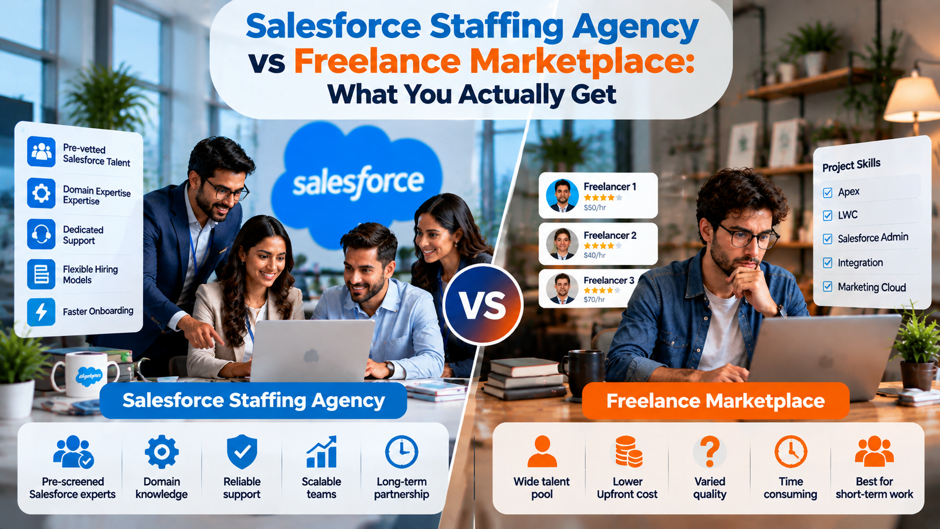
Type “hire a Salesforce developer” into a search engine and the results split cleanly into 2 camps: specialized staffing agencies that place vetted Salesforce professionals directly, and freelance marketplaces like Upwork and Toptal where you post a project and candidates come to you. Both promise to solve the same problem, finding someone who can actually configure flows and write clean Apex without breaking your production org, but the path each one takes to get there, and what you’re actually responsible for once the engagement starts, differ enough that picking the wrong 1 for a specific situation creates real cost.
This post breaks down what each option genuinely delivers: how vetting actually works on each path, how Salesforce certifications get verified, or don’t, how fast each option realistically moves, what the cost structures actually look like once you account for more than the headline rate, and which situations favor 1 approach clearly over the other. The goal isn’t declaring a universal winner, it’s giving you enough of the real mechanics to match the right option to the specific Salesforce work you’re trying to get done.
TL;DR
- A staffing agency and a freelance marketplace solve different parts of the same hiring problem. A specialized Salesforce staffing agency pre-screens candidates against your specific requirements and typically verifies certifications directly, while a freelance marketplace gives you direct access to a much larger pool of candidates but shifts most of the vetting work onto you and your own team.
- Speed varies dramatically and isn’t always in the direction people expect. Upwork’s own data points to an average of roughly 3 days to find a hire, Toptal’s more selective screening process commonly takes 3 to 5 weeks to deliver a match, and a specialized staffing agency’s timeline sits somewhere in between depending on how niche the specific Salesforce skill set actually is.
- Salesforce certification verification is a genuine, checkable differentiator. Salesforce runs an official verification system through Trailhead Academy and Trailblazer.me that lets anyone confirm whether a claimed certification is real and current, and whether a specific hiring path actually uses that system consistently says a lot about how seriously candidate quality gets checked before you ever see a resume.
What Each Option Actually Is
A Salesforce staffing agency is a specialized recruiting firm that maintains its own network of Salesforce professionals, screens them against technical and certification standards before ever presenting them to a client, and typically handles the employment relationship itself, payroll, benefits, tax compliance, for contract placements. The agency’s core value proposition is doing the vetting work upfront so a client receives a shortlist of candidates who have already cleared a technical bar, rather than a wide-open pool the client has to filter through alone.
A freelance marketplace, by contrast, is a platform where clients post a project or role directly and freelancers apply, bid, or get matched by the platform’s own algorithm or internal team. Upwork’s Salesforce developer marketplace represents the fully open end of this model, where any freelancer can create a profile and respond to postings, putting the vetting burden squarely on the client. Toptal sits further toward the curated end, running its own multi-stage screening process before a freelancer ever joins its network, though the client still manages the individual contractor relationship directly rather than working through an agency’s ongoing account management.
Side-by-Side Comparison
| What to Compare | Salesforce Staffing Agency | Freelance Marketplace |
| Who does the initial vetting | The agency, before presenting any candidate | The client, or the platform’s own screening process if it has 1 |
| Certification verification | Commonly checked directly against Salesforce’s own system | Rarely verified beyond what the freelancer claims on their profile |
| Employment relationship | Often handled by the agency for contract placements | Directly between client and freelancer, through the platform |
| Typical time to first candidate | Days to a couple weeks, depending on the skill’s rarity | 3 days on Upwork’s open model, 3 to 5 weeks on Toptal’s screened model |
| Ongoing account support | Usually included, with a dedicated point of contact | Minimal to none beyond the platform’s own dispute process |
| Cost structure | A markup or placement fee built into the bill rate | An hourly or project rate, sometimes plus a platform service fee |
Reading this table top to bottom shows the core tradeoff clearly: a staffing agency compresses the vetting work into the fee you pay upfront, while a freelance marketplace keeps the sticker price lower but expects you to absorb the screening and, quite often, the ongoing management work entirely on your own from start to finish, with no dedicated point of contact to lean on.
How Vetting Actually Works on Each Path
Toptal’s Screening Process Is Genuinely Rigorous, and Genuinely Slow Toptal states it accepts fewer than 3% of the over 200,000 people who apply to join its network each year, and that figure, while company-reported rather than independently audited, reflects a real multi-stage process covering language checks, technical skills assessments, live coding interviews and a trial project. The platform describes its freelancer screening process as evaluating communication, domain expertise and candidates through real-world assessment, which is why its model sits closer to curated talent than an open job marketplace. That screening depth is exactly why matching a client with a freelancer on Toptal commonly takes 3 to 5 weeks rather than days, since the platform is drawing from an already-filtered pool but still needs to find the right specific match for your project’s particular requirements.
Upwork Puts the Vetting Decision Directly in Your Hands Upwork’s model is built around client control rather than platform-driven filtering, which means when you post a role, you’re the 1 reviewing proposals, checking portfolios and deciding who’s actually qualified. Upwork’s own data suggests clients typically find a hire within about 3 days, a genuinely fast number, but that speed reflects how quickly the marketplace surfaces candidates, not how thoroughly any of them have been verified before they reach your inbox.
A Specialized Staffing Agency Vets Against Your Specific Requirements Before You See Anyone A specialized agency offering Salesforce staffing solutions builds its value proposition around doing this filtering work before a candidate ever reaches you, which typically means confirming technical experience against the specific Salesforce clouds and features your project actually needs, checking references from prior placements, and, in stronger agencies, directly verifying claimed certifications rather than taking a resume’s word for it. This front-loaded vetting is why a staffing agency’s timeline sits between the 2 marketplace extremes: slower than Upwork’s open posting model, but often faster than Toptal’s full screening pipeline, since the agency has already built and maintained its vetted pool rather than running every candidate through a fresh multi-week process.
Certification Verification: The Real Differentiator
- Salesforce runs an official, public verification system for exactly this purpose. Through Trailhead Academy and a connected Trailblazer.me profile, a certified professional can make their credential status, name, location, certification name and date earned, publicly searchable, and Salesforce’s official credential verification tool lets anyone, including a potential employer, confirm whether a specific claimed certification is actually real and currently active.
- This system exists specifically because self-reported certifications aren’t reliable enough on their own. Organizations have real reason not to rely solely on what a candidate or a resume claims, since the risk of trusting someone without the actual skills a certification is supposed to represent is significant enough that Salesforce built dedicated infrastructure, spanning both Trailhead Academy and the older Webassessor exam-tracking system, specifically to let employers check credential claims directly rather than taking them on faith.
- Whether a hiring path actually uses this verification consistently varies enormously. A specialized Salesforce staffing agency that regularly places certified professionals has strong practical reason to check every claimed certification against Salesforce’s own verification page as a standard part of its screening process, while a general freelance marketplace handling thousands of skill categories has far less built-in incentive or process to verify 1 specific platform’s credentials as rigorously.
- This gap matters most for roles where the certification itself signals real, checkable competence. A Salesforce Certified Technical Architect credential, for instance, requires passing multiple prerequisite certifications and a notoriously difficult board review, which means confirming that credential is genuinely active tells you something concrete about a candidate’s actual depth, information that’s considerably more valuable when you know it’s been checked against Salesforce’s own system rather than simply listed on a profile.
Speed to Hire: What the Numbers Actually Show
| Hiring Path | Typical Time to First Match | What Drives That Timeline |
| Upwork | Around 3 days, per Upwork’s own reported average | Open posting model with minimal upfront platform screening |
| Toptal | Commonly 3 to 5 weeks | Multi-stage screening plus a dedicated matching process for each client |
| Salesforce staffing agency | Typically days to a couple weeks | Pre-built talent pool, though genuinely rare skill combinations can extend the search |
| Direct hire through internal recruiting | Often several weeks to a few months | Full internal sourcing, interviewing and offer process with no external pool to draw from |
The pattern worth noticing here is that raw speed and actual vetting depth tend to move in opposite directions, the fastest option, Upwork’s open model, does the least upfront filtering, while the slowest marketplace option, Toptal, does the most. A specialized Salesforce recruitment service sits in the middle because it’s drawing from an already-vetted pool it maintains continuously, which lets it move faster than a fresh screening process would while still delivering more filtering than an open marketplace posting ever provides on its own.
Cost Structures Compared
Freelance Marketplace Rates Span a Wide Range, and the Headline Number Isn’t the Whole Story Upwork rates for developers commonly run from roughly $10 to $150 an hour depending on experience and location, while Toptal’s more curated pool typically runs $60 to $200 an hour, sometimes requiring a refundable deposit before work begins. These figures represent what you pay the freelancer directly, but they don’t include the time your own team spends reviewing proposals, running technical screens, or managing a freelancer who turns out to be a weaker fit than their profile suggested, costs that are real but rarely show up in a rate comparison.
A Staffing Agency’s Fee Is Built Into the Bill Rate, Not Charged Separately A specialized Salesforce staffing agency typically bills a rate that already includes its placement fee or ongoing markup, which usually runs higher than a comparable freelance marketplace hourly rate for similar experience. Models such as IT staff augmentation also package access to external specialists around defined staffing needs rather than leaving a client to source every contractor independently. That higher headline number reflects the vetting, ongoing account management and, in many cases, the compliance and payroll handling the agency absorbs on your behalf, work that a freelance marketplace client would otherwise have to do internally or simply skip.
The Real Cost Comparison Has to Include What Happens When a Placement Doesn’t Work Out Many staffing agencies offer a replacement guarantee, meaning if a placed candidate doesn’t work out within a defined window, the agency finds a replacement at no additional placement cost, a protection that freelance marketplaces generally don’t provide in the same structured way. Factoring in the realistic cost of a bad match, lost project time, onboarding effort spent twice, sometimes production org changes that need to be reviewed or undone, often narrows the gap between a marketplace’s lower headline rate and a staffing agency’s higher bill rate more than the sticker prices alone would suggest.
Risk and Compliance Considerations
- Worker classification carries real legal weight, and the 2 paths handle it differently. A staffing agency placing a contractor commonly manages the employment relationship itself, handling the distinction between W-2, corp-to-corp and 1099 arrangements and the compliance obligations that come with each, while the IRS worker classification guidance makes clear that employee versus independent-contractor status depends on the full relationship and degree of control rather than simply what the arrangement is called. A freelance marketplace typically treats the freelancer as an independent contractor the client engages directly, which shifts more of that classification responsibility onto the client’s own business.
- Production org access is a genuine security consideration either way. Whether you’re working with an agency-placed contractor or a marketplace freelancer, granting access to a live Salesforce org, even a sandbox, carries risk that has nothing to do with which hiring path you chose. Salesforce itself recommends the principle of least privilege so users receive only the minimum permissions required for their work, and a staffing agency’s established vetting process doesn’t automatically extend to your own internal access controls.
- A replacement guarantee shifts real risk away from the client, when it exists. Staffing agencies frequently build a replacement window into their placements specifically because a mismatched hire is a shared cost, both the client’s lost time and the agency’s own reputation, while a freelance marketplace’s dispute resolution process typically focuses on payment disagreements rather than actively finding you a qualified replacement at no extra cost.
- Ongoing support after the hire differs enormously between the 2 models. A staffing agency typically assigns a dedicated account contact who stays involved through the engagement and can step in if a problem surfaces, while a freelance marketplace generally considers its job done once the match is made, leaving ongoing relationship management, and any conflict that comes up later, largely in the client’s own hands.
What Happens After the Hire: Ongoing Support
The comparison between these 2 options doesn’t end once someone starts working, and what happens afterward often matters as much as how the hire got made in the first place. A specialized staffing agency typically maintains an active relationship through the length of the engagement, checking in periodically, handling any issues that come up with billing or scheduling, and serving as a point of escalation if the working relationship needs adjustment. VALiNTRY’s broader IT staffing services include permanent, contract, project-based and temporary-to-permanent staffing models, giving clients different ways to structure that continuing relationship rather than treating every engagement as a one-off transaction.
A freelance marketplace engagement, once the match is made, generally becomes a direct relationship between client and freelancer with the platform stepping back into a largely administrative role, payment processing, time tracking, dispute mediation if something goes seriously wrong. This isn’t necessarily a disadvantage, since plenty of freelance engagements run smoothly with minimal need for outside involvement, but it does mean the client carries more of the ongoing management responsibility, from performance conversations to simply confirming the work is actually on track, than they would with an agency actively staying involved in the background.
Which Option Fits Which Situation
- Choose a staffing agency when the role is ongoing, sensitive, or requires a specific verified credential. A long-term Salesforce administrator role touching sensitive customer data, or a project requiring a genuinely verified Technical Architect-level credential, benefits from the upfront vetting and ongoing accountability a specialized agency provides, especially when the cost of a bad match includes real production risk rather than just a delayed deliverable.
- Choose an open marketplace like Upwork when speed and budget matter more than deep pre-screening. A well-defined, short-term task, cleaning up a specific set of flows, building 1 discrete integration, fits Upwork’s faster, lower-cost model well, particularly when your own team has enough Salesforce expertise internally to evaluate a freelancer’s work quality directly rather than relying entirely on external vetting.
- Choose a curated marketplace like Toptal when you want senior-level talent without building an agency relationship. For a single complex project needing a genuinely experienced specialist, and where a 3-to-5-week matching timeline fits your schedule, Toptal’s screening process offers a middle ground between an agency’s full-service model and an open marketplace’s speed, provided you’re comfortable managing the individual contractor relationship yourself once the match is made.
- Choose internal hiring, direct or through either path, when the role needs to become a permanent part of your team. Both staffing agencies and marketplaces work well for contract and project-based engagements, but a role that’s genuinely meant to grow into a long-term, full-time position often benefits from a direct hiring process from the start, since a contract-to-hire conversion through either path adds its own complexity that a straightforward direct hire avoids entirely.
What a Statement of Work Adds to Either Option
Beyond straightforward hourly or contract placements, many Salesforce engagements benefit from a formal statement of work, a document that defines the specific scope, deliverables, timeline and acceptance criteria for a project before any work actually begins. How readily each hiring path supports this kind of structured engagement differs meaningfully, and that difference matters most for larger, multi-phase Salesforce implementations rather than smaller, well-defined tasks.
A specialized staffing agency, particularly 1 that also offers project-based delivery rather than just individual contractor placement, is typically well-positioned to build and manage a statement of work, since it already has processes for defining scope, tracking deliverables and handling the kind of change management that inevitably comes up during a complex implementation. Projects that require multiple specialists can also involve Salesforce consultants alongside developers, administrators or architects, which matters considerably for larger projects, a full Sales Cloud rollout, a complex integration touching multiple systems, where a loosely defined hourly arrangement risks scope creep that neither side fully anticipated at the outset.
Freelance marketplaces can support statement-of-work-style engagements too, particularly Toptal’s managed consulting services for more complex projects, but the default model on most marketplaces, including Upwork, leans toward hourly or simpler fixed-price arrangements rather than a fully structured, deliverable-based contract. A client wanting genuine statement-of-work discipline through a marketplace often has to build that structure themselves, defining milestones, acceptance criteria and change processes independently, rather than relying on the platform or an individual freelancer to bring that framework to the engagement automatically.
How to Evaluate a Specific Staffing Agency or Marketplace Before Committing
- Ask directly how candidates actually get screened, well beyond simply whether they do at all. A vague answer like “we vet all our candidates” tells you very little, while a specific answer describing technical assessments, reference checks and certification verification against Salesforce’s own system tells you the screening process is genuinely substantive rather than a marketing claim without real process behind it.
- Request specific examples of past placements in your particular Salesforce use case. Whether you’re evaluating a staffing agency or a curated marketplace’s matching process, asking for examples involving roles such as Salesforce developers gives you a much better sense of real capability than a generic list of skills the provider claims to cover, ideally with some detail on how those engagements actually went.
- Clarify what happens if the match doesn’t work out. Understanding the specific terms of a replacement guarantee, if 1 exists, including the window during which it applies and any conditions attached, matters considerably more before you sign an agreement than after a placement has already gone wrong and you’re left trying to figure out your actual remaining options.
- Confirm exactly who handles worker classification and compliance. Before starting an engagement, clarify in writing whether the staffing agency or marketplace platform is handling employment classification and associated compliance obligations, or whether that responsibility sits with your own organization, since assuming the wrong answer here creates real legal exposure that’s considerably harder to unwind after the engagement has already started.
Common Mistakes When Choosing Between the 2
Many organizations default to whichever option they used last time, without reconsidering whether that choice still fits the specific role they’re trying to fill this time around. A company that successfully used Upwork to fill a straightforward, well-defined task might reflexively use the same platform for a sensitive, ongoing administrator role touching production customer data, missing the fact that the lighter vetting model that worked well for a discrete task doesn’t provide the same level of assurance for a role carrying meaningfully higher stakes.
A second common mistake involves comparing only the headline hourly rate without accounting for the full cost of each option. A lower marketplace rate looks attractive in isolation, but if it comes paired with weeks of internal screening time, a higher risk of a mismatched hire, and no replacement guarantee if that mismatch actually happens, the total cost can end up exceeding a staffing agency’s higher bill rate once every real cost gets factored in rather than just the number on the invoice.
A third mistake involves assuming certification claims are automatically trustworthy regardless of which hiring path surfaced the candidate. Organizations filling advanced roles such as Salesforce architects have even more reason to confirm certification claims directly, since Salesforce provides a genuine, official way to verify certification status rather than requiring employers to trust a resume at face value. Organizations that build certification verification into their own standard hiring checklist, regardless of which path brought the candidate to them in the first place, catch discrepancies before they become a much more expensive problem to untangle later.
Where Remote and Onshore Preferences Fit Into the Decision
- Freelance marketplaces default to fully global talent pools. A client posting a role on Upwork, or getting matched through Toptal, is drawing from candidates located anywhere in the world, with time zone overlap and working-hours alignment left largely to the client to sort out during the hiring conversation itself, rather than filtered for upfront by the platform in any structured way.
- A staffing agency often maintains a more geographically concentrated pool, especially regional firms. This can matter considerably for organizations with a genuine onshore or same-time-zone requirement, whether that’s driven by client-facing work needing business-hours availability, data residency considerations tied to a specific industry, or simply a strong internal preference for closer day-to-day collaboration on an active, fast-moving project.
- Confirming actual geographic reach before engaging avoids a frustrating mismatch later. Assuming a staffing agency sources locally, then discovering its real strength sits somewhere else entirely, wastes real, genuinely avoidable time that a few proper upfront questions during the evaluation process would have easily caught before any formal commitment was ever made to that specific agency in the first place.
- Neither approach is inherently better on this specific dimension. Plenty of organizations run smoothly with a fully distributed Salesforce team sourced through a global marketplace, and plenty of others have real, defensible reasons to want contractors working substantially overlapping hours, which makes this a genuine fit question specific to each organization, rather than a quality question between the 2 paths available overall.
The Question of Long-Term Relationship Value
A final dimension worth weighing is how each hiring path performs across multiple Salesforce needs over time as an organization’s requirements evolve, rather than only for a single engagement viewed in isolation. Working repeatedly with experienced technology recruiters can preserve context around previous hiring requirements, technical expectations and team preferences instead of rebuilding that understanding from scratch every time a new role opens. A staffing agency that places a strong contractor today often becomes a resource an organization returns to repeatedly, since the agency already understands the client’s specific Salesforce environment, past requirements and working preferences, which can meaningfully shorten the ramp-up time for every subsequent engagement after the first.
Freelance marketplaces, by their nature, tend to reset more of that context with each new engagement, particularly on a fully open platform like Upwork where a client might work with an entirely different freelancer for each new project rather than building an ongoing relationship with the same individual or firm. This isn’t necessarily a disadvantage, since some organizations genuinely prefer sourcing fresh talent for each distinct need rather than deepening a single relationship, but it does mean the institutional knowledge that builds up over a longer staffing agency relationship has to be rebuilt, at least partially, with every new marketplace engagement an organization starts from scratch.
Organizations weighing this long-term dimension should consider the realistic pattern of Salesforce work they expect over the coming years, well beyond only the immediate hiring need sitting in front of them right now. A company anticipating a steady, ongoing need for Salesforce expertise across multiple projects often gets more cumulative value from investing in a staffing agency relationship early, even if the first engagement alone doesn’t fully justify the higher bill rate compared with a one-off marketplace hire evaluated purely on its own.
FAQs
Is a Salesforce staffing agency always more expensive than a freelance marketplace? Usually yes on the headline hourly or bill rate, since the agency’s fee for vetting, account management and often compliance handling gets built directly into what you pay. Whether it’s actually more expensive overall depends on factors the sticker price doesn’t capture, like the cost of a bad match, the value of a replacement guarantee, and how much internal time your own team would otherwise spend managing a freelancer relationship directly.
How does Salesforce certification verification actually work?
Certified professionals can make their credential details, name, location, certification name and date earned, publicly searchable through their Trailhead Academy account settings, and Salesforce provides an official verification page where anyone, including a potential employer, can confirm whether a specific claimed certification is genuine and currently active. This system exists specifically because self-reported certifications alone aren’t a reliable enough basis for hiring decisions.
Why does Toptal take so much longer than Upwork to deliver a match?
Toptal runs a multi-stage screening process before a freelancer ever joins its network, language checks, technical assessments, live coding interviews and a trial project, and states it accepts fewer than 3% of applicants. That upfront filtering is exactly why matching a client with the right freelancer for their specific project commonly takes 3 to 5 weeks, compared with Upwork’s roughly 3-day average, which reflects a much more open, client-driven posting model instead.
Do freelance marketplaces verify Salesforce certifications the way a specialized staffing agency would?
Generally no, or at least not consistently. A general freelance marketplace handling many different skill categories has far less built-in process to check 1 specific platform’s certifications against that platform’s own verification system, while a specialized Salesforce staffing agency has strong practical reason to verify every claimed credential directly, since its entire business depends on the quality of the candidates it presents.
What’s the real advantage of a replacement guarantee?
A replacement guarantee means that if a placed candidate doesn’t work out within a defined window, the staffing agency finds a qualified replacement without charging an additional placement fee, which meaningfully reduces the financial risk of a mismatched hire. Freelance marketplaces generally don’t offer this same structured protection, so a freelancer who doesn’t work out typically means starting the entire search process over from scratch.
Can I get a genuinely senior Salesforce architect through a freelance marketplace, or do I need an agency for that?
You can find senior talent through a curated marketplace like Toptal, whose screening process specifically aims to surface experienced specialists, though you’ll still be managing that individual contractor relationship directly rather than working through an agency’s ongoing account support. For roles requiring a verified, specific credential like a Technical Architect certification, confirming that credential directly against Salesforce’s own verification system matters regardless of which hiring path you choose.
How do worker classification rules differ between hiring through an agency versus a marketplace?
A staffing agency placing a contractor commonly manages the employment relationship itself, handling the distinction between W-2, corp-to-corp and 1099 arrangements along with the associated compliance obligations. A freelance marketplace typically treats the freelancer as an independent contractor engaging directly with the client, which shifts more of that classification responsibility, and the risk of getting it wrong, onto the client’s own business rather than an intermediary agency.
Is it possible to use both a staffing agency and a freelance marketplace at the same time?
Yes, and many organizations do exactly this, using a staffing agency for ongoing, sensitive or credential-critical roles while using a freelance marketplace for well-defined, short-term tasks their internal team can evaluate directly. The 2 approaches aren’t mutually exclusive, and matching each specific hiring need to the option best suited for it often produces better results than committing to just 1 path across every kind of Salesforce work an organization needs done.
