
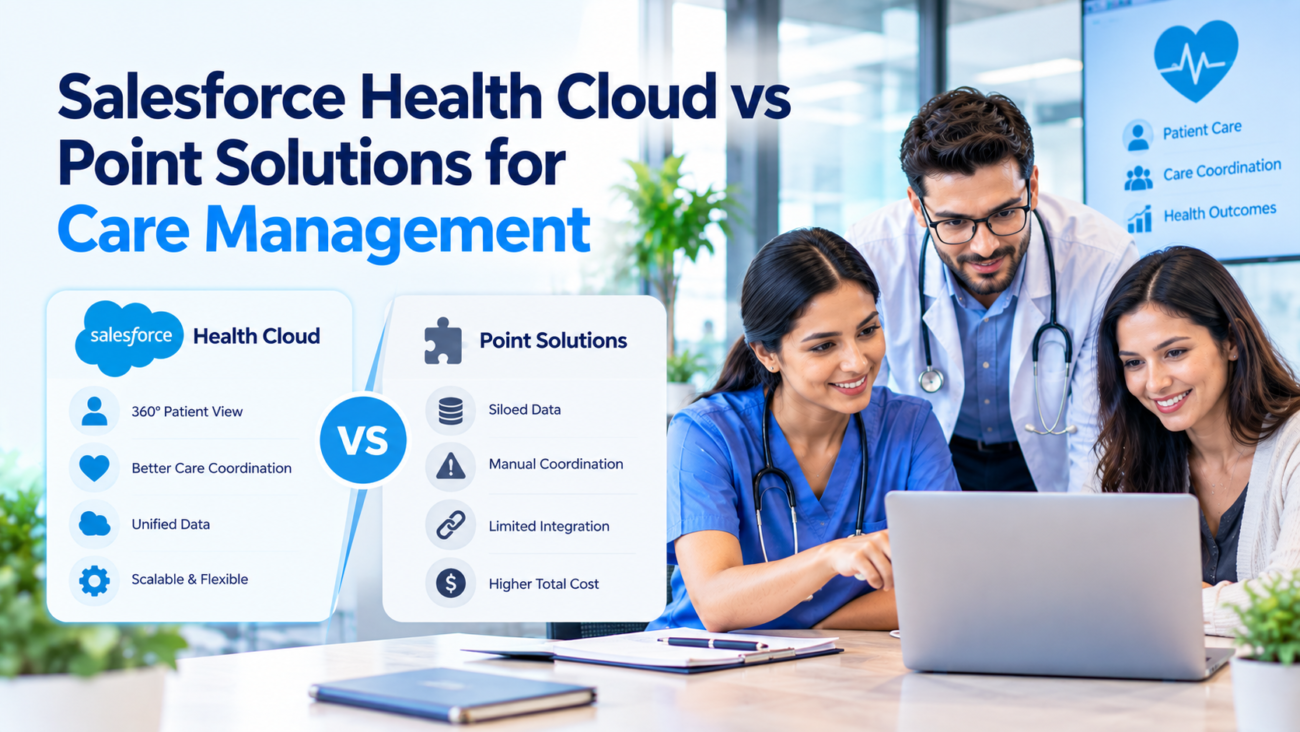
Care management technology decisions are getting harder because the choice is no longer between a basic CRM and a specialist clinical tool. Health systems and payers can now buy broad care platforms that handle care plans, assessments, care gaps, referrals, outreach, and member or patient service. At the same time, specialist vendors keep building focused products for diabetes, behavioral health, remote monitoring, oncology, medication support, and other narrow use cases.
That creates a different buying problem. The question behind Salesforce Health Cloud vs point solutions is whether the organization needs one shared care-management layer across programs or deeper capability for a specific workflow. The answer affects integration work, staff experience, vendor count, data ownership, and the long-term cost of change.
Salesforce Health Cloud has expanded far beyond contact management. Its current health data model includes care plans, care gaps, clinical encounters, claims, medications, social determinants, remote monitoring, utilization management, and other healthcare records. That breadth makes Salesforce Health Cloud care management a serious platform option, but breadth alone doesn’t make it the right choice for every program.
Point solutions still earn their place when they solve a narrow clinical or operational problem better than a broader platform can. The real comparison is therefore about architecture and workflow fit. A shared care platform should reduce handoffs around the patient or member. A specialist tool should earn its place by adding enough depth to justify another product, another integration, and another support path.
TL;DR
· Choose Health Cloud when several care programs need a shared patient or member view and common workflows.
· Choose a point solution when one use case needs deeper clinical logic or specialist workflow support.
· Compare the full care journey rather than feature counts.
· Include integration effort, user switching, data ownership, and ongoing administration in the cost model.
· A hybrid model often works when Health Cloud coordinates care and a specialist product supplies narrow clinical depth.
Why This Choice Matters More In 2026
Care management teams are being asked to coordinate more information across more systems. A care manager may need clinical history from the EHR, claims from a payer system, medication information, referral status, social needs, outreach history, device readings, and program enrollment data. The technology problem isn’t simply storing those records. The harder problem is deciding where work happens and which system becomes the daily operating layer.
Salesforce Health Cloud care management addresses that coordination problem by bringing healthcare records and service workflows into the Salesforce platform. Salesforce describes Integrated Care Management as a way to create enhanced care plans from assessments and clinical data, with support for problems, goals, interventions, care barriers, and related care activities. This gives organizations a broad foundation that can serve several programs instead of building a separate workflow for each condition.
The market is also dealing with the cost of tool growth. A 2026 paper in *Frontiers in Digital Health* describes point solution fatigue as the administrative burden created when purchasers must vet and manage many digital health products. The paper also warns that condition-focused tools can fragment care when they don’t connect well with care-management platforms, claims systems, EHRs, or care teams.
That doesn’t make care management point solutions a bad choice. It means they now need a stronger business case. A specialist application should do something important enough to justify the added connection, governance, and support work. If its main features can be handled inside an existing healthcare care management platform, another standalone tool may increase complexity without adding much value.
The timing also matters because health data exchange requirements keep moving. Payers and providers are under pressure to make information easier to exchange through standards-based APIs. That raises the value of systems that can fit into a broader interoperability plan instead of creating another isolated data store.
What Salesforce Health Cloud Covers In Care Management
Salesforce Health Cloud care management is built around a connected set of care records rather than a single case-management screen. The Integrated Care Management data model links care plans to health conditions, goals, interventions, care barriers, tasks, assessments, clinical measures, and care gaps. It can also connect those records to broader Salesforce service and engagement workflows.
Salesforce’s current Care Orchestration documentation groups Integrated Care Management with referral management, home health, social determinants, virtual care, medication management, assessments, document work, and system connections. That matters because many care-management programs fail at the handoffs between those functions rather than inside one individual task.
A common example is a patient who leaves the hospital and needs follow-up. The care manager may need to review discharge information, identify open care gaps, complete an assessment, create a care plan, address transportation barriers, schedule a referral, and track whether the patient completed the next visit. In Health Cloud, those activities can be represented around the same patient record and routed through related workflows.
The platform model also helps when the same person belongs to more than one program. Someone with diabetes may also have hypertension, medication adherence issues, and a social barrier that affects appointment attendance. A shared healthcare care management platform can give the care team one place to coordinate those issues rather than splitting the person across several condition-specific applications.
This doesn’t mean Health Cloud should replace every clinical system. The EHR will often remain the main source for clinical documentation and orders. Claims platforms, pharmacy systems, and device platforms may also remain authoritative for their own data. Health Cloud is more useful when it acts as the care-coordination and engagement layer around those systems.
That distinction should guide the buying decision. If the organization mainly needs a common operating layer across care programs, Health Cloud has a strong fit. If the requirement is a narrow clinical process with complex domain logic, a point solution may still be the better tool.
What Care Management Point Solutions Do Better
Care management point solutions are usually built around one problem or one population. Their strength is focus. A product designed for one disease, one type of monitoring, or one care pathway can spend more of its product effort on that workflow than a broad platform can.
That depth can appear in several ways. A specialist product may include condition-specific assessments, proprietary scoring, clinical content, device connections, patient coaching methods, or alert logic built for one program. It may also have a user experience designed around a particular type of care team rather than a general case-management model.
McKinsey’s discussion of modular healthcare architecture explains why focused tools keep gaining adoption even as organizations push for more connected platforms. Narrow applications can solve tactical workflow problems quickly, while broader architecture is needed to keep those tools from becoming separate islands.
Speed can also favor a point solution. If a health plan needs a mature diabetes coaching program and a specialist product already has the needed content, device integrations, member experience, and reporting, buying that product may be faster than configuring the same depth from scratch in Health Cloud. A healthcare care management platform gives flexibility, but that flexibility still requires design and implementation work.
The key is to separate true specialist depth from feature packaging. Some care management point solutions look differentiated because they have a polished user interface or a prebuilt workflow. If the same workflow can be built with existing platform capabilities without heavy custom work, the extra vendor may be difficult to justify. The specialist product should solve a hard problem, not merely present a familiar process in another screen.
Point solutions also carry concentration risk. If a critical workflow lives in one niche vendor, the organization depends on that vendor’s product roadmap, integration behavior, support model, and financial stability. That can be acceptable when the clinical value is high. It becomes harder to defend when the product overlaps with functions already available in the main care-management environment.
Salesforce Health Cloud Vs Point Solutions: Core Differences
The most useful comparison starts with operating model rather than brand preference. Salesforce Health Cloud vs point solutions comes down to whether care should be coordinated through a shared platform or managed inside separate specialist products.
| Decision Area | Salesforce Health Cloud | Point Solution |
| Primary strength | Cross-program care coordination | Deep support for a narrow workflow |
| Patient or member view | Broad shared record | Usually centered on one program |
| Care plans | Shared plan model across programs | May be deeper for a specialty |
| Assessments | Configurable across workflows | May include specialist content |
| Care gaps | Can support common gap workflows | Often focused on condition-specific logic |
| Outreach | Connected with Salesforce service and engagement | Usually tied to the product’s use case |
| Integration burden | Requires core system connections | Adds another vendor connection |
| Implementation speed | More setup for broad use | Can be faster for one narrow program |
| Change ownership | Needs Salesforce platform skills | Depends on vendor product model |
| Vendor count | Can consolidate functions | Increases with each added product |
The first major difference is scope. Salesforce Health Cloud care management can connect care coordination with service cases, referrals, outreach, care plans, and other healthcare records. A point solution is more likely to go deeper inside a single use case.
The second difference is where the user works. If care managers spend most of their day in Health Cloud, a specialist product that requires a separate login creates another handoff. That handoff may be worth it when the product adds real clinical depth. It becomes a burden when users must copy notes, chase updates, or manually reconcile tasks between systems.
The third difference is change. A shared care platform gives the internal team more control over workflows, automation, and data relationships. A point product gives the vendor more control over product changes. Buyers should decide which model fits their internal skills and governance.
There is no universal winner in Salesforce Health Cloud vs point solutions. The same Salesforce Health Cloud vs point solutions decision can produce different answers for different programs. The right answer depends on the care journey, the depth of the specialist requirement, and the cost of keeping multiple systems synchronized.
Where Health Cloud Has The Stronger Case
Health Cloud has the stronger case when care needs to cross teams and programs. That is especially true when the same patient or member may move through referrals, assessments, care plans, service requests, outreach, and follow-up without a clean boundary between departments.
Care gaps are a good example. Salesforce’s care gap workflow lets care managers evaluate clinical measures, identify missing care, and create care plans from open gaps. The value isn’t only the care-gap record. The larger benefit is that the gap can sit within the same workflow used for care plans, tasks, and patient engagement.
Assessments work in a similar way. Salesforce uses Discovery Framework and OmniStudio to collect structured responses. Its assessment framework can map answers to care-plan recommendations such as problems, goals, or interventions. That gives teams a way to connect intake information with the next care action rather than leaving assessment results in a separate form system.
Health Cloud is also attractive when several business units already use Salesforce. The organization may already have identity, case management, digital engagement, reporting, or integration patterns in place. Extending that environment can reduce the number of systems the care team has to learn and support.
Another advantage is cross-program visibility. If a member is in a maternal health program and later enters a behavioral health or chronic-disease program, the organization can keep shared service history and related care information in one platform. That can reduce duplicate outreach and conflicting tasks.
Salesforce Health Cloud integration also becomes more useful when the organization wants one place to coordinate data from the EHR, claims platform, contact center, and other systems. The platform still needs interfaces, mapping, and governance, but it can give care managers a common work layer over those sources.
Health Cloud is less compelling when the organization only needs one narrow program and has little reason to connect that work to other Salesforce processes. A broad platform can become expensive if the business uses only a small part of it. The case is strongest when several care workflows can share the same foundation.
Where Point Solutions Still Win
A point solution wins when specialization matters more than consolidation. That usually means the product has clinical or operational capability that would be difficult to reproduce inside a general healthcare care management platform without significant custom work.
Remote patient monitoring shows the difference. Health Cloud can support remote monitoring and present biometric measures around the patient record. Salesforce’s remote monitoring documentation describes charts for data such as heart rate, blood glucose, and weight, along with care metrics and follow-up triggers. That may be enough for some programs.
A specialist remote-monitoring platform can still be the stronger choice if the program depends on a specific device ecosystem, advanced alert rules, specialized clinical protocols, device logistics, or patient coaching that goes well beyond what the broader platform offers. The same reasoning applies to oncology navigation, behavioral health, musculoskeletal care, or other focused programs.
Care management point solutions can also make sense when the organization needs to start one program quickly. A mature product with predefined workflows and content may reach production sooner than a broader platform project. That speed has value when the care model is stable and well understood.
In Salesforce Health Cloud vs point solutions, the buyer should still test what happens outside the specialist workflow. Where do tasks go when the point solution detects a problem? Can the main care team see the result without opening another application? Does the tool write information back to the EHR or healthcare care management platform? Can patient outreach be coordinated with other programs?
Those questions are important because a strong product can create weak system-level operations. A tool may perform its own task well while forcing staff to reconcile data manually across the rest of the care environment.
The specialist product should therefore be judged on 2 levels: how well it handles its core use case and how well it fits the larger care-management model. A point solution that scores high on the first and low on the second may still be worth buying, but the integration and operating burden must be visible in the decision.
Care Plans, Care Gaps, And Assessments Need Deeper Comparison
For Salesforce Health Cloud vs point solutions, feature labels can hide major differences. Two systems may both claim to support care plans, yet one may provide a simple task list while the other supports detailed clinical structures, templates, goals, interventions, barriers, and links to assessments.
Health Cloud’s Integrated Care Management uses an FHIR R4 and USCDI-aligned model. Salesforce states in its care plan model that the data structure supports care plans, health conditions, goal assignments, interventions, care barriers, care gaps, and related records. Users need the Care Plans Access permission set license for this functionality.
That structure gives Salesforce Health Cloud care management a useful base for organizations that want common care-plan logic across several programs. A care plan can represent the patient or member’s problems, goals, and planned actions without tying the entire model to one disease.
A care management point solution may still have more useful content for a specific specialty. For example, it might arrive with validated questionnaires, condition-specific pathways, or rules developed around one care model. The question is whether those assets are materially better than what the organization can configure in Health Cloud.
The same comparison applies to care gaps. Health Cloud can create care gaps from clinical measures and then use those gaps in care planning. A point product may provide more advanced or proprietary logic for a single condition. Buyers should ask how that logic is maintained, who validates it, and how results enter the wider care workflow.
Assessments deserve the same attention. A general healthcare care management platform gives flexibility to build different assessments. A specialist tool may offer less flexibility but stronger prebuilt content. Neither model is automatically better. The right choice depends on whether the organization values reusable platform control or specialist clinical content more.
A useful test is to take one real care pathway and model it in both options. Compare the steps from assessment through care-plan creation, outreach, escalation, documentation, and closure. That reveals the actual work better than a feature matrix.
Interoperability And The EHR Question
The EHR usually remains central to clinical care, so Salesforce Health Cloud vs point solutions should never be evaluated as if either option operates alone. Salesforce Health Cloud vs point solutions is therefore also an interoperability decision. Both models need a clear relationship with the clinical record and other source systems.
Salesforce Health Cloud integration is built around healthcare data models and APIs. The Healthcare API uses FHIR-aligned endpoints and includes modules for care management, clinical summaries, medications, prior authorization, and other healthcare data. That creates a standards-based route for exchanging information, but the organization still has to build, test, and govern the connection.
FHIR alignment matters because care plans are part of a broader interoperability model. HL7’s CarePlan resource represents how practitioners intend to deliver care for a patient or group over time. Using common structures can reduce custom mapping, though standards alignment doesn’t remove the need to decide which system owns each field and process.
The regulatory direction also favors stronger exchange. CMS’s interoperability final rule requires affected payers to meet certain operational requirements beginning in 2026, with major API requirements generally starting in 2027. Those APIs cover areas such as patient access, provider access, payer-to-payer exchange, and prior authorization.
The data standard itself continues to move. ONC published USCDI Version 7 in July 2026, continuing the national effort to define data classes and elements for interoperable health information exchange. That doesn’t mean every care-management system must store every USCDI element. It does mean architecture decisions should account for a future in which more health information moves through standardized exchange.
Point solutions vary widely here. Some expose strong FHIR APIs and write data back into enterprise systems. Others depend on flat files, custom feeds, or manual work. A care management point solution should be evaluated as part of the interoperability architecture, not as a standalone purchase.
The best design often leaves the EHR as the clinical source of record while the healthcare care management platform coordinates cross-system work. Specialist tools can plug into that model when they contribute data or functions that the platform doesn’t provide well. The ownership rules must be explicit so staff know which system holds the authoritative version of each record.
The Real Cost Is Bigger Than License Price
License cost is visible, but operating cost usually decides whether the architecture holds up. Buyers comparing Salesforce Health Cloud vs point solutions should model at least 3 years of ownership rather than comparing a per-user rate with a point-solution subscription.
Salesforce’s current public US Health Cloud pricing lists Sales & Service Core at $350 per user per month and Sales & Service Advanced at $525 per user per month, billed annually. Higher Max editions are also listed. Public license prices don’t include the full cost of implementation, interfaces, data migration, change management, or internal administration.
A Health Cloud program may need Salesforce Health Cloud integration with the EHR, claims data, identity services, contact-center tools, and other systems. It also needs workflow design, permissions, testing, release management, and staff who can maintain the platform after go-live.
Point solutions can look cheaper because implementation is narrower. That advantage can disappear as the number of tools grows. Each new vendor may add procurement work, security review, legal review, interface maintenance, user provisioning, reporting differences, and another renewal cycle.
The cost model should therefore include:
· Software and add-on licenses.
· Implementation and configuration work.
· Interface development and maintenance.
· Data migration and historical-data access.
· User training and support.
· Internal platform or vendor-management staff.
· Security and compliance review.
· Release testing and change work.
· Contract renewals and vendor exit costs.
Avoid comparing only the first-year project. A healthcare care management platform may cost more at the start but support several programs on one foundation. Care management point solutions may be cheaper for one program but become expensive as the portfolio grows.
The opposite can also happen. If only one specialist workflow is needed, a broad Health Cloud program may create more platform work than the organization can justify. Cost should follow the care model rather than drive the architecture before the workflow is understood.
When A Hybrid Model Makes More Sense
Many organizations won’t end up choosing one side of Salesforce Health Cloud vs point solutions. In practice, Salesforce Health Cloud vs point solutions often becomes a hybrid architecture question. A hybrid model can work when Health Cloud handles shared coordination while specialist products handle the narrow work they do best.
In this model, Salesforce Health Cloud care management can hold the shared care-plan context, cases, outreach history, referrals, tasks, and patient or member service activity. A specialist product can handle a deeper workflow such as remote monitoring, behavioral-health coaching, or a condition-specific clinical program.
The design only works if responsibilities are clear. The team should decide where eligibility is calculated, where enrollment is stored, which system creates alerts, who owns outreach, where care-plan updates are recorded, and how status flows back to the main care-management layer.
Salesforce Health Cloud integration becomes the key discipline in a hybrid model. Salesforce Health Cloud integration should move only the information needed for coordination. The goal isn’t to move every specialist data element into Salesforce. The goal is to move the information required for coordination. A care manager may need to know that a patient triggered a critical alert and that follow-up is due. They may not need every device reading stored twice.
A hybrid model also reduces the pressure to force every clinical use case into one platform. That can help avoid heavy custom development. At the same time, it avoids letting every department buy isolated software without a shared operating model.
The governance rule should be simple: a care management point solution must define what unique value it adds, what data it exchanges, who supports it, and how it fits the main patient or member workflow. If those answers are weak, the organization should question whether the extra tool is needed.
A Buyer Checklist For Choosing The Right Model
The decision should start with a care journey, not a vendor demo. Pick one high-volume or high-risk workflow and map it from the first trigger through closure. Include every system touch, every role, and every handoff.
Then ask the same questions for Health Cloud and each specialist alternative.
Workflow Fit
Can the product support the actual sequence of assessment, care planning, outreach, referral, escalation, and follow-up? Where does a user have to leave the main workflow? Which steps require custom development or manual entry?
Clinical Depth
Does the use case depend on condition-specific clinical logic, scoring, protocols, or device behavior that a general platform doesn’t provide? If yes, test whether the specialist depth is essential or merely convenient.
Data And Integration
Which systems provide the source data? Which system owns the care plan? Can updates move through standards-based interfaces? How much Salesforce Health Cloud integration or vendor-specific connection work will be required?
User Experience
Count logins, screens, duplicate documentation, and context switches. Ask care managers to walk through realistic cases. A strong technical design can still fail if staff have to reconcile the same patient across several interfaces.
Governance
Who controls workflow changes? Who reviews access? Who monitors interfaces? Who owns vendor incidents? Who decides when a new care management point solution can be added to the environment?
Cost Over Time
Build a 3-year model. Include software, implementation, support, integration, internal staffing, and expected change work. Compare the cost per program as the number of programs grows.
Exit And Change Risk
Ask how data can be exported, what happens if the vendor contract ends, and how workflows are transferred. A specialist application may be easy to buy but difficult to unwind if it becomes deeply embedded in patient operations.
The buyer should score the options against these questions rather than asking which product has the longer feature list. Salesforce Health Cloud vs point solutions is an operating-model decision. The system that best fits the real care journey will usually produce the clearest answer.
Conclusion: Choose The Architecture That Matches The Care Model
The best choice depends on where the complexity sits. Salesforce Health Cloud is stronger when the organization needs cross-program coordination, a shared patient or member view, common care plans, integrated outreach, and one place to manage work across several healthcare processes. A point solution is stronger when one clinical or operational workflow needs specialist depth that would be difficult to reproduce inside a broader platform.
The decision should also account for the cost of fragmentation. Every specialist product adds another relationship, another data path, and another operating dependency. That extra burden can be justified when the product adds meaningful clinical or workflow value. It becomes harder to justify when the functionality overlaps with the existing care-management environment.
For organizations already using Salesforce, Salesforce Health Cloud care management can provide a common layer for care coordination while the EHR and other source systems keep their core roles. Salesforce Health Cloud integration then becomes the mechanism that connects those systems rather than an attempt to replace them.
A hybrid model is often reasonable. The platform can coordinate the patient journey while care management point solutions handle narrow areas where they offer clear depth. The important part is to define ownership and data exchange before adding another tool.
That is the practical answer to Salesforce Health Cloud vs point solutions: choose the broad platform when coordination is the hard problem, choose the specialist product when clinical depth is the hard problem, and use both only when the value of specialization is greater than the cost of another system.
FAQs
What Is The Main Difference Between Salesforce Health Cloud And A Care Management Point Solution?
Salesforce Health Cloud is a broad healthcare platform that can connect care plans, service workflows, assessments, referrals, outreach, and other patient or member records. A point solution usually focuses on one condition, population, or workflow. The practical difference is breadth versus specialist depth.
Is Salesforce Health Cloud A Care Management Platform?
Yes. Health Cloud includes Integrated Care Management and related healthcare data models for care plans, care gaps, assessments, care barriers, goals, interventions, and other coordination work. The exact fit still depends on the organization’s workflows and edition or license requirements.
Can Salesforce Health Cloud Replace An EHR?
Health Cloud generally fits better as a care-coordination and engagement layer around the EHR rather than as a replacement for the clinical record. Most organizations still need the EHR for core clinical documentation, orders, and other clinical functions.
When Is A Point Solution Better Than Health Cloud?
A point solution can be better when one program needs deep specialist capability such as condition-specific clinical logic, proprietary assessments, device behavior, or a mature workflow that would require substantial custom work in Health Cloud.
What Is Point Solution Fatigue In Healthcare?
Point solution fatigue describes the burden created when an organization has to buy, integrate, govern, monitor, and renew many separate digital health products. It can also create more work for care teams when patient information is split across several systems.
Does Health Cloud Support Care Plans?
Yes. Integrated Care Management supports enhanced care plans that can include health problems, goals, interventions, barriers, care gaps, and related activities. Care plans can be built from assessments and other patient or member information.
Does Health Cloud Support Care Gaps?
Yes. Health Cloud can evaluate clinical measures and create care gaps when defined criteria aren’t met. Care managers can use open gaps when creating or updating care plans.
Can Health Cloud Support Remote Patient Monitoring?
Yes. Health Cloud supports remote-monitoring data and care metrics such as heart rate, blood glucose, or weight. Whether it is enough for a specific program depends on the device ecosystem, clinical rules, and workflow depth required.
How Important Is FHIR In This Decision?
FHIR matters because both platform and point-solution architectures usually need to exchange clinical and care-management data with other systems. FHIR alignment can reduce some custom interface work, but organizations still need clear data ownership, mapping, testing, and governance.
Does A Point Solution Always Cost Less Than Health Cloud?
No. A narrow product may have lower first-year implementation cost, but buyers should include integration, security review, user administration, vendor management, reporting, support, and renewal work. The total cost can rise as more point products are added.
Is Health Cloud Better For Payers Or Providers?
Health Cloud can support both payer and provider use cases. The choice depends on the care model, source systems, data access, staff workflows, and whether the organization needs broad coordination or a specialist function.
Can An Organization Use Health Cloud And Point Solutions Together?
Yes. A hybrid model can use Health Cloud as the shared coordination layer while a specialist product handles one deep clinical or operational workflow. The model works best when ownership and data exchange are defined before implementation.
What Should Be Compared Before Buying A Care Management System?
Compare workflow fit, clinical depth, integration effort, user experience, total operating cost, security responsibilities, data ownership, change control, and exit risk. Use a real care journey rather than relying only on product feature lists.
How Does Interoperability Affect Care Management Software Selection?
Interoperability affects how easily care teams can use EHR data, claims, referrals, authorizations, device data, and other records in one workflow. A product with strong standalone features can still create operational problems if information can’t move reliably to the rest of the care environment.
Which Option Is Better For A Multi-Program Care Management Team?
A broad platform often has the stronger case when the same team manages several populations or conditions and needs one patient or member view. A point solution can still be added when one program requires specialist depth that the common platform can’t provide efficiently.
