
A mid-market manufacturer running SAP ECC wants to be live on S/4HANA before mainstream maintenance ends on December 31, 2027, and it receives 3 proposals. A certified partner quotes a fixed-price conversion with a defined team and a delivery methodology. An independent architect offers to lead the design for a daily rate. A staffing firm offers 6 consultants on time and materials, to work under the company’s own project manager. All 3 are credible, and their prices can’t be compared line by line, because each 1 transfers a different amount of risk, management effort and accountability to the buyer.
This post compares the 3 delivery models on cost, risk, control and fit, using published 2026 rate guides, SAP program documentation and ERP survey data. The rate figures come largely from staffing and vendor sources that sell these services, and they conflict with each other, so treat them as ranges to test against real quotes. Contractor classification and contract terms vary by jurisdiction, and nothing in this post is legal advice, so involve counsel before signing any engagement.
TL;DR
- The 3 models sell different things, so price alone won’t separate them. A partner sells an outcome backed by methodology, a bench and a contractual commitment, an independent sells senior expertise from 1 person, and staff augmentation sells hours from people who work under your direction, which means the buyer carries delivery risk in the last 2 models. Comparisons that ignore this gap favor whichever model pushes the most work onto you.
- Published 2026 rates overlap heavily. 1 guide lists SAP independents at $150 to $250 an hour, staffing-firm contractors at $130 to $220 and boutique partners at $200 to $325 or more, so the real difference lies in what each rate includes, such as project management, quality assurance, substitution and accountability for the result. Rates also shift with seniority, module, region and contract length, so treat any number as a starting point.
- Most successful programs mix models and write the mix down. A partner for core delivery, an independent for design authority and augmented staff for capacity gaps is a common pattern, and it works when contracts name key people, require knowledge transfer and define who owns each deliverable and each risk. Without that written mix, overlapping duties turn into disputes in the stressful weeks before go-live, when delays cost the most.
Why the Engagement Model Matters More in 2026
The Deadline Compresses the Market Mainstream maintenance for SAP Business Suite 7 core applications ends on December 31, 2027, optional extended maintenance runs through 2030 at an added cost, and 1 planning guide notes that full S/4HANA migrations commonly take 18 to 36 months. Consultant availability tightens as a deadline approaches, and prices tend to follow, which rewards buyers who choose their delivery model early and penalizes buyers who begin shopping once the calendar is already short.
Outcome Data Shows Why Delivery Structure Matters Panorama Consulting’s 2026 ERP report found that more than a quarter of surveyed organizations went over budget and almost a quarter ran over schedule, with a median project timeline of 9 months, and organizational issues were the most common reason for schedule overruns. Other sources cite failure rates of 50% to 75%, which depends on how failure is defined. A secondary summary of Panorama’s 2025 report also claims that 35% of failures involved junior partner staff, a figure worth confirming.
The Model Decides Where Risk Lands Under a partner contract, scope, staffing and delivery commitments sit in a document both sides can enforce, and disputes follow a defined path. Under an independent or staff augmentation arrangement, the buyer typically provides management, quality control and integration across workstreams. None of these arrangements is automatically better, and the right 1 depends on how much management capacity the company has, how well the scope is defined and how much delivery risk the company wants to hold itself.
The 3 Models at a Glance
| Dimension | SAP Partner | Independent Consultant | Staff Augmentation |
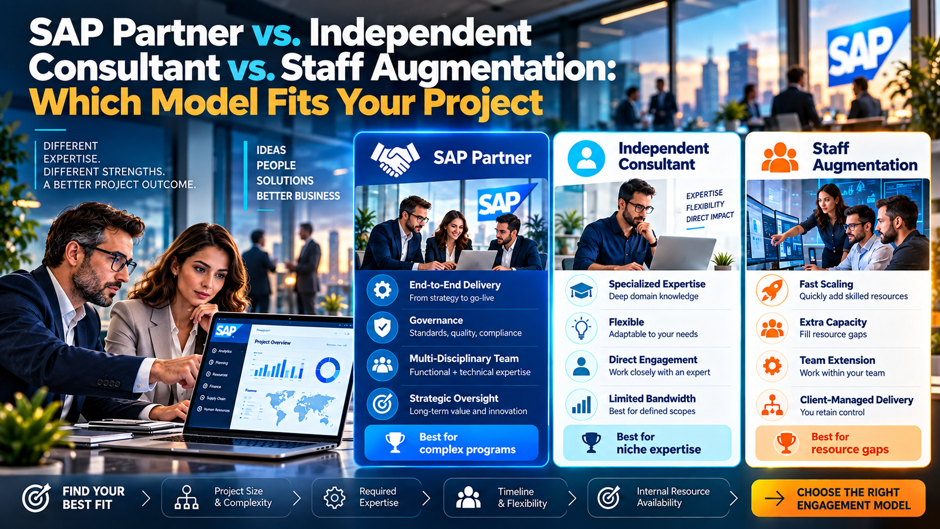
| What you buy | A defined outcome, usually with methodology, a team and project governance | Senior expertise from 1 person | Individual specialists billed by the hour, working under your direction |
| Who carries delivery risk | Shared, with the partner committed through the contract | Mostly the buyer | Mostly the buyer |
| Typical commercial structure | Fixed price, time and materials, capped time and materials or a hybrid | Daily or hourly rate, sometimes a retainer | Hourly or monthly rate plus the provider’s margin |
| Management burden on you | Moderate, since the partner supplies a project manager and quality gates | High for scope and integration, low for the consultant’s own task | Highest, since you assign work, review output and coordinate the team |
| Bench and substitution | Partner replaces people from its bench | None, since the consultant is a single point | Provider replaces people, with quality varying by firm |
| Best fit | Large, multi-module programs with defined scope and a go-live date | Advisory, design authority, specialist fixes and support | Defined skill gaps over 3 months or more on a team you already run |
Reading the table across a row shows that the models differ most on risk and management, and less on raw capability. A strong independent can out-design a mid-tier partner team, and a good staff augmentation provider can place the same people a partner would use. What changes is who has to coordinate them, who answers for the result and what happens when a person leaves the project, and those are exactly the questions a project plan has to answer before any model is chosen.
The SAP Partner Model
- Partners work inside SAP’s program structure, which gives buyers a way to shortlist. SAP’s PartnerEdge program offers 4 engagement models, Build, Sell, Service and Run, and implementation work falls mainly under Service. SAP’s partner directory helps buyers identify consult, implementation and managed-service partners, while directories and program structures give buyers a common vocabulary when comparing proposals from different firms.
- Tier helps with a shortlist and says little about the specific team. 1 guide cautions that partner tier works as a starting filter and doesn’t amount to a definitive quality ranking, which means a buyer still has to verify the named consultants, their certifications and their recent project history before treating a platinum or gold label as proof of a good outcome. Ask for the named team before accepting any tier claim as evidence of quality.
- Methodology and bench depth are where partners earn their premium. Partners typically deliver through SAP Activate, with its Discover, Prepare, Explore, Realize, Deploy and Run phases, plus pre-built templates, certified staff and governance that spans modules, and for a program with finance, supply chain, data migration, testing and cutover running at once, that coordination is worth real money. Without that coordination, buyers often end up paying for it in rework and missed dependencies later.
- The main risks are price, scope disputes and team composition. Partner rates sit at the top of published ranges, fixed-price quotes rest on assumptions that can trigger change orders when requirements shift, and buyers sometimes meet a senior team during the sale and a more junior team during delivery, so named staffing and substitution rights deserve explicit contract language. Naming the team in the contract and requiring approval for substitutions reduces that exposure considerably.
- Ask which commercial model applies and what assumptions sit behind it. Fixed price, time and materials, capped time and materials and hybrids all exist, and a price only means something alongside its assumptions, so request the list of assumptions that can change the fee, the way change requests are priced and the rules for what happens when the buyer’s own team misses a dependency. Written assumptions also make later disagreements about scope far easier to resolve.
The Independent Consultant Model
Senior Expertise at a Rate That Usually Undercuts Partners Many independents left larger firms after years of project work, and a buyer gets that experience directly, without layers of overhead or a junior team behind a senior name. That makes independents especially strong for design authority, solution architecture and troubleshooting a specific module, where depth of judgment matters more than team size, and where the buyer’s alternative is paying a partner’s rate for a person who would have done the same work.
Flexibility and a Fast Start An independent can often begin within weeks, scale hours up or down and work on a narrow problem without a large statement of work or a long procurement cycle. That suits advisory engagements, short stabilization efforts, license and architecture reviews and support for a system that’s already live and stable, since each needs a skilled person for a defined stretch. Speed of onboarding is often the deciding factor when a deadline is close.
Capacity and Key-Person Limits A single person has a fixed number of hours and a fixed set of skills, and large programs usually need several modules, testing, data migration and change management at once. Buyers either engage several independents and coordinate them, or pair 1 with a partner or an internal team. If the consultant becomes unavailable, there’s no bench to replace them, so contracts should require documentation, scheduled knowledge transfer and a notice period before the consultant steps away.
Classification, Insurance and Liability Engaging an individual directly raises worker classification questions in many jurisdictions, and an independent typically carries less liability capacity than a firm. Buyers should check how the engagement is structured, what insurance the consultant holds, who is responsible if a mistake affects production and how losses would be handled, and they should involve legal counsel early, since correcting a classification problem after months of work is slower and more expensive than setting the arrangement up correctly.
The Staff Augmentation Model
Staff augmentation places individual specialists on your team through a provider that handles recruiting, payroll and contracts. One 2026 explainer describes the arrangement simply: augmented staff deliver work as part of your team, under your direction, and pricing is time and materials, an hourly or daily rate for the specialist plus the provider’s margin. A guide to staffing markups puts typical margins at 35% to 65% over the consultant’s pay for W-2 placements, and independent contractor rates at 15% to 25% below equivalent bill rates.
The model fits a company that already has a delivery structure and needs capacity or a specific skill. An internal program manager and architect can direct augmented ABAP, Fiori, BASIS or functional specialists while keeping design decisions and quality control. Regional sourcing widens the options, and 1 explainer lists senior SAP consultant rates of $130 to $185 an hour in the US and Western Europe, $50 to $80 in Poland and Romania, $25 to $55 in India and $40 to $65 in Latin America, with BTP and RAP specialists commanding a 10% to 20% premium.
The tradeoff is that the buyer owns the result. A staffing provider is accountable for supplying qualified people, while the success of the project stays with the buyer, so scope, integration, quality, schedule and knowledge retention all sit with the buyer’s management. Nearshore and offshore blended teams cost less per hour but add coordination effort across time zones, so plan for that management time as a real line in the budget.
What Each Model Costs
| Model | Published 2026 Rate Range for SAP Work | What the Rate Typically Includes |
| Independent consultant | $150 to $250 per hour | The consultant’s time, with no bench, project management or quality assurance |
| Staffing-firm contractor | $130 to $220 per hour | The consultant’s time plus the provider’s margin and recruiting, and replacement if a person leaves |
| Boutique partner or systems integrator | $200 to $325 or more per hour | Team, methodology, project governance, bench depth and delivery accountability |
| Other published figures | Freelancer rates of $65 to $155, with the same consultant billed through a firm at $180 to $240, and a 12-month engagement discounted from about $190 to $150 | Vendor sources that differ in method and region |
These ranges come from staffing and vendor sources that sell these services, and they overlap and sometimes contradict each other. 1 guide adds that SAP contract rates run 30% to 50% above the equivalent full-time hourly rate and that senior solution architects reach $165 to $300 an hour. The practical conclusion is that a rate near the middle of a range doesn’t show whether a model is cheap, since it has to be read alongside what’s included.
Illustrative arithmetic shows how rates scale. A 3-person team working 6 months at about 1,040 hours each totals 3,120 hours. At the low and high ends of the published ranges, that’s $468,000 to $780,000 with independents, $405,600 to $686,400 through a staffing firm and $624,000 to $1,014,000 with a boutique partner. The partner figure includes project management and quality assurance that the other 2 options don’t, so a fair comparison adds the cost of an internal project manager, a test lead and the buyer’s own time for coordination.
Who Is Accountable When Something Slips
- Delivery and scope risk follows the commercial model. In a fixed-price partner contract, the partner has agreed to deliver defined scope for a set fee, so overruns on that scope are largely its problem while changes outside it become change orders. In time-and-materials work the buyer pays for effort regardless of progress, which makes management quality and scope control the buyer’s job. Writing this allocation down at signing prevents arguments when a milestone slips.
- Continuity and knowledge risk depends on the bench. Partners and staffing providers can substitute people, though a replacement needs time to learn the project and quality varies. An independent has no substitute, and knowledge concentrated in 1 person is a risk for any long program, so documentation standards, shared design repositories and scheduled handovers belong in the statement of work. Even strong bench coverage doesn’t remove the ramp-up time a replacement needs.
- Quality and compliance risk sits with whoever runs quality control. Partners usually bring quality gates and testing methodology, while the buyer runs quality for independents and augmented staff. Compliance matters as well, since engaging individuals raises classification questions, and projects that handle regulated data need confirmation of background checks, security practices and access controls from whichever party supplies the people. Naming the quality owner for each deliverable closes a gap that otherwise stays invisible until testing.
- Commercial and exit risk shows up at the end of the project. A partner contract should define transition assistance, the handover of artifacts and rights to project documentation, and an independent or staffing arrangement should specify notice periods, the return of access credentials and ownership of work product, because buyers who skip these terms often discover they depend on a party they can’t easily replace. Cooperation is easiest to secure while the contract is still being negotiated.
Matching the Model to the Project Type
| Project Type | Likely Best-Fit Model | Why |
| Greenfield S/4HANA implementation across several modules | SAP partner | Needs methodology, program governance and a bench across workstreams |
| System conversion with moderate custom code | Partner for core delivery, with independents or augmented ABAP staff for custom code remediation | Core scope needs commitment, and code work is a defined skill gap |
| RISE with SAP migration | Partner validated for RISE | Responsibilities split between SAP, the customer and partners |
| Rollout of an existing template to a new country | Partner or augmented team led by an internal program manager | Repeatable scope suits either, depending on internal capacity |
| Application management and support | Independent, small partner or augmented staff | Work is ongoing, smaller and often per-ticket or per-month |
| Fiori or BTP build for a defined requirement | Independent or augmented specialists | Skill-specific work with a clear specification |
| Architecture review, licensing review or program rescue | Independent advisor | Short, senior and judgment-heavy, with no need for a large team |
| Cutover and hypercare surge | Augmented staff | Temporary capacity directed by the existing team |
This table gives a starting point instead of a rule, because the best-fit model also depends on the buyer’s internal capacity, so treat the table as a prompt for discussion with your own team. A company with an experienced program manager and a strong internal SAP team can run a larger share of the work with augmented staff, while a company that has never run an SAP program usually needs the governance a partner brings.
Hybrid Models in Practice
A Common Mix and Why It Works Most large programs end up with a mix. A partner often leads core implementation, an independent architect serves as the buyer’s design authority and reviews the partner’s work, and augmented developers supply capacity for custom code, data migration or testing surges. The arrangement works because each model covers a different weakness: the partner brings governance and breadth, the independent brings an unbiased senior opinion and the augmented staff bring flexible capacity under the buyer’s direction.
Governance Holds the Mix Together Each party needs a written scope, a named owner for every deliverable, a shared repository for design and test artifacts and a single escalation path, because overlapping responsibilities are the most common source of finger-pointing when a deadline slips. An independent reviewer inside the buyer’s organization, reporting to the program sponsor instead of the partner, gives the sponsor a second view on status and quality that a partner’s own reports can’t provide.
Avoiding Duplicate Effort and Gaps If the partner’s fixed-price scope includes data migration, a separate augmented team shouldn’t also be building migration programs, which is a common source of avoidable cost, and if the independent is reviewing design, the partner’s schedule should include time to respond to review findings. A short responsibility matrix, listing who designs, builds, tests, approves and supports each area, prevents most overlap, and it should be reviewed at each phase gate.
How to Evaluate Each Option Before Signing
Start with the people, since the individuals who do the work determine the result. For a partner, request the proposed team with résumés, certifications and relevant project references. For independents and augmented staff, verify SAP certifications and recent S/4HANA experience in your modules, and ask how long each person is committed to the project. A strong brand name says little about the person who will configure your finance module, and a reference from a similar company is far more informative than a vendor case study.
Next, compare commercial models by their assumptions, since the headline price tells little. Ask whether the offer is fixed price, time and materials, capped time and materials or a hybrid, which assumptions can change it and how change requests are priced, because a low fixed price built on optimistic assumptions can cost more than a realistic quote. Then test the substitution story: ask what happens if a named consultant leaves, how long a replacement takes and who pays for the learning curve, since the answer shows whether a bench is real.
Finally, assess your own capacity honestly. An independent or augmented model pushes management work onto your team, so check whether you have a program manager, a solution architect and a test lead available with real spare capacity. That internal cost belongs in the comparison alongside the vendor’s rate card. Buyers who skip this step often pick the cheapest hourly model, then find that coordination, integration and quality control consumed the savings.
Contract Terms That Protect You
- Name key personnel and control substitution. Contracts with partners and staffing providers should name key personnel, require your approval for substitutions and set a minimum notice period and overlap for handovers, and for independents the contract should include a notice period and a documentation requirement. These terms address the most common complaint about large engagements, which is that the team that won the work isn’t the team that delivers it.
- Require knowledge transfer and documentation as deliverables. Specify the documents each party must deliver, such as configuration workbooks, design specifications, test scripts, data migration rules and custom code documentation, along with scheduled knowledge transfer sessions and acceptance criteria. Treat documentation as a deliverable with an owner and a review date, since it’s the 1 asset that protects the buyer if any individual or firm leaves. Review the documentation at each phase gate instead of waiting for final delivery.
- Define acceptance, warranty and intellectual property. For deliverable-based work, set acceptance criteria and a warranty period in which defects are fixed at no charge, state that the buyer owns custom code, configuration and documentation created for the project, and confirm ownership of any reusable partner assets the project depends on, since ambiguity here becomes expensive when the buyer later changes vendors or supports the system internally. Legal review of these clauses is worth the modest cost.
- Address classification, insurance and confidentiality. For individuals engaged directly, confirm the classification approach with legal counsel, along with insurance coverage, confidentiality obligations and data protection terms. For staffing providers, confirm who employs the consultant, who handles taxes and benefits and what background checks apply, since these details are easy to overlook in the rush to start and they protect the buyer from compliance exposure unrelated to SAP skills. Counsel can confirm the details for your jurisdiction.
- Plan the exit before the start. A partner contract should define transition assistance, the handover of artifacts and rights to project documentation, and an independent or staffing arrangement should specify notice periods, the return of access credentials and ownership of work product, because the end of an engagement is when a buyer most needs cooperation and has the least bargaining power to demand it. Include a realistic transition period so that knowledge isn’t lost in a rush.
Common Mistakes
Comparing Hourly Rates Without Comparing What Each Rate Includes A partner’s rate covers project management, quality assurance and bench depth that an independent or augmented rate doesn’t, so a model that looks cheaper per hour can cost more once the buyer adds an internal project manager, a test lead and the time spent coordinating several parties across the program. A simple spreadsheet that adds internal effort to each quote makes the comparison honest. Ask each bidder to state exactly which management tasks its rate covers.
Buying Staff Augmentation and Expecting an Outcome Augmented staff do the work you direct, and the provider is accountable for supplying qualified people, so a project that needs a committed result with a defined scope belongs in a deliverable-based contract. A time-and-materials arrangement without strong management is a common path to schedule overruns and budget surprises that surface late in the project, when they’re hardest to fix. Matching the contract type to the outcome you need avoids most of these disputes.
Relying on a Single Independent for a Program-Sized Scope An independent can be an outstanding architect, but 1 person can’t cover a multi-module program, and the key-person risk is large. Pair an independent with a team or limit the scope to advisory and design authority roles where the model’s strengths apply and its weaknesses matter less, which is how many successful programs use independents. Teams that ignore this limit usually discover it when the consultant’s calendar fills up or when they become unavailable mid-project.
Assuming Partner Tier Guarantees Team Quality A platinum or gold designation helps a buyer build a shortlist, though it doesn’t guarantee that the people assigned to a specific project are the best available. Verify the named team, their certifications, their recent project history and their references before signing anything, and ask how long each named person is committed to the project. A short call with the proposed lead consultant often reveals more than a tier badge or a brochure.
Starting the Search Too Late Consultant availability tightens as the 2027 maintenance deadline approaches, and a late start narrows options and weakens the buyer’s bargaining position. Buyers who choose models and begin conversations early have more choices on both price and talent, and more time to check references properly and negotiate terms without a deadline forcing the decision. Early conversations also make it easier to compare several options side by side, check references and negotiate without pressure.
A Simple Decision Framework
| Question | Points Toward a Partner | Points Toward an Independent | Points Toward Staff Augmentation |
| How well defined is the scope | Clear scope with a firm deadline and a fixed or capped price | Narrow scope or advisory work with an open end | Defined skill gap inside a larger plan you already run |
| How much management capacity do you have | Limited capacity, so the vendor supplies governance | Enough capacity to define and review a single consultant’s work | Strong internal program and architecture leadership |
| How large is the program | Multi-module, cross-functional and long | Small, specialist or senior and judgment-heavy | Any size, as long as you can direct the added people |
| How much risk do you want to hold | Less, with delivery commitments shifted to the vendor | More, in exchange for senior expertise and flexibility | Most, since the provider only supplies people |
| How tight is the timeline | Tight, with a bench ready to start together | Moderate, with a fast start for a narrow task | Flexible, with capacity added as the plan requires |
A practical way to use the table is to answer each question for your own project and count which column fits most rows. Scoring each question from 1 to 5 for each model produces a rough ranking that’s often clearer than any rate comparison, though the scores are judgments that the program sponsor, finance partner and technical lead should debate. The goal is to make the allocation of risk, management and cost explicit before contracts are signed.
The result is frequently a hybrid, and that’s a sound outcome. Buyers who write down which party owns each deliverable, who reviews it and who pays if it slips tend to see fewer surprises than buyers who choose a model on price and sort out accountability later, and they spend less time in difficult conversations during the final months before go-live. Revisit the decision at each phase gate as needs change.
FAQs
Which model is cheapest for an SAP project?
There’s no single answer. Published 2026 ranges show independents at about $150 to $250 an hour, staffing-firm contractors at $130 to $220 and boutique partners at $200 to $325 or more, but those rates include different things. Independents and augmented staff usually require the buyer to supply project management and quality assurance, so total cost depends on internal effort and project risk as much as hourly price.
When should a company choose an SAP partner over independents?
A partner makes sense for large, multi-module programs with a firm go-live date, limited internal management capacity or a need for contractual accountability. The methodology, bench and governance a partner provides matter most when many workstreams must align. Partners also suit RISE with SAP programs where responsibilities are divided between SAP, the customer and implementation partners, and where clear accountability reduces disputes.
What are the biggest risks of hiring an independent SAP consultant?
Key-person dependency is the largest risk, since there’s no bench and the knowledge sits with 1 individual. Capacity is the second, because a single person can’t cover a large program. Buyers should also address classification, insurance and liability questions. Contracts should require documentation, scheduled knowledge transfer and a notice period so the project can continue if the consultant becomes unavailable.
How is staff augmentation different from hiring a consulting firm?
Augmented staff work as part of your team under your direction, and you’re responsible for assigning tasks, reviewing output and coordinating the work. A consulting firm engaged for a defined scope takes responsibility for delivering that scope with its own management. Staffing providers are accountable for supplying qualified people, so the buyer carries delivery risk and needs the management capacity to run the team. That distinction matters most when a project has a firm deadline and a defined scope.
Can a company combine all 3 models on 1 project?
Yes, and many large programs do. A partner might lead core implementation, an independent architect might act as the buyer’s design authority and augmented developers might supply capacity for custom code or testing. The arrangement works when scopes are written down, each deliverable has a named owner, artifacts live in a shared repository and there’s a single escalation path for disputes. Reviewing the arrangement at each phase gate keeps the responsibilities accurate as the project changes.
How much does the 2027 ECC deadline affect the choice?
It adds urgency and cost pressure for many buyers. Mainstream maintenance for ECC 6 ends December 31, 2027, extended maintenance runs through 2030 at an added cost, and migrations commonly take 18 to 36 months. Consultant availability tightens as the date approaches, so companies that choose a model and begin conversations early have more options on both talent and price, and more time to build a hybrid team. Early planning also gives more time to check references and negotiate.
What should be in a statement of work for any of these models?
Include named key personnel with approval rights over substitutions, defined deliverables with acceptance criteria, documentation and knowledge transfer requirements, a warranty period, ownership of custom code and project assets, and exit and transition terms. For individuals and staffing providers, add classification, insurance, confidentiality and background check provisions that match your legal and security requirements. Counsel should review these provisions before signature.
How should we verify an SAP consultant’s qualifications?
Ask for the consultant’s SAP certifications, recent project experience in your modules and S/4HANA version, and at least 2 references from engagements of similar scope. A short technical conversation led by your own architect or a trusted independent reviewer reveals depth faster than a résumé. For partners, verify the named team along with the firm’s tier and brand. Checking recent project dates matters because older S/4HANA experience may predate current methodology and tooling.
