
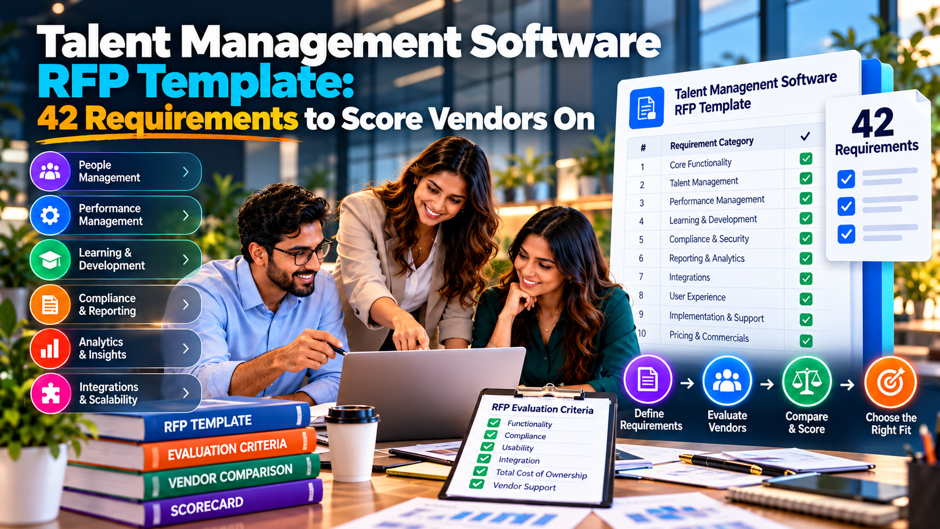
A people team sends a 140-question spreadsheet to 8 vendors and gets back 8 answers that all say yes. Every product supports calibration, every product has an API, every product is secure and every product is easy to use, and the team can’t tell the vendors apart. 3 months later the scoring meeting turns into an argument about which demo felt best, because the questions asked whether a feature existed and never asked for evidence of how well it works, how it’s secured or what it costs to keep running.
This template fixes that with 42 requirements in 6 categories of 7, each paired with a question to ask and the evidence that earns a high score. It also gives a 0 to 5 scoring scale, category weights, gating rules, a worked scoring example, a process timeline and a list of mistakes. Treat it as a starting point that you trim and adapt, since no company needs every line. Regulatory points come from public legal summaries and may change, so confirm them with counsel before relying on them.
TL;DR
- Use 42 requirements in 6 categories and score evidence, not claims. The categories are core talent capabilities, data and integration, security and privacy, AI and analytics, experience and adoption, and vendor and commercial terms, each with 7 requirements, a 0 to 5 scale and gating rules, so a vendor must show the capability in a live demo, a document or a reference instead of saying yes in a cell. Score unsupported claims as 1.
- AI rules now belong in the RFP. Public legal summaries report that EU AI Act obligations for high-risk employment systems now apply from December 2, 2027, that New York City’s Local Law 144 has required annual bias audits since July 2023 for covered hiring and promotion tools, and that Colorado’s rules were reset to January 1, 2027, so ask every vendor to disclose and document its AI features. Confirm each rule with counsel.
- Set the weights before you read the responses. In the worked example, 2 vendors land 0.03 apart on 1 weighting and the order reverses on another, so agree on weights with HR, IT, security and finance first, and use scripted demos, references and a paid pilot to settle close results. Record the reasons for the weights in writing so the final ranking can be explained to stakeholders and vendors alike.
How to Use This Template
Start by deleting what you don’t need. A company that has no compensation module in scope can drop requirement 7, and a company with no operations outside 1 country can shorten requirement 13. Keep the 6 categories and keep the structure of each row: a requirement, a question and the evidence that earns a high score. Then set weights, mark the gating requirements and issue the RFP as a spreadsheet where each vendor answers in a fixed format, such as a score of fully meets, partially meets or road-map, plus a link or attachment.
The point of the format is to turn claims into evidence. Ask for a document, a demonstration or a customer reference for every line that matters, and tell vendors in the cover note that unsupported yes answers will be scored 1. Ask them to mark each answer as standard, configured, custom or road-map, because the difference changes cost and risk. Scoring then becomes a matter of reading evidence, and the group can spend its meeting time on the few lines where reviewers disagree.
Scoring Scale, Weights and Gating Rules
| Score | Meaning | Evidence Needed |
| 0 | Not offered | Vendor states no capability |
| 1 | Roadmap or claim only | Statement without a demo or document |
| 2 | Partial or workaround | Demonstrated with limits, or requires custom work |
| 3 | Meets the requirement | Live demo or documentation that matches the question |
| 4 | Meets well | Demo plus a reference or document showing it works at your scale |
| 5 | Exceeds and is verified | Demo, document and 2 references, with no material gaps found |
Suggested category weights are 25% for core talent capabilities, 15% for data and integration, 20% for security and privacy, 10% for AI and analytics, 15% for experience and adoption and 15% for vendor and commercial terms, summing to 100%, and you should adjust them to your priorities. Mark a short list of requirements as gates that a vendor must pass regardless of score, such as single sign-on, a current SOC 2 Type II or equivalent report, a data protection agreement and data export rights.
Why Evidence Beats Claims in Scoring
Vendors respond to RFPs with marketing language, and a scoring sheet built on yes and no rewards the vendor that writes the most confident answers. Evidence changes the incentives. A demo with your data shows how many clicks a task takes, a document shows what’s covered and a reference shows what happens 9 months after go-live. Ask the same scripted scenarios of every vendor, record the sessions and have at least 3 reviewers score independently before any group discussion, so a persuasive presenter can’t sway the room.
Independent scoring also exposes where requirements are unclear. When reviewers give the same vendor a 2 and a 5 on 1 line, the cause is usually an ambiguous question or a demo that skipped the point, and fixing it before the final round is cheaper than debating it afterward. Keep a short log of questions asked of vendors during the process, and share answers with all bidders, since a clarification given to 1 vendor but not the others can undermine the fairness of the result and any later negotiation.
Core Talent Capabilities: Requirements 1 to 7
| Requirement | What to Ask Vendors | Strong Evidence |
| 1. Review cycle configuration | Can we run annual, semiannual and project-based reviews with different templates, scales and workflows by group? | Live setup of 2 templates and a customer using several cycle types |
| 2. Goals and OKR alignment | Can goals cascade from company to team to individual, with check-ins and links to reviews? | Demonstrated cascade with a sample hierarchy and an alignment report |
| 3. Continuous feedback and 1:1 tools | How do managers record notes, share feedback and track actions, and what do employees see? | Walkthrough of a 1:1 with agenda, notes, actions and privacy settings |
| 4. Calibration and talent review | How do calibration sessions, rating distributions and 9-box views work, and is every change logged? | Calibration demo with change history and distribution charts |
| 5. Succession planning | Can we mark critical roles, name successors with readiness ratings and see bench strength by function? | Bench strength report from sample data with access controls on sensitive views |
| 6. Development planning and skills | How are development plans, skills and stretch assignments captured and linked to goals and learning? | Plan tied to a skill gap and an export of plan data |
| 7. Compensation and merit links | If in scope, how do ratings flow to merit and bonus planning with budgets and approvals? | Merit cycle demo with budget controls and an approval audit trail |
Data, Integration and Architecture: Requirements 8 to 14
8. HRIS integration. Ask which HR systems have native connectors, which fields sync, how often and how conflicts are resolved when the HR system and the talent platform disagree. A strong answer includes a connector for your system with a documented field map, a stated sync frequency and a customer reference running the same pairing. Treat a custom build as a cost and a risk, and ask who maintains it when either vendor changes its interface.
9. Single sign-on and provisioning. Ask whether the product supports SAML or OpenID Connect for sign-in and SCIM or an equivalent for automatic user creation, updates and removal. Strong evidence is a configuration walk-through, documentation of supported identity providers and a description of what happens to a person’s data when they leave. This is a common gate, since weak provisioning produces orphaned accounts and access that outlasts employment, which creates security and audit problems.
10. Open API. Ask for API documentation, authentication methods, rate limits, web-hook support and a list of objects that can be read and written. A strong response includes public documentation, a sandbox key for your team to test and examples of customers who built reports or workflows on the API. Ask how the vendor announces breaking changes and how long old versions remain supported, because integration’s break when interfaces change without notice.
11. Data export and warehouse access. Ask how to export full data, including ratings, comments, goals and history, in a usable format, and whether scheduled feeds to a data warehouse are supported. Strong evidence is a sample export from a demo tenant and a documented schema. This requirement protects your exit and your analytics, and it tests whether the vendor treats your data as yours, so require export rights in the contract as well as the product.
12. Organization structure and history. Ask how the platform handles matrix reporting, dotted-line managers, interim managers and effective dates, so a manager change in the middle of a cycle doesn’t lose a review. A strong answer includes a demo of a mid-cycle transfer and a description of how history is preserved. Many problems that surface in the first review cycle trace to org data, so test with the messiest structure in your company.
13. Multi-entity and multi-country support. Ask about support for multiple legal entities, local languages, regional data hosting and country-specific rules, such as works council consultation or local notice requirements. Strong evidence is a customer with a similar footprint, a list of supported regions and a description of how local administrators are scoped. If you operate in 1 country, you can shorten this line, though growth plans should be considered before deleting it.
14. Sandbox and release management. Ask whether a test environment is included, how often releases ship, how customers are notified and whether new features can be switched on at your pace. Strong evidence is a release calendar, sample release notes and a description of how the vendor tests changes against customer configurations. Frequent releases are fine when they’re predictable, and a vendor that surprises customers with changes during a review cycle can create real operational risk.
Security, Privacy and Compliance: Requirements 15 to 21
| Requirement | What to Ask Vendors | Strong Evidence |
| 15. Independent security attestations | Provide the latest SOC 2 Type II report and ISO 27001 certificate with scope and exceptions | Reports dated within 12 months that cover the product and its hosting environment |
| 16. Encryption and key management | How is data encrypted in transit and at rest, and who controls keys? | Security whitepaper and an architecture review call |
| 17. Role-based and field-level access | Can ratings, comments and succession data be restricted by role, unit and relationship? | Permission matrix demo with a test user in 3 roles |
| 18. Audit logs and change history | What actions are logged, how long are logs kept and can we export them? | Sample log export showing who changed a rating and when |
| 19. Data protection terms | Provide the data processing agreement, subprocessor list and breach notification window | Template agreement, current subprocessor list and a stated notification time in hours |
| 20. Residency, retention and deletion | Can we set retention by data type, choose a region and delete a person’s data on request? | Configuration demo and a written deletion procedure |
| 21. Accessibility | Provide the current accessibility conformance report and the WCAG level supported | Report dated within 12 months and a screen reader test during the demo |
What the AI-in-HR Rules Mean for Your RFP
Talent platforms increasingly include AI for writing review drafts, summarizing feedback, suggesting goals and flagging attrition risk, and several laws now touch those uses. Public legal summaries report that the EU’s Digital Omnibus on AI, in force since July 27, 2026, moved high-risk obligations for employment systems from August 2, 2026 to December 2, 2027. They also report that New York City’s Local Law 144 has been in force since July 5, 2023, and requires an annual independent bias audit, a public summary and candidate notice for automated tools that substantially assist or replace hiring and promotion decisions.
Colorado’s rules are the least settled. 1 summary says its AI Act was repealed and replaced by SB 26-189 effective January 1, 2027, while another says it was amended and pushed to that date, and 1 summary lists Illinois and California rules as already in force. Applicability depends on how a tool is used, since a performance review assistant may fall outside rules aimed at hiring and promotion, though it could be covered if its output informs promotion. Ask counsel to classify your uses, and then put disclosure and documentation duties into the contract.
AI and Analytics: Requirements 22 to 28
- 22. AI feature inventory and disclosure. Ask the vendor to list every AI feature, where it appears in the product, which model or provider powers it, what data it receives and whether customers can turn it off by feature. A strong response is a written inventory that matches the demo, with an update commitment when features change. Without an inventory, you can’t classify uses for legal review, and surprises appear in the product after signing.
- 23. Human oversight of AI-assisted decisions. Ask whether any AI output can change a rating, recommendation or ranking without a person confirming it, and how managers see and edit AI drafts before anything reaches an employee. Strong evidence is a demo showing editable drafts, a record of who approved them and a setting that prevents automated decisions. Many regulators and employees expect a person to remain accountable for outcomes that affect careers.
- 24. Bias testing and audit support. Ask what bias testing the vendor performs on AI features, how often, on what data and whether it will support customer audits where laws require them. Strong evidence includes a summary of testing methods, recent results and a contractual commitment to supply the data an independent auditor needs. A vendor audit can inform yours, though an employer using a covered tool generally remains responsible for the audit.
- 25. Training data and customer data use. Ask whether customer data is used to train or improve models, whether that use is opt-in, where prompts and outputs are stored and how long they’re retained. Strong evidence is contract language that prohibits training on your data without consent, plus a description of subprocessors for AI services. Performance data is sensitive, so this line deserves legal and security review before scoring. Ask for the clause early.
- 26. Explainability and logging. Ask how the product explains an AI suggestion, whether the inputs behind it are visible and whether outputs are logged with date, user and version. Strong evidence is a demo of an explanation panel and a sample log. Explainability helps managers judge whether to trust a suggestion, and logs help the company answer questions from employees, auditors and regulators months after a decision. Ask to see a real log.
- 27. Standard reporting and dashboards. Ask which reports ship by default, such as completion rates, rating distributions, calibration changes and goal progress, and how managers, HR partners and executives each see their slice. Strong evidence is a demo using your sample data, with filters and drill-downs, and with permissions applied. Reports that require vendor services to build are a cost, so ask which are standard and which are custom. Ask for the full report list.
- 28. Custom analytics and benchmarking. Ask whether HR can build reports without code, join talent data with HR data and export to a warehouse, and how any benchmarks are built, including sample size and industry cuts. Strong evidence is a self-service report built live and a benchmark methodology document. Benchmarks vary by vendor customer base, so treat them as context and confirm that comparisons fit your industry and size. Ask for the methodology in writing.
Experience and Adoption: Requirements 29 to 35
| Requirement | What to Ask Vendors | Strong Evidence |
| 29. Manager experience | How long does a typical manager take to complete a review, and what shortcuts exist? | Timed demo with realistic content and customer data on completion times |
| 30. Employee experience and mobile access | What can employees do on a phone, and which tasks need a laptop? | Mobile demo of feedback, goals and review acknowledgment |
| 31. Language and localization | Which languages are supported for the interface, templates and notifications? | List of languages and a demo in 2 of yours |
| 32. Notifications and nudges | Can reminders run through email, Slack and Teams, and can admins tune frequency? | Demo of reminder rules and sample notification content |
| 33. Admin experience | Can HR configure workflows, templates and permissions without vendor help? | Task test in which your admin builds a template in 15 minutes |
| 34. Workflow, delegation and exceptions | How are approvals, delegation, leaves and late changes handled for managers and HR partners? | Scenario test with a manager change during a cycle |
| 35. Training and adoption resources | What training, guides and office hours are included for admins and managers? | Sample materials and a named adoption contact |
Vendor, Delivery and Commercial: Requirements 36 to 42
36. Implementation method and timeline. Ask for the implementation plan, named team members, milestones, customer responsibilities and the typical timeline for a company of your size. A strong response lists phases with dates, roles and acceptance criteria, and shows a plan from a similar customer. Ask what the vendor needs from you each week, because a plan that assumes unrealistic customer availability will slip, and slips cost more than any line in the subscription.
37. Data migration support. Ask what data the vendor will migrate, such as prior reviews, goals and org history, who does the work, how mapping and validation happen and what the price covers. Strong evidence is a migration plan with a mock load, a reconciliation report and named responsibilities. Decide how much history you need on day 1, since each additional data type adds cost and risk, and require a written statement of what’s included.
38. References and customer retention. Ask for 3 references of similar size and industry live for at least 12 months, plus the vendor’s retention rate and the reasons customers leave. Strong evidence is reference calls where customers describe real timelines, surprises and support quality, and a willingness to share contacts you didn’t pick from the vendor’s short list. A reference script with identical questions for each customer makes the answers comparable across vendors.
39. Support model and service levels. Ask about support hours, channels, response times by severity, uptime commitments, maintenance windows and credits for missed targets. Strong evidence is a written service level agreement, recent uptime history and a description of how incidents are communicated. Check whether a named customer success contact is included or sold as a premium tier, since support cost can be a significant share of the annual price.
40. Pricing transparency and escalation. Ask for a completed pricing form covering subscription, modules, implementation, integration’s, training, support and renewal terms, with a cap on annual increases. Strong evidence is a 3-year total on your headcount, a stated escalator cap and written pricing for added seats. Published guides report renewal increases of 3% to 7% a year, so a cap at signing is worth negotiating and recording in the order form.
41. Contract terms and exit. Ask for the master agreement, data processing terms, liability limits, termination rights, data return format and transition assistance. Strong evidence is a draft contract with clear exit mechanics, including how long you can export data after termination and at what cost. Review these terms with counsel before final scoring, since a strong product with weak exit terms can leave you unable to change course when needs or prices change.
42. Road-map and vendor viability. Ask for the product road-map for the next 12 months, ownership and funding status, customer growth and any pending acquisitions or reorganizations. Strong evidence is a road-map with committed items, a customer advisory process and financial information appropriate to the vendor’s size. Treat road-map promises as road-map and score them 1, since commitments that aren’t in the contract rarely survive changes in priorities or ownership.
A Worked Scoring Example
| Category | Baseline Weight | Vendor A Score | Vendor B Score | Alternative Weight |
| Core talent capabilities | 25% | 4.2 | 3.6 | 15% |
| Data and integration | 15% | 3.8 | 4.4 | 25% |
| Security and privacy | 20% | 4.5 | 4.0 | 20% |
| AI and analytics | 10% | 3.0 | 4.0 | 10% |
| Experience and adoption | 15% | 4.0 | 3.5 | 15% |
| Vendor and commercial | 15% | 3.5 | 4.2 | 15% |
| Weighted total, baseline weights | 100% | 3.945 | 3.915 | Not applicable |
| Weighted total, alternative weights | Not applicable | 3.905 | 3.995 | 100% |
The scores are illustrative averages of the 7 requirement scores in each category, and the weights show how a priorities discussion can change the result. With the baseline weights, Vendor A leads by 0.03, and with the alternative weights that favor integration, Vendor B leads by 0.09. A margin that small shouldn’t decide a multi-year contract. Agree on the weights before reading any responses, record the reasons and use a paid pilot, reference calls and a negotiated total cost to break close results.
Running the Process: Timeline, Demos and References
- Plan about 10 weeks from requirements to signature. An illustrative schedule is 2 weeks to finalize requirements, weights and gates, 2 weeks for vendor questions and RFP issue, 2 weeks for responses, 2 weeks for scripted demos, 1 week for references and 1 week for pilot decisions and negotiation, and you can compress it for small deployments, though shortening demos and references usually costs more later than it saves now.
- Script the demos so every vendor faces the same tasks. Give each vendor the same sample employees and scenarios, such as a manager change mid-cycle, a calibration session, a succession report and a mobile feedback request, and record sessions so reviewers who missed them can watch, because identical scripts turn a performance into a comparison and expose gaps that a polished walk-through would hide. Share the script with vendors 1 week ahead.
- Check 3 references per finalist with the same questions. Ask about the actual implementation timeline, the surprises, the quality of support, the admin time per cycle, the price at renewal and what the customer would do differently, and speak to someone who runs the system day to day as well as the sponsor, since the person who administers the product knows what the sales deck leaves out. Ask each reference the same 6 questions.
- Score independently, then calibrate. Have at least 3 reviewers from HR, IT and security score each vendor on their own before a group session, log disagreements of 2 points or more and resolve them with evidence, and disclose conflicts of interest, since a score that reflects evidence is easier to defend to finance, the board and the vendors that lost. Publish the final scores and notes to the steering group within a week of the last demo.
Common RFP Mistakes
Copying a 300-Question Template Without Pruning A long template feels thorough and produces long answers that nobody reads carefully. Reviewers skim, vendors paste boilerplate and the lines that matter get the same attention as the lines that don’t. Keep the 42 requirements, cut the ones that don’t apply and add only questions you’d act on, since every line you can’t score or don’t care about wastes the effort of the people reading and answering it. Prune before you send.
Setting Weights After Seeing Responses Once a team has seen vendor answers, it tends to adjust weights toward the strengths of a favorite. That makes the result look objective and hides the bias. Agree on weights, gates and the scoring scale before the RFP goes out, record them in writing and keep them fixed through the process, and if priorities change mid-process, document the change, rescore all vendors and explain it to stakeholders. Lock the sheet before issue.
Ignoring Implementation, Exit and Total Cost Product features get most of the attention, though implementation quality, data migration, support and exit terms determine the experience for years. Treat categories 5 and 6 as seriously as category 1. Require a 3-year total on a standard form, include internal time in the comparison and review contract terms before final scoring, because a vendor with a great demo and weak delivery or exit terms can cost more than a plainer product with solid foundations.
After the Scores: Pilot, Negotiate, Decide
Use the scores to narrow the field to 2 finalists, then run a paid pilot with a small group of managers and 1 or 2 integration tests. A pilot answers questions that demos can’t: how long a real review takes, how clean your own data looks in the new system, how support responds and how employees react. Define success measures in advance, such as completion time, error rates and manager feedback, and have the pilot team write a short report that goes into the decision record.
Then negotiate with a clear walk-away position. Ask for a cap on renewal increases, price protection for added seats, data export and transition rights, a defined implementation scope with acceptance criteria and service credits tied to uptime. Keep the scorecard, the pilot report and the final contract in 1 place, and review them before each renewal. The same template then becomes the basis for a quick market check, so the next decision costs weeks instead of months.
FAQs
How many requirements should a talent management RFP include?
This template uses 42 in 6 categories of 7, which is enough to separate vendors on capability, security, AI, experience and commercial terms without overwhelming reviewers. Trim lines that don’t apply, such as compensation or multi-country support, and add only questions you would act on. A shorter RFP with evidence requirements usually beats a long one filled with yes and no answers. Review the list again after the first vendor round and cut lines that never separated anyone.
How should we weight the categories?
A reasonable starting point is 25% for core talent capabilities, 15% for data and integration, 20% for security and privacy, 10% for AI and analytics, 15% for experience and adoption and 15% for vendor and commercial terms. Adjust to your priorities, agree on the weights with HR, IT, security and finance before reading responses, and record the reasons so the result can be defended. Revisit the weights only before the RFP is issued.
Which requirements should be gates?
Common gates are single sign-on, a current SOC 2 Type II or equivalent report, a data protection agreement with a breach notification window, data export rights and a statement on accessibility. A gate is pass or fail regardless of score, so keep the list short and tie each gate to a real risk. Anything that can be negotiated in the contract may belong in scoring instead.
How should we evaluate AI features in an RFP?
Ask for an inventory of AI features, the models and providers behind them, what data they receive, whether customer data trains models, whether features can be switched off and how human oversight and logging work. Public summaries report that EU high-risk obligations for employment systems apply from December 2, 2027 and that New York City requires annual bias audits for covered tools. Ask counsel to classify your uses. Revisit the answers at each renewal.
How should we ask about security?
Request the latest SOC 2 Type II report and ISO 27001 certificate with scope and exceptions, the data processing agreement, the sub-processor list, the breach notification commitment and a permission matrix demo. Read the scope and exceptions sections first, since a report that covers only corporate systems says little about the product. Involve your security team in scoring, and verify that dates are recent. Ask a security engineer to join the demo.
How long should the RFP process take?
An illustrative plan is about 10 weeks: 2 weeks for requirements, 2 for vendor questions and RFP issue, 2 for responses, 2 for scripted demos, 1 for references and 1 for pilot decisions and negotiation. Smaller deployments can compress it, but cutting demos or references usually costs more later. Add a paid pilot for the final 2 vendors when the contract is large. Build slack into the plan for holidays and vendor questions.
Should we require pricing in a standard format?
Yes. Provide a form that covers subscription by module and headcount, implementation, data migration, integration’s, training, support tiers, renewal terms and an escalator cap, and ask for a 3-year total. Published guides report renewal increases of 3% to 7% a year, so a standard form lets you compare vendors fairly and negotiate a cap before you sign. Include internal time as well, so the comparison reflects the full effort beyond the invoice.
How do we avoid vendor responses that all say yes?
Require evidence for every line that matters: a live demo using your scenarios, a document or a customer reference. Ask vendors to label each answer as standard, configured, custom or road-map, and score unsupported claims as 1. Use scripted demos, record them and have at least 3 reviewers score independently before discussing, so differences in evidence drive the ranking. Share the scoring rules with vendors up front so they know unsupported claims will earn little.
