
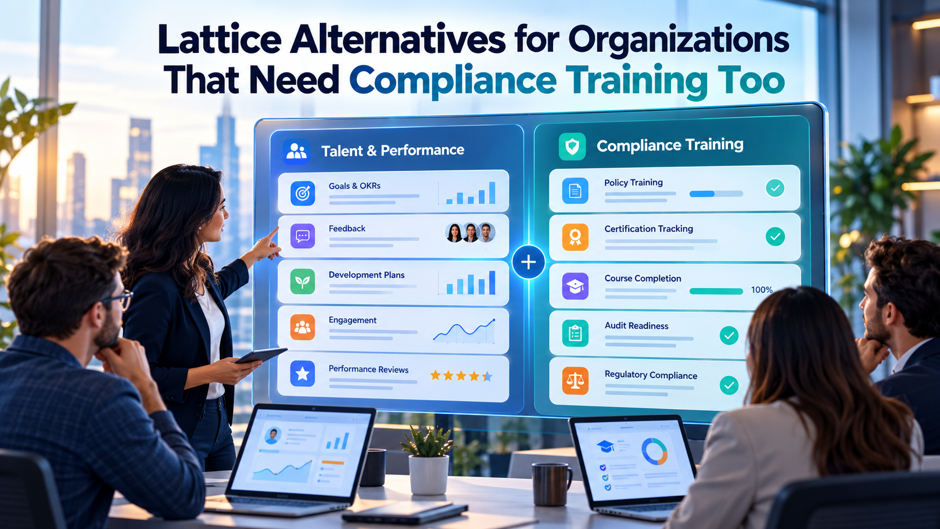
A 700-person company runs performance reviews, goals and compensation cycles in Lattice, and it manages annual harassment prevention, security awareness and code of conduct training in a patchwork of email reminders, a shared spreadsheet and a separate course platform. In an audit, the compliance manager spends 2 days assembling proof that the right people finished the right courses on time, and the people team starts asking a reasonable question: is there a single platform that covers both performance management and compliance training, or are 2 systems the realistic answer.
This guide helps teams answer that question. It explains what compliance training requires from software, uses state harassment training rules as an example of that complexity, summarizes what Lattice covers and where the gap appears, compares 3 ways to close it, shows a cost illustration, offers a scoring framework and lists demo questions and mistakes to avoid. Most public comparisons come from vendors that compete with each other, so feature claims are attributed and should be confirmed in a demo, and nothing here is legal advice.
TL;DR
- Performance platforms and compliance training platforms solve different problems. Lattice is described by several competitor and review sources as strong on performance, goals, engagement and compensation but without a native learning management system, so organizations that need assignment rules, recurring retraining, certificates and audit-ready records usually add a learning platform or move to a suite that includes one. Confirm each tool’s current features in a demo before relying on a comparison page.
- There are 3 realistic paths, and each trades depth against simplicity. Keeping Lattice and adding an integrated learning platform preserves performance depth, suites with built-in learning reduce vendors and hand-offs, and HRIS-first or specialist options can cover compliance at lower cost, and in a 500-person illustration all 3 land in a similar annual range once modules are counted. Ask for line-item quotes so the 3-year totals can be compared fairly.
- Compliance requirements should drive the shortlist. Rules such as California’s training every 2 years and New York’s and Illinois’s annual training show why assignment by location, retraining schedules and retained completion records matter, so score candidates on those capabilities first, test them with your own data and confirm current features with each vendor. Share the requirement matrix with every vendor before demos so each 1 answers the same questions in the same order.
Why Performance and Compliance Training Rarely Come in 1 Box
Performance management and compliance training have different owners, different cadences and different consequences when they fail. Performance work belongs to managers and the people team, runs in review cycles and goal quarters, and produces conversations and ratings. Compliance training belongs to legal, compliance or HR operations, runs on legal deadlines tied to hire dates and locations, and produces records that a regulator, auditor or court may demand. A late review is a management problem, and a missing training record can become a legal one.
The product categories reflect that split. Performance platforms such as Lattice concentrate on reviews, goals, feedback, engagement surveys and compensation, while learning management systems concentrate on course delivery, assignment rules, tracking and reporting. A competitor’s comparison page says Lattice doesn’t include a native LMS and integrates with third-party learning platforms such as WorkRamp, and other review sources repeat the point. Since the claim comes partly from competitors and some pages are older, confirm Lattice’s current learning capabilities directly.
The result is that organizations with compliance training duties have to choose between combining 2 specialist tools, buying a broader suite or using an HRIS with training features. Each choice affects integration’s, data ownership, cost and the experience of employees who must log in to complete both performance tasks and mandatory courses. The sections that follow define the compliance requirements precisely, then compare the paths against them, because a vague wish for an all-in-one tool often leads to disappointment in the audit room.
What Compliance Training Requires From Software
| Requirement | What It Means in Practice | Why It Matters |
| Assignment by role, location and hire date | Courses assigned automatically when a person joins, moves or changes manager status | Rules differ by state and by supervisor status |
| Recurring retraining | Annual or every-2-year cycles that restart without manual effort | Legal frequencies vary by jurisdiction |
| Deadlines and reminders | Due dates, escalating reminders and manager visibility | Late completion creates exposure and audit findings |
| Completion records and certificates | Date, course version, score and a stored certificate for each learner | Auditors and regulators ask for proof of completion |
| Retention and audit trail | Records kept for the required period, with a history of changes | Some states require records for at least 2 or 3 years |
| Content and standards support | A course library or authoring, plus support for formats such as SCORM and xAPI | Compliance content must be current and trackable |
| Policy acknowledgments | Signed or clicked acknowledgments of handbooks and codes | Many policies require proof that employees read them |
| HRIS and identity integration | Employee data, manager status and single sign-on stay in sync | Wrong data means wrong assignments |
| Reporting and dashboards | Overdue lists, completion rates by unit and exportable evidence | Compliance managers need answers in minutes |
| Accessibility and languages | Courses usable by all employees and available in needed languages | Required in some jurisdictions and essential for global teams |
A platform that excels at performance cycles might meet few of these needs, and a strong learning platform might offer weak performance tools. The table is best used as a checklist during demos. Ask each vendor to show, with your own sample data, how a new California supervisor is assigned the right course within 6 months of promotion, how the annual cycle restarts and how an auditor’s report is produced. Seeing the workflow end to end reveals more than any feature list can show.
State Rules as an Example of the Complexity
California Sets a 2-Year Cycle With Role-Based Hours California requires employers with 5 or more employees to train all employees and supervisors within 6 months of hire and then every 2 years, with supervisors receiving 2 hours and non-supervisory employees 1 hour, according to published employer guides. Several guides say employers must keep training records for at least 2 years, including names, dates, materials and trainer details. A platform therefore needs to know who supervises others, and to retrain on a rolling 2-year clock.
New York and Illinois Require Annual Training New York requires all employers, regardless of size, to provide interactive sexual harassment prevention training annually, using the state’s model program or an equivalent that meets its minimum standards, and New York City has additional obligations. Illinois requires annual training for employees working in the state. For multi state employers, that means some employees are on an annual clock and others on a 2-year clock, so assignment rules must follow the work location beyond the company headquarters.
Other States Add Different Frequencies Guides report that Connecticut requires 2 hours within 6 months of hire with updates every 10 years, Delaware requires training every 2 years and Maine has its own timing, and sources differ on some details. Cities such as Chicago and New York City add local rules. A platform that handles only 1 national schedule creates risk, so ask whether schedules are configurable by state and city, who maintains them and how quickly the vendor updates content when laws change.
Federal Law Doesn’t Mandate Training, and Many Topics Beyond Harassment Apply 1 law firm notes that Title VII prohibits sexual harassment but doesn’t itself require anti-harassment training, which is why state rules matter. Companies also assign security awareness, code of conduct, anti-bribery, data privacy, safety and industry-specific courses, each with its own owner and frequency. These examples are illustrative, and laws change often, so have counsel confirm current requirements before configuring a platform around them, and keep a written matrix of who must take what.
What Lattice Covers and Where the Gap Appears
- Lattice’s core is performance, goals, engagement and compensation. Review sources describe project-based and 360-degree reviews, calibration, structured 1:1 meetings, goal tracking, engagement surveys, merit cycle planning with pay equity analysis, cross-module analytics and AI-assisted review writing, and its development and compensation tools are described as uncommon among performance products. That breadth is the reason many teams choose it, and it’s also why a compliance team should ask what it does and doesn’t cover before assuming a single system will do everything.
- Several sources say Lattice has no native LMS. A Leap-some comparison, an Engagedly article and reviews all state that Lattice doesn’t include a learning management system and that organizations needing training functionality integrate third-party platforms, with WorkRamp named as an example, though these are competitor sources and some are dated. Because the claim appears mostly on competitor pages, treat it as a reason to ask Lattice directly instead of as settled fact.
- Treat the gap as something to verify, not assume. Vendors add features, and a comparison page published 2 years ago may be out of date, so ask Lattice what learning, policy acknowledgment and records features exist today, what its partner platforms do and what an audit report would look like when the 2 systems work together. Record the answers in writing and compare them with what other vendors commit to in their proposals.
3 Paths at a Glance
| Path | How It Works | Strengths | Risks | Best Fit |
| Keep Lattice and add a learning platform | Lattice for performance, a separate LMS for compliance, connected through integration | Keeps performance depth, lets compliance choose a specialist | 2 vendors, 2 logins, integration upkeep | Organizations satisfied with Lattice and needing strong compliance |
| Move to a suite with built-in learning | 1 platform covers performance, goals and learning | Fewer vendors, learning tied to reviews and goals | May have less depth in 1 area, migration effort | Teams that value consolidation |
| HRIS-first platform or specialist compliance vendor | Core HR with performance features, or a specialist tool for mandatory training | Lower cost, strong fit for small and mid-size teams | Performance depth may be limited, training features vary | Smaller organizations or compliance-led buyers |
Each path suits a different organization, and no path is best for everyone. A company happy with its performance process but struggling with compliance records will probably keep Lattice and add a learning platform. A company that wants to simplify vendors and link development to performance may prefer a suite. A smaller company with basic needs may find an HRIS-first option enough. The next sections describe each path, then compare candidates and costs using stated assumptions.
Path 1: Keep Lattice and Add a Learning Platform
Keeping Lattice preserves the performance and compensation processes that managers already know, which avoids retraining on reviews and calibrations and keeps historical data in place. The compliance team then selects a learning platform on its own merits, with strengths such as a deep content library, state-specific harassment modules, strong assignment rules and audit reporting. Some specialist compliance training vendors build their products around location-based rules and automatic retraining, which is the capability that matters most for legal deadlines.
The trade-off is integration. The learning platform needs accurate employee data, including hire dates, locations, manager status and terminations, and it usually receives that from the HRIS instead of from the performance tool. Confirm which system is the source of truth for each field, how often data syncs and what happens when records conflict. Single sign-on matters too, because employees who must log in to 2 systems and remember 2 sets of tasks complete training later and ask more questions.
Cost and ownership also deserve a plan. Having 2 vendors means 2 renewals, 2 security reviews and 2 sets of administrators, and an integration may carry a setup fee and ongoing maintenance, with 1 benchmark putting custom integration’s at $5,000 to $25,000 each. In exchange, the organization can replace either tool without disturbing the other. For companies that treat compliance training as a regulated process with its own owner, that flexibility is often worth the added coordination.
Path 2: Move to a Suite With Built-In Learning
Leap-some Is the Most Cited Mid-Market Alternative With a Native LMS Several comparisons describe Leap-some as combining performance reviews, goals, engagement surveys, learning paths and compensation, with a native LMS that supports SCORM and xAPI and integrates with LinkedIn Learning, and 1 source says it’s strong in European markets with GDP compliance and data residency. Pricing sources report about $8 per employee per month to start, with modules reaching $30 to $40 at full build-out. Whether its compliance features meet your rules needs a demo.
Enterprise Suites Offer Learning Within a Larger Stack Workday is described as an enterprise HCM platform covering payroll, HR, finance and performance management, and it includes learning capabilities within its portfolio. Cornerstone OnDemand is listed as an enterprise talent management suite. These platforms suit large organizations with complex structures and deep implementation resources, though they typically carry higher cost and longer projects than mid-market tools, and they raise the same question of whether performance features match what Lattice users are used to.
Consolidation Reduces Handoffs but Adds Migration Risk A single platform can connect training assignments to onboarding, role changes and performance goals, and it gives employees 1 place to complete tasks. The cost is migration: performance history, goals, calibration data and learning records must move, and managers must learn new workflows. Plan for a period when both systems run, and avoid switching performance and compliance platforms in the middle of a review cycle or immediately before a compliance deadline.
Check Depth in Each Area Before Assuming Parity Suites trade breadth for depth. A platform that covers performance, learning and engagement in 1 product may not match a specialist in every area, and reviews describe some all-in-one tools as heavyweight for small teams or less mature in particular regions. Ask for scenarios from your own process, such as a calibrated review with compensation links or a multi state harassment training campaign, and judge the platform on the area that matters most to your risk.
Path 3: HRIS-First Platforms and Specialist Compliance Vendors
- HRIS-first platforms bundle basic performance tools with core HR. Guides describe BambooHR as an HRIS with performance features on its Pro plan, published at $10 per employee per month for Core, $17 for Pro and $25 for Elite, and HiBob as a modern HRIS with performance and engagement at roughly $8 to $12 per employee per month by quote, with both noted for limited performance depth compared with dedicated tools.
- Training features inside HRIS products vary and need verification. Some HRIS vendors include course assignment or training tracking, though depth differs from a full LMS, so ask whether the product supports automatic assignment by location, recurring cycles, certificates and retained records, and request a demonstration with your own multi state employee file instead of relying on a feature list. Ask the vendor to name which plan includes each training feature and what it costs.
- Specialist compliance training vendors focus on mandatory topics. Some vendors build around harassment prevention and other required courses, assign the right track by location and manager status, restart on legal schedules and update content when rules change, which suits organizations whose main need is compliance and who are content to keep performance management elsewhere. Ask how the vendor learns about changes in state law and how quickly assignments and content change after an update.
Candidate Alternatives Compared
| Candidate | Performance Depth | Built-In Learning or Compliance | Typical Buyer | What to Confirm |
| Lattice plus an LMS | Strong in performance, goals and compensation per reviews | Through a connected third-party platform | Teams happy with Lattice who need strong compliance | Data sync, single sign-on and audit reporting across both tools |
| Leapsome | Similar scope to Lattice per several sources, with deeper OKR and learning integration | Native LMS with SCORM and xAPI per sources | Mid-market teams wanting 1 platform | State-based assignment, recurring retraining and record retention |
| Workday | Extensive performance capabilities within an enterprise suite | Learning capabilities within the Workday portfolio | Large enterprises | Implementation scope, cost and usability for managers |
| Cornerstone OnDemand | Enterprise talent management | Enterprise learning heritage | Large organizations | Performance module depth and project timeline |
| BambooHR | Moderate, with performance on higher plans | Varies by plan | Small and mid-size teams wanting HRIS | Training features, location rules and record retention |
| HiBob | Moderate, with performance and engagement | Varies by configuration | Mid-size teams wanting a modern HRIS | Learning features and integration options |
| Performance tool plus specialist compliance vendor | Depends on the performance tool | Specialist handles mandatory courses | Compliance-led buyers | Integration with the HRIS and the performance tool |
The table reflects what published sources say, and it uses qualitative language because comparison pages disagree and age quickly. Treat the last column as the real deliverable: a list of items to verify in a demo. For a multi state employer, the most informative test is to give each vendor the same sample employee file, with a mix of locations, supervisors and hire dates, and ask them to show assignments, due dates, retraining and an audit export. Differences appear quickly when real data is used.
Cost Math: 3 Ways to Cover Performance and Compliance
Path 1: Lattice Plus a Learning Platform A guide lists Lattice’s Foundations plus Engagement package at about $17 per seat per month. For 500 employees, that’s 500 times $17 times 12, or $102,000 a year. An earlier benchmark puts learning modules at $3 to $8 per employee per month, which is $18,000 to $48,000 a year for 500 people. The combined annual range is $120,000 to $150,000, plus an integration cost that 1 benchmark places at $5,000 to $25,000 each.
Path 2: A Suite With Built-In Learning Using the pricing sources for Leap-some, $8 per employee per month to start gives 500 times $8 times 12, or $48,000 a year, and $30 to $40 at full build-out gives $180,000 to $240,000. The starting figure probably excludes modules a compliance buyer needs, and the full figure may include more than needed, so the realistic range depends on which modules are in the quote. Ask for a line-item quote that includes learning, compliance features and any content fees.
Path 3: An HRIS-First Platform Plus Training Capability BambooHR Pro at $17 per employee per month is $102,000 a year for 500 people, and adding $3 to $8 per employee per month for training capability, if it isn’t included, gives $120,000 to $150,000. HiBob pricing is by quote at roughly $8 to $12 per employee per month, which is $48,000 to $72,000 a year before add-ons. All figures come from third-party sources and illustrate scale, and none is a vendor quote.
What the Illustration Shows Once all required modules are counted, the 3 paths can land in similar ranges, so price alone rarely decides the choice. The more useful questions are which path meets compliance requirements with the least manual work, which preserves the performance process the company wants and which carries the lowest migration and integration risk. Build a 3-year total for each finalist that includes implementation, content fees, integration and internal administration time, then compare totals instead of headline per-employee prices.
Migration and Rollout Considerations
- Time the switch around the performance and compliance calendars. Avoid moving platforms during a review cycle, a compensation cycle or the weeks before a compliance deadline, and plan the cutover for a quiet period, with a parallel run until the first full cycle completes, because a failed migration near a legal deadline can create exposure that no software savings can offset. Put the freeze dates on the project calendar and share them with managers.
- Preserve training history, not only performance data. Completion dates, course versions and certificates may be needed for audits and for calculating the next due date, so export them from the old system, import them to the new platform with dates intact and verify a sample against the source, since a lost record can force retraining or leave a gap that can’t be explained. Keep a copy of the export in a secured archive.
- Rebuild assignment rules before loading employees. Document the matrix of who must take what, by state, role and hire date, configure the rules, then test with sample employees, including a new supervisor in California and an employee who moves from Texas to New York, because a wrong rule produces wrong assignments at scale. Keep the matrix under version control so each change has a date, an approver and a clear reason.
An Evaluation Scorecard for Compliance-Ready Selection
| Criterion | Illustrative Weight | What to Test |
| Assignment by location, role and hire date | 20% | Sample employees across states, supervisor status and start dates |
| Recurring and event-triggered training | 15% | Annual and 2-year cycles, onboarding and promotion triggers |
| Records, certificates and audit trail | 15% | Retention, exports and change history for a sample audit request |
| Performance management depth | 15% | Reviews, goals, calibration and compensation links used today |
| Content and standards support | 10% | Course library, authoring, SCORM and xAPI, content update process |
| HRIS and single sign-on integration | 10% | Data sync, manager flags, terminations and transfers |
| Reporting and administration effort | 10% | Overdue lists, dashboards and hours needed per cycle |
| 3-year cost and contract terms | 5% | Line-item totals, renewal caps and exit rights |
The weights are illustrative judgments rather than benchmarks. A company with heavy regulatory exposure might raise the first 3 rows, while a company whose performance process is its main strategic tool might raise performance depth. Agree on weights with HR, legal, compliance and IT before demos, and have more than 1 person score each vendor from a recorded session. Scoring from the same script and the same data makes the comparison defensible when leadership or an auditor asks why a platform was chosen.
Questions to Ask Vendors in Demos
Assignment Rules and Legal Schedules Ask the vendor to show how a new California supervisor is assigned a 2-hour course within 6 months, how an employee in New York is placed on an annual cycle and how a transfer between states changes the assignment. Ask who maintains the rules, how fast the schedule is updated when a law changes and whether the customer can edit rules. A vendor that answers with a live demonstration using your data earns more confidence than one that answers with a slide.
Records, Retention and Audit Evidence Request an audit export for a sample of 25 employees, showing completion date, course version, score and certificate, and ask how long records are kept and who can alter them. Ask what the change history shows and how the vendor handles record requests from regulators. Confirm data export rights at termination, since an organization that can’t retrieve its training history may face duplicate training or an inability to prove past compliance.
Integration, Data Ownership and Support Ask which HRIS and identity systems integrate natively, what fields sync, how often and how conflicts are resolved. If Lattice or another performance tool stays in the stack, ask what data flows between the systems and who supports the connection. Request references from customers with similar headcount and multi state footprints, and ask them how the vendor handled a law change, a data error or a failed sync. Ask for names and contacts.
Cost, Contract and Roadmap Request a line-item quote that separates licenses, learning content, implementation, integration’s and support, and ask what’s included in the first year and what increases at renewal. Ask for price caps and a multi-year lock. Ask what the vendor’s roadmap includes for compliance features and what happens to content if the vendor is acquired. Since sources describe competitors’ features differently, base the decision on a written commitment instead of a verbal claim.
Common Mistakes
Choosing a platform for its performance features and discovering the compliance gap later is the first mistake. Teams compare review templates and calibration views, then learn during an audit that records are incomplete or that assignments don’t follow state rules. Put compliance requirements on the scorecard from the start, involve legal and compliance in demos and test the audit export before signing, because the cost of a missing record usually exceeds the price difference between platforms.
Assuming that an integration solves everything is the second. A connection between a performance tool and an LMS can fail silently when employee data is stale, when a manager flag is wrong or when a location changes without syncing. Define the source of truth for each field, test the sync with real records, set up monitoring and name an owner for the integration, since an unowned integration works until the day an audit asks a question it can’t answer.
Treating compliance training as a one-time project is the third. Laws change, employees move, new hires arrive weekly and content expires, so the system needs a person who reviews assignments, reads legal updates and checks completion rates each quarter. Budget for that administration time and for content updates, review the requirement matrix at least once a year with counsel and use the platform’s reports to catch overdue assignments before a regulator or auditor does.
FAQs
Does Lattice include compliance training?
Several competitor and review sources say Lattice doesn’t include a native learning management system and integrates with third-party platforms such as WorkRamp, so compliance training with assignment rules, retraining schedules and certificates usually sits in another tool. These sources can be dated or biased, so ask Lattice what learning, acknowledgment and records features it offers today. Request a written answer so the decision doesn’t rest on an out-of-date third-party summary from a comparison page.
What are the main ways to cover performance management and compliance training? There are 3 common paths: keep Lattice and add an integrated learning platform, move to a suite with built-in learning such as Leap-some or an enterprise HCM platform, or use an HRIS-first product or a specialist compliance training vendor alongside a performance tool. Each trades depth against simplicity, and the right one depends on regulatory exposure, headcount and appetite for migration.
Which Lattice alternatives include a learning management system?
Sources describe Leap-some as having a native LMS with SCORM and xAPI support and LinkedIn Learning integration, and enterprise suites such as Workday and Cornerstone include learning capabilities. HRIS-first platforms such as BambooHR and HiBob vary, so request a demonstration of training features using your own multi state employee data before assuming they meet compliance needs. Confirm the details in a demo with your own data.
What should a compliance training platform record?
At a minimum, the employee, course and course version, assignment date, due date, completion date, score where relevant and a stored certificate or acknowledgment, plus a history of changes. Some states require employers to keep records for at least 2 or 3 years, so confirm retention periods with counsel and test how records are exported for an audit request. Test the export with a sample.
How often must harassment prevention training be repeated?
It varies by jurisdiction. Published guides say California requires training every 2 years, with 2 hours for supervisors and 1 hour for other employees, New York and Illinois require annual training, Delaware requires training every 2 years and Connecticut has a longer update cycle. Rules change, and local laws add requirements, so have counsel confirm current obligations. Keep a written matrix of the schedules that apply to each location and review it each year.
Can we keep Lattice and add a learning platform?
Yes, and many organizations do. The approach preserves Lattice’s performance and compensation processes and lets compliance choose a specialist, though it means 2 vendors and an integration that must keep manager status, locations and terminations in sync. Confirm which system is the source of employee data, test the sync with real records and name an owner for the connection. Review the integration quarterly to catch drift early, before an audit does.
How much will it cost?
Costs depend on modules, headcount and negotiation. As an illustration for 500 employees, Lattice at about $17 per seat per month is $102,000 a year, learning modules at $3 to $8 add $18,000 to $48,000, and Leap-some’s $8 starting price to $30 to $40 full build-out ranges from $48,000 to $240,000. These are third-party figures, so request line-item quotes and compare 3-year totals. Add content fees and integration costs to each total.
How do we migrate training records without losing compliance history?
Export completion dates, course versions and certificates from the old system, import them with dates intact and check a sample against the source before decommissioning anything. Keep the old system or an archive available until the first full cycle completes, and document the mapping. Preserving history matters because next-due dates and audit evidence depend on it. Run a reconciliation of counts and dates before the old system is switched off for good.
