
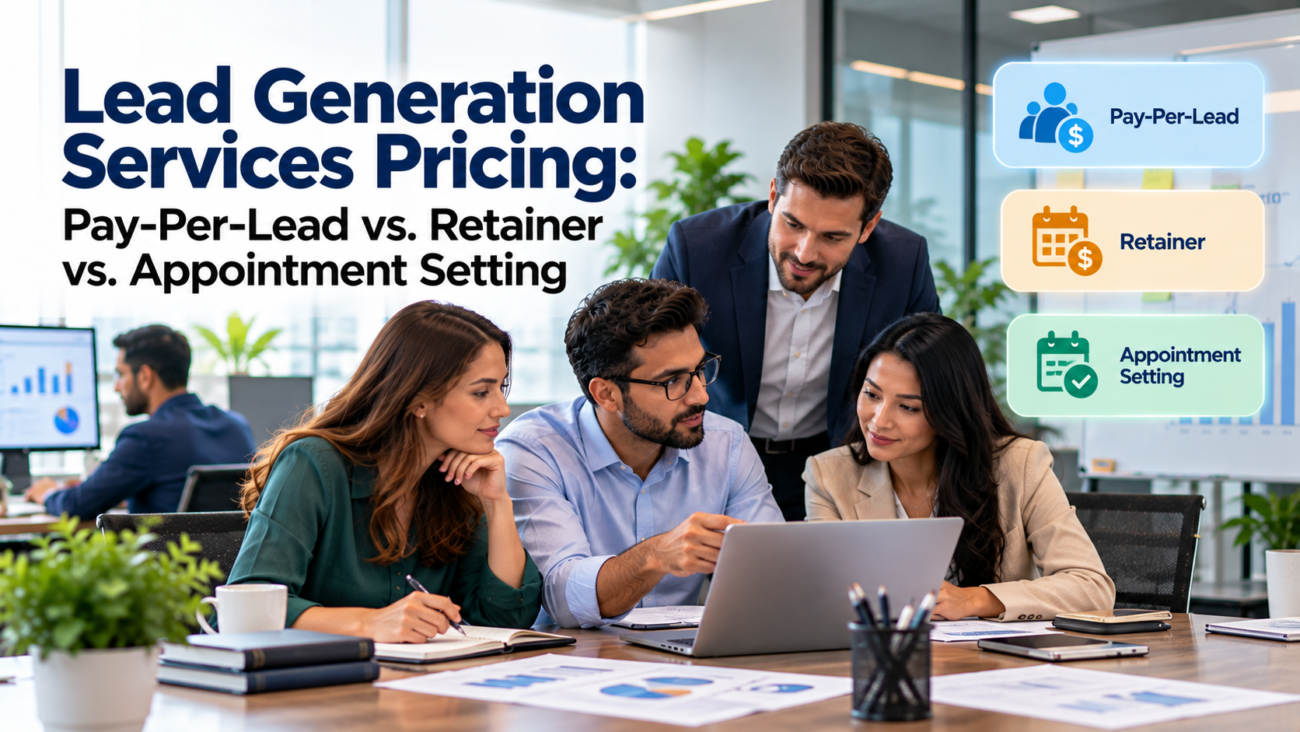
Lead generation quotes are hard to compare because agencies often sell different outcomes under the same name. One charges when it delivers a contact. Another charges every month for research and outreach. A third bills when a prospect agrees to a sales meeting. The cheapest invoice can become the most expensive source of real sales opportunities.
Lead Generation Services Pricing should be judged by what qualifies for payment and what happens after delivery. Buyers need to know whether a lead has asked to speak with sales, whether a meeting actually takes place, and whether the prospect matches the intended customer. Those details affect the work left for an internal team and the money needed to reach a signed customer.
This comparison explains the models, contracts, and cost per accepted opportunity. Published rates differ: Kliqwise lists content-syndication leads from $15 and appointment setting from $800 a meeting; SalesRoads lists staffed outbound from $9,950 per 4 weeks. These are advertised offers, checked in October 2026, not market averages. The worked comparisons below are hypothetical. Quotes vary.
TL;DR:
Pay-per-lead charges for records or inquiries that meet an agreed definition. A retainer pays for continuing research and outreach, whether meeting volume rises or falls. Appointment setting usually aims to deliver sales conversations, but payment may depend on bookings, attendance, or client acceptance. Compare all 3 through cost per held meeting and accepted opportunity. Define valid results, no-shows, duplicates, exclusions, and reporting rules before signing. A limited pilot is more useful than assuming the lowest advertised unit price is the lowest customer acquisition cost.
What Lead Generation Services Pricing Actually Covers
A lead generation service may supply names, generate inbound inquiries, contact target accounts, qualify interested buyers, or book meetings. These are different tasks. The quote should identify the exact handoff point between the provider and the buyer’s sales team. Without that detail, an offer of 100 leads can’t be compared with an offer of 20 appointments.
Lead Generation Services Pricing starts with the ideal customer profile. It describes the companies that fit the product, including sector, size, geography, and any meaningful buying conditions. The agency then needs a definition of an acceptable contact within those companies. A verified finance manager may be a good database record but may have no authority over a cybersecurity purchase. Contact accuracy and buyer relevance need separate checks when comparing B2B Lead Generation Cost.
Clear lead definitions matter before billing starts. Salesforce’s lead qualification lessons explain why marketing and sales teams need to qualify prospects before investing further effort. That principle matters when evaluating agency deliveries. A low-priced file of professional contacts belongs in a different comparison from a list of people who expressed a specific need and agreed to discuss it.
The billable unit might be a lead, a meeting, or dedicated staff time. Agencies may also combine them. Lead Generation Services Pricing needs sample records and a written trigger for each charge. Without that, an advertised rate provides little guidance.
There is another distinction: the service model and the payment model aren’t always the same. An appointment-setting agency can charge a monthly retainer. A research agency can charge per delivered contact. An outsourced sales development team can use a base fee with a bonus for meetings. Compare the work and the billing trigger on separate lines.
Pay-Per-Lead vs. Retainer vs. Appointment Setting Compared
The 3 models shift risk differently. Under Pay-Per-Lead Pricing, the buyer knows the unit price but may spend more time qualifying results. Under Lead Generation Retainer Pricing, the fee is fixed but meeting volume isn’t. Appointment Setting Pricing links charges to a later event, although the definition of success varies.
| Factor | Pay-Per-Lead | Monthly Retainer | Appointment Setting |
| Payment trigger | Accepted lead | Agreed billing period | Booked, held, or accepted meeting |
| Typical provider work | Sourcing and agreed qualification | Ongoing research and campaigns | Outreach and meeting coordination |
| Main buyer responsibility | Fast follow-up and further qualification | Oversight and sales handoff | Attending and qualifying meetings |
| Main pricing risk | Weak or repeated leads | Fees continue during weak periods | No-shows or poor meeting fit |
| Useful performance measure | Cost per accepted opportunity | Cost per accepted opportunity | Cost per held qualified meeting |
| Contract priority | Billable lead definition | Scope and staffing | Meeting acceptance rules |
A company with a strong internal SDR team may prefer lead delivery. A company entering an unfamiliar market may need ongoing campaign work. A company with account executives who have available time may want more booked conversations. None of those observations proves which model will generate more customers.
Include internal costs. If sales spends 12 hours sorting unwanted records, that work still has a price. The B2B Lead Generation Cost includes services and the effort needed to create opportunities.
How Pay-Per-Lead Pricing Works
A pay-per-lead contract sets a fee for each accepted lead. The provider delivers records or inquiries against agreed rules. Pay-Per-Lead Pricing is easier to budget when sales can follow up promptly. It fails when the parties define interest differently.
What Counts as a Billable Lead?
A valid business contact might include a current employee at a target company with an accurate work email. That doesn’t mean the person has asked to buy anything. An inbound inquiry shows an action, but it may concern a product the buyer doesn’t sell. A sales-ready lead normally needs stronger evidence of fit or intent under the client’s own rules.
CRM lifecycle labels can help explain the handoff. HubSpot’s lifecycle stage guidance separates marketing and sales stages so teams can track a contact’s position in their process. A pay-per-lead agreement should identify which stage the agency is expected to produce rather than borrowing a label without defining it. Two businesses may use the term SQL differently, even with the same CRM.
For example, a cloud security vendor could accept a lead only when the business has 100 to 1,000 employees, operates in the United States, and the contact owns or influences security purchasing. If the agency also promises stated interest, it must explain how that interest is established. A recorded request for a meeting is stronger evidence than opening an email.
When This Model Makes Financial Sense
Suppose the agreed price is $180 per accepted lead. Buying 60 leads would cost $10,800 before internal follow-up expense. If 18 meetings take place, the agency cost per held meeting is $600. If 9 become accepted opportunities, agency cost per opportunity is $1,200. These are worked examples, not vendor benchmarks.
This model is harder when the buyer can’t contact leads promptly. Records can sit untouched while their details become stale. Define how soon sales will accept, reject, or follow up on each delivery. Pay-Per-Lead Pricing works best when the buyer can measure downstream quality and return bad records under a clear replacement policy.
What Monthly Retainers Buy
Lead Generation Retainer Pricing usually covers continuing services for a fixed period. The agency may research accounts, prepare lists, send approved emails, make calls, manage replies, and report campaign performance. The scope can differ sharply even when 2 proposals quote the same monthly amount. A retainer is a fee for agreed work, not an automatic guarantee of pipeline.
A typical retainer proposal should state which staff or capacity is assigned, how much prospect research is included, the markets being worked, and which communication channels the agency manages. It also needs to specify whether the fee covers databases, software subscriptions, mailbox infrastructure, creative preparation, and reporting. Otherwise the monthly fee may be only part of the operating cost.
Retainers allow time to learn. A message may work with operations leaders but fail with finance. The provider can adjust within the agreed scope, but shouldn’t change the target market without approval or replace meaningful results with email counts. The buyer should review those changes against lead quality and the agreed scope.
What Happens When Results Are Slow?
Setup and testing take time. A contract should state what setup includes and when results will be reviewed. Paying for months without activity evidence is harder to justify.
For example, a hypothetical $6,000 monthly program could include account research, 1 outreach channel, and weekly reporting. If software and list expenses add $1,000, the month’s direct agency-related cost is $7,000. If the program generates 7 opportunities, that is $1,000 per accepted opportunity before internal sales cost. The calculation matters more than the $6,000 headline.
Lead Generation Retainer Pricing is often worth evaluating for a narrow enterprise audience or work that requires repeated contact with a buying group. The client bears more risk without performance standards or a clear exit. Lead Generation Retainer Pricing should account for that risk. Ask what will be delivered, how progress will be reviewed, and what happens when the agreed work isn’t performed.
How Appointment Setting Pricing Works
Appointment setting services arrange sales conversations and may charge per meeting or through a retainer. Appointment Setting Pricing needs a clear billing trigger. A booking isn’t the same as a held qualified meeting.
Booked, Held, and Accepted Meetings
A booked meeting means the prospect agreed to a date or accepted a calendar invitation. A held meeting means the conversation took place. An accepted meeting adds the buyer’s agreed qualification conditions, such as company fit and the presence of an appropriate decision-maker. Agreements can charge at any of these stages.
Imagine a vendor books 20 meetings at $450 each, for an invoice of $9,000. If only 15 take place, the invoice cost per held meeting becomes $600. If 6 satisfy the buyer’s opportunity rules, cost per accepted opportunity becomes $1,500. If the provider charges only for held, qualified meetings, the economics and its incentives would be different.
No-Shows, Reschedules, and Meeting Quality
No-show terms deserve their own clause. Decide whether a prospect who cancels an hour before a meeting counts as delivery. State how often a rescheduled meeting can be billed and whether the agency must replace a no-show. The client’s own missed appointments need separate treatment so the agency isn’t penalized for its customer’s calendar failure.
A meeting with a junior employee can be useful research without satisfying a contract that promises budget owners. Equally, a senior executive may take a call but have no reason to evaluate the product. The qualification rules should describe job function and account fit rather than promise that every attendee has immediate purchase intent.
Appointment Setting Pricing can suit a company whose closers have room for more conversations. It may be a poor fit if account executives already miss follow-ups or have no time to attend meetings. Paying for appointments doesn’t remove the need for discovery, proposals, and deal management after the call.
Why Lead Qualification Determines the Real Price
Lead Generation Services Pricing changes with what a delivered record proves. A verified contact can be valuable for building an account list. A lead who wants a quote is further along. Those outcomes shouldn’t share 1 acceptance rule merely because an agency calls both of them qualified leads.
To separate raw names from real pipeline, Salesforce explains in its lead conversion guide that a lead is generally an early-stage prospect, while an opportunity represents a viable business deal after qualification. This distinction keeps a contact file from being counted as pipeline. Buyers should apply their own documented handoff criteria before reporting agency results as opportunities.
Define Exclusions Before Delivery
A useful agreement names disallowed sectors, excluded accounts, existing customers, and people outside the agreed job roles. It should address competitors, students, consultants, and vendors if those are unsuitable for the campaign. A record that matches an email format but fails company fit isn’t acceptable merely because the address works.
Duplicate handling is equally important. HubSpot’s record deduplication guide explains how emails and company domains can be used to detect existing records. The agency agreement may need stricter rules: an employee at an account with an open opportunity may be excluded even if the individual email isn’t already in the CRM.
Ask for evidence of qualification with every delivery. That record matters when calculating B2B Lead Generation Cost. That might mean a submitted inquiry, the prospect’s reply, or a short call summary. The agency shouldn’t claim a purchasing budget or deadline unless the person actually stated it. The buyer can then review reasons for rejection without a long dispute over the meaning of SQL.
These rules also affect lead value. A large batch of unverified names may be inexpensive to acquire but costly to work. A smaller set of prospects with clear buying relevance can save internal effort. Pay-Per-Lead Pricing requires the clearest written definition because every accepted unit increases the invoice.
What Changes the Price of an Outsourced Program
Lead Generation Services Pricing varies because target markets need different work. Finding local business owners in a broad category is different from finding finance executives at multinational manufacturers. Seniority, industry knowledge, account availability, and qualification depth can all raise the work needed per result. Price differences aren’t proof that an expensive agency is better.
| Pricing Factor | Why It Matters |
| Market size | Narrow lists need more careful account research |
| Buyer seniority | Senior contacts may be difficult to reach |
| Geography | Calling hours, language, and local rules differ |
| Lead standard | A verified email needs less work than a qualified meeting |
| Exclusivity | Dedicated leads may be priced differently from shared inquiries |
| Outreach channel | Calls and paid media have different cost structures |
| Campaign setup | New domains, research, and materials may add fees |
| Contract length | Setup expense is spread across different periods |
One-time campaign preparation should be itemized separately from recurring service. A provider may charge for research and message development before outreach begins. That work has value, but the buyer should know what it owns afterward. A domain or paid advertising account created for the client should remain accessible according to the contract.
Geography also affects the B2B Lead Generation Cost. A multilingual calling program may require trained callers and local operating hours. Outreach to industries with technical products may require more research before any conversation. Treat all broad online price bands as planning context rather than a quote for your exact audience.
Calculate Cost per Meeting, Opportunity, and Customer
Lead Generation Services Pricing should put every model on the same financial basis. The invoice total is only the first number. Calculate how many meetings happened, how many opportunities sales accepted, and how many customers were eventually won. Use comparable time periods, including the months when deals remain open.
| Illustrative Metric | Lead Purchase | Retainer | Appointment Fee |
| Agency and direct program cost | $10,800 | $7,000 | $9,000 |
| Delivered units | 60 leads | 1 monthly program | 20 bookings |
| Meetings held | 18 | 14 | 15 |
| Accepted opportunities | 9 | 7 | 6 |
| Cost per held meeting | $600 | $500 | $600 |
| Cost per accepted opportunity | $1,200 | $1,000 | $1,500 |
These are hypothetical 1-period examples using the same opportunity acceptance rule and direct program costs only. The retainer costs $7,000 for 7 accepted opportunities, or $1,000 each. The lead purchase costs $10,800 for 9, or $1,200 each. That is why the retainer costs less per opportunity despite fewer held meetings (14 versus 18). Neither calculation includes internal labor, and real campaigns may convert differently.
Cost per held meeting equals total relevant program cost divided by held meetings. Cost per accepted opportunity uses the same numerator divided by opportunities accepted by sales. To estimate customer acquisition cost, add attributable internal labor and other acquisition costs, then divide by customers won. Don’t call agency-only cost full customer acquisition cost.
Where a lead begins online but closes offline, Google’s offline conversion guidance explains how qualified leads or later customer events can be imported from a CRM for measurement. This shows why teams should retain the lead’s original source when tracking sales progress. It doesn’t remove the need to avoid counting the same opportunity twice.
Compare Against Gross Profit
A new customer worth $40,000 in first-year revenue doesn’t necessarily produce $40,000 of profit. If the deal has delivery and support costs, compare acquisition expense with expected gross profit over a suitable period. A model that appears expensive per lead may be sensible if it consistently creates customers with strong margins. Avoid using revenue alone to declare the campaign profitable.
What Current SDR Research Can and Cannot Tell You
Independent sales-development research helps test extreme agency promises. The Bridge Group’s 2025 SDR study surveyed 351 B2B companies, with a sample weighted toward North American B2B SaaS teams. It reported a median monthly quota of 10 held introductory meetings, an average ramp time of 3 months, and median annual on-target earnings of about $80,000.
Those figures describe the surveyed SDR organizations. They aren’t appointment-setting agency price benchmarks and don’t establish how many meetings a provider will produce for your business. Quotas are targets rather than guaranteed delivery. The research is more useful for questioning a claim than for assigning a fair price to an outsourced meeting.
A provider promising 25 qualified meetings from 1 representative every month might have a narrower meeting definition or an unusually broad target market. Ask whether meetings must be held, who attends, and how the agency produced comparable results. The buyer should also compare internal costs fairly. On-target earnings are compensation, not the full cost of hiring, supervising, and equipping an SDR.
Lead Generation Services Pricing has no verified industry-wide median covering every channel and qualification rule. Published agency price lists can illustrate possible budgets, but they reflect the seller’s offer. A custom quote and a documented pilot remain more useful than an unsourced universal range.
Track Results Without Inflating Pipeline
Lead Generation Services Pricing reports often mix activity with outcomes. Calls attempted, emails sent, and contact records researched show agency effort. Replies, held meetings, and accepted opportunities show later progress. None of these alone equals revenue. A report should separate them so buyers can see where a campaign loses prospects.
Define a small set of stages shared by the provider and CRM team. Every delivered lead needs a unique identifier, source, delivery date, current status, and rejection reason when applicable. Every meeting needs booking and attendance status. Opportunities should be created under the sales team’s normal rules, not automatically because an agency marked a contact qualified.
For paid acquisition work, Google’s offline import rules warn about timing and duplicate imports. That is a useful reminder that tracking systems can misstate results when the same event is uploaded repeatedly. Keep consistent event dates and IDs across the agency’s reports and the CRM.
Sales-cycle lag also matters. An enterprise account may require several months after the first meeting before a contract can close. A 30-day campaign report shouldn’t label all open deals as failed. Review the pipeline by the cohort in which the lead was delivered, then update later conversion results as opportunities progress.
Lead Generation Retainer Pricing often includes reporting work, but ask exactly which data will be accessible. The buyer should retain usable activity and outcome records, subject to applicable law and license terms. HubSpot’s duplicate review process shows why record matching may need human review before a reported lead is accepted. Dashboards that disappear when a contract ends make later comparison difficult.
Contract Terms That Protect the Buyer
Lead Generation Services Pricing starts with scope and acceptance rather than a pipeline promise. It states who performs outreach, which audience is targeted, what channels are authorized, and who can approve changes. Pricing schedules should identify setup charges and every recurring or outcome-based fee. Add a clear process for disputing deliveries.
Appointment Setting Pricing contracts need attendance rules and a rescheduling policy. Lead contracts should explain duplicate exclusions and whether an invalid contact is refunded or replaced. Retainer contracts should set reporting frequency and describe staffing changes that require client approval. A hybrid agreement needs to prevent the agency from collecting a performance bonus for an outcome already paid for under another clause.
Data ownership deserves its own section. The client should know whether it can retain delivered contact details and campaign records when service ends. The parties also need to agree how suppression information will be maintained. The NIST Privacy Framework is a voluntary reference for identifying privacy risks in how organizations handle personal data. It isn’t a certification of an agency or a replacement for applicable laws.
Watch for 4-week billing cycles advertised as monthly. There are 13 consecutive 4-week periods in 52 weeks, compared with 12 calendar months. A quote of $5,000 every 4 weeks amounts to $65,000 over 52 weeks, while $5,000 per calendar month is $60,000 over 12 months. Compare like periods before signing.
Finally, define an exit process. The agreement should identify notice periods, final invoicing, handover files, and how pending appointments are treated after cancellation. The best contract reduces ambiguity before a weak quarter puts pressure on both sides.
Which Model Fits Your Sales Motion?
A company with experienced SDRs and no shortage of follow-up capacity may prefer Pay-Per-Lead Pricing if it knows which inquiries convert. It can buy an agreed volume and process those leads internally. A company selling an unfamiliar product into a new market may learn more from a time-bound retainer because the agency can test approaches and report objections.
Appointment Setting Pricing may work when account executives have free meeting slots and the target roles are well defined. The buyer still needs a consistent discovery process after each call. A calendar full of weak-fit conversations isn’t a useful result, regardless of how efficiently the provider scheduled them.
A hybrid arrangement can combine Lead Generation Retainer Pricing with fees for accepted meetings. That may align the parties when the agency must invest in research before results appear. But both fee components need limits. A small base fee plus a high meeting charge can exceed a straightforward retainer if volume rises; the buyer should model low, expected, and high results.
Consider contract value and available margin. A complex enterprise sale may support deeper qualification because each won customer can contribute substantial gross profit. A low-cost monthly SaaS product may need a much less expensive route to acquisition. The same B2B Lead Generation Cost can be acceptable for one company and damaging for another.
No model deserves a default win on B2B Lead Generation Cost alone. Evaluate the source of results, the client’s ability to act on them, and the cost of converting them into revenue. The best agreement fits the current sales process instead of promising that an outside agency will repair a weak offer or an unprepared sales team.
Run a Fair Pilot Before a Long Commitment
A Lead Generation Services Pricing pilot asks whether the provider meets written acceptance rules at an affordable cost. Begin with 1 target profile and a fixed period long enough to test normal outreach. Avoid changing the target midway unless the parties document the reason and separate the results.
Give competing providers the same exclusion list, market boundaries, and acceptance rules. Reserve realistic internal follow-up time. A slow response from the client will distort conversion results even when the agency supplied a good lead. Record how many leads were delivered, accepted, contacted, booked, held, and turned into opportunities. Keep rejection evidence rather than relying on memory.
A pilot doesn’t need a universal minimum number of leads. For a narrow enterprise market, even a modest sample can expose mismatched roles or poor account selection. For a broad SMB market, a larger volume may be needed to evaluate conversion patterns. Avoid presenting a short pilot as proof of long-term customer acquisition cost when deals haven’t had time to close.
B2B outreach must still comply with the law. Google’s email sender guidelines also establish technical requirements for sending mail to personal Gmail accounts; compliance with them doesn’t establish legal permission to contact someone. The FTC’s CAN-SPAM guidance says commercial B2B email is covered and that hiring an agency doesn’t eliminate the client’s legal responsibility. It requires accurate message details and opt-out handling, generally within 10 business days of an opt-out request.
Phone activity has separate rules. The FTC’s telemarketing amendments address additional recordkeeping and deceptive statements in business-to-business telemarketing. For UK outreach, the ICO’s B2B marketing guidance explains different rules for corporate subscribers and certain individual subscribers. The agency and buyer should agree who checks each relevant market before outreach begins.
Where Canada is included, the CRTC’s CASL consent guidance explains when express or implied consent may support commercial electronic messages. A business email found online isn’t automatically permission to market. Consent records and suppression lists should stay available to the responsible party throughout the pilot.
What Matters Most in the Final Choice
Lead Generation Services Pricing works as a comparison only when every fee is tied to an understood outcome. Pay-per-lead may suit a team ready to qualify purchased inquiries. Retainers can fund sustained research and outreach. Appointment setting brings the agency closer to a sales conversation, provided that the contract states what counts as a successful meeting.
The strongest Lead Generation Services Pricing choice compares B2B Lead Generation Cost with actual opportunity quality, rather than choosing the lowest unit price. Separate delivery from acceptance. Count no-shows correctly. Include internal sales expense when assessing total acquisition economics. With those rules in place, the buyer can compare different proposals without confusing a cheap contact with a valuable sales opportunity.
Frequently Asked Questions
How Much Do B2B Lead Generation Services Cost?
Costs vary with the market, channel, scope, and required qualification. Contact delivery, monthly outsourced programs, and held sales meetings use different billing units. Compare written proposals using the same acceptance rules rather than relying on a single industry price range.
What Is Pay-Per-Lead Pricing?
It charges an agreed amount for each lead that meets the contract’s definition. The buyer should specify employer fit, relevant role, required information, and any proof of interest. Invalid and duplicate leads need defined rejection or replacement terms.
Is Pay-Per-Lead Better Than a Monthly Retainer?
It can be better when the buyer has clear targeting rules and staff available for follow-up. A retainer may fit work that requires continued research and testing. The lower cost per accepted opportunity, not the fee format alone, is the better comparison.
What Does a Lead Generation Retainer Include?
It may cover research, prospect lists, outreach, reply management, and reporting. Some contracts include dedicated staff while others provide shared capacity. Software costs and setup work can be additional charges, so the statement of work needs detail.
How Does Appointment Setting Pricing Work?
A provider may bill per booked meeting, held meeting, or qualified meeting accepted by sales. Some appointment-setting services use monthly retainers instead. The agreement should identify exactly which meeting outcome triggers payment.
Are No-Show Appointments Usually Billable?
There isn’t 1 universal rule. Some contracts charge for bookings and others for held meetings. Define how prospect cancellations, client cancellations, and reschedules are treated. Require a written replacement policy if that matters to the purchase.
What Is the Difference Between an MQL and an SQL?
An MQL typically meets marketing’s criteria for fit or engagement. An SQL meets the company’s rules for sales follow-up. Those rules vary between businesses, so the agency’s delivery definition should state the required evidence rather than depend on the label alone.
How Can I Calculate Cost per Qualified Meeting?
Divide the total relevant campaign cost by the number of meetings that took place and met the agreed qualification rules. Include setup and direct campaign charges in the same period. Keep booked and held meetings as separate figures.
What Is a Reasonable Cost per Qualified B2B Lead?
There is no universal price because qualification depth, audience size, and buyer seniority differ. A valid contact is less developed than a prospect who requested a sales conversation. Judge proposed prices against your own opportunity conversion and expected gross profit.
Are Exclusive Leads Worth Paying More For?
They may be when exclusivity is clearly defined and helps avoid repeated outreach to the same prospect. Ask whether exclusivity covers a company, person, industry, or time period. A higher fee alone doesn’t prove that the lead has buying interest.
What Hidden Fees Should I Look For?
Check setup work, software licenses, data purchases, ad spend, minimum billing periods, and charges for extra meetings or replacements. Also compare calendar-month and 4-week billing schedules. Include internal follow-up labor when assessing the whole program.
What Is Hybrid Lead Generation Pricing?
A hybrid model combines a base service fee with a performance charge for agreed results. It can share the cost of outreach work while linking part of payment to outcomes. The contract must prevent the same result from being billed twice.
How Long Should an Agency Pilot Last?
The pilot should cover enough normal outreach to test lead fit and the provider’s process. Longer sales cycles may need later opportunity reviews even after outreach ends. There is no fixed duration that proves future customer acquisition cost for every business.
Which Pricing Model Fits B2B SaaS Companies?
SaaS companies with active internal SDRs may prefer lead delivery. Firms entering a new market may value a research-led retainer. Appointment setting can suit teams with available sales capacity and a well-defined target customer. Unit economics determine the final fit.
How Do I Compare 2 Lead Generation Agency Proposals?
Normalize the billing period, required deliverables, exclusions, no-show rules, and direct costs. Ask both providers to report held meetings and sales-accepted opportunities. Compare the expected cost per accepted opportunity and review contract ownership and exit terms.
