Training records look simple until HR needs to answer a specific question about an employee. A manager may need to confirm whether required training was completed, whether a certification is still valid, or whether development agreed during a performance review actually happened. Those answers can sit across an LMS, an external training provider, HR records, or information maintained by the employee’s manager.
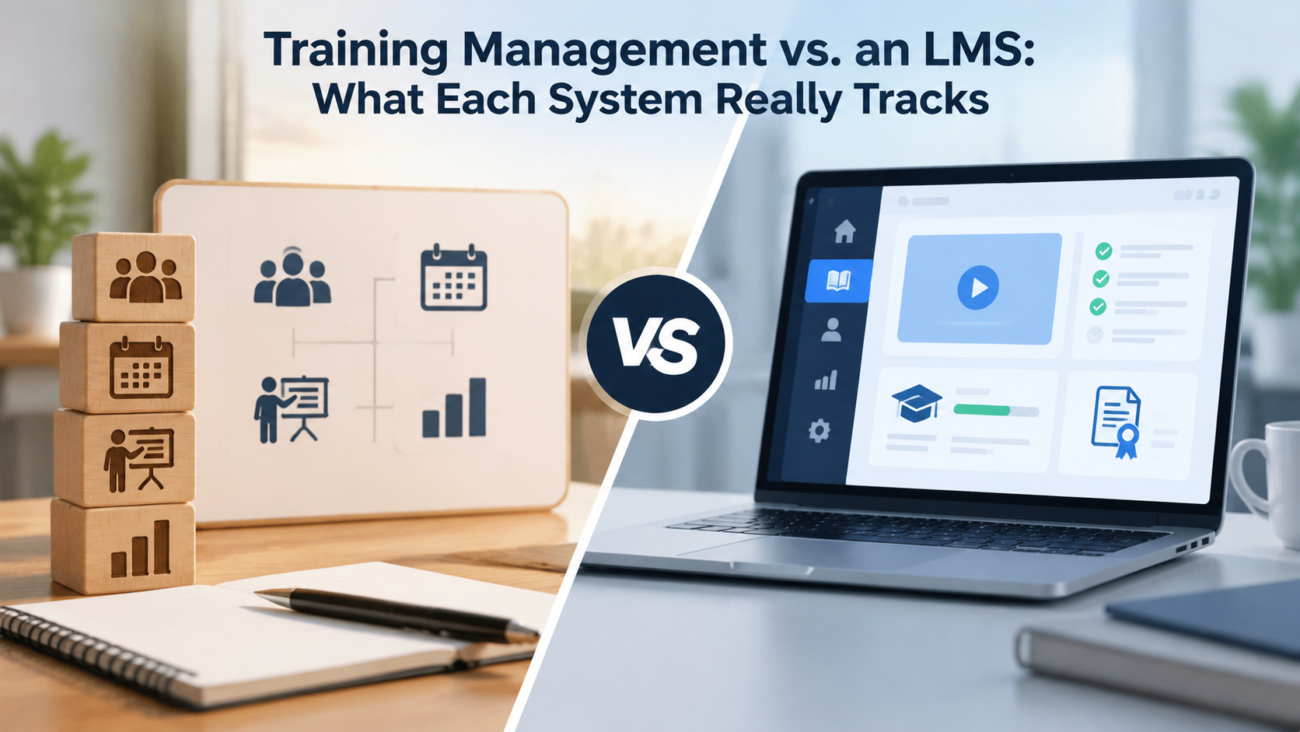
That fragmentation is where confusion around training management vs. an LMS begins. Both systems can work with assignments, completion records, certificates, or instructor-led learning depending on the product. The useful distinction comes from understanding which records each system is expected to hold, how detailed those records are, and what HR intends to do with the information afterward.
An LMS usually gives the deepest view of activity inside courses and learning programs. Training management can give HR and managers a wider view of learning that happened across internal programs, external providers, certifications, employee requests, or development plans. Comparing those records produces a much clearer buying decision than comparing software labels or counting features.
The practical question therefore goes beyond which platform offers more functions. HR needs to understand what information will remain available after learning happens, where that information will live, and whether managers can use it during later talent decisions. Once those questions are clear, the difference between training management and an LMS becomes much easier to understand.
TL;DR
An LMS is usually strongest at delivering learning and recording what happens while an employee moves through a course or learning path. Depending on the platform, it may track enrollment, progress, assessment results, completion, attempts, certificates, time spent, or live-session participation. That detail makes the LMS an important source when L&D teams need to understand activity inside formal learning.
Training management looks at the employee’s wider training record. It can help HR see assigned training, internal programs, third-party learning, certification records, employee-requested development, or group-based assignments in one place. The value becomes clearer when training needs to be viewed alongside employee development rather than treated as a collection of isolated course completions.
The distinction isn’t absolute because current learning platforms increasingly share functions. Some LMS products handle live-session scheduling, registration, attendance, reminders, or blended learning, while some training-management products connect directly with LMS platforms rather than trying to replace them. Buyers therefore need to compare actual records and workflows instead of relying on older category definitions.
BullseyeEngagement follows this connected model through its Training Management software. The platform can bring together internal and third-party training, manage assignments, monitor progress, support employee requests, and maintain certification information while working with existing learning systems. This creates a wider employee training view without forcing every learning experience into the same delivery platform.
The training management vs. LMS decision ultimately comes back to record ownership and purpose. If the main question is what an employee did inside a learning experience, the LMS will usually provide richer detail. If HR needs to understand what training an employee has completed across relevant sources and how that activity connects with development needs, training management becomes more useful.
What Training Management Actually Means
“Training management” doesn’t describe one fixed software category. Vendors use the term for different parts of the learning process, which explains why 2 pages discussing Training Management Systems may describe very different products. Buyers need to identify which meaning applies before they can make a useful comparison with an LMS.
The Training Operations Definition
Some vendors use Training Management System, or TMS, for software that manages the operational work behind instructor-led training. This type of platform may organize sessions, trainers, locations, learner registrations, waiting lists, attendance, or administrative communication. Its purpose is often to help training teams run recurring programs without relying on separate spreadsheets and manual scheduling processes.
This definition is common among organizations delivering large volumes of classroom, virtual instructor-led, or commercial training. Their problems aren’t limited to course content because they also need to manage capacity, instructor availability, course dates, learner communication, and operational reporting. In this model, the TMS runs much of the administration while an LMS handles the digital learning experience.
Common records in this type of training-management system may include:
- Course schedules, session dates, and delivery locations
- Trainer availability and instructor assignments
- Classroom or virtual-session capacity
- Employee registration and waiting-list information
- Attendance and cancellation history
- Course prerequisites and administrative requirements
- Training resources needed for each session
- Operational reports covering training activity
Current comparison material from D2L reflects much of this distinction. The LMS handles learning delivery and learner activity, while the TMS can handle more of the operational work surrounding instructor-led training. That definition is useful, but it doesn’t represent every way organizations use training-management software.
The Employee Training Record Definition
HR teams can use training management in a different way. In this context, the system creates a wider employee training record that brings together learning from several sources instead of concentrating mainly on scheduling and session administration. The goal is to make relevant development visible even when it didn’t happen inside the organization’s main LMS.
That wider record may include formal LMS courses alongside external certifications, internal workshops, employee-requested training, manager-approved development, or learning connected with a competency gap. HR can then see more of the employee’s development history without asking managers to search through different systems. This becomes especially useful in organizations where training happens through several providers or departments.
BullseyeEngagement fits this employee-record definition more closely. Its Training Management module can work with internal and third-party learning while supporting assignments, employee requests, progress monitoring, certifications, and LMS connections. This allows training information to sit within a wider employee context rather than remaining confined to the original learning platform.
The ISO 30422 learning and development guidance provides a useful broader frame for workplace learning. It considers learning and development in relation to current organizational requirements and future workforce needs while also recognizing employee development. That wider perspective helps explain why HR may need information beyond standard LMS completion reports.
An employee might complete a digital course, attend an external workshop, receive an industry credential, and later work through a manager-led development plan. Each activity contributes something different to the employee’s history, yet they may originate in separate systems. Training management becomes valuable when those records need to be understood together.
What an LMS Actually Tracks
An LMS is built around learning delivery and learner activity. Its records normally begin when an employee is assigned or enrolled in learning and continue as that person moves through courses, assessments, or learning paths. The amount of information available depends on the LMS, the content format, and how the learning environment has been configured.
Enrollment and Assignment Records
Enrollment is usually one of the first records created by an LMS. The platform needs to know which learner has access to a course, whether the course is required, when it was assigned, and whether a deadline applies. These records allow administrators to see learning obligations before the employee even starts the course.
Assignment information can also support role-based or group-based learning. An organization might automatically assign onboarding courses to new hires or require specific training for employees in a regulated role. The LMS can then report who received the assignment and whether they have taken action.
Progress and Completion Records
Once the employee starts learning, the LMS can record progress through the material. Depending on the product, that might include the date the course was launched, percentage completed, module status, learning-path progress, or the date of the learner’s latest activity. These records help administrators identify people who have started required training but haven’t yet finished.
Completion becomes the important record once the learner satisfies the conditions established for the course. Those conditions might involve finishing all required content, passing an assessment, attending a session, or completing a defined set of activities. The LMS can then retain the completion date and make that information available for reporting.
Assessment and Result Records
Assessment information provides another level of detail. An LMS may store quiz scores, pass or fail status, attempts, learner responses, or results against individual objectives depending on how the content has been built. This can help L&D teams understand performance within the learning experience rather than relying only on a final completion field.
A learner who passes an assessment after several failed attempts has a different learning history from someone who passes immediately. Both may eventually show as complete, but the underlying records can tell administrators more about how the learning progressed. That depth is one of the reasons an LMS remains useful even when HR also uses a wider training-management record.
How Content Standards Affect Tracking
Learning-content standards affect what information can move between content and the LMS. SCORM is one of the best-known examples because it provides a defined way for compatible learning content to exchange information with a learning platform. The SCORM technical overview explains how records related to completion, success, score, learner location, and time can be passed back to an LMS.
xAPI expands the idea of tracking beyond a traditional course session. The xAPI specification was designed to record learning experiences that can occur in different systems and settings. This matters because workplace learning increasingly happens through activities that don’t fit neatly inside a single browser-based course.
Current LMS products may also support instructor-led sessions, virtual training, blended programs, attendance, or other learning formats. The older claim that an LMS only handles self-paced eLearning no longer describes the full market. Buyers should inspect the product they are considering rather than applying a narrow category definition.
What an LMS May Know About One Employee
Consider an employee completing an online safety program. The LMS may know when the course was assigned, when the learner started, how far the person progressed, what assessment result was recorded, and when the course was completed. Depending on the platform, it may also issue a certificate and retain information about later renewal.
A typical LMS record may include:
- Course assignment and enrollment status
- Launch date and learner activity
- Progress through required content
- Assessment attempts and results
- Final completion status
- Completion date and certificate information
- Learning-path status where the course forms part of a larger program
These records give administrators a detailed view of the learning event. They can answer what happened inside the training experience and whether the learner satisfied the required conditions. What they don’t automatically provide is a complete employee development history across every learning source.
What Training Management Software Actually Tracks
Training management begins with a wider reporting need. HR may already know that an employee completed a course but still lack a reliable view of everything else the person has learned. This gap becomes more visible when employees receive development through external providers or internal programs that sit outside the main LMS.
Training Outside the LMS
External learning is common in many organizations. An employee may earn a professional certification through an industry body, attend a conference workshop, or complete specialist training arranged directly by a manager. Those activities may matter to the employee’s current role or future development even when the organization’s LMS never delivered them.
Internal training can create the same problem. One department may conduct a workshop without adding it to the LMS, while another team records attendance in a spreadsheet or shared file. Over time, the official learning record begins to represent only part of what actually happened.
Training management can give those activities a common employee context. Instead of asking managers to search email, local folders, or separate systems, HR can maintain a more complete training history. That record becomes useful during performance discussions and development planning because managers can see activity from more than one source.
Records HR May Need to Bring Together
The exact record depends on the product, but training-management software may bring together several types of information. The purpose isn’t to duplicate every piece of LMS activity because the LMS may remain the richer source for detailed course interactions. The goal is to keep the employee’s relevant training history visible.
Useful records may include:
- Assigned internal training and completion status
- External courses and professional certifications
- Training requested by the employee
- Manager-approved development activities
- Group or role-based assignments
- Certificate records and expiration information
- Past training history across several sources
- Training connected with development or competency requirements
BullseyeEngagement follows this employee-record approach. Its Training Management module can maintain internal and third-party training information, assign courses, support employee requests, track progress, and retain completed training certifications. The records can then contribute to a wider view of employee development.
That wider view becomes more useful when connected with Talent Development. Development plans can provide the reason training was selected, while later training records show whether the planned activity occurred. Managers then have a clearer connection between development intent and development action.
A Practical Employee Example
Suppose an employee is being considered for a future leadership position. The employee completes a management course through the company’s LMS, attends an outside workshop, and later participates in manager-led development. Each activity contributes to the employee’s progress, but the records may originate in different places.
The LMS can provide detailed information about the management course, including progress and assessment results. Training management can help HR see that course beside the external workshop and other development activity. The employee’s history becomes easier to understand because managers aren’t forced to treat one LMS completion as the entire development story.
This is one of the most useful differences in training management vs. LMS comparisons. One system often provides deeper information about learning activity, while the other can provide a wider view across several development sources. Organizations that need both perspectives should design the systems to work together rather than forcing every record into one platform.
Training Management vs. an LMS: A Record-by-Record Comparison
Feature lists can make these platforms look almost identical because current products overlap in several areas. A clearer comparison examines the actual record each system is expected to maintain, how detailed that record needs to be, and how it will be used after training. This approach also reduces the risk of assuming that every LMS or training-management product has the same functions.
| Record or Activity | LMS | Training Management |
| Learner enrollment | Common core function | May receive or manage assignment information |
| Digital course delivery | Core use case | Usually handled through an LMS or connected learning platform |
| Course completion | Common core record | Often included in wider employee training history |
| Assessment scores | Usually detailed | May receive the result where relevant |
| Learner attempts | Often recorded | Usually secondary |
| Time spent in learning content | Often available | Usually secondary |
| Learning paths | Common in many LMS products | May connect learning with broader development needs |
| Instructor-led attendance | Supported by many current LMS products | Common training-management record |
| External courses | Product-dependent | Often important |
| Training certificates | Common in many LMS products | Often maintained as part of employee history |
| Employee training requests | Product-dependent | Useful development workflow |
| Group assignments | Common in many LMS products | Useful for team or role-based training |
| Skills context | Depends on LMS functions or integrations | Can connect with competency information |
| Career-development context | Product-dependent | Can connect training with development plans |
| Succession context | Usually outside the central LMS role | Can become relevant through wider talent records |
| Compliance evidence | LMS may provide completion evidence | Can bring records from several learning sources together |
How to Read the Comparison
The table doesn’t mean a function can exist only in one system. Many LMS products support external learning, classroom attendance, certifications, and skill-related functions. Training-management platforms can also contain assignment and completion records that look similar to what buyers expect from an LMS.
The difference becomes clearer when teams look at depth and purpose. An LMS may retain detailed learning information because L&D needs to understand what happened inside a course. Training management may care more about whether that learning belongs in the employee’s wider history and how it connects with later development decisions.
The source of record matters as much as the presence of the feature. If the LMS owns the official completion date, other systems should receive that information without creating competing versions. If training management owns an external certificate record, HR needs to know how that record is handled when the employee later changes role or department.
A Better Vendor Test
A useful product demonstration should follow one employee through a realistic learning history. Ask the vendor to show a required digital course, an instructor-led activity, an external certification, manager-approved development, and a later role change. The demonstration should explain where every record appears and which platform owns the official value.
Buyers should also ask what happens when information changes. A completion may be corrected after an administrator discovers an error, or a certificate may be renewed before the original one expires. The vendor should be able to show how those changes move through connected systems without leaving contradictory records behind.
This type of demonstration exposes workflow gaps that feature lists can hide. A product may technically support external training but require enough manual work that employees rarely record it. Another platform may display training history clearly while depending on an integration for the course-level information HR expects.
Where Training Management and LMS Tracking Overlap
The boundary between an LMS and training management has become less rigid. Current learning platforms increasingly include functions that older category definitions placed in different systems. This overlap can reduce administrative work, but it can also create confusion when the same information exists in more than one place.
Live Training Is a Good Example
Some LMS products now manage instructor-led activity alongside digital learning. Functions may include session scheduling, registration, attendance, virtual events, or blended-program reporting. Organizations with these capabilities may not need another platform purely to administer basic live-learning activity.
Training management can still add value when HR needs that learning to appear beside external certifications or other employee development information. The question therefore changes from whether the LMS can record attendance to whether the wider employee record remains useful after attendance is recorded. That distinction is important when several systems contribute to the same person’s development history.
Certificates Can Exist in Both Systems
An LMS may issue a certificate automatically when a learner completes a course. Training management may then maintain that certificate or its status as part of the employee’s broader training history. Both records can be useful, but HR needs to know which one controls the official status.
The ownership question becomes important when certificates expire. One platform may hold the original completion date while another contains the renewal requirement or current document. Without a clear rule, managers may find different expiration information depending on which system they open.
Assignment Records Can Overlap Too
An LMS can assign learning through groups, administrator actions, or learning paths. Training-management software may also create assignments based on employee development requirements. Overlap becomes a problem when both systems independently create the same assignment.
Clear record ownership reduces this risk. HR should decide where the original assignment is created, which platform owns the official completion status, and how connected systems receive updates. The same rules should cover corrections so that inaccurate information doesn’t remain in one platform after it has been fixed in another.
For each important training record, teams should document:
- Where the original record is created
- Which platform owns the authoritative value
- Which connected systems receive the record
- How later corrections move between systems
- What happens when the connection fails
- Who is responsible for resolving mismatched information
Training information becomes more useful when it also connects with employee capability. BullseyeEngagement’s Competency Management software can map role requirements and identify employee gaps that may lead to development activity. In that model, the LMS can manage the learning experience while competency and training records provide the reason the learning happened.
Where Training Data Gaps Start to Cause Problems
Training-data problems often begin with ordinary workarounds rather than major technology failures. A certificate gets emailed to a manager, attendance remains in a spreadsheet, or an external course never reaches the organization’s main learning record. Each gap looks small until HR later needs to make a decision based on information that is incomplete.
Scenario: The Missing Certification
An employee completes a professional certification through an external provider and sends the certificate to a manager. The manager stores the file locally, but the document never becomes part of the employee’s central training record. Months later, another manager reviews the employee’s development history and assumes the certification was never completed.
The employee then has to prove the same training again. HR may also miss the renewal date because the evidence is sitting in a location nobody checks regularly. The problem wasn’t the learning activity because the employee completed it successfully, but the organization failed to keep a usable record.
Scenario: Training Tracked in a Spreadsheet
A regional team runs an internal workshop and tracks attendance in a spreadsheet because the course isn’t part of the LMS. The event goes well, but the attendance record remains inside the department instead of reaching HR. Several months later, the organization launches similar training and automatically assigns it to some of the same employees.
Managers now have to determine who should be exempted from the new requirement. Employees may be asked to repeat content they already completed because the earlier record can’t be found quickly. A small tracking gap has turned into unnecessary administrative work.
Scenario: An Employee Changes Roles
Role changes can create another problem. An employee may continue receiving training assigned for a former role while required learning for the new position hasn’t appeared yet. This becomes harder when the HR system owns role information but the learning system manages assignments independently.
A well-designed connection should update the learning requirement when employee information changes. HR also needs to preserve historical learning rather than removing useful records simply because the employee moved to a new position. Training management can help provide that continuity when the wider employee history matters.
When Records Have Regulatory Value
Some workplace training carries specific recordkeeping requirements. OSHA guidance on electronic certification of training provides an example of circumstances where training records and electronic certification may need to satisfy requirements under relevant standards. Organizations still need to confirm the exact requirements that apply to their work because obligations differ by regulation and training type.
The wider lesson is that completion and proof of completion may be different records. An LMS may know that the employee finished a course while another system holds the certificate or evidence needed later. HR needs to know where both pieces of information are stored and how long they must remain available.
Training records also matter during performance discussions. BullseyeEngagement’s Performance Management software can connect review activity with goals and competency information. When a review identifies a development need, managers gain more value if they can later see whether the related learning was actually completed.
Why Course Completion Isn’t the Whole Development Record
Course completion answers an important question about activity. It tells HR that an employee satisfied the conditions established for a learning experience and usually provides a date or status that can be reported later. What it doesn’t automatically prove is whether the employee can apply the capability effectively in daily work.
Completion Measures Learning Activity
Completion reports are useful when organizations need to verify participation or track required training. They can show whether an employee finished an assigned course, whether a deadline was met, or whether a learning path remains incomplete. These questions matter for routine learning administration.
The record still needs context when the organization is trying to understand development. An employee can pass an online assessment but still require practice before applying the skill independently. Another employee may gain meaningful capability through coaching or project work even though those experiences don’t produce a conventional LMS completion.
Development Needs Context
SHRM’s development and training guidance connects workplace learning with skill gaps and organizational needs. This approach gives the learning activity a clear reason instead of treating every course as an isolated event. HR can then examine whether the selected development action actually addressed the original need.
A stronger employee development record should help managers answer questions such as:
- What capability was the employee expected to develop?
- Why was the training selected?
- Which role requirement created the need?
- What learning activity was completed?
- What evidence exists after the learning?
- Does another development action still need to happen?
- Has the employee’s readiness changed?
These questions require more than a completion field. They require a link between the employee’s current capability, the development action, and the later evidence used to judge progress. Training records become more valuable when that connection remains visible.
Connecting Training With Competency Gaps
BullseyeEngagement can connect development with employee competency information. Its competency tools can compare employee capability with role expectations and identify gaps that may require training or another development action. This allows managers to understand why an assignment exists instead of seeing only a course title.
Suppose an employee preparing for a senior finance role has a gap in financial modeling. The employee completes a related course and later works on a project where the skill is required. The LMS completion confirms that the training happened, while later competency or performance evidence can help the manager judge whether the capability improved.
The same logic applies to future-role development. BullseyeEngagement’s Succession Planning software can connect employee development with readiness for important positions. Training then becomes one part of a wider readiness record rather than the final measure of employee capability.
How BullseyeEngagement Fits Around an Existing LMS
BullseyeEngagement doesn’t require organizations to treat training management and the LMS as competing systems. Its Training Management module can work with internal and third-party learning while giving HR a central view of employee activity. This model is useful for organizations that already have an LMS they want to keep.
Keep the LMS Where It Already Works
A company may have spent years building content inside its LMS. The platform may already contain onboarding programs, compliance courses, product training, technical learning, assessments, or historical completion information. Replacing that environment only to improve wider HR visibility can create migration work without solving a course-delivery problem.
Training management can instead sit around the existing learning environment. The LMS continues to handle the learning experience and detailed course records, while BullseyeEngagement can help bring training activity into a wider employee context. This allows each system to handle the information it is better placed to maintain.
Follow One Employee Through the Process
Consider an employee named Jordan who completes an online compliance course through the organization’s LMS. The LMS records Jordan’s course activity, assessment result, completion date, and related information. That detailed record remains useful to L&D because it describes exactly what happened during the learning experience.
A month later, Jordan attends an external industry workshop that doesn’t originate inside the company LMS. Jordan then requests a leadership course connected with an agreed development plan, and a later competency assessment identifies another area that needs attention. HR now needs to understand several connected development activities rather than one course completion.
Training management can help create that wider view. The LMS still provides detailed evidence for the learning it delivers, while BullseyeEngagement can provide visibility across the employee’s broader training history. Managers can then follow development without forcing every activity into the same system.
Why the Wider Talent Connection Matters
BullseyeEngagement’s solutions overview places Training Management beside talent functions such as competency management, development, performance management, succession planning, workforce planning, and reporting. This matters because training often starts with an HR need and later feeds into another HR decision. Keeping those connections visible can make the training record more useful.
A practical development flow might look like this:
- A development need is identified. A performance review, competency assessment, or manager discussion identifies an area that requires attention. The reason for development is recorded before training is selected.
- Relevant training is assigned or approved. The employee receives learning through the LMS, an internal program, or an external provider. The assignment now has a clear relationship with the development need.
- Training activity is recorded. Completion information and supporting records become visible to the people responsible for the employee’s development. External learning can be represented alongside LMS-based activity.
- Progress is reviewed later. Managers revisit the original development need during future discussions. Training history gives them evidence about what development actions actually occurred.
- The next action is decided. The employee may need additional learning, applied experience, or another development activity. The decision starts from an existing history rather than a disconnected course list.
The value comes from continuity. Training management and an LMS don’t need to compete when each system has a clear role. The better setup is the one that gives employees a workable learning experience while giving HR records it can trust.
When an LMS Is Enough and When Training Management Adds More
Some organizations won’t need another training-management layer. Their existing LMS may already answer the learning questions HR and managers need to ask, particularly when most training happens inside that platform. Adding another application should solve a real record problem rather than simply add another place to store information.
An LMS May Be Enough When
An organization may be well served by its LMS when most relevant learning is already delivered or recorded there. Managers should be able to see the training history they need, certificate workflows should work as expected, and instructor-led activity should already be handled at the required level. External development should represent a small enough share of activity that it doesn’t create significant reporting gaps.
Typical signs include:
- Most employee training is already delivered or captured in the LMS.
- Managers can find the learning history they need without using separate files.
- External certifications represent a small share of employee development.
- Certificate and renewal processes already work as required.
- Instructor-led learning is handled at an acceptable level.
- HR doesn’t maintain substantial training evidence outside the LMS.
In this situation, another system may provide limited value. The organization should first confirm whether its existing LMS can solve any remaining reporting issues through configuration or existing integrations. A second platform makes more sense when the current gap exists outside the learning-delivery environment.
Training Management Adds More Value When
The picture changes when learning spreads across several sources. External certifications may matter, managers may approve development outside the LMS, or departments may run training independently. HR then needs a wider employee record because the learning platform no longer contains enough of the development history.
Common signals include:
- External certifications are important to employee roles.
- Managers frequently approve training outside the LMS.
- Employees attend third-party learning programs.
- HR stores training evidence in email or shared folders.
- Competency gaps need to connect with development activity.
- Managers can’t find a reliable employee training history.
- Connected systems report different completion status.
- Training records need to support future-role discussions.
These issues point to a visibility problem rather than a course-delivery problem. Training management becomes useful because HR needs a place where learning from different sources can be understood together. The system should reduce fragmentation without creating another conflicting source of truth.
Consider Future Workforce Needs
Training information can also contribute to future workforce decisions when it is connected with skills and employee readiness. BullseyeEngagement’s Workforce Planning software supports analysis of workforce information and future talent requirements. Training history can provide additional development evidence when organizations are examining whether employees are preparing for upcoming needs.
Course counts alone can’t answer whether the organization has the capability required for future work. Training connected with competency information provides more context because leaders can see whether development is aimed at an identified need. This is one reason broader training records become more useful as organizations connect learning with talent planning.
The right choice depends on what HR expects the record to support. If the organization mainly needs learning delivery and participation reporting, the LMS may be enough. If managers need visibility across several learning sources and want that activity connected with employee development, training management becomes more valuable.
What to Check Before Choosing or Connecting Training Systems
A training-system evaluation should start with records and workflows rather than a long feature sheet. Many platforms can claim support for assignments, certificates, reporting, or integrations. The important question is how those functions behave when real employee information moves between systems.
Start With Record Ownership
Create a simple ownership map before comparing products. This forces the buying team to decide where important information should originate and which systems only need a copy. It also makes integration requirements easier to define because the team knows which records need to move.
| Record | Possible Source of Record | Questions to Ask |
| Course enrollment | LMS | Who creates it and when? |
| Course completion | LMS | How quickly does it update elsewhere? |
| External training | Training management | Who can add or approve it? |
| Certificate | LMS or training management | Which record controls current status? |
| Competency gap | Talent system | How does it lead to development? |
| Development plan | Talent system | Can training activity update it? |
| Historical training | Existing systems | How will older records be imported? |
The table should be completed using the organization’s own systems rather than treated as a generic template. Different companies may choose different sources of record, and that is acceptable when the ownership rules are clear. Confusion becomes more likely when the same field is treated as authoritative in several applications.
Test the Integration Itself
Integration needs more scrutiny than a yes-or-no response on a feature sheet. Buyers should ask which records actually move, how often updates happen, and what occurs if an administrator changes a record after it has already been transferred. A connection that moves only basic completion information may not support every HR reporting requirement.
Failure scenarios should also be tested. If the connection stops working temporarily, HR should know whether records wait for later transfer or require manual correction. The vendor should also explain how administrators identify failed updates before managers start seeing contradictory information.
Check Identity and Historical Records
Employee identity can create hidden reporting problems. Systems may match people using employee IDs, email addresses, or another identifier, and differences between those values can split one employee’s training history. Buyers should verify how employees are matched and how duplicate records are resolved.
Historical information also deserves attention. Organizations with years of training activity need to know how much history can be imported, whether old certificates remain searchable, and whether previous course names are preserved. Migration quality matters because an incomplete history can reduce confidence in the new system immediately after launch.
Review Practical Employee Workflows
A useful demonstration should cover the experience of employees and managers as well as the administrator interface. The vendor should show how training moves from request or assignment through completion and later reporting. Real workflows make it easier to identify unnecessary manual steps.
Ask the vendor to demonstrate:
- How an employee requests training
- How a manager reviews the request
- How an external certificate is recorded
- How LMS completion appears in the wider employee record
- How a role change affects future assignments
- How a manager views team training history
- How certificate renewal is handled
- How an incorrect completion record is corrected
These demonstrations can expose problems that screenshots won’t reveal. A process may look straightforward in a feature description but still require several manual actions once an employee uses it. Buyers should judge whether the workflow is realistic for everyday use.
Look Beyond Completion Reporting
Training reporting should answer real management questions at employee, team, department, and organizational level. NIST SP 800-50 Rev. 1 discusses metrics and evaluation within learning-program management, which reinforces the need to examine more than simple delivery counts. Organizations need information that helps them judge whether learning activity supports the purpose for which it was created.
The U.S. Office of Personnel Management training evaluation guidance also connects training evaluation with organizational performance. A report showing high completion may answer a participation question, but it doesn’t automatically explain whether the learning addressed the original development need. Training reporting becomes more useful when organizations can connect the activity with its intended result.
Connect Reporting With Wider HR Information
BullseyeEngagement’s Leadership Human Capital BI Dashboard can place human-capital information into a wider reporting view. This type of connection matters when leaders want to examine training alongside other workforce information rather than treating learning reports as a separate dataset. Managers can then consider training activity within the wider context of talent decisions.The final system decision should come back to trust. Managers need confidence that the employee training record reflects what happened and that relevant development isn’t hidden somewhere else. A long feature list has limited value when the underlying records can’t answer practical questions.
Common Questions About Training Management and LMS Tracking
Is Training Management the Same as an LMS?
Training management and an LMS can overlap, but they generally begin with different purposes. An LMS focuses heavily on delivering learning and recording activity inside learning experiences, while training management may maintain a wider employee training history or manage the administration surrounding training. The exact distinction depends on the product, so buyers should compare workflows rather than rely on category labels.Vendor terminology can make the issue more confusing because one company may call its product a TMS while another places similar functions inside an LMS. Organizations should therefore ask vendors to show the employee record and explain where each type of training information is stored. That demonstration gives a clearer answer than the software name alone.
Can Training Management Software Replace an LMS?
Some training-management products may contain enough learning-delivery functions to serve organizations that don’t require a separate LMS. Other products are designed to work beside an LMS and focus on training visibility, external learning, certificates, or wider employee records. The correct answer depends on the actual learning requirements rather than the product category.BullseyeEngagement supports LMS connections, which allows organizations to keep existing learning systems while bringing training information into a wider employee context. This can be useful when the current LMS already handles course delivery well. The organization can improve visibility without replacing a system that is still meeting its learning needs.
What Does an LMS Usually Track?
An LMS commonly tracks enrollment, learning progress, completion, assessment results, course attempts, learning-path activity, and other information connected with the learner experience. The amount of detail depends on the platform and content format. Standards such as SCORM can allow content to send defined learning information back to the LMS.Current LMS platforms can also include live-training records and other functions that older systems may not have supported. Buyers should therefore inspect the specific product rather than assuming every LMS has the same limits. The most useful question is what the system can record at the level required by the organization’s learning programs.
Can an LMS Track Instructor-Led Training?
Many current LMS products support instructor-led learning as well as digital courses. Functions can include registration, scheduling, attendance, virtual sessions, or blended-program reporting. The depth of these functions still varies considerably between platforms.Organizations running large or complicated instructor-led programs should test those workflows carefully. A platform may support attendance but offer limited scheduling or resource administration. Buyers should compare the real operational requirement with what the LMS can actually handle.
Why Keep Training Records Outside the LMS?
Employees often learn through activities that don’t originate inside the primary LMS. External certifications, workshops, manager-approved courses, and other development experiences can still matter to current job requirements or future career plans. HR may therefore need a wider record that includes learning from more than one source.Training management can help bring those activities into a common employee view. The LMS can continue holding detailed information for the learning it delivers, while the wider record represents other relevant development. This approach reduces the need to force every activity into the main learning platform.
Does Course Completion Prove That an Employee Has the Required Skill?
Course completion proves that the employee satisfied the conditions established for the learning activity. It doesn’t automatically demonstrate that the person can apply the skill effectively during real work. A completed course should therefore be treated as one piece of development evidence.Competency assessment, manager observation, job results, or another evaluation method may be needed to judge whether capability changed. The best method depends on the skill and the role. Training records become more useful when they sit beside this later evidence rather than replacing it.
How Should Training Connect With Competency Management?
Competency management can identify the capability expected for a role and show where an employee has a gap. Training can then be selected because it addresses that specific need, giving managers a clear reason for the assignment. This makes the development process easier to understand later.After the learning occurs, another assessment or workplace evidence can help managers judge progress. The training record shows what action was taken, while competency information provides context for why the action mattered. This connection gives development history more meaning than a standalone course list.
Which System Should Hold Training Certificates?
Organizations should identify one authoritative location for certificate status even when several systems can display the document. HR needs to know where expiration dates, renewal information, and supporting evidence are maintained. Clear ownership reduces the chance of different platforms showing different answers.The choice may depend on where the certificate originated and who needs to use it later. A certificate generated by an LMS may remain there while its status is shared with training management, or an external certificate may be stored directly in the wider employee record. The important point is to establish ownership before conflicting copies appear.
Do Organizations Need Both Training Management and an LMS?
Some organizations can meet their requirements with one platform, especially when most relevant learning already happens inside the LMS. Others benefit from using an LMS for detailed learning delivery while training management provides a wider employee view across external learning and other development activity. Neither setup is automatically better for every organization.The decision should follow the organization’s actual records and workflows. Teams should identify where learning happens, what managers need to see later, and how training connects with wider development. Once those requirements are clear, it becomes easier to decide whether one system is enough.
What Is the Biggest Difference Between Training Management and LMS Reporting?
The biggest difference often appears in the context surrounding the learning record. LMS reporting usually provides richer information about learner activity inside courses, while training management can connect that activity with a wider employee history across several learning sources. That wider context becomes valuable when HR needs to understand development over time.When training records also connect with competencies, development plans, performance discussions, or future-role information, managers can see why learning happened and what should follow. The course record still matters, but it becomes part of a wider employee story. That is where training management can add meaning beyond the LMS completion report.
