
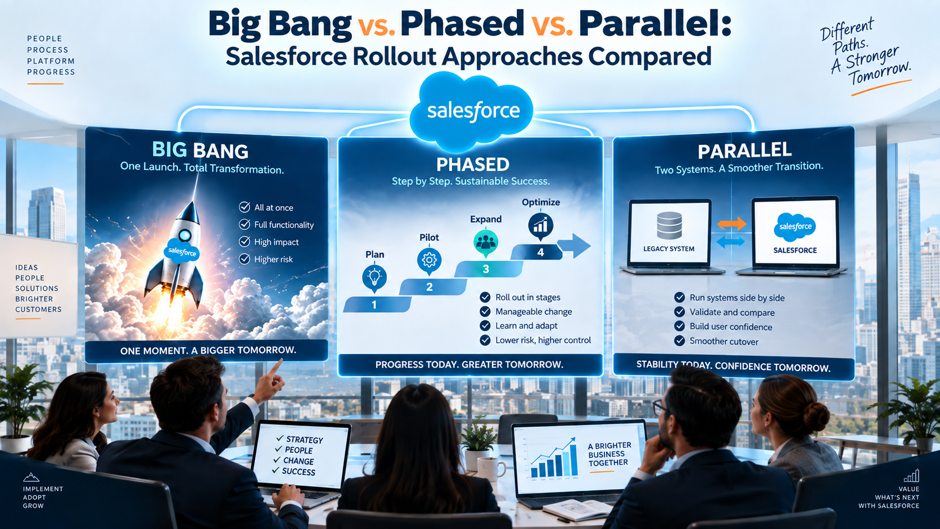
The most consequential decision in a Salesforce implementation isn’t the configuration. It’s the rollout approach. How you sequence going live determines how risk concentrates, how quickly users start generating value, how change management pressure lands on the organization, and what happens when something goes wrong. Get it right and the deployment becomes a platform the business grows into. Get it wrong and the same technology becomes a recovery project before the first quarter closes.
Three core approaches dominate Salesforce deployments: Big Bang, Phased, and Parallel. A fourth, the Hybrid approach, blends elements of all 3 and is a common option for mid-market and enterprise implementations with mixed risk profiles. Each approach carries a distinct risk and cost profile, fits a different organizational context, and produces different outcomes on adoption, timeline, and total cost of ownership. None of them is universally correct.
TL;DR
| Approach | Best for | Primary risk | Speed to value |
| Big Bang | Small businesses, clean data, simple processes, hard deadlines | Everything fails at once if something goes wrong | Fastest single go-live |
| Phased | Large enterprises, multi-cloud, complex processes, high adoption risk | Extended timeline; project-fatigue; split processes during transition | Moderate: early phases get value first |
| Parallel | High-stakes migrations, regulated industries, low tolerance for failure | Cost of running 2 systems; data sync complexity; user confusion | Slowest to full commitment |
| Hybrid | Most mid-market and enterprise scenarios with mixed risk profiles | Requires deliberate governance across phases | Flexible: fastest where risk is lowest, cautious where it’s highest |
The approach that delivers the best Salesforce ROI is the one matched to your actual risk tolerance, data maturity, organizational readiness, and business continuity requirements, not the one that looks simplest on a slide.
What the Decision Actually Involves
Choosing a rollout approach isn’t a technical decision. It’s a risk management decision that happens to have technical consequences, and the distinction matters because it changes where the analysis should start. The question isn’t which approach is safest in the abstract. Every approach has a failure mode. The question is which failure mode your organization can best absorb, given your users, your data, your timeline, your budget, and how much operational disruption the business can tolerate while the new system proves itself.
Four factors drive the decision more reliably than any other. Each one points toward a different set of tradeoffs between speed, risk, cost, and organizational capacity.
| Decision factor | What it means for approach selection |
| Data readiness | Clean, well-understood source data supports a faster cutover. Poor source data increases migration, testing, reconciliation, and schedule risk. Use phased or parallel when smaller validation windows are needed before broader deployment. |
| Organizational change capacity | High change capacity can support a faster rollout. When restructuring, leadership change, a product launch, or another major initiative is already in flight, phased or hybrid sequencing can reduce peak adoption pressure. |
| Business continuity requirements | Low tolerance for disruption favors a cautious route. Regulatory, contractual, or business-continuity requirements can make a parallel period appropriate when a working fallback, live reconciliation, or staged validation is specifically required. |
| Timeline and budget constraints | Hard deadlines can favor a faster cutover. Phased and parallel approaches generally extend delivery time and can increase project or operating cost, so timeline and budget constraints should be tested against the risk the business can absorb. |
None of these factors is decisive in isolation. The right approach is the one that handles the most demanding factor in your specific situation without creating an unacceptable failure mode in another.
The Big Bang Approach
Big Bang means one go-live date for the entire organization: all users, all data, all workflows, and all integrations switch to Salesforce at the same moment. The legacy system goes dark. Active operations switch at one cutover point, while a tested technical or operational rollback path can still be retained for the cutover window.
The appeal is real. Big Bang is the fastest path to a fully live system and typically the lowest total cost when everything goes smoothly. A single cutover eliminates the operational complexity of running split processes across old and new systems, avoids the user confusion that comes from some teams being live while others are still on legacy systems, and compresses the total project timeline.
The risk is equally real. When something goes wrong in a Big Bang deployment, it goes wrong for everyone simultaneously. A data migration error affects every user. An integration failure breaks every connected workflow. A performance problem under full production load hits every team at once. The support burden concentrates into a single compressed window when both the technical team and the users are under maximum stress. For organizations without a clear rollback plan, a Big Bang failure can mean days or weeks of operational disruption before the system stabilizes.
Big Bang works when:
- The organization is small enough that training and change management can be completed before go-live for all users
- The data environment is clean, well-understood, and validated through test migrations before cutover
- The processes being implemented are straightforward, with limited integration complexity
- A hard external deadline makes a phased approach impractical
- Leadership has done a genuine readiness assessment and is confident the organization is prepared
Big Bang fails when:
- Data quality problems weren’t fully diagnosed before the project started
- User training was compressed or skipped because of timeline pressure
- The integration landscape is complex and some integrations weren’t fully tested under production conditions
- There’s no tested rollback plan for the day-of cutover
- Change management was treated as an afterthought rather than a workstream
The single clearest warning sign that Big Bang is the wrong choice is when the project team is counting on the go-live deadline to force adoption rather than building genuine readiness before it.
The Phased Approach
A phased rollout breaks the implementation into discrete stages, typically organized by business unit, geography, or product module. Sales goes live first. Service Cloud follows in the next phase. Marketing automation and advanced integrations come later. Each phase completes, stabilizes, and gets adopted before the next one begins.
Phased rollouts limit the number of users and processes exposed at one time. The reason is structural: phased rollouts surface problems at a scale where they’re fixable, not at a scale where they cascade into an organizational crisis. A data issue discovered during phase 1 gets corrected before it affects the phase 2 migration. A workflow gap identified by the Sales team becomes a lesson applied to the Service team’s configuration. Each phase builds on the lessons of the one before it.
The adoption dynamic is also fundamentally different. Users get the system in manageable increments. The support team can focus intensive attention on phase 1 users before the phase 2 user group goes live. Power users from early phases become internal champions for later phases. The change management load spreads across time rather than concentrating at a single moment.
The costs of this approach are real. Extended timelines mean more consulting hours and a longer period of organizational focus on the implementation. During the transition, some processes will span old and new systems, creating operational awkwardness, data synchronization requirements, and interim procedures that users find frustrating. Teams in later phases can develop a sense that the project will never end, particularly if early phases run over their planned timelines.
A typical phased sequence for a mid-market business:
| Phase | Timeline | What goes live |
| Phase 1: Core CRM | Months 1 to 3 | Sales Cloud for the commercial team: opportunity management, contact and account data migration, basic reporting |
| Phase 2: Service | Months 4 to 6 | Service Cloud for the customer success team: case management, email integration, service-level automation, knowledge base |
| Phase 3: Marketing and integrations | Months 7 to 9 | Marketing Cloud or Marketing Cloud Account Engagement integration, advanced reporting, Data 360 connection for unified customer profiles, secondary integrations |
| Phase 4: AI and optimisation | Month 10 onwards | Agentforce features, advanced analytics, secondary use cases, and continuous optimization |
This sequence is illustrative, not universal. Some organizations phase by geography rather than by product. Others phase by business unit. The right phasing structure is the one that minimizes the period where related processes run across split systems and maximizes the value of early phases as proof points for organizational commitment. The data foundation established in phases 1 and 2 directly determines what becomes possible in phase 4: AI setup in Salesforce using Agentforce, Data 360, and Einstein depends entirely on the quality and completeness of the CRM data that precedes it.
Phased works when:
- The organization is large enough that training and change management for all users simultaneously would be unmanageable
- Different business units or geographies have different readiness levels
- Risk appetite is low and the organization prefers learning at smaller scale before committing fully
- The implementation involves multiple Salesforce products with dependencies between them
- The business needs to demonstrate early value to maintain executive sponsorship
Phased fails when:
- Phase dependencies aren’t managed carefully and phase 2 has to wait for unresolved issues in phase 1
- Timeline slippage in early phases cascades into “project never ends” fatigue for users in later phases
- Interim processes spanning old and new systems aren’t documented and governed clearly
- Phase definitions are too granular, producing a 7-phase project where 4 would have been cleaner
- Each phase go-live generates another wave of disruption without enough stabilization time between them
Phased rollouts fail most often not because the approach was wrong but because the phase boundaries were poorly drawn or the stabilization time between phases was compressed by timeline pressure.
The Parallel Approach
A parallel rollout runs the old system and the new Salesforce org simultaneously for a defined period. Users work in both environments. Data is kept synchronized between them. At the end of the parallel run period, the organization commits fully to Salesforce and decommissions the legacy system.
Parallel running carries the lowest go-live risk of any approach. If Salesforce has a critical problem during the parallel period, the legacy system is still operational. Rollback is genuinely available, not just a theoretical option. For organizations with regulatory, contractual, or business-continuity requirements that specifically call for a working fallback or live reconciliation, this safety net can justify the additional cost and complexity.
The cost and complexity are substantial. Running 2 complete systems means paying for both environments, requiring users to enter data in both (or maintaining a synchronization mechanism that doesn’t require double entry), managing the divergence that naturally develops between 2 live data sources over time, and extending the project timeline and team engagement significantly. The parallel period should be long enough to test production volume, reconciliation, integrations, user processes, and fallback readiness, while still having a fixed decommission date and enough time to resolve material exceptions before the legacy workflow is retired.
The user experience during a parallel run is the most frequently underestimated challenge. Users who are expected to work in 2 systems simultaneously develop workarounds, enter data inconsistently, or gravitate toward whichever system feels more familiar. The parallel run is supposed to build confidence in Salesforce. In practice, it often builds confusion and attachment to the legacy system. Clear governance about which system is the system of record for each data type, and a defined transition plan with a hard decommission date, is the difference between a parallel run that builds confidence and one that creates indefinite indecision.
Parallel works when:
- Regulatory requirements or contractual obligations require continuity assurance during the transition period
- The organization has very low tolerance for any period of CRM downtime or data uncertainty
- The legacy system is being decommissioned on a vendor-controlled timeline, not the organization’s preferred timeline
- Data validation against a live comparison system is genuinely required for accuracy assurance
- The business case can absorb the cost of running 2 complete systems for the duration
Parallel fails when:
- Users develop permanent attachment to the legacy system during the parallel period and resist the decommission date
- Data diverges between systems and reconciliation becomes the primary activity instead of the secondary one
- The parallel run extends beyond its planned window without a new hard commitment date
- Nobody has defined which system is authoritative for which data type during the transition
- The cost of 2 systems erodes the business case for the Salesforce investment before the migration completes
For organizations using Salesforce identity resolution as part of their Data 360 strategy, a parallel period can also serve a specific data purpose: using the overlap window to validate that identity matching between the legacy system and Salesforce is producing the correct unified customer profiles before the legacy system goes dark.
The Hybrid Approach
The Hybrid approach applies different rollout strategies to different parts of the implementation based on the risk profile of each segment. Panorama’s 2026 ERP survey found 37.6% of respondents used a hybrid approach. That shows hybrid is common in broader enterprise-software implementations, but the figure shouldn’t be treated as Salesforce-specific market share.
The appeal is pragmatic. Different parts of any organization carry different risk profiles, and a single rollout approach applied uniformly produces suboptimal results for at least one segment. Hybrid lets you match the approach to the actual risk in each part of the business. Three patterns account for most real-world hybrid deployments.
Big Bang for the pilot, Phased for the rest.
The most common hybrid pattern takes one business unit or geography live on a Big Bang cutover to demonstrate speed and build organizational confidence, then sequences the remaining units through a phased rollout. The pilot provides early proof points and lessons that improve each subsequent phase. A controlled pilot or staged Agentforce deployment can reduce risk before broader rollout, especially when actions, permissions, or data dependencies are complex.
Phased by product, parallel for critical integrations.
Some organizations run a standard phased product rollout while keeping a parallel period specifically for high-stakes integrations or regulated data categories where a fallback option is legally or contractually required. The rest of the business goes live faster while the high-risk elements are validated more carefully.
Big Bang for clean segments, Phased for complex ones.
When some parts of the organization have clean data, experienced users, and low process complexity while others have legacy complications, different segments get different approaches based on their actual readiness rather than a single company-wide timeline.
Hybrid works when these conditions apply.
Different business units, geographies, or user groups carry materially different risk profiles. Some parts of the implementation are well-defined and low-risk while others are complex and high-risk. A pilot entity can go live fast to build organizational confidence before broader rollout. The implementation spans multiple Salesforce products with different dependency and readiness profiles.
The governance requirement for a Hybrid approach is higher than for any single-strategy approach. Managing multiple simultaneous rollout phases with different timelines, different user groups, and different support requirements demands deliberate coordination. The Flow logging and governance practices that keep the Salesforce org maintainable across overlapping releases need to be established before the hybrid phases begin, not retrofitted after the first conflict between simultaneously live configurations.
Head-to-Head Comparison
| Criterion | Big Bang | Phased | Parallel | Hybrid |
| Speed to full go-live | Fastest | Slowest | Slow | Variable |
| Risk concentration | High: all at once | Low: contained per phase | Lowest: legacy fallback available | Mixed: by segment |
| Total cost | Lowest (if smooth) | Higher over time | Highest | Depends on mix |
| Change management load | Maximum at one moment | Spread across time | Spread, but user confusion risk | Spread, structured per segment |
| Data migration approach | Single cutover | Incremental by phase | Parallel loads with sync | Mixed by segment |
| Rollback option | Difficult or impossible | Possible per phase | Available throughout parallel period | Depends on segment approach |
| Best org size | Small to mid-market | Mid-market to enterprise | Any, with high continuity needs | Mid-market to enterprise |
| Adoption risk | High if go-live fails | Lower: incremental adoption | Moderate: legacy attachment risk | Managed by segment |
No single column in this table is decisive on its own. The right approach is the one where the failure modes in the risk column are the ones your organization is best positioned to manage.
The Decision Framework
Walk through these questions in order before settling on an approach. The answers narrow the field faster than any framework built around abstract risk categories.
1. How clean is your source data?
If you haven’t done a data assessment, do one before choosing an approach. Poor source-data quality increases migration work, testing, reconciliation, and schedule risk. If major data issues are unresolved, favor phased, parallel, or hybrid sequencing so validation happens in smaller units. If source data is clean and test migrations pass, Big Bang remains possible where the other conditions support it. Data quality practices for Data 360 activation apply equally to CRM migration: clean data entering the new system determines the accuracy of everything built on top of it.
2. What’s your business continuity tolerance?
If operations require a working fallback or live reconciliation, use parallel for the affected scope. If dual operation is unnecessary, phased or hybrid can contain exposure. If the business can tolerate a controlled single cutover and rollback is tested, Big Bang remains in consideration.
3. How many users, and how distributed?
50 users in one office may be practical to train, support, and cut over together. A distributed workforce across countries, business units, or time zones creates a stronger case for phased or hybrid sequencing. Map each user group to training capacity and cutover support before deciding whether one go-live is realistic.
4. Is there an external deadline?
A vendor contract expiration, regulatory date, or board commitment can constrain the approach. A hard date may favor Big Bang or a narrower first phase, but it should not erase testing, training, data validation, or rollback work. If the scope cannot meet the date, reduce the first release and move lower-priority work into later phases.
5. How many Salesforce products and integrations are involved? A single Sales Cloud rollout with limited integrations can support a faster cutover. Multi-cloud programs, numerous integrations, or tightly coupled dependencies usually favor phased or hybrid sequencing because each dependency can be validated before the next group moves. When later phases include capabilities like
predictive lead scoring and marketing automation that depend on clean, stable foundational data from earlier phases. Choosing the right Salesforce consulting partner for a complex multi-cloud rollout should include evidence that they can manage the chosen sequence, integration dependencies, cutover controls, and recovery decisions, not just Salesforce certifications.
6. What’s the change management capacity?
A highly change-capable organization with experienced users, strong executive sponsorship, and dedicated change support can absorb a faster approach. If users are already handling restructuring, policy changes, or major launches, phased or hybrid sequencing can spread training and support demand. Choose the fastest route the organization can actually absorb without compressing readiness work.
Measuring Success Regardless of Approach
The rollout approach determines how risk concentrates and how value is sequenced. It doesn’t determine whether the implementation ultimately delivers. Measurement does that.
Before any rollout begins, define what success looks like at 30, 60, and 90 days post-go-live for each phase or segment. Three categories of metrics matter, and all 3 need baselines established before go-live:
- Adoption metrics: active user count, records created per user per week, workflow completion rates, login frequency by team, and process steps completed in Salesforce versus worked around it
- Data quality metrics: field completion rates on key objects, duplicate record rate post-migration, data accuracy against the legacy system, and stale record percentage at 30 and 60 days
- Business outcome metrics: pipeline velocity, opportunity win rate, case resolution time, campaign conversion rate, and any revenue or efficiency metric the rollout was justified by
Tracking all 3 categories from the start is what separates an implementation that can demonstrate its value from one that just completes its checklist.
The Salesforce ROI optimisation framework that experienced teams use after go-live starts with baseline measurement before go-live. Without a pre-implementation baseline for the metrics you intend to improve, you can’t demonstrate the value the rollout produced, which matters when leadership asks whether the investment was worth it.
FAQs
What is a common Salesforce rollout approach in 2026?
Hybrid is a common option when different parts of a program carry different risk and readiness levels. Panorama’s 2026 ERP survey found 37.6% of respondents used a hybrid approach, but that figure describes broader enterprise-software implementations rather than Salesforce market share. Big Bang can fit smaller, simpler deployments. Phased can fit larger programs that benefit from staged adoption. Parallel can fit a defined scope when a specific continuity, validation, or contractual requirement calls for a working fallback or live reconciliation.
When should a company choose Big Bang?
Big Bang suits small to mid-market organizations with clean data, straightforward processes, limited integration complexity, strong user readiness, and either a hard external deadline or a strong preference for the simplicity of a single cutover. It requires genuine pre-go-live readiness, not just a scheduled date. The clearest disqualifier is data quality: if your source data hasn’t been assessed and cleaned before the project, a Big Bang approach carries migration risk that could affect every user simultaneously.
What does a phased Salesforce rollout look like in practice?
In practice, a phased rollout for a mid-market business typically starts with Sales Cloud for the commercial team in the first 2 to 3 months, adds Service Cloud in months 4 to 6, then layers in marketing automation, advanced integrations, and Data 360 in months 7 to 9. Phases can also be organized by geography or business unit rather than by product. Each phase has its own go-live, its own stabilization period, and its own adoption metrics before the next phase begins.
Is parallel running worth the extra cost?
For most businesses, parallel running’s cost doesn’t justify its risk mitigation benefit unless there’s a specific continuity requirement driving the decision. The 2-system cost, the user confusion risk, and the data sync complexity add meaningful overhead. When a regulatory, contractual, or business-continuity requirement specifically calls for a working fallback or live reconciliation, the safety net can justify the added overhead. The key is setting a hard decommission date before the parallel run starts, not leaving it open-ended.
How do I decide between phased and hybrid?
If all parts of your organization carry similar risk profiles, phased is simpler to govern. If different parts carry materially different risk profiles, hybrid lets you move faster where risk is lower while being more careful where it’s higher. The governance overhead of managing multiple simultaneous approaches is the main cost of the hybrid strategy.
What are the most common reasons Salesforce rollouts fail regardless of approach? Poor data quality entering the migration, insufficient user training completed before go-live, inadequate change management focus, scope creep that expands the project without corresponding budget or timeline adjustment, and integration complexity that wasn’t fully assessed during discovery. These failure modes appear across all 3 approaches, though they manifest differently. Big Bang concentrates them into a single go-live event. Phased spreads them across multiple phases. The approach doesn’t prevent these problems; it determines how they surface and at what scale.
How long does a phased Salesforce rollout take?
The timeline depends on products, integrations, geographies, data work, testing, and the number of phases. A narrower Sales Cloud and Service Cloud program may move faster than a multi-product, multi-region rollout with Data 360, marketing automation, and advanced AI. Build the schedule from the work required in each phase, then allow enough stabilization time before the next phase begins. Poor source-data quality can extend migration, reconciliation, testing, and overall delivery time.
Can we switch approaches mid-project?
Yes, though it requires a deliberate decision rather than an accidental drift. A project that starts as Big Bang sometimes shifts to phased when pre-go-live assessment reveals more complexity than originally scoped. A project that starts phased sometimes consolidates later phases into a Big Bang when early phases go well and momentum builds. The shift should happen through a formal re-scoping conversation with the implementation partner, not through timeline pressure creating an unplanned acceleration.
What happens if a Big Bang go-live fails?
The severity depends on whether a tested rollback plan exists. If rollback was planned, tested, and documented before go-live, a failed cutover typically means reverting to the legacy system, diagnosing the problem, and rescheduling. If rollback wasn’t planned (which is common when projects are under timeline pressure), a failed Big Bang go-live can mean days or weeks of operational disruption while the team remediates problems on a live system with real users. The absence of a rollback plan is the single biggest risk factor in Big Bang deployments.
How does the rollout approach affect Agentforce and AI readiness?
Agentforce features depend on clean, unified, real-time customer data. The rollout approach determines whether that foundation is built before AI features are enabled. A phased approach that establishes stable CRM adoption and data quality before enabling AI is more likely to produce reliable Agentforce output than a Big Bang that goes live with AI features before the underlying data is stable. A controlled pilot or staged Agentforce deployment can reduce risk before broader rollout, especially when actions, permissions, or data dependencies are complex.
