
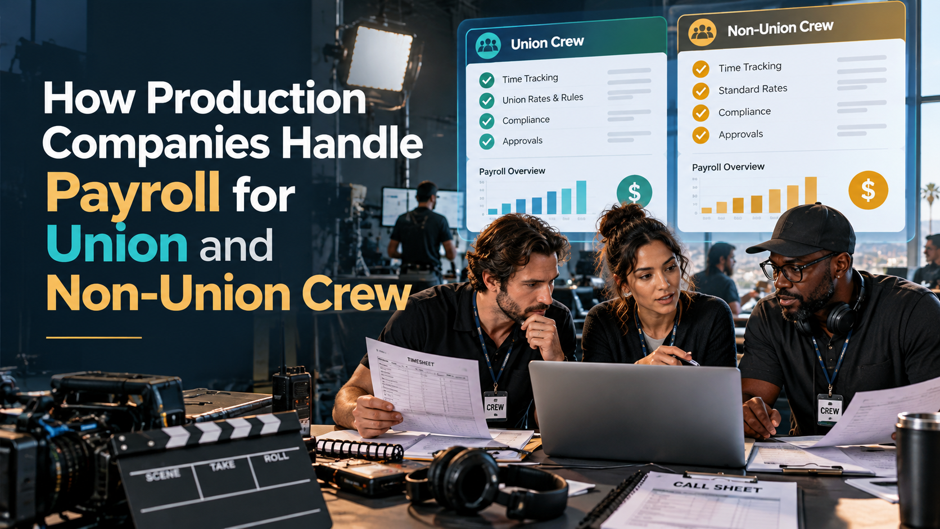
A film or TV production can employ 200 people for 6 weeks and then employ almost none of them again, which makes payroll one of the strangest problems in business, since the entire workforce essentially resets with each new project a company takes on. Some of those 200 people belong to a union with a detailed contract covering pension contributions, meal penalties and turnaround time. Others are freelancers working off a 1-page deal memo with a day rate and nothing else. A production company has to run both kinds of payroll correctly, on the same show, in the same week, without mixing up the rules that apply to each.
This post walks through how that actually works: how union fringe payroll differs from a straightforward day-rate deal, why almost every production hands the whole process to a specialized entertainment payroll company instead of running it in-house, and how state tax incentives add another layer of documentation on top of an already complicated system that most other industries never have to think about at all. The details here reflect how union benefit plans, loan-out withholding rules and state film incentive programs actually operate, cited by source wherever a specific figure appears.
TL;DR
- Union and non-union crew run on 2 different payroll logics. Union crew are paid under a collective bargaining agreement that adds fringe contributions for pension, health and vacation on top of wages, with strict rules on overtime, turnaround and meal breaks. Non-union crew are typically paid a negotiated day rate under a simple deal memo, with far fewer built-in protections beyond baseline state and federal labor law.
- Most productions outsource payroll rather than run it themselves. Specialized entertainment payroll companies such as Entertainment Partners, Cast & Crew and Wrapbook handle onboarding, timecards, union fringe calculations and tax withholding, because getting any of it wrong on a fast-moving production creates real legal and financial exposure that a single-purpose production entity is rarely equipped to absorb on its own.
- State tax incentives turn payroll into a compliance document. States like Georgia require detailed payroll records, loan-out withholding and, in many cases, a mandatory audit before a production can claim its tax credit, which means payroll accuracy directly affects how much money a production gets back once the project wraps and the paperwork finally reaches a reviewer months later.
Why Union and Non-Union Payroll Are Handled So Differently
A union contract exists precisely to remove flexibility from the payroll process, and that’s the point rather than a flaw, since a workforce that moves between employers as often as film crew do needs protections that don’t depend on any single company’s goodwill. IATSE, the Teamsters and the other below-the-line guilds negotiate collective bargaining agreements that specify minimum rates, overtime triggers, meal break timing and mandatory rest periods between shooting days, and every signatory production has to follow those terms regardless of budget or schedule pressure. That rigidity protects crew members who move between employers constantly, since a freelance workforce can’t rely on a single company’s internal HR policy the way a traditional employee can.
Non-union payroll runs on the opposite principle: flexibility bounded only by the law, with the specific terms of each engagement left to negotiation between the production and the individual crew member. A non-union crew member’s pay, hours and overtime terms come from whatever the production and the individual agree to in a deal memo, as long as that agreement doesn’t violate minimum wage, overtime or other labor protections in the state where the work happens. This reflects a genuinely different structure rather than a loophole, since non-union productions still owe every crew member the same statutory protections a union contract would guarantee, just without the additional fringe benefits and work-condition rules layered on top.
The 3 Employment Categories on a Production
- W-2 crew members. Most union crew, and many non-union crew, are treated as employees of the production or the payroll company acting as employer of record, receiving a W-2 at year-end with standard payroll tax withholding. This is the default classification for anyone working under direct production supervision on a defined schedule, since misclassifying an employee as a contractor carries real legal risk for the production.
- Loan-out corporations. Higher-earning cast, directors and some department heads often incorporate a personal loan-out company and get paid through that entity rather than as an individual. The production pays the loan-out corporation a fee, and the loan-out corporation in turn pays the individual as its own employee, which shifts certain tax and liability considerations onto the performer’s own corporate structure while still requiring the production to withhold state tax on the underlying services in many jurisdictions.
- 1099 independent contractors. A smaller share of production personnel, typically specialized vendors or short-term consultants rather than core crew, get paid as independent contractors on a 1099 basis. Productions apply this category narrowly, since state labor agencies actively scrutinize entertainment productions for misclassifying what should be W-2 crew as 1099 contractors to avoid payroll tax and fringe obligations.
Every crew member on a call sheet falls into 1 of these 3 buckets, and the payroll company’s first job on any new hire is confirming which bucket applies before the first timecard is even submitted, since the wrong classification early on affects every paycheck that follows it. Getting this classification wrong at the start creates problems that compound with every paycheck that follows, which is why experienced production accountants treat it as a gating step rather than paperwork to clean up later.
How Union Fringe Payroll Actually Works
Union payroll adds a layer that simply doesn’t exist in a non-union deal: fringe contributions calculated as a percentage or flat amount on top of every dollar of wages paid, funneled into pension, health and vacation funds rather than into the crew member’s paycheck directly. The below-the-line guilds, including IATSE, the Teamsters and the Basic Crafts unions, participate in the Motion Picture Industry Pension and Health Plans, a jointly administered fund that covers roughly 75,000 active members and retirees and is funded entirely through employer contributions tied to hours worked. Some contracts route benefits through the IATSE National Benefits Fund or an employer-specific plan instead, but the underlying mechanism is the same: the production owes money to a benefit plan on top of the crew member’s wages, not instead of them.
The exact fringe percentages are negotiated separately in each collective bargaining agreement and vary by local, by budget tier and by contract renewal cycle, so a payroll company working across multiple productions has to track dozens of different fringe schedules simultaneously, updating each one the moment a new agreement takes effect. One published 2025 Canadian agreement covering IATSE Local 891, Teamsters Local 155 and ICG Local 669 on high-budget features illustrates the structure well: total fringe allocation ran between roughly 21.5% and 22% of paid wages, split across health and welfare, vacation pay, pension and training society contributions, with the exact split differing slightly by union. That percentage sits on top of the crew member’s base wage rather than coming out of it, which is why union labor costs more to a production than the wage rate alone would suggest.
Health and Pension Eligibility Thresholds
The table below summarizes how eligibility works under the Motion Picture Industry Health Plan, the benefit structure most Los Angeles-based IATSE members work under, based on published guild guidance. Payroll companies track these hour thresholds automatically, since a crew member’s coverage can lapse mid-production if their hours dip below the maintenance threshold across multiple shows, and a lapse that goes unnoticed can leave a worker without coverage exactly when they need it most.
| Plan Element | Requirement | Administered By |
| Initial health eligibility | 600 hours of covered union work | Motion Picture Industry Health Plan |
| Maintaining health eligibility | 400 hours every 6 months | Motion Picture Industry Health Plan |
| Individual Account Plan contribution | Employer contributes 6% of wages | Motion Picture Industry Pension Plan |
| Traditional pension credit | Accrued based on days worked in covered employment | Motion Picture Industry Pension Plan |
Because these hours accumulate across every signatory production a crew member works on in a given period, spanning every current and past show rather than only the one running payroll today, a payroll company needs visibility into a worker’s full union employment history to calculate eligibility correctly. This is 1 of the clearest reasons productions rarely try to run union fringe payroll internally, since getting it wrong doesn’t just create an accounting error, it can cause a crew member to lose health coverage they were counting on.
Non-Union Crew Payroll: Deal Memos and Day Rates
A deal memo is the short-form agreement that governs most non-union crew employment, and it does far less than a union contract does by design. The document typically records the crew member’s name, position, start and end dates, the day rate or other pay structure, and any overtime terms the production and the individual agreed to, along with basic payroll information needed to process a paycheck. Deal memos aren’t meant to replace a full employment contract, and on fast-moving independent productions the deal memo is often the only written agreement a crew member ever receives.
Day rates need to be converted into an effective hourly rate to confirm compliance with the minimum wage in whatever state the production is shooting in, since a flat day rate that looks reasonable on paper can fall below minimum wage once it’s divided across a long shooting day, particularly on a 14-hour set day that runs well past what the rate was originally built around. Non-union overtime terms vary far more than union terms do, since there’s no collective bargaining agreement setting a floor, but the traditional baseline many productions still use is time and a half after 8 hours in a day or 40 hours in a week, with some states imposing daily overtime requirements by law regardless of what the deal memo says. A production shooting in a state with mandatory daily overtime can’t negotiate that requirement away in a deal memo, even on a fully non-union show, which is a distinction that catches inexperienced producers off guard more often than any other part of non-union payroll, especially when the production is used to shooting in a different state without that same requirement in place.
Overtime, Turnaround and Meal Penalties
Daily and Weekly Overtime Overtime on a production, union or non-union, typically triggers after a set number of hours in a single day or a set number of hours in a week, whichever comes first under the applicable rule. Union contracts specify these triggers explicitly and often escalate the overtime multiplier further after additional hours, while non-union productions generally follow whatever baseline the state requires, layered with any additional terms the deal memo specifies on top of that statutory floor. Payroll companies calculate this automatically from submitted timecards, which is one of the highest-value functions they perform, since manual overtime calculation across a full crew every week is exactly the kind of repetitive, rule-heavy task most prone to costly human error, particularly when different crew members fall under different overtime rules on the very same show.
Turnaround Violations Turnaround refers to the minimum rest period required between the end of one shooting day and the start of the next, and union contracts treat a violation of that minimum as a penalty owed directly to the crew member, calculated as additional pay rather than simply a compliance note. A production that wraps late and calls crew back too soon the next morning owes a turnaround penalty automatically under most union agreements, and payroll systems that track call times and wrap times can flag these violations before the paycheck goes out rather than after a crew member complains, giving the production a chance to correct the schedule before it becomes a habit.
Meal Penalties Meal penalties apply when a production fails to provide a meal break within the required window, typically 6 hours into a shooting day, and like turnaround violations they convert into additional owed pay rather than a warning, with the amount typically increasing the longer the meal break is delayed. These penalties escalate the longer a production runs past the required meal window, which creates a real financial incentive for assistant directors to manage the schedule carefully rather than simply push through and deal with the extra cost later. Non-union productions face less formal structure here, though many still build a similar penalty system into their deal memos voluntarily, since crew members increasingly expect it even on non-union sets and a production that skips it can struggle to attract experienced crew for a repeat booking.
Why Production Companies Use Third-Party Payroll Providers
- Union fringe calculation at scale. A specialized entertainment payroll provider maintains the current fringe schedules for every union local and contract tier a production might work under, updating them as new agreements get negotiated, which is far more reliable than any single production trying to track that information internally for the length of a single show before moving on to the next one.
- Compliance and liability transfer. Many payroll companies act as the employer of record for production crew, which shifts a meaningful share of payroll tax liability and compliance risk onto the payroll company’s infrastructure rather than the production entity itself, a structure that matters enormously for single-purpose production LLCs that exist only for the life of 1 project and have little internal capacity to absorb a payroll dispute.
- Digital timecards and onboarding. Modern platforms such as Wrapbook let crew submit timecards from a phone and complete onboarding paperwork once, then reuse that same paperwork across future productions using the same payroll provider, cutting down the mountain of repeated tax forms every new show used to require before a crew member could even start earning a paycheck.
- Tax incentive documentation. Payroll companies generate the detailed wage reports state film offices require to certify a production’s tax credit, which matters enormously given how much money is often on the line and how closely some states audit that documentation before releasing a credit that a production may have already budgeted against well before shooting had even wrapped on set.
- Residuals and long-tail obligations. Companies like Cast & Crew’s TEAM Companies division specialize in ongoing residual payments that can continue for years after a production wraps, an obligation that a production entity set up for a single project has no practical way to manage once it’s dissolved and its bank accounts have long since closed and its books were finalized for good.
The entertainment payroll industry itself reflects how central this function has become: Entertainment Partners and Cast & Crew, both founded in 1976 and based in Burbank, have long served as the industry’s dominant providers, while newer platforms like Wrapbook, founded in 2018, have grown by focusing on a more modern, self-service digital experience for onboarding and timecards specifically. Other established names, such as GreenSlate and ABS Payroll, round out a competitive field that gives productions a genuine choice depending on budget, crew size and how much hands-on support they expect from their provider.
Loan-Out Corporations and Payroll Withholding
A loan-out corporation changes the payroll relationship in a specific way: instead of the production paying an individual directly, it pays the individual’s personal corporation a fee for services rendered, and the corporation then handles paying that individual as its own employee. This structure is common among higher-earning directors, actors and some department heads, since it can offer real tax planning advantages tied to business expense deductions that aren’t available to a traditional W-2 employee working the same job.
Productions still can’t treat a loan-out payment as entirely outside their own payroll obligations, however, even when the corporate structure makes it tempting to assume the responsibility has shifted entirely to the performer’s own company. Many states require the production to withhold state income tax on payments made to a loan-out corporation for services performed within that state, treating the withholding requirement as attached to where the work happened rather than to the corporate structure used to receive payment. Georgia’s film tax credit program illustrates this clearly: compensation paid through a loan-out company still qualifies as a credit-eligible expense, but only if the production properly withholds and remits Georgia income tax on that payment, and the same withholding requirement applies to 1099 individuals and personal services contracts more broadly. A production that skips this withholding step doesn’t just risk a tax problem, it risks losing the tax credit eligibility on that entire portion of its labor spend.
How State Tax Incentives Shape Payroll Documentation
| State Incentive Element | What It Requires From Payroll | Why It Matters |
| Minimum spend threshold | Detailed tracking of all qualified in-state wages against the state’s minimum, such as Georgia’s $500,000 | Falling short disqualifies the entire credit rather than only the shortfall amount |
| Per-individual compensation caps | Payroll systems that cap qualified wages per person, such as Georgia’s $500,000 W-2 cap with no cap on loan-outs | Miscounting wages above the cap overstates the credit and risks a clawback |
| Loan-out withholding | Proper state income tax withholding on loan-out and 1099 payments for in-state services | Unwithheld loan-out payments can be disqualified from the credit entirely |
| Mandatory audit | Complete, organized payroll records ready for a CPA or state department review | Georgia has required a mandatory audit on all projects certified since January 1, 2023 |
| In-state labor definition | Tracking whether qualification depends on where work was performed or where the worker resides | States like Georgia and New Jersey look at where money was spent; others tie eligibility to residency |
Every one of these requirements depends on payroll data being accurate and well organized from the first day of production, not reconstructed after the fact when the audit request arrives months after wrap, when memories have faded and staff have moved on to other projects. Georgia’s program is a useful illustration of how much weight payroll documentation carries, since the state offers a credit with no annual cap and no sunset date, but backs that generosity with a mandatory audit requirement on every certified project, meaning a production’s payroll records are directly what stands between it and the credit it’s counting on.
Timecards, Onboarding and Weekly Payroll Cycles
- Digital timecards replaced paper on most productions. Crew members log call time, wrap time, meal breaks and any penalty-triggering delays directly into a mobile app or web platform, which then calculates gross pay automatically based on the applicable union agreement or deal memo terms rather than requiring a production accountant to do the math by hand for every single crew member every week.
- Onboarding happens once per crew member, ideally. Tax forms, direct deposit information, union membership verification and start-work paperwork get collected during onboarding, and platforms built around this workflow let a crew member reuse the same paperwork across future productions with the same payroll provider, which meaningfully speeds up crew onboarding on productions with tight prep schedules and a crew list that changes on short notice.
- Weekly payroll cycles are standard across the industry. Most productions pay crew on a weekly basis with a short lag between the end of a work week and the paycheck, typically about a week, rather than the biweekly or monthly cycles common in other industries. That faster cycle reflects the freelance, project-based nature of the workforce, since crew members moving between short-term jobs need cash flow more like a weekly wage earner than a salaried employee.
- Approval chains still require human review. Even with automated calculation, someone on the production still needs to review and approve each week’s timecards before payroll processes them, catching data entry errors, confirming overtime and penalty calculations look correct, and flagging anything unusual before money goes out the door and that week’s payroll cycle is finalized and closed out for good.
Common Payroll Mistakes on Productions
- Misclassifying crew as 1099 contractors. Treating what should be a W-2 employee as an independent contractor to avoid payroll tax and fringe obligations is one of the most heavily scrutinized issues in entertainment payroll, and state labor agencies actively investigate productions for this pattern, particularly in states with strong worker classification enforcement and a history of pursuing entertainment employers specifically.
- Missing union fringe obligations on a mixed crew. A production with both union and non-union crew members working side by side, which describes most mid-sized productions today, needs airtight tracking of who belongs to which category, since applying non-union terms to a union crew member, even by accident, creates a grievance and a back-pay obligation the production has to resolve well after the crew member in question has already moved on to another job.
- Letting hours-based eligibility lapse unnoticed. A crew member who comes up just short of the hours needed to maintain health plan eligibility can lose coverage without the production ever realizing it happened, which is a serious problem that good payroll tracking should catch and flag well before the eligibility window closes rather than only after a medical claim ends up denied.
- Treating loan-out withholding as optional. Skipping state withholding on loan-out payments because the corporate structure feels like it should shield the production from that obligation is a mistake that can cost a production its tax incentive eligibility on that portion of spend, well beyond the tax filing problem it also creates, and the discovery often comes only once a state audit is already underway.
- Underestimating how long residual obligations last. A production entity that dissolves after wrap still has ongoing residual obligations under union contracts that can continue for years, and failing to arrange for a payroll provider to manage those payments after the production shuts down leaves performers and crew without a clear path to money they’re owed, sometimes for a project that ended long before.
Coordinating Payroll When a Crew Mixes Union and Non-Union Workers
Few productions run entirely union or entirely non-union, and the mix in between is where payroll coordination gets genuinely difficult. A mid-budget independent feature might carry a full union crew in the camera and grip departments while running production assistants and some post-production staff as non-union hires, and every one of those workers needs to be paid correctly under the rules that actually apply to them rather than a single blended policy applied to everyone on the call sheet.
The practical challenge shows up most clearly in the payroll system’s setup, before a single timecard is even submitted. Each crew member’s employment record needs to carry the correct classification, the correct union local and contract tier if applicable, and the correct fringe schedule, and that record has to stay accurate even as people move between departments or as the production adds crew mid-shoot. A payroll error here rarely shows up immediately, since a wrong classification can process correctly for weeks before someone notices a missing fringe contribution or an overtime calculation that uses the wrong baseline.
Experienced production accountants build in a review step specifically for this risk, cross-checking the crew list against the union agreements the production has signed onto before the first paycheck goes out, and repeating that check whenever new crew joins partway through. That extra step costs time upfront, but it’s considerably cheaper than discovering a systemic misclassification error after several weeks of payroll have already gone out under the wrong terms, since correcting that retroactively means recalculating fringe contributions, adjusting withholding and potentially facing a grievance from the union local involved, all while the production is trying to focus on finishing the shoot itself.
FAQs
What’s the main difference between union and non-union crew payroll?
Union payroll adds fringe contributions for pension, health and vacation on top of wages, calculated under the specific terms of a collective bargaining agreement, along with strict rules on overtime, turnaround and meal breaks. Non-union payroll runs on a simpler deal memo structure, with pay and overtime terms negotiated individually and bounded only by baseline state and federal labor law rather than a union contract.
Why do productions use third-party payroll companies instead of running payroll themselves?
Entertainment payroll companies maintain current fringe schedules across dozens of union locals and contract tiers, act as employer of record to absorb compliance risk, generate the documentation state tax incentive programs require, and manage long-tail obligations like residuals that a single-purpose production entity has no practical way to handle after it dissolves. Running this internally on a project-based production is both harder and riskier than it looks.
What is a loan-out corporation and how does it affect payroll?
A loan-out corporation is a personal company that higher-earning cast, directors and some department heads use to receive payment from a production, rather than being paid directly as an individual. The production still typically has to withhold state income tax on loan-out payments for services performed in that state, and skipping that withholding can disqualify the payment from state tax incentive eligibility.
How many hours does a crew member need to qualify for union health benefits?
Under the Motion Picture Industry Health Plan, most IATSE-represented workers need 600 hours of covered union work to initially qualify for health benefits, and then 400 hours every 6 months to maintain that coverage. Because these hours accumulate across every signatory production a person works on, payroll providers need visibility into a crew member’s full union work history to calculate eligibility correctly.
What are turnaround and meal penalties?
Turnaround penalties apply when a production doesn’t provide the minimum required rest period between the end of one shooting day and the start of the next, and meal penalties apply when a meal break isn’t provided within the required window, typically around 6 hours into a shooting day. Under most union contracts, both convert directly into additional pay owed to the crew member rather than simply being flagged as a compliance issue.
How do state film tax incentives affect payroll requirements?
States offering film tax credits typically require detailed, well-organized payroll records to prove qualified wages, and several states, including Georgia, require a mandatory audit before a production can use or sell its credit. Requirements like per-individual compensation caps and loan-out withholding rules mean payroll accuracy directly determines how much of a production’s labor spend actually qualifies for the credit.
Are non-union crew members entitled to overtime pay?
Yes. Non-union crew are still covered by whatever state and federal overtime law applies, and some states require daily overtime after a set number of hours regardless of what a deal memo says. A deal memo can add terms on top of that baseline, but it can’t negotiate away statutory overtime protections that already exist under state law.
What happens to payroll obligations after a production wraps?
Some obligations end quickly, but others, particularly union residual payments, can continue for years after a production entity has dissolved. This is a major reason productions use established payroll companies rather than managing payroll through a temporary in-house structure, since a specialized provider can continue processing these long-tail payments long after the production itself no longer exists as an active entity.
