
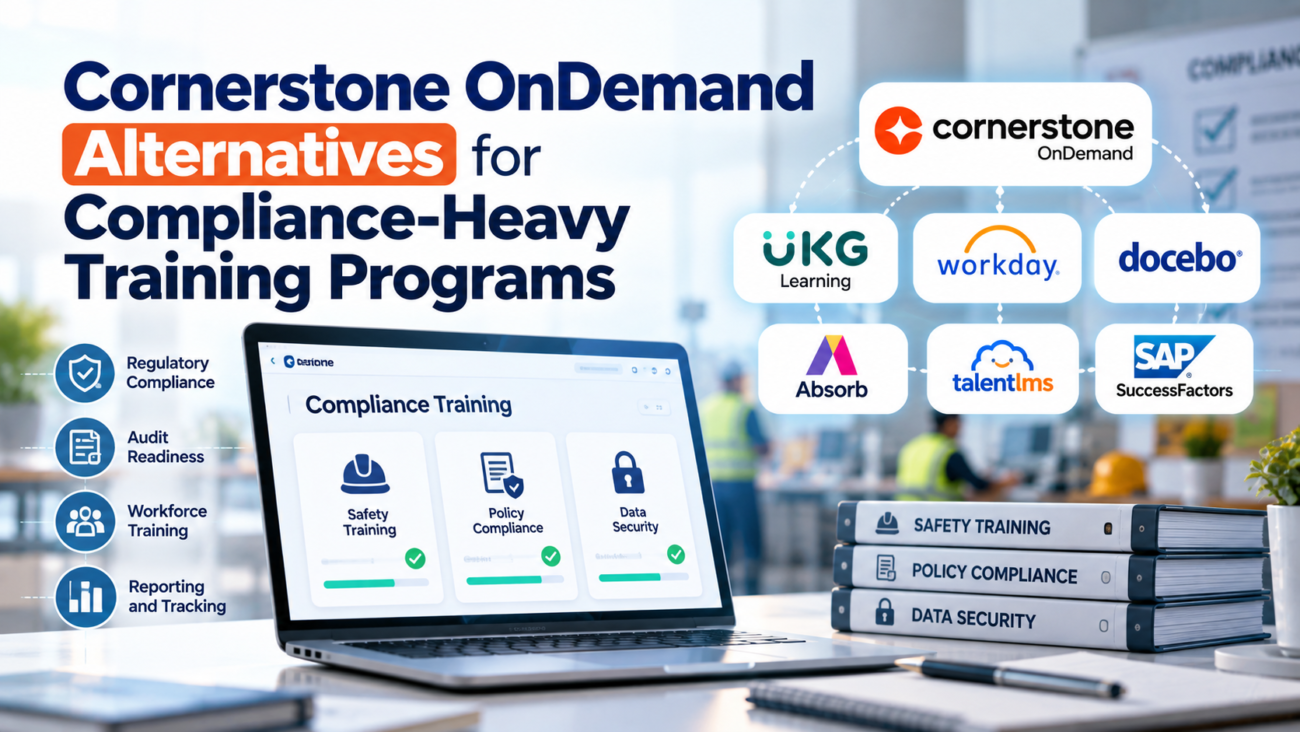
Cornerstone Learning is a serious enterprise LMS for mandatory training, certifications, renewal cycles, and audit evidence. A company looking for Cornerstone OnDemand alternatives isn’t starting from a weak baseline. The replacement has to preserve qualification controls while fixing the reason for change, such as administration effort, suite fit, reporting, HR system alignment, validation work, or external-audience needs.
Compliance-heavy training changes the buying question. The platform has to prove who was assigned training, which version they completed, whether a certification remains current, and what happened after an administrator changed a record. In some industries, signatures, validation, retraining rules, and evidence retention matter as much as course design.
This guide compares 8 Cornerstone OnDemand alternatives through that lens: SAP SuccessFactors Learning, Docebo, Litmos, LearnUpon, Absorb LMS, Moodle Workplace, Workday Learning, and SAI360. It shows where each option fits and what must be tested before a regulated program moves.
TL;DR
The strongest Cornerstone OnDemand alternatives serve different operating models. SAP SuccessFactors Learning fits SAP-centered qualification programs. Docebo offers independent enterprise learning with certification and audit logging. Litmos, LearnUpon, and Absorb LMS focus more tightly on training operations. Moodle Workplace offers more deployment control. Workday Learning fits Workday-centered HR environments. SAI360 is distinct when ethics training connects with GRC. Every finalist still needs a scripted test of audit history, retraining, content versions, record retention, signatures where required, and historical migration.
Why Teams Compare Cornerstone LMS Alternatives
The case for replacing Cornerstone should start with fit, not dissatisfaction for its own sake. Cornerstone currently positions Learning around automated assignments, certifications, renewals, qualification tracking, evidence, and enterprise scale. That means buyers should expect a replacement to match the compliance controls they actually use before they compare nicer dashboards or easier authoring. A move that lowers administration effort but weakens evidence can create a larger problem than the one it solves.
Organizations usually compare Cornerstone LMS alternatives when the operating model changes. A company may want learning closer to SAP SuccessFactors or Workday worker data, a focused LMS instead of a broad talent suite, easier evidence exports, or tighter links between training and GRC. Those are architecture and ownership questions, not cosmetic preferences.
The regulatory setting also determines whether moving is sensible. FDA-regulated electronic records can bring 21 CFR Part 11 controls into scope, and the FDA’s guidance onelectronic records and electronic signatures explains when Part 11 applies to electronic records maintained under predicate rules. An LMS may have useful e-signature features, but the organization still has to determine whether its training records are regulated records and whether the configured process meets its own validation and procedural requirements.
The reason to leave Cornerstone should be specific. Require every finalist to run the difficult workflows with realistic users, records, integrations, and audit questions. That prevents a demo-friendly feature list from replacing evidence about production behavior.
What An LMS For Regulated Industries Actually Requires
A compliance training LMS has to manage obligation, evidence, and time. Mandatory learning must reach the correct population based on role, location, business unit, risk, or another controlled rule. It also needs due dates, escalation, completion logic, and recurring retraining. A certification that lapses unnoticed is still a compliance failure.
Audit evidence is the second requirement. Training administrators need a defensible record of assignment, completion, status, and changes. In life sciences, record integrity can be especially important. The FDA’sdata integrity guidance for drug CGMP states that data should be reliable and accurate and frames controls around preventing and detecting data-integrity problems. An LMS isn’t a laboratory system, but the same audit concern appears when training evidence can be edited without clear accountability or when historical records can’t show what occurred.
Role-based assignment is equally important because regulators rarely require every worker to receive the same training. HHS states in itsHIPAA Privacy Rule summary that covered entities must train workforce members on privacy policies and procedures as necessary and appropriate for their functions. A regulated training LMS should therefore make it practical to map training to worker attributes and keep those assignments current as jobs change.
Retraining rules need similar care. OSHA notes that employers must provide training to workers who face hazards, and itstraining requirements and resources point employers to standards that define specific training duties. Some rules are event-based, some are periodic, and some require retraining when work conditions or employee knowledge change. A system that supports only a simple annual recurrence may be insufficient for a mixed safety program.
A serious compliance LMS software review should test assignment logic, expiry behavior, version control, audit history, acknowledgments where needed, exception handling, historical retention, exports, and what happens after a worker changes role or leaves.
What To Test In Compliance LMS Software
Before comparing products, turn regulatory and internal requirements into test scripts. Don’t ask whether compliance LMS software “supports compliance.” Ask whether it can reproduce the real evidence chain: source worker data, assignment rule, course version, due date, completion result, certification status, and any required approval or signature.
Validation can become a major workload in regulated manufacturing and life sciences. The FDA’s February 2026Computer Software Assurance guidance recommends a risk-based approach to establishing confidence in software used in production or quality systems. Whether an LMS falls inside a particular validated boundary depends on the company’s intended use and regulated process, but the principle is useful: test effort should follow risk and intended use instead of treating every screen as equally important.
The test pack should include changed records. Modify a completion, due date, user status, and learning-history entry, then inspect the audit evidence. Do the same with versioned content. If a policy course changes after 5,000 completions, confirm that the system can show which version each learner saw and apply the required reassignment rule.
Training effectiveness matters too. The U.S. Department of Justice’sEvaluation of Corporate Compliance Programs asks companies to consider risk-based training and how the effectiveness of training is measured. A compliance training LMS should support evidence beyond a raw completion percentage when the program requires it, such as assessment results, targeted populations, overdue trends, or other approved measures.
Accessibility belongs in the selection pack. WCAG 2.2 is a current W3C Recommendation, and theWCAG 2.2 standard provides testable success criteria. Buyers should test the learner portal and real course content with keyboard navigation, screen readers, captions, focus behavior, and color contrast rather than rely on a platform statement alone.
Test standards portability too. SCORM can move course packages, but it doesn’t define every LMS function. ADL’sSCORM guidance notes that certification and compliance functions sit outside the standard. Historical assignments, certifications, signatures, and audit records need their own migration design.
SAP SuccessFactors Learning
Among Cornerstone OnDemand alternatives, SAP SuccessFactors Learning is especially relevant for companies already using SAP SuccessFactors HCM or running structured qualification programs. As an LMS for regulated industries, its value is easiest to see in formal qualification and retraining workflows. Its compliance model uses curricula, retraining periods, assignment rules, learning history, and security domains. SAP documentation also includes e-signature approval processes and a validated SaaS concept for regulated customers. Those capabilities make it worth a detailed fit test for life sciences, manufacturing, and other environments where formal qualification status matters.
The strongest reason to shortlist SAP isn’t simply that it is another large enterprise platform. It is the way curricula can represent qualification requirements and recurring retraining. SAP documents retraining based on fixed dates or prior completion dates, which can support different compliance cycles. It also documents electronic signatures that use additional identity verification for selected learning-compliance steps. Those are specific controls that a regulated buyer can test against its standard operating procedures.
SAP also deserves attention where worker data and organizational structures already live in SuccessFactors. That can reduce the number of separate provisioning rules a team has to maintain. The tradeoff is administrative depth. Learning has its own security concepts in addition to broader SuccessFactors permissions, and SAP advises careful configuration of roles, domains, workflows, and restrictions. A company moving from Cornerstone should confirm that the future administration model is actually simpler for its team rather than assuming suite consolidation automatically reduces work.
Docebo
Docebo is a strong independent compliance training LMS for organizations that want enterprise learning without tying the decision to a full HR suite. As an LMS for regulated industries, it is most interesting where administrator accountability and certification automation matter. Current product material emphasizes automated enrollments, certification and retraining, dashboards, custom reporting, and multiple language support. Docebo’s help documentation also describes an immutable audit trail for administrative actions, including changes that affect course completion and enrollment status. That combination is relevant when audit accountability is a major reason for replacing Cornerstone.
The audit trail is the first area to test in compliance LMS software. Ask exactly which events are logged, how long logs are retained under the contracted plan, who can access or export them, and whether the records show old and new values when administrators make changes. Also test certification expiry and retraining behavior with actual business rules. A compliance LMS software purchase should be based on demonstrated evidence, not the presence of an audit-trail menu.
Docebo also publishes trust material that includes quality and CFR21 resources, including GxP guidance related to 21 CFR Part 11. That doesn’t make every customer configuration Part 11 compliant by default. Regulated companies still need their own requirements, validation, procedural controls, access model, and release-impact process. The presence of vendor material is useful because it gives quality and validation teams something concrete to assess during due diligence.
Litmos
Litmos is one of the more compliance-centered Cornerstone LMS alternatives and a practical compliance LMS software candidate for recurring mandatory training. Its current compliance product material emphasizes recurring certification renewals, reminders, role-based assignments, audit-ready reports, time-stamped history, acknowledgments, and compliance content. That makes the product attractive to teams that want mandatory learning controls without buying a broad talent suite.
The first fit question is whether the organization needs the LMS mainly to administer compliance and recurring learning or whether it also expects deep talent-management workflows. Litmos sits more clearly in the training platform category. For a compliance team that wants a focused system, that can reduce the number of unrelated modules in the operating model. For a company that uses Cornerstone as a wider talent platform, replacing only Learning may create extra integration work across performance, skills, succession, or other talent processes.
Litmos also places strong emphasis on ready-made compliance content. That can reduce content sourcing work for topics such as workplace conduct, privacy, or safety, but buyers should separate content claims from system controls. A current course library doesn’t answer whether the LMS can prove the exact version assigned to a worker, preserve an approval record, or meet a company’s evidence-retention policy. Those controls need direct testing.
Industry rules can also require training beyond a generic annual cycle. FINRA states that registered individuals must complete continuing education annually for each registration they hold, and itscontinuing education overview explains the regulatory program at a high level. A financial-services buyer should test how Litmos handles population rules, deadlines, evidence exports, and internal Firm Element programs rather than assuming a generic compliance library covers the full obligation.
LearnUpon
Among Cornerstone OnDemand alternatives, LearnUpon is useful for organizations that want simpler administration and need to train more than one audience. The platform supports separate learning portals, automated reporting, certification, recertification, and audit-trail exports, while its support documentation includes e-signatures for compliance training. Customer material also shows use in regulated financial services and certification programs. LearnUpon also states that portal Audit Trails can be viewed for a date range of up to 90 days and recommends exporting records every 90 days when a longer-term record is required. Regulated buyers should test that export and retention process against their own record-retention requirements.
Multi-audience structure is one of LearnUpon’s clearer differentiators. A company can use separate portals for employees, customers, associations, or other groups while administering them from one account. That can be useful when compliance obligations extend to contractors or partners but the company doesn’t want every audience inside the same learner experience.
For compliance-heavy use, buyers should inspect the depth behind the simpler interface. Test how the platform handles recurrent certification, audit-history changes, content versions, manager escalation, exception reports, and historical record migration. LearnUpon’s own compliance guidance recommends testing the full workflow from enrollment through reminders, certification, reporting, and recertification. That is a sound buying method regardless of vendor.
Global privacy programs may also need role-based and jurisdiction-aware training. Under the GDPR, Article 39 assigns data protection officers responsibilities that include awareness-raising and training of staff involved in processing operations. The officialGDPR text on EUR-Lex is a reminder that the LMS has to support the organization’s role and geography rules rather than only deliver a generic privacy course.
Absorb LMS
Among Cornerstone OnDemand alternatives, Absorb LMS is a focused compliance training LMS for companies wanting fewer talent-suite dependencies. It can fit an LMS for regulated industries shortlist when recurring assignments are the main operating need. Its compliance material describes scheduled notifications, automated enrollment, certificate delivery, reporting, and periodic renewal. Those functions cover the core administrative loop for many mandatory-training programs.
The product is most relevant when the problem with the current system is day-to-day learning administration rather than a need to redesign the full talent architecture. A company can keep its HR system of record and use integrations to feed learner and organizational data into the LMS. That can be a cleaner ownership model when L&D or compliance wants more control over the learning platform.
A regulated buyer should pay close attention to audit-history depth and record-change controls during the pilot. Public product material makes the automation story clear, but each organization needs to confirm the evidence it can retrieve after an administrator edits a completion, changes a user, alters a course, or updates a certification rule. This is where two products that both claim audit-ready reporting can behave quite differently.
Safety programs provide a useful test. OSHA standard 1910.30 includes retraining triggers when workplace changes or employee knowledge indicate that prior training is no longer adequate. TheOSHA retraining rule shows why some programs need event-driven reassignment rather than a fixed annual recurrence. Buyers should test whether Absorb’s automation can represent the organization’s real trigger logic through native rules or controlled integrations.
Moodle Workplace
Moodle Workplace is one of the most flexible Cornerstone OnDemand alternatives because it combines workplace-learning features with the Moodle ecosystem and multiple deployment choices. For an LMS for regulated industries, that control can be useful when hosting and change governance are explicit requirements. Current product material includes dynamic rules, recurring certifications, programs, multi-tenancy, custom reports, and the option to deploy through managed services or partner-led infrastructure models.
That flexibility can be valuable for organizations with strict hosting, data-location, or configuration requirements. It can also increase governance work. The compliance posture depends on the Moodle Workplace product plus hosting, plugins, custom code, partner practices, upgrade controls, and the organization’s own procedures. A company leaving Cornerstone because it wants less administration should account for that difference before choosing a highly configurable platform.
Moodle Workplace’s certification and dynamic-rule model can handle recurring training and automated allocation. The key pilot question is how the organization will prove controlled change. If administrators or developers can extend the system deeply, change management becomes part of audit readiness. Regulated customers should define who can deploy plugins, change code, alter rules, and modify records, then test whether the required audit information remains available after those actions.
Learning telemetry is another consideration. xAPI can capture richer learning experiences than traditional completion data, but the standard requires its own architecture and record store decisions. ADL’sxAPI specification material describes how experience statements are exchanged with a Learning Record Store. Buyers should decide whether they actually need that level of telemetry and how long-term records will be governed before making xAPI support a selection requirement.
Workday Learning
Workday Learning is most relevant among Cornerstone LMS alternatives when Workday HCM already owns worker records, security, and business processes. As an LMS for regulated industries, its main advantage is the direct connection to worker events and security. Workday documentation describes learning content, enrollments, completions, reporting, security-driven dashboards, learning certifications, and expiration rules for retraining. The value comes from reducing the boundary between HR events and learning obligations instead of operating a separate LMS.
For example, a role change, organizational move, or worker status update already occurs in Workday. If learning assignment and reporting are also inside Workday, the organization may need fewer synchronization jobs to keep required training aligned to the workforce. That can matter in compliance programs where assignment accuracy depends on current worker attributes.
The tradeoff is that Workday Learning makes the most sense as part of a Workday architecture. A company that doesn’t already use Workday HCM would rarely choose it only to replace Cornerstone Learning. Even for Workday customers, the compliance team should test certification expiry, historical evidence, content versioning, administrator audit history, external-audience needs, and any required signatures rather than assume HCM integration covers every regulatory control.
Cybersecurity programs are a useful example of ongoing training needs. NIST SP 800-50 Rev. 1 describes a life-cycle approach to building cybersecurity and privacy learning programs, including role-based needs and measures for improving the program. TheNIST learning-program guidance supports a view of training as an evolving program rather than a yearly checkbox. Workday Learning can be evaluated against that model if HR data is central to assigning role-specific security learning.
SAI360
Among Cornerstone OnDemand alternatives, SAI360 is different because its center of gravity is ethics, compliance, and GRC rather than general enterprise talent management. Its current learning offering includes compliance content, training campaigns, an LMS, analytics, disclosure workflows, and links to wider risk and compliance functions. That can be useful when training is managed by the compliance office and needs to connect with policies, incidents, disclosures, or control work.
The fit is strongest for corporate ethics and compliance programs, such as anti-bribery, code of conduct, conflicts of interest, harassment, competition law, and related risk topics. The platform can also be used to train third parties, which matters when vendors, contractors, or other external groups must acknowledge policies or complete mandatory learning.
The key limitation is scope. SAI360 shouldn’t be treated as a direct replacement for every learning use case simply because its compliance functions are strong. A company that uses Cornerstone for leadership development, broad skills programs, technical academies, customer education, and talent processes may still need another learning platform or a more complex target architecture. SAI360 becomes more compelling when the compliance function is deliberately separating regulated or ethics training from general L&D.
Side-By-Side Comparison Of Cornerstone LMS Alternatives
The table below is a buying map for compliance LMS software, not a product score. These Cornerstone OnDemand alternatives differ in operating model and control depth. Use it to choose products for a scripted pilot, then verify every critical control under the proposed license and configuration.
| Platform | Best Fit In A Compliance-Heavy Program | Controls To Test Closely | Main Tradeoff |
| SAP SuccessFactors Learning | SAP-centered enterprises and formal qualification or retraining programs | E-signatures, curricula, retraining dates, audit history, role security | Deep administration and SAP-specific operating model |
| Docebo | Independent enterprise LMS with automation and audit logging | Audit event coverage, record changes, certification renewal, validation evidence | Regulated configuration still needs customer validation |
| Litmos | Compliance-led training with recurring certification and content needs | Record history, acknowledgments, version evidence, reporting exports | Less of a broad talent-suite replacement |
| LearnUpon | Multi-audience training with simpler administration | E-signature use, audit exports, recertification, portal separation | Complex qualification logic may need extra testing |
| Absorb LMS | Focused employee compliance and recurring certification | Audit-depth, trigger logic, evidence retention, integrations | Public compliance claims need workflow-level verification |
| Moodle Workplace | Organizations needing deployment and configuration control | Change governance, plugin controls, auditability, upgrade process | More technical ownership can shift to the customer or partner |
| Workday Learning | Workday HCM customers linking worker events to learning | Certification expiry, evidence, external audiences, admin audit | Best fit depends heavily on Workday HCM adoption |
| SAI360 | Ethics and compliance teams connecting training with GRC | Assignment logic, policy links, disclosure workflows, LMS scope | Specialist compliance focus may not replace broad L&D |
Check content standards separately. SCORM helps move course packages, and xAPI can support richer experience data, but neither standard carries the full compliance record. Learning history, certifications, signatures, due dates, assignment rules, and audit trails still need a migration design.
Health care provides a clear evidence test. HHS’sHIPAA audit protocol asks for policies, training materials, and documentation showing workforce security training. Ask each finalist to produce that kind of evidence package, not only a dashboard screenshot.
How To Migrate An LMS For Regulated Industries Without Losing Evidence
Migration is where compliance LMS software can create its largest compliance risk. A move from Cornerstone to any of these Cornerstone OnDemand alternatives must preserve the evidence model, not only users and courses. The target system may accept users and courses easily while failing to preserve the evidence model built over years in Cornerstone. Start by classifying records into active obligations, historical completions, certifications, course versions, acknowledgments, approvals, instructor-led attendance, external credentials, and audit history. Each class may need a different migration method.
Don’t assume every historical record should become an editable target record. Some organizations migrate active learning and current qualifications while keeping older evidence in a controlled archive. Others import historical completions. Decide this before extraction because retention, reporting, validation, and reconciliation all depend on it.
Healthcare programs illustrate why documentation matters. HHS states that covered entities must train workforce members on privacy policies and procedures as appropriate to their functions, and the rule requires documentation that the training was provided. That HIPAA training requirement makes historical proof part of the compliance process, not a disposable LMS artifact.
Use at least 2 rehearsal migrations. The first should expose mapping errors, unsupported records, duplicate users, date problems, and content dependencies. The second should prove a repeatable process with agreed control totals. Reconcile assignments, current certifications, completions, and exceptions, then sample high-risk learner histories for dates, results, and course identity.
Content needs controlled transfer too. Record source and target course IDs, version, publication date, and reassignment behavior. If a regulated course changes during cutover, define which version governs each learner population so the migration doesn’t create an evidence gap.
Validate the target with real audit scenarios. Confirm who can edit completion data, what the audit log shows, how evidence is exported, and whether terminated workers remain reportable. The migration is complete when approved systems and archives can answer those questions without spreadsheet reconstruction.
Conclusion
The best Cornerstone OnDemand alternatives for compliance-heavy training aren’t interchangeable. The same is true of Cornerstone LMS alternatives marketed broadly for enterprise learning: regulated fit depends on the configured evidence model. Each one changes the ownership model around learning data, assignments, evidence, and integrations. SAP SuccessFactors Learning is strongest when formal qualifications and SAP HR alignment matter. Docebo offers a strong independent enterprise model with audit logging and certification automation. Litmos emphasizes compliance administration and content. LearnUpon favors simpler multi-audience delivery. Absorb LMS fits focused recurring-training programs. Moodle Workplace offers more technical control. Workday Learning fits organizations already centered on Workday. SAI360 is most distinct when compliance learning needs to connect directly with GRC work.
A replacement decision should begin with evidence requirements. A serious compliance training LMS for regulated industries must prove who needed training, what they completed, which version applied, when retraining became due, and what changed afterward. It also has to preserve those answers through worker moves, content changes, administrator corrections, and migration.
A scripted pilot is the safest way to compare Cornerstone OnDemand alternatives. Bring 2 or 3 high-risk workflows, realistic learner data, a sample historical migration, and an auditor-style evidence request. A finalist earns its place by reducing operating work while preserving the required controls.
FAQs
What Are The Best Cornerstone OnDemand Alternatives For Compliance Training?
The strongest options depend on the operating model. SAP SuccessFactors Learning fits SAP-centered and qualification-heavy environments. Docebo is a strong independent enterprise option. Litmos, LearnUpon, and Absorb LMS suit focused training operations. Moodle Workplace offers more deployment control. Workday Learning fits Workday customers, while SAI360 is strongest when ethics and compliance learning connects with wider GRC processes.
Is Cornerstone OnDemand Good For Compliance Training?
Yes. Cornerstone remains a capable enterprise compliance platform with automated assignments, certifications, renewals, qualification tracking, and reporting. A company should replace it only when another platform better fits its administration, architecture, compliance controls, cost model, or audience needs. The correct comparison is against the Cornerstone workflows the organization actually uses.
What Should A Compliance Training LMS Track?
A compliance training LMS should track assignments, due dates, completions, assessment results, certification status, retraining dates, content versions, and approved exceptions. Regulated organizations may also need administrator audit history, electronic acknowledgments, signatures, instructor records, or validation evidence. The exact record set depends on the regulation and the company’s procedures.
Which Cornerstone LMS Alternatives Support Recertification?
SAP SuccessFactors Learning, Docebo, Litmos, LearnUpon, Absorb LMS, Moodle Workplace, and Workday Learning all document forms of certification, retraining, renewal, or recurring learning. The important difference is how each product calculates due dates, handles role changes, records exceptions, and shows expired or soon-to-expire status. Those behaviors should be tested directly.
Which LMS Is Best For FDA-Regulated Training?
There is no universal answer. SAP SuccessFactors Learning documents e-signatures and regulated-customer options, while Docebo publishes GxP and CFR21 resources. Other platforms can support mandatory training and evidence but may require more customer-defined validation work. The deciding factor is whether the configured system meets the organization’s intended use, record controls, validation approach, and procedures.
Do We Need 21 CFR Part 11 Features In An LMS?
Only if the training records and electronic signatures fall within the organization’s applicable Part 11 scope. That is a regulatory and quality decision, not a generic LMS requirement. Companies should involve quality, compliance, and validation teams before making e-signature or audit-trail features mandatory in the selection process.
Is SAP SuccessFactors Learning A Good Cornerstone Replacement?
It can be, especially for companies already using SAP SuccessFactors HCM or managing formal qualifications and recurring curricula. It has deep compliance administration, but that depth can also mean more configuration. The migration should test security roles, curricula, e-signatures where needed, learning history, reporting, and administrator workflows before a decision.
Is Docebo Suitable For Regulated Industries?
Docebo documents certification automation, reporting, an immutable administrator audit trail, and GxP-related resources. That makes it relevant to regulated organizations. Buyers still need to validate the configured platform against their specific procedures, retention requirements, signatures, content controls, and release-management process before treating it as compliant for a regulated use.
Is Moodle Workplace Suitable For Compliance Training?
Yes, Moodle Workplace supports programs, recurring certifications, dynamic rules, and reporting. Its main difference is the amount of configuration and deployment control available. Regulated organizations need strong governance for hosting, plugins, custom code, upgrades, security, and record changes so that flexibility doesn’t weaken change control or audit evidence.
Which Alternative Is Best For Compliance And GRC Together?
SAI360 is the most specialized option in this comparison for connecting ethics and compliance learning with broader GRC functions. It can fit organizations where training is owned by compliance and closely linked to policies, disclosures, incidents, and risk work. It may not replace all general L&D functions that a broad Cornerstone deployment supports.
Should We Choose Workday Learning If We Already Use Workday HCM?
It deserves a serious evaluation. Workday Learning can reduce the boundary between worker data and training assignments because both operate in the Workday environment. That can simplify role-based assignment and reporting. The compliance team should still test historical evidence, certifications, record changes, external learner needs, and any specialized regulatory controls.
How Do We Compare LMS Audit Trails?
Use the same test in every finalist. Change a learning completion, modify a due date, update a user, alter a course, and correct learning history. Then inspect what the audit record captures, who can view it, whether old and new values appear, how long it is retained, and whether it can be exported in a usable form.
Can SCORM Move Our Compliance History To A New LMS?
No. SCORM is mainly a content interoperability standard. It can help move course packages and runtime behavior, but it doesn’t carry the full compliance history around learners, assignments, certification status, signatures, administrator changes, and retention rules. Those records need a separate migration and reconciliation plan.
How Long Should Historical Training Records Be Kept During An LMS Migration?
The retention period depends on applicable laws, contracts, accreditation rules, internal policy, and the regulated process. Don’t use the LMS vendor’s default retention period as the policy. Legal, compliance, records-management, and quality teams should define the required history before migration so the archive and target design can support it.
How Should We Pilot Cornerstone OnDemand Alternatives?
Choose a small set of high-risk workflows and run them from assignment through audit evidence. Include recurring training, a role change, a content-version change, an administrator correction, an overdue learner, and a historical record import. Ask compliance and system administrators to score the evidence and operating effort before commercial negotiations are completed.
