
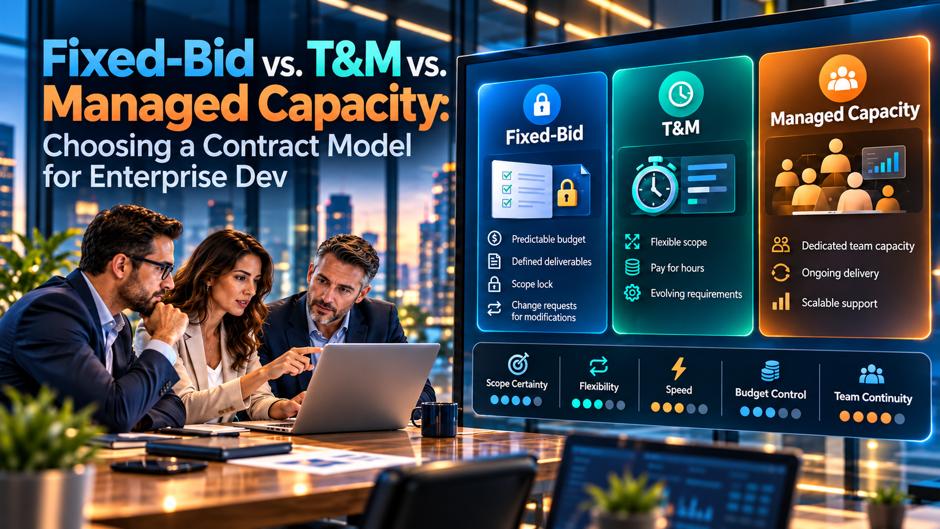
An enterprise platform team needs a customer portal rebuilt and collects 3 proposals. The first is a fixed bid with a 40-page scope appendix. The second is a time-and-materials estimate expressed as a range. The third is a managed team of 6 engineers at a flat monthly fee, with a vendor lead running delivery. All 3 vendors are competent, yet the quotes can’t be compared on price, because each contract assigns a different party the cost of being wrong about scope, effort and staffing.
This post compares the 3 contract models on risk, cost, control and fit for enterprise software development. Most published guidance comes from vendors that sell these models, so figures such as risk buffers are reported as ranges and flagged as unaudited. Terminology also varies, since sources use “managed capacity,” “dedicated team” and “project outsourcing” inconsistently. Contract terms differ by jurisdiction and company, and nothing here is legal advice, so involve procurement and counsel before signing.
TL;DR
- Each model decides who pays when an estimate is wrong. A fixed bid puts overrun risk on the vendor and prices that risk into the quote, time and materials puts it on the buyer in exchange for flexibility, and managed capacity moves it to utilization, since you pay for a staffed team instead of a feature list. Seeing that allocation clearly is the fastest way to compare proposals that look incomparable.
- Published figures are vendor-sourced and vary. Sources report fixed-bid risk buffers anywhere from 15% to 40%, managed capacity minimum terms of about 90 days and teams of 3 to 8 specialists, and none of those numbers are audited, so test every assumption against the actual proposals in front of you. Rates and terms also shift with vendor, region and scope, so treat each figure as a prompt for questions rather than a benchmark.
- Hybrids are common because 1 model rarely fits a whole program. A frequent pattern is time and materials for discovery, fixed price for well-defined execution and managed capacity for long-running evolution, and it works when each phase has its own scope, governance and exit terms written into the contract. Each phase then carries the model that fits its level of uncertainty instead of forcing a single structure onto the entire program.
Why the Contract Model Is a Risk Decision
A contract model is often treated as a pricing choice, but its main job is allocating risk. Every software project begins with an estimate, and every estimate is wrong to some degree, because requirements shift and integrations surprise teams. The contract determines who absorbs the difference. Under a fixed bid the vendor absorbs overruns within agreed scope, under time and materials the buyer pays for the extra effort, and under managed capacity the buyer pays a steady fee for a team whether the backlog turns out light or heavy.
Each model also shapes vendor behavior in predictable ways. A fixed bid rewards finishing the defined scope with minimum effort, which can invite disputes about what counts as in scope. Time and materials rewards hours worked, which makes buyer-side controls on estimates and reporting essential. Managed capacity rewards keeping the team staffed and utilized, which makes team stability, retention terms and a meaningful backlog the critical factors. Knowing those incentives shows where friction will appear.
Enterprise development adds pressures that smaller projects rarely face. Multiple stakeholders can change priorities mid-stream, security and compliance reviews add gates, integration with legacy systems introduces surprises, and procurement processes expect predictable spend. Each of those factors adds effort that a vendor must either price in or absorb during delivery. These factors push buyers toward fixed bids for budget certainty even when requirements are unsettled, which is where many programs get into trouble.
The 3 Models at a Glance
| Dimension | Fixed Bid | Time and Materials | Managed Capacity |
| What you buy | A defined scope for a set price | Actual hours worked at agreed rates | A staffed, vendor-run team for a monthly fee |
| Price unit | Total project price, often paid by milestone | Hourly or daily rate times effort | Fixed monthly or per-team fee |
| Who carries estimation risk | Mostly the vendor, with a buffer priced in | Mostly the buyer | Shared, with the buyer paying for capacity |
| Handling scope change | Change orders and renegotiation | Absorbed through the backlog and budget | Absorbed through reprioritizing the backlog |
| Buyer management burden | Lower during delivery, higher at specification and acceptance | High, since the buyer reviews estimates and reports | Moderate, since the buyer sets priorities and the vendor runs the team |
| Typical minimum commitment | Project duration | Often none | Often about 90 days, according to 1 source |
| Best fit | Stable, well-specified work | Evolving or exploratory work | Ongoing product or platform development |
| Typical failure mode | Scope disputes and change-order friction | Budget drift without controls | Paying for capacity without a clear roadmap |
Reading across a row shows that the models trade certainty for flexibility in different ways. A fixed bid gives cost certainty at the price of rigidity, time and materials gives flexibility at the price of cost variance, and managed capacity gives steady throughput at the price of committing to a team. None is a universal winner, and the best choice depends on how stable the requirements are, how long the work will run and how much management capacity the buyer can supply.
Fixed-Bid: What You’re Really Buying
Price Certainty and Vendor-Owned Estimation Risk A fixed-price contract sets a total price for a defined scope, usually with payments tied to milestones, and the vendor carries the cost of overruns within that scope. For a buyer with a firm budget ceiling, limited technical bandwidth or a procurement rule requiring a fixed bid, that certainty is valuable. It works best when requirements are stable, acceptance criteria are written down and the buyer can describe what done looks like before work starts.
The Quote Includes a Risk Buffer Because the vendor absorbs overruns, it prices that risk into the bid. Vendor-written guides report buffers ranging from 15% to 30% in 1 comparison and 20% to 40% in another, which can make a fixed bid cost more than an equivalent time-and-materials estimate. Those figures aren’t audited, and the actual premium depends on scope clarity, vendor margin and the buyer’s negotiating position, but they illustrate why a fixed bid’s certainty comes with a price.
Where Fixed Bids Break The most common failure is change. Any requirement that wasn’t in the original scope becomes a change order, and every change order triggers negotiation, which slows delivery and can strain the relationship. The vendor’s incentive to protect margin can also lead to minimal interpretation of ambiguous requirements and thinner testing, and the buyer carries a heavy specification burden before work begins. Sources also note that fixed price limits client involvement during development, which can hide problems until acceptance.
When a Fixed Bid Still Wins Fixed bids fit small, discrete deliverables with stable requirements, such as a defined integration, a data migration with clear acceptance tests or a compliance deliverable with a fixed specification. They also fit organizations whose procurement rules require a fixed bid. In those cases, investing in a detailed scope, explicit assumptions and a clear change-control process reduces the odds that the certainty on paper turns into a dispute in practice.
Time and Materials: Flexibility With a Meter Running
- Time and materials charges for actual effort at agreed rates. The buyer pays for the hours each team member works, plus any tools or costs, without a fixed total, and time-and-materials contracts let scope evolve more freely when delivery is iterative. The work can start quickly because no complete estimate is needed first, and the buyer sees detailed time and task tracking throughout. Tools and other costs are billed at cost or at an agreed markup.
- The buyer carries the risk of the bill growing. Sources agree that when delivery takes longer than planned, the buyer pays for the extra effort, so budget certainty depends on estimation discipline, scope control and the quality of reporting rather than on the contract itself, which is why time and materials without governance tends to drift. Teams that skip those controls often learn about overruns only when the invoice arrives, which is far too late to adjust scope.
- Controls turn an open meter into a managed one. Common controls include a not-to-exceed cap that requires approval before further spending, a rate card with fixed rates by role, regular burn-down reports against the estimate, and a monthly review of the backlog and forecast. A cap converts open-ended exposure into a defined ceiling while preserving flexibility within it. Each control costs little compared with the exposure it removes, and all of them can be written into the statement of work.
- Vendor incentives reward hours, so oversight matters. Time and materials pays for effort, which gives a vendor little reason to finish faster than the estimate. Margins are described as lower but more predictable than under fixed price, and buyers protect themselves through senior review of estimates, sprint-level visibility and acceptance of work by outcome as well as by hours logged. Pairing hourly billing with sprint demos keeps attention on working software as well as effort.
- It suits uncertain, long or iterative work. Discovery, product development with changing priorities and large initiatives where the full scope isn’t clear from the start all fit, and dedicated full-stack developers working exclusively on the buyer’s project can retain knowledge as priorities change. In those situations, a fixed price would force decisions that the team can’t yet make well, while an open but monitored budget lets the plan improve as evidence arrives.
Managed Capacity: A Team, Not a Scope
Managed capacity is an engagement model in which the buyer pays a vendor a fixed monthly fee for a set-size team, points it at the buyer’s own backlog, and lets the vendor run, staff and replace that team while the buyer keeps the priorities. 1 guide describes teams of 3 to 8 specialists under a single monthly fee, with the vendor taking primary responsibility for delivery and often committing to KPIs through an SLA. Bain’s guidance on agile vendor models describes a persistent pool of cross-functional teams where the customer sets priorities and an internal product manager owns outcomes.
The model differs from its neighbors in specific ways. Staff augmentation buys individual people by the hour and leaves daily management to the buyer. A dedicated staffing model gives the buyer named specialists who work around an ongoing workload, though the exact management structure depends on the contract. Managed capacity adds a vendor-side lead and makes seat replacement the vendor’s contractual responsibility. Managed services go further, with the vendor owning an outcome and the buyer rarely seeing the people. Because sources use the labels loosely, 1 even applying “managed capacity” to bounded project outsourcing, the contract should define the terms.
The model’s strengths include no change-order negotiation, since scope lives in the backlog, and continuity, since the team accumulates domain knowledge. Contracts typically lock team size for a minimum term, often 90 days according to 1 source, limit turnover and let the buyer exit, within defined cure periods, if the team underperforms. The main risk is paying for capacity without a clear roadmap, or committing to a large team before demand is validated.
How Risk Moves Between Buyer and Vendor
| Risk | Fixed Bid | Time and Materials | Managed Capacity |
| Estimation overrun | Vendor, within defined scope | Buyer pays for extra effort | Buyer, through reduced throughput per fee |
| Scope growth | Buyer, through change orders | Buyer, through added hours | Buyer, through backlog trade-offs |
| Schedule delay | Vendor within contract terms, subject to buyer dependencies | Buyer pays for the extended engagement | Shared, depending on SLA and priorities |
| Staff turnover | Vendor’s problem unless named personnel are specified | Buyer and vendor, depending on replacement terms | Vendor, through contractual replacement duties |
| Idle or underused capacity | Not applicable | Not applicable since hours are billed as worked | Buyer, since the fee is fixed |
| Misunderstood requirements | Buyer if the spec was wrong, vendor if the spec was clear | Buyer through rework hours | Buyer through backlog quality |
The table shows that no model eliminates risk, only relocates it. A fixed bid concentrates estimation risk on the vendor but leaves the buyer exposed to specification quality and change friction. Time and materials leaves cost variance with the buyer while giving maximum flexibility. Managed capacity converts effort risk into utilization risk, which is manageable for organizations with a steady backlog and difficult for those with lumpy demand, so the buyer’s demand pattern matters as much as the project type.
What Each Model Costs Beyond the Rate Card
Fixed Bid: Buffers, Change Orders and Governance Cost An illustrative example shows how the pieces interact. Suppose a scope is estimated at 10,000 hours at a blended $120 an hour, a $1,200,000 time-and-materials estimate. A fixed bid with a 15% to 40% buffer would be $1,380,000 to $1,680,000. If actual effort reaches 12,000 hours, time and materials costs $1,440,000 while the fixed bid stays at its quoted price, and if effort falls to 9,000 hours, time and materials costs $1,080,000, well under either fixed quote. The figures are assumptions for illustration, and change orders can raise a fixed bid’s final cost.
Time and Materials: Management Time and Variance Time and materials is cheapest when estimates are accurate or high, and most expensive when scope grows or reporting is weak. Reporting that separates new delivery effort from rework makes variance easier to explain. The buyer should also budget for management time, such as estimate reviews, sprint demos, invoice validation and ongoing consulting oversight, which consumes internal effort that fixed-scope outsourcing doesn’t. A cap and a monthly forecast keep variance visible.
Managed Capacity: Utilization and Minimum Terms Managed capacity costs the monthly fee times the term, regardless of how much the backlog needs. As another illustration, a $90,000 monthly fee for a 6-person team over 12 months totals $1,080,000, an assumption with no market benchmark behind it. The effective cost per delivered outcome depends on utilization, so a team working through a full, well-prioritized backlog delivers far more value per dollar than the same team waiting for requirements. Minimum terms and ramp-up time should be part of the business case.
Enterprise Factors That Change the Answer
- Procurement and vendor management rules shape the options. Some organizations require fixed bids for new work or restrict open-ended time and materials, while others have master agreements that make managed capacity easy to order. Understanding the internal path to approval early prevents choosing a model that procurement can’t actually sign. Raising the question with procurement before vendor selection saves weeks, because a preferred model can then be written into the request for proposals.
- Annual budgeting favors predictable spend. Finance teams planning by fiscal year often prefer fixed or monthly-fee structures to variable billing, which explains part of the appeal of fixed bids and managed capacity, and it’s an argument for adding a cap when time and materials is the right technical fit. A capped time-and-materials structure with monthly forecasts gives finance a ceiling to plan against while preserving the flexibility engineering needs day to day.
- Security and compliance gates add scope that bids rarely capture. Reviews, audits, penetration tests, data protection requirements and regulated change controls can multiply effort, so fixed bids need explicit assumptions about who performs and pays for those activities, and time and materials needs reporting that separates delivery effort from compliance effort. Agreeing up front on who pays for remediation of findings avoids a common dispute late in the schedule, when fixes are most expensive.
- Internal product ownership decides whether managed capacity works. The model relies on the buyer keeping the backlog prioritized and making trade-off decisions quickly, so an organization without a capable product owner often does better with a defined scope, while an organization with strong product ownership can use a team far more efficiently. Naming a product owner with real decision rights before signing is a precondition for success, which many buyers treat as an afterthought.
- Legacy integration risk raises the cost of fixed scope. When systems are poorly documented, a fixed bid either prices heavy contingency or invites disputes about discovered work, so many enterprise buyers pay for a discovery and ideation phase first and fix the price for execution only after the unknowns shrink. A paid discovery phase that documents interfaces, data quality and hidden dependencies turns an unpriceable unknown into a scope that can be quoted.
Matching the Model to the Project Type
| Project Type | Likely Model | Why |
| Well-specified integration or data migration with clear acceptance tests | Fixed bid | Stable scope and measurable acceptance support price certainty |
| Discovery, architecture and prototyping | Time and materials, ideally capped | Unknowns dominate, and the output informs the next phase |
| New product with evolving requirements | Time and materials or managed capacity | Frequent change makes change orders costly |
| Ongoing platform and product roadmap | Managed capacity | Continuity and a steady backlog justify committing to a team |
| Legacy modernization with unclear dependencies | Time and materials for discovery, then fixed bid or managed capacity | Price risk falls as unknowns are resolved |
| Compliance-driven deliverable with a fixed specification | Fixed bid | Requirements are set externally and acceptance is binary |
| Maintenance and enhancement backlog | Managed capacity or time and materials | Work arrives continuously in small pieces |
| Deadline surge on a defined workstream | Time and materials or short managed capacity term | Speed matters more than price certainty |
This table is a starting point, because the same project can fit more than 1 model depending on how well the scope is understood and how much management capacity the buyer has. The practical test is to ask how much of the work could be written down today with acceptance criteria. If most of it can, a fixed bid becomes viable, and if most of it can’t, flexibility is worth more than certainty.
Hybrid Structures That Combine the Models
Many guides now describe a phased approach to agile contracting as a practical option for enterprise work: time and materials for discovery, fixed price for well-defined execution, and a managed or dedicated team for long-running evolution. The logic is that risk and uncertainty fall as the project advances, so the contract model should shift with them. Discovery reduces unknowns at a controlled cost, a fixed bid then buys defined delivery at a price informed by real findings, and managed capacity sustains the product once the roadmap becomes continuous.
Capped time and materials is another common hybrid. The buyer keeps flexibility within a not-to-exceed ceiling, with a formal approval step before the cap is raised, which converts open-ended exposure into a managed budget. A related pattern pairs a fixed-price core with flexible development capacity reserved for change requests, so small changes don’t trigger full change-order negotiation. Both patterns work only if reporting is detailed enough for the buyer to see burn rate against progress.
Hybrids need clear boundaries to avoid confusion. Written handover steps also prevent duplicate work between phases. Each phase should have its own scope statement, deliverables, acceptance criteria and exit terms, and the transition between phases should be defined, including who owns the documentation produced in discovery and how knowledge passes to the next team. Without those boundaries, buyers can end up with overlapping responsibilities and disputes about which contract governs a particular piece of work.
Contract Clauses That Make Each Model Work
For Fixed Bids: Acceptance Criteria, Assumptions and Change Control A fixed bid depends on the quality of its scope. Write measurable acceptance criteria, list assumptions about data quality, environment availability and buyer response times, and define the change-control process, including how requests are priced and approved. Specify what happens if the buyer’s own delays affect the schedule, and include a warranty period for defects found after acceptance. Ambiguity in any of these areas is where most fixed-bid disputes begin.
For Time and Materials: Rate Cards, Caps and Reporting Attach a rate card by role with rules for rate changes, set a not-to-exceed cap with an approval process for increases, and require regular reports showing hours by person, progress against the estimate and a forecast to complete. When specialist skills are required, hiring developers by role makes those rate-card distinctions especially important. Include senior review of estimates and the right to audit time records. Define how work gets accepted, since paying for hours without acceptance of outcomes leaves the buyer exposed if the deliverable doesn’t work.
For Managed Capacity: Team Size, Turnover, SLAs and Exit Specify the team size and composition, including whether specialist roles such as dedicated UI/UX designers are part of the monthly capacity, a minimum term and ramp-up expectations, limits on turnover with notice and overlap for replacements, and KPIs or SLAs the vendor commits to. Contracts typically let the customer exit if the team underperforms, so define the measures and the cure period. Clarify who owns the backlog, who runs delivery meetings and how capacity can scale up or down during the term. Document all of these expectations in the statement of work itself.
For Every Model: Intellectual Property, Security and Transition Confirm that the buyer owns code, configuration and documentation created for the project, set security and data protection requirements, and align development expectations with practices such as the NIST Secure Software Development Framework. Add termination rights, a transition assistance period, and handover of repositories, credentials and documentation. Without these terms, a buyer can finish a project and still depend on the vendor for access to its own code and systems. Review them with counsel before the first sprint begins.
The AI Effect on Pricing and Productivity
- AI coding tools change how effort translates into output. Research on tools such as GitHub Copilot and developer productivity has increased buyer interest in how AI changes development effort, while some vendors argue that effort-based pricing can mask productivity gains. That broader pricing claim still depends on the vendor and project, so treat it as an argument to examine rather than established fact. Buyers can test the claim by asking how estimated hours compare with delivered output over time.
- Buyers should ask how productivity gains are shared. Under time and materials, faster delivery can shrink the bill or simply finish earlier, and under a fixed bid the vendor keeps any savings. Ask vendors to explain their AI usage, how estimates reflect it and whether rate cards or monthly fees will adjust as productivity improves. Written answers to those questions give procurement a basis for adjusting terms at renewal as the tools mature.
- Outcome-based pricing is emerging as an alternative. Pods priced to a result shift performance risk to the provider, and they demand the most from the vendor, so they work best when outcomes can be measured clearly. Fuzzy outcomes recreate the scope disputes that fixed bids already suffer from. Buyers considering this path should insist on defined measures, a baseline for comparison and a clear process for resolving disagreements about whether a result was achieved.
Common Mistakes
Choosing on headline price instead of risk allocation is the most frequent error. A fixed bid can look expensive because it carries a risk buffer, and a time-and-materials estimate can look cheap because it leaves the risk with the buyer. Comparing totals without comparing who pays for overruns, change and idle capacity produces a decision that feels objective and ignores the factors that determine what the project will actually cost by the end.
Signing a fixed bid on vague scope comes second. When requirements aren’t stable, a fixed price converts uncertainty into change orders, and the vendor’s incentive to protect margin shows up in disputes about what was included. Buyers who want budget certainty on uncertain work are better served by a discovery phase, a capped time-and-materials structure or a phased approach that fixes the price after unknowns are reduced, rather than a rigid contract that breaks on first contact with reality.
Buying managed capacity without a product owner or a backlog is the third mistake. A team that’s paid every month needs prioritized work, quick decisions and acceptance feedback, and without them the buyer pays for idle capacity while the vendor reports high utilization. Pair managed capacity with an internal owner, a roadmap and a quarterly review of KPIs, and start with a smaller team before committing to a larger one.
A Decision Framework
| Question | Points Toward Fixed Bid | Points Toward Time and Materials | Points Toward Managed Capacity |
| How stable are requirements | Stable and written down with acceptance criteria | Evolving, exploratory or dependent on learning | Continuously changing within a product roadmap |
| How long will the work run | A defined project of limited duration | Variable, with uncertain end | 6 to 8 months or more, with sustained demand |
| How strong is internal product ownership | Limited, so a clear spec substitutes for ongoing direction | Moderate, with active review of estimates | Strong, with a prioritized backlog and quick decisions |
| How important is budget predictability | Highest, with a firm ceiling | Moderate, if a cap and reporting are in place | High, with a steady monthly fee |
| How much vendor management can you supply | Low during delivery | High, for estimates, reports and acceptance | Moderate, focused on priorities and KPI review |
Score each question for your own situation and see which column fits the most rows. The result is a starting point for discussion between procurement, finance, engineering and the business sponsor, and it often points to a hybrid, such as discovery on time and materials followed by fixed-bid execution or managed capacity. Buyers who write down which party owns each risk, who approves changes and how the contract ends tend to see fewer surprises than those who pick a model on price alone.
Revisit the choice at each phase gate, because the right structure for discovery rarely matches the right structure for delivery or for long-term evolution. Reviewing the choice at each gate also gives both sides a natural moment to renegotiate rates and team size. As unknowns shrink, shift from flexible to more predictable structures, and as the product matures into continuous development, consider committing to a managed team with clear KPIs and exit rights.
FAQs
What’s the main difference between time and materials and managed capacity?
Time and materials bills actual hours at agreed rates and leaves management and risk of the bill growing with the buyer. Managed capacity charges a fixed monthly fee for a staffed team that the vendor runs and replaces, while the buyer sets priorities. The first pays for effort as it happens, and the second pays for capacity whether or not the backlog fully uses it.
Does a fixed bid guarantee the final cost?
Not always. The vendor carries overrun risk within the agreed scope, but changes outside that scope become change orders that can raise the final price. Fixed bids also include risk buffers, so the starting price may exceed an equivalent time-and-materials estimate. Detailed acceptance criteria, written assumptions and a defined change-control process reduce the chance that the quoted price and the final cost diverge. That protection shifts risk without eliminating it, which is why scope discipline still matters.
How much more does a fixed bid cost than time and materials?
Vendor-written guides report risk buffers of 15% to 30% in 1 comparison and 20% to 40% in another, which show up as a higher quote. Those figures aren’t audited, and the real premium varies with scope clarity, vendor margin and negotiation. The comparison that matters is total cost including change orders, management time and the cost of delays under each model. Ask each bidder to show how its contingency is calculated and what happens to unused contingency.
Is managed capacity the same as a dedicated team or staff augmentation?
They overlap, though sources distinguish them. Staff augmentation buys individuals and leaves daily management to the buyer. A dedicated team gives named people who work only for the buyer, usually under the buyer’s direction. Managed capacity adds a vendor-side lead, responsibility for staffing and replacement, and often SLA commitments. Terminology varies, so the contract should define the roles, responsibilities and replacement obligations. Ask each vendor to describe who manages daily work and who replaces absent people.
What is a capped time-and-materials contract?
It’s a time-and-materials arrangement with a not-to-exceed ceiling on total spend, plus an approval process before the cap rises. The buyer keeps flexibility within the ceiling and gains a defined maximum exposure. Caps work best alongside a rate card, regular burn-down reporting and a forecast to complete, so both sides can see whether progress matches spending before the limit is reached. Both sides benefit from a shared forecast.
When does a fixed bid make sense for enterprise development?
It fits small, discrete deliverables with stable requirements, such as a defined integration, a migration with clear acceptance tests or a compliance deliverable with a fixed specification. It also fits organizations whose procurement rules require fixed pricing. For uncertain work, many buyers fund discovery first and fix the price for execution once unknowns have been reduced and the scope can be written precisely.
How should AI-assisted development change the contract?
Ask vendors how AI tools affect their estimates, how productivity gains will be shared and whether rates or monthly fees will adjust over time. Add terms covering intellectual property ownership, open-source license exposure, security review and data handling for AI-generated code. Some vendors promote outcome-based pricing as an answer, which works best when outcomes can be measured clearly and the provider can truly deliver them. Ask for the answers in writing and review them at renewal.
What minimum term should I expect for managed capacity?
1 source says most capacity statements of work lock team size for a minimum term, often 90 days, because the vendor has committed people. Terms vary by vendor and team size, so negotiate ramp-up expectations, scale-down rights, turnover limits and exit conditions tied to KPIs. Starting with a smaller team and expanding after demand is validated reduces the risk of paying for unused capacity.
