
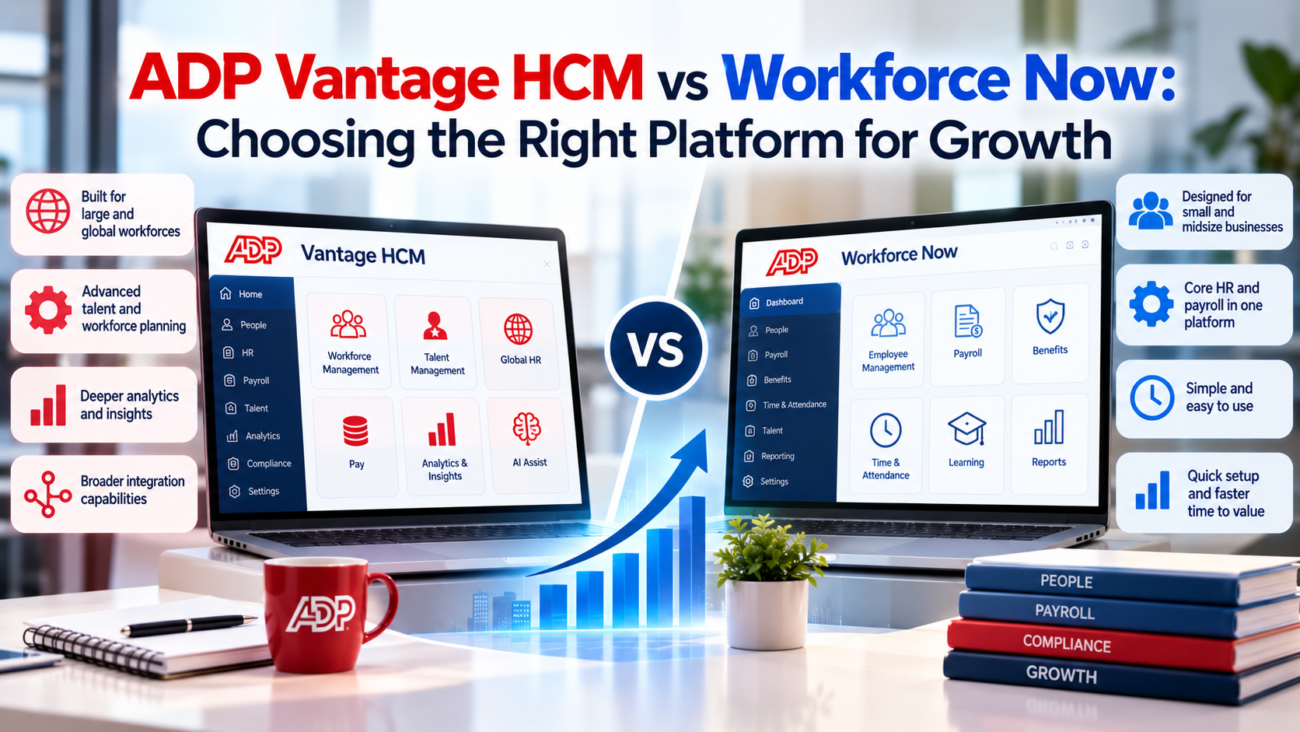
Choosing between ADP Vantage HCM and Workforce Now is harder than comparing employee counts. Both platforms can sit at the center of payroll and HR operations, yet the fit depends on how much organizational complexity the business has to manage as it grows. Legal entities, pay groups, workforce locations, benefit rules, integrations, approval layers, reporting needs, and acquisition plans can matter more than raw headcount.
The 2026 product picture also deserves care. ADP still supports Vantage HCM and continues to list integrations for it. At the same time, ADP’s current product catalog places Workforce Now across midsized and large-business use cases and gives Lyric the headline enterprise position. ADP’s current product lineup makes that shift visible, which means a new buyer should ask about product roadmap as well as present-day features.
This guide compares ADP Vantage HCM vs Workforce Now through the decisions that matter during growth. It looks at payroll, HR administration, workforce management, reporting, integrations, implementation effort, cost drivers, and the point at which added organizational complexity changes the answer.
TL;DR
ADP Workforce Now is the more obvious fit for many growing U.S. organizations that want payroll and HR in one system without taking on an enterprise-heavy operating model. It can also serve larger employers, so crossing 1,000 employees doesn’t automatically mean a platform change.
ADP Vantage HCM remains supported and is associated with large, often multinational U.S.-based organizations. Existing Vantage customers may have strong reasons to stay if the platform already handles their pay groups, policies, integrations, and governance well.
For a net-new enterprise decision in 2026, the buyer should also ask ADP where Lyric fits. The choice should be based on operating complexity, future structure, implementation risk, and the product roadmap rather than employee count alone.
The Short Answer: Which Platform Fits Growth?
The best way to read ADP Vantage HCM vs Workforce Now is as a complexity decision. Workforce Now covers a wide range of organizations because it combines payroll, HR, benefits, talent, workforce management, and reporting in one environment. Vantage HCM has historically served larger organizations with more complex structures and enterprise operating requirements.
ADP’s own login directory still labels ADP Workforce Now for midsized business and ADP Vantage HCM for large business. The same ADP platform directory describes Vantage as a system for large organizations and Workforce Now as an integrated HCM system for midsized employers. That positioning is useful, but it should not be treated as a hard sizing rule.
Current Workforce Now material also includes an enterprise offering. ADP has a dedicated Workforce Now page for larger organizations and provides a 1,000+ employee product experience. This matters because a fast-growing company shouldn’t assume that Workforce Now becomes unsuitable the moment headcount crosses a particular threshold. ADP Vantage HCM vs Workforce Now should be treated as a fit decision rather than a fixed employee-count rule.
| Decision Factor | ADP Workforce Now | ADP Vantage HCM |
| Typical fit | Growing midsized and many large organizations | Large organizations with established enterprise complexity |
| Headcount signal | Commonly starts at 50+ and can extend into enterprise use | Commonly associated with large business |
| Core strength | Connected payroll and HR with modular expansion | Enterprise HR and payroll operations with complex structures |
| Best growth question | Can the current configuration support the next stage? | Does the existing enterprise design still fit the future state? |
| 2026 roadmap question | Which Workforce Now edition and enterprise services fit? | Is Vantage still the intended long-term platform for this account? |
A useful ADP HCM comparison therefore starts with process complexity. The ADP HCM platform decision should reflect how that complexity will change over the next few years. Headcount gives context, but a company with 2,000 mostly U.S. employees and simple payroll may have an easier operating model than a 700-person company with several legal entities, union groups, acquisitions, and complicated benefits.
What ADP Vantage HCM Is Today
ADP Vantage HCM is an enterprise HR and payroll platform that ADP continues to support in 2026. It has been used by large U.S.-based organizations, including businesses with multinational operations, to manage core HR, payroll, benefits, talent, time, and related workforce processes.
ADP’s recent HRIS guidance still lists ADP Vantage HCM as an option for large multinational companies based in the United States. The ADP HRIS guide places it beside Workforce Now and Lyric rather than describing it as an unsupported product. That distinction matters for companies already running Vantage and evaluating whether growth requires a move.
The safest way to think about Vantage is as an established enterprise system with a large installed base, existing integrations, and ongoing support. An organization may have years of payroll rules, custom reports, interfaces, security roles, benefit feeds, and operating procedures built around it. Those assets have real replacement cost even when another platform looks simpler on a feature chart.
ADP also maintains a dedicated Vantage support page that says the platform receives updates, security protections, and client care. That makes an existing Vantage environment different from an abandoned system that must be replaced on a fixed date.
The open question is the long-term destination for a net-new enterprise buyer. ADP’s public product catalog now gives Lyric the lead enterprise position. That doesn’t prove every new enterprise customer must choose Lyric, but it does mean any ADP Vantage HCM vs Workforce Now evaluation should include a written roadmap discussion with ADP before the buyer commits to a long implementation cycle.
What ADP Workforce Now Is Today
ADP Workforce Now is ADP’s main all-in-one HCM offering for organizations starting around 50 employees and extending into larger enterprise use. It combines payroll with HR administration and can add benefits, time, talent, reporting, analytics, and connected services.
The current Workforce Now overview shows 3 package levels: Select, Plus, and Premium. Select centers on payroll and HR. Plus adds benefits administration. Premium adds Time and Attendance. Other capabilities and services can sit around those packages, so buyers should compare the exact quote rather than assume every feature on the broader site is included in the base package.
This modular structure is one reason Workforce Now can fit a growing company well. A business can start with the areas it needs now, then add functions when HR operations become more complex. That approach can reduce the amount of change introduced during the first implementation.
The current Workforce Now capabilities cover payroll, HR, workforce management, benefits, talent, and reporting. ADP also describes AI-assisted functions in several areas. A buyer should still test each capability against its own rules, because a feature category can look identical across 2 products while the depth of configuration differs.
ADP Workforce Now also has a specific enterprise offering. That changes the old comparison logic. A company with 1,000 or more employees may still have a valid Workforce Now path if its operating model fits the platform and the required services are available.
The Core Difference Is Business Complexity
The strongest ADP Vantage HCM vs Workforce Now decision rule is the amount of complexity the company must control. Growth creates more work, but it doesn’t create the same work for every company. Some businesses add employees inside one legal entity. Others grow through acquisitions and inherit different pay calendars, policies, benefit plans, locations, unions, and reporting requirements.
Complexity starts to matter when the HR system has to represent many versions of the same process. Payroll may need several pay groups with different cutoffs. Benefits may have different eligibility rules by business unit. Managers may need approval rights that follow region or cost center. Finance may want labor reporting across several entity structures. IT may need a large set of interfaces with strict ownership.
This is where an ADP HCM comparison should move beyond feature names. An enterprise HCM platform has to represent the company’s operating rules without forcing teams into side spreadsheets. Both platforms can support core HCM work. The real question is how the business rules are represented, maintained, tested, and changed over time.
For a growing organization, look at these signals before deciding whether an enterprise HCM platform is necessary:
· Number of legal entities and tax jurisdictions
· Number of payroll calendars and pay groups
· Frequency of acquisitions or divestitures
· Depth of union or contract-driven rules
· Number of benefit eligibility structures
· Global employee populations and local payroll connections
· Number of required third-party interfaces
· Volume of custom reporting and security roles
· Frequency of reorganizations
A company that is growing headcount inside a stable structure may prefer the simpler administration model of Workforce Now. A company that is growing through repeated acquisitions may care more about how quickly new entities can be mapped into the existing HCM design.
That is why HCM software for growing companies should be evaluated against the next operating model, not the current org chart. The platform has to absorb the business the company expects to become without forcing HR and payroll into constant workaround projects.
Payroll And HR Administration Compared
Payroll is usually the first place where platform fit becomes visible. A growing company can tolerate some manual HR work for a while. Payroll is less forgiving because errors affect employees, tax filings, accounting, and cash movement on a fixed schedule.
ADP Workforce Now is built around connected payroll and HR records. Its current payroll capabilities include payroll processing, employee self-service, reporting, error detection, and links to broader U.S., Canadian, and global payroll services. The same environment can connect employee changes to payroll without requiring a separate master-data handoff for every event.
ADP Vantage HCM is also an HR and payroll system, but the comparison becomes more about enterprise operating depth. Large organizations often have more payroll groups, entity-level controls, union rules, retroactive pay activity, special earnings, and complex reporting. An existing Vantage customer may already have those items encoded in mature production rules.
When comparing ADP Vantage HCM vs Workforce Now, payroll teams should build a scenario pack before looking at demonstrations. Use real cases from the current environment: a retroactive promotion, a transfer between legal entities, an employee with multiple jobs, an off-cycle payment, a union deduction change, and a terminated employee with final pay rules. Ask the vendor team to show how each case moves from HR change through payroll review.
The HR administration side should use the same method. Test new hire entry, job changes, manager changes, leave events, organizational moves, and terminations. Watch where the system requires manual intervention and where approvals can be controlled through roles.
For HCM software for growing companies, the goal is to avoid creating a payroll team that spends each cycle fixing upstream HR data. A good ADP HCM platform should make those ownership boundaries visible in the workflow. The right platform should make ownership clear: HR maintains employee and organization data, payroll controls pay processing, and exception workflows show where a record is blocked.
Benefits, Talent, And Workforce Management
Benefits, talent, and time management often decide whether a company can keep one HCM platform as it grows. Payroll may work well in both systems, but surrounding processes can create the most administration.
ADP Workforce Now offers benefits administration inside its package structure, with Time and Attendance in the Premium package. The current package comparison shows how those functions are layered. Buyers should compare the quoted edition with their actual eligibility rules, enrollment process, carrier feeds, time rules, and scheduling requirements.
For talent, the practical question is whether recruiting, onboarding, performance, learning, and development need to share the same worker record. A growing organization may accept a separate recruiting system if the new-hire connection is reliable. Another business may want fewer systems because HR is spending too much time reconciling identities and status changes.
ADP’s Recruiting Management product can connect with several ADP systems of record, including Vantage and Workforce Now. The recruiting integration details show that a shared vendor doesn’t always mean every talent function lives inside the same product. This is an important detail in an ADP HCM platform decision because buyers often compare brand names instead of actual system boundaries. The ADP HCM comparison should document those boundaries before scoring features.
Workforce management deserves its own test when hourly labor is important. Scheduling, attendance, overtime, shift rules, transfers, and time approvals can become large operational systems. A manufacturer with 800 employees may have more difficult workforce management needs than a 3,000-person professional-services firm with mostly salaried staff.
ADP Vantage HCM vs Workforce Now should therefore be tested with the hardest workforce group, not the easiest. If the system can handle the most complex group without heavy manual work, the simpler populations usually fit as well.
Reporting, Analytics, And Decision Support
Growth changes the questions leaders ask. Early-stage reporting may focus on headcount and payroll totals. Larger organizations need views by legal entity, location, job family, cost center, manager hierarchy, labor type, or acquisition group. The reporting model matters because finance and HR will use the same data for different decisions.
ADP Workforce Now includes reporting and analytics that bring payroll and workforce information together. Its current reporting tools include standard reports, custom reporting, workforce trends, benchmarking, and AI-assisted analysis. Buyers should test whether those tools cover the reporting grain they need rather than judging the platform from dashboard screenshots.
ADP Vantage HCM also supports enterprise reporting and analytics, but existing customers may have a large body of reports built around current field definitions and business structures. A migration can change more than report layout. It can change field names, identifiers, hierarchies, calculation logic, and refresh timing.
That makes reporting one of the hidden cost areas in ADP Vantage HCM vs Workforce Now. A company might move payroll successfully and still spend months rebuilding finance extracts, audit reports, headcount files, compliance reports, and management dashboards.
A good ADP HCM comparison should inventory reports in 3 groups. That exercise also shows whether the business really needs an enterprise HCM platform or mainly needs better report governance. First, identify legally or financially required outputs. Next, identify operational reports used every pay period or month. Then identify reports that are rarely used and can be retired. This avoids carrying years of reporting clutter into a new design.
HCM software for growing companies also needs clear data ownership. Decide which system owns worker status, job, location, manager, cost center, compensation, and benefit eligibility. Reporting becomes far easier when each field has one trusted source.
Integrations And API Requirements
Integrations often determine whether an HCM project stays manageable after launch. A platform may cover most HR functions and still need connections to finance, identity management, recruiting, benefits carriers, learning tools, expense systems, workforce apps, or internal data platforms.
ADP offers API Central for Vantage HCM. The current API Central listing provides access to ADP APIs, developer resources, and support for organizations connecting Vantage and other enterprise ADP products to outside systems. This confirms that Vantage remains part of the supported integration ecosystem.
API availability still needs endpoint-level review. ADP’s developer resources publish product-specific guides and also identify cases where certain APIs are not available for Vantage. A technical team should never assume that an API supported in one ADP product exists with the same data objects or write capabilities in another.
For ADP Workforce Now, the integration question is similar. List every inbound and outbound flow, define the system of record, and confirm whether the connection is file-based, API-based, Marketplace-based, or manual. Then test effective dates and corrections, because those are where employee data integrations often break.
This is also where the 2026 roadmap matters. ADP’s current integration-planning guidance recommends aligning HCM connections with long-term business goals before implementation. The integration planning guide makes a useful point for any ADP HCM platform choice: reducing duplicate entry only works when the connected systems agree on ownership and timing.
Before approving ADP Vantage HCM vs Workforce Now, build an interface register with owner, source, destination, frequency, identifier, failure alert, and correction process for each connection. That register will often reveal more about implementation effort than the feature comparison does. It also helps determine whether an enterprise HCM platform will reduce interfaces or simply move them.
Implementation, Migration, And Governance
Implementation risk rises with the number of rules that must be moved and retested. A new platform can look easier to use while still requiring a difficult conversion because payroll history, employee data, benefit elections, security roles, interfaces, reports, and open transactions all have to land correctly.
An existing Workforce Now customer considering a move should first separate platform limits from configuration problems. If the current issue is a poorly designed approval flow, an inconsistent earnings-code structure, or weak reporting governance, a platform replacement may reproduce the same problem in a new system.
The same applies to an existing Vantage customer. A migration should have a business reason stronger than interface preference. If ADP Vantage HCM already supports the required payroll and HR rules, the organization needs to quantify what it expects to gain from moving and what it will have to rebuild.
A practical migration plan for either direction should cover current-state inventory, future-state design, data conversion, interface rebuilding, role mapping, parallel payroll testing, user acceptance testing, cutover, and post-go-live support. In ADP Vantage HCM vs Workforce Now, migration effort should be scored as part of the platform decision rather than treated as a later implementation detail. Those workstreams can overlap, but each needs a named owner and a measurable exit condition.
Governance matters after launch too. HCM software for growing companies changes often because the business changes often. The ADP HCM platform should make controlled change easier to document and test. New states, new entities, acquisitions, policy changes, and new vendors all create configuration work. Set a change process for payroll rules, integrations, security, and reporting so the system doesn’t become a collection of one-off fixes.
Security should be part of that governance. Any HCM platform contains payroll, tax, identity, banking, benefits, and employment information. The evaluation should cover role design, privileged access, authentication, interface credentials, audit logs, and termination controls. The purpose is to make access follow job need and to ensure an integration doesn’t become a permanent back door into sensitive worker data.
Cost And Commercial Model
Neither ADP Vantage HCM nor Workforce Now should be compared on software price alone. ADP generally uses quote-based commercial terms for these platforms, and the actual cost can depend on modules, employee count, implementation scope, services, integrations, payroll complexity, and support arrangements.
That means the cost model for ADP Vantage HCM vs Workforce Now should include 5 buckets: recurring platform fees, implementation services, integration work, internal project labor, and ongoing administration. The first bucket is the easiest to see in a proposal. The other 4 often explain why 2 systems with similar license costs can have very different total costs.
Workforce Now’s package structure can make initial scope easier to understand, but buyers still need to identify add-ons and connected services in the quote. Vantage customers should review the cost of maintaining existing custom work against the cost of rebuilding it elsewhere.
Don’t treat migration cost as a one-time technical number. A major HCM change also consumes payroll experts, HR staff, finance reviewers, security teams, and managers during testing. Those people still have day jobs, so the organization may need temporary coverage or a longer project schedule.
For an ADP HCM platform decision, ask for a 3-year cost view with assumptions written beside each line. The same cost view should be used in the ADP HCM comparison so both options are judged on the same growth assumptions. Include expected headcount growth, likely acquisitions, new jurisdictions, planned integrations, and support needs. A cheaper year-1 configuration can become expensive if every growth event requires extra services or manual processing.
Which Platform Fits Different Growth Scenarios?
The right answer becomes clearer when ADP Vantage HCM vs Workforce Now is applied to a real growth pattern. The scenarios below are decision guides, not vendor rules.
| Growth Scenario | Likely Direction | Why |
| 300 employees growing to 700 in one U.S. entity | Workforce Now | Broad payroll and HR coverage with room to add modules |
| 800 employees with several states and hourly groups | Workforce Now may still fit | Complexity should be tested, but headcount alone doesn’t force a move |
| 1,500 employees already stable on Workforce Now | Review before changing | ADP offers an enterprise Workforce Now path |
| Large employer already stable on Vantage | Staying may be reasonable | Existing rules and interfaces have replacement value |
| Net-new 5,000-person enterprise review | Ask about current enterprise roadmap | Vantage support continues, but ADP now highlights Lyric for enterprise |
| Acquisition-heavy group with many entities | Complexity-led evaluation | Entity design, payroll groups, integration work, and governance drive fit |
A company on Workforce Now that grows past 1,000 employees shouldn’t move simply because an old comparison article says it has crossed a limit. Test whether performance, administration, payroll rules, workforce management, reporting, and service support still meet requirements.
A company on ADP Vantage HCM shouldn’t move only because Workforce Now looks newer or simpler. The replacement cost of tested payroll rules and enterprise interfaces can be large. The business case should identify a real operating gain, such as simpler administration, fewer interfaces, better reporting access, or a clearer product roadmap.
For a net-new enterprise buyer, there is another question. ADP’s public site now presents ADP Lyric HCM as its full-suite enterprise HCM product. A buyer comparing Vantage with Workforce Now in 2026 should ask ADP whether Lyric belongs in the evaluation and how the long-term roadmap differs across the 3 products.
This current product context is one of the most important parts of choosing HCM software for growing companies. It also matters when an enterprise HCM platform may stay in service for many years. A platform should support the next stage of the business and have a roadmap that matches the life of the investment.
A Decision Checklist Before You Choose
A disciplined ADP Vantage HCM vs Workforce Now review should end with proof, not preference. HCM software for growing companies has to be tested against the business’s next stage as well as today’s requirements. Build a requirements pack and make each platform show how it handles the work that creates the most risk.
Start with payroll complexity. Count pay groups, legal entities, tax jurisdictions, unions, special earnings, deductions, retroactive processes, off-cycle activity, and year-end requirements. Then document the cases that cause the most manual effort today.
Move to organization design. Show the planned entity structure for the next 3 years, including known acquisitions or expansion. Ask how business units, locations, jobs, managers, cost centers, and security groups are maintained after a reorganization.
Then test integrations. List every system that sends or receives worker data. Confirm supported methods and field coverage. Don’t accept “we have an API” as the answer. Ask which endpoint handles the exact transaction and whether it supports both reading and writing when needed.
Next, test reporting. Bring 10 reports that payroll, HR, finance, and leadership actually use. Rebuild or demonstrate them in the proposed platform. Include a report that crosses legal entities and one that depends on historical changes.
Finally, score implementation and support. Ask who owns data conversion, testing, interface setup, training, and post-launch issues. Document what is included in the commercial proposal and what becomes a separate services charge.
Use one final question for the ADP HCM comparison: what business event would make this platform the wrong choice 3 years from now? A useful answer forces the team to discuss limits openly instead of treating every feature as equally important.
Final Thoughts
ADP Vantage HCM vs Workforce Now is no longer a simple enterprise-versus-midmarket decision. Workforce Now now serves a wider range of company sizes, including enterprise use cases, while Vantage remains supported for organizations that already depend on its enterprise HR and payroll setup. At the same time, ADP’s public 2026 product direction gives Lyric a larger role in new enterprise positioning.
The best decision comes from the operating model. Choose the platform that can handle the company’s expected entity structure, payroll rules, workforce patterns, integrations, reporting needs, and governance without creating constant manual work. For an existing customer, include the value of what is already built and tested. For a new buyer, include product roadmap as a formal selection requirement.
Growth doesn’t automatically require the bigger-looking system. A final ADP HCM comparison should test the future operating model rather than reward the longer feature list. An enterprise HCM platform earns its cost only when the extra depth solves real operating problems. It requires an HCM platform that can absorb more complexity without turning each change into a project. That is the standard an ADP HCM platform should meet. It is also the standard for HCM software for growing companies when the business expects repeated change.
Frequently Asked Questions
What Is The Main Difference Between ADP Vantage HCM And Workforce Now?
ADP Vantage HCM has traditionally served large organizations with enterprise-level HR and payroll complexity. ADP Workforce Now is widely used by midsized businesses and now also has enterprise use cases. The practical difference should be judged by business structure, payroll rules, integrations, and governance rather than employee count alone.
Is ADP Vantage HCM Still Supported In 2026?
Yes. ADP maintains a Vantage HCM support page and continues to list Vantage integrations in ADP Marketplace. Existing customers should still ask ADP about long-term roadmap plans when making major new investments in the platform.
Is ADP Vantage HCM A Legacy Product?
Some third-party comparison sites call it legacy, but ADP still supports the platform. ADP’s current public product catalog gives more enterprise marketing emphasis to Lyric, so buyers should confirm Vantage’s role in their specific account roadmap rather than relying on a third-party label.
Is ADP Workforce Now Only For Companies Under 1,000 Employees?
No. ADP currently provides Workforce Now material for 1,000+ employee organizations as well. A company should test its operational complexity and service needs instead of using 1,000 employees as an automatic cutoff.
Which Platform Is Better For A Fast-Growing Company?
ADP Workforce Now is often a practical fit when growth happens inside a relatively consistent U.S. operating model. A company with many entities, payroll groups, acquisitions, or complex workforce rules may need a deeper enterprise review before deciding.
Can ADP Workforce Now Handle Enterprise Payroll?
ADP markets an enterprise version of Workforce Now and describes payroll, HR, workforce management, talent, reporting, and benefits capabilities for larger organizations. Buyers still need to test their own payroll rules and pay-group structure.
Does ADP Vantage HCM Support Integrations?
Yes. ADP provides API Central for Vantage HCM and Marketplace integrations that connect Vantage to other business systems. Endpoint coverage varies, so technical teams should confirm each required data object and transaction.
Which Platform Has Better Reporting?
Both platforms support reporting, but the better fit depends on the reports the company needs. Workforce Now has current reporting and analytics tools, while long-time Vantage customers may already have a large library of enterprise reports that would need to be rebuilt during migration.
Should A Company Move From Vantage To Workforce Now Just To Simplify HR?
Not automatically. A migration can simplify some administration, but it can also require rebuilding payroll rules, interfaces, reports, security roles, and historical processes. The expected operating gain should be large enough to justify that work.
Should A Workforce Now Customer Move After Reaching 1,000 Employees?
No fixed headcount should trigger a move by itself. Review payroll complexity, performance, reporting, workforce management, support needs, and acquisition plans. Workforce Now may continue to fit well above 1,000 employees.
How Should Buyers Compare ADP HCM Pricing?
Use a multi-year cost model. Include recurring fees, implementation work, integrations, internal project labor, and ongoing administration. Ask ADP to state assumptions about headcount, modules, service levels, and future expansion in the quote.
What Should Be Tested In A Product Demo?
Use real transactions from the business. Test a new hire, job change, payroll correction, legal-entity transfer, benefit event, manager approval, interface update, and required report. The difficult cases reveal more than a standard product tour.
How Important Are APIs In The Platform Decision?
They are important when HCM data must move to finance, identity, recruiting, benefits, or internal systems. Buyers should confirm exact API endpoints and supported actions because integration coverage can differ by ADP product.
Where Does ADP Lyric Fit Into This Comparison?
ADP currently presents Lyric as its full-suite enterprise HCM platform for organizations with 1,000+ employees. A net-new large-enterprise buyer comparing Vantage with Workforce Now should ask whether Lyric is the product ADP recommends for the long-term design.
What Is The Best Way To Choose Between The 2 Platforms?
Build the decision around future operating complexity. Compare payroll rules, entity structure, workforce management, integrations, reporting, implementation effort, and product roadmap. Then test the hardest real scenarios in each proposed setup before signing.
