
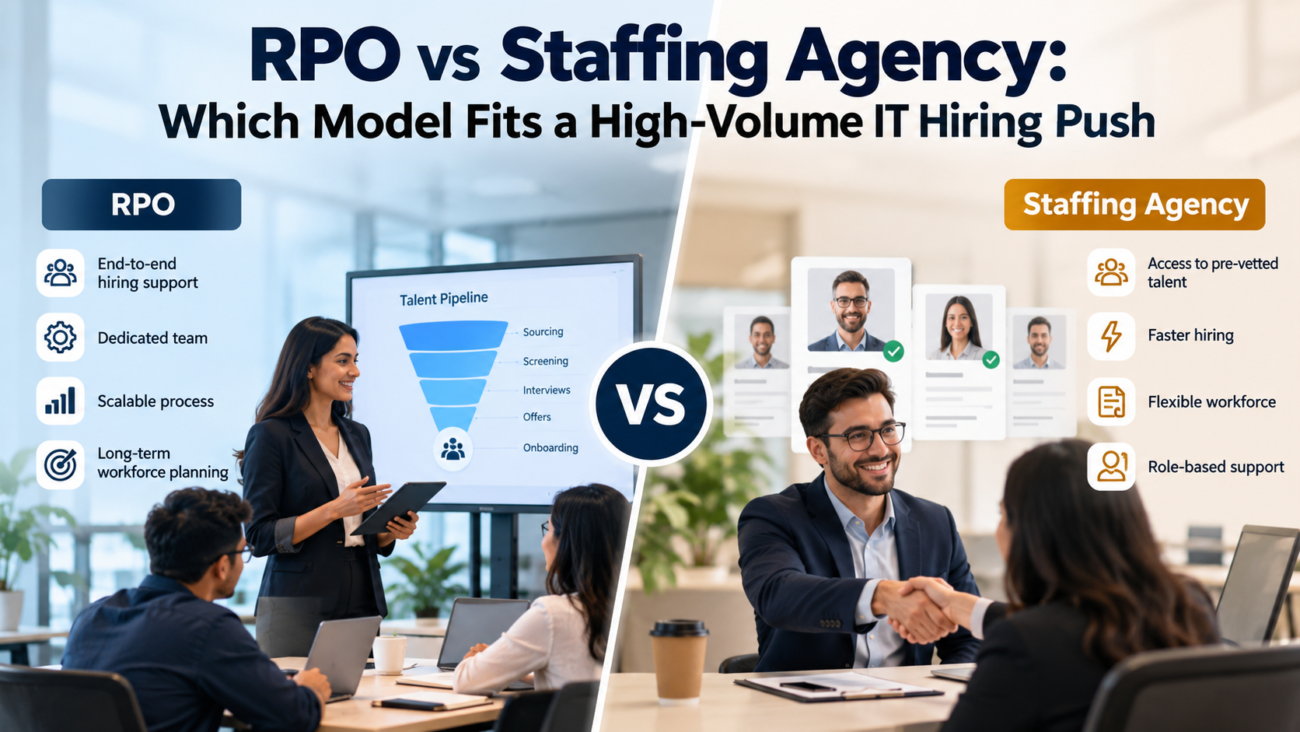
A high-volume IT hiring push creates a different problem from filling 1 difficult role. When a company needs dozens of technical hires in a short window, the bottleneck can move from sourcing to process capacity. Hiring managers still need strong candidates, but the recruiting team must keep the funnel moving under heavier load.
That is the real issue behind the RPO vs staffing agency decision. Recruitment process outsourcing can add an embedded recruiting operation across many requisitions. A staffing agency usually works as an outside supplier that fills selected roles or provides contract talent. Both can produce strong candidates. They differ in what they own, how they scale, and where they create value during a hiring surge.
The better model depends on demand. Predictable hiring across similar job families favors dedicated recruiter capacity. A short burst of specialized roles favors agency networks. Many employers need both because the hiring push can combine repeatable roles with a few niche searches.
TL;DR
• RPO is usually a better fit when IT hiring volume is sustained and the employer needs added recruiting capacity across the full hiring process.
• A staffing agency is usually stronger when demand is uneven or when specific roles require a specialist candidate network.
• Candidate quality depends more on job definition and screening discipline than on the label attached to the recruiting model.
• RPO can give the employer more process consistency because recruiters work inside the employer’s workflow and often under its brand.
• A hybrid model can work well when an RPO team runs the hiring engine while specialist agencies handle the hardest roles.
What RPO And Staffing Agencies Actually Do
The RPO vs staffing agency comparison starts with scope. Recruitment process outsourcing means an outside provider takes responsibility for part or all of the employer’s recruiting process. The provider may supply recruiters, sourcers, coordinators, reporting support, technology administration, or hiring operations. The team often works inside the employer’s applicant tracking system and follows the employer’s interview and approval process.
A staffing agency usually operates as a supplier rather than as the employer’s recruiting function. It receives a job order, finds candidates, screens them, and presents a short list. Depending on the engagement, the agency may place direct-hire employees or employ contract workers who are assigned to the client. An IT staffing agency can move quickly because it can reuse existing candidate relationships and market knowledge across clients.
Volume changes what must be managed. The U.S. Bureau of Labor Statistics expects computer and information technology occupations to produce about 280,000 openings each year on average from 2025 through 2035. That computer occupations outlook shows why technical hiring can stay competitive even when demand varies by role. A high-volume IT hiring program needs enough capacity to manage candidate supply and internal process speed.
The staffing market also remains active. American Staffing Association data released in September 2026 reported that staffing employment in the second quarter rose 0.6% year over year and 5.0% from the prior quarter. Those staffing industry data show continued employer use of temporary and contract staffing during uncertain periods.
The practical distinction is simple. RPO recruiting adds operating capacity around the hiring system. Staffing adds external candidate supply for selected jobs. The RPO vs staffing agency choice should start with one question: is the shortage recruiting bandwidth, candidate access, or both?
Why High-Volume IT Hiring Changes The Decision
Volume IT hiring creates queue problems. More requisitions create more intake meetings, candidate messages, interviews, approvals, offers, and status questions. If each step waits for the same small internal team, time to hire rises even when sourcing is strong.
This is where the RPO model can fit. An RPO provider can assign dedicated capacity across sourcing and coordination while keeping the employer’s process intact. Recruitment process outsourcing works best when the company can forecast a meaningful block of demand across a defined period.
The demand also has to be defined well. LinkedIn’s 2025 Future of Recruiting report found that 93% of surveyed talent professionals viewed accurate skills assessment as important to improving quality of hire. Adding recruiter capacity without fixing assessment can simply move more weak candidates through the funnel faster.
A staffing agency solves a different part of the volume problem. Agencies can add sourcing channels without requiring the employer to build long-term recruiting capacity. That can be useful when volume is temporary or when the hiring plan is still uncertain. If a project may need 40 contractors for 6 months and then drop sharply, agency staffing can be easier to switch on and off than a broader RPO engagement.
The key variable is predictability. RPO recruiting works better when the employer can define the expected hiring load across a planned period. Staffing agencies work better when openings arrive in spikes or when the employer wants to pay for results role by role. The RPO vs staffing agency decision should therefore be mapped by job family, timing, worker type, and expected duration.
Process Ownership Is The Biggest Structural Difference
RPO changes who runs the recruiting workflow. An RPO team may own requisition intake, sourcing, first-stage screening, interview scheduling, candidate updates, offer coordination, and reporting. The employer still makes hiring decisions, but much of the daily recruiting operation can move to the provider.
That structure can be valuable during a hiring surge because weak process ownership creates hidden delays. Candidates may wait for interview scheduling or receive conflicting messages from multiple recruiters. Those failures reduce hiring capacity without appearing in sourcing metrics.
Clear job analysis helps prevent those problems from starting upstream. The U.S. Office of Personnel Management says job analysis guidance should connect the tasks performed in a job with the competencies needed to perform them. Private employers do not have to copy the federal method, but the principle is useful. High-volume roles need a shared definition before dozens or hundreds of candidates enter the process.
A staffing agency usually owns a narrower slice. The agency may clarify the role, search, screen, and submit candidates, but the employer often owns the rest of the process after submission. That can be efficient when internal recruiting operations are already strong. It can create friction when the employer is buying agency candidates because the internal team is overloaded in the first place.
This is a critical RPO vs staffing agency test. If the company has enough interview scheduling and offer support but lacks candidates, an agency may be enough. If the company is short on both candidates and recruiting operations, RPO can address more of the bottleneck.
Process ownership also affects accountability. RPO contracts can measure stages across the funnel. Agencies are usually judged by submissions and hires. The useful model places accountability where the actual failure points sit.
Candidate Quality Depends On Intake And Screening
Candidate quality is often treated as the deciding factor in the RPO vs staffing agency debate, but the label does not guarantee quality. A weak RPO team can produce shallow shortlists. A weak staffing agency can send keyword matches without real technical depth. The better question is which model gives the employer a stronger intake and screening system for the roles involved.
Technical hiring starts with work definition. Cybersecurity titles can hide very different responsibilities. NIST’s April 2026 NICE Framework update uses work roles plus task, knowledge, and skill statements to describe cybersecurity work. Recruitment process outsourcing works better when those differences are defined before several recruiters begin searching.
RPO recruiting can improve consistency because the same team can apply one intake template and one screening rubric across many openings. That is useful when the employer needs several versions of the same role in different locations or business units. The provider can also see funnel patterns across the full program and tell the employer when a requirement is cutting the pipeline too sharply.
A specialist IT staffing agency can have an edge on rare roles because its recruiters may spend most of their time in a narrower market. A firm focused on SAP, ServiceNow, cybersecurity, cloud engineering, or data platforms may already know candidates who are not responding to broad employer outreach. The recruiter may also know which certifications matter in practice and which requirements are common wish-list items.
Software demand illustrates why that depth matters. The Bureau of Labor Statistics projects 10% growth for software developers, quality assurance analysts, and testers from 2025 to 2035. Its software developer outlook also projects about 106,100 openings each year on average. Employers still have to distinguish broad candidate availability from the exact experience a project requires.
Quality improves when screening is tied to the work. For repeat roles, RPO can make that method consistent across recruiters. For narrow roles, an agency can add deeper market judgment. The RPO vs staffing agency model often works best when both forms of quality control are available.
Speed Comes From Capacity And Fast Decisions
A staffing agency often looks faster because it can submit candidates soon after receiving a job order. That is useful when an employer needs an urgent contractor or a difficult specialist. The agency may already have people in its network who match the role and are open to work.
The RPO team can become faster after the initial setup because the team is dedicated to the employer’s hiring program. Recruiters do not need to relearn the company for every requisition. They can reuse intake standards, candidate messaging, screening questions, and interview logistics. The first few weeks may require calibration, but a stable program can reduce repeated setup work across dozens of hires.
The biggest speed gains often come after sourcing. OPM’s hiring assessment guidance emphasizes job-related assessments and structured methods. The federal context differs from private hiring, but the lesson applies: repeatable assessment can move large applicant pools without every manager inventing a new test.
Security roles can expose the cost of slow decisions. The Bureau of Labor Statistics projects employment for information security analysts to grow 21% from 2025 through 2035. Its security analyst outlook estimates about 14,100 openings each year on average over that period. A company competing for people with current security skills can lose strong candidates when interview scheduling or approval takes too long.
Speed should therefore be measured in stages. Track time from requisition approval to first qualified slate, slate to interview decision, interview to offer, and offer to acceptance. A staffing agency may outperform at the first stage. The RPO vs staffing agency difference becomes clearer across the full sequence because it is closer to the internal workflow.
Time to first resume is a weak score by itself. A large IT hiring program needs qualified candidates moving through a process that can make decisions at the same pace.
Cost Changes With Volume And Volatility
Cost comparisons are often oversimplified because RPO and staffing agency pricing use different units. An agency may charge a direct-hire placement fee or a markup for contract workers. An RPO provider may charge a management fee, recruiter capacity fee, cost per hire, project fee, or a blended model. A simple percentage comparison can therefore hide what the employer is actually buying.
RPO becomes easier to justify when hiring volume is high enough to use the dedicated team. Fixed or committed capacity can spread across many hires. The employer may also reduce the amount of internal recruiter overtime, agency coordination, scheduling work, and duplicated sourcing activity that comes with a fragmented model.
A staffing agency can be more economical when hiring demand is irregular. If the company needs 5 difficult hires this quarter and none next quarter, paying a placement fee may be easier to defend than maintaining dedicated RPO capacity. The same logic applies to contract staffing when the project has a clear end date.
Cost per hire should include internal effort. Hiring managers spend time reviewing weak profiles and interviewing candidates who do not meet the role. Harvard Business School’s hidden workers research found that rigid hiring systems can exclude qualified people. Poor filters can therefore raise effort while reducing access to talent.
The right cost model also depends on vacancy impact. An open service desk role and an open principal cloud architect role do not create the same business cost. Hiring budgets should therefore separate repeatable roles from critical specialist jobs. RPO can handle the repeatable hiring engine while a specialist agency receives a different budget for roles where market access matters more than unit cost.
The financial question is not which vendor fee looks lower. It is which model produces acceptable hires at the required pace without creating hidden internal work or locking the company into capacity it cannot use.
Employer Brand And Candidate Experience Matter More At Volume
A hiring surge puts the employer brand under pressure because many candidates interact with the company at once. Delayed updates, duplicate outreach, unclear interview steps, and inconsistent recruiter messages become more visible when the volume rises. Candidates may share those experiences with peers even when they are not hired.
RPO can give the employer more control because the team often recruits under the company’s brand and follows one communication standard. That helps when a firm is hiring several groups at the same time and wants candidates to receive a consistent explanation of the role, interview process, work model, and expected timeline.
Skills-based hiring can also widen the funnel when it is done carefully. Brookings argues in its discussion of skills-based hiring that removing degree requirements alone is not enough. Employers still need ways to identify relevant skills and assess them well. For a large IT hiring push, that means the sourcing message and screening rules should reflect actual work rather than relying on education or title as crude shortcuts.
A staffing agency controls part of the candidate experience before submission. A good recruiter can explain the project, compensation, work arrangement, and interview expectations before the candidate invests time. This can reduce late withdrawals. The experience can become inconsistent when the employer uses many agencies that describe the same role differently.
The RPO vs staffing agency decision should therefore include brand risk. RPO is usually stronger when the employer wants one voice across hundreds of candidate interactions. Agency search can be stronger when a specialist recruiter needs to sell a hard role through a trusted market relationship.
The employer still owns the final experience. Recruiter updates cannot fix repeated interview delays or slow offer approval.
Technology And Hiring Data Favor An Embedded Model
High-volume hiring creates enough activity that spreadsheets become hard to manage. The employer needs one record of requisitions, source channels, candidate stages, interview outcomes, offers, declines, and hiring-manager feedback. In the RPO vs staffing agency comparison, RPO often fits better when the company wants an outside team to work inside that data structure.
An RPO provider can operate directly in the employer’s ATS and build reporting around the full funnel. That makes it easier to compare pass rates between job families, see where candidates leave, and identify managers whose interview decisions are slowing hiring. The embedded team can also keep one source taxonomy so the company knows whether a candidate came from direct sourcing, referral, job advertising, or an outside agency.
Technology can still create bad outcomes when filters are too rigid. The EEOC’s AI hiring guidance warns that software and algorithmic employment tools can raise disability discrimination concerns. Hiring teams should review automated screening for job relevance and accessibility.
A staffing agency usually works in its own recruiting technology and submits candidates into the client’s system. That separation can be useful because the agency can use its own search tools and candidate database. It can also limit visibility. The employer may see only the candidates who were submitted and miss the search activity that explains why a role is difficult.
Data ownership should be defined in both models. The company needs its candidate records, source history, hiring metrics, and process documentation if an RPO relationship ends.
Technology favors an embedded model when the main goal is one measurable hiring system. It favors specialist agencies when proprietary candidate networks and external market search are the larger need.
Compliance And Worker Type Can Change The Answer
RPO is most often associated with recruiting employees whom the client will hire directly. Staffing agencies are frequently used for temporary and contract workers, though many agencies also handle direct hire. That difference matters because a high-volume IT hiring push may include several worker types with different legal and operational requirements.
Employment agencies also have their own anti-discrimination duties. The EEOC explains in its employment agency rules that agencies regularly referring workers to employers are covered by the laws the agency enforces and cannot honor discriminatory employer preferences. The client still needs a lawful intake process. A staffing partner should challenge a request that uses protected characteristics as screening criteria instead of quietly translating it into sourcing instructions.
Worker classification is another issue when companies use contractors. The IRS’s 2026 worker classification guide says the relationship should be examined through evidence of control and independence, including behavioral control, financial control, and the type of relationship between the parties. A contract label by itself does not settle worker status.
Recruitment process outsourcing does not remove the employer’s compliance responsibilities. The provider can follow the employer’s process and maintain records, but the company still needs clear policies for selection, accommodation, background checks, data handling, and offer approvals. The division of responsibilities should be written into the operating model.
An IT staffing agency may take on more employment administration when it employs contract workers. The exact responsibilities depend on the staffing arrangement and applicable law. That can make staffing attractive when the company needs project talent without adding the same number of direct employees.
The RPO vs staffing agency decision should start by separating permanent hiring from contingent staffing. A company that treats both as one purchasing category can end up comparing two services that solve different workforce needs.
A Hybrid Model Often Fits IT Better
Large IT hiring programs rarely consist of one uniform job family. A company may need 40 application developers, 15 support analysts, 8 data engineers, 4 security specialists, and 2 enterprise architects. The first 2 groups may support a repeatable recruiting process. The last few may require deeper niche search.
That is where a hybrid model works. RPO can run the core hiring engine. The RPO team handles intake discipline, direct sourcing, screening, interview coordination, reporting, and candidate communication. Specialist agencies can be activated for selected requisitions that remain hard to fill or need market reach the RPO team does not have.
Specialist agency networks can still add useful context beyond a resume, especially when recruiters have worked with the same candidate market over time.
The hybrid model needs rules. Agencies should know which roles are open to them. Candidate ownership should be clear, and hiring managers should receive one status view instead of separate supplier updates.
A staffing agency can also be placed into a tier based on actual performance. Track manager acceptance, interview conversion, offer acceptance, and assignment or early employment outcomes. Do not keep a supplier in a preferred tier because of history alone.
The hybrid model works when RPO provides order and specialist agencies provide additional reach. It fails when every hard role is sent to every supplier and the RPO team becomes another layer of forwarding resumes.
How To Choose Between The Models
A useful RPO vs staffing agency decision can be made with 6 questions. The first is volume. How many IT hires are expected each month and how long will that level last? A 3-month spike deserves a different answer from a 2-year expansion plan.
The second question is role repeatability. If the company needs many people with similar skills and one assessment process, RPO recruiting becomes easier to standardize. If every requisition is different and highly specialized, a staffing agency model may fit better.
The third question is internal capacity. Count recruiter workload, coordinator capacity, interviewer availability, compensation approvals, and onboarding bandwidth. If those internal steps are already overloaded, buying only candidate submissions will not solve the full problem.
The fourth question is worker type. Decide how many hires will be direct employees and how many will be contractors. RPO can support permanent hiring at volume. Staffing can be better suited to contingent talent when the agency employs the worker and manages the assignment.
The fifth question is market difficulty. Use current labor evidence rather than internal assumptions. Systems analyst demand, for example, is projected to grow 8% from 2025 to 2035 according to the Bureau of Labor Statistics systems analyst outlook. The exact difficulty of a role will still depend on location, stack, pay, industry, and seniority, so broad projections should guide context rather than replace local market testing.
The sixth question is process maturity. If the employer cannot define hiring stages, screening ownership, approval rules, or source tracking, RPO may help create operating discipline. If those systems already work, agencies can plug into them without taking over the recruiting function.
A simple decision table can make the choice clearer.
| Factor | RPO | Staffing Agency |
| Sustained hiring volume | Strong fit | Can become fragmented across many roles |
| Short hiring spike | Project RPO may fit | Strong fit when demand is uncertain |
| Repeatable job families | Strong fit | Useful as extra sourcing capacity |
| Niche technical role | Depends on recruiter depth | Strong fit with a true specialist |
| Process ownership gap | Strong fit | Limited impact outside sourcing |
| Contract worker need | Possible in some programs | Common use case |
| Employer brand consistency | Strong fit | Varies by agency |
| Market network for rare skills | Depends on RPO team | Can be a major advantage |
The table narrows the choice, but the hiring plan still needs a role-by-role view because one program can contain different recruiting problems.
How To Set Up The Chosen Model Without Losing Quality
The buying decision is only the start. RPO recruiting and agency staffing can both fail when the employer launches them with weak requirements and unclear ownership. A volume hiring push needs a short operating design before sourcing begins.
Start with the hiring forecast. Group roles by job family, location, seniority, employment type, and target start period. Stage the launch around actual interview and approval capacity.
Next, define the intake standard. Every role should have a short statement of the work, the skills that are truly required, acceptable substitutes, pay range or approved rate, work location, interview steps, and decision owner. This creates a common search brief for the RPO team or IT staffing agency.
Then build screening around evidence. Assessment methods should connect to the competencies needed for the job. Use structured technical screens or work samples when they add information. Do not add tests because they are easy to administer.
Set service measures before launch. For RPO, measure qualified pipeline, stage conversion, candidate response time, interview scheduling time, offer acceptance, and hiring-manager satisfaction. For agencies, add submission acceptance and duplicate submission rates. Keep resume count as an activity measure rather than a success measure.
Finally, create an exception path. A high-volume process needs standard rules, but rare roles will sometimes need different compensation, extra agency support, a changed location strategy, or a longer search. The hiring team should know who can approve those exceptions quickly.
Strong execution makes the model visible in results. Weak execution turns either model into added cost.
Conclusion: Match The Model To The Hiring Problem
The RPO vs staffing agency choice is clearest when the employer separates recruiting capacity from candidate access. Recruitment process outsourcing is usually the better fit when the company needs an embedded team to run a sustained IT hiring program across many requisitions. It can create one process, one reporting structure, and enough daily recruiting capacity to keep the funnel moving.
An IT staffing agency is usually the better fit when the company needs specific market reach, contract talent, or a smaller number of specialized hires. Agencies can add candidate access without a broader recruiting commitment.
For many IT hiring pushes, the RPO vs staffing agency answer is a controlled hybrid. Use RPO recruiting to run the repeatable core. Use specialist agencies for roles where market knowledge or candidate relationships add real value. Keep one intake standard and one set of quality measures across both channels.
The hiring push succeeds when the company can define the work, reach the right people, assess them consistently, and make decisions before good candidates leave the process. The sourcing model should support those outcomes rather than become the goal itself.
Frequently Asked Questions
What Is The Main Difference Between RPO And A Staffing Agency?
RPO usually takes responsibility for part or all of an employer’s recruiting process across a planned hiring program. A staffing agency usually works as an outside supplier that fills selected roles or provides temporary and contract workers. RPO is broader process support. Staffing is usually more role or worker focused.
Is RPO Better For High-Volume IT Hiring?
RPO can be a better fit when hiring volume is sustained and the company needs added recruiter capacity across sourcing and hiring operations. It works especially well when several similar roles must be filled under one process. Short or unpredictable hiring spikes may fit agency staffing better.
When Should A Company Use An IT Staffing Agency Instead?
Use an IT staffing agency when the main problem is access to candidates rather than recruiting operations. Agencies can be useful for niche technical roles, urgent project needs, contract positions, or demand that may disappear quickly. A specialist agency can also add market knowledge in a narrow skill area.
Can A Company Use RPO And Staffing Agencies Together?
Yes. A common hybrid model uses an RPO team to run the main hiring process while approved agencies support selected roles. This can work well when the company has large repeatable hiring needs plus a smaller set of difficult positions that require specialist networks.
Does Recruitment Process Outsourcing Replace Internal Recruiters?
It can replace some recruiting work or extend the internal team. The exact model depends on scope. Some employers outsource most recruiting activity. Others keep hiring-manager relationships and senior hiring in-house while the RPO team handles sourcing and recruiting operations.
How Long Does An RPO Engagement Need To Be?
There is no single required term. The useful period depends on hiring volume and the time needed to set up the process. A short project RPO can support a defined hiring surge. A longer engagement can fit ongoing hiring where the provider needs to maintain dedicated capacity.
Is A Staffing Agency Faster Than RPO?
An agency can be faster for a single urgent role because it may already know suitable candidates. RPO can become faster across a larger program because dedicated recruiters work inside one process and do not restart the employer learning curve for every requisition.
Which Model Produces Better Candidate Quality?
Neither model guarantees better quality. Quality depends on role definition, recruiter skill, candidate access, screening, and hiring-manager decisions. RPO can improve consistency across many hires. A specialist staffing firm can have an advantage on rare technical roles when its recruiters know the market well.
How Should RPO Performance Be Measured?
Measure qualified pipeline, stage conversion, time in each hiring stage, offer acceptance, candidate withdrawal, hiring-manager satisfaction, and early hire outcomes. Time to fill is useful, but it should not be the only measure because speed can improve while candidate quality falls.
How Should Staffing Agency Performance Be Measured?
Track the percentage of submitted candidates accepted by hiring managers, interview conversion, offer acceptance, starts, early performance, and assignment completion when relevant. Also monitor duplicate submissions and candidate ownership disputes because they create extra work during a volume push.
Is RPO Cheaper Than Using Staffing Agencies?
It can be cheaper at sustained volume because dedicated recruiting capacity can be spread across many hires. Agencies can be cheaper when hiring is occasional because the employer pays for specific placements or assignments. The comparison should include internal time and process overhead in addition to provider fees.
Does RPO Work For Contract IT Hiring?
Some RPO programs can support contingent recruiting, but traditional RPO is often centered on direct hiring. Staffing agencies are commonly used when the agency employs contractors and assigns them to the client. Employers should define worker type before comparing vendors because the operating requirements differ.
What Roles Are Best For RPO Recruiting?
RPO recruiting is a strong fit for repeatable job families such as software development, support, infrastructure, quality assurance, and other roles that share common screening steps. It can also cover niche positions, but some employers add specialist agencies when the candidate market is especially narrow.
What Makes High-Volume IT Hiring Fail?
Common failure points include vague requisitions, too many approval steps, overloaded interviewers, inconsistent screening, slow feedback, and weak offer coordination. Adding recruiters will not fix every one of those problems. The operating process has to move at roughly the same pace as candidate sourcing.
What Should A Company Decide Before Starting RPO Or Agency Hiring?
Define expected hiring volume, job families, worker types, target start dates, screening standards, interview capacity, compensation limits, and decision owners. Those choices make it easier to select the right model and give outside recruiters enough information to search effectively.
