
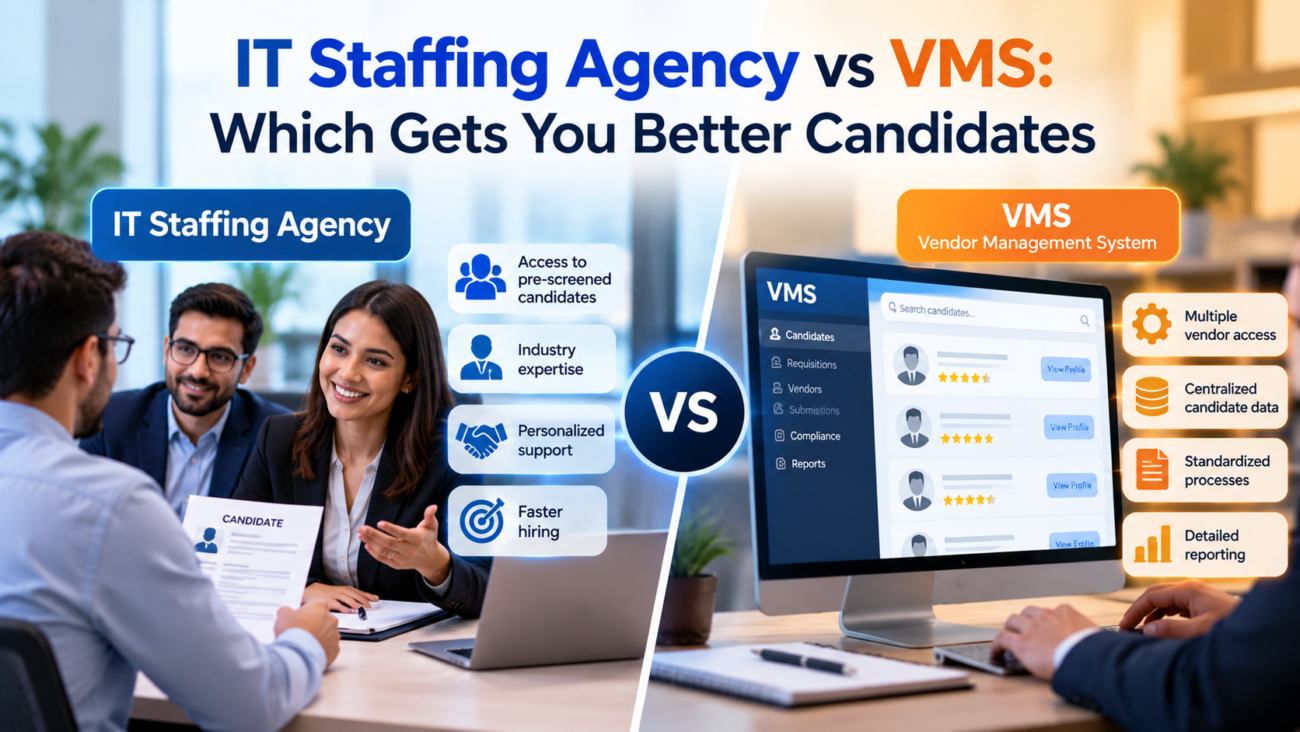
A hiring team can receive 40 resumes and still have no one worth interviewing. That is the real issue behind the IT staffing agency vs VMS question. One model relies on people who search, qualify, and represent candidates. The other relies on software and program rules that distribute requisitions, control suppliers, track submissions, and standardize contingent hiring. They solve different parts of the problem.
That distinction matters in IT. A cloud engineer who handled a difficult migration may look similar on paper to someone who only supported a stable environment. A security engineer may list the right tools but lack the incident response depth the role needs. A vendor management system can organize candidate flow, but it cannot create technical judgment by itself. A strong IT staffing agency can add that judgment, but it may not give procurement the same control across dozens of suppliers.
The better choice depends on what you mean by better candidates. If better means deeper technical fit, access to passive talent, and informed screening before submission, a specialist recruiter has a clear advantage. If better means a controlled supplier program with consistent rates, measurable response times, and one place to manage contingent labor, a VMS has the stronger case. Many large employers use both because sourcing quality and program control are separate jobs.
TL;DR
· An IT staffing agency usually has the edge when the role is specialized, hard to explain, or dependent on recruiter judgment.
· A VMS is stronger when the employer needs one controlled process for many suppliers, locations, hiring managers, or contingent workers.
· Candidate quality falls when a requisition is vague, screening is shallow, or suppliers race to submit resumes before they understand the work.
· The strongest large-company model often uses a VMS as the control layer and specialist staffing firms as the sourcing layer.
· Measure interview quality, hiring-manager acceptance, offer acceptance, early performance, and assignment completion instead of judging a channel by resume volume alone.
What You Are Actually Comparing
An IT staffing agency and a VMS are not direct substitutes. The agency is a service provider that finds and screens people. A VMS is a software platform used to manage contingent labor and the suppliers that provide it. TechTarget describes a vendor management system as enterprise software for procuring and managing a flexible workforce, including temporary workers, contractors, and staffing suppliers. That definition explains why a VMS manages the process around sourcing rather than replacing sourcing itself.
A specialist agency works closer to the candidate market. Recruiters search databases, contact people who are not actively applying, discuss project history, test interest, check work authorization, and decide whether someone is worth presenting. The best firms also learn which requirement is essential and which one was copied from an old job description.
A VMS works closer to program control. Procurement or HR can publish a requisition to approved suppliers, enforce rate cards, limit submissions, record candidate status, track time, and compare supplier performance. The platform can create useful discipline when an enterprise has too many informal staffing relationships. It can also make hiring slower or more mechanical when program rules reward speed and price while giving suppliers little access to the manager.
The U.S. staffing market remains large, so enterprises often need both control and outside recruiting capacity. In September 2026, the American Staffing Association reported that staffing employment grew year over year in the second quarter, while sales also increased. That does not prove one model produces stronger hires, but it confirms that temporary and contract hiring remains an active labor market.
The useful comparison is therefore candidate generation versus candidate governance. IT staffing services influence who enters the funnel. A VMS influences how the funnel is opened, routed, measured, and controlled.
Candidate Quality Means More Than Resume Match
A better candidate can do the work, wants the assignment, and fits the constraints. Resume similarity is only one part of that test. Candidate quality should be defined before the employer compares IT staffing services with a VMS program.
Start with evidence of job performance. The Bureau of Labor Statistics notes that software developers need analytical ability, communication skill, attention to detail, and problem solving in addition to technical knowledge. Its current software developer outlook also projects strong demand through 2035. A search process that only matches tool names can miss the parts of performance that distinguish a capable engineer from a keyword match.
Role clarity matters just as much. O*NET’s current software developer profile describes tasks such as analyzing user needs, developing software solutions, and working with system requirements. Those task statements are more useful for screening than a list of technologies with arbitrary year requirements. A candidate who solved the same problem in a different stack may be stronger than a resume that mirrors every keyword.
Candidate quality also includes motivation. A technically qualified engineer who will not accept the terms is not a usable candidate. Specialist recruiters often surface those problems before submission because they speak directly with the person. A VMS can store the required fields, but the quality of those fields depends on the supplier or direct-sourcing team entering them.
For this article, better candidates means higher probability of manager acceptance and successful work after hire. That definition makes the IT staffing agency vs VMS comparison much more useful than counting how many resumes arrive in 24 hours.
Where An IT Staffing Agency Finds Stronger Candidates
An IT staffing agency is strongest when the search requires interpretation. Hard technical roles rarely fit a clean checklist. A hiring manager may ask for Kubernetes, AWS, Terraform, Python, security experience, and a certain industry background. A recruiter who understands the work can ask which requirement actually separates success from failure. That conversation changes the search before candidate outreach begins.
Specialist recruiters also reach people who are not applying to posted jobs. That matters when the strongest candidate is already employed or finishing another contract. Direct outreach lets the recruiter explain the project and judge whether the person is genuinely open to a move. A VMS can distribute a requisition widely, but distribution is not the same as candidate access.
Human networks can carry information that a resume does not. Research published by the National Bureau of Economic Research found that referrals can contain information about worker performance and persistence that is not visible in standard candidate characteristics. The referral field experiments were not about IT staffing agencies, so they should not be stretched into a claim that agency referrals always produce better hires. They do support a narrower point: relationships can provide useful information beyond a profile alone.
A technical staffing agency can use that information when it has worked with the same consultants or candidate communities over time. Recruiters may know who completed a difficult migration, who communicates well with business teams, or who tends to finish contracts. That history is most useful when the firm records real outcomes instead of relying on recruiter memory.
The agency model also allows deeper intake. A recruiter can ask why the last person failed, what the team is building in the next 6 months, who will interview the candidate, and which skill can be learned after joining. Those questions often expose a mismatch between the written requisition and the actual job.
Current staffing data also shows why skill currency matters. A 2026 ASA and LinkedIn study reported that temporary and contract workers were adding AI skills faster than LinkedIn members overall during the period studied. The useful lesson for IT staffing services is that technical skill sets move quickly, so recruiters need current market knowledge instead of an old keyword list.
Specialist recruiters have the clearest edge when the role is rare, the hiring manager can explain the work, and the recruiter can challenge weak requirements. The advantage shrinks when the agency submits resumes without real screening.
Where A VMS Can Improve Candidate Quality
A vendor management system can improve candidate quality indirectly by creating cleaner supplier behavior. When every supplier receives the same requisition, rate range, location rule, submission deadline, and status information, fewer candidates should be lost to basic process confusion. Standard inputs also make supplier performance easier to compare.
The strongest benefit appears in VMS staffing programs with many staffing suppliers. Without a central system, different managers may send different versions of the same role to different agencies. Candidates can be duplicated. Rates can vary without explanation. Feedback can disappear in email. VMS staffing puts those transactions into one controlled record.
That control can make supplier selection more rational. An employer can compare which suppliers send candidates who reach interviews, which produce accepted offers, and which generate repeated rejections. Resume volume alone should never be the main score. A supplier that submits 5 people and gets 3 serious interviews may be more useful than one that submits 30 weak matches.
A VMS can also enforce basic process gates. Required fields can prevent submissions without location confirmation or rate acceptance. Submission limits can reduce resume flooding. Distribution rules can give specialist suppliers first access to certain roles. Those controls can improve the signal reaching hiring managers when they are designed around quality.
The problem is that VMS recruiting is only as good as its program rules. A platform cannot tell whether a requisition uses the wrong title or whether the manager really needs a backend engineer instead of a full-stack developer. It can create order around a weak requirement without fixing the requirement itself.
For large contingent programs, that order still has value. The VMS is strongest as a control layer that records what happened and gives the employer enough evidence to improve supplier decisions.
Where A VMS Can Hurt Candidate Quality
A vendor management system can hurt quality when the program turns recruiting into a race. If 20 suppliers receive the same requisition at once and each can submit only 2 candidates, recruiters have a reason to move fast. That incentive can reward the first plausible resume instead of the best person the supplier could find after a careful search.
Limited manager access can make the problem worse. A technical staffing agency may see a short requisition but have no chance to speak with the engineering manager. Questions move through an MSP or program office, answers arrive late, and suppliers infer what the manager meant. The operating model around the VMS causes the misunderstanding.
Rate pressure can create another tradeoff. A low ceiling may exclude strong candidates before the manager sees them, especially for scarce skills. The supplier pool may look weak when the real issue is a rate that does not match the experience requested. A good VMS program uses market feedback from suppliers instead of treating every rejection as poor sourcing.
Rigid screening can also hide qualified people. Harvard Business School’s work on hidden workers found that hiring systems can screen out qualified groups when filters are too narrow. The report covers hiring technology broadly. Its lesson applies here: a filter can remove good candidates when the employer defines success too narrowly.
Brookings makes a related point in its discussion of skills-based hiring. Removing a degree requirement is not enough if employers still lack good ways to verify skills and interpret candidate evidence. VMS staffing programs face the same issue when they replace one blunt filter with another.
Quality also falls when suppliers receive no useful feedback. A rejection marked only as “not selected” teaches the agency nothing. Strong programs capture a short reason such as missing hands-on depth, weak communication, rate mismatch, or location conflict. That feedback helps suppliers change the next search.
The lesson is simple. A vendor management system can control the funnel, but poor rules can control it in the wrong direction.
Which Model Wins For Different IT Roles
The best sourcing model changes with the role. High-volume help desk hiring is different from finding a staff-level platform engineer. A company should not force both jobs through the same supplier strategy merely because procurement prefers one process.
Cybersecurity shows why role definition matters. The NIST NICE Framework describes cybersecurity work through tasks, knowledge, and skills instead of relying only on job titles. That matters because titles such as security engineer, cloud security engineer, and security analyst can hide very different work. A recruiter or VMS program should start from the tasks the person will perform.
| Hiring Need | IT Staffing Agency | VMS | Better Starting Point |
| Rare cloud architect | Deep search and candidate outreach | Supplier control and tracking | Specialist agency |
| High-volume service desk | Useful when recruiters screen communication | Strong for distributing demand across suppliers | VMS with strong suppliers |
| Short DevOps contract | Strong when the stack is unusual | Useful for rate and onboarding control | Both |
| Cybersecurity specialist | Valuable when recruiter understands the work role | Useful for supplier records and compliance | Specialist agency inside VMS |
| Multi-location contractor program | Harder to govern across many agencies | Strong central control | VMS |
| Confidential replacement | Direct recruiter relationship can limit exposure | Broad distribution may be unsuitable | Selected agency |
A technical staffing agency usually performs better at the top of the difficulty curve, where sourcing depth and interpretation matter most. VMS recruiting becomes more useful as the number of roles, suppliers, hiring managers, and locations grows.
This is why the strongest answer is often a split model. Use specialist recruiters to solve candidate scarcity. Use the VMS to make sure those recruiters work inside clear rules and that the employer can compare outcomes across suppliers.
Speed Versus Quality In IT Hiring
Speed matters because strong technical candidates rarely stay available forever. The wrong speed metric, however, can reward bad behavior. Time to first submission is easy to measure. It does not tell you whether the submitted person is worth interviewing.
IT staffing services can move quickly when recruiters already know the talent market. A recruiter who has an active bench of contractors or a network in a narrow skill area may reach relevant people within hours. The same speed becomes harmful when the recruiter submits candidates before confirming interest or technical fit.
A vendor management system can shorten administrative steps by distributing one requisition to several suppliers at the same time. It can also slow the search if every clarification must pass through layers of program management. Its speed depends on requisition approval, supplier access, feedback, and interview scheduling.
Use a small set of quality-linked speed measures. Track time to first qualified submission rather than first submission. Track time from submission to manager review. Track time from interview request to scheduled interview. These measures show where the process is actually losing good candidates.
Technical labor demand adds pressure to those delays. BLS projects software developer employment to grow faster than the average for all occupations through 2035, which keeps competition for capable people relevant even when the broader hiring market is uneven. The answer is not to remove screening. It is to remove waiting that adds no judgment.
IT staffing services should therefore be judged on how quickly they produce credible choices. VMS programs should be judged on how quickly those choices move through the employer’s process.
Screening And Assessments Decide More Than The Channel
The biggest quality difference often comes from screening design rather than the sourcing channel. A weak interview process can waste a great candidate from an excellent agency. A clear technical assessment can identify a strong candidate who entered through a broad VMS supplier pool.
The Office of Personnel Management states that job analysis should connect job tasks with the competencies needed to perform them. Private employers are not required to use the federal process, but the principle is useful for IT hiring. Define the work first. Then assess evidence that predicts the ability to do that work.
For software roles, avoid turning screening into trivia. Ask candidates to explain decisions from past projects, diagnose a realistic problem, or review a small piece of code. For infrastructure roles, use scenario questions around failure recovery or access. For security roles, define the work role before choosing the assessment. The goal is proof of relevant thinking, not a test of who memorized the most commands.
Assessment consistency matters when several suppliers feed one requisition. OPM’s current hiring assessment guidance emphasizes valid and fair skills-based assessments tied to the work. Federal hiring rules differ from private hiring, but linking assessment content to job needs is still a useful principle.
Recruiters can add value before the formal interview by checking technical depth and candidate intent. A VMS can make sure every supplier sees the same screening requirements and that results are recorded consistently. Those functions work well together.
Be careful with automated screening. The EEOC has warned that algorithmic hiring tools can create disability discrimination risks when they screen out people who could perform the job with or without reasonable accommodation. Human review does not remove every bias risk either. The employer still needs job-related criteria and a fair process.
The best channel cannot rescue a poor definition of qualified. Fix the assessment model before blaming the supplier pool.
Cost And Rate Pressure Change Who Enters The Funnel
Cost control is one of the reasons companies adopt a VMS. Central rate cards can reduce unexplained differences between suppliers and give procurement a clearer view of contingent labor spend. That control becomes a candidate problem when the rate card stops reflecting the market for a hard role.
Recruiters see rate resistance early because they talk with candidates every day. If qualified cloud engineers keep declining the range, that is market information. The employer can change scope, experience requirements, location, or rate. Ignoring that signal often produces a cheaper funnel with weaker people.
VMS staffing programs can also create fee pressure among suppliers. Competition is useful when it removes excess margin without cutting the work needed to find and screen candidates. It becomes harmful when every supplier is expected to accept the same low margin regardless of search difficulty. Recruiters then have an incentive to spend less time on the hardest jobs.
Candidate quality should be included in cost analysis. Compare channel cost with interview conversion, accepted offers, assignment completion, and rework after failed placements. A higher supplier fee can still be economical if it reduces manager time and failed starts. A lower fee can be expensive if the team interviews many weak candidates.
The same logic applies to IT staffing services outside a VMS. Paying an agency more does not guarantee stronger candidates. The employer needs outcome evidence, not assumptions about price.
Rate governance works best when it allows exceptions with documented reasons. Rare technical work should not be priced as if every candidate were interchangeable.
Governance And Compliance Still Matter
Candidate quality is not the only hiring outcome that matters. Contingent worker programs also need clear rules around worker status, supplier responsibilities, equal employment opportunity, access, onboarding, and offboarding. A VMS can help record those steps, while an agency may perform parts of them as the worker’s employer or referring firm.
The EEOC states that employment agencies are covered by federal anti-discrimination laws when they regularly refer workers to employers. The agency cannot honor discriminatory client preferences. That matters during intake. A hiring manager’s informal request for a certain age profile or another protected characteristic cannot be converted into a sourcing instruction.
Worker classification needs separate attention. The IRS explains that worker classification depends on the facts of the relationship, including behavioral control, financial control, and the type of relationship. A VMS label or contract title does not decide classification by itself. Employers should involve qualified legal or tax advisers when classification is uncertain.
A technical staffing agency often handles payroll and employment administration for its assigned workers. A VMS records the relationship across suppliers and can enforce required onboarding steps. The division of responsibility depends on the contract and worker model.
Governance affects candidate experience too. Slow background checks, duplicate forms, or delayed start dates can cause accepted candidates to leave. Program control should reduce those failures rather than add another layer of waiting.
The best IT staffing agency vs VMS decision therefore includes risk control, but risk control should support hiring rather than replace judgment about candidate quality.
Why The Hybrid Model Usually Works Better At Scale
Large employers often get the strongest result by separating the sourcing engine from the control system. The VMS manages requisitions, suppliers, submissions, rate rules, worker records, time, and program reporting. Specialist agencies find and qualify people. Each side does the work it is better suited to do.
The hybrid model works only when the employer avoids treating every supplier the same. A general staffing supplier may be useful for common roles. A technical staffing agency may deserve priority for cloud, ERP, data engineering, or security positions where market knowledge is more important. Supplier tiers can reflect real performance and specialization rather than historic relationships.
Access to hiring managers should also vary by role. High-volume positions may need a standard intake form. A niche engineering search may justify a 20-minute supplier briefing. That access can prevent days of wrong sourcing.
Supplier scorecards should emphasize quality. Include interview acceptance, offer acceptance, early assignment results, candidate withdrawal reasons, and manager feedback. Submission speed can remain on the scorecard, but it should not overpower the measures that show whether the people were good.
VMS recruiting also needs a feedback rule. Hiring managers should give suppliers enough information to change their search. If a candidate was rejected for shallow Kubernetes experience, say so. If the rate is the problem, do not label it a skills rejection.
IT staffing services become more useful inside VMS staffing when the program protects room for recruiter judgment. The system should create order without turning every search into a transaction.
A Decision Framework For Choosing The Right Model
Choose specialist recruiters first when candidate scarcity is the main problem. This is common for senior engineering, specialized ERP work, cloud architecture, security, and short projects that need a narrow mix of experience. The employer needs someone who can search deeply and explain the opportunity to candidates who are not already applying.
VMS staffing is the better starting point when process fragmentation is the main problem. If many business units use different suppliers, rates vary without reason, duplicate candidates are common, or contingent labor data is scattered, a central platform can create needed control. Candidate quality may improve later because the employer can finally see which suppliers perform well.
Choose both when the organization has enterprise-scale contingent hiring and hard IT roles. That is the common middle ground. The VMS handles governance. The specialist agency handles search and screening.
Use this checklist before deciding:
· How many contingent IT requisitions open each month?
· How many staffing suppliers submit candidates today?
· Which roles repeatedly stay open too long?
· How often do submitted candidates reach an interview?
· Do recruiters have access to hiring managers for difficult roles?
· Are duplicate submissions common?
· Does the company have reliable supplier performance data?
· Are rate cards blocking qualified candidates?
· Which screening steps are job-related and repeatable?
· Who owns candidate experience after submission?
The answers usually reveal the real problem. If the company cannot find the right people, adding more workflow may not help. If the company already has many suppliers but cannot control them, adding another agency may create more noise.
Conclusion: Better Candidates Come From Better Hiring Design
An IT staffing agency has the stronger claim when the main goal is candidate quality for difficult technical work. Recruiter judgment, direct outreach, market knowledge, and deeper intake can uncover people a broad requisition process misses. That advantage depends on recruiter quality. An agency that forwards resumes without real screening adds little.
A VMS has the stronger claim when the employer needs control across a large contingent workforce. It can standardize requisitions, manage suppliers, record outcomes, and make program performance visible. Those benefits are real, but they do not make the software a substitute for skilled sourcing.
The IT staffing agency vs VMS choice is therefore less about picking one winner and more about deciding which problem comes first. Scarce talent calls for stronger search. Fragmented contingent hiring calls for stronger program control. Enterprise employers often need both.
The final measure should be candidate outcomes. Track who gets interviewed, accepts, starts, and performs well enough to complete the assignment. Resume count is easy to improve. Candidate quality takes better role definition, better screening, and a process that gives strong people a reason to stay in it.
Frequently Asked Questions
What Is The Main Difference Between An IT Staffing Agency And A VMS?
The agency finds, screens, and presents candidates. A VMS is software used to manage contingent hiring, staffing suppliers, submissions, rates, worker records, and related processes. An agency is a talent supplier. A VMS is usually the system that controls how suppliers and contingent workers move through the employer’s program.
Does A VMS Find Candidates Directly?
Some VMS programs support direct sourcing or connect with talent pools, but a VMS is mainly a management platform. Many employers still rely on staffing suppliers, internal sourcing teams, or managed service programs to find candidates. The system controls the process around sourcing rather than automatically creating a strong candidate pipeline.
Does An IT Staffing Agency Produce Better Candidates?
A specialist agency can produce stronger candidates when recruiters understand the technical work, have access to relevant talent, and screen people before submission. The advantage is smaller for common roles where many suppliers can find similar candidates. Agency quality varies, so employers should judge firms by hiring outcomes rather than claims.
When Is A VMS Better Than Direct Agency Relationships?
A VMS is useful when an employer has many staffing suppliers, hiring managers, locations, or contingent workers. It can centralize requisitions, rates, submissions, approvals, worker records, time, and program reporting. This makes it easier to control a large staffing program and compare supplier performance.
Can A VMS Lower Candidate Quality?
Yes. Candidate quality can fall when the program rewards very fast submissions, applies rate ceilings that do not fit the market, blocks supplier access to managers, or uses narrow filters. The issue is usually the program design around the VMS rather than the existence of the software itself.
What Is VMS Staffing?
VMS staffing is contingent hiring conducted through a vendor management system. Approved staffing suppliers receive requisitions through the platform and submit candidates inside its rules. The VMS may also track status, rates, time, worker records, and supplier performance.
What Roles Benefit Most From A Technical Staffing Agency?
A technical staffing agency is most useful for roles where the talent pool is narrow or the job is hard to explain through a standard requisition. Examples include senior cloud architecture, niche ERP work, security engineering, data platform roles, and short contracts requiring a specific mix of project experience.
How Should Companies Measure Candidate Quality?
Useful measures include manager acceptance of submissions, interview conversion, offer acceptance, candidate withdrawals, successful starts, early performance, and assignment completion. Resume volume and time to first submission can be tracked, but they should not be treated as proof of quality.
Is A VMS The Same As An MSP?
No. A VMS is software. An MSP is a service organization that may run part or all of a contingent workforce program for the employer. An MSP often operates the VMS, manages staffing suppliers, handles requisition flow, and reports on program results.
Can Small Companies Benefit From A VMS?
They can, but the business case depends on staffing volume and complexity. A company with a few technical contractors and 2 trusted agencies may gain little from a large VMS program. A growing company with many suppliers, locations, or business units may benefit sooner because coordination becomes harder.
How Does An IT Staffing Agency Screen Technical Candidates?
Methods vary. Good screening starts with candidate intent and work history, then tests the depth of relevant project experience. Some agencies use technical recruiters, structured questions, work samples, or outside assessments. Employers should ask exactly what is checked before a resume is submitted.
Should Hiring Managers Talk Directly With Staffing Agencies In A VMS Program?
For difficult roles, controlled access can improve search quality because suppliers can clarify the work before sourcing. High-volume programs may need a standard process to prevent inconsistent treatment. The right approach depends on role complexity and the employer’s governance rules.
How Do Rate Cards Affect Candidate Quality?
Rate cards can improve consistency, but rates that sit below the market for a scarce skill can remove qualified people from the funnel. Employers should review repeated supplier feedback, candidate declines, and unfilled roles before deciding the problem is weak sourcing.
Are Staffing Agencies Responsible For Hiring Compliance?
Staffing agencies have their own legal obligations, including federal anti-discrimination requirements when they act as employment agencies. The client can also have obligations depending on the worker relationship and applicable law. Contracts should define responsibilities clearly, but a contract does not erase duties imposed by law.
What Is The Best Setup For A Large IT Contingent Workforce?
A common effective setup is a VMS for program control with a smaller group of proven staffing suppliers for sourcing. Specialist firms can handle difficult technical roles while the VMS gives the employer one record for requisitions, submissions, rates, workers, and supplier results. The exact model should match hiring volume and role mix.
