
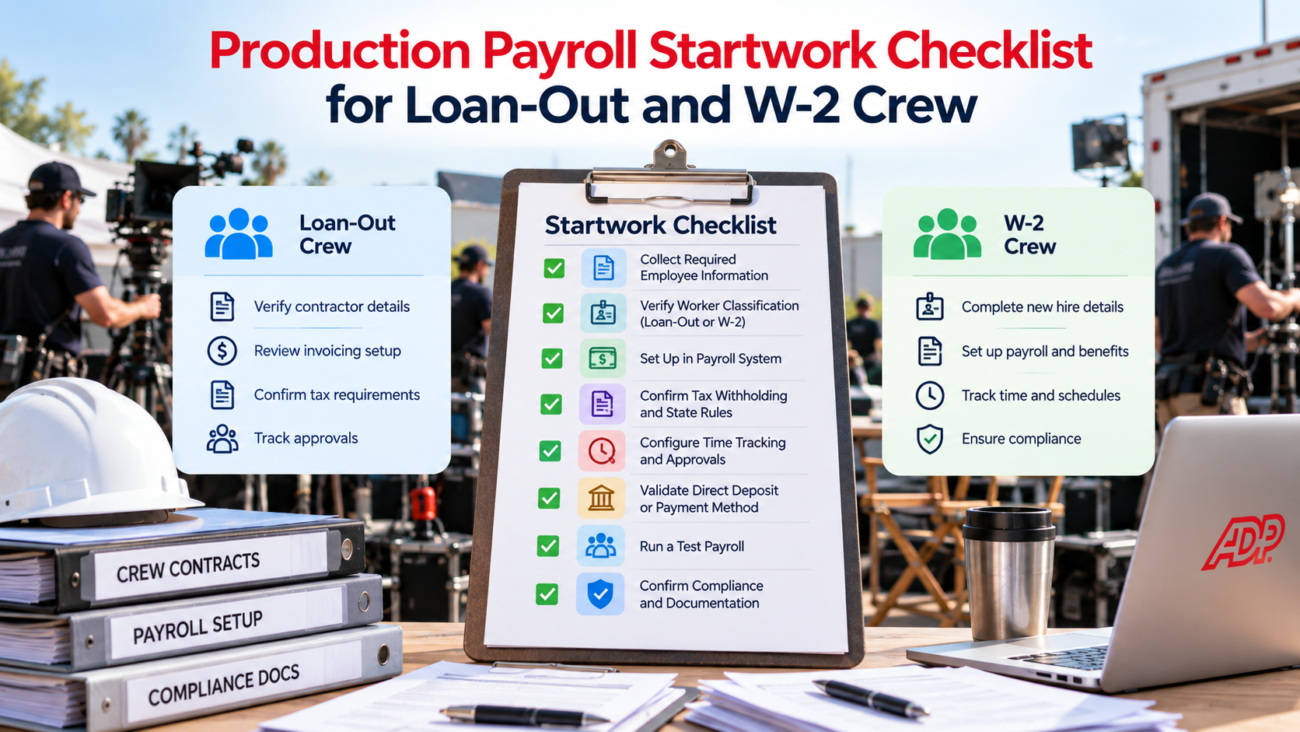
Production payroll can fail before anyone submits a timecard. The usual cause is incomplete or mismatched startwork: the crew member is set up under the wrong payee, the deal memo doesn’t match the rate entered in payroll, a tax form is missing, a loan-out hasn’t been verified, or a state notice wasn’t issued when required. A strong production payroll startwork checklist catches those problems before the first payroll batch is built.
Production crews often mix W-2 employees, union-covered workers, short-term hires, and people who ask to work through loan-out entities. Each path needs a different document set and review, and the first check still has to match the deal that was made.
This guide focuses on the production payroll paperwork and controls that matter before first payroll, from payee setup and I-9 timing to multi-state work and the final audit.
TL;DR
A production payroll startwork checklist should settle the payee and employment path first, then collect only the forms required for that path. W-2 crew generally need employee tax and work-authorization documents plus the deal terms that drive pay. A loan-out needs entity and tax documentation that supports payment to the company, along with the same production-level deal details needed to calculate covered compensation correctly.
· Decide W-2 or loan-out before sending the start packet.
· Match legal names, tax IDs, work state, job classification, union status, rates, and dates across the file.
· Complete I-9 steps on the federal timeline when the production or payroll employer is responsible for the employee’s Form I-9.
· Treat a loan-out request as a review item, not an automatic approval.
· Audit startwork against the first timecard before payroll is released.
Why Startwork Controls The First Payroll
Startwork is the source file for nearly every decision the payroll team makes about a new crew member. It tells payroll who is being paid, which entity is paying them, how the worker is classified, what rate applies, whether union rules affect the calculation, where the work occurs, and which tax documents belong in the file. If those inputs are wrong, a perfect timecard still produces the wrong result.
This is why production payroll paperwork should be reviewed as one connected record rather than a folder of separate forms. A crew member’s start form may say one job title while the deal memo says another, or the payroll system may list an individual even though the approved deal is with a corporation. Those mismatches can change withholding, overtime treatment, fringe calculations, or the name on the payment. Fixing them after payroll closes often means voids, corrections, added approvals, or a late check.
Classification deserves attention at the start because payment method doesn’t decide employment status by itself. The IRS explains that the actual relationship matters under the common-law test, including the right to control how work is done, so a label in a contract doesn’t settle the issue. Production teams should use the IRS employee test as a federal tax reference while also checking the laws that apply to the work location and the production’s contracts. That approach keeps entertainment payroll compliance tied to the real working arrangement instead of the form someone asks to receive.
Decide W-2 Or Loan-Out Before Sending Forms
The first routing decision in a production payroll startwork checklist is whether the worker will be onboarded as an individual employee or paid through an approved loan-out entity. Make that decision before forms go out. Sending both paths at once invites conflicting records, duplicate tax forms, and last-minute requests to change the payee after work has already started.
For a W-2 hire, the production or payroll employer collects employee startwork and withholds payroll taxes based on the worker’s tax elections and applicable law. For a loan-out, payment is directed to an entity that supplies the individual’s services, but the existence of a corporation doesn’t erase every employment or labor-law question. The U.S. Department of Labor’s 2026 rulemaking on contractor status shows why teams should avoid treating entity formation as a shortcut for classification. The current DOL rulemaking should be checked when classification is material because federal guidance has been under active revision.
Use the production’s legal and payroll review process to approve loan-out requests before changing the worker’s path. The review should confirm that the entity type is accepted by the payroll provider, the worker is authorized to act for the entity, the tax name and TIN are consistent, the entity is active where required, and the deal permits payment to that company. This is the point where loan-out company payroll separates from ordinary W-2 crew payroll.
| Question | W-2 Crew | Loan-Out |
| Who is the payee? | The individual employee | The approved business entity |
| Core federal tax form | Form W-4 | Form W-9 or other applicable payee documentation |
| Form I-9 | Usually required for the employee when the hiring employer is responsible | Depends on who is the actual employer of the individual and the payroll setup |
| Entity review | Not applicable | Required before payment to the company |
| Deal terms | Must match payroll setup | Must match both the worker’s engagement and entity payment setup |
| Main risk | Incomplete employee onboarding | Paying an unverified or incorrectly classified entity |
The Master Production Payroll Startwork Checklist
A useful production payroll startwork checklist starts with the fields that must agree across every system. The goal is one clean record that can move from hiring to payroll without forcing the coordinator to guess which document is correct.
Start with identity and engagement data. Confirm the individual’s legal name, preferred working name if used, home address, email, phone number, project title, department, job classification, union or guild status, work state, first work date, and expected last work date. Then confirm the employer or payor name, payroll company if one is being used, project code, department code, account coding, and approver. These fields become the base for W-2 crew payroll and for the production-level record behind a loan-out payment.
Next, lock the compensation terms. The start packet should identify the rate basis, guaranteed hours if any, overtime or premium rules that apply, kit or box rental terms, mileage terms, per diem, travel days, allowances, and any other agreed payment that can appear on a timecard. If a union agreement controls a term, record the correct classification and agreement rather than replacing the union rule with a homegrown note.
The last part of the master check is status. Mark each required item as received, approved, rejected, or pending correction so uploaded files aren’t mistaken for cleared startwork. Good production payroll forms are complete only when the information agrees and the reviewer has cleared the packet for the first payroll.
W-2 Crew Startwork Packet
W-2 crew payroll begins with the employee record. The packet should collect the federal and state forms needed for withholding, the employment details needed for payroll calculation, the work-authorization record where required, payment instructions, and any production payroll forms tied to the job. A crew member shouldn’t have to decide which tax form applies based on guesswork, so the onboarding path should clearly identify them as an individual employee.
The current Form W-4 is the employee’s federal withholding certificate. The IRS says employees use it so the employer can withhold the correct amount of federal income tax, and the 2026 version reflects current federal withholding rules. Keep a link to the current Form W-4 in the production’s startwork reference material rather than recycling an old saved PDF from a prior show. State withholding forms should be selected from the work and residence facts that apply to that employee.
The employee packet should also carry the signed deal memo or start form that payroll will use to set the worker up. These production payroll forms should point to one approved set of pay terms rather than competing versions. That document needs the job title, pay basis, rate, start date, work location, union information if applicable, and any negotiated terms that change gross pay. Direct deposit instructions can be collected separately, but the account name should still be checked against the employee record to reduce avoidable payment holds.
New-hire reporting is a separate employer obligation and shouldn’t be confused with W-4 or I-9 completion. Federal law generally requires employers to report new and rehired employees to the state directory within 20 days, although some states use shorter timelines. The federal new-hire reporting guide is useful for setting a back-office deadline after W-2 crew payroll onboarding is approved.
Loan-Out Company Startwork Packet
Loan-out company payroll needs an entity file as well as an engagement file. The production should know the exact legal name of the loan-out, its business address, federal TIN, entity type, state of formation, person providing the services, and the person authorized to sign for the company. These production payroll forms should also identify the project and approved service provider. The payroll provider may also request formation documents, tax-election evidence, state registration details, or its own indemnity and authorization forms.
Form W-9 is commonly used to collect a U.S. payee’s tax name and TIN when information reporting may be required. The IRS explains the form’s purpose in its Form W-9 guidance, but the form isn’t proof that a loan-out is acceptable for a specific production. Review the W-9 against the entity documents and payroll-provider rules before changing the payee from the individual to the company.
California now adds a specific motion-picture issue that production accounting teams should recognize. Under Senate Bill 422, California defines qualifying loan-out companies for this purpose and requires qualifying Motion Picture Payroll Services Companies to report payments made to loan-out companies for work performed in California, beginning with the first calendar quarter of 2026. The California EDD guidance says the report includes total payments, including reimbursements, and identifies the data that must be reported for the payroll services company and the loan-out.
That rule makes clean entity setup more important because a misspelled legal name, wrong FEIN, missing California employer account number, or incorrect principal information can turn into a reporting problem later. Loan-out company payroll should therefore use a controlled entity record that is approved once and referenced by each project engagement, rather than rebuilding the entity from a free-text field every week.
Deal Memos Rates Guarantees And Union Terms
Within the production payroll startwork checklist, the deal memo is the bridge between hiring and payroll calculation. It should state the terms clearly enough that a payroll reviewer can tell what to do with a timecard without calling the department head for every exception. Production payroll forms that capture tax data but leave compensation terms vague are incomplete for first-payroll purposes.
At minimum, confirm the job classification, rate basis, negotiated rate, guaranteed hours or days if applicable, overtime treatment, workweek basis when relevant, start date, work location, and union or guild agreement. Add specific terms for kit rental, box rental, mileage, per diem, travel, equipment use, or other payments when they were part of the deal. If the rate changes by day, location, episode, unit, or job function, the memo should state the trigger for the change.
Avoid shorthand that only the person who negotiated the deal understands. “Standard OT” can be unclear if the production operates in several states or under several collective bargaining agreements. “Per contract” is also weak unless the applicable contract and classification are identified. Entertainment payroll compliance improves when the deal memo points payroll to the exact rule that controls the calculation.
The same deal terms must follow the worker even when payment goes through a loan-out. The payee may change, but the production still needs a defensible record of covered services, dates, rates, time, and union obligations. That link between the personal services and the entity payment is central to a reliable loan-out company payroll file.
I-9 And Work Authorization Timing
The production payroll startwork checklist should place Form I-9 on the W-2 path when the production or payroll employer is responsible for employment eligibility verification. The employee completes Section 1 no later than the first day of employment for pay, and the employer or authorized representative must complete Section 2 within the federal deadline. That timing is a basic part of entertainment payroll compliance. USCIS states that Section 2 must generally be completed within 3 business days after the employee begins work for pay, with a first-day rule for jobs lasting less than 3 business days. The USCIS Section 2 instructions should control the production’s I-9 timing checklist.
Don’t preselect which identity or work-authorization documents a crew member must present. The employee chooses acceptable documents from the Form I-9 lists, and the reviewer checks whether the documents reasonably appear genuine and relate to the person presenting them. Production staff who act as authorized representatives should be trained because the employer remains responsible for errors made in the process.
Remote onboarding doesn’t automatically mean remote I-9 document examination is allowed. USCIS permits an alternative remote procedure for employers that participate in E-Verify in good standing and follow the stated steps, including document copies and a live video interaction. A production using remote startwork should compare its process with the remote I-9 procedure before treating a video call as a valid document review.
Retention also needs a defined owner after the show wraps. USCIS says Form I-9 must be kept for 3 years after the date of hire or 1 year after employment ends, whichever is later. The I-9 retention rule should be built into the production’s records handoff so the file doesn’t disappear with a temporary production office.
State Notices Withholding And Multi-State Work
State startwork can change when the crew crosses a state line, even if the project and payroll provider stay the same. A production payroll startwork checklist should capture where the worker will physically perform services, where the employee resides, whether the assignment changes during the project, and which entity is the employer for the state rule being applied. Those facts drive the state forms and notices that belong in the packet.
California’s Labor Code Section 2810.5 notice is a useful example. The state requires covered employees to receive specified hiring information such as rates of pay, the basis of pay, overtime rates when applicable, regular payday, employer information, and workers’ compensation carrier information, subject to stated exceptions. The California Labor Commissioner’s notice guidance also explains how changes may need to be communicated and when certain collective bargaining situations are excluded.
New York has its own pay-notice process. The state’s LS 54 form for hourly workers records the rate, overtime rate, payday, allowances, employer information, and employee acknowledgment, and it directs the employer to give the employee a signed copy and retain the original for 6 years. Production teams can use the New York LS 54 as a reminder that production payroll paperwork can’t use one state packet everywhere.
Multi-state work also affects withholding and payroll registration, so entertainment payroll compliance has to follow the actual work locations. Don’t assume the employee’s home state controls every payroll line. The work state, resident state, reciprocal agreements, local taxes, and employer registration status can all matter, so the payroll team should resolve those facts before the first timecard is grossed.
Timecards Workweeks Overtime And Premiums
The production payroll startwork checklist should connect startwork and timekeeping before the first day. The employee record needs the correct workweek, rate basis, union classification, work state, and any setup fields that affect overtime or premium calculations. If those values are left until payroll day, the timecard reviewer may be approving hours against a pay setup that has never been checked.
Federal law generally requires covered nonexempt employees to receive overtime of at least 1.5 times the regular rate for hours over 40 in a workweek. The Department of Labor also treats the workweek as a fixed and regularly recurring period of 168 hours. The federal overtime guidance is only the baseline because state law and collective bargaining agreements can add daily overtime, meal rules, rest rules, sixth- or seventh-day premiums, turnaround provisions, or other production-specific pay obligations.
A useful first-timecard review checks call time, meal periods, return from meal, wrap time, travel time, worked meal periods, forced calls or rest-period issues when covered, and any premium indicator used by the agreement or state. It also checks whether the timecard job and location match the startwork. When the crew member works in a different state or classification than expected, stop and correct the setup before the batch moves forward.
W-2 crew payroll should also preserve a clear audit trail for approved time. The person who enters the time, the person who approves it, the person who changes it, and the reason for any change should be visible in the record. That makes later questions about overtime, premiums, or corrections much easier to answer.
Reimbursements Kit Rentals Per Diem And Expenses
Expense terms belong in startwork because they affect what payroll expects to see later. A crew member may have mileage, per diem, travel reimbursement, kit rental, box rental, cell-phone reimbursement, or other agreed expenses. Each item should state the basis, required support, approval path, and whether the payment is expected to run through payroll or another accounts-payable process.
Tax treatment matters when the payer reimburses employee business expenses. IRS Publication 463 explains that an accountable plan generally requires a business connection, timely substantiation, and return of excess advances. The IRS expense rules also explain that payments that don’t meet the accountable-plan rules can be treated as wages. Production payroll paperwork should therefore distinguish a substantiated reimbursement from a flat allowance that is really part of compensation.
Kit and box rentals need the same level of clarity. Record what is being rented, the agreed amount, the rental period, and any required inventory or equipment list. Don’t bury a kit amount inside an hourly rate unless the applicable agreement and tax treatment support that method. A separate line makes it easier to review the deal, the timecard, and the payment record.
For loan-out company payroll, California’s 2026 reporting rule adds another reason to preserve reimbursement detail because the EDD says total payments reported to a qualifying loan-out include reimbursements. Even when the accounting treatment differs from wages, the payment history needs enough detail to support required reporting.
Union And Guild Checks Before Payroll
Union status should be settled before the start packet is approved. The production needs the correct union or guild, local or classification where relevant, applicable agreement, rate schedule, pension or health treatment, and any special forms required for that production type. A generic “union” flag doesn’t give payroll enough information to calculate or report covered earnings correctly.
The exact documents depend on the agreement. For example, SAG-AFTRA’s low-budget production guidance requires performer contracts and production time reports during production and addresses payroll checks plus pension and health contributions under that specific agreement. Reviewing the SAG-AFTRA production requirements shows why the production office should match the project to the right union paperwork rather than using a prior show’s packet as a template.
Union rules can also follow covered services when the worker uses a loan-out. The production should confirm how the agreement treats loan-outs, which compensation is reportable, who remits contributions, and how the individual’s covered work is identified behind the entity payment. That review belongs in entertainment payroll compliance before the first payroll closes. Don’t assume the vendor-style payee record removes the worker from the agreement.
Entertainment payroll compliance is strongest when payroll setup and labor relations use the same source terms. If a rate, classification, guarantee, or fringe treatment is disputed, resolve it before the first check rather than asking payroll to choose between a deal memo and a union rate sheet.
Pre-Payroll Audit And Exception Handling
The production payroll startwork checklist reaches its final control after startwork is submitted but before the first payroll batch is released. This review compares the approved packet with the first timecard and looks for mismatches that are easy to miss in a form-by-form review. It should be short enough to run on every new hire and strict enough that unresolved exceptions can’t slip into payroll.
For W-2 crew payroll, compare the employee name, work state, job classification, union status, rate, pay basis, start date, withholding setup, direct deposit status, and I-9 status when the employer is responsible for it. Confirm that the first timecard uses the same position and rate and that any premiums or allowances have a documented basis. If a state form is required, make sure it was issued or completed on the required timeline.
For loan-out company payroll, compare the entity legal name, TIN, entity status, authorized signer, service provider, deal memo, work state, payment instructions, and any payroll-provider approval. Make sure the first timecard still identifies the human being who performed the services and the job they performed. The payment can go to the entity while the production record still preserves the person, services, dates, and compensation behind that payment.
Use an exception queue instead of informal email chains. A rejected W-9, missing I-9 review, unsigned deal memo, wrong state, unapproved loan-out, rate conflict, or union-classification issue should have an owner and a status. That is the practical difference between production payroll forms that merely exist and startwork that is ready to pay.
A Practical First-Payroll Audit
1. Match the payee to the approved W-2 or loan-out path.
2. Match legal names and tax IDs to the tax documents.
3. Match job classification, union status, rate, and work state to the deal memo.
4. Match the first timecard to the approved rate and job.
5. Confirm required federal and state onboarding steps are complete or actively controlled.
6. Confirm reimbursements and rentals use the agreed treatment.
7. Clear every exception before final payroll approval.
What A Clean First Payroll File Looks Like
A clean first payroll file lets another experienced payroll reviewer understand the hire without asking what the parties meant. The production payroll startwork checklist identifies the payee, employee or loan-out path, work location, job, rate, union status, required tax and employment forms, and the approval status of each item. The first timecard then matches that setup instead of introducing a new rate, state, or classification.
The best control is consistency across records. W-2 crew payroll should point to one employee identity and one approved set of terms. Loan-out company payroll should point to one verified entity while still preserving the individual and covered services behind the payment. Production payroll forms should support the deal rather than create a second version of it, and entertainment payroll compliance should be visible in the file before the first check is released.
When that standard is met, payroll becomes a verification process instead of a reconstruction exercise. The production can still handle late changes, travel, rate adjustments, or union exceptions, but those events enter a controlled record with a clear owner. That is the purpose of a production payroll startwork checklist: make the first payroll defensible before a correction is needed.
FAQs
What Is Included In A Production Payroll Startwork Checklist?
A production payroll startwork checklist usually covers the worker’s payee path, legal identity, tax forms, work authorization steps when required, deal memo, rate, work state, union status, payment method, and any state-specific notices. It should also record whether each item is pending, approved, or rejected. The checklist is complete when the documents agree with one another and the first timecard can be processed without guessing at the worker’s setup.
Should Every Crew Member Be Paid As A W-2 Employee?
Many production crew members are paid as W-2 employees, but the correct treatment depends on the working relationship, applicable federal and state law, collective bargaining terms, and any valid loan-out arrangement. A request for a W-9 doesn’t by itself turn a worker into an independent contractor. Production should classify the relationship first and then send the document packet that fits the approved path.
What Is The Difference Between A Loan-Out And A 1099 Contractor?
A loan-out is a business entity that supplies an individual’s services to the production under an approved arrangement. A 1099 contractor is a tax-reporting concept tied to nonemployee compensation and doesn’t describe every loan-out relationship. Production should avoid using the terms as synonyms because labor law, union rules, state law, and payroll-provider requirements may treat the relationships differently.
Does A Loan-Out Crew Member Complete Form W-4?
Form W-4 is an employee withholding certificate, so it generally belongs to the individual employee path rather than the entity payee path. A loan-out commonly provides payee tax documentation such as Form W-9, subject to the production’s legal and payroll requirements. If the person is also being paid directly as an employee for part of the engagement, separate records may be needed for the separate payment paths.
Does A Loan-Out Need Form I-9?
The answer depends on who is the employer responsible for the individual’s employment eligibility verification. Form I-9 is completed for employees, so the production shouldn’t decide the requirement solely from the fact that payment is going to a company. The payroll employer and legal team should identify the actual employment relationship and apply the federal I-9 rule to that relationship.
When Must Form I-9 Be Completed For W-2 Crew?
The employee must complete Section 1 no later than the first day of employment for pay. The employer or its authorized representative generally completes Section 2 within 3 business days after the employee begins work for pay. If the job lasts fewer than 3 business days, Section 2 must be completed no later than the first day of work for pay.
Can Production Review I-9 Documents By Video Call?
Only an eligible employer using the DHS-authorized alternative procedure can rely on remote document examination. That process is tied to E-Verify participation in good standing and includes specific steps for copies, live video review, notation, and retention. A normal video call isn’t a substitute for the federal procedure when the employer doesn’t meet those conditions.
What Documents Should A Loan-Out Provide?
The exact packet depends on the payroll provider and jurisdiction, but it commonly includes Form W-9, entity formation or registration evidence, the legal name and TIN, business address, authorized signer information, and documents showing the person providing the services. Some payroll providers request extra tax-election or state-registration evidence. The production should use its approved entity checklist rather than accepting whatever document set the worker used on a prior job.
Can A Crew Member Switch From W-2 To Loan-Out After Work Starts?
A switch may be possible in some situations, but it shouldn’t be treated as a simple name change. Production needs to review the effective date, classification, entity approval, tax documents, prior wages, union terms, and payroll-provider rules before changing the payee. Retroactive changes are especially risky because the production may already have created wage, tax, or reporting records under the individual employee setup.
What Happens If The Deal Memo And Timecard Show Different Rates?
Stop the first payroll item and resolve the conflict before approval. The production should identify which rate was actually agreed, obtain any missing approval, correct the source document that is wrong, and make sure the payroll system matches the final terms. Paying first and fixing later can create underpayments, overpayments, wrong overtime calculations, or union reporting corrections.
How Should Multi-State Crew Startwork Be Handled?
Capture both residence and physical work locations and update the record when the assignment changes. State withholding forms, wage notices, local taxes, paid-leave rules, and employer registrations can vary by location. Production accounting should confirm the rules for each work state rather than copying the packet used for the crew member’s home state.
Should Reimbursements Appear In Startwork?
The agreed reimbursement terms should appear in the deal record even if receipts are submitted later. State the type of expense, approval method, required support, and where the payment will be processed. This helps payroll distinguish business-expense reimbursement from wages, allowances, rentals, or other compensation when the timecard and expense report arrive.
Do Union Crew Need Different Startwork?
Union crew often need the same core tax and identity steps as other employees plus agreement-specific information and forms. The packet should identify the correct union or guild, classification, contract, rate basis, and any documents needed for covered employment or benefit reporting. The production should use the agreement that applies to that project instead of relying on a generic union packet.
How Early Should Production Send Startwork?
Send startwork as soon as the engagement terms are approved and before the first day whenever possible. Early distribution gives the worker time to correct names, tax details, entity documents, or bank information while the production still has time to review the packet. It also reduces the chance that the first payroll deadline becomes the first time anyone notices a missing approval.
What Should Be Checked Before The First Payroll Is Released?
Confirm the approved payee, legal name, tax ID, job classification, union status, rate, work state, start date, first timecard, required onboarding forms, and payment instructions. Then clear any exception such as an unsigned deal memo, missing state notice, incomplete I-9 step, or unapproved entity. The first payroll should be released only after the setup and timecard tell the same story.
