
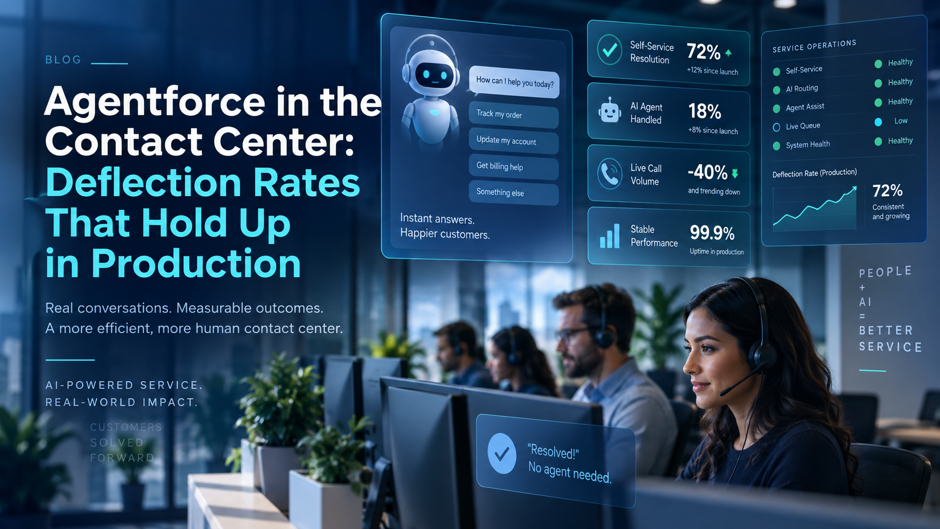
A contact center can report a strong deflection rate while customers continue to return with the same unresolved problem. That gap becomes easier to see once Agentforce moves from controlled testing into live service, where customer wording, account conditions, knowledge quality, workflow failures, and escalation needs vary from one interaction to another. Production therefore places more pressure on the meaning behind the metric than a pilot dashboard ever can.
Salesforce’s 2026 changes to Agent Analytics reinforce that point. Session classification and resolution evaluation changed during the year, so teams reviewing production performance need to know how the metric was calculated during each period and what customer outcomes sat behind it. A percentage can improve while abandonment, repeat contacts, unfinished tasks, or delayed employee work tell a different story.
For organizations building an Agentforce Contact Center model, the useful measure is resolved service demand. Agentforce should complete customer needs that fit its approved scope, send work to employees when judgment or authority is required, and leave enough evidence for teams to understand how each session ended. Production deflection becomes meaningful when the surrounding measures confirm that Agentforce is removing real service demand instead of simply reducing immediate transfers.
TL;DR
Agentforce deflection measures sessions that end without escalation, but those sessions may still leave customer work unfinished. Read it alongside Task Resolution Rate, action success, abandonment, repeat contacts, and customer feedback. A higher deflection rate only helps when it reflects completed service rather than work delayed or passed to another channel.
Compare performance by customer intent and channel, using a known pool of eligible traffic and a consistent repeat-contact window. Account for the 2026 Agent Analytics measurement changes before comparing reporting periods. Published customer results provide context, while your own service baseline should set the target.
Start with requests Agentforce can fully resolve using current knowledge, reliable data, permitted actions, and clear escalation rules. Confirm the final system state before calling a task complete, and pass context to employees when human judgment is needed. Test failure cases, release a limited share of traffic, and review failed sessions each week before expanding. Correct the underlying knowledge, action, routing, or policy issue and check whether the change improves customer outcomes.
What a Production Deflection Rate Actually Tells You
Deflection generally describes customer sessions that end without transfer to a human support representative or another agent. That definition gives contact center leaders a useful starting point, but it doesn’t establish that the customer’s original goal was completed. A session can end without escalation because the issue was solved, because the customer stopped replying, or because the conversation ended before the required action was completed.
Consider an illustrative month with 1,000 Agentforce sessions. Suppose 650 sessions finish without human escalation, creating what appears to be a 65% deflection rate. A closer review can reveal whether those sessions represented completed customer work or merely conversations that didn’t reach a representative.
| Outcome | Sessions | Production Meaning |
| Customer goal fully completed | 430 | Strong deflection outcome |
| Customer stopped responding | 110 | Possible abandonment |
| Information provided, but task unfinished | 65 | Partial service outcome |
| Customer returned about the same issue | 45 | Deferred service demand |
| Conversation escalated | 350 | Human service required |
The difference matters because an accurate answer can still leave the customer with unfinished work. A customer who receives the refund policy but can’t submit the refund has a different outcome from someone whose refund request is completed during the same interaction.
Current Agent Analytics gives teams additional measures for interpreting this difference. Deflection Rate shows how many sessions ended without escalation, while Task Resolution Rate helps evaluate whether the customer’s task was fully resolved. Success Rate adds another view by showing whether interactions containing action steps completed those steps without an error.
These metrics answer separate production questions. Deflection asks whether human support was avoided. Task Resolution Rate looks at whether the customer goal was completed. Success Rate looks at action execution. A production team needs all 3 because a technical action can succeed while the broader customer request remains unfinished.
Repeat contact adds another test. If a customer finishes an Agentforce session on Monday and contacts the service team on Tuesday about the same problem, the first session deserves closer inspection even if it originally appeared deflected. The Agentforce deflection rate becomes more useful when task completion, repeat-contact behavior, customer feedback, and appropriate escalation support the same conclusion.
Why Pilot Deflection Can Fall When Agentforce Reaches Production
Pilots operate inside narrower boundaries than production contact centers. Teams usually select test scenarios, prepare knowledge sources, configure expected workflows, and know which customer intents will appear during testing. Production introduces customer language, account states, service exceptions, and urgency that the original test set may never have represented.
A tester may ask, “Where is my order?” A real customer may explain that the delivery was promised earlier, the carrier stopped updating the shipment, and the item is needed before a deadline. The underlying intent still involves order status, but the production request may also require delivery interpretation, replacement options, inventory information, or escalation.
Traffic volume changes the meaning of small failure rates as well. A problem that affects 1% of 300 test conversations may look minor. The same rate across 100,000 live sessions affects 1,000 customers, which turns a small test weakness into an operating problem.
Organizations using broader Salesforce AI solutions also need to separate model capability from contact center readiness. Correctly interpreting a customer request doesn’t guarantee that the agent can read the right record, execute the required action, apply the current policy, or transfer useful context to an employee. Production performance depends on those supporting systems working as expected.
Live traffic also exposes stale knowledge, integration failures, authentication problems, unusual account states, seasonal questions, and policy exceptions. The eligible traffic mix can change too. A pilot built around routine account questions may post a higher rate than a production deployment that later includes cancellations, payment disputes, delayed orders, or multi-step requests.
Production comparisons therefore need a stable denominator. Teams should record which intents were eligible for Agentforce, which channels were included, how much traffic reached the agent, and whether those conditions changed. A pilot provides evidence that the agent can work under selected conditions, while production shows whether the design continues to perform when actual customer behavior determines the conditions.
How Agentforce Changes Contact Center Deflection
Traditional contact center bots often depend on menus, scripted replies, defined intent trees, or knowledge links. Those methods can handle straightforward informational demand, but their ability to complete multi-step service work is often limited by the workflows available behind the conversation.
Agentforce changes the deflection discussion because the agent can interpret a request, use approved Salesforce context, retrieve knowledge, invoke actions, follow service instructions, and transfer the interaction when human help is required. Organizations using Agentforce for Service can therefore assess more service work around completed outcomes rather than simple answer delivery.
A traditional FAQ interaction may answer questions about business hours, return rules, delivery policy, product setup, or account procedures. Agentforce can also participate in flows where the customer needs a business action, provided that the required data, permissions, integrations, and decision rules are available.
Appointment rescheduling shows the distinction clearly. Giving a customer a scheduling link provides information, while checking available slots, confirming the requested date, updating the appointment, and returning a confirmed result completes the service job. The same principle applies when customers need order changes, account updates, entitlement checks, or other transactional support.
This difference should shape AI customer service deflection targets. Informational requests may have strong self-service potential because the completion condition is simple. Transactional work needs reliable actions and final-state confirmation before the customer request can be considered resolved.
Clear service boundaries protect the metric too. Sending unsuitable requests through an AI agent may keep customers inside automation for longer without increasing real resolution. Deflection becomes more credible when Agentforce completes suitable work and passes the remaining requests to the correct employee path with enough context to continue efficiently.
Salesforce Changed Deflection Measurement in 2026
Salesforce made 2 important changes to Agentforce measurement in 2026, and both affect how contact centers should read production trend lines. The changes show why conversation endings alone can produce misleading results when reporting logic doesn’t account for what happened to the customer’s goal.
On April 3, 2026, Salesforce documented a session-classification correction in Agentforce version 260.9. Timeout sessions had been classified as closed by the user and could therefore be counted as deflected, even when the customer had simply stopped engaging. The corrected Agentforce session classification update changed that handling so expired sessions could be categorized as abandoned instead.
This correction can move a trend line without any change in the agent itself. A contact center may see deflection fall while abandonment rises because the same sessions are being classified more accurately. Teams comparing earlier and later periods need to account for that change before treating the difference as weaker agent performance.
Salesforce introduced another measurement change on July 16, 2026. Earlier Agent Analytics logic relied more heavily on runtime events, while the newer LLM-based deflection and abandonment measurement evaluates the customer’s primary goal across the session. Resolution is scored from 1 to 5, giving the system more context for deciding whether the interaction actually achieved what the customer wanted.
Historical comparisons therefore need reporting context.
| Reporting Detail | Why It Matters |
| Reporting period | Shows which measurement logic applied |
| Agent or version | Connects performance with releases |
| Eligible intents | Shows which customer needs were included |
| Channel | Separates text and voice behavior |
| Traffic allocation | Shows how much eligible demand reached Agentforce |
| Deflection definition | Prevents incompatible periods from being treated as identical |
| Repeat-contact window | Keeps downstream comparisons consistent |
| Knowledge or action changes | Helps explain sudden movement |
This table is an internal comparison framework rather than a Salesforce-required reporting specification. Its purpose is to help teams explain whether a percentage changed because of agent behavior, traffic mix, measurement logic, knowledge updates, or action changes. Production reporting becomes more useful when the conditions behind the metric remain visible.
What Real Agentforce Deployments Say About Deflection Benchmarks
Published Agentforce deployments show that deflection can vary widely because companies automate different service needs under different conditions. A percentage from one organization can provide context, but it shouldn’t become a universal target for another contact center.
Datasite provides a useful Salesforce-published example. Its team introduced Agentforce Script in areas where decisions needed predictable logic, and Salesforce reported that case deflection moved from the low 60% range to an average of 82%, with weekly results between 81% and 84%. The same example reported customer satisfaction averaging 4.8 out of 5.
Manual review strengthened the interpretation. Salesforce’s Datasite Agentforce production case study reports that the team reviewed roughly 400 conversations and found only 2 without a clean answer. That inspection matters because it checks whether the dashboard result aligns with what happened in actual customer conversations.
The 82% figure still belongs to Datasite’s operating conditions. Its intent coverage, Agentforce Script design, escalation model, customer population, action paths, and traffic mix all influence the number. A contact center handling financial disputes, technical support, account exceptions, or sensitive customer circumstances may produce a different rate even when its deployment is working correctly.
A narrow status agent can post a high result because the completion condition is clear and the required data is easy to identify. A broader service agent may encounter more requests that need approval, employee judgment, unusual account handling, or exceptions.
The most useful benchmark therefore starts inside the organization. Teams should establish current self-service resolution, transfer volume, repeat contacts, customer feedback, and employee workload for the intents Agentforce will handle. Production performance can then be measured against that baseline rather than against an external percentage taken from a different service environment.
Start With Intents That Agentforce Can Fully Resolve
Strong production deflection starts with how customer demand is classified. Broad labels such as “billing,” “orders,” or “account support” can contain several customer goals that require different information, permissions, and service paths. Defining the intent at a practical level makes completion easier to test and the resulting rate easier to interpret.
“Billing” may include explaining an invoice, changing a payment method, disputing a charge, requesting a refund, or asking about an overdue balance. Those needs don’t carry the same level of complexity or authority. Teams planning AI customer service solutions should separate them before deciding what Agentforce is allowed to handle.
A practical intent assessment can use 4 questions.
- Can the customer goal be defined clearly?
A suitable intent has an observable completion condition. Order status may be complete once the authenticated customer receives the current fulfillment state and expected delivery information. - Does Agentforce have the information required to resolve it?
Knowledge may be enough for policy questions, while customer-specific requests can require CRM records, payment information, order systems, or another approved source. - Can the agent perform the required action?
Transactional requests need an action path that reaches a confirmed final state. Appointment rescheduling, for example, requires availability checking, an update, and confirmation. - Is autonomous handling appropriate for the decision?
Some requests should remain with employees because they involve exception approval, financial exposure, sensitive circumstances, or authority outside the agent’s approved role.
Eligible traffic should be recorded at this level before teams assign a target. Suppose Agentforce handles order status and password resets in January, then receives billing disputes in March. The overall percentage may fall because the new service work is harder, even if performance on the original intents stays unchanged.
Intent-level reporting prevents that denominator change from being mistaken for a quality problem. Teams can monitor each customer need separately and then build an overall rate from a known mix of eligible demand.
Knowledge Quality Sets a Ceiling on Deflection
Agentforce relies on approved information to answer customer questions and apply service rules. Missing, outdated, vague, or contradictory source material can weaken production results even when the agent understands the customer’s request correctly.
Human representatives often compensate for poor documentation without making the gap visible. Experienced employees may remember an exception that isn’t written down, know which article is old, or understand how policies interact because they have handled similar cases before. Agentforce needs the required information available through sources and rules it can use.
A contact center preparing Data 360 and Salesforce context for Agentforce should review knowledge readiness at the same time. Better customer context can’t repair an incorrect policy article, while a strong policy article can’t replace the account data required for a customer-specific decision.
Common knowledge defects include:
- Articles describing retired procedures
- Conflicting rules across different sources
- Eligibility conditions missing from customer-facing material
- Policies without clear effective dates
- Troubleshooting content that assumes employee knowledge
- Instructions that explain policy without giving the next valid step
The effect should be measured by intent. An order-status agent may perform well while a return-eligibility workflow repeatedly escalates because the return decision depends on product category, purchase date, condition, channel, or region. Those service paths place different demands on the knowledge layer.
Session review helps identify where the information chain failed. A weak answer may come from a missing article, poor retrieval, conflicting sources, an outdated rule, or information that sits outside the approved knowledge sources. Each cause needs a different correction.
Prompt changes won’t repair a missing policy, and another knowledge article won’t fix a permission problem. Production teams need to trace failures to their actual source before changing the agent. Deflection remains more stable when knowledge maintenance follows the same operating discipline as actions and routing.
Actions Turn Good Answers Into Real Resolutions
Knowledge allows Agentforce to explain a service rule, while actions allow it to complete requests that require a system change. This becomes more important when an Agentforce Service Agent moves beyond FAQ handling into transactional or account-specific support.
Consider a customer asking to change the shipping address for an order that hasn’t been dispatched. The agent may correctly retrieve a policy saying that pre-shipment address changes are allowed. The job still requires the correct order to be identified, the new address to be validated, the update to be written, and the final state to be confirmed.
A complete action path contains 5 parts:
- Identify the customer’s actual goal.
- Retrieve the information needed to evaluate the request.
- Apply the relevant business rule.
- Perform the permitted action.
- Confirm the final state before reporting completion.
Production testing should cover where this sequence can fail. An appointment may become unavailable before booking completes, an order may enter a state that blocks changes, an external service may return an error, or authentication may fail. Downstream systems can also reject an update after an earlier step appeared successful.
The conversation should match the confirmed system state. Agentforce shouldn’t tell a customer that a change is complete simply because an action started or returned an intermediate success message. Transactional resolution needs evidence that the intended final state was reached.
Success Rate and Task Resolution Rate help explain different parts of this process. A successful action shows that a technical step ran without error, while task resolution looks at whether the customer’s broader goal was completed. Several successful technical steps can still end in an unresolved customer outcome if the final required step fails.
Human Handoff Belongs Inside the Deflection Design
Human escalation is appropriate when the customer needs judgment, authority, sensitive handling, or support outside Agentforce’s permitted scope. A production contact center should define those conditions before launch so the agent doesn’t remain in a conversation after reaching the edge of what it can safely complete.
Handoff design should cover when the interaction moves to an employee, what context travels with it, and what the representative sees after transfer. Organizations designing inbound call center solutions need particular care here because customers become frustrated when they have to repeat information that Agentforce already collected.
A useful handoff preserves the customer’s stated need, relevant verified information, actions already attempted, and the point where Agentforce reached its service boundary. The representative can continue from that state instead of restarting discovery.
Florida Prepaid provides a useful production example. Salesforce reported that the organization started Agentforce Voice with 10% of calls before moving to 30%, then 50%, and eventually 75% of business-hours calls. The staged rollout gave the team room to inspect production behavior before making the system the first point of contact for a larger share of traffic.
The Florida Prepaid Agentforce Voice deployment also shows why first-touch traffic should remain separate from confirmed resolution. The agent works within approved public knowledge, while sensitive or higher-touch needs can move to representatives with conversation context.
After-hours service creates another distinction. Agentforce Voice may answer routine questions or create a case for later employee follow-up. Creating a case gives the customer a valid next step, but the underlying service need remains open until the required work is completed.
Contact center dashboards should therefore keep first-touch volume, deflection, task resolution, escalation, and queued human work separate. Production performance becomes easier to explain when the team knows which demand Agentforce completed and which demand it intentionally passed to employees.
Test for Failure Before Increasing Production Traffic
Production testing should include failure conditions as deliberately as successful paths. A test set made only from clean questions and expected account states can hide the issues that later reduce AI customer service deflection.
Customers misspell terms, omit information, change topics, refer to earlier events indirectly, or combine several requests in one conversation. Business-state testing matters too. Appointment workflows should include full calendars and invalid dates, while order workflows should include cancellations, delayed shipments, multiple active orders, authentication failures, and records the customer isn’t allowed to access.
A controlled rollout can follow 5 stages.
- Establish the baseline. Record current employee workload, self-service outcomes, transfers, repeat contacts, and customer feedback for the target intents.
- Test normal and difficult cases. Include common customer language alongside the failure patterns already visible in historical service conversations.
- Release a limited share of eligible traffic. Early production should create enough real interaction evidence for review without exposing all customers to an untested failure pattern.
- Review session outcomes manually. Compare dashboard classifications with actual conversations to confirm that deflection, abandonment, and resolution match the customer experience.
- Increase traffic when failure causes are understood. Volume expansion should follow evidence that major weaknesses have been corrected or have clear controls.
Deterministic logic can help where decisions need to happen consistently. Eligibility checks, mandatory disclosures, authentication rules, approval gates, and certain escalation conditions may need fixed paths. Flexible reasoning remains useful where customer wording varies and interpretation is required.
Production testing should show where each approach belongs. Giving every decision to open-ended instructions can create unnecessary variation, while converting every conversation into rigid rules can remove useful flexibility.
Measure Production Performance by Intent and Outcome
Overall deflection can tell leadership whether service demand is moving away from human queues. Operations teams need more detail to understand why that movement happened. Current Salesforce Agent Analytics guidance separates several measures that help teams examine production service from different angles.
| Metric | What It Answers |
| Deflection Rate | How many sessions ended without escalation? |
| Escalation Rate | How many sessions transferred? |
| Abandonment Rate | How many sessions ended without engagement or timed out? |
| Engagement Rate | How many sessions included agent-triggered engagement? |
| Success Rate | How often did action steps complete without errors? |
| Task Resolution Rate | How many sessions were evaluated as fully resolved? |
| Error Rate | How often did processing or response errors occur? |
| Quality Measures | How relevant and grounded were responses? |
A team maintaining Salesforce Service Cloud support processes should break these measures down by intent, channel, agent, action, and reporting period where the data allows. A blended percentage can hide a strong order-status workflow beside a weak returns process.
Task Resolution Rate deserves special attention because it addresses a weakness of relying on deflection alone. A session can end without escalation while leaving the customer’s goal unfinished. Comparing deflection and task resolution can expose conversations that stayed inside automation without producing a strong result.
Repeat contact provides downstream evidence. Teams should choose a defined period for identifying another interaction about the same need and apply it consistently. The window may differ by service type, but changing it silently can distort trend reporting.
Traffic mix should remain visible as well. If January traffic consists mostly of password resets and order-status requests while April adds cancellations and complicated billing cases, a lower blended rate may simply reflect harder eligible work. Intent-level reporting prevents that shift from being mistaken for poorer Agentforce performance.
Channel conditions require similar care. Voice includes recognition issues, interruptions, and spoken confirmation, while messaging allows customers to provide written identifiers differently. The strongest production dashboard keeps these conditions visible instead of reducing the service operation to one percentage.
Build a Weekly Operating Loop Around Failed Sessions
Agentforce performance work continues after deployment because production conversations reveal conditions that test cases didn’t fully capture. A weekly operating review should focus on interactions that produced uncertain or weak outcomes, including abandoned sessions, failed actions, unnecessary escalations, negative customer feedback, and repeat contacts.
Teams can use an Agentforce governance framework to assign ownership for recurring failures across service operations, Salesforce administration, knowledge management, integration work, and policy decisions. Clear ownership prevents issues from sitting between teams without a defined correction path.
A knowledge failure occurs when approved information is missing, old, unclear, or contradictory. An action failure may involve permissions, integration behavior, validation rules, unavailable states, or workflow design. A routing failure occurs when the customer reaches the wrong service path or remains with Agentforce after the request should have moved to an employee.
Policy failures need separate treatment because the business rule itself may be unclear. In that situation, rewriting the agent instructions can automate the ambiguity instead of fixing it. The policy owner needs to define the decision before the service team expects consistent AI handling.
The weekly review should inspect actual conversations rather than relying only on aggregated percentages. If abandonment rises for a return workflow, the cause could be a slow response, missing option, action error, or a dead end after several earlier steps worked correctly. The metric identifies the symptom, while the session evidence reveals the cause.
Corrections should then be measured after release. Changing instructions, knowledge, actions, permissions, and routing at the same time can make the result difficult to interpret. Controlled changes make it easier to connect a production result with the correction that caused it.
What a Deflection Rate That Holds Up Really Looks Like
A production-ready deflection rate needs enough surrounding evidence to show that the percentage represents completed customer work. Teams should be able to explain what Agentforce handled, how the result was measured, and whether customers remained satisfied after the interaction.
The first requirement is a stable measurement definition. Teams should know which Agentforce rules were active, which sessions qualified for the calculation, and whether a reporting change affected the period being compared.
The second requirement is a known traffic denominator. Eligible intents, channel mix, traffic allocation, and major routing changes should remain visible so a change in service demand isn’t mistaken for a change in agent quality.
The third requirement is supporting resolution evidence.
| Production Check | Healthy Interpretation |
| Deflection | Eligible demand ends without unnecessary transfer |
| Task Resolution | Customer goals are completed at an acceptable rate |
| Abandonment | Failed sessions aren’t hidden inside deflection |
| Action Success | Transactional workflows complete reliably |
| Repeat Contact | Resolved sessions don’t create delayed demand |
| Escalation | Appropriate cases continue to reach employees |
| Customer Feedback | Service quality remains acceptable |
| Manual Review | Conversation evidence supports dashboard results |
These measures should tell a consistent operating story. If deflection rises while Task Resolution Rate falls, the team needs to inspect what customers are failing to complete. If deflection rises alongside abandonment, the apparent improvement may be misleading.
The same scrutiny applies when performance appears weaker. Deflection can fall after a complex intent enters production even while earlier service paths improve. Escalation can rise because the team corrected an unsafe automation boundary, while abandonment may rise after reporting logic classifies timeouts more accurately.
Agentforce in the Contact Center should ultimately be judged by how much valid customer work moves through the AI service path without creating hidden demand elsewhere. A lower percentage backed by verified resolution, appropriate transfers, controlled repeat contacts, and stable customer feedback can represent stronger production performance than a higher number built mainly from avoided escalation.
Conclusion
Agentforce can remove meaningful service demand from human queues when customer intent, knowledge, data, actions, and escalation paths are designed around clear completion conditions. Production makes that standard harder because live traffic introduces wording, account states, changing policies, integration failures, and mixed service needs that controlled testing can’t fully represent.
Deflection should therefore be reviewed beside Task Resolution Rate, abandonment, action success, repeat contacts, customer feedback, and escalation. Those measures help show whether fewer human transfers represent completed service or customer work that has simply moved to another channel or later interaction.
Teams also need stable comparison rules. Eligible intents, traffic allocation, channels, repeat-contact windows, and measurement definitions should remain visible in every reporting period so changes in those conditions aren’t mistaken for changes in Agentforce quality.
A durable Agentforce deflection rate is one the contact center can explain at session, intent, and operating levels. The organization knows what Agentforce was expected to resolve, can see where it succeeded, understands why it transferred or failed, and can verify that customers didn’t return because the original interaction left the job unfinished.
FAQs
What Is Agentforce Deflection Rate?
Agentforce deflection rate represents the share of customer sessions that end without transfer to a support representative or another agent. Teams should interpret it beside Task Resolution Rate because a session can stay inside automation without completing the customer’s full goal. Abandonment, repeat contacts, action success, and customer feedback provide additional evidence about the quality of those deflected sessions.
What Is a Good Agentforce Deflection Rate?
A useful target depends on the customer intents being handled, the available actions, channel, authentication requirements, escalation policy, and customer risk. A defined order-status agent can produce a different rate from an agent handling billing disputes or cancellations. Internal baselines and intent-level performance therefore provide better targets than a percentage copied from another deployment.
What Is the Difference Between Deflection Rate and Task Resolution Rate?
Deflection Rate measures sessions that end without escalation, while Task Resolution Rate evaluates whether the customer’s task was fully resolved. The distinction helps teams find conversations that remained within Agentforce but didn’t complete the customer’s goal. Reading both metrics together gives a stronger picture of whether AI-handled demand represents genuine service completion.
What Is the Difference Between Deflection and Containment?
Containment generally describes an interaction that stays within the automated service channel instead of reaching a human representative. Deflection becomes more useful when that containment also represents a valid customer outcome. A conversation that remains inside automation while leaving the task unfinished should be treated differently from a session that reaches a confirmed result.
How Should Teams Compare Agentforce Deflection Before and After July 16, 2026?
Teams should document the measurement logic used during each period before drawing conclusions. Salesforce changed the way deflection and abandonment were evaluated during 2026, including a July move toward LLM-based session assessment. Historical and newer percentages may therefore reflect different classification methods and shouldn’t automatically be treated as directly equivalent.
Why Can Agentforce Deflection Fall After Launch?
Production introduces customer wording, traffic volume, account conditions, data gaps, integration behavior, policy exceptions, and service requests that may not have appeared during testing. The eligible intent mix can also become harder after launch. A lower overall rate should therefore be investigated by intent before the team concludes that Agentforce quality declined.
How Should Eligible Traffic Be Defined for Agentforce?
Eligible traffic should consist of customer intents that the organization has intentionally approved for Agentforce handling. Each intent should have a known completion condition, required data, permitted actions, and defined escalation boundary. Teams should also record the channels and traffic percentages included so the denominator remains visible over time.
Can Routing Changes Affect Agentforce Deflection Without Changing Agent Quality?
Yes. Routing can change the mix of customer needs reaching Agentforce and therefore move the blended rate. Sending more simple status questions may increase the overall percentage, while adding difficult billing or cancellation requests can lower it. Intent-level reporting helps separate routing effects from genuine changes in Agentforce performance.
How Does Knowledge Quality Affect AI Customer Service Deflection?
Knowledge quality determines whether Agentforce can retrieve the information needed for an accurate response and apply the correct service rule. Outdated procedures, contradictory articles, missing eligibility conditions, and undocumented exceptions can lead to incomplete answers or unnecessary escalation. Production reviews should trace repeated failures back to their source before changing the agent.
Why Are Agentforce Actions Important for Contact Center Deflection?
Many customer requests require a system change before the job is complete. Appointment updates, order changes, account servicing, and similar tasks need Agentforce to perform approved actions after understanding the request. Reliable actions allow more transactional needs to reach a verified final state during the same interaction.
Should Repeat Contacts Be Used When Evaluating Deflection?
Yes. Repeat contact can reveal service demand that the original session appeared to remove but failed to resolve permanently. Teams should define a consistent period for identifying another interaction about the same need and apply that method across reporting periods. The appropriate window may vary by service type, so consistency matters more than one universal period.
Should Agentforce Avoid Every Human Handoff?
Human transfer is appropriate when a request requires judgment, special authority, sensitive discussion, exception approval, or support outside the agent’s permitted scope. The important production question is whether the transfer happens at the correct point and carries enough context for the employee to continue efficiently. A well-designed escalation can represent correct service behavior even though it lowers deflection.
Should Voice and Messaging Deflection Rates Be Compared Directly?
Voice and messaging should usually be reviewed separately before teams combine the results. Voice interactions include recognition issues, interruptions, spoken confirmation, and environmental noise, while messaging customers can provide written identifiers differently. Channel-level analysis helps prevent a format difference from being mistaken for an Agentforce quality problem.
How Often Should Agentforce Production Performance Be Reviewed?
High-volume contact centers should monitor major outcome measures continuously and run regular session-level reviews for recurring failures. A weekly operating cycle can help identify knowledge gaps, action problems, routing issues, and policy questions while the evidence is still current. Major releases, new intents, unusual abandonment movement, or sudden changes in Task Resolution Rate should trigger additional review.
What Makes an Agentforce Deflection Rate Reliable in Production?
A reliable rate has a documented definition, known eligible traffic, stable comparison rules, and supporting outcome evidence. Task resolution remains healthy, abandonment doesn’t hide failed conversations, actions complete reliably, repeat demand stays controlled, and appropriate cases continue to reach employees. Manual session review should also support the interpretation shown by the dashboard.
