
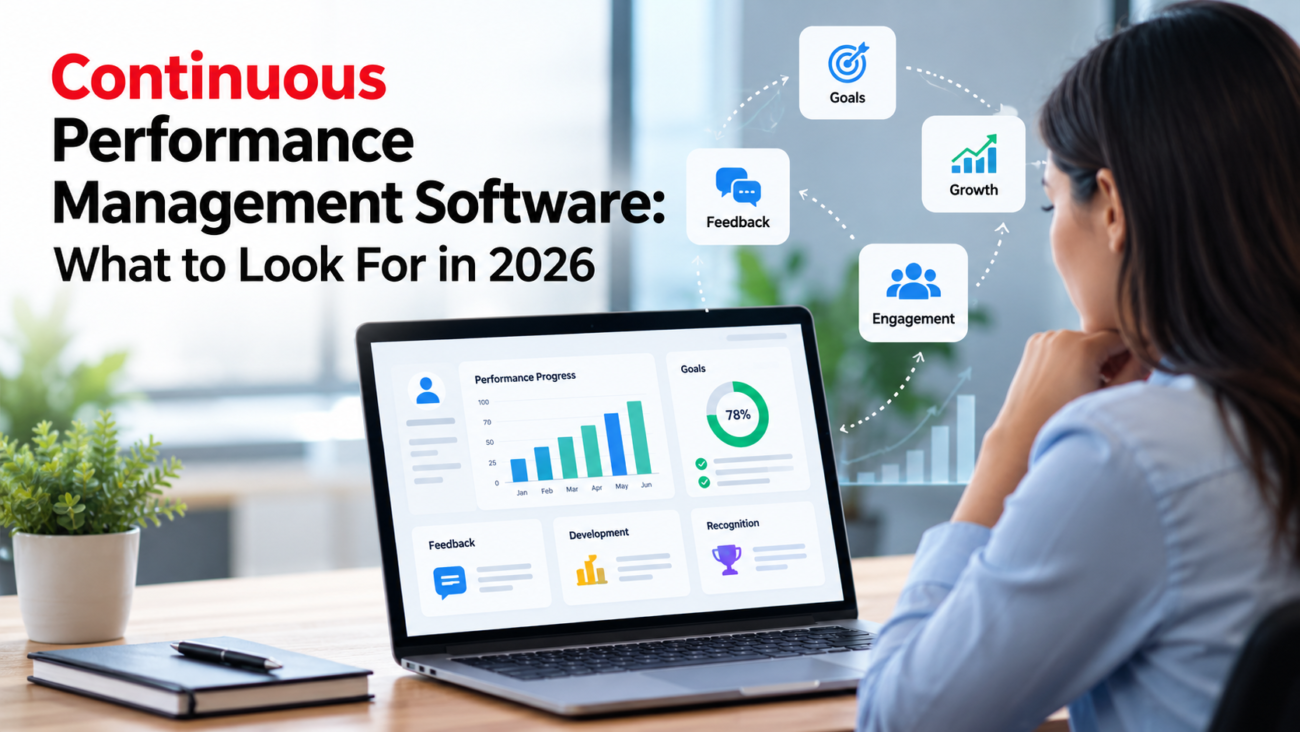
An annual review can describe how someone performed months ago. It often comes too late to help with the project they’re working on today. That’s why many HR teams are examining continuous performance management software in 2026, especially when goals change during the year and managers need a reliable record of conversations.
Buying another HR platform won’t fix unclear expectations or weak management habits. The useful question is whether the system makes good conversations easier and gives employees a fair account of their work. This guide explains the features that matter, the costs buyers sometimes miss, and the tests worth running before signing a contract.
TL;DR
Continuous performance management software helps employees and managers update goals, exchange timely feedback, document check-ins, and carry evidence into formal reviews. In 2026, buyers should look for a simple manager workflow, clear goal ownership, employee development records, fair review controls, and useful connections to existing HR systems. Treat AI summaries as drafts that need human review. Ask about data access, retention, implementation work, and full contract costs. The best choice is the one managers will use regularly without turning conversations into another reporting burden.
What Continuous Performance Management Software Actually Does
Continuous performance management software provides a shared place to record expectations and discuss progress throughout the year. An employee can see the goals agreed with their manager, add evidence of completed work, and ask for support when something blocks progress. A manager can respond while the work is still current, then refer to that history during a formal evaluation.
The approach has a basis beyond software marketing. In its January 2026 overview, the CIPD performance guidance describes performance management as a continuing process involving objectives, employee support, and accountability. The guidance also notes the shift toward regular conversations while keeping structured reviews where they serve a purpose.
A practical system may include meeting notes, feedback requests, review forms, development plans, and reporting. Those functions need to share context. If a manager must copy notes from a meeting tool into a review form, the promised benefit disappears. Check whether a goal change appears in the employee’s next check-in and whether the review form reflects the relevant period.
It’s also important to separate the process from the product category. Some HR information systems include basic reviews. Other tools focus on coaching or goals. An organization with a reliable HRIS might need a dedicated employee performance management software module. Another business may prefer an existing system’s built-in features to avoid moving employee records between applications.
Why Annual Reviews Alone Leave Gaps
Annual appraisals can support pay decisions and create a formal record, but they have limits when used as the main source of feedback. A December conversation can’t reliably reconstruct every project decision from February. Employees may remember their latest work most clearly, while managers may rely on whichever events stand out.
As one example of this wider process, the OPM performance cycle describes ongoing planning, monitoring, development, ratings, and rewards. Although this framework applies to US federal performance management, it illustrates a wider point: progress needs attention during the work period. The periodic rating is a summary of that activity.
A continuous approach creates shorter records closer to the event. Someone who missed a delivery date can document a dependency that caused the delay. A colleague who resolved a difficult customer issue can capture the result before the detail fades. Those notes can make a later evaluation more accurate, provided managers distinguish observation from opinion.
That doesn’t mean every employee needs a weekly score. A score attached to each conversation may discourage honest discussion, especially when someone is asking for help. Continuous feedback software works better when informal coaching is separate from formal rating decisions, even if relevant evidence can be considered later under a clear policy.
Organizations still need review periods, approval rules, and records that support compensation or promotion decisions. Continuous performance management software should preserve those controls rather than make every comment a permanent judgment. Ask vendors to show how informal notes, employee-visible feedback, and formal review records differ.
Core Features That Matter in Daily Use
The most important feature is a workflow people can complete without training notes open beside them. Employees should know where to update progress. Managers should find overdue conversations without building a manual spreadsheet. HR should see whether the process is being followed without reading private coaching notes.
The minimum feature set should cover:
· Configurable check-in schedules, agendas, and follow-up actions.
· Goals with owners, due dates, progress notes, and change history.
· Feedback that can be requested and shared with clear visibility settings.
· Review cycles with self-assessment, manager input, and approval steps.
· Development actions linked to actual skill or role needs.
· Appropriate reports, permissions, and employee data export.
Feature availability is less important than behavior during a real test. In a demonstration, ask a manager to record a 15-minute check-in, revise an employee goal, and carry an agreed action into the next meeting. Count the screens and required fields. If the vendor relies on an administrator to perform routine changes, ask what employees and managers can handle themselves.
This distinction also appears in the SHRM performance guide, which explains why planning and regular monitoring matter alongside periodic appraisals. That distinction should show up in the product. Performance review software that only opens during an annual cycle won’t provide much help with day-to-day conversations.
Look closely at notifications. A useful reminder prompts someone before a scheduled meeting or when an action is due. A poorly designed system sends repeated emails about unchanged goals. Ask whether reminders can be adjusted by role and whether inactive employees or people on leave are handled correctly.
Accessibility matters in routine use as well. Test keyboard navigation, screen-reader labels, mobile behavior, and the process for requesting an accommodation. A workflow that looks simple in a sales demonstration may be difficult for employees using assistive technology or shared devices.
Goal Setting and Business Alignment
Goals should explain what the employee is expected to accomplish and how progress will be judged. They also need room to change. A sales target may stay fixed for a quarter, while a product team’s priorities can shift after a release. Good employee goal tracking software records both the original expectation and an approved revision.
For a starting point on measurement, the OPM standards guidance recommends measures that are objective, realistic, and clearly stated. Its examples distinguish quality from quantity and timeliness. Buyers can apply that reasoning by asking how a platform stores evidence for different kinds of work rather than treating a single percentage as universal proof of performance.
A well-designed goal record identifies an owner, target date, measure, supporting context, and current status. It should also state where the employee has control. A customer success specialist cannot guarantee a renewal when the account is being closed for reasons outside their role. The system should allow managers to record that context before making an assessment.
Goals, OKRs, and KPIs Serve Different Purposes
A goal describes a desired result. An objective and key results framework connects a broad objective to measurable outcomes. A KPI tracks an ongoing indicator. Those ideas can overlap, but employees shouldn’t have to maintain 3 separate records for the same work. Ask vendors how their goal model handles recurring measures and project-based outcomes.
Employee goal tracking software also needs inheritance rules. A team priority can inform individual goals without assigning each employee responsibility for the entire team’s result. Check whether shared goals can have different owners and contributions. When a team target changes, managers should be able to review the effect on individual commitments before a bulk update.
Reporting should show which goals are blocked or overdue while retaining their explanations. A dashboard that displays only red and green status may pressure employees to report progress that hasn’t happened. Strong continuous performance management software gives the discussion enough context to understand the number.
Feedback, Check-Ins, and Recognition
Useful feedback describes a specific event and explains its effect on work. It may recognize a good decision or address a problem that can be corrected. The timing matters because details are easier to discuss soon after they happen, but frequency alone is a poor quality measure.
A useful measure of feedback quality appears in Gallup’s feedback research, which reports that 80% of employees who reported receiving meaningful feedback in the previous week were fully engaged. That is an association from survey research, not proof that adding weekly software notifications causes engagement to rise. The practical lesson is to support relevant conversations rather than chase a feedback count.
Continuous feedback software should allow a manager to give feedback privately and an employee to respond or ask for clarification. Some comments may be suitable for public recognition; performance concerns generally require more limited access. Test visibility carefully. Employees should know which notes are shared, who can see them later, and whether a feedback request can be declined.
What a Useful Check-In Looks Like
A good check-in starts with the employee’s current priorities. The manager asks what has changed, what has been completed, and what support is needed next. The meeting ends with an agreed action if one is needed. Software should preserve those decisions without forcing both people to complete a detailed form after every conversation.
Recognition features deserve the same scrutiny. A public badge may be welcome in 1 team and embarrassing in another. Let people choose how they receive recognition. The more important test is whether a meaningful contribution reaches the manager and can be described accurately in a later review.
Employee Development and Career Growth
Performance discussions should identify what someone can work on next. A development plan might cover a skill needed for a current assignment or experience required for a future role. The plan is stronger when it names an activity, gives the employee time to complete it, and includes a way to check whether it helped.
Evidence about the quality of these discussions appears in Gallup’s manager research, which notes that only 16% of surveyed employees described their most recent conversation with a manager as extremely meaningful. That finding supports looking at the quality of manager conversations before paying for another engagement widget. It doesn’t establish that a specific software feature will produce better managers.
Employee performance management software should connect development actions to observed needs without automatically labeling employees as deficient. Someone preparing to lead a project may need a stretch assignment. Another employee may need time with a subject expert. Both actions belong in a development record, but they have different purposes and success measures.
Ask whether the system can link learning resources or HR learning records to a plan. A completed course is evidence of participation, not proof that a skill has improved. The next manager conversation should examine whether the employee used the learning in real work. A sensible system can document that observation without requiring a separate test score.
Employees should be able to express career interests without making every aspiration visible across the company. Access rules become especially important when managers change. Continuous performance management software needs a clear policy for whether past development notes follow an employee into a new reporting line and which sensitive discussions remain restricted.
Fair Reviews, Calibration, and Documentation
Fairness depends on stated expectations and evidence that can be checked. Software can present common questions and review criteria, but it can’t make a vague rating fair. Managers still need guidance on job-related standards, comparable cases, and how to account for changing assignments.
A related trust problem appears in A related trust problem appears in Deloitte’s 2025 performance research, which found that 61% of managers and 72% of workers surveyed could not say they trusted their organization’s performance management process. The findings describe a trust problem across survey respondents. They aren’t evidence that removing ratings, or buying performance review software, will automatically fix it.
A good review workflow makes a distinction between an employee’s self-assessment, a manager’s evaluation, and an approved final record. Employees should have a chance to correct factual errors. HR may also need a route for comments or a formal challenge under company policy. Ask vendors to show who can edit a record after submission and whether the changes appear in an audit history.
In guidance for employers, the EEOC evaluation advice says employers should communicate standards, apply them consistently, and support assessments with relevant facts. This is a useful basis for reviewing templates. A form that asks only for vague labels such as attitude or potential may require stronger definitions and examples tied to the job.
Calibration meetings can help managers discuss inconsistent ratings across comparable roles. They can also introduce problems if participants lack relevant evidence or rely on quotas. Performance review software should record the reason for an approved change and restrict visibility to authorized reviewers. Don’t assume a forced distribution is required simply because a product supports one.
Continuous performance management software should help teams identify recurring issues, such as missing evidence or late reviews, before a pay decision is due. It should never silently convert informal praise into a formal rating. The distinction protects employees and creates a review record that managers can explain.
Reporting and HR System Integrations
Reports matter because HR needs to find process failures without examining everyone’s personal notes. Useful measures include completed check-ins, overdue reviews, goals awaiting agreement, development actions, and differences in completion rates across teams. Those measures tell administrators where to investigate; they don’t directly measure employee value.
A connection to the HRIS should update manager relationships, employment status, work location, and relevant department information. If a supervisor leaves, the process must define what happens to open approvals and sensitive notes. Poor identity matching can put an employee’s record under the wrong manager, which is a more serious issue than a missed reminder.
Employee goal tracking software may also connect to project tools or sales systems, but automatic imports require care. A closed ticket isn’t always a useful measure of an engineer’s contribution, and a CRM opportunity may depend on several people. Allow managers to select relevant evidence rather than filling performance records with every activity count.
For performance review software, test exports before buying. Ask for a sample file containing a goal’s revision history, the review’s final rating, and the employee’s response. Confirm that fields retain understandable names and timestamps. A vendor claim that data is portable means little if the exported file requires manual reconstruction to make sense.
Employee performance management software should offer HR reports that can be filtered by review cycle and department while respecting privacy settings. Review completion by manager can be useful for administration. Ranking employees by how many feedback messages they received is far less useful because teams communicate differently.
Consider the reliability of integrations during a change. Ask what happens when the HRIS is unavailable, when 2 employees have similar names, or when a worker changes jobs midway through a review period. The vendor should explain error handling and correction processes, not merely display an integration logo.
AI Features, Privacy, and Employee Trust
AI features now appear in performance writing tools, summaries, and analytics. They can reduce time spent turning notes into a readable draft, but they can also repeat factual mistakes or give undue weight to incomplete records. Treat any generated evaluation as an editable suggestion. The manager remains responsible for its accuracy and fairness.
For a risk management reference, the NIST AI framework provides voluntary guidance for managing AI risks through governance and testing. For a performance platform, that means asking what information an AI feature receives, whether outputs can be checked, and whether an organization can disable features that don’t fit its policy. The framework doesn’t certify individual HR products.
Ask whether the system uses employee comments to train an external model and whether a separate agreement governs that processing. Buyers should also examine where prompts and generated text are stored, how long they’re kept, and which administrators can access them. A summary may contain sensitive material even when the original note was meant for a small audience.
Monitoring is a different issue from ordinary feedback. The UK Information Commissioner’s Office covers this in its worker monitoring guidance, which explains that monitoring must be lawful and fair under applicable data protection rules. That guidance is being reviewed following legislative changes, so organizations subject to UK law should check its current status and obtain appropriate legal advice.
Continuous feedback software shouldn’t encourage managers to infer commitment from keyboard activity, meeting minutes, or message counts. Those measures can reflect role requirements or accessibility needs rather than work quality. Before enabling AI recommendations, ask who reviews them, how errors are corrected, and whether employees can challenge an inaccurate characterization.
A product’s privacy controls should be understandable to employees. If people believe every private conversation could become an automated performance score, they may stop discussing problems early. Employee trust is therefore part of the functional evaluation, not a separate communications exercise.
Security, Access, and Retention
Performance records can contain compensation-related comments, health-related context, workplace concerns, or other sensitive personal information. The system needs role-based access so employees can view their records and managers see information appropriate to their responsibilities. HR administrators may require broader access, but every privilege should have a documented purpose.
The case for limiting access is clear in the FTC’s business security guidance, which recommends limiting access to sensitive information based on business need. For buyers, this translates into tests for single sign-on, multifactor authentication through the identity provider, administrator roles, and the removal of access after employment ends. Verify each function for the proposed product and plan rather than assuming it’s included.
Ask where data is hosted and which subcontractors process it. Review the vendor’s data processing agreement, security documentation, incident notification terms, and available audit reports. A certification can support a security review, but it doesn’t replace examining how your organization configures access or handles exports.
Retention rules should distinguish routine check-in notes from final assessments and records relevant to disputes. Employers may have legal duties to retain some records for specific periods, depending on jurisdiction and the type of record. A vendor’s default deletion setting is not an adequate company retention policy.
Employee performance management software should allow authorized teams to export records in a usable format and delete data according to approved schedules, subject to required holds. Ask what happens to backups after deletion and whether the vendor can explain its recovery process. A clear answer is more useful than an unsupported promise that everything disappears immediately.
Security testing should cover a common role change. Move an employee from 1 manager to another in a sandbox, then inspect both users’ access to old feedback, draft ratings, and personal development notes. This reveals whether sensitive history is carried forward appropriately or exposed too widely.
Pricing and Total Cost of Ownership
License price is only 1 part of the cost. A quote may cover performance reviews while charging extra for goals, surveys, advanced reporting, AI features, or integrations. Buyers need an itemized price for the exact workflow they expect to run. Make sure the vendor states whether billing is based on all employees, active users, or another count.
To understand the range across the market, the Capterra buying guide describes a wide price spread across performance management products and recommends asking about feedback, goals, security, and integrations. Directory ranges can’t substitute for a current written quote. Prices change by contract size and package, and some products have minimum annual commitments.
Compare the following items in every proposal:
| Cost Item | Question to Ask |
| Subscription | Who counts as a paid user and when is the count reviewed? |
| Modules | Are goals, check-ins, reviews, and reports in the quoted plan? |
| Setup | Is configuration or data migration charged separately? |
| Integrations | Are HRIS connections, APIs, or single sign-on extra? |
| Support | What response times and support channels are included? |
| Renewal | What notice period and pricing terms apply after year 1? |
| Exit | Is there a charge for export or transition support? |
A simple total cost model adds the first year’s subscription, setup, training time, integration work, and any support charges. Calculate a separate ongoing annual cost because setup costs shouldn’t be counted every year. If the vendor quotes a per-employee monthly rate, multiply by the contracted employee count and 12, then add other required charges.
Don’t assume that adding more features will save manager time. Employee goal tracking software with extensive configuration can require ongoing administration. A smaller product with clear workflows may cost less to operate even if its quoted license rate is similar. Include internal hours for maintaining templates, assigning cycles, and supporting managers.
Continuous performance management software is worth evaluating against a measurable business problem. For example, buyers can compare the time required to prepare a review before and after a pilot, or the share of goals that managers and employees agree are current. Avoid assigning a dollar return to improved morale without evidence that the organization can measure.
How to Evaluate and Roll Out a Platform
A useful buying process begins with 3 representative roles: an employee, a busy manager, and an HR administrator. Each should test the tasks they’ll complete routinely. The goal is to find friction before a company-wide rollout. Vendors should be asked to demonstrate a realistic scenario rather than only the clean path used in sales presentations.
Run a Scenario-Based Demo
Give each shortlisted provider the same tasks. Have an employee update an agreed goal, request feedback, and prepare for a check-in. Have the manager review progress, add a coaching note, and complete a formal review. Have HR correct a reporting-line change and export a final assessment. Compare what actually happened in the system.
If you’re evaluating a feedback platform, include a mistake in the exercise. Ask the manager to correct a comment entered for the wrong person, and confirm what remains in the audit history. If you’re comparing performance review software, ask the provider to reopen an approved review under controlled conditions. These exception cases reveal more than another dashboard tour.
The rollout plan should account for manager capacity. Recent survey context comes from Recent survey context comes from Gallup’s 2026 workplace findings, which report that 20% of employees worldwide were engaged in 2025 and that manager engagement was 22%. Those figures don’t measure software demand, but they reinforce the need to keep new administrative requirements realistic for managers.
Start with a pilot that includes teams with different working patterns. Explain which notes are private and how records will be used in formal evaluations. Train managers to give useful feedback before judging them on completion rates. During the pilot, watch for abandoned forms, duplicate entry, access problems, and disagreements about goal definitions.
Use a short scorecard with agreed weights before seeing sales pitches. Practical categories include manager usability, review controls, HRIS reliability, privacy, reporting, and full cost. Let each evaluator record evidence from the test, then discuss any disagreement. Employee performance management software shouldn’t win because it has the greatest number of features on a spreadsheet.
Once launched, review adoption at the end of the first cycle. Look for the quality of conversations and completed actions as well as form submission. Ask employees whether review outcomes reflect work discussed during the year. Continuous performance management software should make that answer easier to support with evidence.
The Right Choice Depends on Manager Behavior
The strongest buying test is simple: does the platform help managers discuss the work that matters while it’s happening? A system with many settings can still fail if employees don’t understand goals or managers treat check-ins as an administrative task. The process needs ownership before the software can support it.
For disputes about unfair evaluations, the EEOC complaint guidance recommends reviewing relevant evidence and investigating concerns about unfair evaluations. That principle is worth carrying into procurement. A platform should make correction and review possible when a record is challenged, rather than locking the organization into an unexplained score.
For most buyers in 2026, the sensible priority is clear goals, useful feedback, trustworthy records, and realistic manager effort. Test those functions with your own scenarios. Then examine AI controls, integration reliability, contract terms, and data handling. Continuous performance management software earns its place when it improves the quality of decisions and removes avoidable work from the people making them.
Frequently Asked Questions
What Is Continuous Performance Management Software?
Continuous performance management software is a platform for tracking goals and recording performance conversations during the year. It usually supports check-ins, employee feedback, development actions, and formal reviews. The aim is to keep information current so managers and employees can address issues before the next appraisal cycle.
How Is It Different From Annual Review Software?
Annual review tools focus on collecting evaluations at set dates. Continuous systems also handle the conversations and goal changes that happen between reviews. Performance review software may support both methods, so buyers should test what users can actually do outside the formal review window.
Can Small Businesses Use Continuous Performance Management?
Yes. Small teams may benefit from shared goals and a clear record of manager conversations. They should avoid buying complex administration tools they won’t maintain. Employee performance management software makes sense when it solves a recurring problem that simpler existing tools can’t handle reliably.
How Often Should Managers Hold Check-Ins?
There’s no universal schedule. Weekly discussions can help during fast-moving work, while other roles may suit a different rhythm. Continuous feedback software should allow teams to adjust frequency without treating missed meetings as proof of poor performance. Quality and useful follow-up matter more than a fixed count.
Should Performance Ratings Be Removed?
Not necessarily. Some organizations need ratings for compensation or formal decisions. Continuous conversations can improve the evidence behind those ratings. Buyers should confirm that performance review software keeps informal coaching separate from approved assessments and records why any final rating changed.
What Features Are Most Important for Goal Tracking?
Look for clear owners, measurable outcomes, review dates, progress notes, and a visible history of changes. Employee goal tracking software should also show dependencies and allow an approved goal to be revised when business priorities change. Avoid tools that treat every role as if it produces the same type of output.
Does Continuous Feedback Software Replace Manager Meetings?
No. Continuous feedback software can help people prepare for meetings and remember agreed actions. It can’t resolve a sensitive disagreement on its own. Managers still need to listen, ask questions, and explain expectations. The tool should support those conversations without requiring a lengthy report after each one.
Can Employees Give Feedback to Their Managers?
Many systems support upward feedback, but anonymity and visibility rules vary. Employees should understand who sees comments and whether they enter formal review records. A safe process also needs a route for concerns that shouldn’t be sent directly to the person involved.
How Should Remote Teams Use These Platforms?
Remote teams can add progress notes before a scheduled conversation and record decisions afterward. Time-zone differences make asynchronous updates useful. Employee goal tracking software should avoid interpreting online status or message volume as performance. The evaluation should reflect agreed work outcomes and relevant context.
What Should Buyers Ask About AI Features?
Ask which model processes employee information, whether the organization can disable AI, and who checks generated summaries. Confirm whether input data is retained or used for model training. AI-generated ratings or recommendations deserve particular scrutiny because managers must be able to explain decisions based on verified evidence.
What Integrations Are Usually Worth Testing?
Start with employee records, manager changes, and identity access from your HRIS. Then consider learning or project systems where the connection has a clear purpose. Employee performance management software should handle errors without placing an employee under the wrong supervisor or losing approved review data.
How Much Does Performance Management Software Cost?
Prices vary by workforce size, contract terms, and included modules. Request a quote that separates subscriptions from setup and optional features. Performance review software can appear inexpensive until goal management, integrations, or support are added. Compare total first-year spending and ongoing annual costs rather than the headline rate alone.
What Is the Difference Between OKRs and Performance Reviews?
OKRs describe objectives and measurable results, often for a team or project. Performance reviews assess an employee’s work over a defined period using agreed criteria. Employee goal tracking software can supply useful context for reviews, but a team result shouldn’t automatically become an individual’s rating.
How Can HR Measure Whether the Platform Works?
Track whether goals stay current and whether reviews include useful evidence. Ask managers how much preparation time they spend and employees whether feedback helps them act. Continuous performance management software should improve these experiences over time. The number of comments entered is a weak success measure on its own.
What Should Be Checked Before Signing a Contract?
Check privacy settings, access after manager changes, export formats, support terms, and data retention. Run a real review scenario with users from different teams. Continuous feedback software should remain usable when goals change or records need correction. Written prices and a clear exit process are equally important.
