
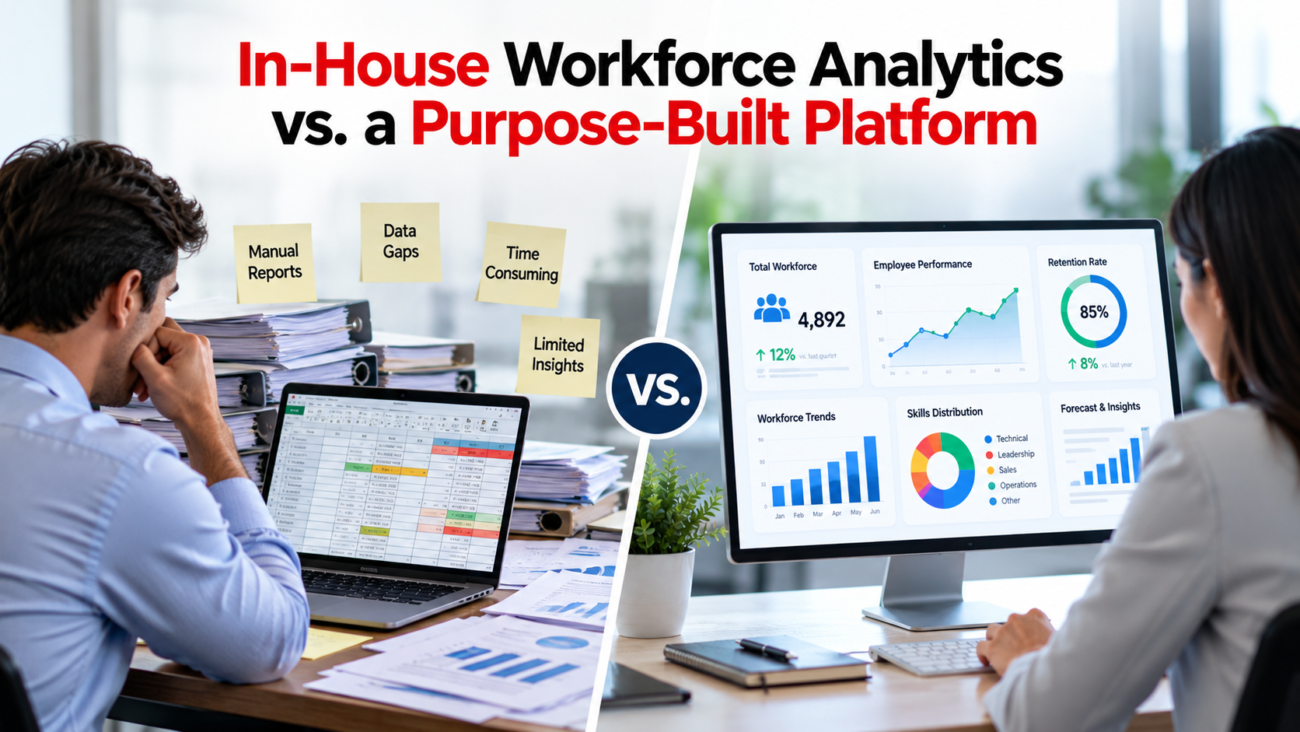
Most companies already run workforce analytics in some form. It’s usually a mix of spreadsheets and HRIS reports, plus a headcount dashboard from finance. The trouble starts when leaders ask harder questions, such as which teams lose people fastest or whether hiring plans match the budget. Answering those questions means pulling HR data from several systems into 1 trusted place, and that’s the point where the build vs buy decision shows up.
HR usually owns the questions, while finance and IT control much of the budget and the plumbing. This guide compares building in-house with buying a purpose-built platform. It covers the real costs, the data work that slows projects down, the employment AI rules that apply either way, and how to choose based on where your team stands today.
TL;DR
Building workforce analytics in-house gives you full control over definitions and models, but it also creates a permanent maintenance job for a small engineering and data team. A people analytics platform gets you to useful reporting faster, yet it still needs clean source data and internal staff to run it. Employment AI laws in the EU and several US states apply to both paths. The build vs buy choice should follow your data maturity, and many teams land on a hybrid that buys core reporting and builds custom analysis on top.
What Workforce Analytics Covers and Where the Data Comes From
Workforce analytics is the practice of joining people data from different systems to answer questions about hiring, retention, cost and capability. The inputs are wider than most people expect. The CIPD analytics factsheet lists HR systems, IT systems and records held by other departments, along with external salary surveys, appraisals, exit interviews, absence records and engagement surveys. Each source has its own owner and its own update schedule, which is why the joining work takes so much effort.
Most programs start with a handful of standard metrics. Turnover and time to fill usually come first, followed by headcount, absence rate and internal mobility. External benchmarks help put these numbers in context. SHRM’s 2026 recruiting benchmarks put the median time to fill for nonexecutive roles at 39 days, and the BLS reported a quits rate of 1.9% for August 2026. You can only compare yourself with figures like these if your own HR data uses the same definitions, such as what counts as a quit or when a requisition officially opens.
The scope then grows from reporting into analysis. Teams move from asking what happened to asking why it happened, and then to forecasting, such as projecting attrition by role or modeling headcount under different budgets. Whether you build or buy workforce analytics software, this progression matters. A setup built for monthly turnover reports may not support attrition models, so know which stage you’re aiming for before you pick a path.
Why the Build vs Buy Question Is Back on the Table
Interest in people data has moved from HR into the boardroom. Deloitte’s people analytics research covered more than 400 organizations in 18 countries and found the most mature ones were twice as likely to treat people data as a core competitive asset. That shift raises the bar for the systems behind the numbers. The CFO needs headcount reconciled with payroll costs.
AI is the second driver. SHRM’s 2025 Talent Trends survey found AI use in HR tasks rose to 43% in 2025, up from 26% a year earlier. Results have lagged behind adoption, though. In an October 2025 Gartner survey, 88% of HR leaders said their organizations hadn’t realized significant business value from AI tools. Most AI features depend on clean, connected HR data, so many teams find the weak point sits in their data foundation.
Skills and disclosure add pressure from 2 more directions. The World Economic Forum’s Future of Jobs Report 2025 found 63% of employers see skill gaps as the main barrier to business change through 2030, with AI and big data among the fastest-growing skills. That turns skills data into a planning input, and most legacy reporting doesn’t capture it well. In the US, the SEC has required public companies since 2020 to describe their human capital resources under Regulation S-K Item 101(c), including employee counts and any measures management focuses on.
What Building In-House Actually Takes
An in-house build is a data platform for HR, usually with 6 components:
1. Source connectors that pull data from the HRIS, payroll, applicant tracking system, learning platform and survey tools on a schedule.
2. A warehouse that stores raw extracts and the cleaned tables built from them.
3. Modeling logic that turns raw fields into agreed metric definitions, such as voluntary turnover or time to fill.
4. An identity layer that links each person’s records across systems.
5. Access controls that limit who can see sensitive fields such as pay and performance ratings.
6. Dashboards for HR users, plus optional predictive models for attrition or hiring demand.
The visible part of this stack is small compared with what sits underneath it. A well-known Google paper on hidden technical debt in machine learning systems found that model code makes up only a small fraction of a real system. Most of the effort goes into the glue code and data pipelines around the model, and the authors warned that these pieces create large ongoing maintenance costs. People analytics builds follow the same pattern, because the models are simple compared with the work of keeping HR data flowing correctly.
Every source system will change during the life of the build. Vendors update their APIs, and HR adds fields when policies change. An acquisition can bring in a second HRIS with its own job codes. Each of these changes lands on the internal team. That’s the real commitment of building workforce analytics yourself: you’re signing up to run a product for years, with HR as the customer who files the tickets.
What a Purpose-Built Platform Does and Doesn’t Do
A people analytics platform puts much of that stack under vendor maintenance, trading some control for speed.
| Dimension | In-House Build | Purpose-Built Platform |
| Control | Full control over definitions, models and storage | Vendor sets the data model, and you configure within it |
| Speed to first reports | Depends on team size and data readiness | Often faster, since connectors and metrics come prebuilt |
| Custom questions | Any question you can model | Limited to what the configuration allows |
| Maintenance | Internal team owns every fix and upgrade | Vendor handles upgrades, and you handle source data issues |
| Skills needed | Data engineers, a data scientist and an HR data owner | An HRIS admin, an analyst and a data steward |
Most products in this category offer prebuilt connectors to common HR systems, standard metric definitions, role-based security and upgrades handled by the vendor. Treat that list as a checklist to test in demos. Ask each vendor to connect a sample of your own systems and to rebuild your turnover definition inside their model. A people analytics platform that looks complete in a sales demo can still struggle with your job architecture or your country mix.
Platforms have limits too. The vendor decides how the data model works, so a question it wasn’t designed for can be slow or impossible to answer. Module scope also varies, so check whether surveys, planning or skills features are part of the quote for any workforce analytics software you shortlist. No platform fixes bad inputs either. If your HRIS has missing termination reasons or duplicate employee records, the platform will chart those errors faithfully.
The Data Model Is Where Most Builds Stall
Data modeling slows many projects. Workforce analytics software comes with a model, but mapping source data remains your job either way.
Matching Employee IDs Across Systems
Each system that holds HR data usually has its own key for a person. The HRIS may use an employee number, while the survey tool keys on an email address. Joining them sounds simple until real cases appear. A rehired employee may get a new number, and a contractor who converts to staff may exist in 2 systems under 2 IDs. Name changes can also break email-based matches. You need written rules for each case, and someone has to review the records that don’t match before they distort headcount.
Keeping Effective-Dated History
Many questions need the state of the workforce on a past date. Headcount at the end of last quarter, or a manager’s team size before a reorg, can’t be answered from a table that only holds today’s values. Effective dating stores each change with the date it took effect, so you can rebuild any point in time. Source systems don’t always keep this history cleanly, and some overwrite fields when records change. If your extracts capture only current values, your trend lines will drift every time someone corrects an old record.
Handling Org Hierarchy Changes
Reorgs create the hardest modeling choice. When a team moves to a new leader, you can restate history so past figures follow the current structure, or you can keep history as it was. Both are valid, but mixing them in 1 report confuses everyone. External reporting raises the stakes. The ISO 30414 standard for human capital reporting, revised in 2025, sets out 11 core areas, and its metrics only work when definitions stay stable across periods. The same discipline applies to the employee counts public companies disclose to the SEC.
Data Quality and Governance Never Finish
Data quality work never reaches a finish line, and ignoring it is expensive. Gartner’s data quality research puts the average cost of poor data quality at $12.9 million a year per organization, based on its 2020 research. That figure covers all business data, but HR data fails in familiar ways, such as manual entry errors and fields that different teams use differently. A job title typed 4 ways or a missing cost center can quietly split 1 group into several.
Error rates are often higher than leaders assume. In a 2017 HBR study, 75 executives each checked the last 100 records their departments had created. On average, 47% of newly created records had at least 1 critical error, and only 3% of the scores met a basic standard. Applied to people data, a critical error could be a wrong hire date or a missing manager. Either one can skew turnover and span-of-control figures before anyone notices.
Governance is how you keep quality from sliding back. That means named owners for each field and a written glossary of metric definitions, with changes approved before they reach a report. Deloitte’s 2020 research found high-performing people analytics teams were 4.3 times more likely to involve HR in enterprise data governance. Good governance also covers interpretation. The CIPD stresses separating correlation from causation, which matters once workforce analytics results start to inform decisions about pay or promotion.
Total Cost of Ownership: An Illustrative Worked Example
Salaries are the largest cost in any build, so start there. The BLS data scientist figures show a median of $120,230 in May 2025, with employment projected to grow 35% from 2025 to 2035, which keeps competition for these hires strong. The table below uses US median pay from the Bureau of Labor Statistics for a lean team. These medians exclude benefits, and your local market may differ.
| Role (Illustrative) | BLS Median Pay, May 2025 | Assumed FTE | Annual Cost |
| Software developer (data engineering) | $135,980 | 1.0 | $135,980 |
| Data scientist | $120,230 | 1.0 | $120,230 |
| Database architect | $139,500 | 0.5 | $69,750 |
| Salary subtotal | $325,960 |
This example assumes 1 data engineer, 1 data scientist and half of a database architect’s time. The software developer pay figure stands in for a data engineer, since BLS doesn’t publish a separate data engineering category. Adding a 1.3 multiplier for benefits and overhead, which is our assumption and should be replaced with your own, brings the total to about $423,748 a year. A smaller company might use a database administrator instead of an architect, at a BLS median of $104,620. This illustrative model also leaves out cloud warehouse fees, BI licenses and contractors.
Maintenance can absorb a large part of a build budget. Stripe’s 2018 Developer Coefficient survey found software developers spent 17.3 hours of a 41.1-hour week on maintenance, including 13.5 hours on technical debt. Applying that developer-wide proportion to every role in the illustrative $423,748 team would allocate roughly $178,000 of its annual loaded payroll to upkeep. This is a sensitivity assumption, not measured HR analytics maintenance spending. It’s already included in payroll, so don’t add it to the build cost again. In McKinsey’s tech debt survey, CIOs reported debt costs and growth that make ongoing maintenance worth budgeting for.
Compare the same 3- to 5-year period for both paths. As a hypothetical quote scenario for 500 employees, assume platform fees of $60,000 a year, $20,000 in one-time implementation charges, and $75,000 a year for part-time internal administration and analysis. That totals $425,000 over 3 years or $695,000 over 5. The in-house staffing model above totals $1,271,244 over 3 years or $2,118,740 over 5, before infrastructure costs. These aren’t vendor quotes or like-for-like feature estimates: integration, hosting, security, scope and renewal terms can change the comparison. Obtain written platform prices and replace every assumption with your own figures.
Time to Value and Delivery Risk
Time to value depends on how fast trusted numbers reach decision makers, and large technology projects tend to miss their targets. A McKinsey and University of Oxford study of more than 5,400 large IT projects found they ran 45% over budget and 7% over time on average, while delivering 56% less value than predicted. Those projects were far bigger than most people analytics builds, so treat the figures as a warning sign.
An internal build delivers value in stages. The first dashboard can appear early if source data is clean, but trusted turnover and headcount history take longer because of the data model work described earlier. The main risk is a long middle period where HR has a half-finished system and still runs its real reports in spreadsheets.
Buying shortens setup, but it doesn’t guarantee results. In a Gartner survey of HR leaders published in May 2024, 26% said their HR technology was not at all successful at reducing HR operations costs, and another 32% said it was only slightly successful. Workforce analytics software sold as quick to deploy still depends on your data mapping and on training managers to use it. Whichever path you pick, compare the date each option is likely to produce its first report that leaders trust.
Employment AI Rules That Shape Either Path
Employment AI rules apply to how a tool is used, so building in-house doesn’t take you out of scope. The EU AI Act lists AI used for recruitment, promotion and termination decisions, task allocation, and monitoring or evaluating workers as high-risk under Annex III. According to the European Commission’s EU AI Act timeline, the AI Omnibus that entered into force on July 27, 2026 moved those high-risk rules to December 2, 2027. Under Article 26, employers that deploy a high-risk system at work must inform workers’ representatives and affected workers before they start using it.
| Rule | Where It Applies | Key Date | What It Requires |
| EU AI Act (Annex III) | European Union | December 2, 2027 | Notice to workers and their representatives before using high-risk employment AI |
| GDPR | European Union | In force since May 25, 2018 | A lawful basis for processing employee data, with fines up to €20 million or 4% of worldwide annual turnover |
| Local Law 144 | New York City | Enforced since July 5, 2023 | A bias audit within 1 year before using an automated hiring tool, a public summary and candidate notices |
| HB 3773 | Illinois | January 1, 2026 | No discriminatory AI use in hiring, promotion, discipline or discharge, no zip codes as a proxy, and notice |
| SB 26-189 | Colorado | January 1, 2027 | Covered ADMT: notice at interaction; post-adverse explanation within 30 days; request rights; 3-year records |
Colorado’s SB 26-189, signed May 14, 2026, applies when covered automated decision-making technology materially influences a consequential decision, including certain employment decisions. A deployer must give clear notice at the point of interaction with that technology. If its use results in an adverse outcome, the deployer must explain the decision and the tool’s role within 30 days. Affected people can request their personal data, correction of factual errors and meaningful human review. Developers and deployers must retain specified compliance records for at least 3 years. A routine dashboard isn’t automatically covered; the technology’s use and statutory exclusions matter. New York City’s Local Law 144 separately requires bias audits and candidate notices for covered automated employment decision tools. An internal tool isn’t automatically exempt from either law.
A shared framework helps whichever path you choose. The NIST AI Risk Management Framework, released in January 2023, is voluntary and organizes the work into 4 functions: Govern, Map, Measure and Manage. It gives HR and legal teams a shared checklist for reviewing models before launch. For a build, your team writes the documentation itself. For a purchase, ask the vendor for its documentation and check that it covers bias testing for the models you plan to use.
Security Reviews and Exit Planning
Security and exit questions are easy to postpone and expensive to fix later. Both apply to builds and purchases alike.
What Security Teams Will Ask
Your security team will review any workforce analytics software that stores pay and performance data, and an internal build should face the same questions as a vendor. Expect these:
• Who can see individual records, and how are manager views limited to their own teams?
• Where is the data stored, and which countries can it move to?
• How are access logs kept, and who reviews them?
• What happens to an employee’s data after they leave or after the contract ends?
• Has an independent auditor tested the controls?
Vendors usually back their answers with independent evidence. The most common is a report under the SOC 2 framework, which tests a service organization’s controls against criteria covering security, availability, processing integrity, confidentiality and privacy. Some vendors also hold ISO/IEC 27001 certification for their information security management system. An internal build has no such report, so your security team will run its own review, and the build team has to document its controls in the same detail a vendor would.
Privacy law adds a separate step. The UK Information Commissioner’s Office expects a data protection impact assessment before any worker monitoring that’s likely to create high risk. It also notes that consent is usually inappropriate in employment because of the power imbalance between employer and worker. Run the assessment early in design, while you can still change which fields you collect.
Planning Your Exit Before You Sign or Ship
Lock-in looks different on each path. With a people analytics platform, the risk is that your history and metric logic live in the vendor’s format. Before signing, confirm you can export full effective-dated history along with current records, and that your metric definitions are documented somewhere you control. Check the notice period, and read what the contract says about data return and deletion at the end of the term.
With a build, the risk is people. If 1 engineer understands the identity rules and pipelines, that person’s departure can stall reporting until someone else learns the system. Require written documentation and a second person who can run each pipeline. On both paths, keeping metric definitions in a plain document owned by HR makes any future switch cheaper.
The Hybrid Model and the Team You Still Need
Many teams end up with a hybrid, because the 2 approaches solve different problems. A common pattern keeps the company’s data warehouse as the source of truth and uses a people analytics platform for HR-facing reports and manager views. Another pattern does the reverse. The platform handles core reporting, and a small internal team builds custom models on exported data, such as attrition risk for a specific job family. The right mix depends on where your strongest data skills sit today.
Buying doesn’t remove the need for people, and talent is often the real constraint. In Gartner’s 2023 survey of 566 data and analytics leaders, only 44% said their team was effective at providing value, and 39% named lack of available talent as a top roadblock. That shortage hits builds hardest, but it also slows platform rollouts that depend on internal staff.
Even with a platform, plan for 3 roles. An HRIS administrator keeps source data and integrations healthy, an analyst turns business questions into reports, and a data steward owns definitions and approves changes. The analyst role matters most. A Harvard Business Review article on talent analytics stressed hiring analysts who work well with business leaders, and an MIT Sloan panel on people analytics argued that much of the value comes from asking better questions. That’s the case for keeping workforce analytics skills in-house even when the tooling comes from outside.
A Maturity-Based Decision Scorecard
Use this scorecard to see which way your organization leans. Score each row based on where you are today, since plans for next year’s hires won’t run this year’s reports.
| Criterion | Signals Favoring Build | Signals Favoring Buy |
| Data team | You already employ data engineers and an analyst with HR experience | No dedicated data staff, or they’re fully committed elsewhere |
| Warehouse maturity | A central warehouse already holds finance and sales data | People data lives in exports and spreadsheets |
| Custom questions | Key questions need models no product offers | Standard metrics cover most of what leaders ask |
| Regulatory exposure | Legal and data teams can document and audit models in-house | You need vendor documentation and audit support |
| Security capacity | Security can review and monitor an internal system | You’d rather rely on SOC 2 or ISO/IEC 27001 evidence |
| Time pressure | Leaders can wait while the data model matures | Leaders need trusted reports this year |
| Budget model | Headcount budget is easier to secure than software spend | Subscription spend is easier to approve than new hires |
| Exit tolerance | You want full ownership of code and history | You can accept vendor dependence with strong export terms |
Read the results against your maturity stage. If most of your people data still lives in spreadsheets and there’s no warehouse, buying is usually the sensible first step, because a build would spend its first year on plumbing. Teams in the middle, with some warehouse capacity but thin data staff, often do best with a hybrid. Organizations with a central data platform and a staffed data team have the most freedom, and building can make sense when their questions go beyond what workforce analytics software covers. Revisit the scorecard as data and staffing improve.
Choosing the Path That Fits Your Organization
The right path depends mainly on what your organization can keep running for years. Building in-house gives you control and a model shaped around your own questions, but it commits you to permanent maintenance and a team that’s hard to hire. Buying gets you to trusted reports sooner, yet it still depends on clean data and internal owners.
Neither path avoids the hard parts. The data model and its governance have to be built either way, and employment AI rules apply whether a model came from a vendor or from your own team. Start with the questions leaders need answered, then score your maturity honestly against them. The build vs buy answer usually becomes clear from there, and for many teams it turns out to be a hybrid.
Frequently Asked Questions
How long does an in-house people analytics build usually take?
There’s no reliable industry benchmark, because timelines depend mostly on data readiness. A team with a mature warehouse and clean HRIS records moves much faster than one starting from spreadsheets. The data model usually takes longer than the dashboards. Large IT projects also tend to overrun, so add a buffer to any plan you present.
Can we start with spreadsheets before choosing a path?
Yes. Spreadsheets are a cheap way to learn which questions leaders ask and which metrics they trust. Their limits show up quickly, since manual joins break when IDs differ and history is hard to keep. Treat this phase as time-boxed discovery, and use what you learn to write requirements for a build or a purchase.
Is a general BI tool enough for people analytics?
A BI tool handles charts and dashboards well, and many teams already own one. It doesn’t solve the HR-specific work underneath, such as matching employee IDs and keeping effective-dated history. Paired with a well-modeled warehouse, a BI tool can work. On its own, it leaves the hardest problems unsolved.
Who should own people analytics: HR, finance or IT?
Shared ownership works when each group owns a clear piece. HR should own metric definitions and the questions being asked. IT or the data team should own infrastructure and pipelines. Finance should agree on headcount and cost figures so reports match the budget. Write these roles down early to avoid fights over whose numbers are right.
When do the EU AI Act’s employment rules take effect?
Some parts already apply. Prohibited practices and AI literacy duties have applied since February 2, 2025. The Annex III high-risk rules, which include many employment uses, were due on August 2, 2026, but the AI Omnibus moved them to December 2, 2027. Check current guidance before launch, since the timeline has already changed once.
Do internally built AI tools fall under Colorado’s new law?
They can if the tool meets SB 26-189’s covered ADMT definition and materially influences a consequential employment decision. From January 1, 2027, deployers must give notice at interaction and explain the tool’s role within 30 days after an adverse outcome. Affected people can request data correction and meaningful human review. Ask counsel to check scope and exceptions.
What should we ask a vendor about data export?
Ask whether you can export full effective-dated history, including terminated employees, in a standard format. Confirm that metric definitions and calculation logic are documented and exportable. Check the notice period and what happens to your data when the contract ends. Get these answers in the contract, since sales conversations won’t bind the vendor later.
How is people analytics platform pricing usually structured?
Most vendors quote per employee per year, so headcount drives the price. Module scope matters as much as the base rate, because surveys or planning features may be priced separately. Ask whether implementation is included and how the price changes at renewal. Compare offers over 3 to 5 years, alongside the internal staff each option needs.
Which roles do we need even after buying?
Plan for an HRIS administrator to keep source data healthy, an analyst to turn questions into reports, and a data steward to own definitions. In smaller companies, 1 or 2 people may cover these jobs. Hiring is the hard part, since data and analytics leaders often name lack of talent as a top roadblock.
What does employee identity resolution mean?
It’s the process of linking a person’s records across every system that holds them. The HRIS, applicant tracking system, payroll and survey tools often use different IDs. Identity resolution sets matching rules for cases like rehires and contractor conversions. Without it, turnover and tenure figures will double count some people and miss others.
Do we need a DPIA for people analytics?
Often, yes. The UK Information Commissioner’s Office expects a data protection impact assessment before worker monitoring that’s likely to create high risk, and uses such as performance monitoring can fall into that category. GDPR requires a similar assessment for high-risk processing. Run it during design, while you can still drop fields or change access rules.
Can employee consent be our legal basis for analytics?
Usually not. The ICO says consent is generally inappropriate in employment because the power imbalance means staff can’t freely refuse. Employers usually need another lawful basis, such as legitimate interests, and should document that choice. Talk with your privacy team before collecting new data, especially survey or monitoring data.
What does ISO 30414 cover?
ISO 30414 is the international standard for human capital reporting. The 2025 edition replaced the 2018 version and covers 11 core areas, including workforce composition, costs, turnover, recruitment and skills. It’s useful even if you never certify, because it gives you a tested set of definitions for internal and external reports.
How do we judge whether the investment paid off?
Set business questions and baselines before launch, then measure against them. If leaders wanted faster hiring, track time to fill. If they worried about losing key staff, track regretted turnover in those groups. Value comes from better decisions, so tie each metric to a decision someone made differently because of the data.
Can we change the build vs buy decision later?
Yes. Revisit it as your maturity changes. Switching is cheaper when you own your metric definitions, keep history in a format you control and have clear export terms. Teams that start with a platform can add internal models later, and teams that built first can move core reporting to a platform to cut maintenance.
