
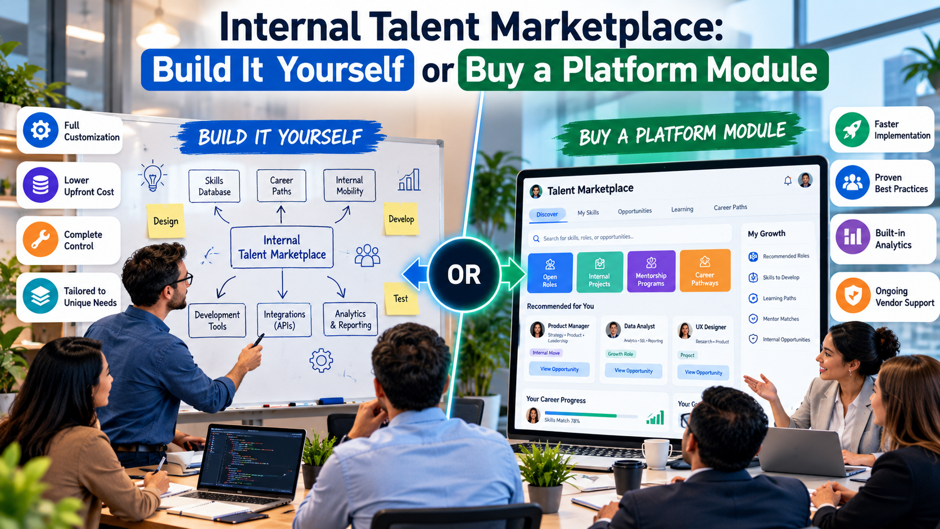
A VP of Talent presents 2 numbers to the executive team in the same meeting: an external hire typically takes 18 months to reach full productivity, while an internal candidate with the right skills could have been ready in 60 days, if anyone inside the organization had actually known that candidate existed and was interested in the role. That gap between what’s technically possible internally and what actually happens in practice is exactly the problem an internal talent marketplace exists to solve, and it’s why the question facing more HR and talent leaders isn’t whether to build one, but how.
The market has already answered the “whether” question fairly decisively. Gartner projects that 30% of large enterprises will have deployed a talent marketplace by the end of 2025, and a $54.6 million acquisition in this exact space in early 2026 signals the broader market now treats skills intelligence as foundational infrastructure rather than an optional HR technology investment. What remains genuinely open, and considerably more consequential for how an organization actually spends the coming budget cycle, is whether to build this capability internally or buy a purpose-built platform module. This guide works through both paths in genuine detail: what building actually requires, what buying actually costs, and the practical framework for deciding which approach fits a specific organization’s actual situation.
TL;DR
| Consideration | What it means for the build-or-buy decision |
| Market maturity | Dedicated platforms and HCM-native modules have matured considerably, with proven skills-matching engines and measurable adoption data now available across multiple vendor categories |
| True cost of buying | Beyond the core per-employee-per-month license fee, implementation typically adds 15% to 35% of the first year’s license cost, with additional modules often priced separately |
| True cost of building | A custom build requires a dedicated, ongoing team, not a one-time project, since skills data, matching logic, and integrations all require continuous maintenance as the organization evolves |
| The cost of doing neither | Internal candidates who could be productive within 60 days go unsurfaced while external hires take up to 18 months to reach full productivity, a gap that compounds every quarter without a working marketplace |
| Implementation complexity | Both paths require genuine change management and phased rollout discipline; the platform itself is rarely the hardest part of a successful launch |
| The realistic middle ground | Many organizations land on an HCM-native module or a phased, hybrid approach rather than a purely custom build or a fully dedicated, standalone platform |
The throughline across every row above: this decision deserves the same rigor an organization would apply to any other significant technology investment, weighing genuine total cost of ownership against the specific capability gap the organization is actually trying to close, rather than defaulting reflexively to either path without a genuine comparison.
Why This Decision Has Become Genuinely Urgent
Before working through the build-versus-buy comparison itself in genuine, careful detail, it’s worth pausing for a moment to understand exactly why internal talent marketplaces have moved from a nice-to-have HR initiative to something considerably closer to genuinely essential infrastructure for a growing, continuously evolving organization operating today.
The Real Cost of Not Having a Working Marketplace
The specific, concrete costs organizations without a genuine internal talent marketplace continue absorbing:
- External hires typically take up to 18 months to reach full productivity, while internal candidates with the right underlying skills could often be ready within 60 days, if the organization actually had visibility into who those candidates were
- Employees increasingly leave not because a competing company found them, but because a genuinely better opportunity existed inside their own organization and remained entirely invisible to them
- Recruiting budgets get spent on external searches for roles internal talent pipelines could have closed considerably faster and at meaningfully lower cost, if that internal pipeline were actually visible and searchable
- Skills gaps persist even when the organization already employs people with adjacent or transferable capability, simply because no system exists to surface that latent capability against an open role or project
Why the Market Has Moved So Decisively Toward This Capability
Gartner’s projection that 30% of large enterprises will have deployed a talent marketplace by the end of 2025 reflects a genuine adoption inflection point, not merely a passing HR technology trend, and recent acquisition activity in this exact space, including a major skills-intelligence acquisition specifically aimed at unifying skills data with enterprise learning at scale, confirms that established HR technology vendors increasingly view this capability as core infrastructure rather than a differentiating add-on feature.
Why This Shift Directly Shapes the Build Versus Buy Conversation
As the underlying capability shifts from optional differentiator to expected infrastructure, the purely custom-build path that might have made sense several years ago, when few mature platforms existed, increasingly competes against genuinely sophisticated, proven vendor options built specifically around skills-based matching, deep taxonomies, and measurable adoption outcomes. This maturation doesn’t automatically mean buying is now the right answer for every organization, but it does mean the comparison itself has shifted considerably compared to even a few years earlier.
What Buying Actually Looks Like: The Platform Categories
Understanding the buy side of this decision requires recognizing directly and clearly, right from the outset, that “buying a talent marketplace platform” isn’t a single, uniform choice at all; it genuinely spans several distinct, meaningfully different categories of solution that are each genuinely worth understanding individually and quite carefully.
The 5 Categories Worth Understanding
| Category | What it offers |
| Dedicated AI talent marketplaces | Purpose-built platforms offering the deepest skills-based matching capability, built specifically around opportunity matching rather than as one feature among many |
| Skills intelligence infrastructure | Platforms specifically focused on inferring and continuously updating workforce capability data, often functioning as an underlying data layer other systems draw from |
| HCM-native internal mobility modules | Internal mobility functionality embedded directly within a broader HR suite an organization may already be running |
| Career pathing and development platforms | Tools connecting individual employee growth and aspiration directly to internal opportunity, with a stronger employee-development orientation than a pure matching engine |
| Workforce intelligence and analytics platforms | Solutions focused on making internal mobility measurable and strategically governable at the organizational level, rather than purely facilitating individual matches |
Why Dedicated Platforms Offer the Deepest Matching Capability
Purpose-built talent marketplace platforms typically offer considerably deeper skills ontologies and more sophisticated matching engines than a module embedded within a broader HR suite, since matching quality represents these platforms’ entire core value proposition rather than one feature competing for development priority against a much broader product roadmap. Organizations whose primary goal centers specifically on genuinely sophisticated, AI-driven skills matching tend to find dedicated platforms deliver meaningfully stronger core matching performance than an HCM-native alternative.
Why an HCM-Native Module Still Makes Genuine Sense for Many Organizations
Organizations already running a broader HR suite that includes an internal mobility module gain a genuine, tangible advantage in integration simplicity, since employee data, org structure, and existing workflows already live within the same system rather than requiring a separate integration layer connecting a standalone marketplace platform to the core HRIS. This integration simplicity typically comes at some cost to matching sophistication and skills-ontology depth compared to a dedicated, purpose-built platform, representing a genuine trade-off rather than a strictly inferior option.
What Building Actually Requires
Turning now to the build side of the decision itself, it’s genuinely worth pausing to be direct and honest about what a custom-built internal talent marketplace actually demands in real, day-to-day practice, since this specific path is frequently underestimated right at the point of initial decision-making by leadership.
The Core Components a Genuine Build Requires
The specific technical and organizational components a custom-built talent marketplace genuinely needs, beyond just the initial development work:
- A skills taxonomy and ongoing data model capable of representing employee capability in a way that supports genuine matching, not simply a static list of self-reported skills that quickly goes stale
- A matching engine or algorithm capable of connecting employee capability to open roles, projects, and gigs with enough sophistication to actually surface non-obvious, valuable matches
- Integration with the organization’s core HRIS, learning systems, and any other data source the marketplace needs to draw from to remain accurate and current
- Ongoing content and opportunity population, since a marketplace with few genuine roles or projects posted provides little value regardless of how sophisticated its underlying matching technology happens to be
- A dedicated, ongoing team responsible for maintaining and evolving the platform, not simply the team that built its initial version
Why a Build Project Rarely Ends at Launch
A custom-built internal talent marketplace, much like other internal platforms an organization might build rather than buy, requires genuine, ongoing investment well beyond initial launch, since skills data, matching logic, and system integrations all require continuous maintenance as the underlying organization itself continues evolving. Treating a custom build as a one-time project with a defined completion date, rather than an ongoing product requiring a genuinely dedicated team indefinitely, is one of the most common and consequential misjudgments organizations make when choosing this path.
Why the Opportunity Cost of Building Deserves Genuine Weight
Every engineering and product hour spent building and maintaining a custom talent marketplace is an hour not spent on the organization’s actual core product or service, and this opportunity cost deserves genuine, explicit weight in the build-versus-buy comparison, rather than being treated as a cost that simply doesn’t count because the team happens to already be internal.
How Specific Vendor Types Compare in Practice
Beyond the 5 broad categories already outlined above in this particular guide, looking closely and carefully at how specific, real examples within those categories actually differ from one another helps make the abstract comparison considerably more concrete, tangible, and genuinely useful for real, practical decision-making purposes overall.
A Closer Look at Category Trade-Offs
| Vendor type | Strengths | Genuine limitations |
| Dedicated marketplace platforms | Deep skills ontologies, advanced AI matching engines, and a people-science foundation built specifically around opportunity matching | Requires standalone integration work, since the platform typically isn’t already embedded in an organization’s existing HR suite |
| Marketplace modules within a broader learning or HCM suite | Adds internal mobility without introducing a new vendor relationship for organizations already invested in that ecosystem | Matching sophistication and skills-ontology depth typically lag behind purpose-built, dedicated platforms |
| Hiring-plus-mobility bundled platforms | Single vendor spanning both external recruitment and internal marketplace functionality, including gigs and mentorship matching | Internal mobility capability may be secondary to the platform’s primary recruitment focus, rather than receiving equal product investment |
Why Organizations Already Invested in a Specific Ecosystem Often Favor the Embedded Module
An organization already running a broader learning or HCM platform gains genuine value from adding internal mobility as a module within that same ecosystem, avoiding both a new vendor relationship and the integration overhead a standalone platform would require, even though this convenience typically comes with meaningfully less matching sophistication than a purpose-built alternative offers.
Why Matching Methodology Deserves Explicit Evaluation, Not Just Feature Comparison
Beyond simply comparing feature lists, organizations evaluating vendor platforms should specifically ask whether a genuine people-science or data-driven foundation underlies the matching methodology, or whether matching functions more as a surface-level keyword search dressed up with an AI label. This distinction matters considerably for actual outcomes, since a matching engine genuinely grounded in verified skills data and sound methodology produces meaningfully more relevant, trustworthy matches than one relying primarily on self-reported skills or superficial job-history inference alone.
The True Cost of Ownership: What Buying Actually Costs
With both paths now outlined conceptually above in this particular guide, understanding the genuine, concrete cost structure behind buying a platform module helps ground the entire comparison in actual, real, specific numbers, rather than abstract trade-offs alone left largely unquantified and vague throughout the entire discussion.
The Pricing Landscape
| Cost component | Typical range |
| Core license, per employee per month | Roughly $4 to $10 for core modules, with fuller bundles often running $12 to $30 or more |
| One-time implementation cost | Typically 15% to 35% of the first year’s license cost |
| Additional skills-framework or mobility modules | Frequently priced as separate add-ons beyond the core license |
| Regional variation | European and DACH-region deals commonly run in the range of €4 to €12 per employee per month, depending on headcount and selected modules |
Why Implementation Cost Deserves as Much Attention as the License Fee
The one-time implementation cost, commonly representing 15% to 35% of the first year’s license fee, is frequently underweighted during initial vendor evaluation, even though it directly reflects the genuine complexity of integrating the platform with an organization’s existing systems and data. An organization comparing vendors purely on the headline per-employee-per-month rate, without weighing this implementation cost band, risks a meaningfully incomplete picture of the platform’s true first-year cost.
Why Add-On Modules Can Meaningfully Shift the Total Cost Picture
Vendors increasingly price advanced capabilities, deeper skills frameworks, AI-driven career pathing, and predictive analytics, as separate add-ons beyond the core license, meaning an organization’s actual total cost can climb meaningfully beyond the initial quoted rate as genuinely valuable additional capability gets added over time. Understanding this pattern before committing to a specific vendor helps an organization forecast the platform’s realistic 2- to 3-year cost trajectory, rather than being surprised by add-on pricing after the core platform is already in place.
A Practical Framework for Making the Decision
Pulling the build and buy paths together into one genuine, practical decision framework helps an organization move from merely understanding the trade-offs purely in the abstract to actually, finally making a real, genuinely defensible choice going forward from this specific point onward in time and budget planning.
The Questions Worth Answering in Sequence
The specific questions an organization should work through, in order, before committing to either path:
- Does the organization have a genuinely unique matching or skills-taxonomy requirement that existing vendor platforms don’t already address well, or would a proven, existing solution reasonably meet the actual need
- Does the organization have genuine, sustained engineering and product capacity to dedicate to an internal platform indefinitely, not just for an initial build phase, but for years of ongoing maintenance and evolution afterward
- How quickly does the organization need working internal mobility capability, given that a mature vendor platform typically reaches production readiness considerably faster than a custom build starting from scratch
- What does the organization’s existing HR technology stack look like, and would an HCM-native module integrate meaningfully more easily than either a standalone vendor platform or a fully custom build
Why Speed to Value Often Favors Buying, Even for Organizations With Strong Engineering Capacity
Even organizations with genuinely strong internal engineering capacity often find that a mature vendor platform reaches meaningful production value considerably faster than a custom build, since the vendor has already solved the core skills-matching and taxonomy challenges that would otherwise consume a substantial share of a custom build’s initial development time. This speed advantage matters considerably given how directly the cost of continued delay compounds, every additional month without working internal mobility capability means more external hires taking 18 months to reach productivity while ready internal candidates remain invisible.
Why a Hybrid Approach Often Represents the Realistic Middle Ground
Many organizations land somewhere between a purely custom build and a fully standalone, dedicated vendor platform, adopting an HCM-native module where deep integration matters most, while supplementing it with custom logic or additional tooling addressing the organization’s genuinely unique requirements. This hybrid approach avoids both the full opportunity cost of a purely custom build and the potential mismatch of forcing a highly specific organizational need into a rigid, one-size-fits-all vendor platform never designed with that specific requirement in mind.
Implementation Considerations Regardless of Which Path You Choose
Whether an organization ultimately decides to build or buy in the end, several implementation realities genuinely apply regardless of which specific path actually gets chosen, and underestimating them is a genuinely common source of failed or stalled marketplace launches across many organizations of every size and industry.
The Phased Rollout Approach That Consistently Works Better Than a Full Launch
The specific phased approach that tends to produce considerably stronger adoption than attempting a full, organization-wide launch immediately:
- An initial phase establishing core technical foundations, single sign-on, HRIS synchronization, and one clearly defined priority use case, whether that’s open roles or shorter-term gigs and projects
- An expansion phase, typically spanning several months, adding a second site or region, tightening the underlying skills model based on early usage data, and standardizing approval workflows across the organization
- A scaling phase, ongoing rather than time-boxed, that connects the marketplace to succession planning, broader workforce planning, and learning orchestration only once initial adoption has genuinely stabilized
Why Governance Needs to Be Treated as a Product Requirement, Not an Afterthought
Genuine governance clarity, exactly what data gets collected, who can see what, how long data gets retained, how employees can correct their own information, and how reporting gets aggregated, needs to be built into the marketplace’s core design from the start, rather than addressed as a separate compliance formality once the platform is already largely built. Organizations that treat governance as a genuine product requirement from day one avoid considerably more rework than those that bolt governance considerations on after the fact, particularly in jurisdictions where works councils or similar employee representation bodies need to be consulted before workflows touching performance-related data can genuinely proceed.
Why Adoption Support Matters as Much as the Underlying Technology
Even the most technically sophisticated platform, built or bought, delivers limited value if managers and employees don’t actually understand how to use it or why it’s genuinely worth their time, meaning manager enablement resources and employee activation support deserve investment at least equal to what goes into the underlying technical implementation itself.
Common Mistakes When Making This Decision
Beyond the framework already covered above in this guide, several recurring, genuinely predictable mistakes show up consistently among organizations working through the build-versus-buy decision, and avoiding them meaningfully improves the odds of a decision the organization genuinely won’t need to revisit within a year or 2.
Treating the build option as free simply because the engineering team is already internal. Internal engineering time still carries genuine opportunity cost, and failing to weigh that cost explicitly against a vendor’s license fee produces a systematically biased comparison favoring building regardless of whether it’s actually the better choice.
Comparing vendors purely on headline license pricing without accounting for implementation and add-on costs. A platform that looks meaningfully cheaper based on its quoted per-employee-per-month rate alone can end up costing considerably more once implementation fees and necessary add-on modules are genuinely factored into the comparison.
Underestimating the ongoing maintenance burden of a custom build. Treating a custom marketplace as a completed project once it launches, rather than an ongoing product requiring dedicated, continuous investment, consistently leads to a platform that gradually degrades in data quality and matching relevance as the organization evolves around it.
Launching organization-wide before validating the approach with a smaller, focused pilot. Attempting a full launch across every department and region simultaneously, rather than the phased approach outlined earlier, considerably increases the risk of a rollout that stalls due to unresolved technical or adoption issues discovered too late to correct efficiently.
Treating governance and change management as secondary to the core technology decision. Selecting between build and buy while deferring genuine governance and adoption planning until after the platform decision is finalized consistently produces weaker outcomes than treating these considerations as equally central to the decision from the very start.
What to Verify Before Signing With Any Vendor
Regardless of which vendor category ultimately fits best for a given organization, several specific due-diligence items deserve genuine, careful, patient verification before an organization ever commits to a platform contract, since gaps discovered only after signing are considerably harder and more expensive to address later on down the road.
The Specific Items Worth Confirming Directly
The concrete due-diligence checklist worth working through before finalizing any vendor selection:
- Confirmed SOC 2 Type II certification or an equivalent, genuinely rigorous compliance and security standard appropriate to the organization’s own regulatory environment
- A clear, documented explanation of how the platform’s matching algorithm actually makes decisions, sometimes referred to as an ethical AI framework, rather than a black-box matching process the organization can’t meaningfully audit or explain to employees
- Explicit features supporting equitable opportunity distribution, such as anonymized profiles during initial matching stages, that help ensure internal mobility doesn’t simply recycle the same small pool of already-visible, well-networked employees
- Genuine manager enablement resources and employee activation playbooks included as part of the vendor relationship, not simply left to the organization to build entirely from scratch after purchase
- Documented reporting capability specifically covering internal fill rate, time-to-fill for internally sourced roles, and retention lift among employees who make an internal move, since these are the metrics that ultimately justify the platform’s ongoing cost
Why Equitable Distribution Features Deserve Particular Attention
An internal talent marketplace that inadvertently continues surfacing the same visible, well-connected employees for every new opportunity fails at one of its core intended purposes: expanding genuine access to internal mobility beyond whoever already has the strongest internal network or visibility with hiring managers. Verifying that a prospective platform includes genuine features supporting equitable opportunity distribution, rather than assuming any AI-driven matching system automatically produces fair outcomes, protects against quietly reproducing the same access patterns a genuine marketplace is meant to disrupt.
Why Vendor-Provided Adoption Support Should Factor Into the Cost Comparison
A vendor offering genuine, substantive manager enablement and employee activation support as part of the core relationship effectively reduces the organization’s own change-management burden compared to a vendor leaving this work entirely to the buyer, and this difference deserves genuine weight in the overall cost and value comparison between vendors, not just the headline license and implementation pricing. A platform that’s meaningfully cheaper on paper but leaves the organization to build all adoption support independently may ultimately cost more in internal time and effort than a pricier alternative that includes this support directly.
FAQs
Is there a company size below which building a custom internal talent marketplace genuinely makes sense?
Custom builds generally make more sense for organizations with genuinely unique matching requirements or substantial existing engineering capacity to dedicate indefinitely, characteristics considerably more common among very large enterprises than smaller or mid-sized organizations. Smaller organizations typically find that a proven vendor platform, particularly an HCM-native module if they already run a broader HR suite, delivers meaningfully faster time to value than committing scarce engineering capacity to a custom build.
How long does it typically take to see genuine value after choosing to buy a platform versus building one?
A vendor platform typically reaches meaningful production value within the phased rollout timeline covered earlier, often measured in months rather than years, since the vendor has already solved the core skills-matching and taxonomy challenges. A custom build’s timeline to genuine, comparable value varies considerably more, frequently extending well beyond a year once the skills taxonomy, matching logic, and necessary integrations are all accounted for realistically.
Should an organization already running Workday or SAP default to their native internal mobility module rather than evaluating dedicated platforms?
Not automatically, though the native module deserves genuine, serious evaluation given its integration simplicity advantage. Organizations whose primary goal centers on sophisticated, deep skills matching may still find a dedicated platform’s matching capability meaningfully stronger, and the right choice depends on how much that matching sophistication genuinely matters relative to the integration simplicity a native module provides.
What’s the biggest hidden cost organizations tend to miss when evaluating vendor platforms?
Beyond implementation fees, the most commonly underweighted cost is the price of add-on modules for advanced capability, deeper skills frameworks, AI-driven career pathing, and predictive analytics specifically, that vendors increasingly price separately from the core license. Organizations that only evaluate the core license price risk a meaningfully incomplete picture of what the platform will genuinely cost once they add the capabilities that actually make the marketplace strategically valuable over time.
Does choosing to buy a platform mean the organization loses the ability to customize the matching approach to its own specific needs?
Not entirely, since most mature vendor platforms offer meaningful configuration around skills taxonomies, matching weightings, and workflow rules, even though this configuration happens within the vendor’s underlying platform architecture rather than through fully custom-built logic. Organizations with genuinely unique requirements that configuration alone can’t address are precisely the cases where a hybrid approach, or in rarer cases a genuine custom build, becomes the more defensible choice.
How should an organization measure whether its chosen approach, built or bought, is actually succeeding after launch?
Tracking internal fill rate, time-to-fill for roles ultimately filled internally, and retention lift among employees who make an internal move gives an organization concrete, comparable metrics regardless of which path was chosen, and these same metrics work equally well for justifying continued investment in a custom build or renewing a vendor contract based on genuinely demonstrated value rather than assumed benefit.
How should an organization handle the transition period if it’s currently relying entirely on informal internal mobility, word of mouth and manager networks, before adopting any formal marketplace?
Organizations moving from a purely informal system benefit from communicating clearly, early and often, that the new marketplace is meant to expand genuine opportunity access rather than replace or undermine existing manager relationships, since employees and managers alike may otherwise perceive the new system as either a bureaucratic layer or a threat to established, informal pathways that have worked reasonably well for some people already. Framing the marketplace explicitly as a tool that surfaces opportunities employees wouldn’t have otherwise known about, rather than a mandatory replacement for every existing informal mobility pathway, tends to produce considerably smoother adoption than a more forceful, all-or-nothing rollout message.
Is it realistic to expect a talent marketplace to meaningfully reduce external recruiting costs within the first year?
Meaningful reductions in external recruiting spend typically take longer than a single year to materialize fully, since building genuine trust in the marketplace, both from employees willing to explore internal moves and from hiring managers willing to consider internal candidates seriously, takes time to develop even with strong underlying technology in place. Organizations should set realistic first-year expectations around adoption and engagement metrics specifically, treating measurable reductions in external recruiting cost as a genuine second-year outcome that follows from strong first-year adoption, rather than an immediate, first-year deliverable the platform alone can guarantee.
Who inside the organization should ultimately own the internal talent marketplace once it’s live, HR, talent acquisition, or a dedicated team?
Ownership typically works best when it sits with a dedicated marketplace leader or a small cross-functional team spanning HR and talent acquisition together, rather than being treated as a side responsibility bolted onto an existing role with limited bandwidth to genuinely champion adoption. The organizations seeing the strongest results consistently have someone explicitly responsible for promoting the platform, demonstrating its value to skeptical managers, and continuously refining the underlying skills model as usage data accumulates, rather than leaving the marketplace to run passively once the initial launch phase concludes.
