
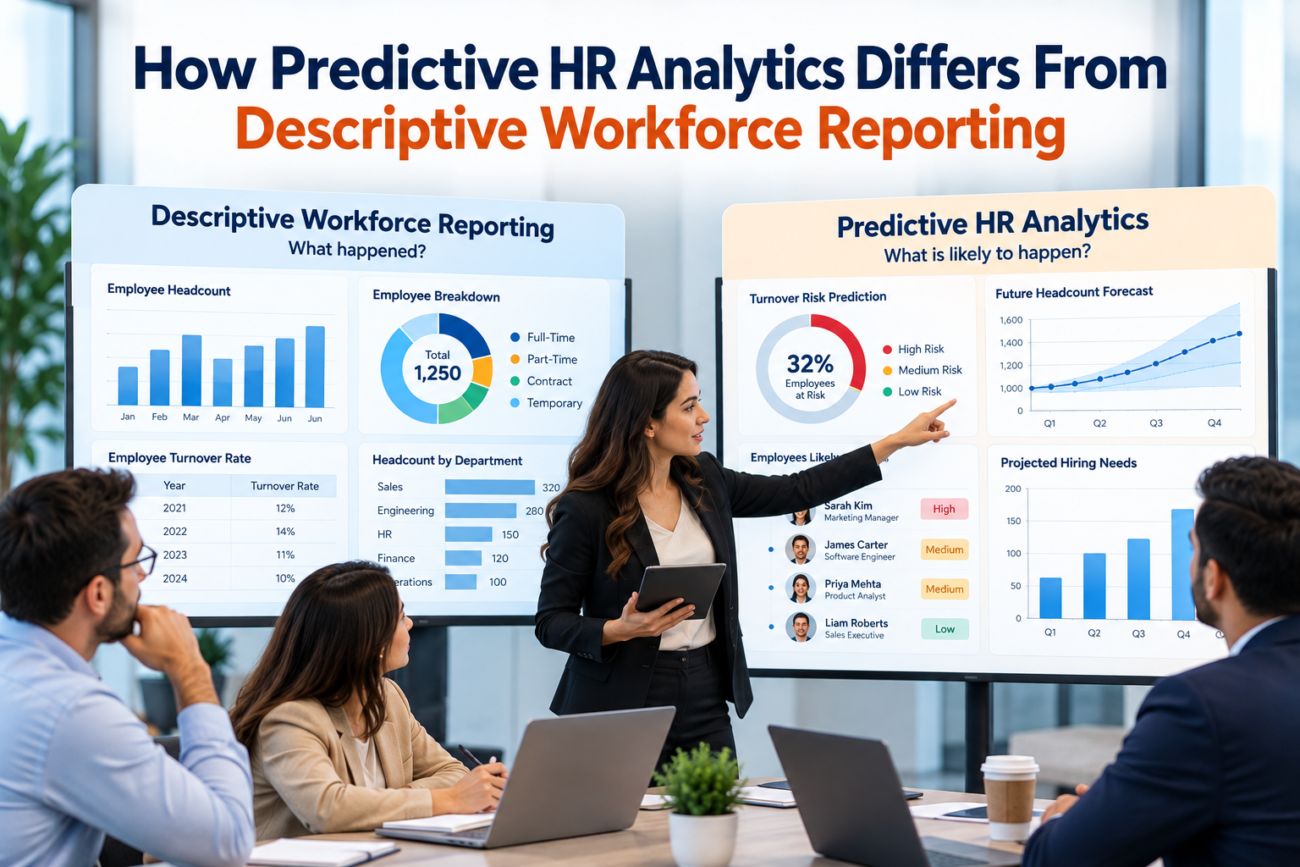
HR teams often use the words reporting and analytics as if they describe the same work. They don’t. A workforce dashboard can be accurate, useful, and well designed while still answering only what has already happened. A predictive model asks a different question. It estimates what may happen next and expresses that estimate with uncertainty.
That difference matters because moving from historical reporting to prediction changes far more than the chart on the screen. It changes the data history the team needs, the way outcomes are defined, how results are tested, and the level of review required before a manager acts on an output. A turnover report can tell HR that voluntary exits rose last quarter. A predictive model may estimate which groups are more likely to leave during the next 6 months. Those 2 outputs carry different evidence requirements and different risks.
The practical question isn’t whether predictive HR analytics is more advanced. The practical question is whether the organization has a business problem that prediction can answer better than descriptive HR analytics, and whether its data and governance are ready for that step.
TL;DR
Descriptive HR analytics summarizes observed workforce facts such as headcount, turnover, absence, hiring, and mobility. Predictive HR analytics uses historical and current information to estimate a future outcome such as attrition, staffing demand, absence levels, or time to fill. The second approach needs a defined prediction target, longer data history, model testing, and ongoing monitoring.
Reliable reporting remains the base layer. If HR can’t reconcile headcount, classify exits consistently, or track job and manager changes over time, a predictive model will inherit those problems. Prediction also doesn’t prove causation. A factor can help forecast an outcome without causing it. That distinction matters when HR moves from identifying risk to choosing an intervention.
The safest path is to start with accurate reporting, investigate why a metric changed, define a measurable future question, and then test whether a predictive model adds enough value to justify its added complexity. When predictions affect named employees, the organization also needs stronger review around fairness, access, privacy, and human judgment.
Why The Difference Matters In Everyday HR Decisions
The difference between descriptive reporting and prediction becomes clear when the same workforce problem is viewed through 2 questions. Descriptive reporting asks what the organization can verify from recorded events. Predictive work asks what the available evidence suggests may happen during a future period.
The CIPD people analytics factsheet describes descriptive analytics as snapshots or trends such as employee turnover and absence, while predictive analytics projects the future direction of workforce measures using historical information and other relevant factors. That distinction is useful because it puts the purpose of the analysis ahead of the software used to produce it.
Consider voluntary turnover. A workforce dashboard may show that turnover increased from 1 quarter to the next, that the rise was concentrated in customer support, and that employees with less than 2 years of tenure represented a large share of exits. Those are observed facts derived from past records. They help HR see where the problem occurred.
Prediction changes the question to something such as: what is the estimated probability that voluntary turnover will increase in customer support over the next 2 quarters? An employee-level model might ask which active employees have patterns associated with a higher probability of voluntary departure within 6 months. The output is no longer a count of known events. It is an estimate about an event that hasn’t happened yet.
That change affects how leaders should read the result. A descriptive count can often be traced directly to employee records. A prediction depends on a model, assumptions, input variables, and the population used for training. The organization must therefore treat the prediction as evidence with uncertainty rather than as a new employee fact.
What Descriptive Workforce Reporting Actually Does
Descriptive reporting turns HR records into a consistent view of the current workforce and recent history. Common measures include headcount, hires, exits, voluntary turnover, absence, overtime, representation, internal moves, compensation distribution, and time to fill. The work may appear in a monthly report or executive dashboard, but the defining feature is the question being answered: what happened or what is true now?
The CIPD workforce reporting guidance defines workforce reporting as communicating the value and impact of the workforce and using workforce information to support decision-making. That purpose goes beyond producing charts for HR. Good workforce reporting creates an agreed record that finance, HR, and business leaders can use when they discuss staffing, cost, capacity, and workforce risk.
A descriptive report can answer practical questions such as these:
· How many active employees were on payroll at month end?
· Which business units had the highest voluntary turnover last quarter?
· How many roles remained open for more than 60 days?
· Which locations recorded the most overtime hours?
· How did internal mobility change during the past year?
These questions require consistent definitions more than complex modeling. HR must decide which workers count toward headcount, when an exit becomes effective, how transfers are classified, and whether contractors are included. If those definitions change from report to report, trend lines become hard to trust.
Descriptive HR analytics can also expose where deeper investigation is needed. A turnover chart may show that 1 function has a sudden increase in exits. That doesn’t tell HR why the increase occurred, but it provides the factual starting point. This is why descriptive work shouldn’t be dismissed as basic. It creates the reference layer that later analysis depends on.
The CIPD guide for people professionals also stresses that useful analysis starts with a focused business question and appropriate evidence.
What Predictive HR Analytics Adds
This approach estimates a future workforce outcome from patterns in historical and current data. The outcome may be an aggregate forecast, such as expected staffing demand next quarter, or a probability attached to a defined unit such as a role, location, team, or individual employee.
A current SHRM discussion of predictive attrition describes the approach as using employee information and statistical models to anticipate future workplace outcomes. Attrition is a common example because HR often has historical records of who stayed, who left, and what conditions existed before those outcomes occurred.
The model might examine tenure, job family, compensation position, internal moves, schedule information, absence history, or survey results. It then estimates a defined future outcome from the relationships present in the training data. The important word is estimate. The model doesn’t know that an employee will resign or that a location will miss its staffing target. It assigns a probability or forecast based on past patterns and current inputs.
That output can support several types of planning. A workforce planning team may forecast demand for critical roles. Recruiting may estimate time to fill for job families with very different hiring histories. HR operations may estimate absence levels during a known seasonal period. Retention teams may examine whether certain populations have a higher modeled risk of voluntary exit.
The Real Difference Is The Question And The Output
Software features can make descriptive and predictive work look similar because both may appear inside a dashboard. The difference sits underneath the screen. Descriptive work summarizes observed records. Prediction applies a model to estimate an outcome that has not yet been observed.
| Dimension | Descriptive Workforce Reporting | Predictive HR Analytics |
| Core question | What happened or what is true now? | What is likely to happen next? |
| Typical output | Counts, rates, trends, distributions | Forecasts, probabilities, risk estimates |
| Time focus | Historical and current | Future period |
| Main methods | Aggregation, filtering, ratios, trend analysis | Regression, time-series methods, statistical learning |
| Data need | Reliable current and historical records | Longitudinal records tied to a defined outcome |
| Quality check | Reconcile totals with source records | Test predictions against unseen or later outcomes |
| Main failure mode | Wrong definitions or source data | Weak generalization, bias, drift, poor target design |
| Typical decision use | Understand condition and change | Anticipate risk or demand before it occurs |
The distinction also explains why a predictive dashboard isn’t automatically more useful. The CIPD future workforce reporting study shows that organizations still have gaps in the quality and consistency of basic workforce information. Adding a forecast layer doesn’t repair weak source records or inconsistent definitions.
A useful decision rule is simple. Use descriptive reporting when the business needs a trustworthy description of workforce conditions. Use prediction when a future estimate would change a real decision and the organization can test whether that estimate is reliable enough for the intended use.
Data Requirements Change Before Modeling Starts
Prediction usually needs more history and more disciplined data design than descriptive reporting. A dashboard can calculate today’s headcount from current employee records. A people analytics team may need several years of dated employee records linked to future outcomes for an attrition model. That creates a longitudinal dataset in which the team can see what was true at a point in time and what happened afterward.
This sounds simple until HR tries to build the history. Employee records often change in place. A current HRIS record may tell you an employee’s present manager, current pay, and current job. A predictive project may need the manager, pay position, schedule, and job that were in effect 6 months before an earlier outcome. If those historical states were not retained, the team can’t reliably recreate them.
Workforce analytics also depends on stable definitions. An exit must be classified the same way across periods. Job families need consistent mapping. Reorganizations can’t erase the ability to understand prior structures. Missing survey responses need explicit treatment. The model must know whether a blank field means unknown, not applicable, or no response.
A predictive project also needs a target variable. “Who may leave?” is too loose. A better target is “voluntary departure within 6 months after the prediction date.” Now HR can define who is included in the population, which exit count, the prediction window, and the date on which each input is measured.
The BLS employment projections methodology offers a useful reminder even outside HR analytics: forecasts are built from models and assumptions, with outputs from 1 step often becoming inputs to another. Internal workforce forecasting works on a smaller scale, but the same discipline applies. Teams need to document where inputs come from and what assumptions connect them to the final estimate.
Prediction Methods Do Not Have To Mean AI
Prediction is often discussed as if it requires artificial intelligence. It doesn’t. A predictive model can be built with long-established statistical methods. Linear regression can estimate continuous outcomes. Logistic regression can estimate the probability of a binary event. Time-series methods can forecast a metric through time. Survival analysis can estimate time until an event while accounting for employees who haven’t yet experienced that event.
Machine learning may be useful when relationships are more complex or when the dataset contains many interacting variables. Decision trees and other methods can model patterns that simple linear forms may miss. But the method doesn’t become predictive because it uses AI. It becomes predictive because the output estimates a future outcome.
This distinction matters for technology buying. A platform may advertise AI while its main workforce view remains descriptive. Another team may build a useful forecast with standard statistical tools and no machine learning at all. Buyers should therefore ask what target is predicted, how the model was tested, and what performance evidence is available rather than relying on a product label.
Current SHRM material on predictive HR dashboards describes dashboards that surface early workforce signals and risk thresholds. Those features can be useful, but they still need an explanation of what produces the score and what the threshold means. A colored risk indicator isn’t self-explanatory evidence.
Validation Separates A Predictive Model From A Reporting Dashboard
A descriptive report is often validated by reconciliation. If the HRIS has 8,412 active employees and the dashboard shows 8,390, the team investigates the difference until it understands the mismatch. Predictive models require another layer of testing because a model can fit historical data very well and still perform poorly on new cases.
The core question is whether the model generalizes. A common approach is to train the model on 1 part of the historical data and evaluate it on records that were not used during training. For workforce problems where time matters, a later time period can be a better test than a random split because it more closely resembles real deployment.
Model quality also can’t be reduced to a single accuracy number. The right measures depend on the use case. Attrition models may need review of precision, recall, false-positive rates, false-negative rates, calibration, and subgroup performance. A model that labels too many employees as high risk can quickly lose manager trust. A model that misses most actual exits may provide little practical value.
The BLS projection evaluation methods compare more elaborate projections with simpler naive models. Internal workforce analytics teams can borrow the same idea. A predictive system should beat a reasonable baseline often enough to justify its cost and added decision risk.
For AI-based models, the NIST AI RMF measurement guidance recommends measuring validity and error rates, documenting the deployment context, and comparing pre-deployment with post-deployment performance. These practices help HR separate a promising prototype from a model that remains useful once real workforce conditions begin to change.
Use Cases Show Where The Difference Becomes Practical
Predictive HR analytics becomes easier to understand when descriptive and predictive questions are paired around the same business issue. The examples below also show why the future estimate must lead to a possible decision. Prediction has little value when no one can act on it responsibly.
Attrition
Descriptive HR analytics asks which teams had the highest voluntary turnover last year and which employee groups made up those exits. A predictive model asks whether certain teams or populations now show a higher estimated probability of voluntary turnover during a defined future period.
The result can help HR decide where deeper manager conversations or workforce planning attention may be useful. It shouldn’t be treated as proof that a named employee intends to leave.
Staffing Demand
A descriptive report may show the number of people used during last year’s peak season, overtime hours, and open positions. Prediction can estimate staffing needs for the next peak period from business demand, hiring lead time, absence history, and prior staffing patterns.
This is closer to operational forecasting than employee scoring. It often carries lower individual decision risk because the output can be used at team or role level.
Recruiting
A descriptive report can show average time to fill by job family. A predictive model can estimate how long a newly opened role may take to fill given location, skill requirements, compensation range, and current pipeline conditions.
The value is in planning. If the estimate shows that a critical role is likely to remain open longer, the business can adjust staffing assumptions or start sourcing earlier.
Absence And Capacity
Workforce analytics may show where absence and overtime were highest during past periods. Prediction can estimate which sites or teams may face capacity pressure during an upcoming period. That gives operations time to plan coverage before the shortage appears in the monthly report.
Correlation Is Not Causation And Prediction Is Not Prescription
A predictive model can identify variables that help forecast an outcome without proving that those variables caused it. That distinction is a major limit in people analytics.
Suppose employees who haven’t changed roles for 3 years show a higher rate of voluntary departure. Role history may improve an attrition model. It doesn’t prove that the lack of a role change caused the departures. Pay, manager quality, external job demand, commute, personal circumstances, or other factors may also be involved.
CIPD people analytics guidance explicitly distinguishes correlation from causation and separates predictive analytics from prescriptive analysis. That boundary should remain visible when HR decides what to do with a forecast.
A prediction might tell HR that a team has higher turnover risk. It doesn’t automatically tell HR whether the right response is a compensation change, manager intervention, workload review, or no action. Choosing an intervention requires additional evidence about what is likely to change the outcome.
Skipping those distinctions creates false confidence. A model can be statistically useful and still be a poor guide to intervention if the organization mistakes association for cause.
Bias, Privacy, And Governance Become More Important With Employee-Level Prediction
The governance burden rises when a model produces scores about named employees or applicants. A team-level headcount forecast usually has a different risk profile from a system that scores an individual’s chance of leaving, promotion potential, or hiring suitability.
The risk begins with historical data. A model learns relationships from prior records. If those records reflect unequal access to assignments, promotions, ratings, or other opportunities, the model may learn patterns that carry those past conditions forward. Removing protected characteristics doesn’t guarantee that the problem disappears because other variables may act as proxies.
The EEOC’s record of guidance on automated employment systems notes that Title VII applies when employers use automated systems, including AI, to make or inform employment selection decisions. That doesn’t make every workforce forecast a selection procedure, but it does mean organizations should pay close attention when predictive outputs begin to influence hiring, promotion, or similar employment decisions.
Data access matters as well. Employee-level predictions may be built from sensitive workforce records that managers did not previously see together. HR needs clear rules for who can view raw inputs, model outputs, and historical scores. A manager doesn’t automatically need every feature used by a model just because the manager receives a risk signal.
The broader workplace technology trend makes this governance issue more urgent. An OECD study of algorithmic management found that managers report concerns about unclear accountability and the ability to understand automated decisions. Predictive HR analytics needs named ownership for the model, its intended use, approval rights, and the process for challenging or correcting an output.
An ILO review of AI in human resource management also warns that weak objectives, biased data, and opaque system design can undermine HR uses of AI. Those concerns reinforce a practical rule: the organization should be able to explain what the model predicts, what information it uses, and which decisions it must never make on its own.
Predictive Models Need Monitoring After Launch
A descriptive workforce report doesn’t usually change its logic unless someone changes the metric definition or source system. Predictive models can lose value even when the code hasn’t changed because the workforce environment changes around them.
A model trained during a period of high remote work may perform differently after a return-to-office policy. Compensation structures may change. A merger may introduce new job families. Hiring conditions can shift. Survey design may change. Any of these events can weaken relationships that once helped prediction.
This is often called model drift. The NIST report on monitoring deployed AI systems says post-deployment monitoring is important because system behavior under real operating conditions can differ from pre-deployment evaluation. For HR teams, that means model review must continue after the dashboard goes live.
Monitoring should answer practical questions. Is the prediction still calibrated? Are false-positive rates rising? Has performance changed for a major employee group? Did a new HR process alter the meaning of an input variable? Is the model being used for decisions that weren’t included in its original purpose?
This is another clear difference from reporting. Reporting needs data quality controls and definition management. Prediction needs those controls plus lifecycle monitoring of the model itself.
How To Move From Reporting To Prediction Without Skipping The Foundation
For people analytics, the best path from reporting to predictive HR analytics is incremental. HR should prove that each layer works before adding the next one.
Establish A Trusted Reporting Base
Start with agreed definitions for headcount, active employee status, hires, exits, voluntary turnover, internal movement, and the other measures tied to the intended use case. Reconcile the reports against source systems and document known gaps.
Reliable reporting gives the organization a reference point. It also reveals missing history and inconsistent classifications before those problems become model inputs.
Investigate The Pattern Before Forecasting It
Use descriptive and diagnostic analysis to understand where the problem appears. If turnover increased, identify the functions, locations, tenure groups, or roles where the change is concentrated. This narrows the predictive question and prevents the team from modeling a problem it hasn’t defined.
Define 1 Future Outcome
Write the target in measurable terms. “Predict attrition” is too broad. “Estimate the probability of voluntary departure within 6 months for active employees as of the monthly prediction date” is specific enough to build and test.
The same discipline applies to workforce planning. Define the planning horizon, unit of forecast, and business event the model is expected to support.
Build A Time-Aware Dataset
Create historical snapshots that contain only information available at the prediction date. Link each snapshot to the later outcome. Review missing data and organizational changes. Check whether the sample reflects the population in which the model will be used.
Compare Models With A Baseline
Start with a simple benchmark. A complex model should show a meaningful improvement before it earns a place in production. This protects the people analytics team from maintaining complexity that adds little business value.
Test For The Intended Decision
Evaluate the error types that matter for the use case. Review subgroup performance where employee impact is possible. Document limitations. Decide what the score can influence and what requires human review.
Monitor And Reassess
Track prediction quality after launch and review changes in workforce conditions. The process should include a clear owner, a review cadence, and a rule for stopping use when the model no longer performs as expected.
This sequence keeps prediction connected to an actual business question instead of treating prediction as the next feature an HR dashboard should have.
When Descriptive Reporting Is The Better Choice
Prediction isn’t automatically the right answer. In many situations, descriptive HR analytics is enough to support the decision.
Use descriptive reporting when the organization needs a reliable view of headcount, cost, movement, hiring, absence, or workforce composition. Use it when the business question concerns a known event and the main challenge is understanding where it occurred. Use it when historical records are too incomplete to support a credible forecast.
Prediction is also a poor fit when the target is vague or when the organization has no responsible action to take from the result. A model that predicts a workforce event but doesn’t change planning or intervention simply adds maintenance work.
NIST’s AI Risk Management Framework guidance emphasizes that risk management should consider reliability, transparency, privacy, fairness, and the context in which an AI system is used. Those considerations are especially relevant when a prediction affects employees directly. If the organization can’t support that level of review, keeping the use case descriptive may be the better decision.
What Leaders Should Ask Before Trusting A Predictive HR Output
Leaders don’t need to become statisticians, but they do need enough context to understand what a model can and can’t support. A useful review starts with the prediction target. Ask what event is being predicted, over what time period, for which population, and at what point the prediction is made.
Then ask about evidence. What data periods were used? Was the model evaluated on later or unseen data? Which performance measures were selected, and why do they match the business decision? How does the model compare with a simple baseline? Has performance changed since deployment?
Leaders should also ask how the model behaves across groups and what happens when it is wrong. False positives and false negatives have different costs. A turnover model that wrongly labels an employee as likely to leave may influence a manager’s behavior toward that person. A staffing forecast that misses demand may create overtime or coverage problems. The acceptable error depends on the decision.
The OECD’s work on AI in the workplace highlights both the potential value of AI and concerns around worker data, monitoring, and workplace effects. Those issues support a simple governance rule for predictive workforce analytics: higher-impact uses need stronger review and clearer accountability.
Finally, ask whether managers understand the output. A probability isn’t a verdict. A score is not a diagnosis of employee intent. Predictive HR analytics should narrow uncertainty enough to improve a decision while leaving room for context that isn’t captured in the model.
Conclusion
The difference matters because it changes the job from recording observed workforce conditions to estimating an unobserved future outcome. That change adds requirements around data history, target definition, model validation, error analysis, and monitoring that ordinary reporting doesn’t have.
Descriptive HR analytics remains essential because prediction depends on trustworthy history. If HR can’t reconcile basic reports or preserve reliable historical states, the model will learn from unstable inputs. A polished prediction interface can’t fix that foundation.
The strongest use cases begin with a clear decision. HR defines what it needs to know, builds a reliable record of what happened, investigates the pattern, and then tests whether a forecast improves the decision. Prediction should earn its place by providing useful earlier information, not by being more technically complex.
For employee-level predictions, the standard should be higher. The organization needs to understand bias risk, privacy, access, limitations, and how human judgment will remain involved. Used within those boundaries, workforce analytics can move from describing workforce change to estimating what may happen next without turning probabilities into facts.
FAQs
What Is Predictive HR Analytics?
Predictive HR analytics uses historical and current workforce information to estimate a future outcome. Examples include future staffing demand, voluntary turnover risk, absence levels, or expected time to fill. The result is usually a forecast or probability rather than a confirmed fact.
What Is Descriptive HR Analytics?
Descriptive HR analytics summarizes workforce events that have already happened or conditions that exist now. Typical examples include headcount, turnover, hires, exits, absence, overtime, representation, and internal mobility.
How Is Predictive HR Analytics Different From Workforce Reporting?
Reporting records and communicates observed workforce measures. A predictive model uses historical patterns and other relevant inputs to estimate what may happen during a future period.
Does Predictive HR Analytics Require Artificial Intelligence?
No. Predictive work can use standard statistical methods such as regression, time-series forecasting, or survival analysis. Machine learning may be useful for some problems, but AI isn’t required for an analysis to be predictive.
Can A Dashboard Be Predictive?
Yes, if it displays a model output that estimates a future outcome. A dashboard that only shows historical counts, trends, and current metrics remains descriptive even if the software vendor calls the feature analytics.
Why Is Historical Data Important For Predictive HR Analytics?
The model needs examples of past conditions linked to later outcomes. That history allows the team to estimate whether patterns found in earlier records help forecast events in later periods.
What Is A Prediction Target In HR Analytics?
The target is the outcome the model is built to estimate. A clear target might be voluntary departure within 6 months or staffing demand for a defined role group during the next quarter.
Can Predictive HR Analytics Tell Why Employees Leave?
It can identify variables associated with later departures, but association doesn’t prove cause. HR needs additional evidence before concluding that a factor caused turnover or that changing it will reduce exits.
What Is Model Validation In People Analytics?
Validation tests whether a predictive model performs on data that wasn’t used to fit it. Time-based testing can be useful for workforce problems because it checks whether earlier patterns continue to work on later outcomes.
What Metrics Should HR Use To Judge A Predictive Model?
The right measures depend on the decision. Teams may examine precision, recall, false-positive rates, false-negative rates, calibration, and subgroup performance rather than relying on 1 overall accuracy number.
What Is Model Drift In Workforce Analytics?
Model drift occurs when the relationships learned from historical data become less useful as workforce conditions change. Policy shifts, reorganizations, labor-market changes, or new job structures can all reduce predictive performance over time.
Is Employee Attrition Risk A Fact About An Employee?
No. Attrition risk is a model estimate based on defined inputs and historical relationships. It shouldn’t be treated as proof that an employee plans to leave or as a substitute for manager and employee conversations.
When Should HR Use Descriptive Reporting Instead Of Prediction?
Descriptive reporting is usually enough when the business needs a reliable view of current or past workforce conditions, when historical data is weak, or when a future estimate wouldn’t change a real decision.
What Is The Safest First Predictive HR Use Case?
Aggregate workforce forecasting is often a sensible starting point because it can support staffing or capacity planning without immediately assigning risk scores to named employees. The right first use case still depends on the organization’s data and decisions.
How Should HR Govern Predictive Workforce Analytics?
HR should define the model’s purpose, approved users, allowed decisions, testing requirements, review cadence, and retirement conditions. Higher-impact employee uses need stronger review around fairness, privacy, and human judgment.
