
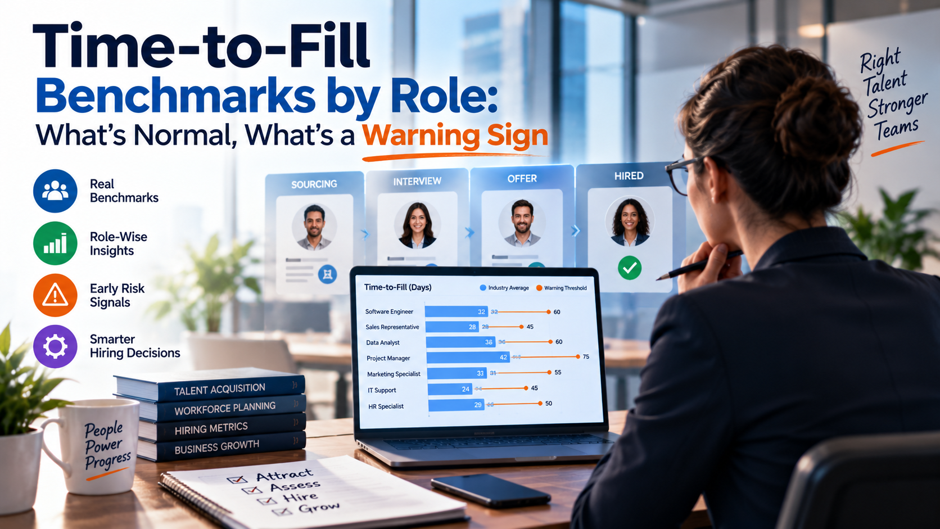
A job that remains open for 55 days can tell 2 very different stories. For a customer support role with a broad local candidate pool, that timeline may point to slow screening, difficult interview scheduling, weak compensation, or delayed decisions. For a senior engineer with a narrow technical profile, the same 55-day search may still fall inside a reasonable hiring window because fewer candidates can meet the requirements and the evaluation usually takes longer.
That is why a single companywide time-to-fill target can be misleading. Current SHRM recruiting benchmarks put median time-to-fill at about 39 calendar days for nonexecutive positions and 45 days for executive positions. Those figures give HR teams a useful starting point, but they combine many industries, job families, locations, and levels. A target that works for an operations coordinator cannot automatically be applied to a cybersecurity specialist or a vice president.
Role-level data makes the difference clearer. Ashby’s 2026 recruiting analysis shows technical roles taking materially longer to reach the first hire than business roles, while senior positions also take longer than junior jobs. Gem’s function-level hiring data shows another layer of variation, with customer support and operations candidates moving through hiring faster than engineering, data science, design, and legal candidates.
The useful question is therefore not simply, “Is this job taking too long to fill?” Hiring teams need to ask whether the timeline is reasonable for this role, this level, this location, and this stage of the funnel. A difficult labor market can explain a long search, while several days of waiting between interviews usually points to something the employer can fix.
TL;DR
The overall 2026 benchmark is useful for orientation, but the right target changes by role. SHRM reports a median time-to-fill of about 39 days for nonexecutive hiring and 45 days for executive hiring, while role-specific datasets show much wider differences underneath those medians.
| Hiring Situation | Practical Interpretation |
| Customer support and routine operations | These roles should usually move faster because qualified candidate pools are often larger and assessments are simpler |
| Sales and general business positions | Hiring can often close inside 30–45 days when compensation and requirements fit the market |
| Finance, marketing, and professional roles | Expect a middle range, with specialist and senior positions moving more slowly |
| Engineering, data, and security | Longer timelines are normal because candidate supply is narrower and evaluation usually takes more time |
| Senior positions | The search normally widens because requirements become more specific and more stakeholders participate |
| Executive leadership | Use stage-level diagnosis instead of relying on one companywide deadline |
| Role running beyond its historical range | Investigate where the extra days are accumulating before changing the entire hiring process |
| Fast candidate entry but slow offer | Interview scheduling, feedback, approvals, or decision-making may be the main problem |
| Slow candidate entry but fast interviews | Sourcing, compensation, location, or job requirements deserve more attention |
A strong internal benchmark uses external data as a starting point and then builds its own history by role family and seniority. Once an organization has enough completed hires, its own median for comparable positions usually becomes more useful than one national average.
Time-to-Fill and Time-to-Hire Measure Different Problems
Time-to-fill usually measures the calendar period between an approved or opened requisition and an accepted offer. That means the metric includes the period before the eventual hire enters the recruiting process. It is especially useful for workforce planning because it shows how long the organization is likely to carry an open position and how early recruiting should begin before a vacancy affects operations.
Time-to-hire begins later. It usually starts when the successful candidate enters the applicant tracking system or active recruiting funnel and ends when that person accepts the offer. This makes it a better measure of screening, interview scheduling, assessment, decision speed, and closing once recruiters have found a viable candidate.
The gap between the 2 metrics matters. Suppose a job takes 60 days to fill but only 24 days to hire the eventual candidate. Most of the delay occurred before that candidate entered the successful hiring path, so the recruiting team should examine sourcing reach, candidate availability, requirements, compensation, or the time taken to build the first credible slate.
The opposite pattern points inward. If qualified candidates appear quickly but the successful person spends 40 or 45 days moving through interviews and approvals, the market is probably not the main cause. The company should look at interview design, calendars, feedback, decision ownership, compensation approval, and the number of steps required before an offer can be issued.
Tracking both measures keeps teams from fixing the wrong problem. Cutting an interview stage will do little for a job that spends most of its calendar waiting for qualified candidates, while expanding sourcing will not solve a process where strong candidates already enter quickly and then wait weeks for decisions.
What the 2026 Overall Benchmarks Actually Tell You
Broad benchmarks establish a reference point, but they should be read with their measurement method in mind. Different studies use different clocks, populations, and definitions, so their numbers answer slightly different questions.
| Benchmark Source | Current Finding | What It Tells Hiring Teams |
| SHRM 2026 | 39-day median time-to-fill for nonexecutive roles | Useful overall U.S. vacancy benchmark |
| SHRM 2026 | 45-day median time-to-fill for executive roles | Executive hiring does not need to follow the same target as routine hiring |
| Ashby 2026 | 60 days median first fill for business roles | Shows the full search can extend well beyond candidate-level hiring time |
| Ashby 2026 | 75 days median first fill for technical roles | Technical recruiting needs a wider planning window |
| Ashby 2026 | 52 days junior, 63 mid-level, 71 senior | Seniority materially changes expected hiring duration |
| Gem 2026 | 21 days median time-to-hire in Customer Service/Support | Candidates can move quickly once they enter the funnel |
| Gem 2026 | 39 days Engineering and 42 days Data Science | Technical candidate evaluation generally takes longer |
| SmartRecruiters 2025 | 35-day U.S. median time-to-hire | Useful candidate-process comparison rather than direct time-to-fill equivalent |
The SHRM figure is particularly useful at the workforce-planning level. A company hiring across several functions can use the 39-day nonexecutive median as a broad reference and then create more specific targets underneath it. A customer support role nearing 50 days and an engineering role nearing 50 days should not trigger the same level of concern.
The SmartRecruiters U.S. benchmark provides another useful comparison because it reports a 35-day median time-to-hire rather than time-to-fill. Company structure can move these benchmarks as well. Larger employers often require more approvals, interviewers, compliance steps, and coordination. These factors can add days even when candidate supply is healthy, which means internal process design needs to be considered alongside external labor-market conditions.
Time-to-Fill Benchmarks by Role
Methodology note: The ranges and review triggers below are editorial planning guidance, not published role-specific time-to-fill medians or industry standards. They combine SHRM time-to-fill benchmarks with Ashby time-to-first-fill data and Gem candidate-level time-to-hire evidence. Because those measures use different clocks and populations, the figures should be used for workforce planning and internal review, then adjusted with the employer’s own comparable hiring history.
| Role Family | Editorial Planning Range | Example Internal Review Trigger | Current Role Context |
| Customer Service / Support | 25–40 days | 45–50+ days | Gem TTH around 21 days |
| Operations | 30–45 days | 50+ days | Gem TTH around 22 days |
| Sales | 30–45 days | 50–55+ days | Gem TTH around 26 days |
| HR / People | 35–50 days | 55+ days | Candidate processing usually sits below technical roles |
| Customer Success | 35–50 days | 55+ days | Gem TTH around 26 days |
| Finance / Accounting | 40–55 days | 60–65+ days | Gem Finance TTH around 34 days |
| Marketing | 40–55 days | 60+ days | Gem TTH around 35 days |
| Product Management | 45–60 days | 65–70+ days | Gem TTH around 38 days |
| IT / Information Security | 45–65 days | 70+ days | Specialist requirements can narrow supply |
| Engineering | 55–75 days | 80–90+ days | Ashby technical first fill around 75 days |
| Data Science / AI | 55–75 days | 80–90+ days | Gem TTH around 42 days |
| Legal / Compliance | 50–65 days | 70–75+ days | Credentials and domain experience can extend search |
| Senior / Specialized Roles | 60–80 days | 85–90+ days | Ashby senior first fill around 71 days |
| Executive Leadership | 60–90+ days | Diagnose individual stages | Search structure varies substantially by employer |
These ranges should be treated as planning guidance rather than rigid performance standards. Candidate availability can change sharply based on geography, remote-work policy, salary, industry knowledge, clearance requirements, licensing, and how narrowly the job specification is written.
The warning column also does not imply that the recruiting team has failed once the role crosses a particular number. It signals that the search deserves a stage-level review so leaders understand whether the extra time comes from genuine market scarcity or avoidable internal delay.
Customer Support and Operations Roles Should Usually Move Faster
Customer support and many routine operations roles typically have wider candidate pools than engineering, security, or specialized professional positions. Current Gem data also shows relatively short candidate-level hiring cycles in these functions, with Customer Service/Support around 21 days and Operations around 22 days. That does not mean every vacancy should close in 3 weeks, but it gives employers a reason to investigate when standard roles remain open much longer.
- Candidate supply should become visible early.
A standard customer support opening should usually produce enough applicant and sourcing activity within the first couple of weeks for the team to understand whether the profile is realistic. If the recruiter still has very few qualified candidates by that point, compensation, location, schedule, language requirements, or job advertising may be narrowing the pool more than expected. - Slow review can create unnecessary aging.
High-volume roles can generate many applications quickly, which creates a different problem when recruiter capacity cannot keep pace. Applicants may wait several days for basic screening while stronger candidates continue interviewing elsewhere, making the vacancy look like a market problem when the actual delay sits inside application review. - Interview design should stay proportional to the role.
A routine customer service position rarely needs the same number of interviews as a technical leadership search. Extra panels, repeated manager discussions, or long assessments can stretch the calendar without producing enough additional evidence to justify the delay. - Patterns across several similar requisitions matter more than one difficult hire.
If 20 support positions are all taking longer than the company’s historical norm, leaders should examine recruiter workload, pay, scheduling, location, and candidate experience. One unusual role can be an exception, while a consistent upward trend usually reflects a broader change.
These roles offer hiring teams a useful process-health indicator because the labor market is often broad enough to expose internal friction quickly. When routine hiring slows significantly, leaders should investigate before accepting the longer timeline as the new normal.
Sales Hiring Should Be Fast Enough to Protect Revenue Plans
Sales vacancies carry an additional cost because the business can lose future pipeline while a quota-carrying position remains empty. Current Gem data shows Sales candidates moving from pipeline entry to hire in a median of about 26 days, suggesting that the candidate-level process can move relatively quickly once the company has identified the right person.
A 30-to-45-day time-to-fill range is therefore a reasonable planning window for many standard sales positions when compensation, territory, location, and expectations fit the market. Senior enterprise sellers and highly specialized industry roles can require more time because proven candidates are harder to reach and often evaluate several competing opportunities before moving.
The strongest warning sign in sales is often a delay after qualified candidates have already reached later interview stages. Hiring managers sometimes keep interviewing because they hope the next person will produce an easier decision, even when existing finalists already meet the agreed criteria. That can cost the company strong candidates who receive faster offers elsewhere.
Revenue leaders should therefore pair time-to-fill with vacancy impact. A role that takes another month to close can affect future pipeline creation, account coverage, and ramp timing well after the actual hiring date. That makes decision discipline particularly important in sales recruiting.
Finance, Marketing, and Professional Roles Sit in the Middle
Finance and accounting staffing often sits between high-volume business hiring and specialist technical recruiting. Marketing, legal, and related professional roles follow a similar pattern. The candidate pool can be broad for generalist positions and much narrower once employers add industry, systems, regulatory, or leadership requirements.
| Function | What Usually Extends the Search | What Looks More Like a Process Problem |
| Finance / Accounting | Tax specialization, audit background, seniority, sector knowledge | Slow manager review for otherwise standard analyst/accounting roles |
| Marketing | Product marketing, analytics, industry expertise, marketing operations | Large applicant volume with unclear screening criteria |
| Legal / Compliance | Licensing, regulatory background, industry specialization | Qualified finalists waiting days for feedback or approvals |
| HR / People | Senior employee-relations expertise, compensation specialties | Repeated changes to role scope after sourcing begins |
| Product Management | Domain depth, technical knowledge, senior stakeholder exposure | Interview loops that test the same competency repeatedly |
For routine finance and accounting positions, a 40-to-55-day planning range is often reasonable. Roles reaching 65 or 70 days should be examined for requirement creep, compensation gaps, or slow decisions unless the search involves a difficult specialty. When urgent coverage is the problem rather than permanent-hire scarcity, temporary accounting staffing can change the practical timeline by using an existing candidate pipeline instead of beginning every search from zero.
Marketing can show the opposite problem, where hundreds of applications create the appearance of a healthy pipeline while very few candidates actually match the required capabilities.
Legal staffing can reasonably take longer because employers may need to verify credentials and direct regulatory experience. Even there, market scarcity does not explain long periods of silence after interviews. Qualified candidates waiting for internal feedback is a process issue regardless of how specialized the original search was.
Engineering, Data, and Security Need a Different Clock
Technical positions consistently require wider hiring windows, particularly when employers depend on specialized IT staffing expertise. Ashby’s 2026 analysis found a median first-fill time of about 75 days for technical jobs compared with 60 days for business roles, while candidate-level hiring also took longer. Gem reports a similar pattern once people enter the funnel, with Engineering around 39 days and Data Science around 42 days.
Sourcing usually requires more work.
A technical posting can attract hundreds of applications while still producing relatively few candidates who meet the required language, infrastructure, security, data, or domain experience. Experienced tech recruiters may therefore rely on outbound sourcing, passive-candidate networks, and referrals alongside inbound applications because applicant volume alone does not guarantee a qualified pipeline.
Assessment adds legitimate time when it produces useful evidence.
Coding exercises, system-design interviews, security scenarios, or technical discussions may be justified because they test important job capabilities. The goal should be to keep each assessment purposeful and avoid repeating the same technical question across several interviewers.
Seniority compounds the difficulty.
Principal engineers, senior security specialists, AI professionals, and technical leaders have smaller available pools and often receive competing offers. They may also assess technical direction, management quality, architecture, flexibility, and compensation more deeply before deciding.
A 55-to-75-day time-to-fill range can therefore be normal for many technical searches. Organizations handling repeated engineering vacancies may need a broader engineering staffing strategy rather than treating each requisition as an isolated search. Highly specialized roles may still need longer. The team should separate market time from waiting time because a difficult talent pool cannot explain a week spent scheduling an interview panel.
Seniority Changes the Benchmark Even Inside the Same Function
Function alone does not provide enough detail for accurate benchmarking. Ashby’s 2026 results show a clear progression in median time to first fill as seniority rises.
| Level | Median Time to First Fill in Ashby’s 2026 Data | Practical Meaning |
| Junior | 52 days | Larger candidate pool and simpler evidence requirements |
| Mid-level | 63 days | More specific experience and stronger performance evidence required |
| Senior | 71 days | Narrower candidate supply and more stakeholder involvement |
A junior financial analyst and a finance director should therefore have different expected timelines even though both belong to Finance. The same logic applies to software engineers, staff engineers, engineering managers, and vice presidents of engineering. Requirements become more specific as level rises, while compensation and leadership fit receive more attention from both employer and candidate.
Senior candidates are also more likely to be employed and approached rather than actively applying. Recruiting often includes relationship building before the person is ready to enter a formal process, which makes sourcing less predictable than a standard inbound search.
Companies with enough internal hiring history should benchmark roles using both function and level. A new senior technical vacancy should be compared with previous senior technical searches rather than with a company average dominated by junior and high-volume hiring.
Executive Hiring Needs Stage-Level Diagnosis
Executive searches require a different form of measurement because their process can vary substantially between organizations. SHRM reports a 45-day median time-to-fill for executive hiring in its 2026 benchmark, but the number should be interpreted carefully because companies define requisition opening differently and some leadership sourcing begins before the formal search clock starts.
Profile calibration is often the first risk.
Senior leaders can disagree about the experience, mandate, or leadership style the organization actually needs. If those disagreements remain unresolved after sourcing begins, recruiters may produce qualified candidates who are rejected for requirements that were never included in the original brief.
Stakeholder coordination adds calendar time.
Board members, executives, investors, and cross-functional leaders may participate in interviews. A strong candidate can therefore spend several weeks in the process simply because schedules are difficult to align, even when the company has no disagreement about the person’s qualifications.
Offer structure can create a final delay.
Executive packages may include salary, bonus, equity, severance, relocation, or other negotiated terms. When approvals begin only after interviews finish, a company can lose another week or more at the end of an already lengthy search.
The better executive benchmark tracks the stages separately. Leaders should know how long market mapping takes, when the first credible slate arrives, how quickly finalists move, and how long the organization takes to reach and close a decision.
What Counts as a Warning Sign?
A hiring timeline becomes a warning sign when the extra days cannot be explained by genuine market conditions or useful evaluation. The total calendar matters, but the pattern behind it tells leaders what needs to change.
| Pattern | Likely Interpretation | What to Examine |
| Few qualified candidates by the company’s chosen early review point | Sourcing or market mismatch | Requirements, pay, location, sourcing channels |
| Many applicants but few pass screening | Poor targeting | Job description, must-have criteria, advertising |
| Strong screens but few reach finals | Calibration or assessment issue | Interview criteria and manager expectations |
| Candidates wait several days between rounds | Internal delay | Scheduling and panel availability |
| Many finalists but few offers | Decision standard may be unclear | Scorecards, debriefs, ownership |
| Offers repeatedly declined | Closing problem | Compensation, flexibility, candidate confidence |
| Similar roles all getting slower | Systemic recruiting issue | Recruiter capacity, approvals, market changes |
| One specialist role remains open | Possible genuine scarcity | Talent supply and search strategy |
| Requisition keeps changing | Intake problem | Hiring-manager alignment |
| Role moves materially above the internal norm for comparable hires | Investigation needed | Stage-level cycle times |
A difficult search should still create useful market knowledge as it progresses. The team should be learning whether the available talent pool is smaller than expected, salary is below candidate expectations, location is limiting interest, or a specific qualification is eliminating most otherwise credible prospects.
If a search continues to age without improving the team’s understanding of the market or where the process is slowing, treat that as a diagnostic trigger. The exact review point should come from the company’s history for comparable roles or from a named external benchmark rather than a universal day count.
Diagnose the Stage Before Trying to Hire Faster
Hiring teams should divide the recruiting calendar into stages before deciding how to improve speed. Each stage has a different owner and different causes of delay, so a general instruction to “hire faster” rarely solves the underlying issue.
- Requisition readiness:
Confirm level, compensation, location, reporting line, business need, and approval before the role enters active recruiting. Requisitions opened while leaders are still debating these basics create artificial aging and force recruiters to source against requirements that may change later. - Sourcing:
Measure how long it takes to produce the first credible slate rather than simply counting applications. Slow sourcing can point to a narrow market, unrealistic requirements, weak employer reach, poor compensation, or channels that are producing the wrong candidates. - Screening:
Review application volume alongside qualified conversion. High volume can still create a slow search when the recruiter spends days processing poorly targeted applicants, while an overly narrow screen can remove candidates who could perform the job successfully. - Interviewing:
- Track scheduling time and feedback separately from the number of interview rounds. Interviewers should know what evidence they are responsible for collecting so the same competency is not tested repeatedly while other important areas receive little attention.
- Offer and acceptance:
Measure the period from final decision to approved offer and from offer to acceptance. Delays can come from compensation approval, references, internal sign-off, or weak closing, while repeated declines usually deserve a separate review of pay, flexibility, role scope, and candidate confidence.
Breaking the calendar apart turns a vague 70-day hiring problem into a specific operational issue. The recruiting team can then remove delays that add little information while preserving assessment steps that genuinely improve the decision.
Candidate Supply Can Make a Long Search Normal
Part of the hiring timeline sits outside the employer’s direct control. A commonly available skill set in a large labor market produces a very different recruiting environment from a specialized security role, licensed healthcare position, principal engineering search, or leadership role requiring narrow industry experience.
Technical hiring demonstrates this clearly because large application counts can coexist with small qualified pools. Engineering and data roles often attract applicants who match part of the technology stack while missing the depth or domain experience required for the job. Recruiters may therefore need more outbound sourcing even when the ATS appears full.
The problem becomes even more pronounced in cybersecurity staffing, where technical requirements, certifications, security responsibilities, and sometimes clearance requirements can reduce the available candidate pool well before interviews begin.
Compensation and working model can narrow the market further. A role may have thousands of technically qualified people nationwide but only a small number willing to work within the approved salary, location, travel, or office requirements. Those restrictions may be legitimate business choices, but the time-to-fill expectation should reflect the smaller candidate market they create.
Recruiting should report these constraints as findings rather than allowing the role to age indefinitely. Once the market evidence is clear, hiring leaders can decide whether to adjust compensation, widen location, change a requirement, or accept the longer search as a deliberate consequence of the original specification.
Faster Hiring Is Useful Only When Quality Holds
Improving time-to-fill should remove waiting and confusion rather than remove useful evidence. A company can make hiring appear faster by cutting assessments or accepting weaker candidates, but that turns a recruiting metric into a target that can damage the quality of the final decision.
Remove idle time first.
Delayed scheduling, late interview feedback, repeated approval, duplicated questions, and offers waiting several days for signatures add calendar time without telling the company more about the candidate. These are the safest areas to address because reducing them improves speed without weakening evaluation.
Keep assessments that answer a real hiring question.
A technical exercise can be justified when it measures work closely related to the role, and a senior leadership search may need broader stakeholder contact because the decision carries more organizational risk. Every step should still have a defined purpose and owner.
Measure the result after hiring.
Time-to-fill should be reviewed beside quality-of-hire, early retention, offer acceptance, and hiring-manager satisfaction. A faster process is valuable when the company continues to hire people who perform well and stay, while lower time-to-fill followed by poor early retention indicates that the process has simply moved risk downstream.
The right goal is a disciplined process where candidates move quickly through steps that produce useful evidence. Speed then becomes a result of good process design rather than pressure to close requisitions at any cost.
Set Role-Specific Hiring Targets Instead of One SLA
A mature recruiting function should use a hierarchy of targets rather than a single time-to-fill number. External benchmarks can establish the first planning ranges, while internal history should gradually become the stronger reference once the organization has enough comparable hires.
| Metric | What It Should Tell You |
| Target time-to-fill | Expected vacancy duration for workforce planning |
| Warning threshold | Point where the role receives a formal review |
| Time to first qualified slate | Health of sourcing and role calibration |
| Candidate time-to-hire | Speed after candidates enter the funnel |
| Interview scheduling time | Internal coordination efficiency |
| Final interview to decision | Hiring-manager decision discipline |
| Offer acceptance rate | Closing strength and market fit |
| Quality-of-hire | Whether faster hiring still produces successful employees |
Targets should be segmented by function and seniority wherever sample size allows. A company might plan 35–40 days for common sales roles, 60–70 days for engineering, and a wider window for senior technical or leadership positions. The exact figures should come from the organization’s market, process, and historical results rather than copied directly from another employer.
Review those targets when something material changes. A return-to-office policy can narrow the candidate pool, a compensation change can improve or weaken conversion, and additional approval layers can add internal waiting time. A benchmark should reflect the current hiring environment rather than remain fixed because it once appeared in an HR dashboard.
The strongest target is one agreed with the hiring manager before recruiting begins. Both sides should know the expected fill window, the point at which the search will be reviewed, and the early indicators that tell them whether the role is moving normally.
Conclusion
Time-to-fill becomes useful when it is specific enough to explain what is happening inside a search. The 2026 SHRM median of about 39 days for nonexecutive hiring provides a useful companywide reference, while current Ashby and Gem data show why the real planning window needs to change by function and seniority.
Customer support, operations, sales, and many routine business roles should generally move faster than engineering, data, security, legal, or senior specialist searches. Technical positions can reasonably require more sourcing and assessment time, while seniority narrows the candidate market and adds more decision-makers. Those differences make a universal hiring deadline difficult to use for day-to-day recruiting decisions.
A role becomes a warning sign when its delay is no longer explained by the market or by useful assessment. Long waits between interviews, changing job requirements, slow feedback, weak qualified-candidate flow, and repeated offer rejection point toward issues the employer can address directly.
The strongest benchmark is therefore a range supported by role context and stage-level evidence. Compare each vacancy with the right external market, your own historical performance, and the behavior of the current funnel. That approach tells leaders when a longer search is reasonable and when another week open is simply another avoidable week lost.
FAQs
What Is a Normal Time-to-Fill in 2026?
SHRM’s 2026 recruiting benchmark puts median time-to-fill at about 39 calendar days for nonexecutive positions and 45 days for executive positions. These are broad benchmarks covering many employers and job types, so they work best as overall reference points. Individual roles can take significantly longer or shorter depending on seniority, skill scarcity, location, compensation, and the design of the employer’s hiring process.
What Is the Difference Between Time-to-Fill and Time-to-Hire?
Time-to-fill usually starts when a requisition is approved or opened and ends when an offer is accepted. Time-to-hire starts later, when the eventual successful candidate enters the recruiting process, and ends at accepted offer. The difference between the metrics helps teams determine whether delay is happening during sourcing or after qualified candidates have already entered the funnel.
How Long Should It Take to Fill a Sales Role?
Many standard sales roles can reasonably target roughly 30 to 45 days from requisition opening to accepted offer when the candidate market and compensation are competitive. Current candidate-level data shows Sales moving relatively quickly after applicants enter the process. Senior enterprise sales positions and roles requiring narrow industry relationships can take longer because the available qualified population is smaller.
How Long Should It Take to Fill an Engineering Role?
A practical planning range of roughly 55 to 75 days fits many engineering searches, while principal, security, infrastructure, AI, or highly specialized roles can take longer. Current Ashby data places median first fill for technical positions around 75 days, which reflects the additional sourcing and evaluation often required. Employers should still separate legitimate technical assessment from avoidable calendar gaps between stages.
Why Do Technical Roles Take Longer to Fill?
Technical hiring combines a narrower qualified candidate pool with deeper job-specific evaluation. Applicants may know the general technology while lacking the exact architecture, security, infrastructure, data, or domain experience required. Recruiters may therefore need more active sourcing, while employers often use technical interviews or assessments that add legitimate process time when they measure important parts of the job.
When Does a Slow Time-to-Fill Become a Warning Sign?
A role deserves closer attention when it moves materially beyond both the external range and the company’s own history for comparable positions. Leaders should then check where the extra time is accumulating rather than treating the total number as the diagnosis. Weak qualified-candidate flow, long interview gaps, late feedback, changing requirements, and repeated offer rejection each point toward a different problem.
Should Every Role Have the Same Time-to-Fill Target?
No. Function, seniority, labor-market supply, location, compensation, and evaluation depth all affect hiring timelines. Current benchmark data shows technical roles taking longer than many business roles and senior roles taking longer than junior positions. Separate targets by role family and level give hiring managers more realistic expectations and make unusual delays easier to identify.
How Does Seniority Affect Time-to-Fill?
Ashby’s 2026 recruiting data reports median first-fill times of about 52 days for junior positions, 63 days for mid-level jobs, and 71 days for senior roles. Senior searches generally involve smaller talent pools, more detailed experience requirements, higher compensation, and more stakeholder involvement. Companies should therefore widen expected hiring windows as level rises rather than applying one departmental target to every position.
Is a 60-Day Time-to-Fill Bad?
The answer depends on the role. Sixty days can signal a problem for a standard support, operations, or sales position with a broad candidate market, while the same timeline can be reasonable for engineering, security, legal, senior finance, or another specialized search. The more useful diagnosis examines how those 60 days were spent and whether the delay came from market scarcity or internal waiting.
How Can Companies Reduce Time-to-Fill Without Lowering Hiring Quality?
Start by removing delay that produces little additional information. Complete role and compensation approval before sourcing, schedule interviews quickly, collect feedback promptly, reduce repeated interview questions, and make decision ownership clear. Keep assessments that produce useful job-related evidence, then monitor quality-of-hire and early retention so faster recruiting does not create weaker hiring outcomes.
Why Can Time-to-Fill Be Long When Time-to-Hire Is Fast?
That pattern usually means the company spends much of the hiring calendar finding the successful candidate. Once that person enters the active process, screening, interviews, and closing move quickly. Recruiting leaders should examine sourcing reach, job requirements, compensation, location policy, and employer appeal rather than assuming the interview process needs to be shortened.
What Is the Best Way to Benchmark Time-to-Fill Internally?
Use enough completed hires to create a meaningful comparison, ideally covering a long enough period to account for seasonality. Segment by function, seniority, and location where sample size allows. A 12-month window can be a useful starting point, but it is not a universal minimum. Track the median because a small number of stalled requisitions can distort an average, then compare current openings with internal history and relevant external evidence before setting a review trigger.
