
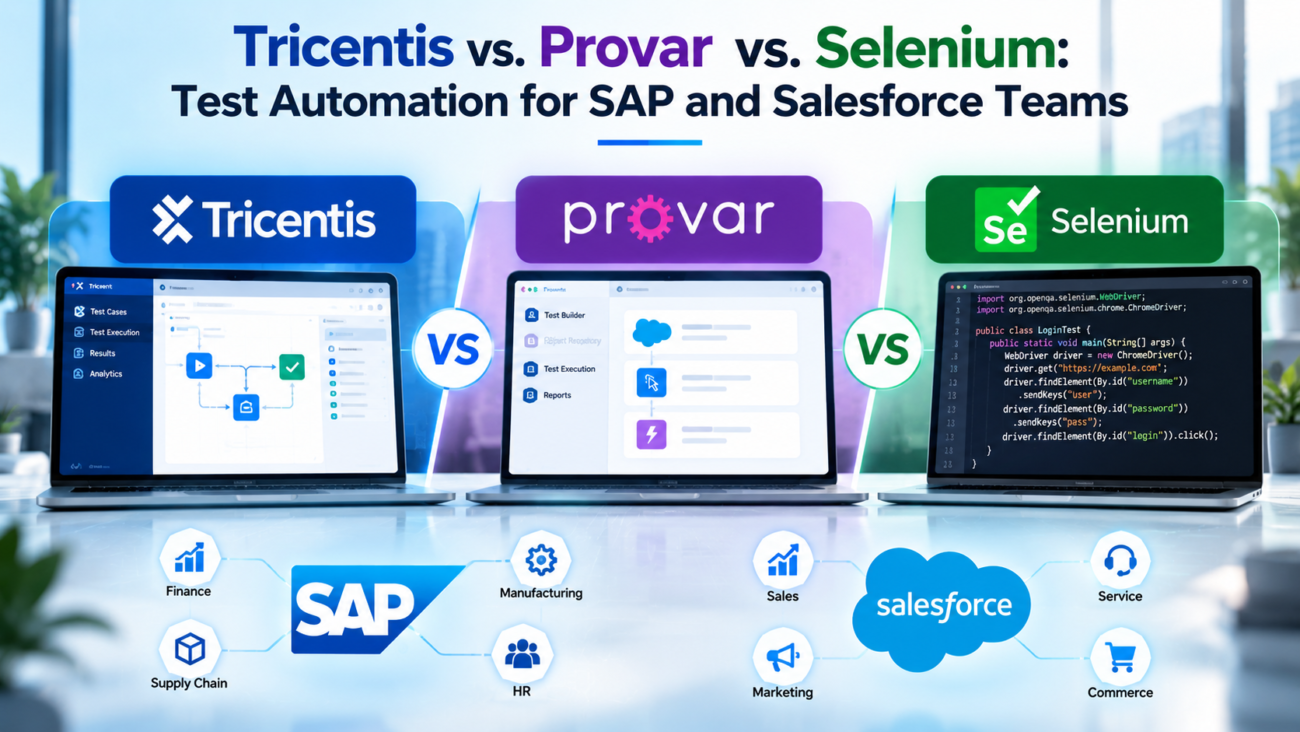
SAP and Salesforce teams face a testing problem that generic browser automation rarely explains well. Both platforms change often, both generate complex interfaces, and both sit inside business processes that cross APIs, middleware, identity systems, and other applications. A tool that works for a simple web page can become expensive when it has to validate an S/4HANA order flow, a Salesforce Lightning journey, and the integration between them.
That is why the Tricentis vs Provar vs Selenium decision should start with platform fit. Tricentis is built for broad enterprise automation and has a close relationship with SAP. Provar is built around Salesforce and reduces dependence on raw page structure. Selenium gives engineers direct browser control but leaves framework design, locators, test data, reporting, and maintenance to the team.
The right choice depends on where the harder risk sits. A major S/4HANA program may value SAP process coverage and Cloud ALM integration. A Salesforce-heavy company may care more about Lightning changes, metadata, Flow, permissions, and seasonal releases. An engineering-led team may prefer Selenium because it fits code review and CI practices. This guide compares all 3 from the viewpoint of teams that operate SAP, Salesforce, or both.
TL;DR
• Choose Tricentis when SAP is a major part of the end-to-end process and the organization wants one enterprise test platform across multiple technologies.
• Choose Provar when Salesforce carries most of the regression burden and the team wants Salesforce-aware automation that reduces dependence on raw DOM locators.
• Choose Selenium when strong automation engineers want full control and can own the framework, locators, test data, CI execution, reporting, and maintenance.
• For mixed SAP and Salesforce estates, compare complete business journeys rather than isolated screens. The tool must prove that an order, case, quote, service request, or other critical process survives changes across both platforms.
• Run a proof of concept with real tests before committing. Measure build time, repair time after UI changes, execution stability, failure diagnosis, and the effort required to move tests through CI/CD.
The Decision In One View
The fastest way to frame Tricentis vs Provar vs Selenium is to ask which platform causes the most testing pain. Tricentis is the broadest for enterprise application coverage. Provar is the most Salesforce-focused. Selenium is the most open and code-driven. Those positions affect who can author tests, how much platform knowledge is built in, and who owns maintenance.
For SAP teams, Tricentis has a structural advantage because SAP supports direct integration between SAP Cloud ALM and Tricentis Test Automation for SAP. SAP explains that Cloud ALM can integrate SAP and third-party providers through its test automation API, which lets teams orchestrate automated execution and monitor results from the ALM layer. That matters when evidence must stay tied to requirements and release work.
For Salesforce teams, Provar’s appeal is platform awareness. Salesforce explains in a Trailhead module produced with Provar that Lightning’s complex DOM, internal framework changes, Shadow DOM, and 3 annual releases create special automation problems. The same Salesforce testing module describes metadata-based automation as a way to reduce locator fragility. This is why Provar Salesforce testing often appeals to teams that have already felt the cost of raw Selenium locators.
Selenium is an open-source project with browser-automation tools and libraries. Selenium WebDriver provides an API for controlling browsers. Teams build their own test framework around it, choosing the language, test runner, page-object model, reporting stack, and CI setup. That freedom is valuable for strong automation engineers. It becomes a burden when functional testers are expected to maintain a large suite without dedicated engineering support.
| Decision Area | Tricentis Tosca | Provar | Selenium |
| Best fit | Cross-application enterprise testing with strong SAP needs | Salesforce-centered functional and regression testing | Engineering-led browser automation |
| SAP depth | Strong | Limited compared with Tricentis | Custom framework work required |
| Salesforce depth | Supported | Core focus | Supported through browser automation |
| Authoring model | Model-based and low-code/codeless patterns | Salesforce-aware low-code testing | Code-first |
| Maintenance ownership | Platform plus test design | Platform plus Salesforce test design | Internal engineering team |
| License model | Commercial | Commercial | Open source |
| Cross-system reach | Broad | Can test beyond Salesforce but Salesforce is the center | Broad for browser-driven flows |
What Each Tool Is Built To Do
A fair comparison starts by separating product purpose from marketing claims. Tricentis Tosca is designed for model-based enterprise test automation. Instead of treating every test as a hand-coded script, Tosca organizes reusable modules that represent application controls and actions. Tests then reference those modules. The goal is to reduce duplicated automation logic when a business process appears in many test cases.
Its strongest fit is a company with many packaged applications and a need to validate long processes across them. SAP confirms that its Cloud ALM test-management capabilities can work with Tricentis for automated end-to-end testing, and its current test management guidance describes automated test orchestration across SAP and non-SAP solutions. This makes Tricentis relevant when SAP test automation needs to sit inside a larger release and requirements process.
Provar is built around Salesforce. Its value is easiest to understand if you view Salesforce as a metadata platform rather than a normal website. Page layouts, objects, fields, permissions, Lightning components, record types, and declarative changes can alter what the user sees without a conventional front-end release. Provar Salesforce testing uses that platform context to build automation that is less tied to raw HTML structure than a basic Selenium implementation.
Selenium is an open-source browser-automation project, with WebDriver at its core. The W3C WebDriver standard defines a browser-control interface, and Selenium provides language bindings and browser drivers that use it. The WebDriver standard supports automation across major browsers without a vendor-specific application model. WebDriver understands browser interactions, but it has no built-in knowledge of SAP business processes or Salesforce metadata. Teams add that knowledge through the test framework they build.
This distinction is central to Tricentis vs Provar vs Selenium. The commercial tools try to package domain knowledge and test-management behavior into the product. Selenium gives you building blocks. A team with mature automation engineering may prefer those building blocks. A team under pressure to let functional testers create coverage may prefer a product that already understands more of the application layer.
SAP Testing: Where The Tools Differ
SAP testing is difficult because the browser is only one layer. A business process can cross Fiori apps, APIs, background jobs, integrations, authorization rules, master data, and custom extensions. A UI test can confirm that a user clicked through a transaction, but deeper failures need service or downstream checks.
Tricentis has the clearest position for SAP test automation among these 3 options. SAP lists Tricentis Test Automation for SAP as an automation provider that can be integrated with Cloud ALM. This gives teams a supported path to combine test execution with SAP ALM traceability rather than keeping automation evidence in a separate silo.
Commercial scope needs a clear distinction. Tricentis Tosca is a commercial enterprise test platform, while Tricentis Test Automation for SAP integrated with SAP Cloud ALM is a specific offering with SAP-defined usage rights. SAP’s usage rights page says its term license is granted with qualifying support offerings through December 31, 2028. The current entitlement includes 5 named users and 500 test runs per calendar month, along with other limits. Broader enterprise test coverage or higher capacity may require separate commercial entitlements. Check the exact contract before assuming SAP’s included offering covers the same scope as a separately licensed Tosca deployment.
SAP also has native automation for S/4HANA Cloud Public Edition. Its automation tool FAQ explains that the built-in Test Automation Tool can create custom processes, manage plans, analyze results, and support post-upgrade regression. That changes the selection scope because some SAP-only tests may stay native while a broader platform covers cross-system journeys.
Selenium can automate Fiori and other browser interfaces when controls can be located reliably. The team still has to design abstractions, synchronization, test data, credentials, reporting, and non-UI checks. That can work for a narrow browser scope with strong engineers. It becomes harder when SAP test automation spans many SAP technologies and functional testers must maintain the suite.
Provar can participate in journeys that touch SAP, but SAP is not its design center. If S/4HANA and other SAP applications drive most regression risk, the Tricentis vs Provar vs Selenium proof of concept should test Tricentis first against the hardest SAP flows. Provar becomes more interesting when Salesforce owns the journey and SAP is downstream.
Salesforce Testing: Where The Tools Differ
Salesforce UI automation has a weakness that often decides Tricentis vs Provar vs Selenium: the DOM is not a stable contract. Salesforce warns that HTML, CSS, and DOM structure in Lightning Experience can change and that tests which reach into component internals require maintenance. Its DOM testing guidance says Selenium WebDriver should be used for end-to-end UI testing rather than component-level testing and explains the extra difficulty created by Shadow DOM.
Many homegrown Selenium suites begin with CSS selectors or XPath expressions tied closely to today’s rendered page. A disciplined framework can reduce that risk through page objects, APIs for setup, and Salesforce’s UTAM model, but the team has to build and maintain those layers.
Salesforce created UI Test Automation Model, or UTAM, to separate tests from page structure through reusable page objects. The UTAM overview explains that page objects are authored in JSON and compiled into Java or JavaScript classes. This gives Salesforce test automation teams a stronger Selenium architecture than direct DOM scripting while keeping an open-source approach.
Provar takes a productized route. Provar Salesforce testing centers on Salesforce metadata and platform concepts, which can reduce custom locator work for common Salesforce screens. That is useful for admins and QA analysts who understand objects, layouts, flows, and permissions but do not want to own a Java or JavaScript framework.
Tricentis supports Salesforce within a wider enterprise test estate. That can fit a quote-to-cash process that starts in Salesforce, crosses middleware, and ends in SAP. Tricentis can keep both sides on one platform, while Provar provides deeper Salesforce specialization.
Salesforce’s current release schedule FAQ says seasonal releases arrive 3 times a year and sandbox preview provides about 4 to 5 weeks of early access. This cadence makes maintenance a recurring operating cost. The best Salesforce test automation option is the one your team can repair and rerun inside that preview window.
Cross-System End-To-End Testing
Most enterprise defects cross application boundaries. A Salesforce opportunity may become an SAP sales order. A service case may trigger entitlement logic, inventory checks, or billing. Testing only one screen can leave the business failure undetected.
Tricentis usually has its strongest argument here. Its model-based approach is built for tests that move across technologies and interfaces. Teams that already use Tricentis for SAP can extend the same process model into Salesforce and surrounding systems rather than maintain separate frameworks with separate evidence.
Provar can also test end-to-end flows, especially when Salesforce remains the anchor. If the test starts in Salesforce, uses Salesforce data, then checks an external web app or API, Provar Salesforce testing can still fit. If half the journey is SAP-specific and the rest spans several non-Salesforce systems, that specialization matters less.
Selenium can automate browser-accessible parts of the journey, but it does not automatically provide orchestration across APIs, queues, batch jobs, or desktop clients. Engineers can add REST clients, database libraries, message checks, and custom helpers, which turns the test framework into a software product that the company must own.
For mixed estates, define 10 to 20 end-to-end journeys before selecting a tool. Record every system, control point, expected data state, and evidence requirement. If a tool needs a second framework for half the checkpoints, include that cost. Tricentis vs Provar vs Selenium should be decided against full journeys rather than isolated login or create-record scripts.
Maintenance After SAP And Salesforce Releases
In Tricentis vs Provar vs Selenium, automation value disappears when teams spend most of the sprint repairing tests that failed for technical reasons. Maintenance should therefore be measured as a first-class selection criterion. Count how many test failures come from real application defects versus locator changes, timing issues, test-data drift, expired credentials, browser changes, or environment differences.
Salesforce recommends treating UI structure as unstable. Its testing documentation explains that Lightning Web Components use Shadow DOM and that tests which depend on internal markup can be fragile. For teams that stay with Selenium, Salesforce provides packaged UTAM objects for supported Salesforce interfaces and examples for using them. This can reduce direct dependency on internal markup, though the engineering team still owns the framework and version alignment.
Provar Salesforce testing is attractive when the current pain is repeated repair after Salesforce changes. Its platform-aware model aims to identify Salesforce elements using metadata and application context rather than relying only on raw browser locators. That can reduce some maintenance, but teams should test their own custom LWCs, managed packages, CPQ screens, OmniStudio components, and heavily customized flows rather than assuming standard-screen behavior applies everywhere.
SAP has a similar problem at a different layer. Quarterly cloud updates, S/4HANA changes, Fiori revisions, and custom extensions can alter test behavior. Tricentis Tosca is designed around reusable modules so a change to one application object can be updated centrally instead of repaired in every test case that references it. The benefit depends on disciplined model design. A poorly structured Tosca repository can still become hard to maintain.
A useful proof-of-concept metric is repair time. Build the same critical flow in all shortlisted tools, then deliberately change a field position, label, component, or test-data condition. Measure how long it takes a different tester to understand the failure and restore the test. For Tricentis vs Provar vs Selenium, this maintenance exercise often reveals more than initial authoring speed.
Authoring Model And Team Skills
For Tricentis vs Provar vs Selenium, tool fit changes with the people who write tests. A center of excellence staffed by automation engineers can be productive with code. A distributed QA group with functional SAP and Salesforce test automation knowledge may need visual authoring. A hybrid team may use specialists to create reusable components while analysts assemble business tests.
Tricentis uses a model-based approach that separates reusable application modules from business test cases. Testers can build flows from existing components without conventional scripts. The repository still needs governance because weak naming and duplicate modules can make low-code automation hard to maintain.
Provar is aimed at Salesforce QA work where authors understand the platform but may not be full-time developers. Provar Salesforce testing can fit Salesforce admins, business analysts, manual testers moving into automation, and QA engineers. Technical skills still matter for APIs, data setup, CI configuration, and unusual custom components.
Selenium requires explicit software engineering. Teams choose a language, runner, assertion library, page-object pattern, logging, parallel execution, and reporting stack. That control is useful, but new testers must understand the framework before extending it safely.
Salesforce recommends Jest for LWC component tests because they run quickly and isolate component behavior without a live org or browser. A mature Salesforce test automation strategy should keep that fast lower-level coverage and reserve UI automation for workflows that need a browser.
The same rule applies to SAP. Do not make SAP test automation prove every rule through a long UI flow when a service-level test can catch the defect earlier. The selected platform should support the test layers your team can maintain.
CI/CD, Execution, And Governance
The Tricentis vs Provar vs Selenium choice also has to work unattended. That means governed repositories, repeatable environments, command-line or API execution, parallel capacity, result export, failure evidence, and release-pipeline integration. The useful question is how your pipeline calls the tool and what happens when a test fails unattended.
Salesforce is bringing more test providers into its DevOps model. Salesforce Help says DevOps Testing can integrate partner providers including Provar Automation alongside Salesforce testing services. This gives Salesforce test automation teams another way to connect external results to release work.
Tricentis has a similar advantage on the SAP side through Cloud ALM. Teams can keep test orchestration and execution status tied to implementation or operations work while Tricentis Tosca handles automation. This helps when release evidence must be reviewed by people outside the automation team.
Selenium fits almost any CI service because it is code, but execution architecture is your responsibility. Teams manage browsers, runners, secrets, parallelism, screenshots, logs, reports, and environment configuration. A mature DevOps team may already have this infrastructure.
Governance should cover naming, review rules, test-data ownership, environment access, quarantine rules for flaky tests, retirement criteria, and evidence retention. The winning option should support those controls with the people you actually have.
Cost And Total Ownership
Selenium is open source, but open source does not mean zero cost. The company still pays for engineers, test runners, browser infrastructure, reporting, framework maintenance, test-data utilities, and troubleshooting. For a large suite, those internal costs can exceed license savings.
Tricentis and Provar are commercial products, and public price points are a poor basis for enterprise comparison because packaging, capacity, support, and negotiated terms vary. Ask both vendors to price the same scope, including authoring users, parallel execution, non-production environments, API testing, reporting, and support.
For SAP customers, existing entitlements can affect SAP test automation economics. SAP’s current Tricentis usage rights can provide a limited footprint for qualifying support customers. Compare those limits with peak regression demand because a large suite with multiple browsers and data variants can consume run capacity quickly.
For Salesforce-heavy teams, the cost case for Provar Salesforce testing often rests on maintenance and contributor mix. A commercial license may still cost less overall if functional testers can create stable tests and fewer engineers are needed to repair them after releases. Test that assumption in your own org.
Build a 3-year model for Tricentis vs Provar vs Selenium. Include setup, training, migration, licenses, execution infrastructure, engineering labor, platform updates, regular maintenance, and support. Then model what happens when the suite doubles.
Security, Test Data, And Environment Control
Security can change the Tricentis vs Provar vs Selenium result because enterprise automation often needs powerful access. Test users may create orders, change account data, trigger integrations, or impersonate business roles. Treat automation identities as service accounts even in lower environments. Use least privilege, managed secrets, rotation, and clear ownership.
Salesforce test design should separate UI regression from native platform tests. Salesforce requires unit tests for Apex deployments, and current Apex testing guidance says deployed Apex needs at least 75% code coverage and all triggers need some coverage. Browser automation does not replace this. It should verify journeys, permissions, and cross-system outcomes.
Flow testing is another layer. Salesforce documents automated Flow testing with assertions and isolated data for supported scenarios. Use native Flow tests where they fit so Salesforce test automation at the UI layer stays focused on end-to-end risk.
SAP teams need the same discipline. Keep reusable test data, business roles, and integration credentials under explicit ownership. If tests create purchase orders, deliveries, invoices, or master data, define cleanup or reset behavior. SAP test automation becomes unreliable when tests share mutable records or depend on yesterday’s state.
The tools package these controls differently, but none removes the need for data design. Tricentis Tosca can centralize reusable components and data patterns. Provar can work with Salesforce-specific data and personas. Selenium can call APIs or utilities your engineers build.
How To Choose By Team Scenario
A single ranking would be misleading because the strongest option changes with the estate. Use scenarios to narrow the field before investing in a full proof of concept.
SAP-Led Transformation With Salesforce At The Edge
Choose Tricentis as the first candidate when S/4HANA transformation drives the program and Salesforce is one connected system. Tricentis Tosca can cover SAP processes while also extending into Salesforce and other applications. Cloud ALM integration gives the SAP program a supported orchestration path. Provar may still be useful for a separate Salesforce QA team, but running 2 enterprise tools needs a clear boundary.
Salesforce-Led Business With SAP Downstream
Start with Provar when the largest regression suite lives in Salesforce and most user-facing change comes from Sales Cloud, Service Cloud, Revenue processes, Flow, LWC, or managed packages. Provar Salesforce testing can reduce the amount of Salesforce-specific framework work. Validate the SAP portion of key journeys to make sure the same tool can provide enough evidence across the boundary.
Engineering-Led SaaS Or Digital Team
Start with Selenium when the organization already treats test automation as software engineering. Strong developers can build page objects, service clients, test-data APIs, containerized execution, and observability around the suite. Selenium is also attractive when avoiding commercial licenses is important and the team accepts ownership of long-term maintenance.
Shared SAP And Salesforce Center Of Excellence
Compare Tricentis and Provar directly against the top cross-platform journeys. If SAP and Salesforce carry equal business weight, Tricentis vs Provar vs Selenium may produce a split answer. Tricentis may own enterprise end-to-end coverage, while Provar handles deep Salesforce regression. That split is acceptable only if duplicate tests and duplicate maintenance are controlled.
Small Team With Limited Automation Engineering
A large Selenium framework is risky when nobody has time to own it. A commercial low-code tool may cost more in licenses but less in engineering and recovery time. Run a small pilot with the actual testers, not a vendor engineer, and see who can author and repair tests after a deliberate UI change.
A Practical Proof-Of-Concept Checklist
A proof of concept should measure daily work rather than demo features. Use real sandboxes and representative data. Give each tool the same scenarios and limit vendor help after setup so you can see what your team can operate alone.
For SAP, choose a process with real dependencies, such as sales order through delivery or purchase order through receipt. Make sure the SAP test automation case crosses an authorization boundary or integration point. For Salesforce test automation, use a Lightning flow with permissions, a custom component or Flow, and a downstream action. Include 1 journey that crosses both systems.
Measure authoring time, execution time, repair time, failure diagnosis, evidence quality, and pipeline setup. Change a locator or component. Rotate a credential. Break an API dependency. This shows how each tool behaves under conditions that resemble production support.
For Selenium, require a maintainable abstraction rather than a quick XPath demo. Salesforce has long explained why Lightning automation needs careful element strategies and why opaque implementation details complicate UI testing. If Selenium uses throwaway locators while commercial products use their intended models, the comparison is invalid.
For Provar, test custom Salesforce behavior and release-sensitive areas rather than only standard account screens. For Tricentis Tosca, change a shared module and measure how many tests require repair. For all 3, have someone other than the author diagnose a failed run.
Use a weighted scorecard after the pilot. Weight maintenance, SAP depth, Salesforce depth, cross-system reach, authoring skills, CI/CD fit, governance, and 3-year cost. Tricentis vs Provar vs Selenium should have a winner only after those weights are agreed.
Conclusion
The right test platform is the one that reduces business risk without creating an automation system your team can’t maintain. Tricentis is usually the strongest starting point for SAP-heavy end-to-end estates. Provar is usually the strongest starting point when Salesforce-specific UI and metadata changes dominate the regression burden. Selenium is a strong choice when the company has automation engineers who want direct control and are prepared to own the framework.
For mixed SAP and Salesforce environments, avoid selecting on license price or initial script speed. Compare maintenance after platform changes, cross-system evidence, CI/CD operation, and support handoff. A tool that builds a test quickly but takes hours to diagnose after every release can be more expensive than a platform that requires more setup but produces stable reusable coverage.
The practical answer to Tricentis vs Provar vs Selenium may also be 2 tools with different jobs. If that happens, write the boundary down. Decide which platform owns SAP regression, which owns Salesforce regression, where shared end-to-end journeys live, and how duplicate coverage will be prevented. Clear ownership matters more than forcing every application into one tool.
FAQs
Is Tricentis Better Than Provar For SAP Testing?
Tricentis is usually the stronger SAP fit because SAP provides direct integration paths between Tricentis Test Automation for SAP and SAP Cloud ALM. Provar is centered on Salesforce. For a mainly S/4HANA regression estate, evaluate Tricentis first.
Is Provar Better Than Selenium For Salesforce Testing?
Provar can be easier to maintain for Salesforce-heavy teams because it understands Salesforce concepts and metadata. Selenium gives more control but requires engineering around locators, page objects, data, execution, and reporting.
Can Selenium Test SAP Fiori Applications?
Yes. Selenium can automate browser-based SAP Fiori interfaces through WebDriver. Teams still need stable locators, synchronization, data setup, reporting, and non-UI validation around those tests.
Can Tricentis Test Salesforce?
Yes. Tricentis supports Salesforce as part of its wider enterprise application coverage. This can help when one process spans Salesforce, SAP, and other systems.
Can Provar Test Systems Outside Salesforce?
Provar can participate in end-to-end testing that reaches connected applications and APIs, but Salesforce remains its main design center. If most regression scope sits elsewhere, compare it with a broader enterprise platform.
Is Selenium Really Free For Enterprise Teams?
The software is open source, so there is no license fee. The enterprise still pays for framework development, engineers, CI runners, browser infrastructure, reporting, test data, and maintenance.
Which Tool Requires The Least Coding?
Tricentis and Provar both provide low-code or codeless authoring patterns for many functional tests. Selenium is code-first and normally requires developers or experienced automation engineers.
Which Tool Is Best For Salesforce Lightning?
Provar is a strong first candidate when Lightning regression is the main problem. Tricentis also supports Salesforce. Selenium can work well with disciplined page objects or Salesforce UTAM when engineers maintain the framework.
Which Tool Is Best For S/4HANA Programs?
Tricentis should usually be evaluated first for large S/4HANA programs because of SAP coverage and Cloud ALM integration. Selenium can fit browser-focused technical teams. Provar matters more when Salesforce owns most business-facing regression.
Do These Tools Replace Apex Unit Tests?
No. Salesforce production deployments still require Apex unit testing and code-coverage rules. UI automation checks user journeys and cross-system behavior, while Apex tests verify server-side code.
Should Salesforce Teams Use UTAM With Selenium?
UTAM is worth evaluating because Salesforce created it to reduce direct dependence on Lightning page structure. The team still owns the surrounding framework, CI execution, data, and reporting.
How Should We Test Salesforce Seasonal Releases?
Use sandbox preview time to run critical regression before production is upgraded. Prioritize business flows, custom Lightning components, permissions, integrations, and managed packages.
How Should We Test SAP Cloud Updates?
Maintain a regression set for critical business processes and custom extensions, then run it in the relevant test environment before production change. Keep evidence tied to the release and investigate failures early.
Can A Company Use Tricentis And Provar Together?
Yes. Tricentis can cover SAP and wider enterprise journeys while Provar handles deep Salesforce regression. The model needs explicit ownership so duplicate coverage stays controlled.
What Should Decide The Final Tool Choice?
Use a proof of concept with your own SAP and Salesforce flows. Measure maintenance, authoring effort, failure diagnosis, CI/CD fit, cross-system coverage, governance, and total ownership cost.
