
SAP systems rarely stay standard forever. A finance team needs an approval step that isn’t delivered out of the box. A field service group needs a mobile process. A manufacturer wants to combine SAP S/4HANA data with information from a supplier portal. For years, the normal answer was often custom code inside the ERP system. That approach solved immediate needs, but it also tied custom logic to the core application’s release cycle.
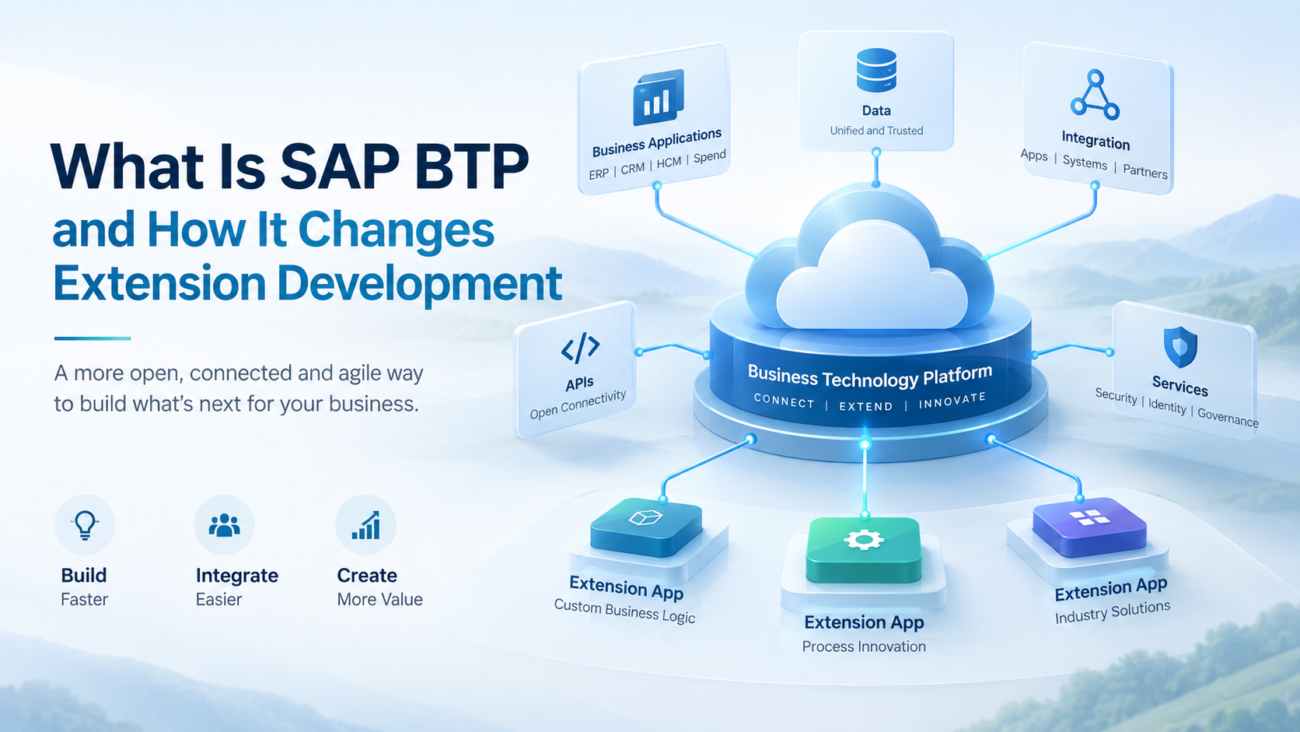
SAP Business Technology Platform changes that design question. It gives SAP teams a platform for building applications, connecting systems, automating business processes, working with data, and adding AI-supported functions without putting every requirement inside the ERP core. The important change is architectural: teams can decide which logic belongs close to SAP S/4HANA and which logic should live outside it with a controlled interface between the 2.
For enterprises planning S/4HANA work, SAP BTP extension development is now part of the broader discussion about clean core design, released APIs, cloud runtimes, and application lifecycle management.
TL;DR
SAP Business Technology Platform is SAP’s platform for application development, process automation, integration, data and analytics, and AI-related services. Its role in extension development is to give teams an external place to build functions that don’t need to run inside the SAP S/4HANA application stack.
The result is a different SAP extension architecture. Simple field or UI changes can stay in-app. Business logic that must run close to S/4HANA can use on-stack developer extensibility with ABAP Cloud. Loosely coupled applications, cross-system workflows, partner-facing apps, and event-driven processes can use the side-by-side model on BTP. This separation supports upgrade-stable design goals because extensions can follow their own lifecycle while SAP applications continue to receive updates with fewer custom-code dependencies.
What SAP BTP Is
SAP Business Technology Platform is a portfolio of cloud services rather than a single runtime or development language. SAP’s current product material groups application development, process automation, integration, data and analytics, and artificial intelligence under the platform. That broad scope matters because an extension may need more than code. It may need identity, connectivity, an event broker, workflow, an API layer, persistence, monitoring, or a user interface.
SAP places those capabilities in one platform context in its SAP Business Technology Platform overview, while the development team can still select only the services a use case requires. That distinction prevents a common design mistake: treating BTP as one large product that must be adopted all at once. An extension can be small and focused, such as a service that reacts to a business event, or it can be a larger application with its own data model and user experience.
Advayan frames BTP around development and integration on its SAP Business Technology Platform service page, which matches the way clients typically encounter it during SAP modernization work. The practical issue for architects is deciding where a requirement should run and which platform services support that decision, not collecting as many services as possible.
SAP Business Technology Platform also changes the boundary between ERP and custom software. Instead of assuming that a requirement belongs inside S/4HANA because it uses S/4HANA data, architects can ask whether the requirement needs local transactional behavior or simply needs governed access to an API, event, or replicated dataset. That question is the foundation of modern SAP extension architecture.
Why Extension Development Had to Change
Traditional SAP custom development grew around close access to ERP tables, transactions, user exits, BAdIs, and custom ABAP objects. In many landscapes, that code became part of the normal operating model. The problem appears during upgrades. A modification or an extension that depends on internal implementation details may need analysis, remediation, and regression testing whenever the underlying system changes.
S/4HANA and cloud ERP push teams toward clearer extension boundaries. SAP’s guidance for extending existing SAP solutions with BTP tells teams to keep the digital core focused, use the simplest extension method that fits, and confirm that suitable APIs or events exist before building an external application. Those points change the sequence of design. The team should classify the requirement before choosing a language or runtime.
This shift is also relevant during migration. Advayan’s material on S/4HANA brownfield implementation highlights custom-code assessment as part of readiness work. A brownfield move can preserve much of an existing system, but preserving every old customization by default can carry old coupling into the new landscape. Migration is therefore a useful point to ask which extensions should remain on-stack, which should be rebuilt using released objects, and which should move outward.
BTP-based extension work supports that change by giving loosely coupled requirements a place to live. It doesn’t remove the need for ABAP or local extensibility. It makes location an explicit architecture decision. That is a better model than treating custom development as a single bucket.
How SAP BTP Changes Extension Architecture
The biggest change is separation of lifecycle. A side-by-side application on BTP can be developed, deployed, monitored, and changed independently from the ERP release cycle. It still depends on the contracts it uses to communicate with SAP, but it doesn’t have to share the same application stack or deployment unit.
That separation creates a new set of design questions. Which system owns the data? Where should a validation run? Does the user need an SAP Fiori experience inside an existing business process, or is a separate application better? Can the extension tolerate an asynchronous event, or does it need a synchronous response before the SAP transaction can continue? These are SAP extension architecture questions, and they should be answered before technical build starts.
SAP Business Technology Platform supports this model with several runtime and service choices. A team can build cloud applications with Java or Node.js in Cloud Foundry, use ABAP in the ABAP environment, run containerized workloads in Kyma, or use SAP Build tools for low-code and code-first development. The platform also provides integration and connectivity services that let the external application interact with SAP and non-SAP systems through defined interfaces.
BTP sits beside S/4HANA in Advayan’s broader SAP implementation services, which reflects how extension design usually appears in practice. The extension isn’t an isolated technology project. It is part of process design, integration design, security, testing, and the operating model for the new SAP landscape.
The practical effect is that SAP BTP extension development can reduce unnecessary coupling when the requirement doesn’t need to live in the core. It also creates new responsibilities outside the core, including application security, logging, service consumption, transport design, and support. Moving code out of S/4HANA doesn’t make those responsibilities disappear. It moves them into a platform model that must be governed deliberately.
In-App, On-Stack, and Side-by-Side Extensibility
SAP extension architecture works best when teams distinguish the main extension patterns instead of selecting BTP by default. SAP’s Extension Architecture Guide describes on-stack and side-by-side options and points teams toward a use-case-led decision process. In practice, the boundary can be summarized like this:
| Extension pattern | Best fit | Typical examples | Main design concern |
| In-app or key-user extensibility | Small changes close to standard application behavior | Custom fields, UI adaptations, simple logic | Stay within released extension points |
| On-stack developer extensibility | Logic that needs close access to S/4HANA business objects or transactions | ABAP Cloud services, local validations, tightly related application logic | Use released APIs and ABAP Cloud rules |
| Side-by-side extensibility | Loosely coupled apps and cross-system processes | Partner apps, mobile apps, event handlers, cross-system workflows | Define stable remote APIs, events, identity, and ownership |
Side-by-side extensibility is useful when the extension has a different lifecycle, user group, or workload profile from the ERP core. A supplier application, for example, may need purchase-order data from S/4HANA but shouldn’t require suppliers to become ERP users. The application can run outside the core and call released APIs while the ERP remains the system of record.
On-stack development remains valid when latency, transaction consistency, or direct business-object behavior requires close execution. Clean core doesn’t mean forcing every requirement into BTP. It means choosing supported extension points and avoiding unnecessary dependency on internal objects. The right architecture may use more than one pattern in the same business process.
This is where upgrade stability becomes practical rather than ideological. The goal is to keep extensions upgrade-stable and understandable. A simple in-app field shouldn’t become a cloud project, and a large partner-facing process shouldn’t become a mass of ERP modifications simply because the source data sits in S/4HANA.
Core SAP BTP Services for Extensions
Integration is one core service area. SAP Integration Suite can connect SAP and third-party applications, expose and manage APIs, and support event-driven integration. For SAP BTP extension development, that integration layer can be more important than the application runtime because the extension must interact with authoritative systems without recreating their data and rules unnecessarily.
Supporting application services sit around the code. An extension may use destination handling, identity services, workflow or process automation, logging, document capabilities, or data services. The right service set depends on what the extension must do. A small event consumer and a multi-role business application shouldn’t have the same architecture simply because both run on BTP.
Cloud engineering concerns also appear in Advayan’s cloud application development services, including deployment and integration. For SAP teams, the additional requirement is to align those normal cloud engineering decisions with SAP’s released interfaces, business semantics, and lifecycle model.
Development Models, Runtimes, and Tooling
A good runtime choice starts with the team’s skills and the extension’s technical needs. Cloud Foundry is a common fit for Java and Node.js applications. Kyma is appropriate when a team needs Kubernetes patterns, containers, or cloud-native components. SAP BTP ABAP environment is relevant when ABAP skills and SAP business semantics are central to the solution but the application should run outside the S/4HANA stack.
For Node.js and Java development, SAP’s Cloud Application Programming Model guidance describes CAP as a framework of languages, libraries, and tools for enterprise services and applications. CAP gives developers conventions for domain models, services, authentication integration, and common application concerns. It can reduce the amount of plumbing a team writes around a business service while keeping the code in familiar JavaScript, TypeScript, or Java ecosystems.
ABAP teams can use the BTP ABAP environment with ABAP Cloud development rules and released objects. This can be useful for organizations that have deep ABAP capability and want to reuse that skill base while moving selected extensions away from the ERP core. The architecture still needs a remote integration boundary to the source system, so the move isn’t simply a lift-and-shift of tightly coupled classic code.
The platform also includes SAP Build products for application development and process automation. Low-code tools can be a good fit for forms, approvals, or departmental applications where the process is clear and the governance model is in place. Code-first tools remain important for complex domain logic, integrations, or performance-sensitive services.
The development environment should follow the architecture, not lead it. BTP extension work often goes wrong when a team chooses a favorite runtime first and then bends the requirement around it. Start with data ownership, transaction needs, user population, security boundary, and interface availability. The runtime decision becomes much easier after those facts are clear.
APIs, Events, and Integration Boundaries
A side-by-side extension is only as stable as its interface to the systems it extends. Remote APIs provide request-response interaction, while business events can support asynchronous processing. The choice affects coupling, failure handling, user expectations, and system load.
SAP Integration Suite is one option for managing this boundary. SAP’s Integration Suite overview describes support for application integration, API management, B2B scenarios, and event-driven integration across SAP and third-party landscapes. An extension may call S/4HANA directly through a released API, use an integration flow for mediation, or consume events when the process doesn’t require a synchronous call.
Events are especially useful when downstream work shouldn’t block the source transaction. Imagine that a sales order is created in S/4HANA and a separate application needs to perform an additional risk check or notify another platform. If the follow-on action can occur after the transaction commits, an event-driven design can reduce direct runtime dependency between the 2 applications.
APIs remain important when the extension must read current data or request a business action. External extension work shouldn’t become an excuse to copy large amounts of ERP data without a reason. The extension should retrieve, cache, replicate, or persist data according to a clear ownership model. If the external application becomes another uncontrolled master-data store, the architecture has replaced one form of technical debt with another.
Upgrade stability also depends on interface discipline. Released APIs and events form a supported contract. Internal tables or undocumented endpoints may be tempting when a required field is missing, but they raise upgrade risk. When the released interface doesn’t cover the use case, the team should revisit the design or create a governed API through supported extension mechanisms rather than bypassing the boundary.
Clean Core and Upgrade Stability
Clean core is an operating principle for keeping SAP applications and their extensions easier to update. It doesn’t mean a company must run SAP exactly as delivered. It means custom behavior should use supported extension models, released interfaces, and controlled dependencies so that standard software can change without forcing large custom-code repair efforts.
That principle is one reason side-by-side extensibility matters. A separate application can evolve on its own schedule, and S/4HANA can evolve on its schedule, as long as the interface contract remains valid. The architecture reduces direct dependency on SAP’s internal implementation details. It also makes ownership clearer because the extension has its own codebase, deployment process, and operational controls.
Deployment choices shape the extension context as well. Advayan’s SAP cloud versus on-premise deployment article discusses how those choices affect cost, control, and modernization. Extension strategy sits inside the same decision. A cloud ERP program usually places more pressure on teams to use released extension points because the software lifecycle is more standardized and direct modifications are restricted.
SAP Business Technology Platform supports upgrade-stable core design by providing a place for external application logic, but the platform itself doesn’t guarantee good architecture. A BTP application can still be tightly coupled if it calls too many interfaces synchronously, duplicates business rules from S/4HANA, or depends on unstable endpoints. Core quality therefore has to be measured through dependency quality, not through the physical location of code alone.
A sound SAP extension architecture also requires an inventory. Teams should know which extensions exist, what business capability each one supports, which APIs or events it consumes, who owns it, and what happens if the interface changes. Without that catalog, custom code can become hard to govern even when it sits outside ERP.
A Practical SAP BTP Extension Architecture
Consider a manufacturer that wants suppliers to confirm delivery dates against purchase orders held in S/4HANA. The suppliers shouldn’t need direct ERP access, and the company wants a simple web application that can be changed independently from the ERP release cycle. This is a strong candidate for SAP BTP extension development because the user population, UI, and application lifecycle are separate from the core transaction system.
A practical design would keep S/4HANA as the owner of purchase orders. The BTP application would authenticate supplier users, retrieve only the purchase-order data they are allowed to see, and send confirmation changes back through a released API. If the company wants downstream teams to react to confirmation changes, the application could publish an event or call an integration flow rather than adding more logic to the original ERP transaction.
The architecture should also decide what data the extension persists. It may need its own application state, audit records, preferences, or cached reference data. It shouldn’t copy the full purchase-order model merely because storage is available. The boundary should preserve one clear source of truth for transactional data while allowing the extension to own information that genuinely belongs to its process.
This work belongs in the wider implementation plan. Advayan’s SAP implementation process and ROI article notes that integrations and custom development need dedicated build and test work. That principle applies directly here. The supplier extension should be tested as part of the end-to-end business process, including identity failures, unavailable APIs, duplicate submissions, and delayed downstream processing.
This external model also makes nonfunctional requirements visible. The team must define availability needs, expected transaction volume, recovery behavior, logging, retention, and support ownership. These details can be hidden when a small custom program lives inside ERP, but they become explicit when the function is an application in its own right. That visibility is useful because it forces the extension to be operated like software rather than treated as an incidental customization.
How to Build an Extension From Requirement to Production
A disciplined SAP extension architecture process starts with the business requirement and ends with an owned production service. The first step is to describe the use case without selecting technology. Define the user, the business event, the system of record, the expected outcome, and any timing or compliance constraints. This exposes whether the requirement is a simple adaptation or a separate application.
Next, classify the extension location. Use in-app tools when the need is small and supported there. Use on-stack developer extensibility when logic must run close to S/4HANA business objects or transactions. Use a side-by-side approach when the application benefits from its own lifecycle, serves users outside ERP, combines several systems, or needs platform services that don’t belong in the ERP core.
Then validate the interfaces. Confirm that the required released APIs, events, or extension points exist and that they expose the data and operations the use case needs. If the interface doesn’t support the design, resolve that gap before build. This check prevents late discovery that the external application can’t perform a critical business action through a supported contract.
After that, select the runtime and services. Choose CAP, ABAP Cloud, Kyma, or low-code tooling based on the technical requirements and team capability. Add only the platform services the use case needs. The extension build should result in a small, understandable service map rather than a catalogue of technologies with no clear purpose.
Build security and operations into the design. Define identity propagation, authorization, secrets, network routes, logging, monitoring, and incident ownership. Create automated tests for business logic and interfaces, then test the full process against realistic error conditions. Release through a controlled pipeline with separate development, test, and production environments where the risk justifies that structure.
Finally, govern the extension after go-live. Track dependencies, update libraries, watch service consumption, review access, and retest interfaces when source systems change. Advayan’s SAP services and support page describes ongoing work such as system maintenance, code review, and performance support. BTP applications need the same operating discipline, even though their tools and deployment model differ from classic SAP support.
Cost, Governance, Security, and Operations
SAP Business Technology Platform cost isn’t a single platform fee that can be estimated from the blog title alone. SAP supports consumption-based and subscription-based commercial models, and individual services have their own metrics and plans. Region, runtime memory, database size, message volume, user counts, and selected services can all affect the commercial picture.
Current commercial options are described in SAP’s BTP pricing information, including Pay-As-You-Go, SAP BTP Enterprise Agreement options, subscriptions for selected services, and free-tier access for eligible services. That structure means cost estimation should happen at service-plan level after the architecture is known. A rough estimate based only on “using BTP” is too vague to be useful.
Governance should start with account structure. Teams need rules for global accounts, directories, subaccounts, regions, entitlements, naming, and environment separation. They also need a service-approval process so projects don’t activate overlapping products without a reason. BTP extension work can spread quickly across departments if each team creates its own approach to identity, networking, and logging.
Security is shared across the platform and the extension. The application team must secure its own code, data, endpoints, roles, and secrets. The integration design must use least privilege and protect service-to-service communication. A side-by-side application can increase the attack surface because it adds interfaces and identities that must be managed outside the ERP boundary.
Operations need equal attention. Monitoring should cover application health, failed integrations, event backlogs, authentication problems, and consumption. The support team should know whether an incident belongs to the extension, the integration layer, BTP infrastructure, or the source SAP application. Without that ownership map, independent lifecycle becomes independent confusion.
When SAP BTP Is the Right Extension Choice
A useful decision test is to ask what would break if the extension were physically separated from the ERP system. If separation causes transaction or latency problems that the business can’t accept, keep the critical logic close to the core. If separation mainly requires a stable API and identity model, a BTP-based extension is likely a reasonable candidate.
The final decision should also consider operating maturity. Teams need people who can run cloud applications, control platform services, and support integrations. SAP extension architecture is an engineering discipline, not a migration slogan. The design should be understandable to the people who will own it after the project team leaves.
Conclusion
SAP Business Technology Platform changes extension development by giving SAP teams a credible place to build outside the ERP core. That shift makes extension location a design decision rather than an assumption. In-app changes, on-stack ABAP Cloud development, and side-by-side development each have a valid role when they match the business and technical need.
The long-term value comes from disciplined boundaries. Released APIs, event contracts, clear data ownership, and independent lifecycle management can reduce the upgrade burden that accumulated custom code often creates. A cleaner core is the result of those decisions working together, not a rule that every custom requirement must move to the cloud.
For organizations modernizing SAP landscapes, SAP BTP extension development should be planned alongside S/4HANA architecture, integration, security, and operations. Advayan’s broader SAP work reflects that connection between platform choices and implementation discipline. The best extension is the one that meets the business need while leaving the surrounding landscape easier to change later.
FAQs
What is SAP BTP in simple terms?
SAP Business Technology Platform is SAP’s cloud platform for building applications, connecting systems, automating processes, working with data, and using AI-related services. For extension teams, its main value is that custom applications can run outside the ERP core while still connecting to SAP systems through supported APIs, events, identity services, and integration tools. This gives architects another location for custom logic when a requirement doesn’t need to run directly inside SAP S/4HANA.
Is SAP BTP the same as SAP S/4HANA?
No. SAP S/4HANA is an ERP system that runs core business processes such as finance, procurement, sales, and manufacturing. SAP Business Technology Platform is a platform used to build, integrate, automate, and extend applications. The 2 are often used together. S/4HANA can remain the system of record while a BTP application provides a separate user experience or cross-system process through released interfaces.
What is SAP BTP extension development?
SAP BTP extension development is the practice of creating custom applications or services on BTP that extend SAP business processes without placing all custom logic inside the core SAP application. The extension can use APIs, events, integration services, identity, and cloud runtimes to work with S/4HANA or other SAP products. The approach is especially useful when the extension needs its own lifecycle or serves users outside the ERP system.
What does side-by-side extensibility mean in SAP?
Side-by-side extensibility means an extension runs outside the SAP S/4HANA application stack, commonly on BTP, and communicates with the core through remote APIs or events. The external application can have its own runtime and release cycle. It is a good fit for loosely coupled scenarios such as partner portals, mobile applications, cross-system workflows, or services that shouldn’t increase workload or custom-code dependency inside ERP.
How does SAP BTP support clean core?
SAP Business Technology Platform supports clean core by giving teams an external place for custom applications that don’t need to live inside S/4HANA. When those applications use released APIs and events, the ERP core has fewer direct custom-code dependencies. That can make upgrades easier to assess. The approach still requires good interface design and governance because poorly designed external applications can create their own form of coupling.
Does clean core mean SAP customers can’t customize S/4HANA?
No. Clean core allows extension, but it favors supported methods and stable interfaces. Simple adaptations can use key-user tools. Tightly related logic can use ABAP Cloud developer extensibility where supported. Loosely coupled functions can run through an external BTP extension. The aim is to avoid unnecessary modifications and dependence on internal objects that may change during upgrades.
When should a team use on-stack extensibility instead of BTP?
Use on-stack extensibility when the requirement needs close transactional behavior, low-latency access to local business objects, or an extension point that is designed to run inside S/4HANA. Examples include local validations or business logic tied closely to a transaction. The design should still use released objects and ABAP Cloud rules where applicable so the extension remains aligned with SAP’s current extension model.
Which runtimes can developers use on SAP BTP?
SAP Business Technology Platform supports several development environments. Cloud Foundry is used for polyglot cloud applications, including Java and Node.js. The ABAP environment supports ABAP Cloud development. Kyma provides a managed Kubernetes runtime for containerized workloads. SAP Build products cover low-code and code-first development scenarios. The right choice depends on the application architecture, skills, integration needs, and operating model.
What is CAP in SAP BTP development?
The SAP Cloud Application Programming Model, usually called CAP, is a framework for building enterprise services and applications with JavaScript, TypeScript, or Java-based tooling. It provides conventions for domain models and services and integrates with common BTP capabilities. CAP is often used for BTP extension projects when teams want a structured model for cloud services without writing every technical concern from the ground up.
Can SAP BTP extensions use ABAP?
Yes. SAP BTP ABAP environment allows teams to build cloud applications and extensions with ABAP under the ABAP Cloud development model. This is useful for organizations with strong ABAP skills or requirements that fit SAP business semantics. The application still runs outside the S/4HANA core, so its connection to ERP should use appropriate remote interfaces and a clear SAP extension architecture.
How do SAP BTP extensions connect to S/4HANA?
They typically connect through released remote APIs, events, destinations, connectivity services, or an integration layer such as SAP Integration Suite. The exact pattern depends on whether the application needs synchronous data access, asynchronous notification, or mediated integration across several systems. The external model should keep these interfaces explicit so both the extension and the source system can be managed independently.
Do SAP BTP extensions need their own database?
Not always. Some extensions can remain stateless and retrieve data from source systems when needed. Others need persistence for application-owned information such as preferences, process state, audit data, or cached reference data. The database decision should follow data ownership. A BTP application shouldn’t duplicate S/4HANA transactional data without a clear need and a defined consistency model.
How much does SAP BTP extension development cost?
There is no single fixed cost. Charges can depend on the commercial model and the services consumed, including runtime resources, databases, integration messages, or user-based services. Development and support effort also vary by scope. Teams should define the architecture first, map each required service to its plan and usage metric, then estimate build, test, security, and ongoing operating costs.
Is side-by-side extensibility always better than in-app extensibility?
No. The side-by-side model adds value when a requirement benefits from a separate lifecycle, user group, runtime, or cross-system design. A small field change or simple UI adaptation is often better handled with in-app tools. The best approach is the smallest supported extension method that meets the business requirement without creating unnecessary coupling or operating overhead.
What should an SAP BTP extension architecture review include?
A review should cover the business use case, extension location, data ownership, released APIs or events, identity and authorization, runtime choice, persistence, integration behavior, error handling, deployment, monitoring, cost, and support ownership. It should also test alignment with upgrade-stability goals and document dependencies. This gives future teams enough context to maintain the extension when SAP systems or BTP services change.
