
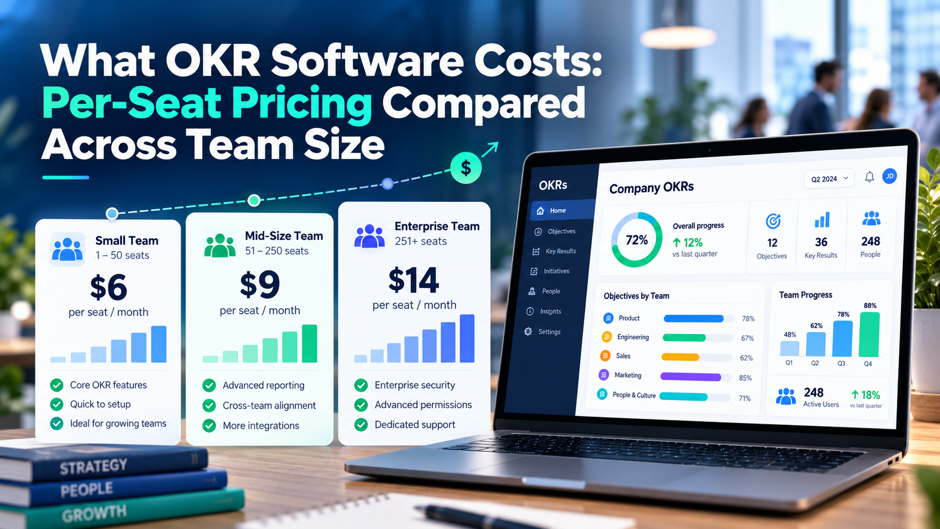
A finance leader approves an OKR software purchase after seeing a clean, advertised rate of $8 per user per month, multiplies that by the company’s 22 employees, and expects a bill somewhere around $2,100 a year. The invoice that actually arrives is closer to $4,000, because the vendor’s published per-seat rate only applies above a minimum seat count the company doesn’t meet, and the contract carries a flat annual minimum regardless of actual headcount. This gap between the advertised rate and the real bill is one of the most common, and most avoidable, surprises in OKR software procurement, and it happens specifically because per-seat pricing looks deceptively simple until team size, minimum contracts, and tier-gated features all interact at once.
Understanding what OKR software genuinely costs requires looking past the single number most vendors lead with on their pricing page, and comparing that number against how it actually behaves at a specific team size. This guide works through the real per-seat rates currently published across the market, the specific minimums and seat floors that change the actual math for smaller teams, and what a genuine cost comparison looks like at small, mid-size, and enterprise scale. The market itself has also shifted meaningfully in the past year, with a major platform retirement and a significant acquisition reshaping which vendors are even worth comparing, and that context matters directly for anyone evaluating options today.
TL;DR
| Team size band | What the pricing landscape looks like |
| Under 15 employees | Free tiers and low-seat-count plans exist, but minimum contract values often make the effective per-seat cost considerably higher than the advertised rate |
| 15 to 50 employees | The core competitive range for dedicated OKR platforms, with published rates typically between $7 and $15 per user per month |
| 50 to 200 employees | Volume-based declining rate cards become common, and modular pricing structures start meaningfully affecting total cost |
| 200 to 500 employees | Enterprise-tier features and integrations become relevant, with several major vendors shifting to custom, quote-only pricing |
| 500+ employees | Pricing is almost universally custom-quoted, with enterprise platforms built specifically around this scale |
The pattern across every row above points to the same underlying lesson: the advertised per-seat rate is a genuine starting point for comparison, but it consistently understates the real cost until it’s checked against the specific minimums, tier gates, and volume discounts that actually apply at a given organization’s team size.
Why the Advertised Rate Rarely Tells the Full Story
Before working through actual vendor pricing in genuine, careful, methodical detail, it’s worth pausing to understand the specific mechanisms that make OKR software pricing considerably less straightforward than a single, clean advertised number initially suggests to a first-time buyer evaluating the category for the very first time.
The Specific Gotchas Worth Watching For
The recurring pricing mechanisms that change the real cost away from the headline rate:
- Minimum annual contract values that apply regardless of actual headcount, meaning a small team can end up paying a considerably higher effective per-seat rate than the advertised number implies
- Entry-level tiers that exclude OKR or goal-setting functionality entirely, with the actual goals capability gated behind a higher-priced tier than the one most prominently advertised
- Modular pricing structures where OKR tracking is one add-on module among several, rather than included in a single flat rate
- Seat floors requiring a minimum number of paid licenses regardless of how few employees actually need access, effectively setting a cost floor well above what a very small team’s headcount alone would suggest
- Declining volume rate cards where the per-seat price drops meaningfully at higher headcounts, meaning the rate quoted for a 20-person team says little about what a 150-person team would actually pay per seat
Why Entry-Tier Feature Gating Specifically Trips Up Buyers
Several platforms market a low headline price that actually belongs to an engagement or general performance tier without genuine goal-setting or OKR functionality included, meaning a buyer comparing prices at face value can select a plan that doesn’t actually deliver the OKR capability they were shopping for in the first place. This specific pattern makes it essential to confirm exactly which tier includes genuine OKR functionality before comparing that tier’s price against a competitor’s entry rate.
Why Minimum Contract Values Disproportionately Affect Smaller Teams
A minimum annual contract value of several thousand dollars barely registers for a 200-person organization, since it’s likely below what per-seat pricing would produce anyway, but it can more than double the effective per-seat cost for a team of 15 or 20 people who’d otherwise fall well below that minimum under a purely linear, per-seat calculation.
The Core Pricing Models Across the Market
Understanding the specific structural models vendors use to price OKR software clarifies exactly why the exact same headline rate can produce meaningfully different real-world costs depending heavily on an organization’s actual, current team size and its own future growth trajectory as well, over an extended period of time.
The 4 Pricing Models in Use
| Pricing model | How it works | Where it’s most common |
| Flat per-user-per-month | A single, consistent rate multiplied directly by headcount | Smaller, dedicated OKR-focused platforms with straightforward pricing pages |
| Declining volume rate cards | The per-seat rate drops at defined headcount thresholds, rewarding larger teams with a lower marginal cost | Platforms explicitly built to scale from small teams into mid-market and enterprise accounts |
| Modular or add-on pricing | OKR functionality is priced as one module among several, layered on top of a base platform fee | Broader HR or performance management suites where OKRs are one feature among many |
| Custom, quote-only pricing | No published rate; pricing is negotiated directly based on headcount, features, and contract length | Enterprise-focused platforms built specifically for large, complex organizations |
Why Per-User Pricing Remains the Dominant Model Despite Its Complexity
Per-user-per-month pricing remains the most common approach across the category specifically because it scales in a way both vendors and buyers can reason about directly, even though the actual math gets considerably more complex once minimums, tier gates, and volume discounts all layer onto that basic per-seat structure. A straightforward illustration makes the underlying mechanics clear: a 200-person team paying a flat $10 per user per month lands at $24,000 annually, and every additional hire under this model adds a fixed, predictable increment, typically in the range of $96 to $120 per year per new seat, with no efficiency gained from scale unless the vendor specifically offers a declining rate card.
Why Custom Quote Pricing Becomes More Common Specifically at Enterprise Scale
Vendors targeting genuinely large organizations increasingly abandon published, self-service pricing entirely in favor of a custom quote process, reflecting the reality that enterprise deals typically involve considerably more complex integration requirements, security review processes, and multi-year contract negotiation than a straightforward per-seat calculation can capture on a public pricing page.
Actual Per-Seat Rates Currently Published Across the Market
With the underlying pricing models now genuinely understood at this particular point in the ongoing discussion, the table below compiles specific, currently published rates across the full range of vendors most commonly compared during genuine, real-world OKR software evaluations conducted by buyers today, across many organizations.
Published Entry Rates by Vendor
| Vendor | Published entry rate | Notes on what’s actually included |
| Synergita | Around $3 per user/month | One of the lowest published entry rates in the category |
| Tability | Around $4 to $6 per user/month | Positioned as a lightweight, AI-assisted tracking option |
| Weekdone | Roughly $7.20 to $10.80 per user/month depending on volume | Free tier available for very small teams, with a declining rate card at higher headcounts |
| Perdoo | Roughly $7 to $9 per user/month | Requires a minimum contract period and, per some vendor reporting, a minimum paid seat count |
| Profit.co | From around $7 per user/month | Positioned around extensive integration depth, with 400 or more supported integrations |
| Mooncamp | Roughly €7 to €10 per user/month | Published in euros; annual billing only |
| Peoplebox / Betterworks | Around $8 per user/month at entry | Betterworks’ fuller enterprise capability typically moves to custom pricing at scale |
| Lattice | $8 per seat/month specifically for the Goals & OKRs module | Full-featured Foundations tier runs closer to $13 per user/month; carries a minimum annual spend |
| 15Five | $11 per user/month for the tier that actually includes OKRs | A lower, roughly $4 tier exists but covers engagement features only, without goal-setting included |
| Asana | $24.99 per user/month for the tier including Goals | The lower-priced Starter tier does not include Goals functionality at all |
| WorkBoard | Estimated around $30 per user/month | Primarily quote-based in practice, reflecting its enterprise-scale positioning |
Why the Spread Between Vendors Is So Wide
The published entry rates above span roughly a tenfold range, from around $3 to $30 per user per month, reflecting genuinely different product positioning rather than simple price competition on an identical product. The lowest-priced options typically offer more basic, simpler OKR tracking, while the highest-priced options bundle considerably deeper enterprise integration, AI-driven insight, and strategy-execution capability that a smaller organization typically doesn’t need and wouldn’t fully use even if it purchased it.
Why Confirming Which Specific Tier Includes OKRs Matters More Than the Headline Number
As the table above makes clear, several vendors’ lowest advertised rate belongs to a tier that doesn’t actually include OKR or goal-setting functionality, meaning the genuinely comparable rate for evaluating actual OKR capability sits meaningfully higher than the first number a prospective buyer typically encounters on a vendor’s pricing page.
What a Small Team Actually Pays
Translating the published rates above into one concrete, genuinely worked example scenario for a small, growing organization reveals exactly how minimum contract values genuinely reshape the real, actual cost picture for a team of this particular size and current, specific stage of growth right now, today.
The Small-Team Scenario Worked Through
A team of 15 to 20 employees evaluating dedicated OKR platforms will typically encounter the following pattern:
- Several vendors’ advertised per-seat rate, applied directly to a headcount this size, would suggest an annual cost somewhere in the range of $1,500 to $3,500
- Multiple vendors specifically carry a minimum annual contract value, commonly cited around $4,000 for one major platform and around $6,000 for another, that applies regardless of how far below that figure the straightforward per-seat calculation would otherwise land
- This means the genuine effective per-seat cost for a small team can run considerably higher than the advertised rate once the applicable minimum is actually factored in
- Free tiers and low-seat-count options do exist specifically for teams in this range, though they typically cap functionality or user count at a level that a growing team will likely outgrow within a year or 2
Why Small Teams Should Specifically Ask About Minimums Before Comparing Rates
A small organization comparing 2 vendors purely on advertised per-seat rate risks selecting the option that looks cheaper on paper while actually carrying a higher effective cost once a minimum contract value gets applied, making it essential to ask directly about any minimum annual spend before finalizing a comparison based on the headline number alone.
What a Mid-Size Team Actually Pays
Moving up to a mid-size organization changes the underlying calculation quite meaningfully and noticeably, since team sizes in this particular range typically clear most published minimums outright and start to genuinely benefit from any volume-based rate structure a given vendor happens to offer at this specific stage of growth.
The Mid-Size Scenario Worked Through
An organization in the 50 to 150 employee range evaluating dedicated OKR platforms will typically encounter the following pattern:
- At this headcount, straightforward per-seat pricing typically produces an annual cost comfortably above most vendors’ minimum contract thresholds, meaning the advertised rate becomes a considerably more reliable predictor of the actual bill
- Vendors offering declining volume rate cards begin delivering genuine savings at this scale, with the per-seat rate often dropping meaningfully once headcount crosses a specific published threshold
- Modular pricing structures become more consequential at this size, since adding a second or third module, engagement tracking alongside core OKRs, for instance, multiplies the added cost across a considerably larger headcount than it would at a smaller organization
- This is also the range where several dedicated OKR platforms specifically position themselves as the strongest fit, reflecting a genuine product-market alignment between mid-market team complexity and these platforms’ core feature depth
Why This Range Represents the Most Genuinely Competitive Part of the Market
The 50 to 150 employee range is where the largest number of dedicated, purpose-built OKR platforms actively compete for business, producing the most genuinely comparable, apples-to-apples pricing landscape across the entire category, compared to either the minimum-contract-distorted small-team range below it or the custom-quote-dominated enterprise range considerably above it.
What a Large or Enterprise Team Actually Pays
At the largest end of the entire team size spectrum, the pricing conversation shifts considerably and quite dramatically away from published, self-service rates and toward genuinely negotiated, custom enterprise contracts instead, tailored specifically to each individual deal and buyer involved in the overall procurement process from start to finish.
The Enterprise Scenario Worked Through
An organization above roughly 500 employees evaluating enterprise-grade OKR and strategy execution platforms will typically encounter the following pattern:
- Published, self-service pricing largely disappears at this scale, replaced by a custom quote process that accounts for the organization’s specific integration requirements, security review needs, and desired contract length
- The platforms genuinely built for this scale offer considerably deeper capability than a mid-market tool, including AI-driven strategy execution features, deep integration with existing enterprise systems, and dedicated account management
- Per-seat costs at this tier, where estimable at all, tend to run meaningfully higher than mid-market rates, often in the range of $25 to $35 per user per month or beyond, reflecting the additional depth and dedicated support included
- Multi-year contract structures become considerably more common at this scale, trading some short-term pricing flexibility for negotiated rate stability over a longer commitment period
Why Enterprise Buyers Should Weight Total Cost of Ownership Over Sticker Price Alone
At this scale, the genuine cost comparison extends well beyond the quoted per-seat rate to include implementation timeline, integration complexity, and the internal resourcing required to actually roll the platform out across a large, complex organization, all of which can meaningfully affect total cost of ownership independent of the negotiated per-seat figure itself.
Seat Floors: The Other Minimum Worth Checking
Beyond minimum annual contract values already covered above in this guide, a separate but genuinely related mechanism worth understanding closely, the seat floor specifically, deserves its own explicit, dedicated attention when carefully comparing pricing across different, meaningfully varied team sizes and organizational growth stages more broadly.
What a Seat Floor Actually Means in Practice
| Concept | What it means | Why it matters |
| Minimum annual contract value | A flat dollar amount the organization pays regardless of actual per-seat math | Distorts the effective per-seat rate most heavily for very small teams |
| Seat floor | A minimum number of paid licenses the vendor requires, independent of actual headcount | Forces payment for seats the organization may not actually need or use |
| Combined effect | Both mechanisms can apply simultaneously on the same contract | Produces a real cost considerably higher than either mechanism alone would suggest |
Why Seat Floors Specifically Affect Very Small Teams Differently Than Contract Minimums Do
A seat floor requiring a minimum number of paid licenses, commonly somewhere between 3 and 10 seats depending on the specific vendor, functions differently from a flat dollar minimum: it specifically forces a small organization to pay for licenses beyond its actual current headcount, rather than simply setting a dollar floor the organization’s genuine per-seat spend must clear. A team of 6 people facing a 10-seat floor effectively pays for 4 unused licenses, inflating the genuine effective per-seat cost well beyond what the headcount alone would suggest, even before any separate dollar-based contract minimum gets applied on top of it.
Why Confirming Both Mechanisms Separately Matters Before Signing
Because seat floors and minimum contract values can apply simultaneously and independently on the same vendor agreement, a genuinely accurate cost comparison for a small team requires confirming both mechanisms explicitly, rather than assuming clearing one automatically means the other doesn’t apply. Vendors don’t always foreground either mechanism prominently on their public pricing page, making a direct question during the sales conversation the most reliable way to confirm the genuine, all-in cost before signing.
The Market Consolidation Reshaping Vendor Choice
Beyond pricing mechanics themselves already covered above throughout this entire guide, recent market consolidation directly affects which specific vendors are even genuinely worth including in a real, current comparison today, and understanding this specific context matters considerably before ever finalizing any genuine evaluation or purchasing decision.
The Specific Consolidation Worth Knowing About
The significant market changes that have reshaped the OKR software landscape recently:
- A major platform, previously bundled within a widely used productivity suite, was fully retired at the end of 2025 with no direct replacement offered, forcing its existing customers to actively migrate to a different vendor
- One of the category’s largest, most established platforms acquired a major competitor in 2025, consolidating 2 of the biggest names in strategy execution software into a single company and product roadmap
- The acquired platform’s capability is being folded into the acquiring company’s product, meaning organizations evaluating based on the acquired platform’s older, independent reviews are evaluating a product that’s actively being absorbed and changed
- This consolidation has meaningfully reduced the number of genuinely independent enterprise-scale options, concentrating more of the large-organization market share into fewer remaining vendors
Why This Consolidation Directly Affects Pricing Comparisons Today
Organizations currently comparing OKR software should specifically confirm whether a given vendor’s pricing and product roadmap reflect its current, post-consolidation state, since older comparison guides and reviews may reference a product that’s since been retired, absorbed into a different platform, or meaningfully changed in scope and pricing structure as a direct result of this recent market activity.
Matching Vendor Category to Actual Team Size and Use Case
Beyond raw pricing numbers alone, the specific vendor category most commonly recommended for a given team size genuinely reflects real, meaningful product-market fit that’s genuinely worth factoring directly into the overall, complete cost comparison being made by any prospective buyer evaluating the category today and going forward.
Common Recommendations by Organizational Profile
| Organization profile | Category typically recommended | Why this fit tends to work well |
| Under 15 employees, first-time OKR adoption | A low-cost, education-focused dedicated platform | These smaller platforms emphasize methodology guidance a first-time team genuinely needs, at a price point matched to limited early-stage budget |
| 30 to 80 person company scaling OKRs for the first time | A dedicated mid-market platform with strong methodology support | This range benefits most from a platform built specifically around teaching and reinforcing genuine OKR discipline, not just tracking numbers |
| Already running Jira or Asana for core work | The native goals feature within that existing tool | Avoids a separate integration entirely, capturing a meaningful share of the value with no additional vendor relationship required |
| OKRs as part of a broader HR transformation | An integrated HR suite with a genuine OKR module | Makes sense when OKRs are one piece of a considerably larger performance and engagement initiative, not a standalone tracking need |
| Already on Microsoft 365, needing a replacement for a retired platform | An enterprise-focused platform with strong Microsoft Teams integration | Directly addresses the migration need created by the recent platform retirement covered earlier in this guide |
Why Using an Already-Owned Tool’s Native Goals Feature Can Be the Most Cost-Effective Path
For an organization whose core work already lives inside a project management tool offering a native goals or objectives feature, adopting that native capability first, before evaluating a dedicated, separately priced OKR platform, often delivers a meaningful share of the value at effectively zero incremental cost, since the organization is likely already paying for that underlying tool regardless of whether it adopts formal OKRs.
Why Matching Category to Use Case Prevents a Common, Costly Mismatch
An organization that selects a dedicated OKR platform without first confirming whether its existing tools already offer adequate native functionality risks paying for genuinely redundant capability, while an organization with genuinely complex, cross-functional strategic initiatives that selects only a lightweight tracking tool risks quickly outgrowing that tool’s capability within a single budget cycle. Matching the vendor category deliberately to the organization’s actual profile, rather than defaulting to whichever platform appears first in a generic search, meaningfully improves the odds the eventual pricing comparison reflects a genuinely appropriate set of alternatives rather than an arbitrary one.
Common Mistakes When Comparing OKR Software Pricing
Beyond understanding the specific numbers and market context already covered throughout this entire guide, several recurring, genuinely predictable mistakes show up consistently among organizations evaluating OKR software pricing, and avoiding these specific mistakes meaningfully improves the odds of reaching an accurate, genuinely defensible cost comparison overall in the end.
Comparing headline rates without confirming which tier actually includes OKR functionality. As covered earlier, several vendors’ lowest advertised price belongs to a tier that excludes goal-setting entirely, making a direct headline-rate comparison genuinely misleading unless each vendor’s actual OKR-inclusive tier gets confirmed first.
Ignoring minimum contract values when evaluating options for a smaller team. A small organization that calculates cost purely through headcount times the advertised per-seat rate, without checking for an applicable minimum annual spend, risks a significant, unwelcome surprise once the actual invoice arrives.
Assuming a single vendor’s pricing structure applies uniformly across every team size. Given how meaningfully declining volume rate cards and custom enterprise quotes change the actual math at different headcounts, a cost comparison done at one team size doesn’t necessarily hold true if the organization’s headcount changes significantly within the contract period.
Overlooking modular add-on costs when comparing a suite platform against a dedicated OKR tool. A broader HR suite’s OKR module may carry a lower headline rate than a dedicated platform, but the total cost once other genuinely needed modules get added can end up exceeding the dedicated tool’s all-inclusive price.
Evaluating vendors based on outdated comparison content that predates recent market consolidation. Given the significant platform retirement and major acquisition covered earlier, relying on older pricing comparisons risks evaluating a product that no longer exists in its previously reviewed form, or comparing against a vendor that’s since been absorbed into a different company entirely.
FAQs
Is it ever worth paying above the market’s lowest published rate for OKR software specifically?
Yes, particularly for organizations needing deeper integration with existing enterprise systems, AI-driven insight into goal attainment risk, or dedicated strategy execution capability beyond basic OKR tracking, since the lowest-priced options in the category typically don’t include this depth of capability regardless of how attractively priced they appear on a comparison chart.
How much does adding OKR functionality typically increase the cost of a broader HR or performance management suite an organization already uses?
This varies by vendor, but modular pricing commonly adds somewhere in the range of $4 to $10 per user per month specifically for OKR or goals functionality layered onto an existing suite subscription, meaning the genuine incremental cost depends heavily on whether the organization already has other modules from that same vendor in place.
Should a growing company choose a vendor based on its current team size or its projected size a year or 2 out?
Projected future size deserves genuine weight in the decision, since a platform well-suited to a 20-person team may become considerably less cost-effective or capability-appropriate once that same organization reaches 100 or 200 employees, making it worth evaluating how a given vendor’s pricing and feature set actually scale rather than optimizing purely for the organization’s current headcount.
Are free OKR software tiers genuinely usable for a small team, or are they primarily marketing tools?
Several vendors specifically covered throughout this guide offer free tiers that remain genuinely usable rather than serving purely as a marketing gateway to a paid plan, though these free tiers typically cap either user count or feature depth at a level suited only to very small teams, meaning most organizations should expect to outgrow a free tier within their first year or 2 of genuine OKR adoption.
How should an organization factor in the recent market consolidation when choosing between remaining vendors?
Organizations should specifically favor vendors with a clear, currently stable product roadmap and confirmed continuity, rather than selecting based primarily on historical reputation or older reviews, since the recent platform retirement and major acquisition covered earlier demonstrate that even well-established, seemingly stable vendors in this category can meaningfully change or disappear with relatively short notice to existing customers.
Is it realistic to negotiate below a vendor’s published per-seat rate, or are these rates generally fixed?
Published self-service rates for smaller, dedicated OKR platforms are typically closer to fixed, though minimum contract values and specific feature inclusions sometimes carry some negotiation room, particularly for a multi-year commitment. At the enterprise, custom-quote tier, negotiation is expected and standard practice, meaning the initially quoted rate at that scale should rarely be treated as genuinely final without at least attempting a negotiation conversation.
How should an organization budget for OKR software cost increases as it grows from a small team into a mid-size company?
The most reliable approach involves modeling the total cost at both current headcount and a realistic projected headcount 2 to 3 years out, using the vendor’s published rate card if a declining volume structure exists, or confirming directly with the vendor how per-seat pricing is expected to evolve at higher headcounts if no public rate card covers that range. Organizations that budget only for current-year cost risk an unpleasant surprise once headcount growth pushes them into a different pricing tier or triggers a contract renegotiation the original budget never accounted for.
Does annual billing genuinely save meaningful money compared to monthly billing for OKR software specifically?
Most vendors in this category price meaningfully lower on annual commitments compared to month-to-month billing, and several dedicated platforms covered throughout this guide only offer annual or quarterly billing at all, without a genuine month-to-month option. Organizations confident in their OKR adoption plan, rather than still evaluating whether the broader OKR methodology itself will genuinely take hold internally, generally find the annual billing discount worth the reduced flexibility, while organizations still in an earlier evaluation phase may reasonably prioritize a vendor offering genuine monthly flexibility even at a modest price premium.
What’s the single most important question to ask a vendor’s sales team before comparing final pricing across options?
Asking directly and explicitly for the all-in annual cost at the organization’s actual current headcount, including any minimum contract value, seat floor, and required modules for genuine OKR functionality, produces a considerably more reliable comparison than relying on the headline per-seat rate alone, since this single question forces the vendor to surface every pricing mechanism covered throughout this guide in one consolidated answer rather than leaving the buyer to piece them together independently from a pricing page.
