
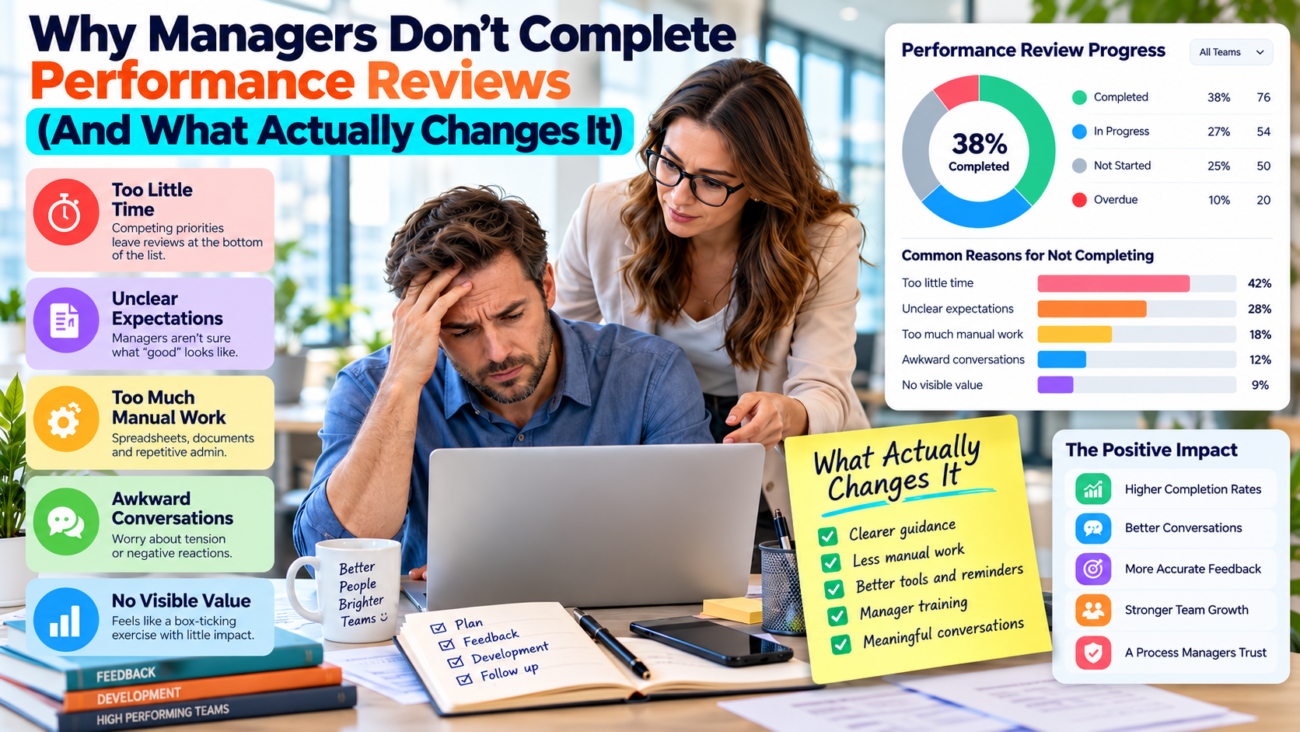
HR sends the third reminder on Thursday. Of 62 managers, 11 haven’t opened the review form, and several more have started with a rating and nothing else. The VP says to tell everyone the deadline is mandatory. The team did that already, and completion crossed 90% only after the deadline moved twice. Many of the reviews that came in at the end were 3 sentences long. Chasing harder produced a number on a dashboard, and it didn’t produce feedback anyone could use.
This guide separates the reasons managers skip reviews into 7 causes, shows what each sounds like and describes the fixes that have evidence behind them. The evidence mixes independent sources, such as Gallup, Gartner (as reported by SHRM) and CEB (as reported by Wharton), with vendor data from Lattice and PerformYard, which we label because it comes from customer bases and shows correlation. Hours and dollars in the examples are illustrative assumptions, so replace them with your own numbers.
TL;DR
- Skipped reviews trace to discomfort and time, and reminders fix only part of it. Gartner reports managers spend an average of 210 hours a year on performance management, per SHRM. Lattice says a clear schedule, reinforced by training and reminders, gets teams 50 to 75% of the way to full completion, so the last stretch needs structural changes.
- Make the review cheaper to write and costlier to skip. Move first drafts to the employee, protect writing time, use short guided templates and put each manager’s open-review list in front of their own boss. In the illustrative model, a 25% time cut for 60 managers is worth about $31,500 a cycle.
- Measure quality as well as completion. Track on-time rate, days late, hollow reviews and rating spread. A review submitted at 11:58 p.m. with 3 sentences counts as complete in most systems, and it tells the employee nothing about where they stand or what to do next.
What incomplete really means in your data
Incomplete comes in 3 forms, and each needs a different fix. A late review arrives after the deadline but has real content. A missing review never arrives, usually because the manager left the form open and the cycle closed around it. A hollow review arrives on time with a rating and 1 or 2 generic sentences. Most dashboards count the hollow review as a success, which hides the problem. Pull 20 submitted reviews from your last cycle and read them before you decide anything.
Scale shows why small percentages matter. Lattice reports a median completion rate of 89% across its customers, with the 75th percentile at 96%, based on its 2019 and 2020 customer data. If 60 managers each owe 8 reviews, that’s 480 reviews. At 89%, about 53 are outstanding, and at 96%, about 19 are. Each of those is a person waiting to hear about pay or promotion. Treat the vendor figures as a rough yardstick, since they come from a single vendor’s customers rather than a random sample.
Why managers skip reviews, in 7 causes
| Cause | What the manager says | What sits underneath | Fix that fits |
| Time pressure | “I’ll do it this weekend.” | The review competes with delivery work and has no protected time | Calendar holds and employee-prepared drafts |
| Conflict avoidance | “They already know how they’re doing.” | Fear of a hard conversation and of the reaction | Practice sessions and opening scripts |
| Rating anxiety | “I can’t decide between a 3 and a 4.” | Worry about pay consequences and challenges to fairness | Plain rating definitions, calibration before delivery |
| Weak records | “I can’t remember what happened in Q1.” | No notes through the year, so recent events dominate | Running notes and logged check-ins |
| Low perceived value | “Nothing happens with these.” | Reviews don’t visibly change pay or promotions | Link reviews to decisions and show the outcomes |
| Unclear expectations | “What does HR want me to write?” | Vague questions and no examples of good answers | Writing guidance and sample answers |
| No consequence | “HR will chase me anyway.” | Skipping carries no visible cost, and peers skip too | Visible status and skip-level accountability |
Why discomfort outweighs lack of time
Time is the reason managers give, and it’s partly true. Gartner’s Brian Kropp reports, per SHRM, that managers spend an average of 210 hours a year on performance management, and that the time it takes is their top frustration. That’s about 4 hours a week. The same managers still find time for urgent meetings and customer problems, which suggests the review loses the competition for reasons beyond the calendar. The work that gets postponed is usually the work that carries an emotional cost.
Conflict avoidance hides behind busy weeks. A manager who has to tell a solid performer they’re not ready for promotion, or tell a weak performer they’re falling short, faces a conversation with a real chance of tears or anger. Putting it off feels sensible each day. Appraisd’s list of manager objections includes “I don’t feel comfortable doing a performance review,” and its advice is to start with short, frequent conversations of 5 to 10 minutes so the formal review stops being the first hard talk.
Rating anxiety shows up in the data. Lattice’s internal research found that 1.3% of reviewers give the lowest score on numerical scales, compared with 10% on descriptive scales. The sample isn’t stated, so treat it as a hint instead of a finding. A plausible reading is that a number feels like a verdict and a described level feels like a description, which makes the lowest rating easier to give. Test that on a single team before changing your scale company-wide.
Weak memory makes the task heavy. A manager writing about a full year from memory spends more time and leans on the last 6 weeks. Running notes change that: a few lines after each check-in turn the review into editing and assembling. SHRM’s advice is to record performance conversations and feedback in the organization’s human capital management system, so the material is there when the cycle opens and the manager isn’t reconstructing the year.
Checks to diagnose your own cycle
- Read 20 submitted reviews from the last cycle. Pick them at random across departments and count how many contain a specific example and a clear next step. If fewer than half do, that’s a quality problem that completion rates will never show. Share the findings with the executive team, because reading actual text is more persuasive than any percentage. Mark each review as specific or generic, and keep the tally to compare with next cycle.
- Sort late reviews by manager. Check whether a few managers account for most of the delays. If they do, that’s a coaching problem that targeted support can fix. If lateness is spread evenly, that’s a process problem, such as a confusing form or a deadline that collides with another deadline. Share the pattern with the managers’ bosses in a private note, since they’ll know what else is competing for those managers’ time.
- Compare completion with span of control. PerformYard reports that each additional 5 direct reports is associated with roughly a 2% decline in eNPS, and the pattern is plausible for completion too, since a manager with 15 reviews faces double the work of a manager with 7. Check completion by span, then consider lighter formats for managers with the widest spans. Keep the check simple: a table of managers, their reviews due and their days late is enough to show whether span matters.
- Ask the managers who finished early what they did. Interview 3 to 5 of them. They often have habits others can copy, such as writing a paragraph after each 1:1 or booking a 90-minute block in the first week. Turn the best habits into a 1 page guide and share it with every manager before the next cycle. Credit the managers by name when you share their habits, because recognition raises the odds that others copy them.
- Run a 3-question pulse with the late managers. Ask what slowed them down and what would have helped most. Keep it anonymous and short, and group the answers by the 7 causes in the table above. The distribution tells you whether to spend your next budget on training, templates, tooling or accountability. Send the pulse within 2 days of the deadline, while the experience is fresh, and report the results back to the managers so they see that their answers led to changes.
Why more reminders stop working
Reminders have a ceiling. Lattice’s article on participation, drawing on People Ops leaders who reported 98% or higher completion, says a clear schedule, reinforced by training and reminders, gets teams 50 to 75% of the way to full completion. The remaining managers have a reason that an email can’t fix, such as dread or doubt that the review matters. Sending the fourth reminder in the same format as the first 3 adds noise, and managers start filtering it out.
What worked for the companies in that article was social and specific. Insight Data Science asked managers to raise unfinished reviews in their next 1:1 meeting, which the company found to be the most effective nudge. Policygenius set a team goal of 100% completion and posted daily participation updates in Slack to create friendly competition. Both approaches put the status in front of a person the manager respects. Treat these as practices from a single vendor’s customers, and test them on your own population.
The time math behind a review cycle
| Step | Assumption | Hours per manager |
| Write 8 reviews | 1.5 hours each | 12 |
| Read 8 self-reviews | 0.5 hours each | 4 |
| Hold 8 review conversations | 1 hour each | 8 |
| Calibration meetings | 4 hours per cycle | 4 |
| Admin and corrections | 2 hours per cycle | 2 |
| Total for a cycle | 30 | |
| Loaded cost per manager | 30 hours at $70 | $2,100 |
| Cost for 60 managers | 60 times $2,100 | $126,000 |
| Value of a 25% time cut | 7.5 hours per manager, 450 hours in total | $31,500 |
Every number above is an illustrative assumption, and it covers 1 annual cycle for managers with 8 direct reports. The 210 hours a year that Gartner reports covers all performance management activity, and the cycle is only part of it. At $70 an hour, 210 hours would cost $14,700 per manager. The point of the table is to give you a way to price a fix: if shorter forms and employee-prepared drafts cut a quarter of the time, the savings fund the redesign.
Design changes that make reviews easier to finish
Put the first draft on the employee. SHRM quotes consultant Dick Grote on delegating preparation: “Put that work on the employee.” A short self-summary with directed questions, such as “What are my priorities right now?”, gives the manager material to react to. The manager then edits, adds the rating and focuses the meeting on what matters. This change attacks the time cause and the memory cause together, and it costs little to try.
Keep forms short, and test the length. PerformYard’s report, based on anonymized data from more than 2,000 of its customers, found that forms with 15 to 20 questions had the highest completion rates and forms with 5 or fewer had the lowest. It also reports that 3 to 5 long-text questions were associated with 27% higher completion than 2 or fewer. Those are correlations from a single vendor. They suggest that a form too thin to guide the writer can stall people, so test length instead of assuming shorter is better.
Block the time. Lattice describes Button’s VP of People using a 6-week timeline with set windows for each review type. Calendar holds do the same job for individuals: HR sends a 90-minute writing block for each manager 2 weeks before the deadline and a second block 1 week before. A held slot on the calendar converts an intention into a plan, and managers who have a slot are more likely to start.
Define each rating in plain words. Write 1 or 2 sentences per level that describe what performance looks like in this company. Add an example for each level. Clear definitions reduce the hesitation behind rating anxiety, and they reduce the number of employees who challenge a rating. Pair the definitions with a calibration meeting before delivery, so a manager who gives a hard rating knows peers and HR have seen the evidence.
Accountability moves that work
- Show the open list to the manager’s own boss. Send each executive a weekly list of which of their managers have open reviews, with counts and dates. Executives rarely want to explain a late team to their peers, and a short list does more than a company-wide email. Keep the tone factual and offer help alongside the list, so the message reads as support instead of surveillance. Send it every Monday during the cycle, with the count and the names.
- Put people management in the manager’s own goals. Add a goal for timely, useful reviews to every manager’s objectives, and review it in the manager’s own cycle. The goal should name both timeliness and quality, such as a rating of useful from the employee. Confirm with your compensation team before tying it to pay, since a pure timeliness goal can reward hollow reviews. Review progress at the mid-year check-in, so the goal isn’t first discussed after the cycle has already run.
- Use the 1:1 as the nudge. Ask each manager’s boss to open the next 1:1 with a question about which reviews are still open and what’s blocking them. Insight Data Science found this the most effective nudge in the Lattice article. It works because it’s personal and specific, and it’s timed to a meeting the manager already attends, which makes it harder to ignore than a system email. Give the boss a 1 line script so the question is easy to ask.
- Make completion visible and friendly. Policygenius posted daily participation updates in Slack and set a team goal of 100% completion. A shared tracker by department turns a private chore into a public result. Keep it light and avoid shaming individuals, because a manager who feels humiliated will often submit something hollow just to disappear from the list. Share a few strong examples with permission and names removed, so the tracker shows quality alongside speed.
An escalation ladder you can run
| Timing | Action | Owner |
| 14 days before the deadline | Send a 1 page guide and 90-minute calendar holds | HR partner |
| 7 days before | Send each manager a status list of open reviews | HRIS admin |
| 3 days before | Ask in the 1:1: which reviews are open and what’s blocking them | Manager’s boss |
| Deadline day | Share completion by department with executives | HR lead |
| 2 days after | Offer a 30-minute working session with an HR partner | HR partner |
| 5 days after | Hold a skip-level conversation and agree a dated plan | Skip-level leader |
| 10 days after | Record the result in the manager’s people management goal | Executive sponsor |
The ladder is a template, and the timing is illustrative. What matters is that each step has a named owner, a specific action and a date. Managers should know the ladder before the cycle opens, so the escalation feels like an agreed process instead of a surprise. Keep the early steps supportive and the later steps firm, and document each step. If a manager still hasn’t finished after the last step, talk to your HR and legal team before taking any formal action.
Train managers on the conversation as well as the form
Gallup’s analysis lists manager training in how to hold these conversations as a factor that supports better performance management, along with frequent honest feedback so the formal review isn’t a surprise. That points to a gap in many programs: managers get a tool walkthrough and no practice with the hard talk. Run a 60-minute session where managers rehearse the first 2 minutes of a difficult review in pairs, then swap. Practice lowers dread more than reading a policy ever will.
Separate pay from performance where you can. Gallup recommends holding these topics in different conversations, and Appraisd warns that combining the review with a bonus or salary discussion makes it awkward and can surprise employees. A manager who knows the review will lead straight into a money conversation has more reason to avoid it. If your cycle ties pay to ratings, give managers a script for explaining the link, and let HR join the first few conversations.
What the software should do for managers
Give every manager a personal to-do list. The login page should show open reviews, due dates and the next action, with a single click to start. A manager who has to hunt for the form through 3 menus will postpone it. Ask your vendor to demonstrate the flow with a regular manager account, and time it. If it takes more than 2 minutes to reach the first open review, that friction will show up in your completion data.
Keep notes and check-ins in a single place. Notes taken after 1:1 meetings should feed the review form automatically, so the manager sees the year’s events when writing. SHRM recommends recording conversations and feedback in the human capital management system for this reason. Check that notes carry the date and the employee, that employees can add their own, and that access controls keep private notes private. Ask the vendor to show how a note moves from a 1:1 into the review form, step by step.
Use AI drafting carefully. Some systems draft a review from check-in notes, which can cut writing time. Treat the feature like any AI tool: test it on 20 real cases, check for generic text and invented facts, and require the manager to edit and own the final words. A draft that goes out unedited returns you to a hollow review with better grammar. Never let a system set the rating on its own.
Report on quality as well as status. Ask whether the system can flag reviews with very short text or identical text across employees. Those flags help HR coach managers early. Status alone will tell you who clicked submit, and it won’t tell you whether the employee got anything useful. Pair status reports with a monthly sample read of 10 reviews. Ask how the system treats flagged reviews and whether HR can see the flags without reading private notes. Agree who acts on each flag before the cycle opens.
What to stop doing
- Stop sending the same reminder every 2 days. Repeated identical messages train managers to ignore them. Change the message at each step, add a specific list and name who’s following up next. A reminder that arrives with a calendar hold and a 1 page guide is a different thing from a reminder that just repeats the deadline. Rotate the sender between HR and the manager’s own boss, since a message from a leader usually gets more attention than a system notice.
- Stop extending deadlines without a reason and a new date. Each quiet extension teaches managers that the deadline is a suggestion. If you must extend, publish the new date, explain why and keep the escalation ladder attached to it. Record how many extensions you granted in the cycle, since a rising count tells you the original schedule was unrealistic. Tell managers the rule before the cycle opens: extensions need a written reason and a date from the sponsor.
- Stop using long forms with many questions. PerformYard’s page names long review forms and too many long-text questions as causes of form fatigue. Review each question against a single test: will anyone read the answer and act on it? Cut every question that fails. The earlier finding about thin forms still applies, so cut to the questions that matter and leave the guiding ones. Run the question test with 3 managers and 3 employees before the next cycle opens.
- Stop surprising employees. Gallup says frequent, honest feedback means the formal review holds no news. If employees learn their rating for the first time in the review, the manager has a harder conversation and more reason to avoid it. Ask managers to name the review topics in a check-in 4 weeks earlier, and treat any big surprise as a sign the earlier conversation didn’t happen. Add a pulse question asking employees whether the review contained news, and track the answer over time.
Scorecard for the next cycle
| Measure | How to calculate | What it tells you |
| On-time completion rate | Reviews submitted by the deadline divided by reviews due | Whether the process works at the basic level |
| Median days late | Middle value of days past deadline for late reviews | How long employees wait for their feedback |
| Hollow review rate | Share of reviews with under 50 words or identical text across employees | Whether completion hides low effort |
| Rating spread | Share of ratings at each level, compared with prior cycles | Whether managers avoid the low end |
| Manager time per review | Self-reported hours in a short pulse | Whether the burden is falling |
| Gap to conversation | Days between submission and the review conversation | Whether the meeting actually happens |
| Employee usefulness score | Share who agree the review helps them improve | The outcome the whole cycle exists for |
| Surprise rate | Share of employees who learned something new in the review | Whether check-ins happen during the year |
Set your own targets in the first month, using last cycle as the baseline. Lattice’s median of 89% and its 75th percentile of 96% give a rough reference, and Gallup’s finding that only 14% of employees strongly agree their reviews inspire them to improve gives context for the usefulness score. A target for completion alone invites hollow reviews, so always pair the on-time rate with at least 1 quality measure and publish both together.
Does more frequent feedback fix this?
Gallup’s data suggests frequency matters. Managers who give weekly feedback, compared with annual feedback, have team members who are 5.2 times more likely to strongly agree they receive meaningful feedback, 3.2 times more likely to strongly agree they’re motivated to do outstanding work and 2.7 times more likely to be engaged. Gallup also reports that nearly half of employees get feedback from their manager a few times a year or less. A manager who talks to people weekly has less to write in the review and less to fear.
Dropping the annual review isn’t a clean answer. CEB’s survey, reported by Wharton, found that the share of Fortune 1000 firms eliminating annual reviews rose from 1% in 2011 to 12% in 2015, and that at those firms engagement and performance measures dropped by 10%. Gallup notes that early evidence on alternatives is limited. A safer path is to add short regular check-ins with notes and keep a lighter annual summary, then pilot the change with 1 or 2 teams before you roll it out.
Mistakes that keep completion low
Treating it as an HR chasing problem. If HR owns the follow-up alone, managers see completion as HR’s goal. Make the leaders of each function responsible for their teams, and give HR the role of support and reporting. The shift is visible in the ladder above, where executives and skip-level leaders carry the later steps. HR can’t hold a senior leader accountable on its own, and it shouldn’t have to.
Setting the deadline with no room for calibration. A deadline that lands the day before calibration forces managers to submit rushed text, and calibration meetings then change ratings that managers have already drafted. Work backward from the date employees receive results. Leave time for managers to write, 1 week for calibration and a few days for HR to review. A schedule that fits the whole chain removes the pressure that makes people cut corners.
Rewarding on-time hollow reviews. If the only measure is a timestamp, managers learn that 3 generic sentences at 11:58 p.m. are acceptable. Add a quality read to the process, and share a few strong examples, with permission and names removed, so managers see what good looks like. Recognize managers whose reviews employees rate as useful, as well as those who submit early. Track the hollow review rate for 2 cycles before you set a quality target, so the target rests on your data.
Changing everything at once. A new tool, a new form, a new scale and a new calendar in the same cycle makes it impossible to see what worked. Change the 2 or 3 things your diagnosis points to, run them for a cycle and measure. Keep a log of what you changed and what happened, since the next HR lead will want to know why the form looks the way it does.
FAQs
What’s a good completion rate for manager reviews?
Lattice reports a median of 89% and a 75th percentile of 96% across its customers, based on 2019 and 2020 data. That’s vendor data and doesn’t represent every company, so use it as a reference rather than a target. A sensible goal is 95% or higher on time, paired with a quality measure such as the hollow review rate. A high completion rate with low quality isn’t a success, so publish both numbers together.
Should review completion be part of manager bonuses?
It can be, and the design matters. A goal that rewards only timeliness invites hollow reviews, so pair it with a quality measure such as employee-rated usefulness. Many companies start with a people management goal in the manager’s own review and use it as a conversation point before tying it to pay. Check the plan with your compensation team and legal counsel, since pay changes can have contractual and fairness implications.
How long should a review take a manager?
The illustrative model in this guide uses about 3 hours per direct report, split as 1.5 to write, 0.5 to read the self-review and 1 for the conversation. PerformYard reports that reviews take 19% less time in a customer’s second year and 28% less by the third year, which is vendor data from its own customers. Treat your own baseline as the starting point, measure it with a short pulse and aim to cut it by about a quarter.
What should we do about a manager who never completes reviews?
Start with the diagnosis. Ask what’s blocking them, using the 7 causes as a guide, and offer a concrete fix such as a working session or a lighter format. If the pattern continues, follow the escalation ladder and make the expectation part of their goals. Document each step. Before any formal action, talk to HR leadership and legal counsel, because the right response depends on your policies and local employment law.
Do shorter forms always raise completion?
No. PerformYard’s data found forms with 15 to 20 questions had the highest completion and forms with 5 or fewer had the lowest, though the same report points to form fatigue from very long forms and says the pattern for goals is 10 to 15 questions. These are correlations from a single vendor. Test 2 or 3 lengths with different teams, and watch both completion and the quality of the answers.
Should we drop annual reviews altogether?
Be careful. CEB’s survey, reported by Wharton, found a 10% drop in engagement and performance measures at firms that eliminated annual reviews, and Gallup says the evidence on alternatives is limited. Gallup also says the exact system matters less than regular, constructive conversations. A sound middle path is frequent short check-ins with recorded notes and a lighter annual summary, piloted with a few teams before you commit. Run the pilot for a full cycle before you decide.
Can AI drafting help managers finish faster?
It can cut writing time when a system drafts from check-in notes, and it carries risks. Drafts can be generic or invent facts, and they can reflect bias in the notes. Test the feature on 20 real cases, require the manager to edit and own the final text and keep the rating decision with a human. Confirm how the vendor handles your data before you switch it on. Review the first 10 drafts with the managers who used the feature.
How do we handle managers with many direct reports?
Check completion by span of control first. PerformYard associates each additional 5 direct reports with roughly a 2% decline in eNPS, which is a correlation from a single vendor but a useful warning. Options include a lighter review format for wide spans, structured peer input to share the load, team leads who prepare the first draft or a smaller span. Pick the fix by looking at the hours in your own time model.
