
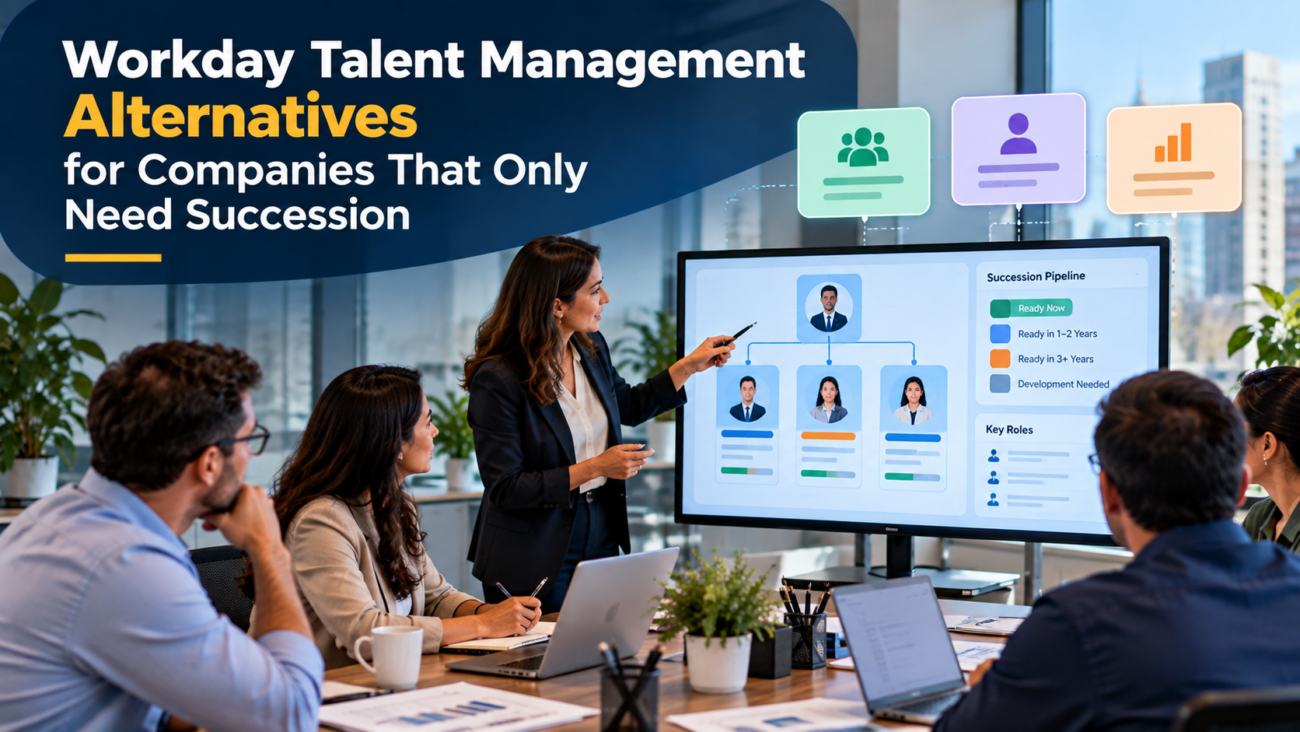
Many companies look at Workday for succession planning and find they’re being shown a much larger product. Workday’s talent tools are built for organizations that run their whole HR operation on one platform. That fits some buyers well. It fits poorly for a company that wants to plan successors for 30 critical roles and has no plans to replace its HR system.
This guide is for that second group. It explains why succession-only buyers look at Workday talent management alternatives, what a lean succession process actually needs and which types of succession planning software can deliver it. It covers HRIS integration, compliance for AI features and a step-by-step way to choose. It names 5 current alternatives by type without ranking them, because product features and packaging change often. The goal is to give you a clear way to judge any tool you’re shown.
TL;DR
Companies that only need succession planning often don’t need a full talent suite, and Workday talent management alternatives usually fall into 4 groups. Standalone succession tools focus on successor lists and readiness. Performance and talent platforms add succession features to a broader set of tools. The succession module in your current HRIS may cover basic needs at little extra cost. Spreadsheets with a reporting tool remain a fair baseline for small programs. The right choice depends on how many roles you plan for, how often you review successors and how well each option connects to the HR system you already use. Start with your process and your data, then judge each tool against them, so you don’t end up paying for a platform when you only needed a plan.
Why succession-only buyers look beyond Workday
Workday is one of the best-known HR platforms for large companies. Its talent management tools sit inside a wider system that covers core HR and payroll among other areas. Workday’s own talent management datasheet presents its talent tools as part of that broader HCM platform. For a company already running Workday, using its succession features is often the simplest path.
The picture changes when succession is the only need. A company using a different HRIS would have to weigh a much larger decision than buying a succession tool. Buyers should confirm directly with Workday how its talent tools can be licensed, because packaging changes over time. For many succession-only buyers, a full platform can bring more cost and implementation work than the need justifies.
There are also practical reasons beyond cost. Many mid-sized and growing companies run a different HRIS that works well for them. They don’t want to migrate core HR data to get one feature. Others have a small HR team that can’t run a large implementation alongside daily work. For these buyers, Workday talent management alternatives are a way to match the tool to the size of the problem.
The need itself is real, even when the budget is small. A critical role left empty can stall a product launch or a key customer account. BLS data on employee tenure shows that older workers tend to stay with employers far longer than younger ones, so retirements can remove decades of knowledge at once. Succession planning software helps a company see those risks before they turn into vacancies, whichever platform it runs on.
Workday can still make sense when a company expects to move its wider HR platform there within the next year or 2. Make that choice based on the planned platform change rather than buying the suite by default.
What a succession-only team actually needs
Before comparing Workday talent management alternatives, write down what your succession process requires. Most buyers who only need succession share a short list of must-haves. Everything else is optional, and optional features are where costs grow.
Must-have capabilities
• Critical role list. A way to mark which roles need successors and why.
• Successor nominations. Managers can name successors and record readiness.
• Readiness ratings. A simple, consistent scale, such as ready now or ready in 1 to 2 years.
• Development actions. A place to record what each successor needs to grow.
• Talent review support. Tools to run calibration sessions, such as a 9-box grid.
• Reporting. Views of bench strength and gaps that leaders can read quickly.
• Access controls. Strict limits on who can see succession data.
This list matches what established guidance describes. SHRM’s toolkit on how to modernize succession planning treats it as an ongoing process tied to development. That’s why development actions and regular review cycles belong on the must-have list. A tool that only stores names, without supporting review and development, will leave most of the work in spreadsheets anyway.
Nice-to-have capabilities
Talent pools and links to learning systems are useful, but many succession-only teams can live without them at first. The same goes for AI-generated suggestions. Add these once your process is stable enough to use them.
Who will use the tool
List the people who’ll touch the system before you compare products. HR usually owns it and sets up roles and reports. Managers nominate successors and update development plans. Executives review results and approve decisions. Each group needs different access, and succession planning software that can’t separate those views will create privacy problems quickly.
The number of active users matters for cost and training as well. A program where 20 managers rate successors needs a simpler interface than one run entirely by HR. Ask each vendor to show the manager experience on its own, since the program depends on managers keeping their records current.
Types of Workday talent management alternatives at a glance
Workday talent management alternatives for succession-only buyers fall into 4 broad types. Each one fits a different company size and process maturity.
| Option | Best For | Main Strength | Main Risk |
| Standalone succession tool | Companies with a formal talent review process | Focused features for successors and readiness | Another system to integrate and maintain |
| Performance and talent platform | Companies that also want better performance reviews | Succession linked to performance data | Paying for tools you may not use |
| Succession module in your HRIS | Companies happy with their current HR system | Uses data you already have | Features may be basic |
| Spreadsheets and BI | Small programs with few critical roles | Low cost and full control | Weak access control and version history |
These types can also be combined. A company might keep successor lists in its HRIS module and run calibration sessions in a performance platform it already owns. Mixing tools adds some admin work, but it can avoid buying a new system for a single feature. Decide which system holds the official succession record, so nobody has to guess which version is current.
The right type depends on your process more than your headcount. A 400-person company with quarterly calibration sessions may need a standalone succession tool. A 2,000-person company that reviews successors once a year may be fine with its HRIS module. The sections below cover each type in more depth.
Current alternatives by type
The types above are easier to judge with real products in mind. Each product below has a vendor product page or datasheet that describes succession planning features. They’re listed in alphabetical order, and the order doesn’t signal a ranking. Features and packaging change, so confirm what’s included with each vendor before you build a shortlist.
• Cornerstone Succession. Type: performance and talent platform. Cornerstone offers succession planning as a named product within its wider talent platform.
• Dayforce succession planning. Type: succession module in an HCM suite. It’s worth checking first if your company already runs Dayforce for core HR.
• Lattice Succession Planning. Type: performance and talent platform. Lattice offers succession planning alongside its performance tools, so it may suit teams that already use Lattice for reviews.
• Oracle Cloud HCM talent review and succession. Type: succession module in an HCM suite. It’s most relevant for companies that already run Oracle for HR.
• SAP SuccessFactors Succession & Development. Type: succession module in an HCM suite. Check whether SAP can license it for your scope without the wider SuccessFactors suite.
This list doesn’t include a standalone succession tool. If you’re considering one, use the vendor questions in the next section to judge it against the same needs.
Standalone succession planning tools
A standalone succession tool does one job: it helps you name successors for critical roles and track their readiness. These tools are often the closest match to what a succession-only buyer wants. They may put more depth into calibration and reporting than general HR platforms do.
The strength of these tools is focus. Workflows are built around succession from the start, so managers aren’t asked to fill in forms designed for other purposes. Some offer calibration support, such as a 9-box grid and readiness ratings, as core features instead of add-ons. Reporting may be built for leadership teams and boards, which matters if your succession program reports upward.
The main trade-off is integration. Each tool needs employee data from your HRIS, including names, job titles and reporting lines. If that feed is unreliable, the tool will show outdated information, and managers will stop trusting it. Ask every vendor exactly how data moves from your HRIS, how often it syncs and who fixes errors.
Standalone tools also add another system for HR to manage. That means another set of permissions and another vendor relationship. For a small HR team, that overhead is real. It’s worth it when succession is a priority, and less so when succession is one of many programs competing for attention.
Questions to ask standalone vendors
A short set of questions separates focused tools that fit from those that only look good in a demo:
• How does employee data reach the tool from our HRIS, and how often does it update?
• Can we limit which managers see which succession plans?
• What happens to a plan when a successor changes roles or leaves?
• Which reports can we share with the board without extra work?
• How do we export all succession data if we leave?
The answers tell you how much manual work the tool will leave for HR. Written answers also give you something to hold the vendor to after the contract is signed.
When you evaluate a standalone succession tool, ask for a demo that uses your own critical roles instead of sample data. Watch how long it takes to set up a role and run a talent review. If the vendor can’t show that flow clearly, the tool may be more complex than your process needs.
Performance and talent platforms with succession features
Performance and talent platforms sit between focused succession tools and full HR suites. Their main focus is usually performance reviews and goals, with succession features added on top. For many succession-only buyers, they’re a natural option to consider among Workday talent management alternatives.
The appeal is the link between performance data and succession. Readiness ratings make more sense when managers can see performance history alongside them. A calibration session is faster when the 9-box grid can draw on ratings already recorded in the same system. If your company also wants to improve performance reviews, one platform can solve both problems.
The risk is paying for scope you don’t need. If performance reviews already work well in another tool, a performance platform’s succession features may not justify moving everything. Some platforms also treat succession as a lighter feature than performance, with fewer reporting options or less control over workflows. Check the succession features closely instead of judging the platform by its performance tools.
Look at succession depth before you commit. Ask whether the platform keeps a history of readiness ratings, so you can see how a successor has progressed over several reviews. Check whether plans can cover a role that’s about to open as well as roles held today. A platform that handles performance well but offers thin succession planning software features may leave you exporting data to spreadsheets again.
These platforms also depend on a good data feed from your HR system, just like standalone tools. Many connect to common HR systems, but the depth of that connection varies. Some only import basic employee data, while others sync job changes and org structures in near real time. That difference affects how accurate your succession data stays between reviews.
Succession modules in your existing HRIS
Many HR systems include succession features, either in their main plans or as an add-on module. For a company that likes its current HRIS, this can be the simplest of all Workday talent management alternatives. Employee data is already there, permissions are already set up and HR doesn’t need to learn a new system.
The trade-off is depth. Built-in succession modules often cover the basics well, such as critical roles, successor lists and readiness ratings. They may be lighter on calibration tools or board-level reporting. For a company planning successors for a modest number of roles, basic features may be enough.
Check what’s included before you look elsewhere. Some HR teams don’t know their current plan already includes succession features, or that a module is available for a small extra fee. A short call with your HRIS vendor can save a long evaluation of outside tools.
Ask about the module’s roadmap too. HRIS vendors decide where to invest, and succession features don’t always get much attention next to payroll or benefits. If the vendor can describe recent and planned improvements to its succession planning software, that’s a good sign the module will keep up with your needs. If nothing has changed in years, plan for its limits to stay.
If the built-in module falls short, note exactly where. Maybe it can’t run calibration sessions, or its reports don’t show bench strength the way your leadership team wants. Those gaps become your requirements list when you look at outside options.
Spreadsheets and BI as a baseline
Spreadsheets still run many succession programs, and they deserve a fair hearing. For a company with a small number of critical roles and an annual review, a well-built spreadsheet and a reporting dashboard can work. They cost little and give HR full control over the format.
Public sector guidance shows that process matters more than tooling. The US Office of Personnel Management’s leadership succession guide describes succession management as a system that ties leadership needs to development over time. Nothing in that model requires specialized software. What it requires is ownership and a regular cycle, which a spreadsheet can support for a small program.
The problems start as the program grows. Spreadsheets have weak access control, so sensitive succession data can be shared too widely. Version history is easy to lose. Managers update different copies, and nobody is sure which one is current. Linking succession data to performance history or org changes is manual and slow.
Use the spreadsheet stage to learn what you need. Track which tasks take the most time and which reports leaders ask for. When the spreadsheet starts holding the process back, those notes become your requirements for any succession planning software you consider.
HRIS integration when you don’t run Workday
HRIS integration often decides whether a succession tool works in practice. Succession plans depend on accurate employee data. If a successor changes roles or leaves the company and the tool doesn’t know, the plan becomes wrong without anyone noticing.
Start by listing what data the succession tool needs from your HRIS. Most need employee names, job titles, departments, managers and hire dates. Some also use performance ratings or location. The more data a tool needs, the more important the HRIS integration becomes.
Then ask each vendor how the connection works. A prebuilt connector to your specific HRIS is the easiest case. A generic file import is workable but needs someone to run it and check for errors. Custom API work gives the most control but costs the most to build and maintain. Ask how often data syncs, what happens when a sync fails and whether changes flow both ways.
Org structure deserves special attention. Succession plans are built around roles and reporting lines, so reorganizations can break them. Ask how the tool handles a manager change, a merged team or a renamed role. A good HRIS integration updates plans automatically or flags them for review instead of leaving stale records.
Security reviews also cover the integration itself. Your IT team will want to know what credentials the tool uses, what data it stores and where. For companies selling to enterprise customers, those answers may also matter in your own security questionnaires, since employee data is part of your data handling.
Data export and exit rights
Data has to move out as well as in. If you later adopt Workday or another full HR suite, you’ll want to bring succession history with you. Check that every option on your list of Workday talent management alternatives lets you export plans and development notes in a standard format. Confirm whether export is included in your plan or charged as a service.
How pricing differs for succession-only buyers
Pricing is often what pushes buyers toward Workday talent management alternatives in the first place. Large HR suites often price on total headcount, because they expect to serve every employee. A succession-only buyer may only need the tool for a few dozen roles and the managers who rate those successors.
That gap shapes which options make sense. A focused tool priced per participant can cost far less than a suite priced per employee, if only a small group uses it. A succession module in your current HRIS may add little cost, because you already pay for the platform. A performance platform sits in between and makes the most financial sense when you also use its performance features.
Look beyond the license, too, when you compare Workday talent management alternatives. Implementation work and admin time can matter as much as the subscription. A cheaper tool that needs custom integration may end up costing more than a pricier one with a ready connector. Compare total cost over 3 years, including the internal hours your HR team will spend running the program.
Contract terms matter too. A 1-year term with a renewal cap gives a succession-only buyer room to switch if the program changes. Some vendors offer a paid pilot, which lets you test succession planning software on a real review before a full contract. Ask for one when the vendor’s standard trial is too short to run a full cycle.
Most vendors in this space quote prices on request, so ask each one to show how the price would change if you added roles or managers later. If the program expands, you’ll want predictable costs. A pricing model that fits year 1 but jumps sharply in year 2 is worth spotting before you sign.
AI features and data privacy rules
Many succession tools now offer AI features, such as suggested successors or automated readiness summaries. These can save managers time, but they also bring legal and privacy questions that succession-only buyers should weigh early.
Promotion decisions are employment decisions. US guidance on employment tests explains that selection procedures, including those used for promotion, can’t create unjustified adverse impact on protected groups. If a tool ranks or suggests successors, your team should understand how it reaches its suggestions and check the results.
Local rules can add specific duties. New York City’s Local Law 144 requires bias audits and notices for automated tools that substantially help make hiring or promotion decisions about candidates or employees in the city. Ogletree’s summary of NYC’s automated tools law explains what those audits and notices involve. If your team uses AI features for succession decisions in scope, plan for that work.
Europe has its own approach. The EU AI Act treats AI systems used for decisions about promotion as high-risk, which brings duties for providers and users. The AI Omnibus has now entered into force, and the high-risk rules for Annex III areas, including employment, apply from December 2, 2027.
Buyers also need a method for questioning vendors. NIST’s guidance in its AI risk framework covers areas such as bias and transparency. Turn those areas into a short list of questions for every vendor that sells AI features.
Keep people in charge of the final call. AI suggestions should be one input to a calibration discussion, with managers and HR making and recording the decision. Ask whether AI features can be turned off for some regions or roles, so you can use them where rules allow and skip them where they don’t.
Privacy rules apply to succession data whether or not AI is involved. In the EU, the GDPR text covers personal data such as performance ratings and potential assessments. Succession records are sensitive because they show who leadership sees as a future leader. Ask where each vendor stores data and who at the vendor can access it.
US companies face growing state rules too. The California attorney general’s CCPA overview explains privacy rights that now extend to employee data. Make sure any tool you choose can support access and deletion requests for succession records, not only for core HR data.
How to choose: a step-by-step selection process
A short, structured process helps you compare Workday talent management alternatives without getting lost in demos. These steps work whether you’re comparing 2 tools or 6.
1. Define your scope. List the critical roles you’ll plan for in year 1 and the managers who’ll take part.
2. Map your current process. Write down how you run talent reviews today, including who attends and how often.
3. Check your HRIS first. Confirm whether your current system already includes succession features, and note their gaps.
4. Set must-have requirements. Use your process map and HRIS gaps to build a short list of non-negotiables.
5. Shortlist by type. Decide whether a standalone succession tool, a performance platform or your HRIS module best fits those requirements.
6. Run scripted demos. Give each vendor the same scenario, using your own roles, and compare how each handles it.
7. Test the HRIS integration. Ask for a trial connection or a detailed technical walkthrough before you sign.
8. Review security and compliance. Check data storage and any AI features against your legal requirements.
9. Run a pilot. Use 1 department or business unit for a full talent review cycle before rolling out widely.
The pilot often reveals the most. A full talent review cycle shows how managers use the tool, how clean the data is and which reports leaders actually read. It also gives you real evidence for the final decision instead of relying on vendor claims.
Keep the decision tied to your process. A succession program can stall when the tool doesn’t match how the company actually reviews its people. Choosing the simplest option that supports your real process often works better than choosing the most powerful one.
Before and after the demos
Free public guidance can help with the early steps. New York State’s succession planning resources for its agencies are one example of material an HR team can adapt when mapping its process and setting requirements. Using a neutral framework at this stage keeps vendor demos from setting the agenda.
Plan for the cycle after the purchase. The federal workforce planning guide for agency HR leaders frames planning as a repeating cycle of analysis and review. Any succession planning software you choose will only be as current as the last time someone ran that cycle. Name an owner and set a calendar before rollout.
Manager adoption shapes whether the tool stays useful. Short training and a clear deadline for each review both help. Managers who see executives using the reports are more likely to keep their own records current. Without that signal, the tool can drift back into a stale list, whatever it cost.
Board and external reporting
For governance-heavy companies, check reporting needs early. Public companies treat CEO succession as a board topic. The SEC’s Staff Legal Bulletin 14E explained in 2009 that CEO succession planning raises a significant policy issue for shareholders. If your board expects regular succession updates, make reporting part of every demo.
Some companies also report human capital metrics externally. The ISO standard on human capital reporting, ISO 30414:2025, includes mobility and succession planning among its reporting areas. If that applies to you, confirm that each tool can export the metrics you need in a consistent format.
Final thoughts
Companies that only need succession planning have more options than a full talent suite. Workday talent management alternatives range from focused standalone tools to well-run spreadsheets, with performance platforms and HRIS modules in between. Each fits a different scale and level of process maturity.
The right choice starts with your own process. Define your critical roles and check what your HRIS already offers. Make HRIS integration a deciding factor, then test the options against a real review cycle. A tool that fits how your company actually plans successors will do more than a larger platform with features nobody uses.
FAQs
Can I buy Workday’s succession features without its full HR platform?
Workday presents its talent tools as part of its broader HCM platform. Packaging can change, so confirm current licensing options directly with Workday before you decide.
What are the main types of Workday talent management alternatives?
The main types are standalone succession tools, performance and talent platforms with succession features, succession modules in your existing HRIS and spreadsheets with a reporting tool.
When does a standalone succession tool make sense?
It makes sense when succession is a priority, you run regular talent reviews and your current HRIS lacks strong succession features. Expect to manage another system and its integration.
Is my current HRIS good enough for succession planning?
It may be. Many HR systems include basic succession features or offer a module. Check what’s included before evaluating outside tools, and note any gaps.
What features should a succession-only team prioritize?
Prioritize critical role lists, successor nominations, readiness ratings, development actions, calibration support, reporting and strict access controls.
Do I need a 9-box grid?
You need some way to run consistent talent reviews. A 9-box grid is a common method, but the key is that managers rate people the same way across teams.
How important is HRIS integration?
It’s critical. Succession plans depend on accurate employee data, so the tool needs a reliable feed of job titles, managers and org changes from your HRIS.
Can spreadsheets work for succession planning?
Yes, for small programs with few critical roles and annual reviews. They become risky as the program grows, mainly because of weak access control and version history.
How do pricing models differ for succession-only buyers?
Large suites often price on total headcount, while some standalone tools price per participant. For a small program, participant-based pricing can cost far less.
Do AI succession features create legal risk?
They can. Promotion decisions are covered by employment law, and New York City’s Local Law 144 requires bias audits and notices when a covered automated employment decision tool is used in qualifying hiring or promotion decisions.
How should we protect succession data?
Limit access to a small group, check where each vendor stores data and confirm the tool can handle privacy requests for succession records.
How long should a pilot run?
Run the pilot for at least 1 full review cycle in a single department or business unit. That shows how managers and leaders actually use the tool.
Should we choose a tool based on the demo?
Not alone. Give every vendor the same scripted scenario with your own roles, test the data connection and run a pilot before deciding.
What if we plan to move to Workday later?
If a full move to Workday is likely soon, starting succession there may make sense. Otherwise, choose a tool with strong data export so you can move later.
What is a common mistake succession-only buyers make?
A common mistake is buying a large platform for a small process. Match the tool to the number of roles you plan for and how often you review successors.
