
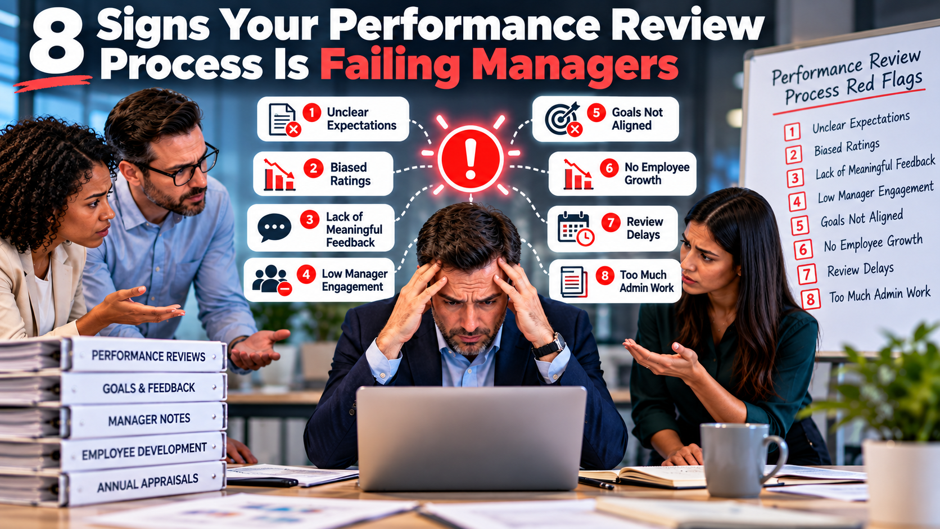
A manager finishes writing the last of 11 performance reviews on a Sunday night, having spent nearly every evening that week doing the same thing after a full day of actual work, and closes the laptop with the quiet certainty that none of it will meaningfully change how the coming year actually goes. That feeling isn’t a personal failing or a sign of a manager who simply needs to get better at time management. It’s the predictable result of a performance review process built around administrative burden rather than genuine management support, and it’s happening at a genuinely staggering scale.
95% of managers now express dissatisfaction with their current performance management systems, and only 6% of companies believe their review process is actually worth the time it consumes. Managers spend roughly 210 hours a year on review-related activities alone, a workload stacked on top of already rising spans of control, increasing meeting loads, and the reality that most managers are still doing individual contributor work at the same time. This isn’t a story about employees disliking their reviews, though they do; it’s a story about an organizational process quietly breaking the people responsible for running it. This guide walks through the 8 clearest signs a performance review process has become a genuine burden on managers specifically, why each one matters, and what actually needs to change.
TL;DR
| Sign | What it reveals about the process |
| 1. Managers spend 200+ hours a year on review administration | The process consumes a genuinely significant share of a manager’s total working time, crowding out actual coaching and team leadership |
| 2. Nearly every manager reports dissatisfaction with the system | Near-universal dissatisfaction signals a structural problem with the process itself, not a training or attitude gap among managers |
| 3. Managers are the only real check on goal quality | The entire burden of ensuring goals are meaningful and well-constructed falls on one person, with no organizational backstop |
| 4. Review forms have grown well past the point of usefulness | Bloated forms reduce both manager efficiency and actual goal completion, working against the process’s own stated purpose |
| 5. The annual cycle persists despite everyone knowing better | Managers are stuck doing painful, infrequent review crunches instead of the lighter, more effective continuous check-ins the evidence supports |
| 6. Managers receive little to no training on conducting reviews well | Fewer than half of managers worldwide have received real management training, leaving them to improvise a high-stakes process |
| 7. This burden sits on top of managers’ own individual contributor work | Most managers are still doing their own job while also managing and reviewing a team, with no reduction in either workload |
| 8. Manager engagement and wellbeing are visibly declining | Manager burnout and disengagement are rising sharply, and a broken review process is a significant, measurable contributor |
Every sign above points toward the same underlying conclusion: a performance review process that quietly assumes unlimited manager time, attention, and goodwill will eventually run out of all 3, and the organizations that recognize this early are the ones already rebuilding their process around what managers can genuinely sustain.
Why This Problem Specifically Centers on Managers
Before working through the 8 signs individually and in genuine, careful detail, it’s genuinely worth taking a moment to understand exactly why performance review dysfunction lands so disproportionately on managers specifically, rather than being evenly distributed across everyone the broader process genuinely touches throughout the entire organization.
Managers Sit at the Structural Center of the Entire Process
A performance review process typically requires a manager to write assessments, calibrate ratings, deliver difficult conversations, and follow up on goals, while an individual employee experiences only their own single review and HR administers the process at a policy level rather than executing it review by review, employee by employee. This structural position means managers absorb the process’s full administrative weight multiplied across every single person on their team, a burden that scales directly with team size in a way no other role in the process experiences.
Why Manager Strain Matters Considerably Beyond the Manager Themselves
A manager stretched thin by review administration doesn’t just suffer personally; the strain directly affects the entire team, since burned-out managers are considerably less effective at the coaching, feedback, and genuine engagement work performance reviews are theoretically meant to support in the first place. This creates a genuinely counterproductive cycle: the process meant to improve performance instead consumes the exact time and energy a manager would otherwise spend on the coaching conversations that actually do improve performance.
Why This Problem Has Intensified Rather Than Improved Over Time
Manager engagement fell sharply in a single recent year, dropping several percentage points as spans of control widened and organizational pressure increased, even as best-practice organizations demonstrated considerably stronger outcomes remain genuinely achievable with the right approach. This gap between what’s currently typical and what’s genuinely possible is precisely why recognizing the specific signs below matters, since it reveals the problem as fixable rather than an inevitable feature of managing people at scale.
The 8 Signs in Detail
With the broader context now genuinely established, the sections below walk through each of the 8 signs individually and in turn, explaining specifically what it looks like in daily practice and why it represents a genuine structural failure rather than simply a difficult but necessary part of everyday management work.
Sign 1: Managers Are Spending Over 200 Hours a Year Just on Review Administration
Managers currently spend approximately 210 hours annually on review-related activities, a figure equivalent to more than 5 full standard work weeks consumed entirely by writing assessments, calibrating ratings, and preparing for review conversations rather than the actual coaching and team leadership work a manager’s role genuinely exists to provide. When this volume of time gets treated as simply an unavoidable cost of doing business, rather than a genuine signal the process itself needs fundamental redesign, the organization is effectively asking managers to absorb the equivalent of an extra month of work annually with no corresponding reduction anywhere else in their existing workload.
Sign 2: Nearly Every Manager You Ask Reports Genuine Dissatisfaction With the System
95% of managers express dissatisfaction with their current performance management systems, a level of near-universal agreement that should immediately rule out individual attitude or skill gaps as the explanation. When virtually every manager across an organization dislikes a process they’re required to execute repeatedly, the honest conclusion is that the system itself is fundamentally broken, not that an entire population of managers simply needs better training or a more positive outlook toward the same flawed process.
Sign 3: Managers Are the Only Real Check on Goal Quality Across the Entire Organization
In only 1 out of 10 organizations does anyone other than an employee’s direct manager review the actual quality of that employee’s goals, meaning the entire responsibility for ensuring goals are meaningful, well-constructed, and genuinely aligned with broader organizational priorities rests on one person’s judgment, with no organizational backstop or second layer of review to catch a poorly framed or misaligned goal before it becomes the basis for a full year’s performance evaluation.
Sign 4: Your Review Forms Have Grown Well Past the Point Where They Actually Help
The specific evidence pointing toward form bloat as a genuine, measurable problem rather than a minor inconvenience:
- Goal completion rates peak specifically when review forms contain somewhere between 10 and 15 total questions, indicating a clear, evidence-backed relationship between focus and actual execution
- Forms that exceed this range don’t simply take longer to complete; they measurably reduce the odds an employee actually finishes and acts on the goals the form was meant to capture
- A bloated form burdens managers doubly, first through the time required to complete it themselves, then again through lower actual goal completion among their team, undermining the very outcome the review process is supposed to produce
- Organizations that have never revisited form length since a review process was first built often don’t realize how far it’s drifted from the range where evidence shows it actually works
Sign 5: The Annual Cycle Persists Even Though Everyone Involved Knows Continuous Feedback Works Better
90% of HR professionals report that ongoing feedback produces more accurate reviews than a purely annual cycle, yet 71% of companies continue running review processes built entirely around a single annual event. This gap between known best practice and actual organizational behavior places managers in a genuinely difficult position: forced to compress an entire year’s worth of feedback, context, and evaluation into a single, high-stakes review period, rather than distributing that same work across smaller, considerably more manageable check-ins throughout the year.
Sign 6: Managers Receive Little to No Training on How to Actually Conduct a Review Well
Fewer than half of managers worldwide have received genuine management training, meaning a substantial share of the people responsible for conducting high-stakes performance conversations, conversations that directly affect compensation, career trajectory, and team morale, are essentially improvising a genuinely difficult skill without the structured preparation the task actually warrants. Research specifically linking inadequate training with elevated manager stress and burnout confirms this isn’t simply a nice-to-have gap; it’s a direct, measurable contributor to why managers experience the review process as so genuinely draining.
Sign 7: This Entire Burden Sits on Top of Managers’ Own Individual Contributor Work
Nearly all managers in recent research were found to still be performing individual contributor work themselves, meaning the 200-plus hours spent on review administration doesn’t come from freed-up management capacity; it gets layered directly on top of a manager’s own existing workload, with no corresponding reduction anywhere else to actually make room for it. This dual burden, doing one’s own job while also managing, coaching, and evaluating an entire team, represents one of the clearest structural reasons manager time for review work is so consistently scarce and so consistently resented.
Sign 8: Manager Engagement and Wellbeing Are Visibly Declining Alongside Review Burden
Global manager engagement fell several percentage points within a single recent year, while manager burnout rates have climbed to levels exceeding those reported by individual contributors, with middle managers specifically reporting the highest burnout rate of any group measured. A performance review process consuming a significant share of a manager’s already limited time and energy is a direct, measurable contributor to this broader decline, and organizations that track employee engagement and wellbeing separately from review process design are missing a genuinely direct, causal connection between the 2.
What “Good” Actually Looks Like Once You Move Past These Signs
Understanding the 8 signs above becomes considerably more useful and genuinely actionable when paired with real evidence of what a healthier, better-functioning process actually achieves, since it clarifies these problems are genuinely fixable rather than an unavoidable feature of managing performance at any real organizational scale.
The Evidence for What Actually Works
| Practice | What the evidence shows |
| Frequent, structured check-ins over a single annual event | The most effective leaders conduct brief but meaningful check-ins roughly every 2 weeks, distributing feedback across the year rather than compressing it into one high-stakes conversation |
| A moderate, focused volume of feedback contributors | Employee satisfaction peaks when between 20 and 40 people provide qualitative feedback in larger organizations, with satisfaction actually declining once contributor volume becomes excessive |
| AI-augmented, not AI-replaced, manager support | Organizations using AI-enhanced performance systems report considerably faster manager response times and measurable improvement in employee trust around evaluation fairness |
| Sustained, consistent process over multiple years | Goal completion rates climb substantially by the fourth year of consistent performance management practice, reflecting the genuine value of sustained investment rather than repeated process overhauls |
| A strong culture of continuous feedback | Organizations with genuinely strong continuous feedback cultures see measurably lower turnover compared to those relying on infrequent, formal review cycles alone |
Why AI Augmentation Specifically Helps Managers Rather Than Replacing Their Judgment
The organizations seeing the strongest results from AI-enhanced performance systems consistently use that technology to augment managers, surfacing patterns in feedback and goal progress a manager might otherwise miss, rather than attempting to replace the human judgment and empathy genuine performance conversations require. This distinction matters considerably: technology that reduces the administrative burden covered throughout the 8 signs above, without displacing the coaching relationship itself, is precisely the kind of intervention capable of addressing manager strain without sacrificing the genuine value performance conversations can provide when they’re actually well supported.
Why the Shift From “Reviewer” to “Coach” Represents the Deeper Fix
The most effective organizations increasingly frame managers not as reviewers completing a periodic administrative task, but as coaches engaged in an ongoing, ambient practice of feedback and development that happens to culminate in a formal review rather than being defined entirely by it. This reframing matters because it directly addresses several of the 8 signs simultaneously: distributing feedback more continuously reduces the annual crunch described in sign 5, and treating review conversations as coaching rather than administration naturally reduces the sense of pure burden described throughout signs 1 and 2.
What This Actually Costs the Organization Beyond Manager Frustration
Beyond the direct impact on managers themselves already covered above in this guide, a performance review process genuinely failing at the level described throughout carries real, measurable organizational costs that are genuinely worth naming explicitly and examining together, one by one, in full, careful detail right here.
The Downstream Costs Worth Understanding
The specific ways a manager-failing review process ends up costing the broader organization, not just the managers directly experiencing it:
- Reduced employee engagement, since only a small share of employees report their reviews genuinely inspire them to improve, meaning the process consumes enormous manager time while delivering limited return on that investment
- Elevated turnover risk, given the measurably lower turnover organizations with strong continuous feedback cultures achieve compared to those relying on the kind of strained, annual-only process described throughout this guide
- Weaker goal quality across the organization, a direct consequence of the single-check-mechanism problem described in sign 3, where no second reviewer exists to catch a poorly constructed goal before it shapes an entire year’s evaluation
- Compounding manager burnout that eventually affects retention among the organization’s own management ranks, not just the broader employee population the reviews are nominally meant to serve
Why HR Leadership Often Underestimates This Cost
A significant share of HR leaders themselves acknowledge that performance reviews fail to accurately reflect employee contributions, yet this acknowledgment doesn’t always translate into recognizing the specific, disproportionate burden the current process places on managers as the root cause. Treating manager burden as a secondary, softer concern behind broader performance management effectiveness misses that manager strain is frequently the actual mechanism driving the broader effectiveness problem in the first place, rather than a separate, unrelated issue worth addressing independently.
The Burnout Gap That Review Season Makes Worse
Beyond the general manager burnout picture already described above in this guide, the data reveals a further, genuinely important pattern that’s worth understanding directly: this burden doesn’t distribute evenly across every single manager, and review season specifically tends to widen gaps that already genuinely exist well beforehand.
Where the Data Shows a Measurable Gap
| Comparison | What the data shows |
| Women versus men in leadership roles overall | Women in leadership report frequent burnout at a meaningfully higher rate than men in comparable leadership roles, a gap of roughly 10 percentage points |
| Women versus men at the manager level specifically | The gap narrows somewhat at the manager level specifically but remains genuinely significant, at roughly 7 percentage points |
| Middle managers versus other worker groups | Middle managers report the highest burnout rate of any group measured, reflecting the unique pressure of sitting between executive expectations and frontline team needs simultaneously |
| Adequately resourced managers versus under-resourced managers | Managers who report their organization genuinely prioritizes mental health show dramatically higher confidence in that prioritization than under-resourced peers, a gap of nearly 60 percentage points |
Why Review Season Specifically Tends to Widen These Existing Gaps
Performance review periods concentrate an unusually heavy, time-bound workload into a compressed window, and this kind of concentrated, high-stakes burden tends to disproportionately affect exactly the managers already carrying more of an organization’s invisible workload, whether that’s disproportionate caregiving responsibilities outside work, a wider span of direct reports, or simply less organizational support reaching them relative to peers in similar roles. Research into manager wellbeing and middle-management pressure makes this workload question worth examining directly rather than treating burnout as a uniform experience across the entire management population.
Why This Pattern Deserves a Deliberate Audit Rather Than an Assumption
Gaps of this size and consistency across multiple studies should genuinely prompt a workload and opportunity audit within an organization’s own management population, rather than being explained away through assumptions about individual resilience or preference. Examining team size, role ambiguity, the volume of invisible administrative work assigned to different managers, and genuine access to organizational support specifically during review season gives an organization concrete, actionable data rather than a vague, unexamined sense that burnout is simply an unavoidable cost of management work generally.
Common Mistakes When Attempting to Fix a Manager-Failing Review Process
Beyond simply recognizing the 8 signs covered above throughout this guide, several recurring, genuinely predictable mistakes show up consistently among organizations attempting to redesign a performance review process, and avoiding them meaningfully improves the odds the redesign actually reduces manager burden rather than simply relocating that same burden elsewhere.
Adding more structure without removing anything from managers’ existing workload. Introducing new review requirements, additional questions, or supplementary check-ins without eliminating anything from the existing process simply adds to the 200-plus hour burden already described in sign 1, rather than genuinely addressing it.
Assuming more frequent check-ins automatically means more total manager work. Shifting from an annual cycle to continuous feedback only reduces manager burden if the total volume and depth of required documentation genuinely decreases per touchpoint; simply running the same heavy annual process 6 times a year instead of once multiplies the burden rather than distributing it more manageably.
Rolling out AI or automation tools without genuine manager input on what actually helps. Technology introduced to reduce administrative burden that managers themselves weren’t consulted on often ends up solving a problem managers don’t actually experience as their biggest pain point, while leaving the genuine bottleneck untouched.
Treating manager training as optional rather than foundational to any process redesign. A redesigned process still depends on managers actually knowing how to conduct meaningful performance conversations, and skipping genuine training investment while changing the surrounding process structure addresses only half of what sign 6 identifies as a genuine problem.
Measuring success purely by employee satisfaction without also tracking manager burden directly. A process redesign that improves employee experience while leaving manager time investment and reported dissatisfaction unchanged hasn’t actually solved the problem this guide describes; it’s addressed only one side of a 2-sided failure.
Why Rising Spans of Control Make This Problem Worse Every Year
Beyond the specific signs already covered throughout this entire guide, one broader structural trend deserves particular, genuine attention, since it directly amplifies nearly every one of the 8 signs described throughout, often without an organization ever deliberately choosing for it to happen in the first place.
The Trend Worth Understanding Directly
The specific way rising spans of control compound the review burden problem year over year:
- The average number of direct reports assigned to a single manager has been climbing steadily, meaning the same 200-plus hour review burden increasingly gets spread across a growing number of individual reviews rather than staying fixed
- Managers already struggling with heavy meeting loads, in some cases exceeding 260 meetings annually, find that additional direct reports compound an already tight schedule rather than simply adding a proportional, manageable increment
- Wider spans of control reduce the amount of genuine one-on-one coaching time available per employee, directly undermining the quality of the goal-setting and ongoing feedback that would otherwise make the eventual formal review considerably easier to write
- Organizations that expand span of control as a cost-saving measure, without simultaneously revisiting how much administrative review burden each additional report actually adds, are effectively compounding sign 1 and sign 7 simultaneously without any deliberate decision to do so
Why This Trend Often Goes Unexamined Until It Becomes a Genuine Crisis
Span of control decisions typically get made for organizational efficiency reasons entirely separate from performance review process design, meaning the 2 decisions rarely get evaluated together even though they directly compound each other in practice. Gallup’s latest workplace research reports that manager engagement declines with larger spans of control, which makes the connection harder to dismiss once team size and review workload begin rising together.
Why Addressing Span of Control Belongs in Any Genuine Process Redesign Conversation
A genuine fix to the 8 signs described throughout this guide can’t stop at redesigning the review process itself in isolation; it needs to account for how many direct reports a given manager is actually responsible for reviewing, since even a well-designed, lightweight review process still multiplies by however many people report to a specific manager. Organizations serious about reducing manager burden should examine span of control and review process design together, as 2 interconnected levers rather than 2 entirely separate organizational decisions made by different teams with no coordination between them.
FAQs
Is the 210-hours-per-year figure typical across organizations, or does it vary considerably by company size and industry?
This figure represents a broad average, and the actual number varies meaningfully based on team size, review frequency, and how much documentation a given organization’s process requires, but the broader pattern, that review administration consumes a genuinely significant share of a manager’s total working time, holds consistently across the research regardless of the exact hours in a specific organization’s own context.
Should an organization address manager training or process redesign first when tackling this problem?
Both genuinely need attention, but process redesign that reduces the sheer volume of administrative work, addressing signs 1 and 4 specifically, tends to create the capacity managers actually need to benefit from training investment addressing sign 6. Training alone, layered onto an unchanged, overly burdensome process, risks simply making managers more skilled at executing a process that remains fundamentally too heavy regardless of how well-trained they become.
How can an organization tell whether its own performance review process exhibits these signs without conducting a full, formal survey?
Directly asking managers, informally and without requiring a lengthy survey process, how many hours they genuinely spend on review administration and whether they believe the process is worth that time investment, tends to surface remarkably similar patterns to the broader research covered throughout this guide, since manager dissatisfaction with review burden is close to universal rather than being an unusual, hard-to-detect problem specific to any one organization.
Does moving to continuous feedback genuinely reduce manager burden, or does it just spread the same workload across more touchpoints?
It genuinely reduces burden only when implemented deliberately to do so, meaning each individual check-in needs to be considerably lighter and less documentation-heavy than a traditional annual review, rather than simply running the full weight of an annual process multiple times throughout the year. Organizations that get this distinction right see genuinely reduced manager strain; those that don’t often end up multiplying the burden rather than distributing it more manageably.
What’s a reasonable first metric to track when beginning to address these 8 signs?
Directly tracking total manager hours spent on review-related activities, gathered through a simple, informal survey rather than a lengthy formal process, gives an organization its own concrete baseline against the roughly 210-hour figure referenced throughout this guide, and provides the clearest single number to track improvement against as specific changes get implemented over subsequent review cycles. This single metric also tends to surface the other signs almost automatically, since managers reporting an unusually high hour count will typically also point directly toward which specific factors, form length, lack of training, excessive span of control, are driving that number highest for them personally.
Should smaller organizations with only a handful of managers still worry about these 8 signs, or is this primarily a large-enterprise problem?
Smaller organizations genuinely aren’t exempt from this pattern, and in some respects face proportionally higher stakes, since losing even one manager to burnout-driven turnover represents a considerably larger relative loss of institutional knowledge and management capacity in a small organization than in a large one with more redundancy built into its management structure. The specific numbers cited throughout this guide come primarily from broad, cross-industry research, but the underlying mechanisms, administrative burden, lack of training, rising span of control, apply just as directly to a 5-manager organization as to one with hundreds of managers spread across multiple divisions.
What role should AI or automation genuinely play in fixing a manager-failing review process?
AI works best when it specifically targets the administrative, pattern-recognition portions of the review process, summarizing feedback, surfacing trends across goal progress, drafting initial content a manager can then refine, rather than attempting to replace the genuine human judgment and empathy a real performance conversation requires. Organizations seeing the strongest results consistently position AI as something that gives managers back time for coaching, rather than as a tool meant to reduce the amount of genuine human judgment involved in the process itself.
Is manager burnout from performance reviews specifically distinguishable from broader manager burnout, or are they essentially the same problem?
They’re genuinely related but distinguishable: broader manager burnout stems from multiple sources, including rising spans of control, meeting load, and organizational pressure generally, while review-specific burden is one particular, measurable contributor within that broader picture. Addressing the performance review process specifically won’t resolve every source of manager burnout on its own, but given how much of that 210-hour annual figure concentrates within a relatively narrow window around review season, it represents one of the more direct, addressable levers an organization actually has available.
How should an organization weigh reducing span of control against the cost of hiring additional management layers?
This genuinely requires balancing the direct cost of additional management headcount against the compounding costs of manager burnout, disengagement, and eventual turnover described throughout this guide, since a wider span of control that appears cheaper on paper often carries real, if less immediately visible, costs in weaker coaching, higher manager attrition, and the downstream employee engagement effects covered earlier. Organizations that model the full cost of manager strain, not just the direct salary cost of an additional management layer, frequently find that a somewhat narrower span of control pays for itself through reduced turnover and stronger team performance over time.
Does fixing the performance review process alone resolve manager burnout, or is it only one piece of a larger problem?
It’s genuinely one significant piece rather than a complete solution on its own, since manager burnout draws from multiple sources beyond review burden specifically, including meeting load, span of control, and broader organizational pressure. That said, because review season concentrates such a disproportionate share of total manager workload into a relatively narrow window each year, addressing the specific signs covered throughout this guide represents one of the more concentrated, high-impact opportunities available for meaningfully reducing overall manager strain, even though it won’t single-handedly resolve every source of burnout an organization’s managers currently face.
