Skill visibility has become a workforce problem with direct business consequences. The World Economic Forum found that 63% of employers see skill gaps as a primary barrier to business transformation for the 2025 to 2030 period. Its research also found that employers expect 39% of workers’ existing core skills to change by 2030. Those figures matter because an organization can know who works for it and still have little confidence about whether people have the capabilities required for changing roles.World Economic Forum Future of Jobs research
That distinction explains why a list of employee skills is rarely enough. HR may know that an employee has project management experience, for example, while still lacking a clear way to judge the level at which that employee can plan work, manage dependencies, make decisions under pressure, or lead a larger program. The same problem appears when job descriptions use broad terms such as leadership, communication, technical knowledge, or commercial judgment without defining what capable performance looks like at different levels. Competency management gives those expectations structure so they can be assessed against roles rather than treated as loose labels.
A useful competency system therefore has to answer several connected questions. What capabilities does a role actually require? What level is expected? What evidence shows that an employee has reached that level? Where does the gap matter enough to require development? The value comes from answering those questions consistently enough that managers can use the information for development, career movement, succession decisions, and workforce planning.
Competency management starts with a shared definition of capable performance
A competency describes more than possession of a piece of knowledge. The U.S. Office of Personnel Management defines a competency as a measurable pattern of knowledge, skills, abilities, behaviors, and other characteristics needed to perform work roles or occupational functions successfully. OPM also distinguishes general competencies from technical competencies and connects competency identification with job analysis.OPM competency-based assessment guidance
That definition helps separate terms that often get mixed together in HR systems. A skill usually describes an ability to perform a particular task or activity. A competency puts capability into a work context and can include behavior, judgment, knowledge, and the level at which the person needs to apply them. A qualification or certification can prove that a person completed a defined external requirement, while a performance result shows what happened in a particular period or assignment. None of those concepts should automatically be treated as interchangeable.
| Concept | What it represents | Example | What should be measured |
|---|---|---|---|
| Skill | Ability to perform a defined activity | Financial modeling | Demonstrated ability to perform the task |
| Competency | Capability applied within a role | Commercial decision making | Expected behavior, knowledge, judgment, and proficiency |
| Qualification or certification | Completion of a formal requirement | Professional certification | Validity, issue status, and relevance to the role |
| Performance result | Outcome achieved during work | Delivery against an annual target | Actual result against the agreed expectation |
The distinction matters because organizations make different decisions from each type of information. Training completion may show exposure to a subject, but it doesn’t prove that the employee can apply the capability at the level a role requires. A strong sales result may show high performance during a period, but it doesn’t automatically establish every competency required for a future sales leadership role. Competency management becomes useful when the organization defines what capable performance means for each role and measures it in a way that employees and managers can understand.
Why skills inventories fail when workforce decisions become more complex
A basic skills inventory can work when the organization mainly wants a searchable record of who knows a particular system, language, product, or process. Problems begin when that information is expected to support decisions about role readiness, development priorities, internal movement, or succession. A label such as “advanced Excel” tells a manager very little unless the organization has defined what “advanced” means and how the claim was assessed. The same weakness appears when employees rate themselves using different interpretations of a scale.
This is where competency management becomes more structured than maintaining a skills list. BullseyeEngagement’s current competency page describes a centralized competency library, role-specific assignments, manager and employee assessments, target levels, gap identification, career comparison, development tracking, and learning connections. The important idea isn’t the software screen itself. It is the relationship between a defined role requirement and evidence about an employee’s current capability.
Disconnected records also become harder to trust as an organization grows. One department may use a 5-point scale while another uses labels such as beginner, working, advanced, and expert. A third team may record certifications while another relies almost entirely on manager judgment. The data can look detailed while failing to support comparison because the meaning changes between teams.
The business pressure behind this problem is visible in current learning research. LinkedIn’s 2025 Workplace Learning Report found that 49% of surveyed L&D and HR professionals agreed that their executives were concerned employees lacked the skills needed to execute business strategy. The underlying survey included 937 L&D and HR professionals with budget influence and 679 learners across several regions. That concern isn’t solved by collecting more labels. It calls for clearer definitions and a stronger connection between role requirements and development decisions.LinkedIn 2025 Workplace Learning Report
A competency framework turns job expectations into something measurable
A competency framework gives the organization a common way to describe what people need to demonstrate in particular roles. The framework may contain organization-wide expectations as well as technical or role-specific requirements. Its usefulness depends on whether employees can understand the wording and managers can recognize the difference between proficiency levels. A framework with hundreds of vague labels creates administration without necessarily creating better decisions.
Define the competency in observable terms
Broad labels need enough detail to tell people what successful application looks like. “Leadership,” for example, may mean different things for a team supervisor, a department head, and an executive. The definition should identify the capability that matters in the work rather than assuming everyone interprets the term in the same way. Job analysis and input from people who understand the role can help establish that connection.
Set proficiency levels people can distinguish
A proficiency scale should describe meaningful differences in capability. A lower level might require performing routine tasks with guidance, while a higher level could require handling unfamiliar cases or guiding others. The exact number of levels matters less than whether users can tell them apart. OPM guidance on competency assessment makes a similar point, noting that rating-scale definitions can matter more than simply adding more points to the scale.
Map expected levels to actual roles
The framework becomes operational when competencies are connected to jobs. CIPD’s current guidance notes that competency frameworks can clarify performance expectations and connect individual performance with organizational needs, while warning that frameworks can become too prescriptive when detail overwhelms flexibility.CIPD guidance on competency frameworks
NIST’s NICE Workforce Framework provides a useful public example of this principle in cybersecurity. Its structure connects work roles with task, knowledge, skill, and competency-area information, while NIST continues to maintain and update those components as the work changes. A framework doesn’t have to copy the NICE model to learn from the principle: role definitions need a common language and a process for staying current.NIST NICE Framework guidance
Assessment quality determines whether competency data can be trusted
A well-written framework still produces weak information when assessment quality is poor. Employees may overrate themselves because they read a proficiency label differently from their manager. Managers may rate people based on recent performance rather than the competency definition. Other managers may avoid low ratings because they associate them with punishment rather than development. These differences can produce a precise-looking score that hides inconsistent judgment.
Assessment methods should fit the type of competency being measured. A technical capability may need work evidence, a practical exercise, certification data, or direct observation. A behavior-based competency may need manager observation across a meaningful period, supported where appropriate by peer or multi-rater input. Self-assessment can contribute useful context about experience and confidence, but it usually needs another source of evidence if the score will influence significant talent decisions.
Useful assessment inputs can include:
- Employee self-assessment against clearly defined behaviors.
- Manager assessment based on observed work and evidence.
- Peer or multi-rater feedback when other working relationships are relevant.
- Work samples, completed assignments, or demonstrated technical tasks.
- Current certifications or qualifications when they directly relate to the requirement.
- Structured assessment methods for capabilities that require stronger evidence.
Calibration helps when several managers use the same framework. The purpose isn’t to force every rating into the same distribution. It is to check whether managers are interpreting levels consistently and can explain the evidence behind a rating. If one manager treats “expert” as the ability to work independently while another reserves it for people who set standards across the organization, aggregated competency data won’t mean the same thing across teams.
Assessment records also need dates. A rating made several years ago may describe a capability the person hasn’t used recently, while a new role may require knowledge that didn’t exist when the assessment was completed. Competency information should therefore be treated as time-sensitive workforce information rather than a permanent label attached to an employee.
Gap analysis should show what action is needed, not merely produce a red cell
Competency gap analysis starts with a straightforward comparison: the role requires one level and the employee currently demonstrates another. The difference becomes useful when the organization understands what that gap means for the work. OPM describes competency gap analysis as comparing current employee proficiency with the level established as required or desired, then using the findings to inform areas such as development and workforce decisions.OPM competency gap assessment guidance
A gap should therefore be interpreted in context. A 1-level difference in a capability needed every day for a safety-sensitive role can matter more than a larger difference in a competency that rarely affects the employee’s current work. Career intent changes the meaning too. An employee may meet every requirement for the present role while having meaningful gaps against a role they want to pursue next.
| Role requirement | Current level | Gap | Practical response |
|---|---|---|---|
| Client negotiation: level 4 | Level 3 | 1 level | Observed negotiation work with coaching |
| Financial analysis: level 3 | Level 3 | No gap | Maintain through normal work exposure |
| Team leadership: level 4 | Level 2 | 2 levels | Development assignment before role movement |
| Compliance knowledge: level 3 | Level 2 | 1 level | Targeted learning followed by reassessment |
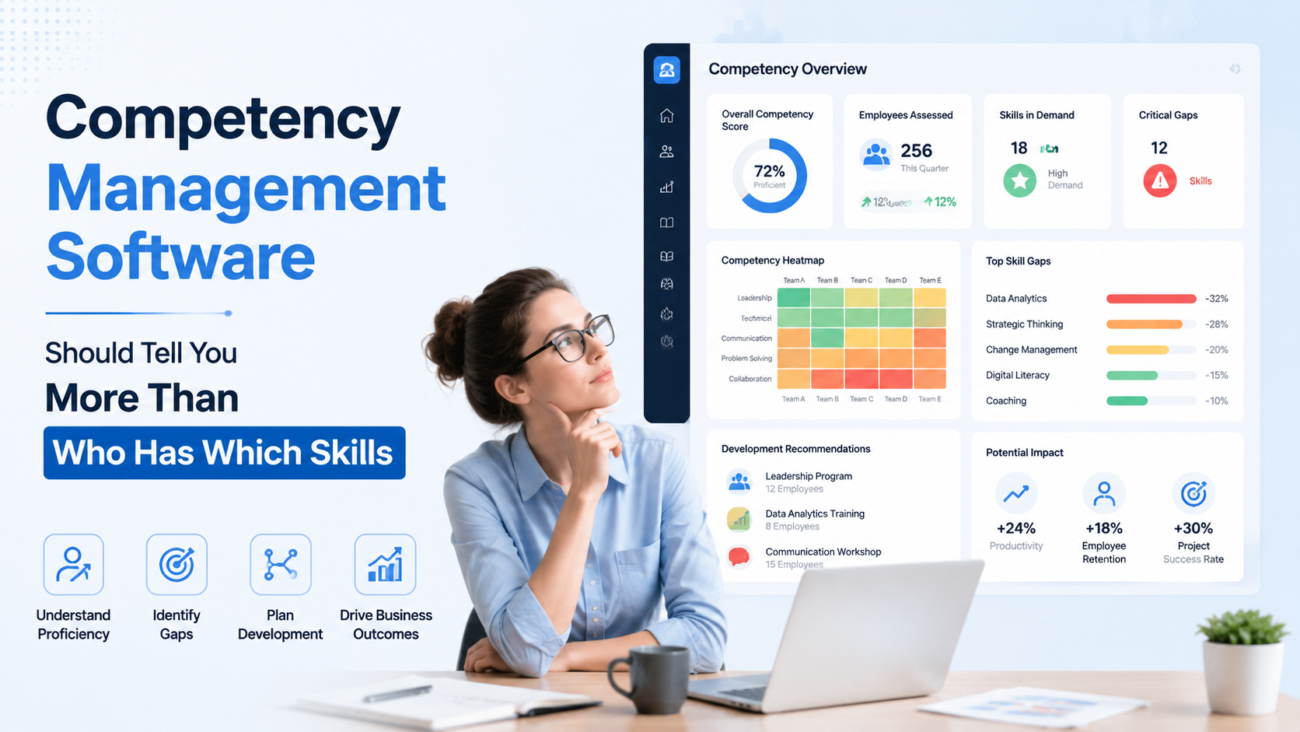
This example is illustrative, but it shows why a colored matrix alone isn’t enough. HR and managers need to decide which gaps deserve attention, which can be accepted for the current role, and which should affect readiness for future work. Aggregated gap information can also reveal whether an issue belongs to one employee or represents a broader workforce problem.
Competency gaps become useful when development follows them
Finding a gap has little value if the result stops at reporting. Development should follow the type of capability that needs to change. A knowledge gap may respond well to formal learning. A leadership gap may require coaching and responsibility for more difficult work. A technical competency may need repeated practice before reassessment. The response should fit the capability rather than assuming every gap can be closed with another course.
That is why competency information andtraining management can complement one another. BullseyeEngagement’s training page describes a centralized training library, assignment controls, progress tracking, and support for third-party LMS connections. Used with competency information, that type of record can help answer whether development activity was assigned and completed. It still remains important to distinguish completion from proven capability.
Current workforce research points to the size of the development challenge. The World Economic Forum estimates that 59 out of every 100 workers will need reskilling or upskilling by 2030. Its 2025 report also found that 77% of surveyed employers expected to upskill existing workers in response to AI-related workforce change. Those findings suggest that development decisions will increasingly need prioritization rather than broad training activity disconnected from defined capability needs.World Economic Forum skills and reskilling findings
A development plan should also create a point at which progress can be tested. Completing a course may be one part of that plan, while the employee may still need to demonstrate the competency in actual work. That closes the loop between identifying a gap and deciding whether the capability has changed.
The same competency data can support career paths and succession decisions
Employees often find career paths difficult to interpret because job postings describe responsibilities without showing the difference between what they can do today and what a future role requires. Competency mapping can make that difference more visible. An employee can compare a current profile with the requirements of a target role and see where development effort would have the greatest value. That creates a clearer basis for conversations between the employee and manager.
This connection fits naturally with talent development and coaching. BullseyeEngagement describes talent profiles, competency assessment, career pathing, development plans, training connections, and manager coaching within its talent development offering. The useful relationship is that competency information can give development discussions a defined reference point instead of leaving career advice at the level of general encouragement.
Succession planning adds another layer. Future-role readiness should consider whether someone has the capabilities required for a critical position, but a competency score shouldn’t become the sole promotion rule. Current performance, relevant experience, willingness to take the role, development progress, and organizational need may all affect the decision. A person can perform strongly in a current position while still needing development before taking on a larger scope.
BullseyeEngagement’ssuccession planning page describes competency matching, talent readiness views, individual development plans, and gap analysis as parts of its succession process. Used carefully, that connection allows competency information to support readiness discussions without reducing succession planning to a single score.
Competency information gets more valuable when workforce planning can use it
Individual competency records become more informative when the organization can look across teams. A manager may know that 1 employee lacks a particular capability, while workforce-level analysis can reveal that an entire function depends on a small number of people who hold it. That difference affects hiring, internal development, succession coverage, and decisions about where new capability needs to be built.
The same analysis can help distinguish headcount gaps from capability gaps. An organization may have enough people numerically and still lack sufficient coverage at the proficiency level required for upcoming work. Another team may appear understaffed until leaders discover that capability could be moved internally. Workforce planning therefore benefits from competency information when the definitions and assessments behind it are reliable.
BullseyeEngagement’sworkforce planning offering focuses on workforce information, staffing models, cost forecasts, organizational changes, and what-if scenarios. Competency information can add another decision layer when leaders need to understand whether planned workforce structures also contain the required capabilities.
This use case becomes more important when role requirements are changing faster than traditional job descriptions. Workforce planning can’t depend entirely on last year’s role profile if new systems, business models, regulations, or operating methods have changed the work. The competency framework and planning assumptions need to be reviewed together so leaders aren’t planning future capacity with outdated capability definitions.
Where competency management implementations usually go wrong
Competency management usually fails through design and operating problems rather than through a shortage of competency labels. An organization can buy software and still create poor information if the framework is unclear, assessments are inconsistent, or nobody owns updates. Several predictable failure points deserve attention before the organization scales the process.
| Failure point | What causes it | What happens | Better response |
|---|---|---|---|
| Too many competencies | Every desirable attribute is added | Employees and managers struggle to assess meaningfully | Start with capabilities that affect real role decisions |
| Vague proficiency levels | Labels aren’t tied to observable differences | Ratings become subjective | Define evidence and behaviors for each level |
| Manager inconsistency | Rating standards differ by team | Scores can’t be compared reliably | Use manager guidance and calibration |
| Stale role profiles | Competencies aren’t reviewed as work changes | Gap reports compare people with outdated requirements | Assign ownership and review dates |
| Weak governance | No owner controls framework changes | Duplicate or conflicting competencies appear | Set change rules and named owners |
| No development response | Gaps are identified but no action follows | Assessment becomes administrative work | Connect material gaps with development decisions |
The common pattern is that competency management is treated as a one-time HR project. Teams spend months writing definitions, load them into a system, complete the first assessment cycle, and then assume the structure will remain useful. Role requirements change, managers rotate, new technologies appear, and the original framework gradually loses relevance.
Another mistake is trying to make the framework answer every workforce question. Competency information is one decision input. It shouldn’t replace performance evidence, career preference, staffing forecasts, qualification records, or professional judgment. Its strength comes from giving those decisions a more consistent view of required capability.
Competency data stays useful only when governance keeps it current
Governance determines who can create competencies, who approves changes, how role requirements are updated, and how assessment scales are maintained. Without those rules, different business units can gradually create several versions of the same idea. “Stakeholder management,” “client stakeholder management,” and “relationship management,” for example, may end up measuring largely the same capability with different wording. Duplicate definitions make reporting harder and confuse employees who work across teams.
Ownership should sit close enough to the work that changes are noticed. HR can manage the framework method, while business or technical subject matter experts may need to confirm whether particular role requirements still represent actual work. Review doesn’t have to mean rewriting the entire library each year. It should mean having a defined way to identify competencies that are outdated, missing, duplicated, or set at the wrong proficiency level.
Assessment governance matters as well. Organizations should know when a rating was made, what assessment method produced it, and whether the competency has changed since that assessment. A current certification may have a clear expiry date, while behavioral or technical competencies may require reassessment after role movement or a meaningful change in responsibility. Different evidence types can therefore have different review rules.
Governance also protects the credibility of employee development conversations. If employees repeatedly discover that role requirements don’t reflect actual jobs, they’ll stop treating the framework as useful. Accurate competency information depends on maintenance, and maintenance needs named responsibility rather than an assumption that somebody will notice when the framework becomes old.
What to evaluate in competency management software before buying
Software evaluation should begin after the organization understands the decisions its competency process needs to support. A buyer focused mainly on development may value different workflows from an organization using competency information heavily for regulated roles or succession planning. The useful question isn’t how many features exist. It is whether the system can maintain clear relationships between competency definitions, role requirements, employee evidence, identified gaps, and the action that follows.
Framework control and role mapping
The system should let administrators maintain a shared library without forcing every role to use the same competency set. Buyers should examine how competencies are created, categorized, revised, assigned to roles, and given target proficiency levels. Version control also matters because changing a definition shouldn’t leave the organization unable to understand what an older assessment measured.
Assessment and calibration
Check which assessment methods the system supports and how clearly managers can see rating definitions while assessing. The system should make it possible to record useful evidence and distinguish employee self-ratings from manager ratings where those are separate inputs. Buyers should also consider how managers review differences and whether assessment dates remain visible.
Gap visibility and reporting
Useful competency management software should make the relationship between required and current proficiency easy to inspect without reducing every difference to an emergency. BullseyeEngagement’s current page states that managers and employees can assess competencies, compare them with job requirements, identify gaps, track development, and use competency information for career and succession discussions. Those are relevant functions when the buying goal extends beyond maintaining a skills directory.
Development connections
A gap report should be able to lead into a development response. Buyers should ask how competency needs connect with training, coaching, development plans, and future-role comparisons. They should also check whether completing an activity automatically changes a competency rating or whether reassessment is required, since training completion and demonstrated capability aren’t the same thing.
Historical records and governance
Buyers should examine how changes are logged and how older assessments remain interpretable. Permission controls matter when different groups own role requirements or technical definitions. It should also be clear who can change target levels and what happens to existing employee records after the framework changes.
Integration with the wider talent process
Competency information gains value when relevant talent processes can use it without requiring repeated manual entry. Bullseye describesBullseye’s Human Capital Development platform as connecting employee development, performance processes, succession information, planning, and related people data while augmenting existing ERP systems. For a buyer, the broader question is whether competency information can move into the processes where real decisions occur without creating another isolated record.
A practical path from scattered skills data to a working competency system
1. Start with the decision the competency system needs to improve. Organizations should identify the workforce question before building a large library. The first use case might involve development for a priority function, role readiness, succession coverage, or identifying capability gaps linked with future business needs. Starting with the decision creates a test for every competency added later. If a competency doesn’t affect a meaningful workforce decision, it may not need to be in the first version.
2. Choose a manageable set of roles. Mapping the entire organization at once can turn the project into a long documentation exercise. A priority business area gives the team a smaller environment in which to test definitions, proficiency levels, assessment instructions, and reporting. The organization can then correct weaknesses before applying the method more widely.
3. Define competencies with people who understand the work. HR can provide the framework method, but role knowledge needs input from managers, experienced employees, and subject matter experts where appropriate. Definitions should describe what people need to demonstrate rather than collecting impressive-sounding attributes. Each proficiency level should make a meaningful distinction that employees can recognize in actual work.
4. Select assessment methods based on the capability. Some competencies can be assessed through manager observation, while others need stronger evidence. Decide how self-assessment, manager assessment, technical evidence, qualifications, or multi-rater input will be used before collecting scores. Managers also need guidance on how to apply the scale so ratings don’t become a reflection of local interpretation.
5. Set ownership and review rules before launch. Every competency library changes eventually. The organization should identify who can create definitions, who approves updates, how duplicate terms are handled, and when role requirements are reviewed. Assessment records need dates, and employees should understand whether a score is expected to remain current indefinitely or be revisited after a defined event.
6. Connect important gaps with a real development response. A gap report should lead somewhere. Depending on the competency, the response may involve formal learning, coaching, practical assignments, mentoring, supervised work, or another form of development. The organization should also determine what evidence will show that development changed capability rather than assuming completion equals competence.
7. Review the system based on decision quality. After the first cycle, examine whether managers can interpret the reports, employees understand their profiles, and the data changes workforce decisions in useful ways. Look for competencies that receive almost identical ratings, role requirements managers dispute, or gaps that repeatedly produce no action. Those signals reveal where the framework needs correction. A working competency system is one that continues to reflect actual work as roles and capability requirements change.
Frequently asked questions
What is competency management?
Competency management is the structured process of defining the capabilities required for work, assessing employees against those requirements, identifying gaps, and using the results to guide workforce decisions. Competencies may include knowledge, applied skills, behaviors, abilities, or other characteristics connected with successful role performance. The process normally includes a shared competency library, role mapping, proficiency levels, assessment, gap review, and development actions. Its purpose is to create a consistent way to understand capability rather than relying only on job titles or self-reported skills.
What does competency management software do?
Competency management software records competency definitions, connects them with roles, captures assessments, and compares current employee proficiency with required levels. Depending on the system, it may also support development planning, career comparisons, historical tracking, reporting, and connections with succession or learning processes. The software provides structure for the process, but reliable results still depend on clear competency definitions and consistent assessment. Poor framework design won’t become reliable simply because it has been entered into a software platform.
What is the difference between competency management and skills management?
Skills management usually concentrates on identifying and tracking particular abilities, while competency management places capability within the context of successful job performance. A competency can combine knowledge, behavior, applied skill, judgment, and proficiency expectations. Skills inventories can be useful when an organization mainly needs to find people with specific technical experience. Competency management becomes more useful when the organization needs to compare people with defined role expectations or use the information for development and readiness decisions.
What is the difference between competency management and performance management?
Competency management focuses on what capabilities someone needs and the level at which those capabilities are demonstrated. Performance management focuses on how the employee is performing against work expectations, goals, responsibilities, or agreed outcomes during a period. The 2 processes can inform each other, but they shouldn’t be treated as identical. A high performer may still have competency gaps for a future position, while an employee who holds required technical competencies may still have performance issues in the current role.
How do you create a competency framework?
Start by identifying the jobs or workforce decisions the framework needs to support. Gather current role information and work with people who understand the actual responsibilities to define the capabilities that affect successful performance. Each competency then needs a clear description and proficiency levels that represent observable differences in capability. After mapping target levels to roles, test the framework with managers and employees before applying it widely, because practical use often reveals wording or rating problems that aren’t obvious during design.
How should competency levels be measured?
Competency levels should be measured using evidence that fits the capability being assessed. Manager observation may work for competencies demonstrated regularly in day-to-day work, while technical abilities may require work samples, formal assessments, or qualification evidence. Self-assessment can provide useful information about experience and perceived capability but shouldn’t automatically be treated as proof. Whatever method is used, proficiency descriptions need to be clear enough that different assessors can interpret the levels in a reasonably consistent way.
What is competency gap analysis?
Competency gap analysis compares an employee’s current assessed proficiency with the level required or desired for a role. The difference indicates an area that may require development, hiring support, reassignment, or another workforce response. The size of the numerical gap isn’t the only factor that matters. Organizations also need to consider how important the competency is to the role, how often it is used, the timeframe for closing the gap, and whether the analysis concerns the employee’s present position or a possible future role.
How often should competencies be reviewed or updated?
Competencies should be reviewed often enough to remain consistent with actual work, and there isn’t one fixed interval that suits every organization. A review may be triggered by new technology, regulation, restructuring, role redesign, business expansion, or a recurring governance cycle. Technical competencies in changing fields may require more frequent attention than stable behavioral expectations. The organization should also review target proficiency levels because a competency can remain relevant while the level required for a particular role changes.
Can competency management support succession planning?
Yes, competency information can support succession planning by comparing potential successors with the capabilities required for future roles. It can help managers identify readiness gaps and decide where development may be needed before a transition. Competency scores shouldn’t be used as the sole succession decision, however. Experience, current performance, employee interest, role availability, leadership requirements, and other evidence may also affect whether a person is ready for a future position.
What should organizations look for in competency management software?
Organizations should look for software that supports the way they intend to define roles, assess capability, manage gaps, and connect findings with workforce action. Buyers should examine competency-library controls, proficiency scales, role mapping, assessment methods, historical records, reporting, permissions, and connections with development or succession processes. They should also test whether managers and employees can understand the information without extensive interpretation. The strongest fit is a system that supports the organization’s actual competency process rather than forcing the organization to build its process around a long feature list.
