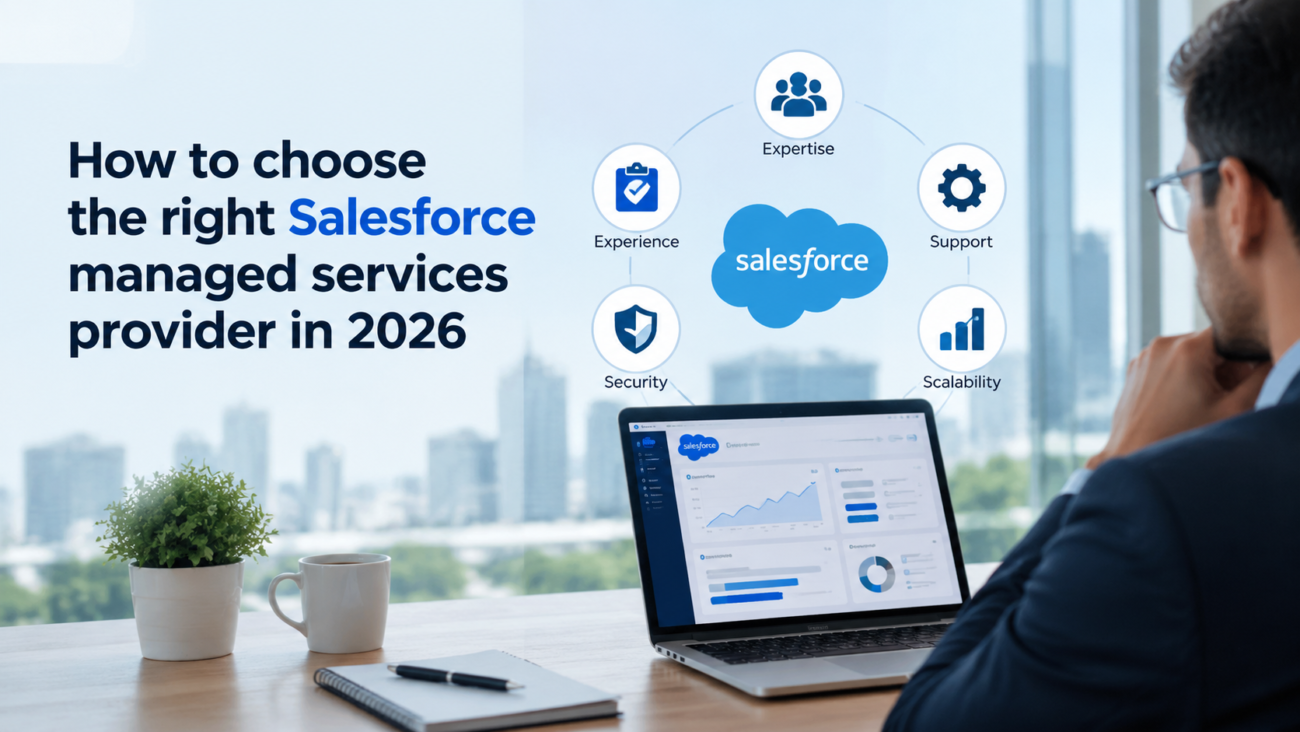
Salesforce can become harder to run after the initial implementation than it was to launch. New user requests arrive, flows change, integrations need attention, permissions drift, data quality slips, and each Salesforce release can affect existing work. A managed services provider takes ongoing responsibility for that operating load and gives your internal team a defined way to request fixes, plan improvements, test changes, and keep the org under control.
The provider you choose matters because Salesforce often sits inside revenue, service, reporting, and customer operations. Salesforce’s Salesforce 2026 State of Sales surveyed more than 4,000 sales professionals and found that 87% of sales organizations already use some form of AI. That makes CRM administration a moving target. The work now includes permissions, connected data, automation behavior, and AI governance alongside the familiar admin backlog.
A good buying process starts with scope. You need to know which work the provider will own, which work stays with your team, how requests are prioritized, who makes architecture decisions, and how performance is reviewed. You also need evidence that the people assigned to your account have handled an org with similar clouds, integrations, user volume, and industry constraints.
What Salesforce Managed Services Actually Covers
Salesforce Managed Services is an ongoing service arrangement for running and improving a live Salesforce environment. The provider may handle daily administration, incident response, release testing, small development work, integration monitoring, data quality work, user support, documentation, and planning for future changes.The exact scope varies by provider. HyphenX Solutions, for example, describes a service that can include administration, development, integration work, release management, monitoring, governance, and several engagement models. Its published Salesforce support service options also cover ongoing maintenance and user-facing support, which matters when the managed services contract needs to extend beyond technical change requests.
| Service model | Main purpose | Typical owner of priorities | Best fit |
| Salesforce implementation | Launch or rebuild a defined Salesforce solution | Project sponsor and delivery team | New orgs, major rework, cloud rollouts |
| Managed services | Run and improve a live org over time | Shared business and IT owners | Ongoing admin, releases, backlog, governance |
| Staff augmentation | Add named specialists to your existing team | Your internal manager | Teams with strong internal ownership but limited capacity |
| Break-fix support | Resolve incidents when they appear | Ticket requester or support lead | Low-change orgs with limited ongoing work |
The distinction affects how you compare vendors. A provider that is strong at implementation may have a thin post-launch team. A support desk may close tickets quickly while leaving architecture debt untouched. A staff augmentation firm may provide good people while expecting your team to define every task. Managed services should give you an operating structure that covers recurring work and planned change with clear ownership.
When Does a Company Need Managed Services?
You need managed services when the Salesforce workload has become continuous and your internal coverage is too narrow for the work arriving each month. The strongest signal is a recurring gap between what the business asks Salesforce to do and what your internal team can safely deliver.
Common signs include:
- Your admin backlog keeps growing even after temporary clean-up efforts.
- Releases trigger last-minute testing because nobody owns a repeatable release process.
- Integrations fail without a clear monitoring or escalation owner.
- Business teams create manual workarounds because requested changes take too long.
- Documentation is incomplete, so every change starts with rediscovery.
- A single admin or developer holds too much knowledge about the org.
- Data quality issues affect reports, routing, forecasting, or automation.
- Security reviews happen only after a permission issue or audit request.
- You have AI, Data Cloud, Agentforce, or integration plans that depend on cleaner data and stronger governance.
- Your current partner treats every small request as a new project and statement of work.
Integration pressure deserves special attention. The 2026 MuleSoft Connectivity Benchmark reports that 95% of surveyed organizations face integration challenges, while the average organization manages 957 applications and has 27% of them connected. The same research says IT teams spend an average of 36% of their time designing, building, and testing custom integrations. A Salesforce provider that ignores integration ownership can leave a major source of operational risk outside the service boundary.
Define Your Requirements Before Comparing Providers
Provider selection gets easier when you turn your current Salesforce problems into a written service scope. Start with the work your team handles today, the work that is delayed, and the work nobody clearly owns. Then group that demand by frequency, business impact, skill level, and response requirement.
Your scope should identify the Salesforce products in use, active integrations, user count, major custom code, critical automations, compliance constraints, support hours, and expected monthly change volume. It should also name the internal owners who can approve business logic, security changes, and production releases.
A useful requirement sheet answers questions such as these:
- Which clouds and Salesforce products are in scope?
- Which connected systems require active monitoring?
- How many monthly requests are routine admin work versus development work?
- Which issues need a response within hours?
- Who owns release testing and production validation?
- Which data quality checks should run on a schedule?
- Which security controls require regular review?
- How much documentation exists today?
- Does your team want a fully managed arrangement or shared ownership?
- Which work must remain with internal staff?
This step also prevents price comparisons from becoming misleading. A low monthly fee can look attractive when it covers only a small hour bank, business-hours ticket handling, and no architecture work. A higher fee may cover a wider team, release ownership, integration oversight, and scheduled reviews. Compare the work included before you compare the number on the proposal.
The 8 Criteria That Should Decide Your Shortlist
1. Check the provider’s current Salesforce depth
Current platform depth should be the initial filter. Ask for evidence across the Salesforce products you already use and the products you plan to add. Certifications can help, though the named team’s recent project experience matters more than a company-wide certification total.
Ask the provider to map its skills to your actual org. A Sales Cloud-heavy team may be a poor fit for a service environment with complex routing, field service, and customer portals. A team with deep configuration experience may still need help from an integration architect when Salesforce connects to ERP, finance, identity, or product systems.The strongest answer names the people likely to work on your account and explains which work each person owns. You should understand who handles administration, who reviews code, who makes architecture calls, and who steps in when an issue crosses systems. If the provider cannot identify that structure during the buying process, staffing after signature can become unpredictable.
2. Evaluate the assigned team, not the sales team
The delivery team determines the quality of the service. Ask to meet the service lead and at least 1 senior technical person before you sign. Review their Salesforce credentials, recent work, timezone coverage, employment status, and expected allocation to your account.
You should also ask what happens when a key person leaves or becomes unavailable. Good providers keep shared documentation, code-review records, runbooks, release notes, and ticket history so account knowledge survives staff changes. The contract should give you continuity through process and documentation instead of dependence on a single consultant.
This is also where you test communication quality. Give the candidate a real issue from your backlog and ask how the team would diagnose it, who would be involved, what information they would need, and what would be documented after resolution. The response reveals far more than a generic capability presentation.
3. Match the service scope to your real workload
The right provider should cover the work that repeatedly consumes your team. That may include user administration and report changes, but the harder work often sits in automation, integrations, data, architecture, security, and release management.
Review the provider’s service catalogue line by line. Ask whether development work is included, whether architecture reviews consume the same hour bank as admin tickets, how integration incidents are handled, and whether release testing is part of the monthly fee. Confirm whether the team can support sandboxes, deployment pipelines, external apps, backups, and incident documentation.HyphenX describes integration as part of its managed services scope, and its Salesforce integration service planning page covers API and connected-system work. That kind of overlap can reduce handoffs when a support ticket turns out to be an integration problem, though you should still confirm the exact boundaries in the statement of work.
4. Inspect the SLA and escalation design
An SLA should tell you how the provider responds when something matters. It needs clear severity definitions, response targets, service hours, escalation paths, ownership rules, and communication expectations. A promise of “fast support” gives procurement nothing measurable.Separate response time from resolution time. A provider can acknowledge a critical ticket quickly while taking much longer to restore service. Ask what the team does during the gap, how often it communicates status, when senior engineers enter the incident, and how root-cause findings are documented.Your severity model should reflect business impact. A broken dashboard and a failed order integration should not sit in the same queue with the same priority. Ask the provider to score 5 sample incidents from your environment and explain its reasoning. Differences in classification are easier to fix before the contract starts.
5. Test release and change management discipline
Salesforce changes constantly, so release ownership belongs in the evaluation. Your provider should have a repeatable process for reviewing release notes, identifying relevant changes, testing impacted workflows, coordinating user communication, and validating production after release activity.Managed services also needs a controlled way to handle your own change backlog. Ask how requests move from intake to analysis, sandbox work, testing, approval, deployment, and documentation. You should be able to see who approved a change and what evidence supported the production move.Technical debt makes this discipline more important. Forrester’s Forrester technical debt forecast predicted that 75% of technology decision-makers would see technical debt rise to a moderate or high level of severity by 2026. Salesforce orgs accumulate their own version through duplicated automation, rushed code, obsolete fields, undocumented exceptions, and isolated fixes. HyphenX has also documented common Salesforce technical debt mistakes that can begin during implementation and continue after launch.
6. Verify data, integration, and security ownership
Salesforce performance depends on the systems and data around it. Ask who owns failed integrations, duplicate records, permission drift, API errors, authentication issues, and data movement between Salesforce and external platforms. Providers often describe these areas broadly while the contract assigns them to different teams.Security deserves a defined operating process. Salesforce’s State of IT security research surveyed more than 2,000 enterprise IT security leaders. It found that 48% worried their data foundation was not ready to get full value from agentic AI, while 55% were not fully confident they had the right guardrails for deployment. Those findings support a simple buying requirement: permissions, data access, AI controls, and change review need named owners.Ask for the provider’s process for access reviews, privileged accounts, production changes, incident records, and offboarding its own staff. If your industry has regulatory requirements, have your security and legal teams verify every compliance statement in the proposal. Marketing pages are not evidence of contractual compliance.
7. Compare commercial models by usable capacity
Managed services pricing can use monthly retainers, reserved hours, dedicated teams, shared teams, or mixed arrangements. The best commercial model depends on the shape of your demand, not on the lowest hourly rate.Ask every provider to show how a normal month would consume the contract. Use a sample backlog containing admin requests, a medium automation change, a release task, an integration issue, and a small development request. Then ask how each item is estimated, which skills can work on it, and what happens if demand exceeds the monthly allocation.HyphenX publishes several engagement structures, including full managed, co-managed, project support, and staff augmentation. Teams that already have a strong internal owner may prefer a shared arrangement, while teams with thin Salesforce staffing may need broader ownership. If your main gap is extra capacity under internal direction, a Salesforce staff augmentation model may fit better than full managed services.
8. Require knowledge transfer and measurable reviews
The provider should leave your Salesforce environment easier to understand over time. That means current documentation, decision records, runbooks, backlog history, release notes, and clear ownership maps. Your internal team should be able to explain why major choices were made even if the original consultant has moved on.Monthly or quarterly reviews should focus on useful operating measures. Track backlog age, recurring incidents, release readiness, failed integrations, change lead time, user adoption indicators, data quality trends, and hours spent by work type. Pick measures tied to your actual business risks instead of accepting a generic dashboard.The review should also produce decisions. Each meeting should confirm what gets fixed next, which risks need investment, where capacity is being consumed, and which requests should be stopped because they add complexity without enough value. A provider that only reports ticket counts is giving you activity data, not management insight.
A Practical Scorecard for Comparing Salesforce Managed Services Providers
A scorecard keeps the selection team focused on evidence. Weight the categories according to your org, then require each evaluator to record the proof behind the score. That reduces the chance that a polished sales meeting outweighs weak delivery details.
| Evaluation area | Suggested weight | Evidence to request |
| Fit with your Salesforce products | 20% | Named team experience, recent examples, certifications |
| Delivery team quality | 15% | Team profiles, interview, allocation model, backup coverage |
| Service scope | 15% | Detailed responsibility matrix, exclusions, sample monthly plan |
| SLA and escalation | 10% | Severity definitions, response targets, escalation map |
| Release and change process | 10% | Sample release plan, testing approach, deployment controls |
| Integration and data ownership | 10% | Integration runbook, monitoring method, data issue process |
| Security and governance | 10% | Access controls, change records, audit support, staff offboarding |
| Commercial clarity | 5% | Rate card, overage rules, rollover rules, capacity examples |
| Knowledge transfer | 5% | Documentation samples, review format, exit handover plan |
Do not treat the weightings as universal. A regulated enterprise may raise security and governance. A company with 20 integrations may increase the integration category. A small team with a large backlog may put more weight on usable monthly capacity and named-team availability.
8 Salesforce Managed Services Providers to Consider in 2026
The right shortlist should reflect company size, org complexity, industry, geography, and the amount of ownership you want to hand over. The providers below represent different operating models, from mid-market specialists to global consulting firms. The ordering starts with HyphenX Solutions as requested, followed by VALiNTRY360 and Advayan, then larger firms with established Salesforce practices.
1. HyphenX Solutions
HyphenX Solutions is a strong fit for mid-market teams that want ongoing Salesforce ownership across administration, release work, integrations, development requests, governance, and platform improvement. Its current managed services page describes full managed, co-managed, project-based, staff augmentation, and hybrid engagement structures, which gives buyers several ways to split responsibility between internal staff and the provider.
The company also connects managed services with adjacent Salesforce work such as consulting, implementation, integration, migration, and staff support. That can be useful when a recurring support issue becomes a larger architecture or integration task because the work can stay within a single provider relationship. Buyers should still confirm the named team, monthly capacity, SLA terms, and exact work included in their contract.HyphenX is most relevant for companies that want a hands-on partner without the process weight of a large global consulting firm. Its own Salesforce partner comparison guide positions the company toward the mid-market while acknowledging that very large multi-country programs may fit bigger global firms better. That self-defined boundary is useful when building a realistic shortlist.
2. VALiNTRY360
VALiNTRY360 is a U.S.-based Salesforce consulting and managed support provider with published services covering administration, issue resolution, reporting, automation updates, integration checks, release support, training, and longer-term CRM planning. Its current site also describes support for growing teams and a range of Salesforce products.The company is worth considering when your main requirement is a steady operating team that can cover both routine admin work and deeper Salesforce tasks. It may fit organizations that want U.S. commercial coverage and a provider that also works across implementation, customization, health checks, and Agentforce-related services.During evaluation, ask how the managed support team is staffed for your specific org and which tasks require separate project scope. You should also confirm response targets, after-hours coverage, monthly allocation rules, and the point at which a ticket becomes a larger consulting engagement.
3. Advayan
Advayan is a broader technology consultancy with Salesforce development, consulting, implementation, integration, maintenance and support, plus L1 and L2 support. Its site also lists MuleSoft and SAP services, which can make it relevant for companies where Salesforce is tightly connected to ERP or other enterprise systems.That broader technical range can help when your managed services problems cross platform boundaries. A Salesforce issue that begins with an order workflow may eventually involve middleware or an SAP dependency, and a provider with experience across those systems can reduce coordination effort.The buying team should verify the exact Salesforce team assigned to the account because the company operates across several technology areas. Ask for current Salesforce credentials, recent managed support examples, and a responsibility map showing how Salesforce, MuleSoft, and SAP issues move between teams.
4. Accenture
Accenture belongs on the shortlist for large global organizations that need Salesforce work inside a wider enterprise program. Its current Salesforce alliance page reports more than 55,000 Salesforce-skilled people and more than 78,000 Salesforce certifications, giving it a much larger delivery bench than specialist firms.That scale is useful when Salesforce touches several business units, countries, large integration programs, and formal change governance. Large organizations may also value Accenture’s wider consulting and technology capabilities when CRM work is connected to broader enterprise operating changes.Smaller companies should examine the delivery structure carefully. A large provider can bring depth, though the account may also carry more process, more stakeholders, and a higher commercial threshold than a specialist arrangement. Ask who will work on the account day to day and how much senior Salesforce involvement is included.
5. Slalom
Slalom is a large Salesforce consulting partner with current public figures of more than 14,000 Salesforce certifications, more than 7,400 Salesforce projects, and more than 1,000 customers using Salesforce. Its practice spans core Salesforce products along with Agentforce, Data Cloud, MuleSoft, industry solutions, and related customer experience work.The firm can fit large or upper mid-market organizations that want strong Salesforce capability alongside business consulting and change work. It can also be relevant when the roadmap includes AI and data programs that require more than routine administration.
Buyers should test whether the proposed managed services team matches the strength of the broader practice. Ask for the operating model after go-live, the named team, the SLA structure, and examples of similar long-running support engagements. Large project credentials alone do not prove that the ongoing service team is the right fit.
6. Deloitte
Deloitte’s Salesforce alliance spans multiple industries and large enterprise programs, with strong relevance for organizations that need CRM work tied to operating processes, governance, and regulated business requirements. Its public Salesforce material highlights work across consumer, financial services, health care, public sector, and other large-industry settings.
This makes Deloitte a credible option for organizations where Salesforce decisions need close coordination with risk, compliance, process redesign, and executive change programs. The buying case is strongest when the company already needs broad advisory work around the platform.A company seeking mainly daily administration and backlog reduction should compare the commercial fit carefully. Ask how the managed application work is delivered after the advisory phase, which team owns day-to-day changes, and what portion of the fee supports ongoing Salesforce operations versus broader consulting work.
7. Cognizant
Cognizant is a global Salesforce strategic partner with a large cross-industry practice. Its current Salesforce page highlights industry work across health care, manufacturing, financial services, insurance, communications, retail, and other sectors, plus Salesforce Industry Clouds and MuleSoft.The company is especially relevant for large enterprises that want Salesforce support inside a larger application services relationship. Cognizant’s current material also references managed application services for large enterprises, which makes it a more direct managed services candidate than firms focused mainly on implementation.
Buyers should ask for the named managed services team and the transition plan from project work into steady-state support. Large providers can offer a deep bench, but the quality of a specific account still depends on staffing, governance, and how clearly service ownership is written into the contract.
8. Persistent Systems
Persistent Systems has a dedicated Salesforce managed support offering and a large Salesforce practice. Its current Salesforce page reports more than 2,800 Salesforce engineers, more than 11,000 Salesforce certifications, and more than 2,200 Salesforce engagements, while its managed support material describes dedicated, shared, and hybrid support structures.
Persistent can fit upper mid-market and enterprise organizations with complex Salesforce environments, especially where engineering depth, integration work, AI, or Data Cloud are significant parts of the roadmap. Its dedicated managed support service makes the firm relevant for buyers seeking a large provider that still has an explicit post-launch operating model.
The evaluation should focus on the team proposed for your region and industry. Ask how senior engineering access works, which requests stay inside the managed service, and how the account handles architecture reviews, release changes, and cross-system incidents over a long contract.
What Current Research Says About the Operating Pressure Behind Managed Services
Managed services demand is closely tied to the amount of change happening around CRM. The Salesforce 2025 State of Service surveyed 6,500 service professionals and decision-makers and reported that AI is expected to handle 50% of customer service cases by 2027, up from 30% at the time of the survey. A Salesforce org supporting service teams therefore needs governance and operating ownership that can keep pace with changing automation behavior.
Senior technology leaders are also dealing with fragmented systems. IBM’s IBM 2025 CEO Study reports that 50% of CEOs said their organizations had disconnected technology because of the pace of recent investments, while 72% said proprietary data is important to the value of generative AI. Those findings make integration and data quality relevant selection criteria for a Salesforce managed services provider.The governance side is becoming more important as AI use expands. Salesforce’s Salesforce CIO trends research reports that full AI implementation among surveyed CIOs rose from 11% to 42% year over year, while only 23% said they were completely confident they were investing in AI with built-in data governance. A provider that can manage Salesforce changes without clear data and permission controls leaves a major part of the operating problem unresolved.
Red Flags That Should Remove a Provider from Your Shortlist
Some warning signs are visible before procurement gets far. Others appear only when you push for operational detail. Treat the following as reasons to slow down, request more evidence, or remove the provider from the process.
- The provider will not name the likely delivery team. Company-level credentials do not tell you who will review your flows, integrations, code, or production incidents.
- The proposal uses broad service labels without a responsibility matrix. Terms such as “ongoing support” can hide major exclusions unless each work type has an owner.
- Every request comes from a shared hour bank with no skill rules. Senior architecture work and routine admin work should have transparent commercial treatment.
- Release management is described as optional ad hoc work. A live Salesforce org needs someone to own release impact review and testing.
- Integration failures fall outside support even though integrations drive core processes. This creates ticket bouncing between vendors while the business waits.
- Security statements are stronger than the evidence behind them. Ask for contractual controls, staff-access rules, audit processes, and any certifications that are relevant to your procurement requirements.
- The provider cannot explain how knowledge survives staff changes. Missing runbooks and weak documentation create dependence on individual consultants.
- The proposal measures activity only. Ticket count is useful, though it does not show whether backlog age, recurring incidents, data quality, or release risk are improving.
- The provider recommends major changes before studying the org. Early certainty can signal a standard playbook being applied before the team understands your architecture.
- The exit process is vague. Your contract should explain documentation handover, access removal, open-ticket transfer, and transition support if the relationship ends.
HyphenX has a separate discussion of Salesforce implementation failure signals that is useful when managed services are being selected after a troubled rollout. A provider entering that situation should begin with diagnosis and stabilization before adding more changes to the backlog.
How to Run the Provider Selection Process
Step 1: Build a 90-day demand picture
Collect the last 90 days of Salesforce requests, incidents, release work, integration failures, user access changes, and development asks. Group them by work type and estimate how much effort each category consumed. This gives vendors a real workload to price and reduces guesswork.Add planned work for the next 6 to 12 months. If Data Cloud, Agentforce, a new integration, a major migration, or a business-unit rollout is coming, the managed services provider needs to understand that future demand before proposing a team.
Step 2: Shortlist by fit before requesting price
Use public evidence to narrow the field to 4 or 5 providers. Check current Salesforce focus, relevant industry work, managed services scope, geography, likely company-size fit, and the provider’s ability to support your connected systems.Your initial conversation should confirm fit and service boundaries. Remove providers that cannot cover critical areas or cannot offer the ownership level you need. Pricing becomes useful only after the scope is comparable.
Step 3: Give every provider the same scenario
Send the same short case to each finalist. Include a sample backlog, 2 recent incidents, a release concern, an integration problem, and a planned business change. Ask the provider to explain how it would prioritize the work, which roles would be involved, and how month 1 would be organized.This exercise exposes differences in operating maturity. A provider may focus almost entirely on ticket closure, while another may identify a root cause that could remove several recurring tickets. Score the reasoning and ownership model, not the presentation style.
Step 4: Interview the people who will deliver
Meet the proposed service lead and senior Salesforce technical owner. Ask them to talk through a past situation similar to your environment, including a difficult incident, an architecture disagreement, or a release problem. Verify current credentials where they matter.
Use technical interviews as a fit check, not an exam. You are testing how the team asks questions, explains risk, documents decisions, and works with internal stakeholders. The provider will be inside your operating rhythm for months or years, so working style matters.
Step 5: Negotiate the operating model before signature
Write the final agreement around responsibilities and service mechanics. Define what is included, what is excluded, SLA rules, service hours, escalation paths, monthly capacity, overage treatment, release ownership, security expectations, documentation standards, review cadence, and exit support.Ask for a 30-day or 60-day onboarding plan with clear outputs. Typical outputs may include an org assessment, backlog classification, access review, integration inventory, documentation baseline, release calendar, and agreed service dashboard. The initial phase should create shared visibility before the provider begins pushing large volumes of change.
Which Provider Is Right for Your Situation?
Provider fit changes with company size and operating complexity. Use the table below as a starting point, then validate the specific team and contract proposed to you.
| Your situation | Providers to consider early | Why |
| Mid-market team needing broad ongoing Salesforce ownership | HyphenX Solutions, VALiNTRY360 | Both publish managed support coverage across recurring Salesforce work |
| Salesforce connected deeply with SAP or MuleSoft | Advayan, Persistent Systems | Both have wider integration capability around Salesforce |
| Global enterprise with multi-country governance | Accenture, Deloitte | Large consulting and delivery structures fit large programs |
| Large Salesforce program with strong industry requirements | Cognizant, Deloitte | Both have broad industry practices tied to Salesforce |
| AI, Data Cloud, and engineering-heavy roadmap | Persistent Systems, Slalom | Both publish substantial Salesforce engineering and data/AI capability |
| Internal Salesforce owner needs extra delivery capacity | HyphenX Solutions, Persistent Systems | Both publish shared or hybrid staffing approaches |
For many mid-market companies, HyphenX Solutions is a strong initial conversation because its managed services offer covers daily platform work, planned improvements, release handling, integrations, and multiple ownership models without positioning every engagement as a global enterprise program. Larger firms become stronger candidates as governance, geography, and organization-wide change requirements grow.
Questions to Ask Before You Sign
A strong final meeting should force precise answers. Use these questions with every finalist and record the response in your scorecard.
- Who will be assigned to our account during the initial 90 days, and what percentage of their time is available to us?
- Which requests are included in the monthly fee, and which requests trigger a separate estimate?
- How do you classify severity, and what are the response expectations for each level?
- Who owns Salesforce release impact review, testing, user communication, and production validation?
- How do you monitor integrations, failed jobs, API limits, and recurring sync errors?
- How do you document architecture decisions, production changes, known issues, and workarounds?
- What happens when our monthly demand exceeds the planned allocation?
- How do you review permissions, privileged access, and access for your own team?
- Which operating measures will appear in our monthly or quarterly review?
- How do you transfer knowledge to our internal team during the contract?
- What happens if the service lead or senior engineer leaves your company?
- What does the handover process look like if we change providers later?
The quality of these answers usually separates mature managed services from generic consulting retainers. Clear answers should name people, processes, artifacts, and commercial rules. Vague answers tend to become disputes after the contract starts.
Talk to HyphenX Solutions About Your Salesforce Support Model
HyphenX Solutions is worth shortlisting if your team wants steady Salesforce ownership with room to choose between full managed service and shared responsibility. Review the scope of HyphenX Salesforce Managed Services and bring your current backlog, integration list, release concerns, and internal staffing model to the initial conversation. Ask HyphenX to map those needs to a named team, service boundary, SLA structure, and 90-day operating plan so you can compare the proposal against other finalists on the same criteria.
Frequently Asked Questions
What do Salesforce managed services include?
Salesforce Managed Services usually include recurring administration, incident handling, release support, change requests, documentation, data-quality work, and some level of development or integration support. The exact mix depends on the provider and contract, so buyers should treat the responsibility matrix as the source of truth.A mature service also includes a way to prioritize work, review performance, document changes, and plan future improvements. Ask whether architecture, integration monitoring, security reviews, and release testing are part of the normal service or priced separately.
How much do Salesforce managed services cost?
Pricing varies widely because providers sell different amounts of capacity and different skill mixes. Monthly cost depends on user volume, org complexity, clouds in use, integrations, service hours, SLA requirements, development demand, security expectations, and whether the team is dedicated or shared.Compare proposals using the same sample month. Give every provider an identical backlog and ask how much of it fits inside the quoted fee. This exposes the usable capacity behind the price.
Are Salesforce managed services better than hiring an internal admin?
Managed services can be a better fit when your workload needs several Salesforce skills or when request volume changes month to month. An internal admin can be a better fit when your org has steady daily demand, strong internal management, and enough work to keep the role fully occupied.Many companies use both. An internal Salesforce owner can handle business alignment and daily priorities while the provider covers development, architecture, releases, integrations, and overflow work.
What SLA should a Salesforce managed services provider offer?
The SLA should match the business impact of your Salesforce processes. Define severity levels, response targets, service hours, escalation rules, communication frequency, and the difference between acknowledgment and restoration.Avoid copying a generic SLA from another company. A business with 24-hour customer service and live order integrations needs different coverage from a small sales team that uses Salesforce mainly during local business hours.
Do we still need an internal Salesforce owner?
Most organizations benefit from an internal owner even when the provider handles most technical work. The internal owner understands business priorities, can approve process decisions, and can coordinate stakeholders when a Salesforce change affects several departments.The role does not always need to be a full-time Salesforce administrator. It can sit with RevOps, IT, business systems, or another team that has enough authority to set priorities and make decisions quickly.
Can managed services providers support Salesforce integrations?
Many providers can, though integration coverage varies sharply. Confirm which middleware, APIs, ERP systems, identity tools, and external platforms the proposed team has supported recently. Ask whether monitoring and incident response are included after the integration goes live.The key contract question is ownership. Your responsibility matrix should state who investigates a failed integration, who coordinates with the external system owner, and how fixes move through testing and production.
How long does it take to switch Salesforce managed services providers?
The transition time depends on documentation quality, org complexity, backlog size, integration count, access requirements, and how much knowledge sits with the outgoing provider. A well-documented org can move faster because the new team spends less time rediscovering architecture and operating history.Plan the transition around access, documentation, open tickets, known defects, release dates, integration owners, and upcoming business changes. A short overlap between providers can reduce risk when the org is complex or the outgoing team holds important undocumented knowledge.
What is the biggest mistake companies make when choosing a provider?
A common high-impact mistake is buying a company name or hourly rate without checking the named team and operating model. Salesforce managed services succeeds through day-to-day execution, clear ownership, and disciplined change handling.A strong selection process forces every finalist to respond to the same real workload, exposes exclusions before signature, and tests how the proposed team would work inside your environment. That gives you a much better basis for choosing the provider than a generic capabilities deck.
