
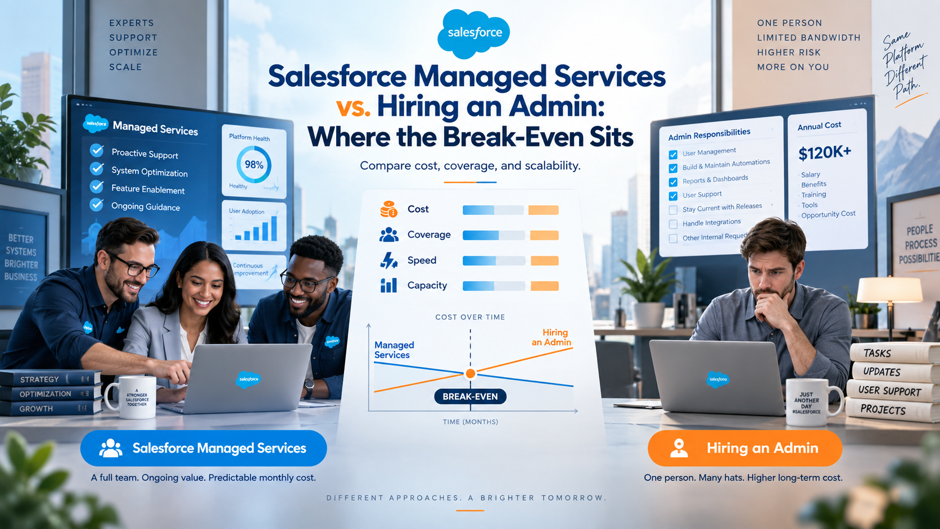
The choice between Salesforce managed services and hiring a full-time administrator often starts with the wrong comparison. A company looks at an annual salary, compares it with a monthly support proposal, and assumes the lower number is cheaper. That misses how much Salesforce work the company actually has, which skills that work requires, what an employee costs beyond salary, and what happens when the only internal administrator is unavailable during a release, incident, or period of heavy change.
Current U.S. salary data gives the calculation a useful starting point. Public salary trackers in September 2026 put average Salesforce administrator pay near the $99,000 to $103,000 range, although real offers vary by location, industry, experience, certifications, and scope. Salary still understates employment cost because benefits, paid leave, equipment, recruiting, management time, and specialist support sit outside the base figure. Using broader private-industry compensation data as a planning proxy pushes the direct annual cost of a roughly $100,000 administrator much closer to $140,000.
That changes the break-even question. A business should compare loaded internal capacity with the amount, type, and urgency of Salesforce work it actually consumes each month. Managed services tends to look stronger when the workload fills only part of a full-time role or regularly crosses into development, integration, architecture, Data 360, Agentforce, security, or release work. Hiring becomes more attractive when Salesforce creates enough steady daily work to use most of one administrator’s capacity and internal business context has real operating value.
TL;DR
A full-time Salesforce administrator usually becomes financially attractive when the company has enough predictable work to use most of that person’s capacity and most of the workload fits an administrator-level skill set. Salesforce managed services usually has the stronger case when recurring demand is lower, monthly volume changes sharply, or the work regularly needs several technical specialties that one administrator cannot reasonably cover alone. The answer changes again when the business needs a permanent internal owner who can participate in daily decisions and carry long-term organizational context.
Using roughly $12,000 per month as a planning estimate for direct loaded employee compensation gives a practical way to test the crossover. At an effective managed-services cost of $125 per hour, the simple cost break-even appears near 96 hours per month. At $150 per hour, it moves closer to 80 hours, while an effective $110 hourly cost moves it to roughly 109 hours. These are planning calculations rather than market-price claims, but they explain why the gray zone often appears around 80 to 110 recurring hours per month.
- Below that range, managed capacity can avoid paying for unused employee time.
- Near that range, skill mix, urgency, and business context can decide the outcome.
- Above that range, an internal administrator becomes more attractive when work is steady and mostly administrative.
- Specialist-heavy demand can keep managed services economical even at higher monthly hours.
- A hybrid model can work well when an internal admin has enough daily work but still needs technical backup.
- The final decision should use at least 6 months of real Salesforce work rather than estimates based only on user count.
Start With What a Salesforce Admin Actually Does
A Salesforce administrator is more than the person who creates users and adds fields. The role can cover user access, data quality, reports, dashboards, automation, security configuration, troubleshooting, release support, documentation, user enablement, and ongoing platform maintenance. In mature environments, the admin may also coordinate with developers, integration teams, security, revenue operations, service leaders, and business owners who depend on Salesforce every day.
That scope matters because the break-even depends on what the company expects one person to own. A smaller org may have a steady stream of access requests, reports, basic Flow changes, data imports, and minor configuration work. A larger environment can add integration monitoring, release testing, permission reviews, documentation, backlog management, technical-debt cleanup, sandbox coordination, and change governance. The total volume can grow even when the user count remains fairly stable.
The first break-even question is therefore how much of the monthly workload is genuinely administrator work. A company with 120 hours of predictable declarative and operational work has a stronger hiring case than a company with the same 120 hours divided among admin requests, Apex defects, integration failures, architecture decisions, and data-platform work. The second company may still need several specialist skills after hiring one admin.
What a Full-Time Salesforce Admin Really Costs
Base salary is the most visible hiring number because it appears in the offer letter. Employer cost is wider. Health insurance, retirement contributions, paid leave, payroll-related benefits, equipment, software, recruiting, onboarding, internal management, training, and vacancy periods all affect the real cost of keeping a role staffed. An accurate comparison should therefore use loaded employment cost rather than salary alone.
Broad U.S. private-industry compensation data can be used as a planning proxy when a company does not yet have its own loaded-cost figure. If salary represents roughly 70% of total employer compensation, a $100,000 base salary translates to direct compensation closer to about $143,000 before recruiting, equipment, or specialist support. Companies with richer benefit packages or higher local salary markets can sit above that figure, while others may sit below it.
| Base Salary Benchmark | Approx. Direct Compensation Proxy | Approx. Monthly Cost |
| $90,000 | $128,600 | $10,700 |
| $98,862 | $141,200 | $11,800 |
| $103,422 | $147,700 | $12,300 |
| $115,000 | $164,300 | $13,700 |
| $125,000 | $178,600 | $14,900 |
The table is a planning model rather than a hiring quote. Companies should replace the proxy with their own payroll, benefits, recruiting, and equipment data before making a final decision. They should also add the cost of specialist contractors if the internal administrator cannot cover advanced development, integration, architecture, security, or emerging Salesforce products.
What Salesforce Managed Services Actually Buys
Salesforce managed services should be compared with the work and coverage purchased rather than with a job title. A well-defined engagement may include routine administration, reporting, Flow changes, bug fixes, release support, user access, documentation, integration monitoring, development, architecture guidance, and specialist escalation. The exact scope varies, which is why the contract matters as much as the headline monthly price.
The staffing model is also different. An internal administrator is one person with a particular range of strengths and limitations. A managed-services team can assign an admin to access work, a developer to Apex, an integration specialist to an ERP issue, and an architect to a design decision. That breadth has economic value when the company needs small amounts of several skills but not enough of any one specialty to justify another full-time hire.
| Dimension | In-House Admin | Managed Services |
| Business context | Usually deep | Must be learned and documented |
| Availability | Employee work schedule | Defined by SLA and contract |
| Skill breadth | Depends on individual | Can span several roles |
| Monthly capacity | Mostly fixed | Can be contracted around demand |
| Absence coverage | Requires backup | Provider should supply continuity |
| Management | Internal manager | Shared with provider |
| Knowledge retention | Can concentrate in one person | Depends on documentation and team continuity |
| Specialist work | May need separate support | Can be included or escalated |
| Cost shape | Mostly fixed | Retainer, capacity block, or tiered |
| Priority control | Direct internal control | Requires clear intake and governance |
Managed services becomes attractive when the company needs only a fraction of a full-time Salesforce role or when monthly work combines several specialties. The internal model becomes stronger when the company needs constant business presence, rapid informal decisions, and enough routine Salesforce work to keep one employee productively occupied.
The Break-Even Formula
The simplest crossover can be estimated by dividing the monthly loaded cost of an administrator by the effective hourly cost of managed services. This does not settle the decision because service contracts and employee roles contain different kinds of value, but it provides a baseline before adjusting for skill mix, urgency, and business context. Using $12,000 per month as a rounded direct-compensation planning figure produces the following sensitivity view.
| Effective Managed-Services Cost | Approx. Break-Even Workload |
| $100/hour | 120 hours/month |
| $110/hour | 109 hours/month |
| $125/hour | 96 hours/month |
| $140/hour | 86 hours/month |
| $150/hour | 80 hours/month |
| $175/hour | 69 hours/month |
These hourly figures are illustrative inputs, not standard managed-services market rates. Providers use different commercial models, and a retainer can include reserved capacity, service management, reporting, specialist access, documentation, and response commitments that do not translate neatly into one hourly number.
The table still reveals the basic pattern. At 50 or 60 hours of real Salesforce work each month, hiring a dedicated administrator means paying for a large amount of unused capacity. Once recurring demand reaches roughly 90 to 100 hours, the comparison becomes much closer. At 120 or more recurring hours, an internal administrator can become compelling when the work is stable, predictable, and mostly administrative.
Why the Break-Even Often Appears Around 80 to 110 Hours
The 80-to-110-hour range is useful because several plausible cost scenarios begin to converge there. At a $12,000 monthly loaded employee cost, a $125 effective managed-services rate crosses near 96 hours, a $150 rate moves the crossover closer to 80 hours, and a $110 rate moves it toward 109 hours.
Workload composition is the first factor that changes the answer. Ninety hours of repeatable administration can support an internal role because one person can build knowledge, reduce context switching, and own the queue directly. Ninety hours divided among complex development, integrations, releases, AI, data, and architecture can favor managed services because the company is buying a blend of skills rather than raw time.
Demand variability is the second factor. A company averaging 90 hours may use 45 hours in quiet months and 140 during releases, acquisitions, territory changes, compliance work, or annual planning. Salesforce itself delivers 3 seasonal releases each year, which can add testing and preparation work to the operating calendar. A flexible support agreement can fit that pattern better than a fixed full-time role when its commercial terms allow capacity to move with demand. Embedded business ownership can push the decision in the opposite direction when daily access to an internal Salesforce owner is important.
Skill Mix Can Move the Break-Even Before Hours Do
Two organizations can each consume 100 Salesforce hours per month and still need different staffing models. Company A may spend most of its time on users, permissions, reports, dashboards, data maintenance, declarative automation, documentation, stakeholder questions, and light release support. A strong administrator can own most of this workload and become faster as business knowledge accumulates, which strengthens the internal hiring case.
Company B may spend 45 hours on administration, 20 on complex Flow and Apex issues, 15 on ERP integrations, 10 on Data 360, and 10 on architecture and release design. Hiring one general administrator solves only part of that demand unless the person has a broader technical profile and is paid accordingly. The company may still need external development, integration, and architecture capacity after making the hire.
This is why headcount comparisons can mislead. Managed services can buy fractions of several skills, while hiring buys the capacity and expertise of one person. The employee model becomes stronger as work becomes more uniform and predictable, while the managed model becomes stronger as specialist demand becomes more varied or intermittent.
When Hiring a Salesforce Admin Usually Makes More Sense
Hiring becomes attractive when Salesforce has become a permanent operating function with enough recurring work to keep one person productively occupied. The strongest case combines stable demand, deep business context, and a workload that fits one primary skill profile. Companies that meet those conditions can gain more than raw capacity because the administrator’s knowledge compounds as the person works with the same stakeholders, processes, data, and release history over time.
Daily Work Is Predictable
A company that consistently generates user requests, access changes, reports, Flow updates, data work, testing, documentation, and process changes can use a full-time employee efficiently. Stable demand gives the admin useful work even when project volume falls, because quieter periods can be used for cleanup, documentation, release preparation, and technical-debt reduction. This makes the role more productive than a ticket count alone may suggest.
Business Context Matters Constantly
An internal admin learns which sales manager owns a territory rule, why Finance distrusts a particular field, which integration cannot be changed during month-end, and where documented processes differ from daily practice. That context shortens decision cycles and reduces repeated discovery. The value rises further when the admin joins planning discussions early and can challenge requests before weak requirements turn into configuration debt.
The Work Fits One Primary Skill Profile
Hiring is easier to justify when most recurring work fits one administrator’s capabilities. Platform operations, security configuration, reporting, data maintenance, Flow, user support, documentation, and stakeholder coordination can form a coherent full-time role. Salesforce’s own guidance describes core administrator responsibilities across areas such as user management, data management, product management, security, and analytics. The economics weaken when the company expects the same person to operate as a senior Apex developer, integration architect, Data 360 engineer, Agentforce specialist, and security architect.
Internal Ownership Is Strategically Important
Some companies want a Salesforce owner inside the business even when direct cost remains close. The role can maintain governance and long-term platform direction, train users, manage the enhancement backlog, and carry long-term platform knowledge across projects. That value can justify hiring before the mathematical crossover when immediate access, business alignment, and accountability matter enough to the operating model.
When Salesforce Managed Services Usually Makes More Sense
Managed services becomes stronger when the organization needs Salesforce expertise but does not have enough stable administrator work to justify full-time headcount. It also fits environments where monthly demand changes in both volume and technical complexity. The economic case is strongest when the company needs reliable capacity and specialist access but cannot use one employee efficiently every week of the year.
Monthly Demand Is Below Full-Time Utilization
A company with 40, 60, or 70 hours of genuine Salesforce work each month can pay for large amounts of unused employee capacity by hiring a dedicated administrator. A right-sized support agreement can align spending more closely with actual demand and can be increased later as the org grows. This also gives smaller teams time to learn their true operating workload before committing to permanent headcount.
The Backlog Spans Several Skills
A managed team can cover administration, automation, development, integrations, data, releases, and architecture according to the engagement scope. This is valuable when no individual specialty is large enough to justify a separate employee. The contract must still be checked carefully because an admin-only package and a multidisciplinary support team may have similar labels while delivering very different capabilities.
Support Demand Spikes
Salesforce work rarely arrives in equal monthly increments. Territory changes, acquisitions, releases, new products, reporting deadlines, integrations, and compliance work can create sudden peaks. A managed-services model can absorb those peaks more efficiently when the provider has enough capacity and the commercial terms allow usage to move with demand. The company should verify overage rules and scheduling expectations before assuming the capacity is truly flexible.
Single-Person Risk Is Uncomfortable
One internal administrator can become a concentration point for system knowledge. Vacation, illness, resignation, or another critical project can expose that dependency immediately when no backup exists. A managed team should provide continuity through shared documentation, handoffs, and substitute resources. That coverage can have value even when the external model is slightly more expensive on raw hours.
A Full-Time Admin Has Hidden Costs Beyond Compensation
Loaded compensation captures salary and benefits, but it does not capture every cost of owning an internal role. Recruiting consumes internal time, and the position can remain vacant while Salesforce work continues to arrive. After hiring, the new admin needs time to understand the org, integrations, stakeholders, business rules, technical debt, and undocumented history before reaching full productivity. A company replacing a departing admin may therefore experience both recruiting cost and an operating backlog at the same time.
Management time belongs in the model as well. Someone must prioritize work, review performance, approve training, support career development, and resolve conflicts between teams competing for the same Salesforce capacity. Key-person dependency can add another hidden cost if the admin becomes the only person who understands a major Flow, permission model, release sequence, or recurring data process. Documentation and backup coverage need to be maintained deliberately.
Specialist help may still be required. A difficult Apex defect, middleware change, security review, Data 360 design, or Agentforce implementation can sit outside the admin’s core strength. Those partner or contractor costs belong inside the internal staffing model because the company would incur them specifically to supplement the hire.
Managed Services Has Hidden Costs Too
Managed services can look inexpensive on a spreadsheet and still perform poorly when the agreement or operating model is weak. The first hidden cost is context transfer. An outside team needs documentation, stakeholder access, architecture history, release practices, and clear decision rights before it can work efficiently. Weak documentation can turn routine tickets into repeated discovery and consume more contracted capacity than expected.
Contract structure creates another source of cost. Unused hours, overage rates, rollover rules, severity definitions, included specialist roles, response commitments, project exclusions, and after-hours work can change the economics substantially. A low retainer is less attractive when normal Salesforce work repeatedly falls outside scope or when specialist requests are billed separately at a higher rate.
Internal coordination remains necessary as well. Someone inside the company still needs to set priorities, approve business decisions, resolve stakeholder conflicts, and remain accountable for Salesforce as an operating platform. Provider turnover can also create knowledge risk, so documentation, credential ownership, configuration history, and transition requirements should be explicit in the agreement.
Coverage and Response Requirements Can Override the Cost Math
Some organizations need an administrator available throughout the working day because Salesforce questions are woven directly into revenue, service, and operating decisions. Users may need rapid access changes, leaders may need reporting updates before meetings, and teams may depend on an internal person who can make small decisions without opening a formal support process. That level of embedded presence raises the value of hiring even when utilization sits below the simple cost crossover.
The opposite situation can also occur. One internal admin normally works one schedule and takes normal leave. A company that needs release-weekend coverage, after-hours incident support, specialist escalation, or continuity during employee absences may need more than one internal resource to match the coverage a mature service provider can offer. Twenty urgent and unpredictable hours can therefore require more available capacity than 40 planned backlog hours.
Response requirements should be priced separately from raw workload. The better model is the one that matches the timing and risk of the work as well as its total volume. A higher nominal hourly rate can still be economical when it buys guaranteed coverage the internal model would otherwise need additional headcount to provide.
The Hybrid Model Often Becomes the Real Break-Even Answer
Many organizations eventually reach a point where the decision stops being managed services or admin. The stronger design can be an internal administrator supported by an external Salesforce team. The internal admin owns business context, user relationships, priorities, governance, routine configuration, and the enhancement backlog, while managed services provides specialist depth, project overflow, release support, architecture review, integration expertise, and coverage during absences or demand peaks.
| Internal Admin Owns | Managed Services Covers |
| Daily user requests | Advanced technical issues |
| Access and permissions | Integration troubleshooting |
| Routine reports | Apex/LWC work |
| Standard Flow maintenance | Architecture review |
| Business discovery | Release overflow |
| Documentation ownership | Specialist platform expertise |
| Backlog prioritization | Data 360 or Agentforce support |
| Stakeholder relationships | Capacity during peaks or absence |
This model becomes attractive when the company has enough recurring work to justify an internal owner but not enough specialist demand to hire a developer, integration engineer, architect, and data specialist separately. The company also reduces the risk that one administrator becomes both a bottleneck and the only person who understands the org.
The hybrid approach changes the break-even calculation. The company is no longer asking whether an external contract can replace the admin. It is deciding how much external capacity prevents the internal role from becoming overloaded or technically stretched beyond its intended scope.
Use Your Last 6 Months of Work to Find Your Own Break-Even
The best staffing decision comes from actual Salesforce demand rather than company size or user count. Pull at least 6 months of tickets, incidents, enhancement requests, release tasks, project work, recurring administration, and informal support that happened through chat or meetings. Informal work should be included because many organizations underestimate Salesforce demand when only formal tickets are measured.
Classify each item by skill category, such as administration, automation, development, integrations, data, security, reporting, releases, architecture, and user support. Record hours, urgency, recurrence, and whether a capable administrator could reasonably own the work without specialist assistance. This step shows whether the company has one full-time admin job or several partial technical jobs hidden inside one monthly total.
Next, examine the monthly pattern rather than only the average. Eighty-five hours every month is easier to staff internally than a workload that swings between 35 and 135 hours while producing the same average. Compare that pattern with the fully loaded internal cost and the complete managed-services proposal, including overages, specialist access, response commitments, employee benefits, recruiting, equipment, and external contractors the internal model would still require.
The resulting break-even will be specific to the organization. It can also be reviewed every 6 or 12 months as Salesforce adoption grows, new Clouds are added, or AI and data work changes the mix of skills required.
A Simple Decision Table
The following table provides a starting point for interpreting the workload analysis. It should be adjusted for local salary levels, provider pricing, technical complexity, support hours, and the value the organization places on internal business context.
| Situation | Model Usually Worth Testing First |
| Under 50 hours/month, mostly routine | Managed services or fractional admin |
| 50–80 hours/month, mixed demand | Managed services |
| 80–110 hours/month, mostly admin | Run a full break-even comparison |
| 80–110 hours/month, specialist-heavy | Managed services or hybrid |
| 110–130 hours/month, steady admin work | Internal admin becomes compelling |
| 130+ hours/month, steady daily ownership | Internal admin |
| Full admin workload plus specialist needs | Hybrid |
| Highly variable demand | Managed services or hybrid |
| Strong need for embedded business context | Internal admin or hybrid |
| Several Clouds and technical disciplines | Managed services or hybrid |
The middle rows are intentionally less decisive because this is where financial and operating variables interact most strongly. A company can rationally hire at 90 hours when internal ownership is critical, while another can continue with managed services at 120 hours when the workload spans several specialties and changes sharply from month to month. The table should therefore be used as a starting filter rather than as an automatic staffing rule.
Conclusion
The break-even between Salesforce Managed Services vs. Hiring an Admin starts with cost but is ultimately determined by workload design. Current U.S. salary benchmarks near the $100,000 level, combined with a broader private-industry compensation proxy, suggest that direct employee compensation can approach roughly $140,000 or more per year before recruiting, equipment, management time, and specialist support are added.
That puts a reasonable planning benchmark for monthly direct compensation near $12,000. Managed services costing less than that can still become the more expensive choice when scope is narrow, coordination is heavy, or the company needs an internal owner throughout the day. Hiring can still become the more expensive choice when the organization uses only part of an administrator’s capacity or continues buying external specialists for work the employee cannot cover.
The practical gray zone often appears around 80 to 110 recurring hours per month under reasonable external-cost assumptions. Work below that range usually strengthens the managed-services case, while consistent admin-heavy demand above it increasingly supports hiring. Skill mix, workload variability, response expectations, salary market, and the value of business context can move the crossover significantly. The strongest decision uses at least 6 months of real work data and compares complete internal and external costs rather than headline prices.
FAQs
What Is the Main Difference Between Salesforce Managed Services and an In-House Admin?
An in-house Salesforce admin is an employee who works inside the organization and develops deep knowledge of its users, processes, priorities, and decision-making. Managed services provides contracted Salesforce capacity through an outside team and can offer access to several technical skill sets. The better model depends on recurring workload, specialist demand, response expectations, business context, and how much internal platform ownership the company wants to retain.
How Much Does a Salesforce Administrator Cost in 2026?
Public U.S. salary trackers in September 2026 placed average Salesforce administrator pay near the $99,000 to $103,000 range, although the exact figure varies by source and role definition. Actual offers can differ materially based on location, certifications, experience, industry, number of Salesforce products, and technical responsibilities. Companies should use their local labor market and internal compensation structure when building a final business case.
Is Salary the Full Cost of Hiring a Salesforce Admin?
No. Employer cost can include health insurance, retirement contributions, paid leave, legally required benefits, equipment, recruiting, training, management time, and other employment expenses. Broad private-industry compensation data can provide a planning proxy when internal loaded-cost data is unavailable, but companies should replace that proxy with their own figures before approving headcount. Specialist contractors required to support the administrator should also be included.
At How Many Hours Does Hiring a Salesforce Admin Become Cheaper?
There is no universal threshold because employee costs and managed-services rates vary. Using roughly $12,000 per month for direct loaded employee compensation, a $125 effective external rate produces a simple crossover near 96 monthly hours, while $150 produces a crossover near 80 hours. Skill mix, urgency, coverage, demand variability, and the need for internal business context can move the practical break-even in either direction.
Is a Salesforce Admin a Full-Time Job?
It can be when the organization generates enough recurring work across users, permissions, data, automation, reporting, security, releases, documentation, stakeholder support, and general org health. Smaller companies may have far less than a full-time workload, while complex environments can require several admins plus developers, architects, integration specialists, and data experts. Staffing should therefore be based on measured workload and skill demand rather than user count alone.
Can Managed Services Replace a Salesforce Admin Completely?
Managed services can cover ongoing Salesforce administration for some organizations, especially where demand is moderate and the provider has clear responsibility for routine operations. The business still needs an internal owner who can set priorities, approve changes, provide requirements, and remain accountable for CRM processes. In larger organizations, managed services often works better as specialist and overflow support around an internal administrator rather than as a complete replacement for internal ownership.
When Is an Internal Salesforce Admin the Better Choice?
An internal admin becomes attractive when Salesforce produces steady daily work, users and leaders need frequent access to a platform owner, and most tasks fit an administrator’s skill set. The case becomes stronger when institutional knowledge has high value and the company wants someone involved in planning before requirements are finalized. Predictable workload also lets the employee use quieter periods for documentation, cleanup, governance, training, and technical-debt reduction.
When Are Salesforce Managed Services More Cost-Effective?
Managed services often has the stronger financial case when monthly demand is below full-time utilization, workload changes sharply, or requests span several specialties. The model can provide fractional access to administration, development, integration, architecture, and data skills without separate hires for every discipline. Companies should verify which roles and tasks are included because an admin-only package and a multidisciplinary managed-services team provide very different value.
What Costs Should Be Included in a Managed-Services Comparison?
Include the monthly retainer, overage rates, unused-capacity rules, rollover terms, specialist charges, onboarding, project exclusions, after-hours work, service-management overhead, and internal coordination time. Review whether releases, documentation, development, integrations, architecture, and incident response are included or billed separately. A low headline fee can become expensive when normal Salesforce work repeatedly falls outside the contracted scope or needs premium specialist rates.
What Is the Best Model for a Company With One Salesforce Admin Already?
A hybrid model is often worth evaluating when the internal admin has enough daily work but lacks specialist capacity or backup coverage. The employee can retain business context, user relationships, backlog ownership, and routine configuration while managed services handles advanced development, integrations, architecture, project peaks, releases, Data 360, Agentforce, and absences. Clear responsibility boundaries keep the 2 teams from duplicating work or assuming the other party owns an issue.
How Should Companies Calculate Their Salesforce Support Break-Even?
Start with at least 6 months of actual Salesforce demand and classify each item by hours, urgency, recurrence, and required skill. Calculate the loaded monthly cost of an internal administrator and compare it with the complete cost of a real managed-services proposal. Add specialist work, peak demand, business-context requirements, management time, absence coverage, recruiting risk, and contract overages so the resulting threshold reflects the company’s actual operating model.
Should a Growing Company Hire First or Use Managed Services First?
A growing company with limited or uneven Salesforce demand can use managed services while it learns how much recurring work the platform actually creates. As workload becomes stable and daily internal ownership gains value, hiring an administrator can make more sense. External specialist support can remain useful after the hire so the internal admin does not become responsible for every technical discipline and every workload spike.
