
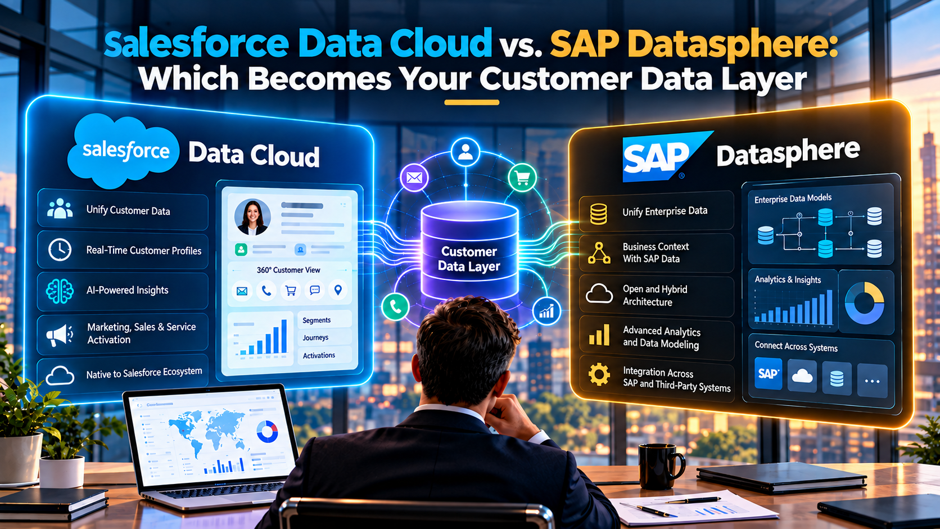
A manufacturer sells through dealers, runs orders and invoices in SAP, tracks accounts and opportunities through Salesforce integration services and keeps website behavior in a marketing tool. Its leadership wants a single view of each customer, an AI assistant that can answer account questions, and consistent consent records, and both vendors have a pitch: Salesforce offers Data Cloud, now branded Data 360, and SAP offers Datasphere, now part of SAP Business Data Cloud. Each pitch is credible, and each begins from a different place, which is why choosing between them is rarely a feature comparison.
This guide compares the 2 platforms as candidates for the customer data layer, covering what each product natively does, how identity and consent work, how zero-copy and federation change the architecture, how each is priced and which operating model fits which company. Most public comparisons come from vendors, resellers and competitors with commercial interests, so consumption figures appear as reported claims, and confirm every capability, price and licensing term with the vendors before relying on it.
TL;DR
- The 2 products start from different jobs. Salesforce Data 360 is built to unify customer profiles, resolve identities and activate them in Salesforce apps and AI agents, while SAP Datasphere is a business data fabric that integrates and models SAP and non-SAP data, and SAP’s profile-unification product is a separate offering, so the label customer data layer means something different for each vendor. That difference decides which product answers each requirement.
- Both are consumption priced, and consumption is hard to forecast. Data 360 uses credits that different operations draw at different rates, with 1 vendor blog claiming identity resolution costs 100,000 credits per million records, while Datasphere meters capacity units for compute, storage and data movement, so prove consumption on real data before committing to a pool. Pilot results on production-like data give a far better basis for budgeting than vendor estimates.
- Many enterprises will run both, and the winner depends on where customer data originates. A Salesforce-centric go-to-market team gravitates to Data 360, an SAP-centric order-to-cash business to Datasphere with SAP’s customer data platform, and mixed estates need a written rule about which system owns each entity and which direction data flows. Without that written rule, duplicate matching and conflicting metrics tend to appear within the first year of operation and are costly to unwind.
What “Customer Data Layer” Means, and Why Names Matter
A customer data layer is the part of the architecture where records about a person or an account are unified, governed and made available to the systems that act on them. Its jobs include ingesting data from many sources, resolving which records describe the same customer, storing consent, building profiles and segments, and serving that context to marketing, sales, service and AI tools. Platforms differ in how many of those jobs they do natively and how many they leave to partner products or custom work.
Naming adds confusion because both vendors have rebranded. Salesforce renamed Data Cloud to Data 360 at Dreamforce on October 14, 2025, as part of its Agentforce 360 launch, so older articles and contracts may use either label. SAP Datasphere is the successor to SAP Data Warehouse Cloud, and in February 2025 SAP announced Business Data Cloud, which brings together Datasphere, SAP Analytics Cloud, SAP Business Warehouse and SAP Databricks. Buyers should confirm which product names and bundles appear in each quote.
The scope of each vendor’s customer story also differs. Salesforce positions Data 360 as the real-time data engine that unifies customer data and powers its apps and agents. SAP describes Datasphere as a platform for integrating, cataloging, modeling and federating data with business context, and SAP Business Data Cloud brings that work into a wider data and AI architecture. Comparing the products fairly means comparing the jobs they do, beyond their names.
The Platforms at a Glance
| Dimension | Salesforce Data 360 (formerly Data Cloud) | SAP Datasphere and Business Data Cloud |
| Primary purpose | Unify customer data, resolve identities and activate profiles in apps and AI agents | Integrate, catalog, model and federate SAP and non-SAP data with business context |
| Customer profile unification | Native identity resolution and unified profiles | Typically handled by SAP Customer Data Platform, with Datasphere supplying business data |
| Natural data center of gravity | Salesforce CRM, marketing, commerce and service data | SAP S/4HANA, SAP applications and enterprise business data |
| Zero-copy and federation | Zero-copy access to platforms such as Snowflake, Databricks, BigQuery and Redshift | Federation and virtualization, plus data products shared with Databricks |
| Semantic layer | Customer 360 data model and Tableau Semantics, according to Salesforce-aligned sources | SAP-managed data products aligned to a common domain model |
| AI role | Grounds Agentforce and other Salesforce AI in unified customer data | Supplies business context for analytics, planning and AI, with SAP Databricks inside Business Data Cloud |
| Commercial model | Consumption credits | Subscription measured in capacity units |
Reading across the table shows that the 2 products overlap at the edges and diverge at the center. Data 360 is closer to a customer data platform with a strong activation story inside the Salesforce ecosystem, and Datasphere is closer to an enterprise data fabric whose strength is business semantics for SAP data. A buyer who needs both profile unification and rich ERP context will usually find that each product covers 1 half well and relies on connections for the other.
Salesforce Data 360: What It Does Well
Identity Resolution and Unified Profiles Identity resolution is widely cited as Data 360’s strongest capability. It uses deterministic and probabilistic matching rules to combine records from the same person across systems, such as different email addresses or device identifiers, into a persistent unified profile. For organizations with fragmented marketing, commerce and service records, this native capability reduces custom matching work, and review sites describe it as a core reason customers choose the product over assembling their own.
Zero-Copy Federation With External Platforms Zero-copy lets Data 360 query data where it lives, such as Snowflake, Databricks, BigQuery or Redshift, using virtual tables instead of duplicating records. 1 review describes the federation as bi-directional, with warehouse data feeding identity resolution and enriched insights flowing back without outbound ETL. A Salesforce-aligned source reports that the company processed more than 53 trillion records through zero-copy in fiscal 2026, though that claim comes through secondary coverage and should be confirmed.
Activation Inside Salesforce Apps and AI Agents Data 360 makes unified profiles available to Sales, Service Cloud, Marketing and Commerce Clouds, Flow and Agentforce, so the same context that segments an audience can brief a service agent or ground an AI agent. Because the data layer and the apps share a platform, activation requires less integration work than exporting profiles to a separate marketing tool, and that tight coupling is the strongest argument for choosing it in Salesforce-centric organizations.
Where Gravity and Complexity Show Up Reviews note that the value is highest when Sales, Service and Marketing Cloud are all in place, and that teams running a heterogeneous stack get less from the zero-copy and grounding advantages. Setup complexity is a recurring theme, and consumption credits are described as hard to forecast because unification, segmentation, activation and AI inference draw from 1 pool at different rates. Buyers should test these points against their own architecture.
SAP Datasphere and Business Data Cloud: What They Do Well
- Business semantics and SAP data products are the core strength. SAP describes Business Data Cloud as delivering fully managed data products aligned to a unified domain model that keeps original business context, and it says these products replace the Business Content that customers once maintained themselves, which is valuable when customer and order data originates in SAP S/4HANA and finance, supply chain and sales data must line up. Alignment of those definitions reduces reconciliation work later.
- Datasphere integrates and federates SAP and non-SAP data. It provides data integration, cataloging, semantic modeling, warehousing, federation and virtualization on SAP Business Technology Platform, which lets teams create a unified layer without physically moving every dataset into a central warehouse, and it suits organizations that need governed access to operational data across many systems. Business teams can reuse the same models across analytics and planning, which reduces duplicated logic between departments.
- SAP’s separate Customer Data Platform handles profiles and permissions. SAP describes SAP Customer Data Platform as unifying customer profiles and relationships at the individual or account level, orchestrating data according to privacy permissions and integrating ERP and supply chain data through a common data model, and community material shows it working with Datasphere and SAP Analytics Cloud through Direct Data Access. Buyers should confirm whether the Customer Data Platform is licensed separately from Datasphere in their agreement.
Identity, Profiles and Consent: Where Capabilities Differ
| Capability | Salesforce Data 360 | SAP Datasphere and SAP Customer Data Platform | What to Test |
| Identity resolution across channels | Native, with deterministic and probabilistic rules | Provided through SAP Customer Data Platform rather than Datasphere itself | Match rates on your messy data, merge rules and the ability to explain a merge |
| Unified profile at person level | Core capability, with calculated insights and segmentation | Profile unification in the Customer Data Platform | Profile freshness, attribute coverage and how profiles reach channels |
| Account and relationship hierarchies | Possible through the data model and CRM objects | Account-level relationships and ERP structures are a strength | B2B hierarchies, parent-child accounts and dealer networks |
| Consent and privacy permissions | Governance features within the platform | Permission-based orchestration described for the Customer Data Platform | Consent capture, propagation to downstream systems and audit trails |
| ERP, finance and supply chain context | Available through connectors and zero-copy, with more assembly | Strongest through SAP data products and the common domain model | Whether order, invoice and shipment data arrive with correct business meaning |
| Real-time activation | Strong inside Salesforce apps | Depends on connected engagement tools such as SAP Emarsys | Latency from event to action in your channels |
| Semantic consistency across tools | Customer 360 model and Tableau Semantics | SAP-managed data products and Datasphere semantic modeling | Whether metric definitions match across sales, finance and marketing |
This table summarizes vendor-described capabilities, and the right interpretation is that neither product wins every row. Data 360 leads when the work is person-level identity, where Salesforce’s identity resolution engine creates unified profiles from source records, and SAP’s stack leads when the work depends on ERP structures and business meaning. The last column matters most, because matching quality, consent propagation and latency vary with your data, so the proof-of-value should measure them on real records instead of vendor demonstrations.
Architecture Patterns: Zero-Copy, Federation and Replication
Both vendors have moved away from copying everything into a central store. Salesforce’s zero-copy integrations let Data 360 read external lakes and warehouses without duplicating data, and SAP’s federation and virtualization let Datasphere present data from remote sources while leaving it in place. Both patterns reduce storage and movement costs and can simplify governance, though they shift performance and cost to the source system, and federated queries are only as reliable and fast as the platform that holds the data.
Replication still has a role. Real-time activation, identity resolution at scale and consistent history often require data to land in the platform that performs the work, which is why Data 360 ingests and resolves records and Datasphere stores modeled data in its own layer. A practical design chooses, entity by entity, whether to federate, replicate or connect systems through MuleSoft integration, and documents the reasoning so teams don’t reintroduce uncontrolled copies later.
Warehouse-centric companies add another option. A company already centralized on Snowflake or Databricks can treat the warehouse as the customer data hub and connect either vendor to it, using Data 360 for activation and Datasphere or Business Data Cloud for SAP context. Reviews note that newer entrants activate straight from the warehouse with no duplication, so a buyer should ask whether a separate customer data layer is needed at all or whether the existing platform can serve that role.
Pricing and Consumption Models
| Dimension | Salesforce Data 360 | SAP Datasphere and Business Data Cloud |
| Unit | Consumption credits drawn by operations such as unification, segmentation, activation and AI inference | Capacity units covering compute, storage, integration and premium features |
| Published pricing | Credit-based, with rates varying by operation and contract | Calculator for capacity units, with commercial terms often negotiated |
| Forecasting difficulty | Reviews describe credits as hard to forecast | Advisors warn against committing to capacity units based on projections rather than measured use |
| Notable cost drivers | Identity resolution is described as the largest credit drain by 1 vendor blog | Compute blocks, storage and outbound data egress, according to 1 licensing advisor |
| Contract structure | Credits purchased in advance, with renewal and uplift terms | Business Data Cloud subscription separate from the BTP enterprise agreement, per 1 source |
| Questions to ask | How each operation converts to credits and what happens to unused credits | How capacity units map to workloads and whether added units keep the same rate |
Both vendors price by consumption, so the bill follows usage patterns that are hard to predict before the system runs on production data. The practical response is to run a pilot with real volumes, record credits or capacity units consumed per operation, extrapolate to full scale with a safety margin and negotiate flexibility to add capacity at the same rate. Treat third-party claims about rates as hypotheses to test, since pricing varies by contract and changes over time.
Cost Drivers and Forecasting
Data 360: Identity Resolution, Activation and AI Use 1 vendor blog claims identity resolution costs 100,000 credits per million records, and if that rate applies as described, resolving 20 million records would consume 2 million credits before any ongoing processing. Segmentation, activation to channels and AI inference also draw credits at different rates. Ask Salesforce to model your volumes by operation, ask how often resolution reruns as data changes and ask how unused credits are treated at renewal.
Datasphere: Compute, Storage and Egress A licensing advisor describes Datasphere cost as a function of provisioned compute blocks, storage volume and integration activity, metered in capacity units on top of an SAP HANA Cloud database, with outbound data egress drawing units when data leaves for other systems. That last point matters for a customer data layer that feeds many tools, because the more integrated the platform becomes, the more capacity it consumes, so model egress explicitly.
Hidden Costs in Both Cases Neither bill captures the work of data modeling, source connectors, consent design, testing and change management, and Salesforce implementation services or other partner effort can exceed the first year’s platform fees. Include internal staff time, partner services, data quality remediation and the cost of integrating each channel. Compare the 2 options on a 3-to-5-year total that includes these items and shows low, expected and high consumption cases, since a single point estimate hides the risk.
Operating Model and Implementation Considerations
- Skills determine how fast value arrives. Data 360 needs Salesforce administrators, data modelers and developers familiar with its data model and activation tools, while Datasphere needs SAP data engineers and BTP skills, and the practical question is which team already exists, because hiring and training for an unfamiliar platform is slower and costlier than extending an existing team. Salesforce consulting expertise and partner capacity in each ecosystem should be checked early, because experienced consultants are scarce in both.
- Data quality limits both platforms equally. Identity resolution matches what the sources contain, so inconsistent emails, missing keys and stale records reduce match quality in either architecture, and any plan should include a data profiling step, ownership for source cleanup and a way to measure match rates before and after. Profiling a sample of source records during selection shows how much cleanup is needed and gives each vendor a realistic test.
- Consent and privacy design must come first. The customer data layer concentrates personal data, which raises the stakes for consent capture, purpose limitation, retention and deletion, so define the rules, test propagation to every downstream system and keep audit evidence, regardless of whether profiles live in Data 360 or in SAP’s Customer Data Platform. Involve legal and privacy teams in design workshops from the start, since changing consent logic after launch is expensive.
Which Company Fits Which Platform
A Salesforce-Centric Go-to-Market Organization Companies whose customer relationships live in Salesforce Sales, Service, Marketing and Commerce Clouds and that want unified profiles for segmentation, personalization and Agentforce usually find Data 360 the shorter path. Native identity resolution and in-platform activation can work alongside Salesforce Pardot and marketing automation to reduce integration work, and the main risks are credit consumption and the need to bring ERP context in through connectors or zero-copy from SAP-side data platforms. Test how ERP context will arrive before committing to the architecture.
An SAP-Centric Manufacturer or Distributor Companies where orders, invoices, pricing and customer master data live in S/4HANA, and where sales run through dealers and distributors, benefit from SAP’s data products and account-level structures. Datasphere with SAP Customer Data Platform fits when the priority is aligning ERP and customer data, though teams should test whether SAP’s engagement tools meet marketing and service needs that Salesforce handles natively. Include dealer and distributor hierarchies in the proof of value to test account-level matching.
A Mixed Estate With Both Systems of Record Many mid-size and large enterprises run Salesforce for front-office work and SAP for operations, and they usually need both layers. Data 360 can own profiles and activation, SAP’s platform can own ERP context and financial data, and a defined exchange pattern connects them. The decision then turns on boundaries and ownership, covered in the coexistence section, instead of picking a single winner. Draw the exchange pattern on a single page and review it with both teams.
A Warehouse-First Company Organizations that already centralize data in Snowflake, Databricks or BigQuery may not need either product as the primary layer. They can use the warehouse as the hub, connect Data 360 through zero-copy for activation and connect SAP data through Business Data Cloud or other pipelines. The evaluation should ask which capabilities are missing from the warehouse, such as identity resolution and consent management, and buy only those. Buy only the capabilities that are genuinely missing from the warehouse.
Selection Criteria and Illustrative Weights
| Criterion | Illustrative Weight | What to Score |
| Customer identity and profile needs | 20% | Match quality on your data, profile freshness and explainability |
| Source system landscape | 20% | Where customer, order and finance data originate and how easily each platform reaches them |
| Activation channels and AI use cases | 15% | Latency, channel coverage and quality of grounding for AI agents |
| 5-year cost and predictability | 15% | Pilot-measured consumption, low and high cases and contract flexibility |
| Governance, consent and security | 10% | Consent propagation, auditability, residency and access controls |
| Skills and operating model | 10% | Availability of internal and partner expertise |
| Ecosystem and roadmap | 10% | Partner depth, product direction and openness to external platforms |
These weights are illustrative judgments rather than benchmarks, and they should change with your priorities. A retailer focused on personalization might raise activation and identity, and a manufacturer focused on order-to-cash alignment might raise source landscape and governance. Agree on the weights with marketing, sales, finance, data and security leaders before demos, so the scoring reflects company priorities instead of the most polished presentation, and document the rationale for leadership review.
The Coexistence Pattern: Using Both Without Duplicating Everything
Running both platforms works when responsibilities are explicit. A common arrangement lets Data 360 own person-level identity, unified profiles, segments and activation inside Salesforce apps, while SAP’s platform owns ERP-derived business data, financial context and governed data products. The 2 connect through federation, zero-copy, Delta Sharing or APIs, and each entity has a named system of record, so a customer’s credit status, for example, comes from SAP while their engagement history comes from Data 360.
The main risk is duplicated logic. If both platforms run identity resolution on the same people, or both define customer lifetime value differently, the organization ends up with competing numbers and an expensive reconciliation process. Decide which platform performs matching for which entity, publish the metric definitions once, and share them through the semantic layers each vendor offers. Treat data contracts between the platforms as formal agreements with owners, schemas, freshness targets and change procedures.
Governance ties the pattern together. Consent captured in 1 system must propagate to every system that uses the data, and deletion requests must reach copies and derived data in both platforms. Build a single record of processing activities, define who approves new data flows, and test the end-to-end path with synthetic customers before go-live. A coexistence design that works on a whiteboard but lacks tested consent and deletion paths creates compliance exposure that outweighs the benefit of the integration.
How to Run the Evaluation
- Start with 3 prioritized use cases. Pick scenarios such as a unified service view of a customer with open orders, a segment for a retention campaign and an AI agent answering account questions, then define success measures, data sources, freshness needs and consent rules, so both vendors are tested on identical work that the business actually cares about. Keep the list short so the pilot finishes quickly and the results stay comparable.
- Run a proof of value on real data. Load a representative sample, measure match rates, profile completeness, latency and credits or capacity units consumed, and ask each vendor to explain the results, since a pilot with production-like data reveals complexity and cost that demonstrations hide. Ask each vendor to document assumptions, such as refresh frequency and matching rules, so the consumption you measure can be repeated at production scale without costly surprises later.
- Test consent and deletion paths end to end. Create test customers, change their consent status, request deletion and verify that the change reaches every downstream tool and copy, and keep the evidence, since regulators and auditors ask for proof of operation beyond written policy. Include at least 1 deletion request that spans copies in both platforms, and capture timestamps for each step so auditors can see how long propagation takes in practice.
- Negotiate contract terms that match consumption risk. Ask for the ability to add credits or capacity units at the same rate, clarity on how unused units are handled, defined overage rates, renewal uplift caps, export rights and termination assistance, and obtain the entitlement details for bundled products in writing. Obtain entitlement details for any bundled products in writing, because verbal assurances from a sales conversation won’t help during a true-up at renewal.
Common Mistakes
Treating the Product Names as Equivalent Data 360 and Datasphere share a place in vendor marketing, though they do different jobs. Assuming that Datasphere resolves identities like a customer data platform, or that Data 360 models ERP data like a business data fabric, leads to gaps discovered late in the project. Compare the capabilities required for each use case, and identify which additional products, such as SAP Customer Data Platform, belong in the comparison. That check takes an hour and prevents months of rework.
Buying Capacity Before Measuring Consumption Committing to a large pool of credits or capacity units based on a vendor projection leaves the buyer exposed to either overage charges or stranded prepaid capacity. Run a pilot, measure consumption by operation, build low, expected and high scenarios and negotiate flexibility to add capacity at the same rate, since consumption pricing rewards buyers who understand their workload and penalizes those who guess. Written flexibility terms matter as much as the unit price.
Ignoring Source Data Quality Neither platform can resolve identities that the source data doesn’t support. Duplicate records, missing keys and inconsistent formats limit match quality and inflate processing, and a plan without data profiling and ownership for cleanup will underdeliver on any platform. Include remediation work in the schedule and budget, and measure improvement over time so leadership sees progress. Early profiling gives both vendors the same realistic starting point for their estimates and schedules.
Skipping the Ownership Rules in a Mixed Estate Running both platforms without a written system of record for each entity produces duplicate matching, conflicting metrics and consent gaps. Define which platform owns each entity and metric, document data contracts, name accountable owners and review the arrangement as capabilities change, because both vendors continue to add features that blur the boundary between customer data and business data. Review the rules whenever either vendor ships major features that overlap the other platform.
FAQs
Is Salesforce Data Cloud the same as Data 360?
Yes. Salesforce renamed Data Cloud to Data 360 at Dreamforce on October 14, 2025, as part of its Agentforce 360 launch, and the product is the same engine under a new name. Older contracts, documentation and articles may still use Data Cloud, so confirm the product names and bundles in any quote and make sure the entitlements match what you expect to receive. Check that renewal paperwork uses the current product names too.
Is SAP Datasphere a customer data platform?
Not by itself. SAP describes Datasphere as a platform for integrating, cataloging, modeling and federating data with business context, and it offers a separate SAP Customer Data Platform for unifying customer profiles and managing permission-based data. The 2 can work together, and community material describes Datasphere and the Customer Data Platform connected through Direct Data Access, so evaluate them as a combination. Ask SAP which of these products are included in your quote.
Can Data 360 and SAP Datasphere work together?
Yes, and many enterprises run both. Data 360 can own person-level identity, profiles and activation, while SAP’s platform supplies ERP-derived context and governed data products, connected through federation, zero-copy, data sharing or APIs. Success depends on naming a system of record for each entity, avoiding duplicate identity resolution and testing consent and deletion across both platforms. A written data contract between the platforms keeps responsibilities clear as both vendors add features.
How are the 2 platforms priced?
Both use consumption models. Data 360 draws credits at different rates for operations such as unification, segmentation, activation and AI inference, and Datasphere meters capacity units for compute, storage, integration and related features, with Business Data Cloud sold as a separate subscription according to 1 source. Rates vary by contract, so run a pilot, measure consumption and request written quotes. Ask each vendor for a written sizing based on your pilot results.
Does Data 360 require Salesforce CRM?
Data 360 can ingest data from many sources and use zero-copy access to external platforms, so it isn’t limited to Salesforce records. Reviews note that its strongest advantages, such as in-platform activation and Agentforce grounding, appear when Sales, Service and Marketing Cloud are in use. Teams with heterogeneous stacks should test whether the benefits justify the cost for their architecture. Run the proof of value on your actual mix of sources and channels.
Does Business Data Cloud require RISE with SAP?
Sources report restrictions that vary by component. 1 source says SAP Databricks inside Business Data Cloud was initially limited to RISE Private customers, and another says fully managed data products and insight apps remain exclusive to RISE customers, while on-premise S/4HANA customers can still use Datasphere. These reports may change, so ask SAP to confirm entitlements in writing for your landscape. Entitlements can change as SAP adjusts packaging, so recheck before renewal.
What if we already use Snowflake or Databricks?
Consider using the warehouse as the data hub and buying only the capabilities it lacks, such as identity resolution, consent management or activation. Data 360 offers zero-copy access to Snowflake, Databricks, BigQuery and Redshift, and SAP shares data products with Databricks, so either vendor can connect to an existing platform. Test whether a separate customer data layer adds enough value to justify its cost.
How should we run a proof of value?
Choose 3 prioritized use cases, load representative data and measure match rates, profile completeness, latency and consumption for each vendor. Test consent changes and deletion requests end to end, record credits or capacity units used per operation and extrapolate to production volumes with low, expected and high cases. Use the results to score proposals and negotiate flexible capacity terms. Share the scoring sheet with both vendors in advance so the criteria are transparent.
