
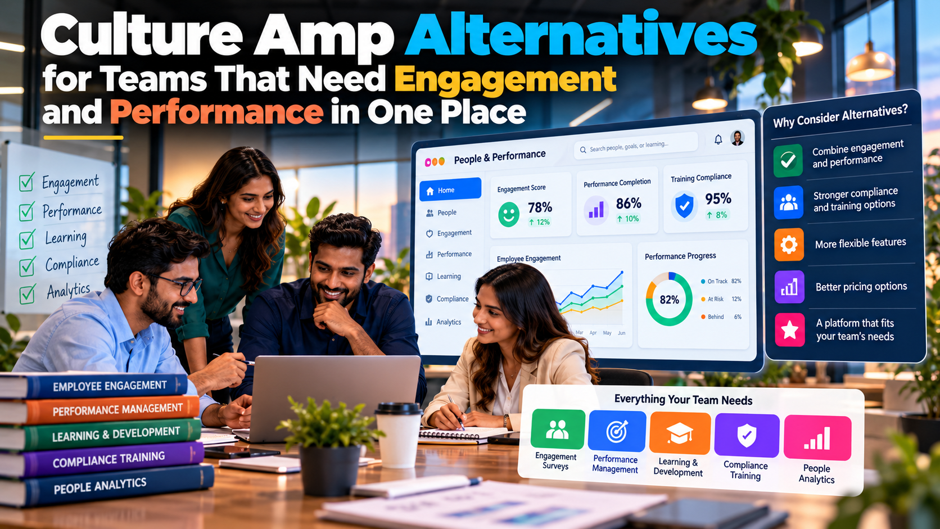
A 400-person software company has run its engagement surveys in Culture Amp for 3 years, and the survey side works well: response rates are high, managers read their reports and the benchmarks are useful. The trouble starts after the survey closes. Performance reviews, goals and 1:1 notes live in a separate tool, so a manager who sees low scores on career growth in 1 system has to open another to see whether the same people have goals, development plans or overdue reviews, and the people team spends days stitching the 2 pictures together for leadership.
This guide is for teams in that position. It looks at what engagement and performance in one place should mean, profiles the all-in-one candidates, engagement-first options that need a partner and HRIS-first platforms, then covers anonymity and privacy when survey data meets review data, cost arithmetic for 400 people, scenarios, a 90-day switch plan, a scoring sheet and mistakes to avoid. Almost every public comparison comes from a vendor with a stake, and prices conflict, so figures are attributed and should be confirmed in writing.
TL;DR
- Engagement-first tools and performance-first tools start from different places. Several comparisons describe Culture Amp as strongest in engagement listening with performance management that isn’t its core strength, while Lattice, Leapsome and 15Five combine surveys with reviews, goals and check-ins, so the right shortlist depends on which side of the work you can’t compromise on. Start from the capability your teams can’t give up, then test the others against it in a scripted demo.
- Prices are published inconsistently, so the safest math is a range. Sources list Lattice from $4 per seat for engagement alone to $11 for performance and $25 at full build-out, 15Five from $4 to $16 and Leapsome from $3 or $8 to $15, which turns a 400-person annual bill into anything from roughly $19,200 to $120,000 depending on modules. Ask every vendor for line-item quotes built on the same modules before comparing totals.
- Linking surveys to performance data creates privacy duties. Combining engagement results with reviews, ratings and goals can expose individual responses if group thresholds, manager access and data use rules aren’t set carefully, so define anonymity limits and written data rules before launch, and keep survey history from Culture Amp for trend continuity. Ask each vendor to show, with test data, how anonymous responses stay separate from identifiable performance records and small teams.
Where Culture Amp Fits, and Where Teams Outgrow It
Engagement Listening Is the Strength Culture Amp is best known for engagement surveys, benchmarks and analytics, and comparison pages repeatedly place it in the engagement-first group. 1 head-to-head comparison says that while it offers performance management, performance isn’t its core strength, and another describes the performance product as newer and still short of parity with dedicated tools. Teams whose main goal is a strong listening program, with trend lines and benchmarks, often stay satisfied for years because that’s the product’s center of gravity.
The Gap Shows Up When Reviews and Goals Matter as Much as Surveys Teams outgrow an engagement-first tool when managers need reviews, OKRs, calibration, compensation links or structured 1:1s in the same system as survey results. At that point, 2 tools mean 2 logins, 2 employee records and a manual effort to connect insights to actions. Review sites describe the alternative as consolidating performance and engagement under 1 vendor, with 1 dashboard for team goals, survey scores and pending reviews, which is the use case this guide addresses.
Cost and Complexity Are Other Triggers Culture Amp’s pricing is described as opaque, which makes budgeting and renewal negotiation harder, and some teams report paying for more analytic depth than they use. Others find the survey rhythm and the performance rhythm don’t line up, so action plans from surveys never reach review conversations. None of these is a reason to leave on its own, but together they explain why people teams ask whether a combined platform would reduce friction without sacrificing the listening quality they value.
Staying Is Still a Legitimate Outcome A switch is expensive, and 1 consolidated platform can be weaker in 1 area than 2 specialists. If survey quality, benchmarks and analytics drive your decisions and performance management is handled well elsewhere, the pain may be integration rather than product choice. The last section of this guide describes when staying with Culture Amp is the better call, and the scoring sheet in the middle helps quantify the tradeoff so the decision rests on evidence.
What “One Place” Should Mean
- 1 employee record that survey and performance data both attach to. The value of consolidation comes from linking results to context, such as team, tenure and manager, so a leader can see engagement trends beside goal progress and review completion without exporting spreadsheets, which means data model and permissions matter more than the number of modules on a feature page. Ask each vendor to show 1 profile with both kinds of data.
- Survey results that lead to actions inside the manager’s workflow. Action planning tools that turn a low score into a task, a 1:1 topic or a development goal close the loop that separate systems leave open, and several vendors emphasize manager insights and suggested actions, so test whether the follow-up lives where managers already work. Ask to see a low score become a goal, a task or a 1:1 topic without leaving the platform.
- Reviews, goals and 1:1s that use survey context without exposing individuals. Managers should see team-level trends and themes, and performance conversations shouldn’t reveal who said what, so the platform needs thresholds, role-based access and clear separation between anonymous survey data and identifiable review data. Test this with a sample team of 4 people, where a single comment could reveal its author, and confirm that managers see themes and aggregates only, never individual responses tied to names.
The Shortlist at a Glance
| Candidate | Type | Reported Starting Price | Notes From Sources |
| Lattice | All-in-one performance and engagement | Engagement from $4 per seat per month with a $4,000 annual minimum, performance from $11, $25 at full build-out in 1 source | Strong in reviews, goals and compensation, engagement as an add-on |
| Leapsome | All-in-one with learning | $3 in 1 source, $8 to $15 for fuller suites, often quote-based | Surveys, reviews, OKRs, learning and compensation, popular in Europe |
| 15Five | Manager-focused continuous performance with engagement | $4 for Engage up to $16 for the full platform, $9 to $15 in 1 comparison | Weekly check-ins, manager insights, OKRs, reviews |
| Quantum Workplace | Mid-size engagement plus performance | Contact sales | Described as practical for mid-size companies wanting both |
| Workday Peakon | Engagement-first for Workday customers | About $10 to $14 estimated, no published rate | Listening inside the Workday ecosystem |
| Microsoft Viva Glint | Engagement-first for Microsoft 365 | About $6 per user per month in 1 source | Surveys delivered inside Teams |
| Qualtrics | Enterprise experience analytics | Custom quote | Deep analytics and 300 or more benchmarks, described as complex and expensive |
| BambooHR | HRIS with light engagement and performance | Performance on higher plans | Suits small teams wanting HR plus basics |
The table mixes categories on purpose, because teams asking for engagement and performance in 1 place can reach that goal in several ways. All-in-one platforms consolidate, engagement-first products pair with a separate performance tool and HRIS-first systems add light features to a core record. Prices come from third-party comparison pages that conflict, so treat them as orientation. The next sections explain where each group fits, and a cost section shows how the arithmetic changes when 2 products replace 1.
All-in-One Candidates, Profiled
Lattice Review sites describe Lattice as the most widely adopted all-in-one alternative for mid-market organizations that want performance management and engagement under 1 vendor, with OKRs, reviews, calibration, 1:1s, engagement and pulse surveys, eNPS, benchmarks and compensation tools. Reviewers note configurable anonymity thresholds and suggested action planning, and criticize premium pricing and some extra steps for simple tasks. 1 comparison says Lattice is easier to implement for teams new to continuous performance management.
Leapsome Leapsome is described as a modular people enablement platform covering engagement surveys, reviews, goals and OKRs, learning paths, meetings and compensation, with strengths in European markets, GDPR posture and data residency. Comparisons call it the most direct Lattice competitor in scope, and 1 says it beats Lattice on OKR depth and learning integration. Drawbacks cited include a heavier feel for small teams and costs that can climb as modules are added.
15Five 15Five is positioned around manager effectiveness: weekly check-ins, 1:1s, objectives, performance reviews, engagement surveys and an outcomes dashboard with AI coaching for managers. Its logic, per 1 review, is that managers gather feedback through daily management rather than through top-down surveys alone. It’s often the most affordable full performance option in comparisons, with published tiers from engagement-only to a total platform, and it suits teams that prioritize manager habits over formal review machinery.
Quantum Workplace Quantum Workplace appears in comparisons as a practical option for mid-sized companies that want engagement and performance together without enterprise complexity. Public detail is thinner than for the other 3, and pricing generally requires a conversation with sales, so treat it as a candidate to test, not as a settled recommendation. Ask for references from companies of similar size and request the same demonstration script you give every other finalist.
Engagement-First Options That Need a Performance Partner
- Workday Peakon is the natural choice for Workday HCM customers. Comparisons describe it as engagement listening inside the Workday ecosystem, with estimated pricing of about $10 to $14 per user per month and no published rate, and they recommend it when native system integration matters more than platform flexibility, which also means performance management would come from Workday’s own modules. Ask what the Workday performance modules cost on top of the survey product.
- Microsoft Viva Glint suits organizations standardized on Microsoft 365. It delivers surveys inside Teams, avoids a separate login and appears in 1 source from about $6 per user per month, and the argument for Viva Glint is higher participation through familiar tools, though performance reviews and goals would need another product if Viva doesn’t cover them. Check whether Teams-based surveys reach employees who rarely use Teams, such as plant or field staff.
- Qualtrics offers enterprise-grade analytics and benchmarks. 1 comparison credits it with AI insights, more than 300 benchmarks and lifecycle surveys, and also calls it complex to set up and expensive, so it fits large organizations with research capacity and a dedicated analyst, and a performance tool would sit beside it. Ask what analyst time and training the platform needs before the first survey runs, since those costs rarely appear on the quote.
HRIS-First Options and Where They Stop
Some teams reach the same goal from the other end by choosing an HRIS that includes performance and basic engagement. BambooHR is described as an HRIS with performance features on its higher plan and light engagement, suited to small and mid-size teams that want HR, time off and basic reviews in 1 place, while HiBob is described as a modern HRIS with performance and engagement modules priced by quote. Comparisons also note that performance depth is limited relative to dedicated platforms.
The tradeoff is breadth versus depth. A single HRIS record is convenient, and permissions, org charts and employee data are already there, which removes integration work. But survey design, benchmarks, calibration and analytics may be thinner than in specialist tools, and action planning may be basic. Teams under about 200 employees with simple review cycles often find the depth sufficient, while larger teams with several business units usually outgrow it and look again at all-in-one platforms or specialist pairs.
If you’re already on an HRIS, check what it offers before buying anything. A feature you already own, even if less polished, may meet a need at no added license cost, and testing it with a pilot team costs far less than a platform migration. Compare the HRIS option on the same scoring sheet as the others, with the same data and demo script, and record whether managers actually use the features, because adoption matters more than the feature list.
Anonymity and Privacy When Surveys Meet Reviews
| Risk | Why It Happens | Control to Require |
| Small-group exposure | A team of 4 with 1 critical comment makes the author guessable | Minimum group size for reporting, commonly set between 5 and 10 responses |
| Linking responses to performance records | A shared employee record can tie identity to answers | Separate anonymous response storage from identifiable review data |
| Slicing by demographics | Filters by tenure, location and role shrink groups to a person | Suppress cells below the threshold and limit combined filters |
| Manager access to comments | Verbatim comments can reveal writers through details | Comment review, masking and aggregated themes for managers |
| Using survey data in ratings | Engagement scores used to judge individuals harm trust | Written policy that survey data informs team actions rather than individual evaluations |
| Regional and works council rules | Some jurisdictions require consultation and strict data handling | Legal review, data residency options and documented lawful basis |
| Data retention and deletion | Old survey and review data linger | Retention schedule and deletion tools for both datasets |
Anonymity is the issue that most often surprises teams moving from a separate survey tool to a combined platform. Engagement tools promise confidentiality, and performance tools hold identifiable records, so a combined system must prove that the 2 data types stay separate. Reviews describe configurable anonymity thresholds in at least 1 all-in-one product, but you should test the controls, read the privacy documentation and have legal and employee representatives review the design before the first survey runs.
Cost Math for 400 People
All-in-One Platforms at Listed Prices Using the ranges in third-party sources, Lattice engagement at $4 per seat per month is 400 times $4 times 12, or $19,200 a year. Performance at $11 is $52,800, and the $17 bundle cited for performance plus engagement in an earlier source is $81,600. 15Five from $4 to $16 runs $19,200 to $76,800, and Leapsome at $8 to $14 runs $38,400 to $67,200. Lattice’s $4,000 annual minimum isn’t binding at this size.
Pairing 2 Specialist Tools An engagement-first product plus a separate performance tool can cost more. Workday Peakon’s estimated $10 to $14 and Lattice’s $11 performance price together are $21 to $25 per seat, which is 400 times $21 times 12, or $100,800, up to 400 times $25 times 12, or $120,000. Viva Glint at about $6 plus the same performance price is $17 per seat, or $81,600. The pairings can match all-in-one cost or exceed it, before integration work and 2 administrator workloads.
What the Ranges Don’t Show Per-seat prices exclude implementation, integration, training, premium support and renewal increases. An earlier benchmark in this series put talent software implementation at 15% to 35% of first-year license, and custom integrations at $5,000 to $25,000 each. A 400-person company at $67,200 a year might see $10,080 to $23,520 of implementation alone. Prices also vary by tier and contract, so request line-item quotes for the same users and modules from every vendor.
How to Compare Fairly Convert each proposal to a 3-year total with the same headcount, modules, integrations and support level. Add internal administration time for each option, since 2 tools need more, and add the cost of a transition from Culture Amp, including data export, survey redesign and communication. The cheapest per-seat price rarely wins on a 3-year total, and the more informative question is which option delivers the reports and workflows your leaders need with the least manual work.
7 Scenarios and the Best-Fit Path
| Scenario | Likely Best Fit | Why |
| Desk-based mid-market team wanting reviews, goals and surveys in 1 tool | Lattice or 15Five | Published pricing and combined modules in 1 interface |
| Company that wants learning, OKRs and engagement together | Leapsome | Broad scope with learning in the same platform |
| Managers need coaching and weekly rhythm more than formal reviews | 15Five | Check-ins and manager insights are the center of the product |
| Already on Workday HCM | Workday Peakon plus Workday performance modules | Native integration with the system of record |
| Microsoft 365 standardized and engagement-led | Viva Glint plus a performance tool | Surveys inside Teams improve participation |
| Frontline workforce without regular email | Multi-channel listening tool plus a performance tool | SMS or messaging surveys reach people who skip email |
| Small team under 200 with simple reviews | HRIS-first platform | Core HR, light performance and low cost |
Scenarios simplify real organizations, and many companies fit 2 rows at once. A company on Workday with a frontline workforce, for example, may choose Peakon for listening and a separate tool for hourly employees. Use the table to narrow the shortlist to 2 or 3 candidates, then test them with scripted demonstrations, because the difference between a good fit and a poor one often appears only when real data and real managers are involved, not on a feature list.
Keeping Your Culture Amp History: Benchmarks and Trend Continuity
Years of survey history are an asset, and a switch can break trend lines if it isn’t planned. Before moving, export results by survey, item and demographic group, along with question wording, scales and response rates, and keep a copy in a secure location. If the new platform uses different questions or scales, map old items to new ones where possible, and decide which questions to keep unchanged for at least 1 cycle so leaders can compare year over year without confusion.
Benchmarks are the part that’s hardest to replace. Vendors draw benchmarks from their own customer bases, so a new platform’s industry comparisons will differ from what leaders know. 1 comparison credits Qualtrics with more than 300 benchmarks, and Lattice lists benchmarks among its survey features, but coverage varies by industry and region. Ask each vendor how it builds benchmarks, which segments are available for your industry and size, and how often they refresh, and consider overlapping both tools for 1 survey cycle to calibrate the difference.
Plan the communication as carefully as the data. Employees may be surprised by a new survey format and may worry about confidentiality in a platform that also holds performance data. Tell them what’s changing, why, who sees what and how anonymity is protected, and explain that old results remain available to leaders at the team level. A clear message before the first survey in the new tool often matters as much as the tool, because response rates depend on trust.
A 90-Day Switch Plan
- Days 1 to 15: define requirements and export history. Write down the reports leaders need, the survey and review cadence, the integration list and the privacy rules, then export Culture Amp history and agree on which survey questions will stay unchanged, so vendor conversations start from a written brief and the team has a safe copy of past data before anything moves. Put the brief in 1 document that every vendor receives.
- Days 16 to 35: run scripted demos and score vendors. Give each finalist the same sample data and script, such as a survey result linked to a team goal and a pending review, have at least 3 people score each demo using the weighted sheet and check references from companies of similar size, because a shared script makes differences visible and protects against a polished presentation. Record the sessions for later review.
- Days 36 to 55: configure, integrate and test privacy controls. Connect the HRIS and single sign-on, set group thresholds, role permissions and comment rules, then test with synthetic data, including small teams and filtered views, to confirm that anonymous survey data can’t be linked to identifiable review records, and have legal or privacy staff review the setup. Document the settings so the same thresholds apply in every environment and every cycle.
- Days 56 to 75: pilot with 2 or 3 teams. Run a short pulse survey, a goal-setting session and a 1:1 cycle with managers who volunteered, record the time administrators spend and the questions managers ask, and fix gaps in templates, notifications and permissions before a wider rollout. Choose pilot teams of different sizes, including at least 1 small team, so the anonymity thresholds are exercised with real responses during the pilot.
- Days 76 to 90: train managers and launch. Hold short manager sessions on reading team results, turning scores into actions and protecting anonymity, communicate the changes to all employees and set a review at 30 days to check participation, support tickets and early feedback, with an overlap plan for Culture Amp until the first full cycle completes. Keep a short feedback form open for the first 2 weeks after launch day.
Scoring Sheet and Demo Script
| Criterion | Illustrative Weight | What to Test |
| Survey quality, benchmarks and analytics | 20% | Question library, pulse options, benchmark segments and trend continuity |
| Performance depth | 20% | Reviews, calibration, goals and OKRs, 1:1s and compensation links |
| Link between survey results and actions | 15% | Manager action planning that creates goals, 1:1 topics or tasks |
| Privacy and anonymity controls | 15% | Thresholds, separation of datasets, comment handling and role access |
| Integrations and data model | 10% | HRIS sync, single sign-on, Slack or Teams, 1 employee record |
| Reporting for leaders | 10% | The 3 reports executives request most, built from sample data |
| 3-year cost and contract terms | 10% | Line-item totals, renewal caps, minimums and exit rights |
The weights are illustrative judgments rather than benchmarks, and teams should set their own before the first demo. A company whose survey program is its strategic asset might raise the first row, while one whose managers struggle with reviews might raise the second. Keep the demo script identical for every vendor, use real anonymized data where possible and ask each vendor to show, not describe, how a low survey score becomes a manager action and how an individual’s answer stays protected.
Rollout Mistakes That Undo the Value
Buying the Platform and Skipping the Operating Rhythm A combined platform doesn’t create a cadence on its own. If surveys, reviews and goal check-ins run on separate calendars with separate messages, employees feel the same fatigue they felt with 2 tools. Plan the year on 1 calendar, decide which weeks carry surveys and which carry reviews, and give managers a simple monthly routine that uses both types of data, because the value of consolidation appears only when the rhythm is shared.
Linking Survey Data to Individual Ratings Some leaders are tempted to use engagement scores to judge individual managers or employees, and that destroys honesty in the next survey. Set a written rule that survey data informs team-level actions and manager coaching, and that individual survey responses are never visible to anyone, and apply the same rule to comments. Employee trust is slow to build and fast to lose, and a single incident can reduce response rates for years.
Migrating Everything Without Cleaning It A move is a chance to retire outdated survey questions, unused review templates and inactive goals. Teams that import everything inherit old clutter, and managers see a confusing system on day 1. Decide what moves, what stays archived and what is deleted, keep the questions needed for trends and test the migrated data with a sample before launch, so the new platform opens clean and credible. Archive whatever you remove, with a note on why.
Underestimating Manager Training Managers decide whether survey insights lead to action. Without short, practical training on reading team reports, running an action planning conversation and protecting anonymity, they ignore the new features or misuse them. Budget manager sessions and office hours for the first 2 cycles, give managers a 1-page guide and track whether action plans are created, because adoption by managers is the strongest predictor of value from any platform in this category.
When Staying With Culture Amp Is the Right Call
Staying is sensible when the engagement program is the product you value and performance management works well elsewhere. If leaders trust the benchmarks, managers act on results and the performance tool is stable and liked, then the pain may be a missing integration rather than a missing module. Compare the cost of a switch, which includes implementation, retraining, lost trend continuity and communication, against the cost of improving the connection between the 2 tools through a better integration or a monthly reporting routine.
A few signs favor staying. Your survey response rates are high and leaders use the data. Your performance process is mature and uses tools or templates people like. Your people team is small and can’t absorb a migration this year. Your compliance or data residency needs are met by the current setup. In those cases, the best action may be to document the handoff between systems, assign an owner for the combined view and revisit the question at the next contract renewal with better data.
Whichever way you decide, use the same scoring sheet and demo script to document the choice. Include the reports leaders need, the privacy controls, the 3-year cost and the risks of change, and store the record where the next people leader will find it. A decision made with evidence is easier to defend to finance, to the board and to employees, and it makes the next review of the stack faster, because the criteria and the data are already written down.
FAQs
Does Culture Amp include performance management?
Yes, Culture Amp offers performance management, but comparison sources describe engagement as its core strength and performance as less central or newer than dedicated tools. If performance depth, calibration or compensation links are critical, test its performance features against your actual process in a demo, and compare them with an all-in-one platform such as Lattice or Leapsome using the same script. Ask for a recorded demo of its review cycle with your own templates.
What are the best Culture Amp alternatives for engagement and performance together? Comparisons most often name Lattice, Leapsome and 15Five for combining engagement surveys with reviews, goals and check-ins, and some add Quantum Workplace for mid-size companies. Lattice leans toward performance and compensation, Leapsome adds learning and has European strength, and 15Five focuses on manager habits. The best fit depends on your size, cadence and priorities, so test 2 or 3 finalists.
How much do these alternatives cost?
Published prices conflict. Sources list Lattice from $4 per seat per month for engagement and $11 for performance, with bundles higher, 15Five from $4 to $16 and Leapsome from $3 or $8 to $15, while Culture Amp and Peakon are quote-based. For 400 people, that spans about $19,200 to $120,000 a year depending on modules, so request line-item quotes. Ask each vendor to confirm minimums, tiers and renewal caps in writing.
Is it cheaper to pair an engagement tool with a performance tool?
Not necessarily. At 400 people, the illustration here shows Peakon’s estimated $10 to $14 plus Lattice performance at $11 totaling $100,800 to $120,000 a year, which can exceed an all-in-one platform’s range. Pairing can still make sense when engagement depth or an existing ecosystem matters most, but add integration cost and extra administration time to the comparison. Request line-item quotes for both options, with the same headcount and support level, before deciding.
Can survey results stay anonymous in a combined platform?
They can, if the platform and your policies are set up for it. Require minimum group sizes for reporting, separate storage for anonymous responses and identifiable review data, limits on demographic filtering, comment masking and clear rules against using survey data in individual ratings. At least 1 all-in-one product is described as offering configurable anonymity thresholds, so test the controls with small teams. Involve legal and employee representatives in the review.
How do we keep our survey history and trends when we switch?
Export results by survey, item and demographic group with question wording and scales, store them securely and map old questions to new ones. Keep some questions unchanged for at least 1 cycle, and consider running both tools through 1 survey to compare results. Ask the new vendor how its benchmarks are built, since industry comparisons will differ from what leaders know. Store the export where the next people leader can find it.
How long does a switch take?
A focused plan can take about 90 days from requirements to launch, covering vendor selection, configuration, privacy testing, pilot and manager training, and more complex organizations take longer. Avoid switching in the middle of a review cycle or immediately before a survey, and keep Culture Amp available through the first full cycle in the new platform. Add time for works council or legal review where it applies to your employees.
When should we stay with Culture Amp?
Stay when the engagement program is the capability you value most, performance management works well elsewhere and the real problem is a missing connection rather than a missing module. Consider a better integration or a monthly combined report first, compare that cost with a full migration and revisit the decision at renewal using a written scoring sheet and 3-year totals. Write down the reasons and the review date.
