
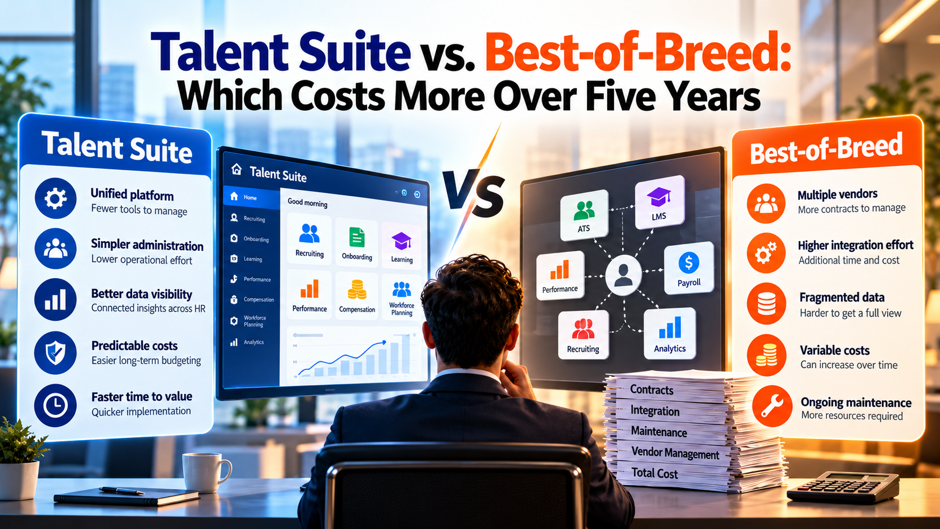
A people team at a 500-person company gets 2 pitches in the same month. The suite vendor says consolidation lowers total cost, because 1 contract, 1 integration and 1 administrator console replace several. The best-of-breed vendors say each of their tools is cheaper and better in its own category, so a stack of 4 specialists wins on both price and quality. Each side brings a spreadsheet, each spreadsheet leans on different assumptions, and the finance partner asks the obvious question: over 5 years, which one actually costs more.
This guide builds the answer from the ground up. It starts with how to read published cost claims, lists the cost components that differ, builds a transparent 5-year model for 500 employees, tests which assumptions flip the result, and then covers hybrid stacks, switching costs, contract terms, a decision guide and mistakes. Published sources are mostly vendors and consultancies with a stake in the answer, and they conflict, so the model uses stated assumptions that you should replace with your own quotes.
TL;DR
- Published claims point in opposite directions, so build your own model. 1 suite-oriented guide says connected suites cost 50% to 150% less than 3 or 4 point solutions, an automation consultancy says best-of-breed costs 5% to 15% more in subscriptions while delivering efficiency gains, and mid-market guides lean toward unified platforms, so no source settles the question without your assumptions and your quotes. Treat each figure as a hypothesis to test.
- In the 500-employee model, the suite wins by $173,910 to $290,258 over 5 years. The suite totals $768,175 to $939,346 and 4 point tools total $942,086 to $1,229,604, and about 69% to 78% of the gap comes from integration and administration time rather than from license fees, which differ by under $52,000. Ask each vendor for written quotes so the license, implementation and support lines can replace the placeholders in this model.
- The answer flips under specific conditions. The suite’s price would need to reach about $22.84 to $24.67 per employee per month, against $18 assumed, before best-of-breed wins, and if best-of-breed administration time matched the suite’s, the gap shrinks to $80,160 to $196,508, so verify admin hours, integration cost and escalators first. Measure admin hours for a quarter, then rerun the model with your own numbers before you negotiate any contract this year.
How to Read 5-Year Cost Claims
Nearly every published comparison of suites and point solutions comes from a company that sells 1 of them. A connected-suite vendor says total cost is much lower once replaced tools and integration upkeep are counted, an automation consultancy that builds integration’s for best-of-breed stacks says the subscription premium is modest, and general SaaS blogs cite statistics about integration failures and maintenance hours without describing their method. Each claim can be consistent and still depend on what the author counted.
Most of the disagreement is about 3 inputs: how many tools the suite replaces, how many hours of administration each model needs and how much integration work a best-of-breed stack requires. A guide for HR software buyers says first-year total cost typically runs 1.5 to 2.5 times the quoted subscription once implementation and integration’s are included, which shows why the sticker price misleads in both directions. Any comparison that uses only per-employee prices is comparing the part of the bill that matters least.
A 5-year view is a better horizon than 3 for talent technology because the costs that separate the models compound slowly. Annual escalators at renewal, integration maintenance, repeated vendor upgrades and the cost of leaving all show up in years 3 through 5, and many contracts run 3 years before the first renegotiation. The 5-year view also forces a question that a first-year view hides: what does it cost to change course, in either architecture, if the first choice turns out to be wrong.
Where the 2 Models Really Differ in Cost
| Cost Component | Talent Suite | Best-of-Breed Stack | Why It Differs |
| Subscription | A bundle price per employee per month, often $12 to $30 or more in 1 source | The sum of separate module prices, such as performance at $4 to $10, learning at $3 to $8, succession at $2 to $6 and add-ons at $1 to $5 | Bundles discount, and separate tools price each function in isolation |
| Implementation | 15% to 35% of first-year license in 1 guide, higher for enterprise suites | The same share, repeated for each tool | Several projects mean several rounds of setup, testing and training |
| Integration build | 1 connection to the HR system | 1 connection per tool, reported at $5,000 to $25,000 each | More tools need more interfaces |
| Integration maintenance | Small | Larger, since each interface changes with each vendor release | An annual maintenance share of build cost is an assumption in this guide |
| Administration | 1 console, 1 permission model | Several consoles and permission models | Admin hours rise with the number of systems |
| Support premium | 10% to 20% of license in 1 source, and about 22% in 1 suite guide | The same share across several contracts | Tiers are often priced as a share of license |
| Annual escalators | 3% to 8% in suite guides | 3% to 7% per contract | Every contract escalates on its own schedule |
| Switching cost | Higher, since a suite is hard to leave as a whole | Lower per tool, higher for the integrated whole | Lock-in depends on how many functions sit in 1 vendor |
The table shows that license fees are only 1 row, and often not the deciding one. A suite typically trades a larger single commitment for fewer interfaces, fewer consoles and fewer renewals. A best-of-breed stack trades flexibility and depth for more integration’s and more administration. Whether the trade is favorable depends on the number of tools, the quality of connectors and the size of the team that has to run them, which is why the model in this guide makes each of those explicit.
What the Published Sources Claim
Claims That Favor Suites 1 HCM-oriented guide says the total cost of ownership for a connected suite is typically 50% to 150% lower than the equivalent capability through 3 or 4 separate point solutions, because integration maintenance and manual data transfer disappear. Another guide says a suite with a higher per-seat rate frequently wins on 3-year cost because it eliminates integration build and several replaced tools. A selection guide suggests suites become worth considering once headcount exceeds 150. Both guides come from suite vendors.
Claims That Favor Best-of-Breed An automation consultancy says best-of-breed stacks tend to cost 5% to 15% more in direct subscription fees over 3 years but deliver 30% to 50% higher efficiency gains, because each tool is built for its function, and says integration quality is the largest factor in whether the stack delivers. It also notes that starting with specialists avoids a migration if a company expects to outgrow a suite in 2 to 3 years. The consultancy earns revenue from building those integration’s.
Statistics to Treat Cautiously A general SaaS consolidation article reports integration failures of 34% for best-of-breed and 12% for all-in-one platforms, and about 280% more maintenance time for best-of-breed, but it gives no clear method and covers service businesses broadly, not HR technology. Numbers like these may point in the right direction, though they shouldn’t be used as inputs. A better approach is to measure your own admin hours and integration incidents, and compare the results with vendor claims.
Spend Benchmarks That Help Frame the Model A 2026 HR software pricing guide puts a wide range around HR technology spending and stresses that implementation, training, migration and support sit beyond the sticker price. Those ranges frame the model here, in which $18 for a suite and $19.50 for 4 point tools both sit inside a plausible mid-market software budget.
The Model: Assumptions for 500 Employees
- Scope covers 4 capabilities. The company needs performance and goals, learning, succession planning and an analytics or engagement add-on, which are the functions most talent buyers consider, and the model compares 1 suite that delivers all 4 with 4 separate point tools, each connected to the existing HR system, over 5 years without discounting future dollars. Anything outside those 4 capabilities, such as payroll or recruiting, is excluded from both models.
- Subscription prices come from published ranges. The suite bundle is $18 per employee per month, or $108,000 a year, while the 4 point tools use midpoints of reported module ranges, performance at $7, learning at $5.50, succession at $4 and an add-on at $3, which sum to $19.50 or $117,000 a year, so the license gap at year 1 is only $9,000. Replace these placeholders with written quotes for your headcount.
- Implementation and support use the reported ranges. Implementation is 15% in the low case and 35% in the high case of first-year license for both models, and the support premium is 10% in the low case and 20% in the high case of license, which are ranges from published guides rather than quotes, and they apply to the whole stack in each case. Ask vendors whether support is bundled into the license.
- Integration counts differ, and the unit cost is the same. The suite needs 1 connection to the HR system and the stack needs 4, each at $5,000 in the low case and $25,000 in the high case, with annual maintenance assumed at 15% of build cost, an assumption in this guide with no published benchmark behind it. Ask each vendor whether a prebuilt connector exists and whether it carries a fee.
- Administration hours are the least certain input. The suite takes 300 hours a year to administer and the stack 550, valued at $75 an hour, which reflects several consoles, permission models and reconciliation tasks, and the model shows how the result changes if the 2 are equal, since this input rests on judgment rather than published data. Log real hours for a full quarter to replace this estimate with measured data.
- Escalators and exclusions are stated. Renewal increases are 3% a year in the low case and 7% in the high case, applied to license, and the model excludes employee training time, content, and the value of any efficiency gains or replaced tools, so a different company could add or subtract those items. Because the escalator compounds, a 4-point difference changes the license total by tens of thousands of dollars over 5 years.
5-Year Totals Side by Side
| Line Item | Suite, Low Case | Suite, High Case | 4 Point Tools, Low Case | 4 Point Tools, High Case |
| License with escalators | $573,387 | $621,080 | $621,169 | $672,836 |
| Implementation | $16,200 | $37,800 | $17,550 | $40,950 |
| Integration build | $5,000 | $25,000 | $20,000 | $100,000 |
| Integration maintenance, 5 years | $3,750 | $18,750 | $15,000 | $75,000 |
| Internal administration, 5 years | $112,500 | $112,500 | $206,250 | $206,250 |
| Support premium | $57,339 | $124,216 | $62,117 | $134,567 |
| 5-year total | $768,175 | $939,346 | $942,086 | $1,229,604 |
| Gap versus suite | Baseline | Baseline | $173,910 more | $290,258 more |
The totals use the assumptions in the previous section and they’re illustrations rather than quotes. Low and high cases combine favorable and unfavorable inputs, so reality for any company probably sits inside the ranges. Replace each line with numbers from written quotes, your own admin hour log and your own integration estimates, and the table becomes your model. The more important result is the shape of the gap, which the next section explains by showing where the difference comes from.
Reading the Result
Under these assumptions, 4 point tools cost 22.6% to 30.9% more than the suite over 5 years, a difference of $173,910 in the low case and $290,258 in the high case. License is a minor part of the gap, since the stack’s license total is $47,782 higher in the low case and $51,756 in the high case. Implementation and support add about $6,100 to $13,500 more. Integration and administration account for $120,000 in the low case and $225,000 in the high case, which is about 69% to 78% of the gap.
That pattern matches suite-oriented guides and shows why best-of-breed advocates emphasize integration quality. If the connectors are prebuilt, the interfaces rarely break and the admin load per tool is small, the stack’s disadvantage shrinks. If the connectors need custom work, each vendor release breaks something and a person spends hours each week reconciling reports, the disadvantage grows. In other words, the model says that the cost of a best-of-breed stack is mostly the cost of making the pieces behave like 1 system.
The result is no verdict that suites are better in general. It says only that, for a company with 500 employees, 4 capabilities and these assumptions, the best-of-breed premium is real and mostly operational. A company with a strong integration team, excellent connectors or a need for depth in 1 or 2 areas may accept the premium for capability. The next section tests which assumptions matter most, so a reader can see how far the result moves when their own numbers differ from the ones used here.
What Flips the Answer
Administration Hours Carry the Most Uncertainty If best-of-breed administration took the same 300 hours a year as the suite, the stack’s 5-year totals would fall by $93,750, to $848,336 in the low case and $1,135,854 in the high case. The gap versus the suite would shrink to $80,160 and $196,508. Admin hours rest on judgment in this model, so log real hours for a quarter, including time spent on user changes, reconciliation and vendor tickets, before trusting either figure.
The Suite’s Price Premium Has a Break-Even Solving for the suite’s per-employee price at which its 5-year cost equals the stack’s gives about $22.84 per month in the low case and $24.67 in the high case, against $18 assumed. That’s a premium of roughly 27% to 37% on the suite’s price before best-of-breed becomes cheaper. A suite quote at $26 or more per employee per month would reverse the model’s conclusion, which shows why bundle pricing and discounts deserve as much negotiation attention as any contract term.
Free Integration’s Don’t Close the Whole Gap If integration build and maintenance cost nothing for either model and admin hours were equal, the stack would still cost $53,911 more in the low case and $65,258 more in the high case, because it carries higher license totals, implementation and support. That residual gap comes from the assumed $9,000 a year license difference compounded by escalators and support percentages. It would vanish only if the stack’s subscription prices fell below the suite bundle.
Module Fit Can Dominate Everything If a suite’s module in 1 area is weak enough that employees avoid it, the savings disappear in practice. A company might then add a specialist tool for that function, which the hybrid section prices. The cost of a poor fit shows up in adoption, rework and shadow spreadsheets, none of which the model counts, so the final choice should weigh a pilot of the suite’s weakest module against the best-of-breed option before the 5-year totals are treated as decisive.
Hidden Line Items in Each Model
- Suites can hide shelfware and bundled add-on. A bundle that includes 8 modules when the company uses 4 still carries the cost of the other 4, and renewals may add AI features priced separately, since 1 spend report says most HR software price increases now come from AI feature additions, so ask for a utilization report before every renewal and negotiate the bundle down to what’s used. Track usage each month.
- Suite support tiers can be expensive. 1 pricing guide for a large HCM suite reports a support program costing about 22% of annual license and automatic escalation of 3% to 8% a year, and the same guide says a $300,000 annual license could grow to $350,000 to $440,000 by year 5 without adding a module, so read support and escalation language before comparing prices. Ask for the tier definitions in writing.
- Best-of-breed adds contract sprawl. 4 tools mean 4 renewals, 4 security reviews, 4 data processing agreements and 4 sets of usage terms, and each renewal arrives on its own date, which spreads negotiating attention across the year and makes it harder to bargain as a single customer, so a renewal calendar and a named owner for each tool are part of the real cost. Align the dates where the vendors allow it.
Hybrid Stacks: A Suite Core With 1 or 2 Specialist Tools
| Model | Modules | Integrations | 5-Year Total Range | Position |
| Suite only | 4 capabilities in 1 bundle at $18 | 1 | $768,175 to $939,346 | Lowest cost in the model |
| Hybrid | 3 capabilities in a suite at $15 plus 1 specialist at $4 | 2 | $850,366 to $1,064,101 | Between the 2 |
| Best-of-breed | 4 separate tools at $19.50 | 4 | $942,086 to $1,229,604 | Highest cost in the model |
The hybrid row uses the same method, with 400 administration hours a year, 2 integration’s and a combined license of $114,000 a year. Under those assumptions, adding 1 specialist to a suite costs about $82,191 to $124,755 more than the suite alone over 5 years and about $91,720 to $165,503 less than a full best-of-breed stack. For companies that need depth in 1 function, such as learning in a regulated industry, the hybrid keeps most of the consolidation benefit while giving that function a stronger tool.
The hybrid also changes risk. A suite core means 1 main contract, 1 main employee record and fewer interfaces, so the specialist can be replaced without disturbing the rest. The cost is that the specialist’s data must flow back to the suite for reporting, and the company must decide which system owns each record. Document that boundary on 1 page before signing, because unclear ownership between a suite and a specialist is where the extra hours and duplicate records come from.
Switching Costs and the Year-6 Question
A 5-year model ends at the point where many companies decide whether to renew, renegotiate or leave, so the cost of exit belongs in the comparison. Leaving a suite means migrating performance history, goals, learning records, succession data and integration’s at once, retraining managers across all functions and rebuilding reports, which makes the switch large and infrequent. Leaving a point tool means migrating 1 function, which is smaller, although the integration’s around it must be rebuilt.
A rough way to estimate exit cost is to use the same categories as the entry cost: implementation at 15% to 35% of the new first-year license, data migration at an amount that depends on history to be moved, integration’s at $5,000 to $25,000 each, training and internal labor. On the model’s numbers, replacing the whole suite would start with implementation of $16,200 to $37,800 plus migration, integration and training, and replacing 1 of 4 point tools would cost about a quarter of that scale.
The practical lesson is to negotiate exit terms at signing and to prefer architectures that keep data portable. Ask for full data export in a usable format, a transition assistance period, a cap on renewal increases and the right to reduce modules. A 5-year contract with strong exit terms is safer than a 3-year contract with weak ones, because the real risk is being unable to leave at a reasonable price when needs or vendor behavior change.
Contract Terms That Move the 5-Year Number
Escalation Caps The difference between a 3% and a 7% annual escalator on the suite’s $108,000 license is $47,693 over 5 years in this model, from $573,387 to $621,080. A guide on 1 suite recommends pushing for a 3% cap instead of the usual 3% to 8%, noting that this saves a large sum on larger contracts. Negotiate the cap at signing, since a buyer’s position is weaker at renewal, and apply it to every contract in a best-of-breed stack.
Bundle Scope and Module Swap Rights Ask the vendor to list every module in the bundle and to confirm the price of removing and adding modules during the term. A right to swap an unused module for a used one reduces shelfware, and a right to drop modules at renewal prevents paying for features that adoption data doesn’t support. For best-of-breed, align renewal dates where possible so the company negotiates all contracts in the same quarter and gains bargaining power as a larger customer.
Support Tiers and Service Levels Premium support is commonly priced at 10% to 20% of license in published guides, and 1 suite guide reports about 22%. Ask what’s included in the base tier, what response times each tier promises and whether the premium tier is needed for your size. Compare the support terms of each vendor in a stack, since 4 premium tiers can add up to a large annual cost that doesn’t appear in the headline price.
Data, Exit and Price Protection Require data export rights in a usable format, a transition period at the end of the contract and price protection for added seats or modules. Ask for the same rate for additional employees as for the initial count, so growth doesn’t trigger a higher price. These terms are cheap to obtain before signing and expensive to obtain later, and they determine how painful the year-6 decision is. Put each term in the order form.
Decision Guide by Company Profile
| Company Profile | Lean Toward | Why |
| Under about 150 employees with simple needs | Point tools or an HRIS with built-in features | Integration and suite overhead may not pay back at small scale |
| 150 to 1,000 employees with a small HR operations team | Suite or suite-led hybrid | Fewer consoles and interfaces reduce admin hours |
| 1,000 or more employees across several countries | Suite, with specialists where depth is critical | Governance and data consistency matter, and procurement values fewer contracts |
| Deep specialty need, such as regulated-industry learning | Hybrid with a specialist | Capability gap may outweigh integration cost |
| Strong integration team and good connectors | Best-of-breed becomes viable | The operational premium shrinks when integration is cheap |
| Already on an HCM suite with talent modules | Test the suite’s modules first | Marginal license cost may be low |
| Rapid growth or acquisitions | Platform that scales with consistent data | Frequent re-implementation costs more than a larger initial commitment |
The table gives a starting point, and the right answer for a company depends on its own admin hours, integration capacity and module needs. Use the 5-year model as a template, replace the assumptions with your own and run the sensitivity checks before choosing. If the result is close, favor the option with better exit terms and a pilot that shows the weakest module meets real needs, because a small cost difference matters less than adoption and the ability to change course.
Keeping the Stack’s Cost Honest After Signing
- Name an owner for the total cost, not only each contract. One person should hold the 5-year model, update it each year with actual invoices and admin hours, and report the variance to finance, because costs drift when each tool is managed in isolation and nobody sees the combined trend or compares it with the original business case. Share the updated model with finance each year so variances are explained early.
- Track utilization before every renewal. For each module, measure active users, completion rates and feature use, then compare them with the contract, and cut or renegotiate modules that adoption doesn’t support, since shelfware is among the most common ways a suite’s cost advantage erodes in practice. Share the report with the vendor before the renewal call so the conversation starts from facts, and remove seats and modules that sit unused for 2 consecutive quarters.
- Log administration hours for a quarter. Ask the people team and IT to record time spent on user changes, permissions, reconciliation, vendor tickets and report building, then replace the model’s assumption with the measured figure, which is the single input that moves the result the most. Repeat the log each year, because admin load changes with headcount, vendor releases and the number of integration’s in use, and the trend matters as much as the level.
Common Mistakes in 5-Year Comparisons
Comparing First-Year Prices The first year includes implementation and one-time costs, while years 2 through 5 include escalators, support and admin time, and each model’s pattern differs. A suite may cost more in year 1 and less over 5, or the reverse. Build all 5 years, show the totals and show the year-by-year path so finance sees when each model’s costs peak, and make sure both models use the same horizon and the same escalator assumptions.
Leaving Internal Time Out Invoices capture only part of the cost. Administration, integration monitoring, reconciliation and training time are real expenses even when no one sends a bill. In this model, internal administration is $112,500 to $206,250 over 5 years, which exceeds the license difference between models. Count it with a loaded hourly rate, measure it with a log, and ask each vendor for the typical admin effort of customers your size. Log it for 1 quarter.
Treating Vendor Claims as Neutral A suite vendor’s claim of 50% to 150% lower cost and a best-of-breed consultant’s claim of 30% to 50% efficiency gains are marketing inputs, and neither shows the method. Ask each vendor to show the assumptions behind the number, request references of similar size and rebuild the claim in your own model. The strongest comparison uses written quotes, your own admin data and sensitivity tests, because those are the numbers you can defend.
Signing 5 Years Without an Exit Plan A long contract at a low per-seat price can look attractive, but it locks the company in if the product, the vendor or the business changes. Negotiate renewal caps, data export and transition terms, and keep a calendar with notice dates. A cheaper contract with weak exit terms often costs more than a slightly higher price with real flexibility, since the option to leave has value even when it’s never used.
FAQs
Which costs more over 5 years, a talent suite or best-of-breed?
It depends on your assumptions. In the 500-employee model here, 4 point tools cost $942,086 to $1,229,604 and a suite costs $768,175 to $939,346, so the stack costs $173,910 to $290,258 more, mostly because of integration and administration. Different admin hours, integration costs or suite pricing can change the result, so use your own quotes. Replace them with your own inputs.
How much do integration’s cost?
1 benchmark puts custom integration’s at $5,000 to $25,000 each, and the model assumes annual maintenance of 15% of build cost, an assumption with no published benchmark. A suite needs 1 connection to the HR system and 4 point tools need 4, so integration build and maintenance in the model total $8,750 to $43,750 for the suite and $35,000 to $175,000 for the stack. Confirm which connectors are prebuilt and which carry a fee.
What annual price increases should we expect?
Guides report 3% to 7% at renewal for HR software and 3% to 8% in 1 suite guide. In the model, the difference between 3% and 7% on a $108,000 license is $47,693 over 5 years. Negotiate an escalation cap at signing, apply it to every contract in a stack and ask for a multi-year price lock. Ask for the cap in writing before signing.
Is a suite always cheaper?
No. A suite tends to be cheaper when it replaces several tools, when connectors are limited for point solutions and when admin time is a major cost. It can be more expensive if the bundle includes unused modules, if its price per employee reaches roughly $22.84 to $24.67 against $18 in this model, or if weak modules force you to buy specialists as well. Check modules fit in a pilot before signing.
When does best-of-breed win?
It wins when a function needs depth that a suite can’t provide, when integration’s are cheap and reliable, when the company has the staff to manage several tools and when the cost of poor adoption of a weak suite module is high. A company with strong integration capacity can narrow the operational premium, so measure the real admin hours before deciding. Pilot the specialist tool with real users first.
How should we count internal time?
Estimate hours for administration, integration monitoring, reconciliation, vendor management and training, then value them at a loaded hourly rate such as the $75 used here. Log real hours for a quarter and replace the estimate. In the model, internal administration is $112,500 for the suite and $206,250 for the stack over 5 years, which is larger than the license difference. Share the log with finance so the numbers are agreed in advance.
What about a hybrid approach?
A suite core with 1 or 2 specialist tools can keep most consolidation benefits and add depth where it matters. In the model, a hybrid of a $15 suite plus a $4 specialist totals $850,366 to $1,064,101 over 5 years, between the suite and the full stack. Document which system owns each record, since unclear ownership drives extra work. Keep the boundary on 1 page for the team.
How do we run our own 5-year model?
List modules and prices, implementation, integration build and maintenance, admin hours, support premiums, escalators and exit costs for each option, then calculate 5 years in low and high cases. Replace assumptions with written quotes and measured hours, run sensitivity checks on admin hours and suite price and favor the option with stronger exit terms when results are close. Share the model with finance and legal before negotiation starts, and update it at each renewal.
