
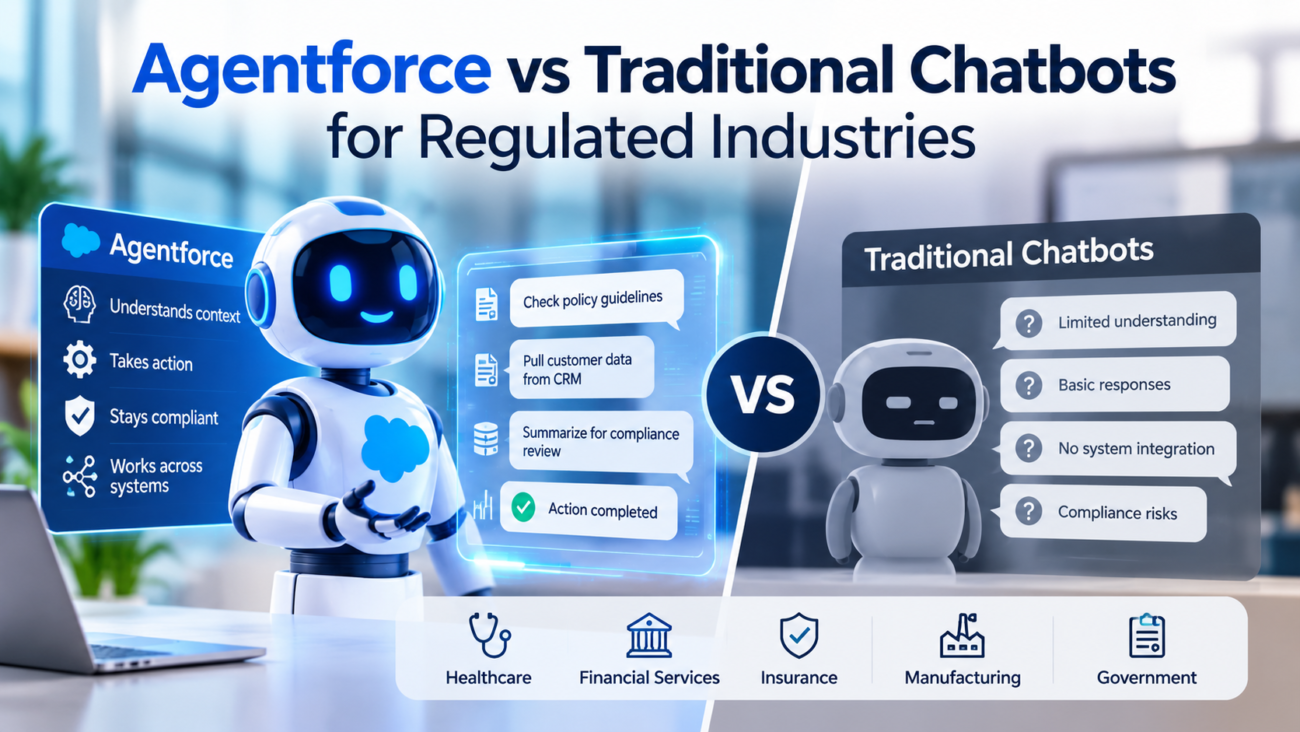
Regulated organizations have a harder AI decision than most companies. A chatbot that gives a weak answer can create a service problem. An AI agent that reads protected data, chooses an action, and updates a system can create a compliance problem as well. That difference changes how leaders should compare Agentforce vs traditional chatbots.
The useful question isn’t which technology sounds more advanced. The useful question is how much judgment, data access, and action authority a use case needs, then whether the organization can govern that level of autonomy. Traditional chatbots can still be the better fit for tightly scripted interactions. Agentforce becomes more useful when a task needs context from Salesforce, controlled reasoning, and approved actions across a workflow.
For regulated industries, the buying decision therefore sits between capability and control. Agentforce for regulated industries can handle work that a fixed bot can’t, but the extra range raises the standard for testing, permission design, logging, human review, and change management. This guide compares those tradeoffs across financial services, healthcare, life sciences, insurance, and other regulated environments.
TL;DR
• Traditional chatbots work well when the allowed questions, answers, and paths are narrow and stable.
• Agentforce can interpret broader requests, use Salesforce context, choose approved actions, and continue through multi-step work.
• Regulated organizations should judge the two options by action risk, data sensitivity, audit needs, and human review requirements.
• Higher autonomy should come with tighter permissions, stronger testing, clearer escalation rules, and ongoing monitoring.
• A mixed model often makes sense: keep deterministic flows for fixed disclosures or low-variance tasks and use agents for cases that need context and controlled action.
What Agentforce And Traditional Chatbots Actually Do
A traditional chatbot usually works from predefined intents, decision trees, fixed replies, or a controlled knowledge source. Some products add natural-language processing, but the operating idea stays similar: recognize the request, match it to an approved path, and return a prepared response. That design makes behavior easier to predict, especially when the bot has little authority to change records or trigger business processes.
Agentforce uses a different operating model. Salesforce describes AI agents as systems that can reason about a request, use business context, and take actions, while its ownAI agent comparison contrasts that behavior with the preset paths common in older bots. The distinction matters because a regulated organization is governing more than conversation once an agent can choose what to do next. It is governing software that can interpret context and act within permissions.
That makes Agentforce vs traditional chatbots a scope question before it becomes a technology question. If the task is “show the approved fee schedule,” a deterministic bot may be enough. If the task is “review this member’s case, identify the right policy, check eligibility, update the case, and prepare a handoff if an exception applies,” an agent has a clearer functional advantage.
Traditional chatbots in regulated industries also have a practical strength that is easy to underrate: narrow behavior. A fixed path can reduce the number of possible outputs. That can be useful for mandatory disclosures, regulated scripts, or processes where every branch has been reviewed in advance. An agent offers more range, but every added action or source expands the control surface.
Why Regulated Industries Change The Choice
Regulated industries care about evidence. A service team may need to show which policy applied, which data was accessed, who approved a change, how a customer was informed, and what happened after an exception. Those needs can make a simple bot attractive because its behavior is easier to map. They can also make an agent valuable when the agent’s controls are strong enough to support the same evidence at a wider task level.
The risk also depends on consequence. A weak answer about store hours is inconvenient. A weak answer about a benefit denial, investment restriction, coverage term, clinical instruction, or regulated filing can cause a different class of harm. NIST’sAI Risk Management Framework gives organizations a cross-sector way to map AI risk to governance and measurement, which is a useful lens for any Agentforce vs traditional chatbots decision. The key point is to scale controls with the effect of the system, not with how impressive the interface looks.
Agentforce for regulated industries becomes attractive when a business already relies on Salesforce as a system of record or workflow hub. The agent can work with customer context and approved actions instead of forcing the user through a rigid decision tree. That can reduce repeated questions and manual transfers. It also means the agent may touch records that are subject to privacy rules, supervisory procedures, retention duties, or internal access policy.
The practical test is simple: what happens if the system is wrong? If the answer is “the user sees an unhelpful response,” traditional automation may be enough. If the answer is “a protected record changes, a regulated communication goes out, or a customer outcome changes,” the use case needs stricter review before autonomy is granted.
Agentforce Vs Traditional Chatbots: Architecture Comparison
The architecture is where the comparison becomes concrete. Traditional bots tend to route messages through intent recognition and predefined conversation logic. Agentforce uses Salesforce’s reasoning layer to classify requests, assemble context, choose from available actions, observe the result, and decide whether another action is needed.
Salesforce’sAtlas reasoning workflow describes topics, instructions, and actions as core building blocks for this process. That matters in a regulated deployment because each building block becomes a control point. A topic can define scope, an instruction can state a policy boundary, and an action can limit what the agent is physically able to do.
| Comparison Area | Traditional Chatbot | Agentforce |
| Request handling | Matches known intents or follows designed paths | Interprets intent and chooses within configured topics |
| Context | Usually limited to session data or connected sources | Can use Salesforce data and connected knowledge within permissions |
| Next step | Follows predefined branches | Selects from approved actions based on instructions and context |
| Business actions | Often limited or separately integrated | Can call configured Salesforce actions and workflows |
| Output range | Narrower and easier to predict | Broader and more dependent on grounding and instructions |
| Failure mode | Dead end, fallback, or human transfer | Wrong reasoning, wrong action choice, weak grounding, or transfer |
| Control design | Conversation flow review | Topic, instruction, action, permission, and output review |
| Best fit | Stable, low-variance tasks | Context-heavy work with controlled action authority |
This is why Agentforce vs traditional chatbots shouldn’t be reduced to “scripted versus smart.” A well-built chatbot can use APIs and a knowledge base. A poorly designed agent can still fail on scope or grounding. The important difference is that Agentforce is built to choose and execute actions through a reasoning loop, so its governance has to cover decisions as well as words.
Agentforce security also begins at architecture. If an agent can call only 2 low-risk actions, its exposure is different from an agent with access to 20 actions across service, billing, identity, and account data. Permission design should follow the smallest useful action set for each role and use case.
Governance And Compliance Controls
Governance starts by defining the agent’s job in plain language. Teams should name the users, allowed purposes, permitted data, approved actions, prohibited outcomes, and escalation conditions before building prompts. That requirement may sound basic, but it prevents a common failure: giving an agent a broad objective and trying to add controls after testing exposes the gaps.
Salesforce’sAgentforce guardrail guidance explains that topics group actions and instructions, and that topic instructions can state boundaries such as “always,” “never,” or conditional rules. In practice, those controls should reflect approved operating policy rather than informal team habits. The agent’s permitted behavior should be traceable to a policy owner.
A strong Agentforce for regulated industries program also separates policy from implementation. Compliance or legal teams define the rule. Product owners translate it into system requirements. Salesforce admins and developers implement those requirements in topics, instructions, permissions, flows, and actions. Testing then checks whether the system actually follows the rule under normal and adverse inputs.
Traditional chatbots in regulated industries often make this mapping easier because the path is explicit. A reviewer can inspect each response and branch. That doesn’t remove governance work, especially when integrations are involved, but the review surface is smaller. Agentforce expands the review surface to include what the agent can infer and which action it selects from the allowed set.
A practical governance file for either system should include the use-case owner, policy owner, data classes used, user population, action inventory, human-review rule, known limitations, test evidence, change history, and incident owner. For Agentforce, add the model and grounding dependencies that could alter output behavior even when the business process itself hasn’t changed.
AI agents for regulated industries need a change gate as well. A new knowledge source, revised topic instruction, added action, permission change, or model update can change behavior. Teams should decide which changes require regression testing and which changes require a fresh business or compliance signoff.
Data Privacy And Agentforce Security
Data handling is usually the first concern raised by security and privacy teams. That concern should be split into 2 questions: what Salesforce or the connected model provider does with prompts and outputs, and what the agent itself is allowed to retrieve from enterprise systems. Those are related, but they aren’t the same control problem.
Salesforce’sTrust Layer documentation describes grounding, toxicity detection, an audit trail, zero-data-retention agreements with third-party LLM partners, and data-masking features for supported uses. Those controls support Agentforce security, but they don’t replace customer-side access design. A system can protect model traffic and still expose too much internal data if permissions or retrieval scope are broad.
Salesforce states that Einstein Trust Layer data masking is disabled for Agentforce agents, including pattern-based and field-based masking. Teams handling regulated information should verify which data reaches the model and restrict access through permissions, approved retrieval paths, and other applicable controls. Zero-data-retention agreements don’t replace those restrictions.
Agentforce security should follow least privilege at the agent, action, object, field, and connected-system levels. A service agent that needs to read claim status shouldn’t automatically gain the ability to edit payment information. A benefits agent that drafts a response may not need access to every clinical note. Small permissions reduce the damage from bad reasoning, prompt injection, or a mistaken configuration.
Healthcare makes the point clear. TheHIPAA Security Rule requires covered entities and business associates to protect the confidentiality, integrity, and availability of electronic protected health information through appropriate safeguards. If an Agentforce use case handles ePHI, the organization still has to fit that deployment into its HIPAA risk analysis, access controls, vendor arrangements, and security practices. The product label doesn’t decide compliance.
Traditional chatbots in regulated industries can lower exposure when they are intentionally isolated from sensitive systems. A public FAQ bot that never authenticates a user and never reads account records has a small data footprint. The tradeoff is that it can’t answer account-specific questions or complete protected workflows.
For Agentforce for regulated industries, data minimization should be visible in the design. Document which fields can be grounded into prompts, which source systems are eligible, what data masking is applied, what gets logged, and how long logs are retained. Security review should also test indirect prompt injection through connected content, because an agent may consume instructions from data that a user never typed directly.
Auditability, Records, And Evidence
A regulated organization has to prove what happened after the fact. That makes observability a core selection criterion in Agentforce vs traditional chatbots. Logging should capture enough detail to reconstruct the interaction without collecting more sensitive data than the organization is allowed or willing to retain.
NIST’sGenAI risk profile identifies risks that are specific to generative AI and suggests actions across the AI lifecycle. For an enterprise agent, that translates into evidence around testing, source quality, monitoring, incident handling, and change control. A transcript alone is weak evidence if it doesn’t show which action ran or which policy source shaped the answer.
For a traditional chatbot, useful evidence may include the detected intent, conversation path, content version, authentication status, and handoff event. For Agentforce, teams may also need the selected topic, instructions in force, action calls, action results, grounding sources, permission context, output, and final disposition. The exact fields depend on the use case and the organization’s retention rules.
Financial services adds another layer. FINRA’sGenAI regulatory notice says existing FINRA rules remain applicable when member firms use GenAI and highlights supervision, governance, privacy, reliability, and accuracy considerations. That means an AI interface doesn’t sit outside the firm’s existing supervisory structure. The control owner still needs evidence that the system was reasonably designed for its assigned job.
The 2026FINRA oversight report also notes that member firms have focused GenAI on internal processes and information retrieval, with summarization and information extraction as a leading use case. That pattern makes sense for early adoption because a human can review the output before it changes a customer outcome.
Human Oversight And Escalation
Human oversight works best when it is tied to risk, not added as a generic fallback. A person should take over when the agent reaches a defined condition such as low confidence, missing evidence, conflicting data, a protected decision, a complaint, a vulnerable-customer scenario, or an action above the agent’s authority.
This matters because Agentforce vs traditional chatbots changes the meaning of escalation. A traditional bot often escalates because it can’t match an intent. Agentforce may understand the request perfectly and still need to escalate because policy requires human judgment. The trigger is therefore a governance rule, not a technical failure.
AI agents for regulated industries should have explicit stop conditions. For example, an insurance service agent might explain policy language and collect facts but stop before making a coverage determination. A financial-services agent might summarize an account and prepare an employee handoff but stop before personalized investment advice. A healthcare agent might handle scheduling and benefit questions while routing symptoms or clinical decisions to qualified staff.
Salesforce itself advises human checking for many model responses in its trust documentation. That principle is useful even when an organization later grants more autonomy. Start with read-only or draft modes, measure error patterns, then increase action authority only where test evidence supports it.
A human handoff also needs context. The employee should receive the user’s request, relevant verified data, actions already taken, and the reason for escalation. Requiring the customer to repeat everything defeats much of the value of the agent and makes it harder to reconstruct the full interaction later.
How The Choice Changes By Industry
The right design changes with the regulated outcome. Agentforce for regulated industries should therefore be evaluated against the process, not against an abstract list of AI features.
Financial Services
Financial institutions should separate service automation from decisions that affect money, suitability, credit, fraud disposition, or regulated communications. An agent can be useful for internal policy lookup, account-service preparation, case summarization, or gathering information for a trained employee. Higher-impact work needs stronger controls and often a human decision point.
The regulatory map is also moving. The OCC’s2026 model guidance expressly says generative AI and agentic AI models are outside the scope of that revised model-risk guidance. Banks shouldn’t read that as an exemption from governance. It means they need to identify the controls that actually apply to the use case rather than assuming an older model-risk framework answers every agent question.
Healthcare
Healthcare use cases should separate administrative support from clinical judgment. Scheduling, coverage status, referral routing, patient-service case updates, and approved education can fit an agent when identity and data access are controlled. Diagnosis, treatment selection, or other clinical decisions require a very different risk assessment.
Agentforce security is especially important when an agent can see PHI. The design should restrict fields, separate user roles, verify identity before account-specific disclosure, and make sensitive actions reviewable. Traditional chatbots in regulated industries remain useful for public health-system FAQs because they can answer approved questions without touching a patient record.
Life Sciences
Life sciences teams should distinguish commercial or service workflows from AI that supports regulated product decisions. FDA’sAI decision guidance proposes a risk-based credibility assessment for AI used to produce information supporting regulatory decisions about drug and biological product safety, effectiveness, or quality. That guidance doesn’t turn every enterprise chatbot into a regulated model, but it shows the level of evidence expected when AI output moves close to a regulated scientific decision.
An Agentforce deployment used for case routing or approved medical-information intake may therefore need a different validation package from an AI system used in product development. Use context decides the control burden.
Insurance And Public Sector
Insurance teams often face a similar line between service and adjudication. An agent can collect documents, explain approved process steps, or summarize a claim file. Authority to approve, deny, price, or materially alter coverage should be treated as a higher-risk action with stricter oversight.
Where Traditional Chatbots Still Fit Better
Traditional bots remain useful because predictability has business value. A fixed interaction can be easier to approve when exact language matters more than conversational freedom. That is common with disclosures, consent language, standard eligibility questions, public information, and status checks that don’t require interpretation.
The strongest case for traditional chatbots in regulated industries is a stable process with low variation. If users choose from known options and the system returns reviewed content, the team can test every major branch. Maintenance is also straightforward when policy changes: update the affected response or branch and rerun the relevant test set.
Traditional bots can also reduce attack surface. A bot that cannot call a workflow cannot accidentally execute the wrong workflow. A bot that cannot read protected records cannot expose those records. These limits may be intentional safeguards rather than product shortcomings.
Agentforce vs traditional chatbots becomes harder when the use case sits in the middle. Consider an authenticated claims-status assistant. A traditional bot can query a status field and return the result. Agentforce could interpret unusual questions, explain next steps from policy, and prepare a case update. The agent delivers more value only if those extra behaviors are needed often enough to justify the wider governance burden.
Another reason to keep a traditional bot is regulatory wording. Some communications must use approved text or follow an exact sequence. A fixed response can preserve that language without asking a generative model to recreate it. An agent can still route the user to that fixed response as one controlled action.
Cost And Operating Model
Cost should include the system around the software. Traditional chatbots can look cheap in licensing but become expensive when teams maintain large intent libraries and brittle conversation trees. Agentforce can reduce manual flow design for variable conversations, yet it adds work in agent testing, grounding design, permission review, monitoring, and governance.
Salesforce currently offers more than 1 Agentforce pricing path. ItsAgentforce pricing page lists consumption-based options such as Flex Credits and conversations, along with per-user options for some use cases. That means buyers should model real action volume instead of comparing only a headline license fee. A single conversation can call multiple actions, and higher-risk actions may also create internal review cost.
A useful cost model for Agentforce for regulated industries includes platform charges, implementation labor, integration work, knowledge cleanup, test design, compliance review, security review, monitoring, incident response, and ongoing regression testing. The expensive part can be the control system around the agent if the organization chooses a high-impact use case too early.
Traditional chatbots in regulated industries have a different cost curve. They often need more conversation design up front and more manual maintenance as intents expand. Their governance cost can stay lower when they remain read-only and tightly bounded. Once a traditional bot gains many integrations and complex branching, the apparent simplicity starts to disappear.
Implementation Checklist For Regulated Teams
A regulated implementation should move from low authority to higher authority in clear stages. The checklist below works for Agentforce vs traditional chatbots, but the agent path requires deeper testing because behavior can vary with context.
1. Define The Outcome. State the exact job, user population, success condition, prohibited outcomes, and business owner. Avoid goals such as “improve service” because they are too broad to test.
2. Classify The Data. List every data source the system may read or write. Mark regulated, confidential, customer, employee, and public data according to the organization’s own policy.
3. Set Action Boundaries. Give the system only the actions required for the job. Separate read, draft, and write actions so authority can be increased in stages.
4. Map Applicable Rules. Connect each requirement to a control. This may include privacy rules, supervision, recordkeeping, consumer protection, internal policy, or sector-specific validation.
5. Design Human Review. Decide which outputs need approval and which conditions force escalation. Assign the reviewing role before launch.
6. Build A Test Set. Include normal requests, ambiguous requests, policy conflicts, missing data, malicious inputs, and attempts to cross role boundaries. Test outcomes, not only wording.
7. Capture Evidence. Log the information needed to reconstruct each material action. Confirm retention and access rules before production use.
8. Pilot With Limited Authority. Start with read-only, draft, or low-impact actions where practical. Measure failure modes before expanding scope.
9. Set Change Gates. Define when a prompt, topic, action, model, knowledge source, or permission change requires retesting and approval.
10. Plan Incident Response. Name the owner who can disable an action, remove a source, change an instruction, or stop the agent when behavior creates risk.
AI agents for regulated industries need this discipline because the control surface extends beyond text generation. A passing conversation test doesn’t prove that every action path is safe. Test the full chain from user request to data access, action execution, logging, and human handoff.
Decision Framework: Which Option Fits Which Risk Level?
The easiest way to choose is to score the use case on variability and consequence. High variability means users ask the same underlying question in many forms or the process depends on several records. High consequence means a wrong answer or action can affect rights, money, health, access, or a regulated record.
Low variability and low consequence: use a traditional chatbot or fixed self-service flow. Public FAQs, office information, basic status checks, and standard navigation usually don’t need agentic reasoning.
High variability and low consequence: consider Agentforce with read-only access or low-risk actions. Internal knowledge search, case summaries, drafting, and employee assistance can benefit from reasoning while keeping final authority with a person.
Low variability and high consequence: prefer deterministic controls. Exact disclosures, approved consent language, fixed eligibility rules, or sensitive transaction confirmations may be better implemented as reviewed flows that an agent can invoke without rewriting them.
High variability and high consequence: use an agent only when the organization can support strict permissions, strong grounding, human review, detailed evidence, and ongoing testing. Many teams should start with agent assist rather than full autonomy in this quadrant.
EU operations add another decision layer. The European Commission’sAI transparency guidelines explain Article 50 transparency duties that generally apply to certain AI interactions from August 2, 2026. The amended EU AI Act application timeline sets a later date for high-risk systems: December 2, 2027 for Annex III use cases and August 2, 2028 for high-risk AI embedded in regulated products covered by Annex I. Separatehigh-risk deployer duties include human oversight, monitoring, input-data duties, and log retention requirements for deployments that fall within the high-risk regime. Organizations should classify the actual use case before assuming those duties apply to every chatbot or agent.
Agentforce security controls can support a regulated design, but they don’t classify the legal use case for the organization. That judgment still depends on geography, sector, intended purpose, users, data, and outcome. Legal and compliance teams should therefore review the deployment context, while technical teams show how the configured system enforces the approved boundaries.
For most buyers, Agentforce for regulated industries makes the strongest case when Salesforce already contains the trusted workflow context and the use case needs controlled action. Traditional chatbots in regulated industries make the strongest case when predictability and narrow scope matter more than conversational range.
Conclusion
Agentforce vs traditional chatbots is a control decision as much as a capability decision. Traditional chatbots remain a sound choice for narrow, predictable interactions where fixed paths reduce risk. Agentforce is better suited to requests that need business context, reasoning across approved information, and actions inside Salesforce.
Regulated organizations should grant that extra authority in stages. Start with use cases where errors are reversible and human review is practical. Expand only after the team can show that permissions, grounding, tests, logs, escalation, and change controls work under real conditions.
AI agents for regulated industries can reduce manual work and handle cases that older bots can’t manage, but greater range creates a larger duty to govern behavior. Agentforce security features help with that job. They don’t replace sector rules, internal policy, or accountable human ownership.
The strongest architecture may use both technologies. Keep deterministic steps where wording or execution must stay fixed. Use Agentforce where context and controlled action provide clear value. That approach keeps the technology aligned with the risk of the process instead of forcing every interaction into the same automation model.
FAQs
What Is The Main Difference Between Agentforce And A Traditional Chatbot?
The Agentforce vs traditional chatbots difference comes down to decision and action scope. Traditional bots usually follow designed paths or return approved content. Agentforce can interpret broader requests, use configured business context, choose approved actions, and continue through multi-step work. That wider authority requires stronger controls.
Is Agentforce Safer Than A Traditional Chatbot For Regulated Industries?
Neither option is automatically safer. A tightly bounded bot can have a smaller risk surface because its paths and data access are limited. Agentforce includes grounding, permission, monitoring, and trust controls, but safety still depends on the use case, configuration, testing, and consequence of a wrong action.
Can Agentforce Be Used In Financial Services?
Yes. It can support internal knowledge retrieval, case preparation, service workflows, and summarization when suitable supervision and access controls are in place. Activities involving investments, credit, fraud outcomes, or regulated communications need closer review because existing financial rules can still apply when AI is used.
Can Agentforce Be Used With HIPAA-Regulated Data?
A healthcare organization should assess the specific deployment against HIPAA and its own security program. Key questions include what ePHI the agent can access, how identity is verified, what actions are allowed, what gets logged, and what vendor terms apply. Product features don’t remove HIPAA responsibilities.
When Are Traditional Chatbots Better For Regulated Industries?
Traditional chatbots in regulated industries often fit stable tasks with exact language and little decision-making. Public FAQs, fixed disclosures, standard routing, and simple status checks are common examples. Their narrower behavior can make review easier when the team can inspect every major path before release.
Does Agentforce Always Make Autonomous Decisions?
No. An Agentforce deployment can be read-only, draft content for a person, run low-risk actions, or complete a wider process. Teams can also require human approval or escalation. Regulated organizations should grant the lowest level of autonomy that still solves the business problem.
What Does Agentforce Security Cover?
It includes Salesforce platform controls, Einstein Trust Layer protections, and customer-configured permissions and actions. Organizations still need least-privilege roles, connected-system review, retention rules, prompt-injection testing, and incident procedures. The product can supply controls, while the customer still defines and enforces the approved operating boundary.
Do AI Agents For Regulated Industries Need Human Review?
Often, yes, especially when an output or action can affect a customer, patient, investor, employee, or regulated record. Human review should be tied to defined risk conditions and authority limits. Low-risk information retrieval may need less review than a decision or record-changing action.
Can Agentforce Replace An Existing Chatbot Completely?
It can replace some use cases, but the Agentforce vs traditional chatbots choice doesn’t require an all-or-nothing migration. Fixed flows can remain useful for approved wording or exact process steps, while Agentforce handles requests that need more context and controlled action.
How Should A Regulated Company Test Agentforce?
Test the full workflow with expected requests, unusual phrasing, missing data, conflicting sources, permission boundaries, malicious instructions, escalation cases, and action failures. Verify the data retrieved and the action selected. Re-run material tests after changes that could alter behavior.
What Records Should An Organization Keep For Agentforce?
Useful evidence can include the request, identity or role context, selected topic, grounding sources, action calls, results, final response, escalation event, and relevant configuration version. Retention should follow applicable law and internal policy. Avoid keeping extra sensitive content simply because the system can log it.
How Does Agentforce Vs Traditional Chatbots Affect Compliance Cost?
Agentforce can reduce manual work in complex conversations but may add cost for testing, security review, monitoring, and change management. Traditional bots can require more conversation-tree maintenance while remaining cheaper to govern when their scope stays narrow. Compare cost per safely completed outcome instead of license price alone.
What Is A Good First Agentforce Use Case In A Regulated Company?
A good first use case has clear value and limited consequence if the system makes a mistake. For AI agents for regulated industries, internal knowledge retrieval, case summarization, draft preparation, and read-only service assistance can expose behavior patterns before the organization grants higher action authority.
How Should Companies Approach Agentforce For Regulated Industries?
A regulated Agentforce program should start with a defined purpose, small permission set, approved knowledge sources, measurable tests, and named control owners. Document the rules that shape behavior and the events that require human review. Continue monitoring and regression testing as data, instructions, integrations, and platform features change.
Will AI Agents For Regulated Industries Replace Traditional Chatbots?
Some will. AI agents for regulated industries are likely to replace use cases that need context-aware help or actions across business systems. Traditional bots will still fit tasks where fixed wording, low data access, and predictable paths are useful controls. Many organizations will keep both technologies.
