
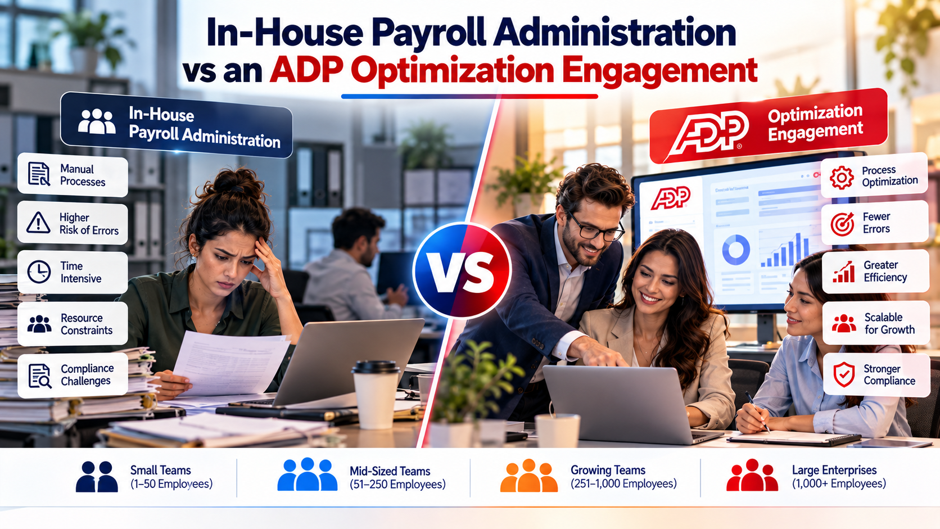
Most companies running ADP don’t actually use the platform the way it was originally designed to be used from day 1, when it was first implemented. A system gets configured once during the initial implementation phase, staff learn just enough to process payroll correctly, and over the following years small workarounds pile up steadily as people leave the company, policies change, and nobody ever really circles back to clean any of it up properly again. That real, persistent gap between what an ADP platform is capable of doing and what a company actually gets out of it in daily practice is exactly the space an ADP optimization engagement is built specifically to close, and it’s a genuinely different kind of thing entirely from the day-to-day work of in-house payroll administration.
This post carefully lays out what genuinely separates the 2: what in-house administration actually involves on an ongoing, day-to-day basis, what a professional optimization engagement typically covers from start to finish, and how a company figures out which one it actually needs right now, today. The short answer for most growing companies is that these aren’t really competing options at all, they’re genuinely complementary, but understanding the real difference between them is exactly what makes that combination work well in practice instead of becoming 2 disconnected efforts quietly pulling in different directions.
TL;DR
- In-house administration is an ongoing staffing model. It means a company’s own employees process payroll every single period, maintain the ADP configuration, handle compliance monitoring and answer employee questions, indefinitely, as a standing, permanent part of their job description that never really ends, pauses or gets handed off to someone else entirely, no matter how the rest of the business changes around them.
- An optimization engagement is a defined, time-boxed project. Outside consultants, sometimes from ADP’s own professional services team and sometimes from an independent ADP consulting partner, audit an existing system, fix misconfigurations, activate unused features and close compliance gaps, then hand a genuinely stronger, better-configured system back to the in-house team once the whole defined engagement finally wraps up for good and the consultants move on.
- The 2 usually work best together rather than as a choice. Most companies with in-house payroll staff still benefit from a periodic optimization engagement, since day-to-day administration rarely leaves time to step back and audit the system as a whole, which is precisely the gap a focused outside engagement is specifically built to fill for a busy, stretched-thin team.
What Each Approach Actually Means
In-house payroll administration is the ongoing, everyday work of running payroll inside a company using its own internal staff, week after week without interruption. That includes processing each individual pay run, maintaining employee records, managing tax filings, handling garnishments and deductions, answering employee questions directly, and keeping the underlying ADP system configured correctly as company policies, benefits and headcount all continue changing over time. It’s a genuinely permanent operational responsibility, not a project with a defined start and end date, and the people doing it are usually also handling other HR or finance duties alongside payroll rather than working on it as their sole, exclusive focus.
An ADP optimization engagement is something genuinely different in kind, well beyond simply being a difference in scale alone, from what in-house administration typically involves. It’s a defined consulting project, delivered either by ADP’s own professional services team or by an independent ADP consulting partner, focused specifically on reviewing an existing ADP setup and improving it. That typically means carefully and methodically auditing the current configuration against what the company actually needs today, since most systems were configured once during implementation and rarely, if ever, revisited as the underlying business continued to change and grow. The engagement itself has a clear start date, a tightly defined scope, and a specific end point where the improved system finally gets handed back to whoever runs it day to day, which is usually the very same in-house team that was administering it before the engagement first began.
In-House Administration and an Optimization Engagement Side by Side
| What to Compare | In-House Payroll Administration | ADP Optimization Engagement |
| Duration | Ongoing and indefinite, a permanent operational function | Time-boxed, typically weeks to a few months per engagement |
| Who does the work | The company’s own payroll or HR staff | Outside consultants from ADP or an independent ADP partner |
| Primary focus | Processing payroll accurately and on time, every period | Auditing and improving the underlying system’s configuration and workflows |
| Depth of ADP expertise | Varies widely depending on staff training and tenure | Specialized, since consultants work across many ADP implementations |
| Typical outcome | Payroll gets run correctly, period after period | A specific list of fixes, activated features and process improvements |
| Cost structure | Ongoing salary or allocated staff time | A project fee for the defined scope of the engagement |
Reading this table makes the complementary relationship clear: in-house administration is what keeps payroll running every single period without interruption, while an optimization engagement is what periodically steps back and asks whether the system running underneath that daily work is actually configured as well as it realistically could be at this specific point in the company’s own growth.
What In-House Payroll Administration Actually Involves
Processing and Compliance Work That Never Stops Every single pay period brings the same core cycle around again: collecting and verifying hours, calculating gross pay accurately, applying the right deductions and garnishments, confirming tax withholding is correct for each employee, and getting the run fully approved and paid out on time. Layered directly on top of that continuous cycle sits ongoing compliance monitoring: tracking changing state and federal requirements, managing year-end reporting obligations, and making sure the company’s ADP configuration reflects current law rather than whatever happened to be accurate back when the system was first originally set up.
System Maintenance That Often Gets Deprioritized Beyond simply running payroll itself, in-house staff are technically responsible for keeping the ADP configuration genuinely current as the business changes: new departments opening, new benefit plans getting added, new pay codes needed, new physical locations coming online. In practice, this maintenance work is exactly the kind of task that gets pushed aside every single time, whenever the pressing deadline of the next pay run always takes priority instead, which is precisely how a well-configured system gradually drifts into one quietly carrying years of small, uncorrected workarounds.
Employee-Facing Support and Institutional Knowledge In-house staff also field the questions that come directly from employees every week: why a paycheck looks different this particular period, how to update a direct deposit account, what a specific deduction actually is and why it’s there, and that role carries real institutional knowledge that an outside consultant simply doesn’t have access to. This is genuinely one of the strongest arguments for keeping payroll administration in-house even when bringing in outside help for a specific project, since the day-to-day relationship with employees and the company’s own accumulated policy history rarely transfers cleanly to a temporary, outside engagement team.
What an ADP Optimization Engagement Actually Covers
- System implementation and integration support. For companies still finishing an initial rollout, or connecting ADP to other business systems like accounting or time tracking, this covers the technical work of getting everything talking to each other correctly, which is foundational work that has to be right before any further improvements on top of it can mean very much at all.
- Core optimization services. This is the heart of a typical engagement: aligning existing workflows with how the business actually operates today, identifying and activating specific features the company is already paying for but never turned on, and automating manual processes that are still being done entirely by hand years after the system theoretically first supported doing them automatically on its own.
- HR excellence and employee experience improvements. Many engagements also touch the employee-facing side of the platform, building out self-service portals, customizing workflow templates, and reducing the manual effort required to apply company policy consistently across every department, rather than relying on individual staff members to remember every single rule themselves from memory alone, which tends to break down as teams grow larger.
- Compliance services and system health checks. A significant portion of most engagements involves reviewing how the current system configuration and underlying data actually interact with compliance obligations, since a misconfigured field or an outdated workflow can create real regulatory exposure that nobody ever notices until an audit or a penalty notice finally shows up completely unannounced, catching everyone off guard.
Consultants who specialize in this specific kind of work consistently make the exact same underlying point: an ADP system isn’t something a company configures once and then simply leaves alone indefinitely, untouched. It needs genuinely periodic attention as the business, the surrounding regulations, and the platform itself all continue to change and evolve, and an optimization engagement is the structured, deliberate way most companies actually get that attention rather than leaving it entirely to whenever an already-overloaded in-house team happens to find some spare time.
Signs Your In-House Setup Has Drifted
Features You’re Paying For but Never Turned On Most ADP packages include capabilities that extend well beyond what a typical company actively uses day to day, and it’s genuinely common for a business to be paying for a feature tier that includes reporting, workflow automation or self-service tools that nobody on staff ever actually configured or properly rolled out to employees. This usually isn’t anyone’s fault directly at all, it’s simply what happens naturally when the person who set up the system originally has since moved on and nobody afterward has had the time or the specific expertise required to revisit those unused capabilities properly.
Workarounds That Accumulated Instead of Getting Fixed Every in-house team develops small manual workarounds over time without really meaning to, exporting data to a spreadsheet because a built-in report doesn’t quite show what’s actually needed, or manually adjusting a calculation each period because the underlying rule was never configured correctly in the first place. Individually each of these feels minor and easy to justify, but a system carrying a decade of accumulated workarounds is usually a system that’s become genuinely harder to administer than it ever needed to be, and often considerably riskier from a compliance standpoint than anyone currently on staff even realizes.
Why Software Doesn’t Stay Optimized on Its Own
A payroll platform isn’t something a company configures once and can then simply leave untouched indefinitely, the way installing a piece of office equipment or furniture might reasonably work. Regulations keep changing, benefit plans get renegotiated on their own schedules, the company adds new locations or departments over time, and ADP itself regularly releases new features and capabilities that an already-configured system doesn’t automatically pick up or begin using entirely on its own. Without someone actively revisiting the configuration on a regular basis, all of that drift accumulates quietly and steadily in the background while day-to-day payroll processing continues to run smoothly enough, which is exactly why a system that worked genuinely well at launch can end up meaningfully underperforming several years later, all without anyone clearly noticing the decline as it slowly happens around them.
This is the core argument behind treating this kind of review as a periodic, recurring need rather than a one-time project a company completes once and then never really thinks about again for years afterward. A business that invests in an optimization engagement once, several years ago, and then simply assumes the system is now permanently sorted is very likely carrying the same kind of quiet, accumulating drift today that the original engagement was specifically brought in to fix the first time around.
What a Typical Optimization Engagement Looks Like
| Phase | What Happens | Typical Focus |
| Discovery and audit | Consultants review current configuration, workflows and how the in-house team actually uses the system day to day | Identifying gaps between what the system could do and what it’s actually doing |
| Prioritization | Findings get organized into a list of fixes, ranked by risk, cost savings and effort required to implement | Making sure the most impactful issues get addressed first rather than getting lost in a long list |
| Configuration and implementation | Consultants make the actual changes: activating features, correcting workflows, fixing compliance gaps | Turning the audit findings into a system that’s genuinely different from where it started |
| Training and handoff | In-house staff get trained on any new workflows or features before the engagement formally closes | Making sure the improvements actually stick after the consultants leave |
| Ongoing support option | Some engagements include a follow-up period or subscription-style support for questions that come up later | Catching issues that only surface once the new configuration is actually in daily use |
Not every engagement runs through all 5 of these phases with equal weight or time, since a company that mainly needs a focused compliance review will spend considerably more time in discovery and less in configuration than one whose main problem is years of accumulated manual workarounds that need fixing. The shape of any specific engagement should track the specific problems a company is actually trying to solve, rather than following some rigid, one-size-fits-all template regardless of what the business genuinely needs from it.
Compliance Areas an Optimization Review Typically Covers
- Affordable Care Act tracking and reporting. Reviewing how employee hours, eligibility determinations and required reporting are actually configured inside the system, since an error here can affect both a company’s overall compliance exposure and the accuracy of the information ultimately reported each and every single year to the federal regulators who review that particular annual filing quite closely.
- SECURE Act 2.0 provisions. Newer retirement plan requirements carry specific configuration implications for how payroll systems handle contributions and eligibility, and a system configured before these particular provisions took effect may not reflect the current legal requirements correctly at all anymore, even if nobody currently on staff has flagged that specific gap just yet all on their own.
- Payroll-Based Journal and labor reporting. For employers in industries with specific labor reporting obligations, confirming that the underlying data feeding those reports is both accurate and complete is a common focus area, since a reporting error usually traces straight back to some underlying data or configuration problem the vast majority of the time it actually happens to a company.
- Wage and hour configuration. Reviewing how overtime rules, pay codes and time tracking rules are actually set up against current federal and state law, since wage and hour violations are among the more common and genuinely costly compliance failures a misconfigured system can quietly produce over time, often without a single person on staff ever noticing it was happening at all.
A consultant reviewing these areas isn’t simply checking a box on some intake form, they’re looking specifically and carefully at whether the system’s actual configuration matches current regulatory requirements, which is a different and considerably more concrete question than simply asking whether the company happens to have a written policy that says the right thing on paper somewhere.
Cost Considerations for Each Approach
In-House Administration Costs The ongoing cost of in-house administration is largely a staffing cost: salary, benefits and the specific portion of a finance or HR employee’s time that payroll work actually consumes during each individual pay period. That cost is relatively predictable overall and scales gradually with company size, though it can be genuinely difficult to isolate exactly how much time payroll administration actually consumes when the same staff member is also handling other HR or finance responsibilities right alongside it.
Optimization Engagement Costs An optimization engagement is typically priced as a single project fee tied directly to its defined scope, and consultants generally frame the return on that investment in terms of specific features activated that reduce manual work, compliance risk reduced well before it ever turns into an actual penalty, and staff time freed up once workflows that used to require constant manual effort finally get properly automated instead. Because the engagement is bounded rather than ongoing, the cost is easier to evaluate against a specific, expected outcome than the more diffuse cost of ongoing in-house staffing.
Why These 2 Approaches Usually Work Together
The framing of “in-house administration versus an optimization engagement” makes good sense as a way to understand what each 1 actually is on its own terms, but in practice most companies that actually use ADP end up doing both rather than ever choosing permanently between the 2. In-house staff keep payroll running every period, indefinitely and without pause, while a periodic optimization engagement steps in every few years, or whenever a specific trigger like a genuine compliance concern or a system that feels increasingly clunky and outdated comes up, to audit and refresh the underlying configuration that the day-to-day team simply doesn’t have the bandwidth to step back and properly review entirely on its own.
This combination tends to work considerably better in practice than either extreme approach on its own. A company relying purely on in-house administration with no outside review at all risks the kind of slow configuration drift described earlier in this post, accumulating quietly for years without anyone truly noticing until a compliance issue or an obviously inefficient process finally forces the question into the open. A company that brought in an optimization engagement once and then simply assumes the system stays permanently fixed after that single project risks the exact same kind of drift starting over again the moment the engagement team leaves and daily operational pressure quietly takes back over the routine.
How to Decide What Your Team Needs Right Now
- If payroll runs smoothly but nobody’s touched the configuration in years, consider an optimization engagement. A system that’s been quietly drifting without active harm yet is still a system carrying unrealized value and unnoticed risk, and a periodic review is the way most companies actually catch that before it becomes a real problem rather than a theoretical one.
- If in-house staff are stretched thin just keeping payroll running, address staffing before optimization. An engagement that hands a beautifully improved system back to a team with no real capacity to actually use those improvements well will see much of that hard-won value quietly erode again within just a year or 2, right back to where it started.
- If a specific compliance concern has surfaced, prioritize a focused compliance review over a broad optimization project. A narrower, faster engagement targeted directly at the specific risk area usually resolves the urgent concern faster than a full system-wide audit that takes far longer to eventually reach the 1 single issue that actually needs attention right now, before it escalates further.
- If the company has grown significantly since the system was last configured, a full optimization engagement is usually worth it. Significant headcount growth, new locations or major benefit plan changes are exactly the kind of shift that often leaves an originally well-configured system meaningfully out of step with what the business actually needs from it right now, today, rather than years earlier.
What Gets Missed When a Company Skips the Comparison
Some companies never formally consider bringing in any outside help at all, either because nobody on staff has ever heard the term “optimization engagement” before, or because it sounds like an expense reserved specifically for much larger, better-funded organizations. That assumption ends up costing more than it might first appear to, since a system quietly underperforming for years represents both a direct cost, unused features the company is still actively paying for every month, and an indirect one, staff time spent on manual workarounds that automation could have eliminated long ago instead.
Other companies go in the exact opposite direction instead, bringing in a consultant for a single engagement and then treating the resulting system as permanently finished, closed, and never worth revisiting again. That second assumption is just as costly in its own particular way, since it ignores the plain reality that regulations, business needs and the platform itself all keep changing well after any single engagement formally wraps up and the consultants leave. A company that skips this comparison entirely, in either direction, ends up making an implicit decision, either “we’ll never need outside expertise” or “we’ll never need to revisit this again”, without ever consciously weighing whether that assumption still holds.
The more useful mental model treats this whole choice as a recurring, ongoing question rather than a permanent decision made just once and then forgotten about. Every so often, a company running ADP should genuinely stop and ask whether its in-house team currently has the bandwidth and the specific expertise needed to keep the system well configured on its own, or whether it’s time to bring in a focused engagement to catch up properly on whatever has drifted since the last review took place. Companies that build this question directly into a regular planning cycle, rather than waiting for some crisis to force the issue later, consistently report catching problems while they’re still cheap and easy to fix, rather than after they’ve already become expensive compliance issues or deeply embedded, hard-to-remove workarounds.
How to Prepare for an Optimization Engagement if You Decide to Move Forward
- Gather your in-house team’s own list of frustrations first. The people running payroll every period usually already know which reports don’t quite work, which processes feel unnecessarily manual, and which parts of the system nobody fully understands anymore, and that list is genuinely valuable input for consultants planning exactly where to focus their discovery work first, before they even open the system.
- Pull together recent compliance correspondence or concerns. Any recent audit findings, employee complaints about paycheck errors, or nagging uncertainty about whether a specific configuration is actually compliant should go directly into the scoping conversation with prospective consultants, since these concrete signals shape exactly which specific areas the engagement should end up prioritizing first, ahead of everything else on the list.
- Clarify what success actually looks like before the engagement starts. Some companies want fewer manual workarounds, others want stronger compliance confidence, and others mainly want their staff freed up to focus on higher-value work instead of routine maintenance; being explicit about the actual goal upfront shapes how the whole engagement gets scoped and later measured against real, tangible outcomes.
- Make sure in-house staff have time set aside for training and handoff. An engagement that ends with a rushed, poorly attended training session tends to see its improvements decay far faster than one where the in-house team had genuine, protected time to properly absorb what changed and why each specific change matters going forward for the whole business.
Companies that walk into an engagement having already done this preparation tend to get considerably more value out of the very same project budget, since the consulting team spends noticeably less time rediscovering problems the in-house staff already knew about and more time actually solving them, which is ultimately the whole point of paying for outside expertise in the first place, after all.
FAQs
What’s the main difference between in-house payroll administration and an ADP optimization engagement?
In-house administration is the ongoing, everyday work of processing payroll and maintaining the system using a company’s own internal staff, indefinitely and without any defined end date. An optimization engagement is a defined, time-boxed consulting project where outside experts audit and improve an existing ADP setup from the ground up, then hand the improved system back to the in-house team that continues running it day to day going forward.
Does bringing in an optimization engagement mean replacing in-house payroll staff?
No, and this is genuinely one of the most common misconceptions people hold about these engagements before they’ve actually gone through one. Optimization consultants typically work alongside the existing in-house team throughout the engagement, improving the very system they’ll continue to run afterward rather than taking over ongoing administration themselves, and the engagement’s final phase usually includes thorough training for the in-house staff on whatever specifically changed.
How often should a company consider an ADP optimization engagement?
There’s no single fixed schedule that fits every company equally well, but many organizations genuinely benefit from a review every few years, or whenever a specific trigger comes up: significant growth, a genuine compliance concern, or simply a general sense that the system feels increasingly inefficient compared with what it should genuinely be capable of doing by now, at this particular stage of the company’s own life.
What compliance areas does a typical optimization review cover?
Common focus areas typically include Affordable Care Act tracking and reporting, SECURE Act 2.0 retirement plan provisions, Payroll-Based Journal and labor reporting for applicable industries, and wage and hour configuration around overtime rules and pay codes specifically. The specific areas actually reviewed usually depend heavily on the company’s particular industry and the specific risks that originally prompted the engagement in the first place.
Why do ADP systems tend to become underoptimized over time even without anyone doing anything wrong?
Regulations keep changing, benefit plans get renegotiated over time, companies grow and add new locations, and ADP itself regularly releases new features that an already-configured system doesn’t automatically start using on its own accord. Without someone actively revisiting the configuration on a regular, ongoing basis, all of that drift accumulates quietly in the background while payroll continues processing correctly period after period, effectively masking the growing gap until it eventually becomes obvious to someone.
Is an optimization engagement only useful for companies having active payroll problems?
No. Many of the most valuable engagements actually happen for companies whose payroll runs smoothly enough on the surface but whose underlying system carries real unrealized value, unused features, manual workarounds that could be automated, that nobody has had the time or specific expertise to properly address. Waiting for an active, visible problem to force the question often means the underlying drift has already been quietly accumulating for years by the time anyone finally looks closely at it.
How is an optimization engagement typically priced compared with ongoing in-house administration?
An optimization engagement is usually priced as a single project fee tied to a clearly defined scope of work, which makes the overall cost considerably easier to evaluate against a specific, expected outcome up front. In-house administration costs, by contrast, are ongoing and largely tied to staffing: salary, benefits and the portion of an employee’s time payroll work actually consumes, which scales gradually with company size but is genuinely harder to isolate precisely when the same staff member also handles other responsibilities.
Can a small company with just 1 or 2 payroll staff benefit from an optimization engagement?
Yes, and in some genuine ways smaller in-house teams actually benefit even more from this kind of engagement, since they typically have far less capacity to step back from daily processing work and review the underlying system configuration entirely on their own. A focused engagement can activate features and automate manual processes that free up genuinely meaningful time for a small team that’s otherwise fully consumed by the routine, period-to-period cycle of simply running payroll week after week.
