
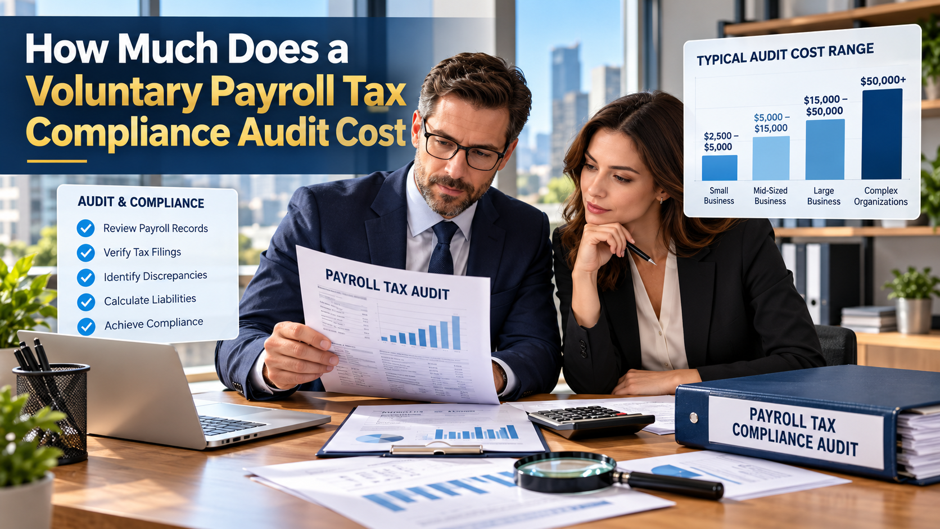
A voluntary payroll tax compliance audit usually costs somewhere between a few thousand dollars and low 6 figures, and the honest, complete answer to “how much” depends almost entirely on which specific problem a company is actually trying to get ahead of before anyone else finds it. A business that checks its own worker classification early through the IRS’s own settlement program pays a fraction of what a full state audit defense runs, while a company untangling years of missed withholding across several states faces a very different bill. Both fall under the same general heading, and both are genuinely, measurably cheaper than simply waiting for a government agency to find the problem first on its own terms.
This post breaks the cost question down into its real, underlying components: the professional fees paid to whoever actually performs the review, the settlement or back-tax payment owed as part of any formal voluntary program, and the specific factors that push either number up or down in a given situation. It also works carefully through a few real, named programs with actually published cost formulas, since those give a far more reliable anchor point than any vague, generic industry average ever could. None of this is legal or tax advice for a specific situation, and a company with an actual compliance concern should be talking to a CPA or tax attorney who can look at its real numbers.
TL;DR
- Most engagements have 2 separate cost components. Professional fees pay for the review itself, typically billed hourly or as a flat project fee, while a settlement or back-tax payment covers what’s actually owed to the government once a problem is found, and these 2 numbers can differ by an entire order of magnitude depending on what the review actually uncovers.
- Named federal and state programs publish real cost formulas. The IRS Voluntary Classification Settlement Program charges roughly 1% of 1 year’s wages paid to reclassified workers, with no interest or penalties attached, which is dramatically cheaper than the tens of thousands of dollars a full audit on those same wages could otherwise end up producing for the business.
- Scope drives cost more than anything else. The number of states involved, how many years get reviewed, whether the issue is a simple withholding error or a deeper worker classification problem, and how organized the underlying records already are all swing the final bill significantly, in either direction, well before any actual work even starts on the engagement.
What a Voluntary Payroll Tax Compliance Audit Actually Is
A voluntary payroll tax compliance audit is essentially a review a business initiates entirely on its own, before any government agency has formally opened an examination of its own, specifically to find and fix real payroll tax problems on the company’s own terms and its own timeline. That can mean hiring a CPA firm or tax attorney to carefully comb through withholding calculations, deposit timing, worker classification and state filings looking for errors, or it can mean formally enrolling in a named government program built specifically to reward employers who come forward before they’re ever caught.
The distinction between these 2 paths matters directly for overall cost, since a purely internal review’s total expense is entirely professional fees, while a formal program like the IRS’s Voluntary Classification Settlement Program adds a clearly defined settlement payment on top of whatever the company already pays its own advisor to prepare and file the application. Both paths share the same underlying logic throughout: correcting a payroll tax problem voluntarily almost always costs meaningfully less, sometimes dramatically less, than having that exact same problem discovered later during a government-initiated audit instead.
The 2 Cost Components Almost Every Engagement Has
| Cost Component | What It Covers | How It’s Typically Priced |
| Professional fees | The actual work of reviewing records, identifying issues, and preparing any required filings or applications | Hourly rates, a flat project fee, or a package tied to company size and scope |
| Settlement or back-tax payment | What the company actually owes the government once an issue is identified and voluntarily corrected | Set by formula under named programs, or calculated directly from the underlying tax liability in an informal correction |
These 2 cost components move largely independently of each other, and understanding that separation matters for anyone trying to budget accurately. A smaller company with a single, well-documented worker classification issue might pay fairly modest professional fees and a small, formula-based settlement under the VCSP alone. A company with years of messy multi-state withholding records, by contrast, might pay substantial professional fees just to reconstruct what actually happened, on top of a much larger back-tax payment once the full liability finally becomes clear. Understanding which component is likely to dominate a specific company’s final bill is the first real, practical step toward estimating the total cost accurately.
The IRS Voluntary Classification Settlement Program: A Real Cost Example
What the Program Actually Offers The Voluntary Classification Settlement Program lets an employer that has been treating certain workers as independent contractors reclassify them as employees going forward, in exchange for a settlement payment calculated under the already-reduced rates in Section 3509 of the tax code. The employer pays just 10% of what the full employment tax liability would have been for the most recent tax year, with no interest and no penalties attached at all, and critically, no employment tax audit at all for prior years covering those specific reclassified workers.
Eligibility Requirements Worth Knowing To qualify for the program at all, a business must have consistently treated the workers in question as nonemployees, including filing Form 1099 for their compensation for the past 3 years, and it can’t currently be under an IRS, Department of Labor or state employment tax audit. The application itself, Form 8952, needs to be filed at least 60 to 90 days before the planned reclassification date, and accepted employers agree to extend the standard 3-year statute of limitations to 6 years for the following 3 years after signing.
What the Math Actually Looks Like The numbers make the value proposition concrete. A business that paid $1,000,000 in compensation to workers who all earned below the Social Security wage base would calculate its Section 3509 liability at roughly 10.68% of that amount, or about $106,800, then pay only 10% of that figure under the VCSP, landing at approximately $10,680 in total. That same $1,000,000 in wages, examined under a full audit instead, could produce a real assessment somewhere between $80,000 and $250,000 before any penalties or interest even get added on top, according to tax advisors who work through both scenarios regularly with clients facing this exact decision.
What Professional Fees Typically Look Like
| Fee Structure | How It Works | Where It Tends to Show Up |
| Hourly billing | The advisor charges per hour of actual work, with total cost depending on how many hours the specific engagement requires | Common for complex, open-ended reviews where the scope isn’t fully known upfront |
| Flat project fee | A single, agreed-upon price covers a defined scope of work, regardless of exactly how many hours it takes | Common for well-defined engagements like a single VCSP application or a focused single-issue review |
| Tiered package | Pricing scales with company size, employee count or number of states involved, similar to how many professional services are packaged | Common among firms that specialize in this work and serve a range of client sizes |
Real-world numbers help anchor these abstractions. One tax attorney firm handling California Employment Development Department payroll tax audit defense reports that most engagements run between $5,000 and $7,500, reflecting roughly 10 to 15 hours of professional time, with cost climbing noticeably when the underlying documentation is messy or the government auditor proves genuinely difficult to work with. That figure covers audit defense specifically rather than a voluntary review, but it offers a genuinely useful, concrete sense of what an hour of specialized payroll tax expertise actually costs in practice, since the hourly rates involved don’t change much between a reactive audit defense and a self-initiated voluntary review covering similar ground.
What Drives the Cost Up or Down
- The number of states involved. A company with payroll tax exposure in a single state faces a fundamentally simpler review than one operating across a dozen different jurisdictions at once, each carrying its own withholding rules, unemployment insurance requirements and voluntary disclosure procedures that all need to be checked separately by the advisor before anything else can move forward.
- How many years need reviewing. Most voluntary programs limit the lookback period, but an informal internal review might need to reconstruct several full years of records just to understand the true scope of a problem, and each additional year pulled into the review adds real, billable hours to the professional fee side of the final bill, sometimes substantially so.
- Whether the issue is classification or calculation. A worker classification problem, like the kind the VCSP addresses directly, tends to have a considerably cleaner, more formulaic resolution path than a messy pattern of withholding calculation errors, which requires a slow, line-by-line reconstruction of exactly what should have happened each individual pay period across every single affected employee on staff.
- How organized the underlying records already are. A company with clean, complete payroll records from the very start pays considerably less in professional fees than one whose advisor has to spend hours just reconstructing what actually happened, before any real analysis of the underlying problem can even properly begin in earnest at all, let alone reach a conclusion.
- Whether multiple issues surface at once. A review that starts out targeting 1 specific concern sometimes uncovers a second or third completely unrelated issue along the way, and each additional problem found adds its own scope, and its own added cost, to what the advisor originally scoped as a considerably narrower engagement right from the very start of the project.
State Voluntary Disclosure Agreements: A Different Cost Model
Many states offer their own voluntary disclosure agreement programs, commonly used when a business realizes it should have been registered and withholding payroll tax in a state where it has employees or remote workers but never actually did so. These voluntary disclosure agreement programs typically work by limiting the lookback period to a set number of years, often 3 or 4, and waiving penalties in exchange for the business coming forward, registering properly and paying the back taxes actually owed for that limited window.
The cost structure here differs meaningfully from the VCSP’s formula-based approach. Instead of a fixed percentage, a state voluntary disclosure agreement typically requires paying the actual back taxes owed for the lookback period, which can be a substantial number if a company has had unregistered payroll tax exposure in a state for several years, plus whatever professional fees the advisor managing the disclosure charges for structuring and filing the agreement. The real savings usually comes from the shortened lookback period itself, since a state’s normal audit reach can often extend much further back than the voluntary disclosure window, along with the penalty waiver that comes as part of the deal.
Florida’s Certified Audit Program: Another Voluntary Model
How the Program Works Florida’s Certified Audit Program lets a taxpayer hire a qualified CPA firm to review its own sales, use and local option tax compliance, with the state accepting that CPA-led review in place of conducting its own audit for the years covered. This is a state-level example of the same underlying idea behind the VCSP: pay to review your own compliance voluntarily, and receive meaningful relief in exchange for doing so.
What the Taxpayer Gets in Return A business that completes a certified audit under this program receives a full waiver of penalties, an abatement of the first $25,000 in interest, and a 25% reduction on any interest owed beyond that threshold. Once the state approves the certified audit report, the business also gains protection from being separately audited for the same years and the same tax, barring fraud or misrepresentation discovered later.
Who Actually Pays and How Much The fee arrangement for the CPA firm’s work sits strictly between the firm and the taxpayer, with no state-set rate, which means the cost mirrors general CPA billing practices rather than a government-published number. The program itself notes that the cost of hiring the CPA firm is deductible as an ordinary business expense, which somewhat offsets the professional fee side of the equation for a business that goes this route.
What a Reviewer Actually Checks During the Engagement
Understanding what an advisor actually spends billable hours doing during a voluntary payroll tax review helps explain why the fee side of the cost varies so much from one engagement to the next. The work runs as a sequence of distinct checks rather than a single, uniform task, and each check can either wrap up quickly or expand significantly depending on what the reviewer actually finds along the way.
- Worker classification review. The advisor examines how each nonemployee worker is actually treated in practice, hours, direction, exclusivity, equipment, against the legal tests that determine whether that classification would genuinely hold up, since a misclassified worker remains one of the single most common and costly findings that turns up in this kind of review, time and time again.
- Withholding accuracy checks. This covers whether federal and state income tax, Social Security, Medicare and unemployment insurance were calculated and withheld correctly for every single employee, across every pay period under review, which is exactly the kind of check that gets noticeably slower as more years and more individual employees all get pulled into the review’s overall scope.
- Deposit timing verification. Beyond simply calculating the right amount, employers also have to deposit withheld taxes on a specific, defined schedule, and a pattern of late deposits can trigger its own entirely separate penalty exposure even when the underlying withholding amounts were calculated entirely correctly the whole time, from start to finish, without a single calculation error anywhere.
- Multi-state nexus analysis. For companies with remote employees or operations spanning several states, the advisor checks whether the business should have been registered and withholding in states where it currently isn’t doing either, which is precisely the gap that state voluntary disclosure agreements exist specifically to address for any employer that finds itself caught in that exact situation.
- Documentation and recordkeeping review. Even when the underlying tax calculations turn out to be entirely correct, gaps in supporting documentation can create real audit risk all on their own, since an employer needs to be able to actually prove its compliance with real paperwork on hand, well beyond simply having achieved that compliance somewhere in its own records.
A narrow engagement might only need the first 1 or 2 of these checks, while a full compliance review walks through all 5 of them in sequence, which is exactly why 2 companies describing what sounds like a similar problem on the phone can end up with very different final quotes once the advisor actually understands the true scope involved in each case.
Comparing a Few Common Engagement Types by Cost
| Engagement Type | Typical Cost Range | What Drives the Price |
| Single VCSP application | A few thousand dollars in professional fees, plus the formula-based settlement itself | Straightforward scope, a defined application process, and a fixed settlement calculation |
| Single-state voluntary disclosure agreement | Professional fees in the low thousands, plus the actual back taxes owed for the lookback period | How many years fall within the lookback window and how much payroll ran through that state |
| Broad multi-state compliance review | Fees that can run into the tens of thousands, depending heavily on company size | Number of states, years under review, and how many distinct issues the review ultimately uncovers |
| State-certified audit program, such as Florida’s | CPA fees set independently between the firm and the taxpayer | Firm’s standard billing rates and the complexity of the specific tax type being reviewed |
These ranges are necessarily broad, since the underlying driver in every single row is the same: scope determines cost far more than any fixed price list ever could. A company evaluating its own likely cost gets a much better answer by discussing its specific situation directly with a prospective advisor than by anchoring on any general range like the ones above.
What It Costs to Skip the Voluntary Route
| Scenario | Approximate Cost on $1,000,000 in Affected Wages | What’s Included |
| VCSP settlement | Roughly $10,680 | 10% of Section 3509 reduced-rate liability, no interest, no penalties |
| Full audit assessment | Roughly $80,000 to $250,000 | Full employer and employee FICA, income tax withholding, FUTA, before penalties and interest |
| Added penalties and interest | Highly variable, often substantial | Failure-to-pay, failure-to-deposit and failure-to-file penalties, plus daily compounding interest on the full balance |
The gap between the voluntary and involuntary paths runs far beyond a rounding error, reaching several multiples of difference on the exact same underlying wages. That gap exists specifically because the government built these voluntary programs to reward employers who come forward on their own, and the pricing reflects a deliberate policy choice rather than a loophole a company happens to stumble into.
How to Estimate Your Own Likely Cost
- Start by identifying which category the problem actually falls into. A worker classification issue with a clear path through the VCSP has a genuinely predictable cost formula attached to it from the outset, while a multi-year, multi-state withholding mess requires a much more open-ended estimate built entirely around hourly professional fees instead of any single fixed figure quoted upfront.
- Pull together whatever records already exist before requesting quotes. An advisor can give a far more accurate, realistic cost estimate once they’ve actually seen the real state of the payroll records firsthand, rather than working only from a vague, secondhand verbal description of the problem given quickly over a short, rushed phone call early on in the process.
- Ask prospective advisors directly how they structure their fees. Some firms quote a flat fee for a defined scope like a single VCSP application, while others bill hourly for more open-ended reviews instead, and knowing which pricing model a specific firm actually uses changes how a company should realistically budget for the whole engagement well ahead of time, before work begins.
- Factor in the settlement or back-tax payment separately from professional fees. These 2 numbers come from completely different sources: 1 reflects the advisor’s time and expertise, the other reflects what’s actually owed to the government, and conflating those 2 very different figures together tends to produce a badly distorted sense of the total cost actually involved in the engagement.
- Get a rough sense of the worst-case alternative. Knowing roughly what a full, government-initiated audit on the same underlying issue could end up costing gives useful context for evaluating whether the voluntary route’s cost, whatever it eventually turns out to be, is genuinely worth paying relative to the real, ongoing risk of simply choosing to do nothing at all instead.
Is a Voluntary Compliance Audit Worth It
The math tends to favor the voluntary route whenever a real compliance gap actually exists, since every documented example in this post shows the same basic pattern: paying to fix a problem on your own terms costs a fraction of what the same problem costs once a government agency finds it first. The VCSP’s roughly $10,680 settlement against a potential $80,000 to $250,000 full audit assessment, calculated on the exact same $1,000,000 in wages, makes that math about as clear as it gets in tax policy.
The harder question isn’t usually whether a voluntary audit is worth it once a problem is confirmed, it’s whether a company should spend the professional fees to find out if a problem exists in the first place. For a business with any reasonable doubt about its worker classification decisions, its multi-state withholding compliance, or the accuracy of its payroll tax filings over the past few years, the cost of a focused review to answer that question directly is almost always smaller than the cost of continuing to operate under genuine uncertainty, particularly given how much cheaper every documented voluntary correction path turns out to be compared with the alternative.
How Timing Affects What a Voluntary Review Ultimately Costs
The cost of coming forward tends to climb the longer a known or suspected problem sits unaddressed, and that relationship holds across nearly every program and engagement type covered in this post. A worker classification issue caught after 1 year of misclassification costs far less to resolve through the VCSP than the same issue left to run for 5 years, simply because the settlement formula is tied to actual wages paid, and more years of misclassified wages means a larger number feeding directly into that calculation.
The same logic applies with even more force to state voluntary disclosure agreements, where the whole value of the program rests on a limited lookback period. A business that discovers its own multi-state withholding gap and acts on it quickly can often resolve the issue within a state’s standard 3 or 4 year voluntary disclosure window. The same business that waits, and gets discovered by the state instead, loses access to that limited lookback protection entirely and faces the state’s full audit reach instead, which in many states extends considerably further back than any voluntary program would have covered.
Professional fees follow a related pattern, even though the mechanism differs slightly. A problem caught early usually means fewer years of records to reconstruct, a narrower scope for the advisor to review, and a more straightforward path to resolution. A problem that’s been quietly accumulating for years, by contrast, often means the advisor has to spend considerably more time simply understanding what actually happened before any real correction work can even begin, and that additional time shows up directly as additional professional fees on the final invoice.
A Few Practical Notes Before Moving Forward
- Confirm current audit status before assuming any voluntary program is available. Nearly every named voluntary program, including the VCSP and most state disclosure agreements, specifically excludes businesses that are already under an active audit covering the same issue, which makes checking this specific detail early on genuinely essential rather than an afterthought handled much later in the process.
- Expect the advisor to ask for several years of records upfront. Even a seemingly narrow engagement usually requires looking back further than the specific issue in question to confirm the full scope, since a problem that looks like it started just last year sometimes turns out to trace back considerably further once someone actually looks closely at the full history.
- Treat the initial quote as a starting estimate, not a final number. Because scope tends to expand once a reviewer starts actually working through the records in detail, many advisors build in some flexibility for additional findings, and a company should ask directly how unexpected discoveries get handled and priced before formally signing any engagement letter at all.
- Keep the business case in mind throughout the process. Even when the professional fees feel like a real, immediate expense on their own, comparing that cost against the documented gap between voluntary and involuntary resolution paths, several multiples on the exact same underlying tax liability, usually keeps the decision in clear, sensible perspective for whoever ultimately has to approve the budget.
FAQs
What’s the difference between a voluntary payroll tax compliance audit and a regular IRS audit?
A voluntary audit is initiated by the business itself, before any government agency has opened an examination, specifically to find and correct problems on the company’s own terms. A regular IRS or state audit is initiated by the government, and by the time it starts, most voluntary correction programs and their associated cost savings are no longer available to the business being audited.
How much does the IRS Voluntary Classification Settlement Program actually cost?
The VCSP charges 10% of the employment tax liability that would have been due on reclassified workers’ compensation for the most recent tax year, calculated under the reduced rates in Section 3509. In practice, that works out to roughly 1% of the wages paid to those workers, with no interest or penalties added, and no audit exposure for prior years on those specific workers.
Can any business use the VCSP, or are there eligibility requirements?
A business must have consistently treated the workers being reclassified as nonemployees, including filing Form 1099 for their compensation for the past 3 years, and it can’t currently be under an IRS, Department of Labor or state audit covering those workers. The application, Form 8952, needs to be filed at least 60 to 90 days before the planned reclassification takes effect.
What are state voluntary disclosure agreements, and how do their costs compare to the VCSP?
State voluntary disclosure agreements typically apply when a business should have registered and withheld payroll tax in a state but never did, and they work by limiting the lookback period, often to 3 or 4 years, while waiving penalties in exchange for the business coming forward. Unlike the VCSP’s fixed percentage formula, the cost here is the actual back taxes owed for that limited window, which varies considerably based on how much payroll the business ran in that state during the relevant years.
Why do professional fees vary so much between different voluntary compliance engagements?
Fees scale with how much work the engagement actually requires, and that depends heavily on how many states are involved, how many years need reviewing, and how organized the underlying payroll records already are before the advisor starts. A single, well-documented worker classification issue resolved through the VCSP requires far less professional time than reconstructing years of multi-state withholding records from scratch.
Is the cost of a voluntary payroll tax compliance audit tax deductible?
Professional fees paid to review payroll tax compliance are generally deductible as an ordinary and necessary business expense, as Florida’s Certified Audit Program explicitly notes for the CPA fees involved in that specific program. Any settlement or back-tax payment itself typically isn’t deductible in the same way, since it represents a tax obligation rather than a business operating expense.
What happens if a company waits and gets audited instead of doing a voluntary review? Based on the documented VCSP comparison, a full audit on the same underlying wages can cost several multiples more than the voluntary settlement path, before even adding penalties and daily compounding interest on top of the base assessment. Beyond the direct financial difference, a government-initiated audit also removes the company’s ability to control the timeline, the scope and the resolution process in the way a voluntary engagement allows.
How long does a typical voluntary payroll tax compliance review take to complete? Timing varies with scope, but a focused engagement like a single VCSP application often wraps up within the program’s required 60 to 90 day filing window once the underlying records are in order. A broader, multi-state or multi-year review can take considerably longer, particularly if the initial review uncovers additional issues that expand the original scope of work.
