
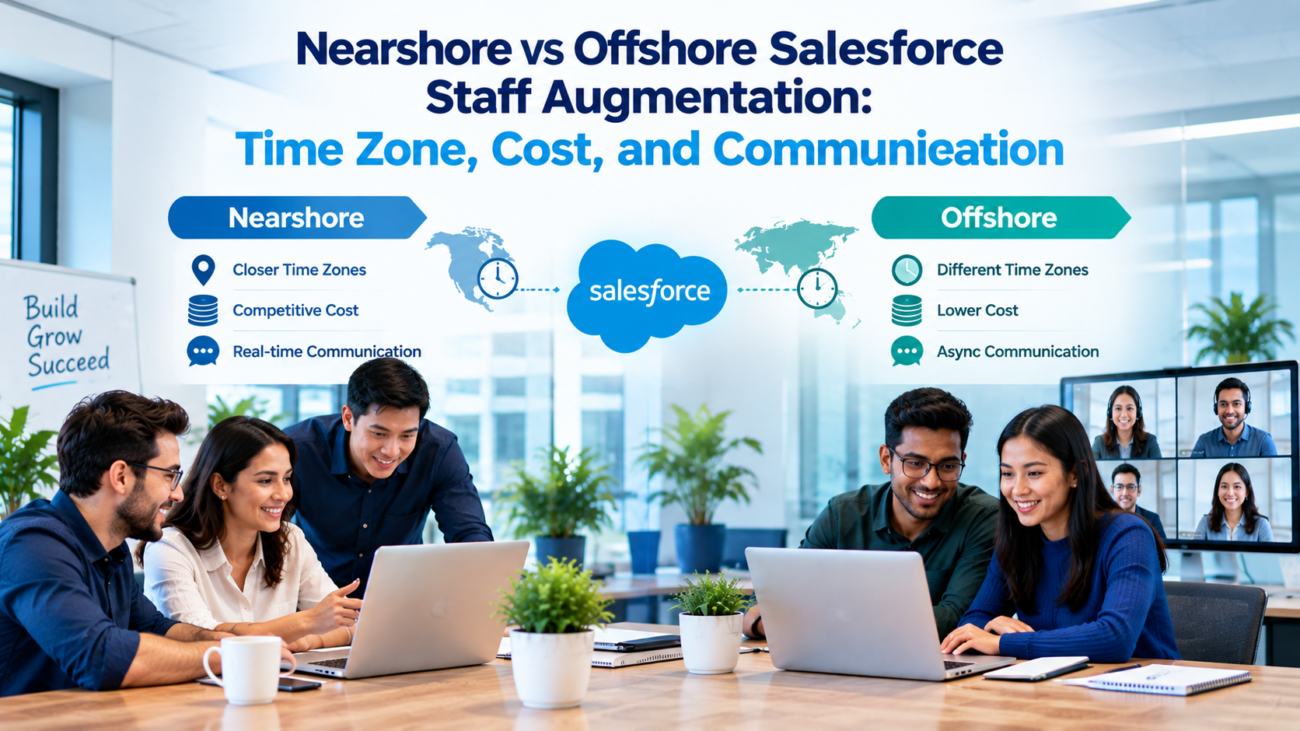
Salesforce teams usually consider outside staff when the internal team can’t cover a release backlog or a project needs skills that aren’t available in-house. Salesforce staff augmentation lets a company add external specialists while keeping control of priorities and delivery standards. The harder question is where those specialists should work from.
A US company may hire nearshore Salesforce developers in Latin America or offshore Salesforce developers in India, the Philippines, or another distant market. The location label alone doesn’t tell you whether the arrangement will work. Start with the working time the teams share and the full delivery cost. Then check how often the role needs live access to business or technical owners.
Those factors matter because Salesforce work ranges from highly interactive discovery to defined build tickets that can move with little live discussion. A functional consultant running workshops has a different communication need from a developer working through accepted Apex stories. The right model depends on the work pattern first. Geography helps explain the schedule around that work.
TL;DR
Nearshore vs offshore Salesforce staff augmentation is mainly a tradeoff between natural working-hour overlap and the amount of asynchronous work a team can support. Nearshore teams serving US companies often share much more of the normal business day. Offshore teams can still work well when requirements are written clearly and the team agrees on a dependable overlap window.
Cost needs the same care. There isn’t a neutral public dataset that gives one reliable nearshore rate and one reliable offshore rate for equivalent Salesforce roles. Compare quotes for the same role, seniority, Salesforce product experience, and working schedule. Then add the internal cost of coordination or rework that the delivery model may create. Salesforce outsourcing decisions become easier to defend when the buyer uses one job description and one set of working-hour assumptions for every proposal.
What Nearshore and Offshore Salesforce Staff Augmentation Mean
Salesforce staff augmentation places external professionals inside the client’s existing delivery process. The client normally owns the backlog and decides whether work is accepted. The external person may be a developer, administrator, QA engineer, business analyst, release specialist, consultant, or architect. The arrangement differs from a fixed-scope project because the buyer manages the person’s day-to-day priorities as part of its team.
Nearshore usually means the external professional works in a country with a relatively small time difference from the buyer. For a US company, the term often refers to Latin America. Nearshore Salesforce developers can therefore work a normal local schedule while sharing much of the US business day.
Offshore usually refers to a team based several time zones away. For US buyers, India and the Philippines are common examples. Offshore Salesforce developers may work local daytime hours or shift part of their day toward the client. Those choices matter more than the word offshore because a developer working a US-aligned schedule has a very different collaboration pattern from someone who has no shared working hours.
A 2021 study based on a survey of 80 outsourcing customers and 6 follow-up interviews examined temporal distance in software outsourcing. The Oxford University Research Archive study on temporal location reported better results for temporally nearshore arrangements on several measures, including project management effort and communication problems. The study isn’t Salesforce-specific, so it is useful context rather than proof that a nearshore engagement will perform better.
Time Zone Overlap Changes the Working Day
Time-zone distance changes when a question can be answered. That becomes important in Salesforce when a developer needs a decision about sharing, an integration mapping, a Flow condition, or an acceptance rule before continuing. A large gap doesn’t make the work impossible. It increases the value of written context because the person who can answer may be offline.
The scheduling effect appears in broader workplace research. Microsoft analyzed 20 million meetings and found that cross-time-zone collaboration was closely associated with early-morning and late-evening meetings. The Microsoft Research study on synchronous work across time zones also found that these meeting times often conflicted with employee preferences. Salesforce teams that rely on frequent live workshops should account for that burden before they promise daily overlap.
Older Microsoft interviews with globally distributed teams found that people separated by about 8 hours still found times to meet, often outside the normal workday. The study of globally time-zone-shifted collaboration is from 2011, but its scheduling point remains useful: large gaps can be managed, although somebody usually changes normal working hours when live discussion is required.
For a concrete comparison, use New York as the US reference. New York is on UTC-4 on September 29, 2026 and returns to UTC-5 on November 1. The 2026 New York time-zone record matters because a promised overlap window can change by 1 hour when the US clock changes and the delivery country doesn’t.
Bogota stays on UTC-5 and doesn’t use daylight saving time in 2026. The Bogota time-zone record shows that it is 1 hour behind New York while New York is on daylight time. That creates substantial natural overlap for teams working normal local business hours.
Bengaluru stays on UTC+5:30 throughout the year and doesn’t change clocks in 2026. The Bengaluru time-zone record shows a 9.5-hour difference from New York on September 29, 2026. Normal 9 AM to 5 PM schedules therefore don’t overlap on that date.
If both sides work 9 AM to 5 PM in their own location, the natural overlap looks like this on September 29, 2026:
| Example Location | UTC Offset | Difference From New York | Natural 9 AM to 5 PM Overlap With New York |
| Bogota | UTC-5 | 1 hour behind | 7 hours |
| Mexico City | UTC-6 | 2 hours behind | 6 hours |
| Buenos Aires | UTC-3 | 1 hour ahead | 7 hours |
| Bengaluru | UTC+5:30 | 9.5 hours ahead | 0 hours |
| Manila | UTC+8 | 12 hours ahead | 0 hours |
After New York returns to UTC-5, the natural overlap changes again. Bogota lines up with the full New York workday, while Bengaluru moves 10.5 hours ahead. A buyer should therefore ask for the named person’s actual local schedule and the guaranteed client overlap. A contract that says only “US hours” leaves too much room for interpretation.
Natural overlap and arranged overlap should be treated as different things. Nearshore Salesforce developers may share 6 or 7 normal daytime hours with an Eastern Time client without changing their schedule. Offshore Salesforce developers can create similar meeting access by shifting their workday, but the buyer should confirm whether that shift is permanent and who covers the role when the assigned person isn’t available. This distinction helps a Salesforce development team compare schedules without assuming that country alone determines availability.
Cost: Compare Equivalent Roles and the Cost of Delivery
Salesforce staff augmentation cost should start with an apples-to-apples quote. Compare the same job level and the same Salesforce product experience. Keep the required working hours consistent as well. A senior integration developer who works late US hours shouldn’t be compared with a mid-level administrator working a local daytime schedule and then treated as evidence that one region is cheaper.
Public pricing data has limits. Clutch publishes broad software development company rates by country, and its software development pricing guide can provide regional context. It isn’t a Salesforce contractor rate database, and it doesn’t normalize quotes for seniority or working schedule. That makes it unsuitable as proof of a fixed nearshore-versus-offshore Salesforce price difference.
A better buyer comparison uses the vendor quotes received for the same role. Record the hourly or monthly rate, then record what is included in that number. One proposal may include replacement coverage or a delivery manager. Another may charge only for the named contractor. Some rates assume local daytime hours, while a US-aligned shift can carry different commercial terms. The quote should be read together with the service conditions that affect how many useful hours the buyer receives.
The next step is to count internal coordination. A lower external rate can lose part of its advantage when a product owner spends more time rewriting tickets or managers have to repeat decisions across separate meetings. This doesn’t mean offshore work carries a fixed management penalty. The cost depends on how well the team can work asynchronously and how much business context is already written down.
Rework belongs in the comparison as well. A Salesforce ticket that omits an exception can lead to a technically correct change that still fails UAT. The same risk exists with nearshore staff. The difference is how quickly the missing context can be resolved when it appears. When the role has little natural overlap, weak requirements can turn a small clarification into a next-day delay.
Replacement and onboarding costs are easy to miss. A new contractor needs access and enough business context to work safely. They also need to learn the team’s release process. If one staffing option has a higher replacement rate or a slower backfill process, the advertised rate won’t show that cost. Ask each provider what happens when the named person leaves and how much transition support is included.
Use the same calculation for both models:
Usable delivery cost = external staffing spend + internal coordination cost + rework cost + delay cost + onboarding or replacement cost
The formula isn’t meant to create a fake industry benchmark. It gives buyers a way to compare their own nearshore and offshore quotes on the same basis. When no neutral Salesforce-specific regional rate dataset exists, that is more defensible than publishing a universal percentage saving.
Rate comparisons should also record the commercial unit. Some Salesforce staff augmentation proposals quote an hourly rate, while others use a monthly amount for a named full-time resource. Those numbers can’t be compared until the expected hours and included services are clear. A monthly quote may include vendor management or replacement support that an hourly quote doesn’t. The buyer should convert each proposal to the same period and note what the vendor is responsible for before drawing a cost conclusion.
The schedule can also change the price discussion. A role that requires permanent US-aligned hours may be priced differently from the same role on a normal local schedule, depending on the provider and market. Salesforce staff augmentation cost should therefore be reviewed together with the promised working window. The useful question is what the company will pay for the role under the schedule it actually needs.
Communication Depends on Response Time and Written Context
Communication quality is easier to assess when it is broken into 2 questions: how quickly can the right person respond, and how much context is available without a meeting? A team with strong written tickets can handle a larger time difference than a team that keeps key decisions in calls or private messages.
Nearshore Salesforce developers usually have more chances to resolve an unexpected question during the same US workday. That helps during discovery or UAT, where business owners may need to confirm what should happen before development can continue. The benefit is access to the decision maker while the task is active.
Offshore Salesforce developers often depend more heavily on handoffs when they work local daytime hours. The ticket should state the expected behavior and identify any dependencies. Examples or screenshots can be added when they remove ambiguity. The goal is to let the developer continue working without waiting for a meeting that starts after their normal day has ended.
Role design matters more than a general claim that one region communicates better. A business analyst gathering requirements has a high need for live conversation. A QA engineer running an agreed regression pack can work with much less. Buyers should judge communication against the job that will actually be assigned.
Salesforce outsourcing also needs a rule for unresolved questions. The person raising a blocker should record the decision needed and the work that can continue without it. That gives the next available owner enough context to respond quickly. A Salesforce development team that uses this habit can make better use of a short overlap window because live time is reserved for decisions that truly need discussion.
Match the Delivery Model to the Salesforce Work
The easiest way to choose a location model is to map the work by its dependence on live decisions. Configuration work can sit close to business process because changes to Flow logic or permissions may need quick confirmation from process owners. Nearshore Salesforce developers can fit that pattern when requirements are still moving during the sprint.
Defined engineering work can tolerate more time-zone distance. Apex classes or Lightning Web Components can often progress asynchronously when interfaces are settled and acceptance rules are clear. The same is true for planned test execution and documented data tasks. Offshore Salesforce developers can fit these jobs when they have the needed platform background and a clear blocker path.
Salesforce’s own delivery guidance supports stronger written control for distributed work. The Salesforce DevOps Center source-control documentation describes source control as the single source of truth for project changes and supports review before promotion. That gives a distributed Salesforce development team one place to track changes instead of depending on conversation history.
Work-item quality matters for the same reason. Salesforce says a work item should describe the work and recommends acceptance criteria that identify successful completion. The Salesforce guidance for DevOps Center work items notes that clear requirements can avoid lost time from unnecessary iterations. That is especially useful when the person who wrote the requirement won’t be online for the developer’s full workday.
| Salesforce Work | Need for Live Decisions | Typical Location Fit |
| Discovery and process design | High | Nearshore or scheduled US-aligned offshore hours |
| Functional consulting | High | Nearshore or substantial planned overlap |
| Architecture workshops | High | Model with dependable senior overlap |
| Defined Apex or LWC tickets | Medium | Nearshore or offshore |
| Regression testing | Low to medium | Nearshore or offshore |
| Data work with agreed rules | Low to medium | Nearshore or offshore |
| Production incident support | Depends on support window | Model with contracted coverage |
Compare Skill and Quality Without Using Geography as a Shortcut
Geography isn’t a technical screening method. A team in a distant location can produce strong work, and a nearby team can still miss requirements or create poor code. Microsoft found negligible differences in post-release failures between distributed and collocated components in its Windows Vista study after other factors were considered. The Microsoft Research case study on distributed software quality is from 2009 and isn’t Salesforce-specific, but it is useful evidence against treating distance as a direct measure of engineering quality.
Screen the person for the exact Salesforce work. A developer with strong Apex experience may still lack the integration background required for a difficult ERP connection. A consultant who knows Sales Cloud may not be ready to lead a complex Health Cloud design. Ask what the candidate personally delivered and which decisions they owned.
Certifications can support that review when they are current and relevant. Salesforce provides a public process to check active credentials, and the Salesforce certification verification guidance explains how certification and maintenance status can be checked. Verification should sit beside practical screening rather than replace it.
The interview should also test working habits. Ask how the person raises a blocker when nobody is online and how they handle code review. Those answers show whether the candidate can work inside the communication model you plan to use.
Build an Operating Model Before the Team Starts
A distributed team needs a defined working model before outside staff receive tickets. Decide where requirements live and how decisions are recorded. The process should be clear enough that a new team member can tell what to do when a ticket is ready and what to do when it is blocked.
Start with the backlog. Each item should describe the business problem and expected behavior. Add dependencies or acceptance conditions where they change how the work is built. The level of detail should match the task. A small label change doesn’t need a long specification, while a sharing or integration change usually needs more context.
Set core collaboration hours by role instead of inventing one company-wide threshold. A functional consultant may need several hours with stakeholders. A developer with a stable backlog may only need enough overlap for blockers and review. These are planning choices, not industry benchmarks, so the team should set them from its own workflow.
Create a handoff rule for work that crosses time zones. The person ending the day should record the current status and the decision needed if work is blocked. The next team can then act without reconstructing the issue from chat. A clear handoff protects the shared meeting window for decisions rather than status recaps. This is one of the most important operating habits in Salesforce outsourcing because it reduces the amount of context that disappears between working days.
The Salesforce development team should also agree on who can make which decisions. A developer may be able to choose an implementation detail without waiting, while a change to a business rule may require a product owner. Writing those boundaries down prevents unnecessary waiting and reduces the risk that a contractor makes a decision the client expected to retain.
Control Salesforce Access for External Staff
External staff may need access to sandboxes or source repositories, and some roles may require production access. The access decision should follow the person’s tasks rather than their country. Keep permissions narrow enough that a contractor can do the assigned work without receiving unrelated privileges.
Salesforce recommends using the Minimum Access profile as a baseline and adding task-based permission sets to enforce least privilege. The Salesforce permission-set guidance provides a practical basis for contractor access because permissions can be tied more closely to the work being performed.
Authentication needs the same attention. Salesforce requires MFA for employee logins to production and sandbox orgs, and enforcement for employee users began in summer 2026. The Salesforce MFA requirements also identify stronger requirements for privileged users such as many admins and developers. Teams should account for those controls during onboarding rather than fixing access after work starts.
Development should use non-production environments when the task allows it. Salesforce’s developer guidance explains how teams can choose the appropriate development org, and the Salesforce guide to development environments also discusses masking sensitive sandbox data. Offboarding should then disable the person’s named access and review any remaining repository or integration credentials. The Salesforce development team should apply the same access standard to nearshore and offshore staff who perform equivalent work.
When Nearshore Salesforce Staff Augmentation Fits
Nearshore Salesforce staff augmentation is a strong fit when a role depends on frequent same-day decisions. Functional consulting and discovery often fall into this category because the person may need business owners throughout the day. The same pattern can appear during UAT or release troubleshooting, where the next action depends on a quick answer.
Nearshore Salesforce developers can also fit teams with a backlog that changes during the sprint. The shared workday gives developers more chances to confirm a new rule before spending several hours on the wrong interpretation. That benefit matters most when requirements are still being shaped while development is underway.
The nearshore label still needs verification. Ask for the person’s actual hours and country. Confirm whether the schedule changes when the US enters or leaves daylight saving time. A nearby location helps only when the assigned person’s working schedule creates the overlap the project expects.
When Offshore Salesforce Staff Augmentation Fits
Offshore Salesforce staff augmentation fits best when the work can move from written context and the team doesn’t require continuous access to US stakeholders. Defined development stories and planned testing can fit this pattern. Release preparation can also work when responsibilities are settled in advance.
Offshore Salesforce developers can extend the working day when the handoff is intentional. A US team can finish with a written decision or a ready ticket, then the offshore team can continue during its daytime. This model is useful only when the task can progress without repeated questions. Otherwise, the time difference turns the handoff into waiting.
Salesforce outsourcing with offshore staff should therefore make the schedule explicit. Ask whether the person works local hours or a partial US shift. If the role uses a full night schedule, ask how long that schedule is expected to continue and how coverage is handled when the person is unavailable. Those questions reveal more than a generic promise of US overlap.
When a Mixed Nearshore and Offshore Model Fits
A mixed model can separate work by collaboration need. A nearshore architect or business analyst can handle stakeholder-heavy work during US hours, while offshore developers take defined build items. Another Salesforce development team may use nearshore engineers for integration work and offshore QA for a planned test cycle.
The model needs one written source for decisions. Salesforce outsourcing becomes harder to manage when each location keeps its own version of the requirement. A nearshore person shouldn’t become a permanent translator between the client and offshore staff because the backlog is weak. That creates an extra communication layer and can hide requirements from the people doing the work.
A mixed Salesforce outsourcing model also needs clear ownership at handoff points. The person receiving the work should know what is complete and who can answer the next blocker. Without that clarity, adding more locations can increase coordination work instead of extending useful coverage.
A Decision Checklist for Buyers
The comparison should begin before candidate interviews. Define the role and the work schedule you need, then ask nearshore and offshore providers to respond to the same requirements. That keeps the commercial comparison consistent and reduces the chance that a cheaper quote reflects a different job.
Use this checklist during evaluation:
· Confirm the named person’s local working hours and guaranteed overlap.
· Record how US daylight saving changes affect that schedule.
· Compare the same Salesforce role and seniority across proposals.
· Confirm experience with the Salesforce products used in your org.
· Ask what the candidate personally delivered in similar work.
· Verify current Salesforce credentials when they are relevant.
· Define where acceptance criteria and technical decisions will live.
· Agree on the blocker path outside shared working hours.
· Confirm who reviews code and who approves releases.
· Match org access to the contractor’s actual tasks.
· Ask how replacement coverage works if the named person leaves.
· Set knowledge-transfer expectations before the engagement ends.
Nearshore Salesforce developers and offshore Salesforce developers should be judged against the same role definition. Compare the proposed person’s experience and actual working schedule. Then compare cost using the same commercial assumptions. That produces a more useful decision than treating location as a score for quality or value.
How to Choose Between Nearshore and Offshore
Nearshore vs offshore Salesforce staff augmentation comes down to the operating needs of the role. Work that depends on frequent live decisions benefits from more natural overlap. Work that is well defined can tolerate a larger time difference when handoffs are clear.
Cost should be compared after those conditions are fixed. Use equivalent roles and actual quoted terms, then account for the internal work required to keep delivery moving. Salesforce staff augmentation is most useful when the client knows who owns decisions and how the external person will fit into the delivery process.
The final choice should therefore be based on the named candidate and the schedule that person will work. Salesforce outsourcing can succeed in either model when the job is designed for the communication pattern it creates. The same rule applies to the Salesforce development team as a whole: assign work according to its need for live decisions rather than using one location rule for every role.
FAQs
What Is the Main Difference Between Nearshore and Offshore Staff Augmentation?
The main difference is the time-zone distance between the client and the external Salesforce professional. Nearshore teams usually work closer to the client’s normal business day. Offshore teams often have a larger time difference and may need scheduled overlap. The effect shows up in meeting availability and how quickly blockers can be answered.
Is Nearshore Staff Augmentation Always More Expensive Than Offshore?
No. Public market data doesn’t support one universal Salesforce rate gap. Price changes with role level and product experience, and working hours can affect commercial terms. Compare equivalent proposals for the same job, then include the internal cost of coordination or rework when those costs are material.
How Many Overlap Hours Should a Salesforce Team Have?
There isn’t one evidence-based number that fits every role. A consultant who runs workshops may need several shared hours, while a developer with a stable backlog may need a shorter window for blockers or review. Set the overlap requirement from the actual work instead of using a generic benchmark.
Can Offshore Developers Work US Hours?
Yes. Some offshore developers work partial or full US-aligned schedules. Confirm whether those hours are the person’s normal assignment and how the schedule changes when US daylight saving time starts or ends. The agreed working window should appear clearly in the staffing terms.
Are Nearshore Developers Better for Agile Teams?
Nearshore developers often have more natural overlap with US teams, which can make frequent Agile interaction easier. Location doesn’t prove Agile skill or delivery quality. Backlog quality and team ownership still affect how well the engagement works.
Which Salesforce Work Is Easier to Send Offshore?
Work with clear requirements is easier to run across a large time-zone gap. Defined Apex development or planned regression testing can fit well when the person has enough context to work independently. Tasks that need frequent unscheduled business decisions are harder to run with little overlap.
How Should We Compare Salesforce Staff Augmentation Cost?
Start with quotes for the same role and seniority. Keep Salesforce product experience and working schedule consistent. Then add internal coordination or rework costs that differ between proposals. This gives a better view of staff augmentation cost than comparing hourly rates from different job definitions.
Does Offshore Staffing Reduce Salesforce Quality?
No general rule supports that conclusion. Engineering quality depends on the person’s skill and the team’s review process. Requirements and testing also matter. Offshore developers should be screened against the same technical bar used for nearshore or local candidates.
How Do We Verify a Salesforce Contractor’s Skills?
Verify current certifications when they matter to the role, then test practical experience. Ask about work with the exact Salesforce products involved in your org. Use a realistic technical problem with sensitive details removed to see how the candidate reasons through the task.
What Communication Process Works Best With Offshore Teams?
Use written tickets that state the expected behavior and dependencies. Define a fixed overlap window for decisions that need live discussion. The team should also have a clear handoff process so a blocker doesn’t sit unnoticed until the next US workday.
Is a Mixed Nearshore and Offshore Salesforce Team Practical?
Yes. A mixed model can place stakeholder-heavy work in a nearshore schedule and defined execution work in an offshore schedule. It works best when both groups use the same written source for requirements and decisions. Extra locations should have a clear reason tied to the work.
What Security Controls Should External Salesforce Staff Have?
Give external staff named access that matches their tasks. Use least-privilege permissions and the MFA controls that apply to their user type. Development should use a non-production environment when possible, and access should be removed promptly when the engagement ends.
Should Nearshore and Offshore Developers Get Production Access?
Production access should depend on job need rather than location. Many development tasks can be completed in sandboxes or scratch orgs. When production access is necessary, keep permissions narrow and define who can approve or make changes.
What Should We Ask a Staff Augmentation Provider Before Signing?
Ask who will actually work on the account and what hours that person will work. Confirm relevant Salesforce experience and how replacements are handled. The agreement should also make responsibilities clear so the client knows which decisions remain with its internal team.
When Is Staff Augmentation a Poor Fit?
The model is a poor fit when the client can’t provide enough ownership or context for an external person to work safely. It may also be the wrong model when the company wants a vendor to own an entire fixed outcome rather than manage individual external specialists inside its own delivery process.
