
SAP application support can look affordable in a proposal and become expensive once the work begins. A low ticket rate means little if every reopened incident generates another charge. A dedicated team offers predictable monthly fees, but the business might pay for capacity it rarely uses. An agreement tied to results sounds appealing until nobody can agree on who caused a missed target. Teams that want an experienced partner can look at Advayan’s Salesforce development.
Choosing between SAP AMS pricing models starts with a practical question: what kind of work will the support provider actually perform? Stable finance operations need different coverage from manufacturing systems with recurring integration faults. Their contracts should reflect that difference.
SAP AMS pricing models affect how incidents are classified, when specialists become available, and who pays for unlisted changes. A cheaper annual quote may leave the buyer carrying more risk.
This guide compares SAP AMS pricing models through ticket-based billing, dedicated full-time equivalent (FTE) capacity, and payment linked to results. It explains cost formulas, key clauses, and a way to compare proposals against real demand.
TL;DR
SAP AMS pricing models determine whether a customer pays for completed support requests, reserved specialist capacity, or verified service results. Ticket-based billing fits limited and fairly predictable incident demand but can become costly when issues recur. FTE arrangements fit steady work that requires ongoing access to specific SAP skills, although unused capacity still costs money. Outcome-based agreements connect some payment to agreed performance measures, but they require reliable baseline data and clear control over the measured result. Compare annual costs using the same scope, support hours, incident mix, enhancement allowance, and transition requirements. Many buyers will find that a mixed contract handles routine support and unusual demand better than a single method.
What SAP AMS covers and why scope comes first
SAP Application Management Services, or AMS, generally means the work required to keep SAP applications operating after go-live. The exact coverage varies by system and contract. It can include functional incident resolution, user assistance, application configuration changes, interfaces, scheduled job support, minor developments, and problem investigations. A provider may also handle release testing and regular operational reports. Those activities do not necessarily belong in every quoted package.
This matters because the SAP product and deployment model affect which tasks a third party can perform and which duties are already funded. SAP’s offering comparison guidance separates application management from the responsibilities already assigned to SAP or the customer across deployment options. Buyers should identify those boundaries before asking an AMS provider to price work already covered elsewhere. Otherwise, apparently similar offers may include different duties.
Scope needs business definitions. SAP Finance support may cover posting errors and configuration defects without including a finance process redesign. Interface monitoring may be included while repairing third-party code remains excluded. Put these boundaries in the service catalog before an emergency occurs.
Service scope must establish who owns each operating task, especially in private cloud environments where responsibilities may be shared between several parties. SAP’s responsibility breakdown distinguishes standard technical operations from optional application services and customer tasks. It gives teams a basis for checking who owns each service. The buyer should then map those duties to the proposed AMS statement of work, including the handoff points between SAP, the AMS provider, internal IT, and other vendors.
To compare SAP AMS pricing models, a scope baseline lists applications, business units, interfaces, service hours, languages, and expected changes. Include internal duties too; otherwise suppliers may price different services.
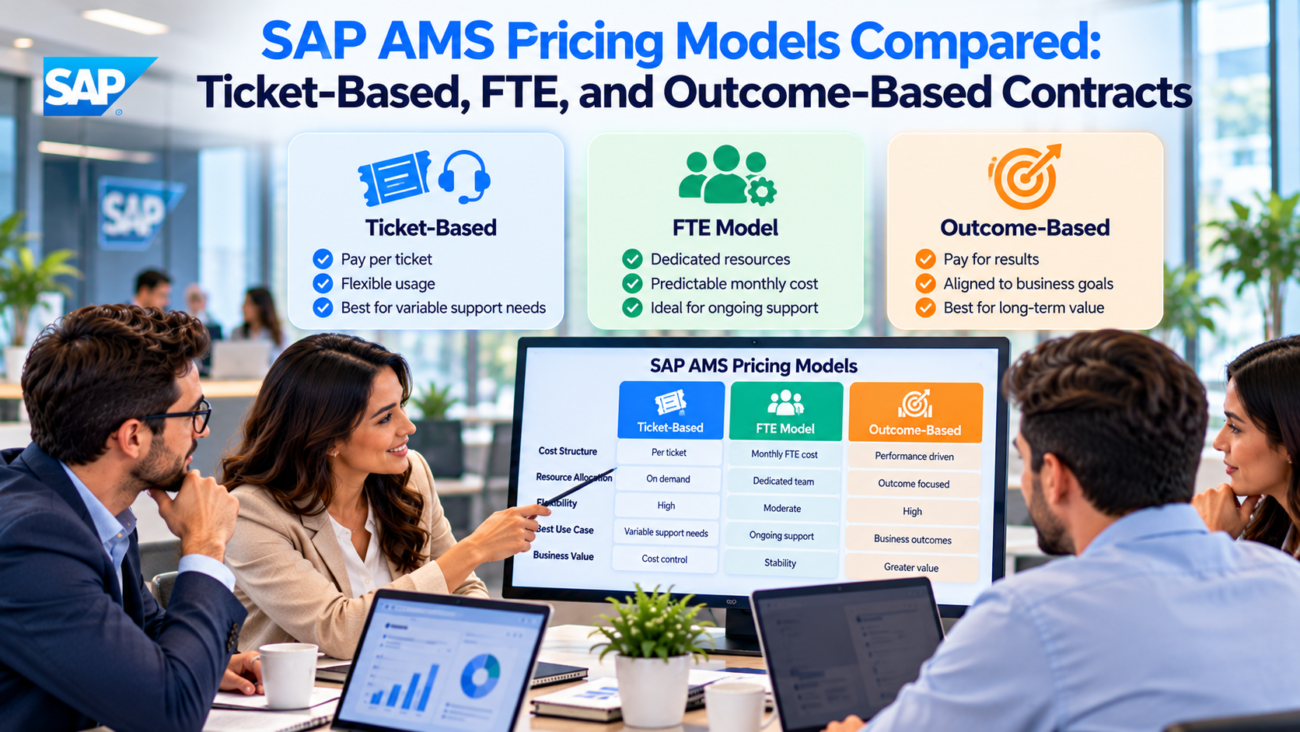
SAP AMS pricing models at a glance
SAP AMS pricing models define what creates a charge. They don’t, by themselves, guarantee response times, quality, or the availability of rare skills. Every model can miss service targets or exclude work the buyer expects.
| Factor | Ticket-Based | FTE-Based | Outcome-Based |
| What the buyer pays for | Agreed ticket units or volume bands | Committed consultant capacity | Agreed results or performance conditions |
| Cost behavior | Changes with billable demand | Mostly fixed for reserved capacity | Base fee plus agreed adjustments |
| Main buyer concern | Volume and ticket classification | Unused hours and skill coverage | Attribution and measurement disputes |
| Typical fit | Limited or uneven request volumes | Steady operational and change workload | Mature services with stable measures |
| Key contract control | Ticket definitions and exclusions | Allocation, substitution, and capacity rules | Baselines, data ownership, and payment triggers |
The same caution applies to outcome pricing. A fixed monthly AMS fee with penalties for missed response times is not necessarily an outcome-based deal. It may simply be a managed service with service credits. The decisive question is whether part of the payment truly depends on a measured result rather than the presence of a contract label.
How ticket-based SAP AMS pricing works
Under ticket-based SAP AMS pricing, the invoice follows the number and type of support records accepted under the billing rules. Suppliers may charge per closed ticket or sell monthly allowances and effort bands. The invoice may use P1, P2, and P3 rates, with surcharges for longer effort bands. A monthly minimum can apply even if few tickets arrive. The agreement should state whether the charge follows severity, actual effort, or both, and whether a band change needs approval. In ticket-based SAP AMS pricing, the buyer needs clear billing triggers before forecasting spend.
Ticket categories should begin with the cause of a request and whether the work could be planned in advance. SAP itself distinguishes unexpected incidents from planned activities. Its service process explanation identifies a case as an unexpected issue and a service request as work that can be planned. An AMS contract may use different commercial categories, but the separation is useful. A failed payment run, a password question, and a requested report change shouldn’t automatically attract the same treatment.
Ticket units and severity bands
A unit may mean a closed incident, approved request, or effort band. Severity describes business impact, not necessarily time spent. Define band limits, when the clock starts, and how a higher band is approved. A monthly minimum of 10 units, for example, can still bill 10 units when only 6 qualify. The contract should prevent an incident from attracting both an unapproved effort surcharge and a full severity surcharge.
The most important rule concerns ticket splitting. A single failed interface can produce many business reports, yet the underlying issue may be one defect. The contract should say whether the provider bills the original incident, each linked report, or each separate work order. Reopened records also need a clear rule. Customers shouldn’t pay repeatedly for the same unresolved defect merely because the workflow moves a record into a closed status.
When this model works best
Ticket-based SAP AMS pricing can work for systems with modest incident volumes and little ongoing enhancement work. It can also provide an overflow channel for a small internal SAP team. The buyer gets a direct link between billable activity and spending, provided minimum commitments do not erase that benefit. A rarely used application may not justify reserved specialist capacity.
The weakness becomes visible when demand rises. Repeat incidents, seasonal processing peaks, and new releases can create a large number of records. Without included root-cause work, repeat tickets may keep generating charges. ITIL’s problem management guidance explains the role of finding causes and managing known errors. Buyers should turn that principle into an agreed service obligation, not assume ticket closure will solve persistent failures.
For ticket-based SAP AMS pricing, obtain a unit schedule and sample invoices. Check duplicates, reopenings, cancellations, and emergencies. Forecast costs from historical volumes by category, not raw help-desk totals.
How FTE-based SAP AMS pricing works
FTE-based SAP AMS pricing buys access to a defined amount of consultant time or capacity. A customer might reserve a functional SAP specialist, a share of a Basis engineer, or an agreed blend of expertise. A full-time equivalent describes committed capacity, not necessarily 1 exclusive employee. The agreement must state whether staff are dedicated or shared and define the billable hours in a month. For example, if 1 FTE means 160 service hours monthly, 0.5 FTE means 80. That is a contract assumption, not an industry-wide rule.
FTE-based SAP AMS pricing is useful when incidents and changes arrive throughout the month. The same consultants can learn business rules, recurring pain points, and the history of custom developments. Continuity saves explanations, but the monthly fee may still apply when demand falls.
FTE allocation versus actual hours
Define working calendars and hours of coverage. A 0.5 FTE allocation doesn’t promise instant access throughout the day if that consultant is shared. Specify scheduled availability, which meetings count as billable time, and whether a qualified substitute covers leave without a new charge. State whether unused monthly hours expire or carry forward, and any limit on carryover.
Reserved capacity and billed hours can sound alike in a proposal even though they create different commitments for the buyer. The US government’s labor-hour contract explanation describes charging specified labor rates for hours supplied, whereas a reserved-capacity deal may charge a stable monthly amount regardless of actual workload. These federal rules aren’t rules for private SAP contracts, but they give procurement teams a clear way to distinguish commercial structures that suppliers sometimes describe with similar words.
The utilization problem
FTE-based SAP AMS pricing is easiest to defend when planned work remains steady. If a team spends most of its time waiting for assignments, the effective cost per resolved issue increases. If it is constantly overloaded, work piles up and extra staff may be needed. Both problems can occur while the monthly invoice stays the same. Tracking hours alone won’t reveal whether the right skills are available for important requests.
Ask for monthly allocations by role and work type. Distinguish incidents from changes and preventive work. Check whether highly paid specialists handle routine tasks and require approval before the supplier changes agreed personnel.
FTE-based SAP AMS pricing fits businesses with ongoing configuration changes, regular release work, and enough demand to use the reserved team. It works less well when the required skills vary sharply from month to month. In those cases, a smaller core team and an agreed specialist pool may offer better coverage.
How outcome-based SAP AMS contracts work
Outcome-based SAP AMS contracts make part of the provider’s compensation depend on an agreed and measurable result. The result might be a reduction in recurring incidents, sustained recovery performance for a critical service, or fewer failed production changes. A contract can retain a fixed operating fee and put an additional payment at risk. For illustration, suppose the annual base is $108,000, paid as $9,000 monthly. An agreed measure is the share of provider-owned P2 incidents restored within 8 covered hours. The year-end payment is $108,000 plus $12,000 if the rate reaches 97%, stays $108,000 from 95% to below 97%, or falls to $96,000 if it is below 95%. The incentive and deduction each cap at $12,000, and only 1 band applies. Define exclusions, records, and appeals before using this formula. These dollar figures are hypothetical contract terms, not published SAP AMS rates.
Outcome-based SAP AMS contracts need definitions that let both parties test whether a promised result was delivered. The performance-based acquisition rules require measurable standards and a way to assess whether a supplier meets them. Private SAP contracts aren’t governed by those rules merely because they use outcome language. The principle is still useful: a result cannot support a fair payment formula if the parties can’t measure it consistently.
Choose results the provider can influence
For outcome-based SAP AMS contracts, strong measures sit close to work the provider actually controls. For example, the percentage of incidents restored within an agreed period can be tracked when the provider owns the restoration activity. A target for reducing repeat incidents can also be sensible when the supplier is responsible for investigating causes and implementing approved fixes. Account for customer approval delays and external faults.
A target such as reducing the entire finance close cycle is much harder to assign. The cycle may depend on finance staffing, late source data, and policies outside the AMS team’s control. A provider should not earn credit for an improvement it didn’t create, or lose fees because a customer withheld a required decision. Attribution rules protect both sides.
To assess business results, customers need records linked to real processes and consistent definitions for the measures they will use. SAP’s business process monitoring documentation describes process indicators that can help identify disruptions across connected SAP applications. These measures may inform an outcome agreement, but the presence of a dashboard doesn’t establish responsibility. The baseline, scope, exclusions, and data quality still need joint approval.
Build a payment mechanism that can be audited
State the base fee, possible payment adjustment, reporting source, and treatment of missing data. Both parties should be able to reproduce each calculation.
SAP AMS contract costs and the main price drivers
SAP AMS contract costs depend on the service scope, skills, operating hours, and billing rules. There is no defensible universal monthly rate for SAP AMS. A support quote for a single application with weekday coverage cannot be compared directly with a proposal covering global production systems around the clock. Published provider prices also reflect their own packaging and exclusions, not a market-wide benchmark.
SAP AMS contract costs also depend on the number of applications. Finance, procurement, manufacturing, and warehousing require different experts. Custom ABAP developments, complex interfaces, multiple countries, and local calendars can add support effort.
Service hours also matter. Weekday work can use ordinary staffing, while continuous support may need shifts or on-call specialists. Confirm whether the fee covers response and restoration work outside business hours.
Buyers must distinguish baseline SAP services from separately purchased application support. For SAP S/4HANA Cloud Private Edition, some technical operations fall within the standard service fee. SAP’s Cloud Application Services guidance describes supplementary service packages, which may require their own contract and fee. Functional incident work and other application tasks are not automatically included in baseline cloud support. Review the signed order form and SAP roles-and-responsibilities list before paying another provider for the same task.
Transition work also affects first-year SAP AMS contract costs. The incoming provider may need system access, current documentation, knowledge transfer, monitoring rules, and a verified backlog. A proposal that excludes these tasks can look less expensive than one that prices them openly. Similarly, an expected improvement project should not be hidden in the incident budget. To control SAP AMS contract costs, price steady support separately from known project work.
Comparing annual costs under different workloads
Compare SAP AMS pricing models by annual spending for equivalent coverage, including demand spikes. A monthly quote can hide minimums and work charged separately. Use the same service scope for every offer.
| Model | Annual Calculation | Check Before Comparing |
| Ticket-based | Billable tickets times agreed unit rate, subject to minimums and approved surcharges | What counts as a billable unit |
| FTE-based | Monthly reserved-capacity fee times 12, plus approved excess effort | Whether staffing covers the full workload |
| Outcome-based | Annual base fee plus earned incentive or minus eligible deduction | Whether outcomes are within provider control |
Consider a hypothetical scope: weekday SAP functional incident support, defined response and restoration targets, root-cause reviews, and monthly reporting. All 3 offers cover the same service hours and duties. Major enhancements, weekend work, and transition are excluded from all 3. Assume a similar severity mix in each scenario. These are illustrative figures, not market quotes.
The ticket offer charges $250 per accepted ticket, with a $2,500 monthly minimum. The FTE offer reserves 1 FTE at $10,000 per month, or $120,000 yearly. For outcome-based SAP AMS contracts, the offer uses the $108,000 base and $12,000 maximum annual adjustment. The table assumes its target band is met without a bonus or deduction, and tickets arrive evenly enough that the monthly minimum is exceeded.
| Annual Ticket Volume | Ticket Cost | FTE Cost | Outcome Base Cost |
| Low: 240 | $60,000 | $120,000 | $108,000 |
| Expected: 480 | $120,000 | $120,000 | $108,000 |
| High: 720 | $180,000 | $120,000 | $108,000 |
The ticket and FTE fees break even at 480 tickets per year: $120,000 divided by $250. Below that volume, ticket billing costs less under these assumptions. Above it, reserved capacity costs less, provided 1 FTE can handle the work. At 2 service hours per ticket, the high case uses 1,440 hours yearly, leaving 480 of an assumed 1,920 annual capacity hours for reporting and other included tasks. If either offer needs extra capacity, add that approved charge before comparing.
The fixed-price contract framework illustrates how clear scope changes who carries cost risk. Those federal rules don’t govern a private SAP AMS contract. Here, the useful test is whether each bid supplies the same service when ticket volumes rise or fall.
Service levels, metrics, and payment risk
Service level agreements describe what the provider must do and how performance will be checked. They don’t automatically determine the fee. A ticket contract, a capacity contract, and an outcome contract can all include service levels, though the financial consequences may differ. Define response, restoration, final resolution, and approved change completion separately.
Response is acknowledgment and initial action. Restoration returns a service to agreed use, possibly through a workaround. Resolution may need a lasting fix. A quick acknowledgment does not prove that the business process is working.
Service levels should reflect actual business impact during an interruption and establish the point at which a process is usable again. ITIL’s service level management material emphasizes targets that reflect business service needs. For SAP support, that means defining the actual effect of an incident on payroll, order processing, or financial close. Severity should be based on agreed impact criteria, with documented rules for downgrading priority or pausing clocks. A provider shouldn’t control the reported result simply by changing a ticket label.
Payment terms should be measurable. Keep routine SLA credits separate from agreed outcome fees, and define when both can apply. Address maintenance windows and delays caused by the customer or other systems.
For outcome-based SAP AMS contracts, retain access to time stamps and ticket histories. Sample closed incidents to confirm restoration, and record excluded events and disagreements in monthly reviews.
Contract clauses that change the final bill
Small clauses can decide SAP AMS contract costs more than the unit rate. A contract may include a minimum number of paid tickets, an annual increase in rates, or a narrow definition of included changes. It may treat weekend assistance as a separate charge. These terms can change SAP AMS contract costs even when the day-to-day service looks unchanged.
Scope and change control
Define incident support, service requests, problem investigation, minor enhancements, and project work separately. Specify whether effort estimates require customer approval and whether unapproved work can be billed. The contract should describe how a new SAP module, country rollout, or interface enters scope. Without a change process, every expansion becomes a negotiation after the work is already urgent.
When a business process spans SAP and outside systems, a failed transaction can cross several support responsibilities and supplier boundaries. SAP’s integration monitoring guidance describes tracing message flows across connected systems. That cross-system view is useful when an incident crosses responsibility boundaries. The commercial agreement should then say which provider investigates first, who coordinates the handoff, and when work on a non-SAP component becomes separately billable. Otherwise, teams may spend valuable time debating ownership while the business process remains stuck.
Staffing, credits, and exit rights
FTE-based SAP AMS pricing needs rules for absences, replacement qualifications, and access to specialists who aren’t part of the regular team. Ticket-based contracts need clear closure rules and billing disputes. Outcome agreements need measurement and credit calculations. All models need a workable exit clause, including knowledge transfer, documentation handover, open-ticket ownership, and access removal.
Service oversight continues through delivery reviews, transition work, and eventual transfer to another provider, well beyond approving monthly invoices. The service management requirements in ISO/IEC 20000-1 cover service planning, transition, delivery, and improvement. The standard doesn’t prescribe an SAP AMS price, but it supports the idea that an orderly service lifecycle must be managed beyond the monthly invoice. Contract terms should match that practical need, particularly when support changes providers.
Legal and security teams should review liability, data access, subcontracting, and security reporting. These provisions can create losses larger than ordinary support fees if ignored.
How to evaluate SAP AMS proposals fairly
Give each bidder one service scope with incident history, support hours, applications, critical processes, and planned work. Identify tasks retained by SAP and internal teams so exclusions are visible.
A fair evaluation has 2 layers. The first compares commercial cost under the same workload. The second tests whether the proposed operating method can deliver the service. A low bid should lose value if it cannot provide a specialist for a critical application or if its ticket rules encourage repeated billing for the same problem.
Use this checklist during proposal review:
· Require a complete list of included and excluded work, with rates for exceptions.
· Request an example invoice for routine months and months with unusually high demand.
· Verify the available consultant roles, coverage hours, and substitution policy.
· Ask how root-cause investigation is funded and how repeat incidents are treated.
· Require measurable service targets and direct access to reporting evidence.
· Price transition, knowledge transfer, and exit support before comparing totals.
Providers should demonstrate how their proposed service results can be verified. SAP Cloud ALM’s service level reporting describes business service disruptions and calculated service levels. Ask each bidder for a sample report with matching incident records. A dashboard alone doesn’t prove contract performance.
Reject proposals that cannot cover critical applications or meet minimum service needs before comparing cost. A weighted score cannot compensate for a missing specialist during a production failure.
When hybrid SAP AMS pricing makes sense
A hybrid agreement blends SAP AMS pricing models for different kinds of work. For example, a fixed monthly fee might fund service coordination and routine monitoring, while specialist enhancements are billed after approval. Another contract might reserve a small core team and use ticket rates for overflow. A performance payment can be added when reliable measures are available.
Support demand varies. Routine work needs continuity, while major changes may require temporary specialists. A mixed structure can price those activities separately rather than force every request into one unit.
Hybrid agreements need precise category boundaries. Assign each work type to one billing bucket and reconcile capacity, tickets, changes, and performance adjustments each month. This reduces double billing.
A staged change can be sensible for teams moving toward outcome pricing. Start by defining responsibilities and gathering reliable data under an existing fee. Add a narrow measured incentive once both parties trust the records. Expand the result-based portion only when the provider controls enough of the service to accept that responsibility. Review pricing after an SAP migration or major scope change.
Choosing the right model for your SAP environment
The right choice among SAP AMS pricing models follows demand. Review past incidents by application and severity, then separate ordinary support from approved change work. Look for patterns across the business calendar. A financial close period might bring concentrated demand even when the rest of the month is quiet. A manufacturing system may need dependable recovery coverage even if the average number of tickets is low.
Ticket-based SAP AMS pricing is a reasonable starting point when work is occasional and the buyer can validate billed records. It needs clear minimum fees and anti-duplication rules. FTE-based SAP AMS pricing becomes more attractive when the organization has continuous work for a known set of skills. Its value depends on using that capacity for meaningful support and changes rather than simply keeping people available.
Outcome-based SAP AMS contracts suit stable services with reliable records and provider-controlled results. Mixed agreements may suit applications with different needs. Avoid choosing terms only because they sound modern.
Review the model after significant SAP changes. A migration, country rollout, or retired interface changes support demand. SAP describes the capabilities of integration monitoring tools that can reveal patterns across connected applications. Use actual service records when renewing instead of copying old allocations, including application exceptions and approved change work.
Final thoughts on SAP AMS contract value
The best choice among SAP AMS pricing models matches the work and makes the buyer’s financial exposure clear. Ticket billing offers a direct charge for recorded activity but needs strict billing definitions. Reserved FTE capacity provides continuity for steady workloads but requires utilization checks. Payment linked to outcomes can reward measurable improvement, provided targets reflect work the supplier can control.
Before signing, compare annual spending across demand levels. Check duties, service targets, transition fees, and excluded work. Those details decide whether SAP AMS pricing models remain fair once the service is live. Price matters, but the agreement also needs to make everyday support decisions clear before the next important SAP incident occurs.
Frequently asked questions
What are the 3 main SAP AMS pricing models?
The 3 common approaches are ticket-based billing, committed FTE capacity, and contracts tied to measured outcomes. Ticket billing charges for defined support records. FTE agreements reserve consultant capacity. Outcome agreements link some compensation to service results. A provider may also combine these methods in one contract.
Is ticket-based SAP AMS pricing cheaper than FTE pricing?
It can be cheaper when support demand is low and minimum charges are modest. The comparison changes if incidents recur or the customer needs extensive enhancement work. A fair decision requires historical ticket volumes, comparable service coverage, and the extra charges that each proposal excludes.
How is a billable SAP support ticket defined?
The contract should say whether a billable unit is a resolved incident, a service request, or a predefined effort band. It should also cover duplicate reports, reopened tickets, canceled requests, and issues caused by a single underlying defect. These rules strongly influence the invoice.
What does FTE mean in an SAP AMS contract?
FTE means full-time equivalent, a measure of committed work capacity. A contract can reserve one consultant or a portion of a consultant’s time. It must define availability, coverage hours, leave arrangements, and whether the capacity is dedicated or shared with other customers.
Is FTE-based support the same as time and materials?
No. Reserved FTE capacity generally involves a commitment to a defined allocation, often billed monthly. Time-and-materials work usually bills actual approved hours at agreed rates. The two approaches can use similar role rates, but their billing rules and utilization risks differ.
What is an outcome-based SAP AMS contract?
It is an agreement in which some compensation depends on measurable service results. The result might concern recovery performance or fewer repeat incidents. The contract needs a baseline, a shared measurement method, exclusions, and a clear formula for earned payments or deductions.
Are SLA penalties enough to make a contract outcome-based?
Not necessarily. Ordinary service credits can exist in any managed support agreement. A meaningful outcome arrangement ties payment to an explicitly defined result and explains how responsibility for that result is assigned. The labels used in a proposal do not settle the distinction.
Which SAP AMS pricing model offers the most predictable budget?
A committed FTE fee or a fixed service fee often makes ordinary monthly spending easier to forecast. That certainty can disappear when critical skills, emergency coverage, or changes are excluded. Buyers should compare the possible extra charges as well as the recurring amount.
What costs are commonly left out of SAP AMS quotes?
Common exclusions include transition work, knowledge transfer, additional enhancements, unusual specialist support, and after-hours services. Some agreements also charge separately for work beyond a ticket allowance. The quote should identify each exclusion and its approval process before service begins.
How should SAP AMS ticket volumes be forecast?
Use recent service history grouped by application, work type, and severity. Remove duplicates and identify periods affected by major releases or business changes. Then consider what could change during the new contract period. A single average ticket count hides important differences in effort.
Which metrics work best for outcome-based SAP support?
Useful measures include restoration performance for provider-owned incidents, reduction of recurring defects, and approved changes completed without production issues. Each metric should have a clear source, baseline, measurement period, and rules for delays beyond the provider’s control.
Can SAP AMS providers charge for reopened tickets?
They can if the contract permits it. Customers should negotiate rules that prevent repeated charges for the same unresolved issue. A reopened ticket caused by an unsuccessful fix is different from a new request covering unrelated work. The service record should preserve that distinction.
Should SAP S/4HANA Cloud customers buy the same AMS scope as on-premises customers?
Not automatically. SAP’s responsibilities differ across deployment options and support arrangements. Buyers should first identify services included with SAP and tasks that remain with the customer. Third-party AMS coverage should address the remaining work without unnecessary overlap.
When should a company use a hybrid SAP AMS contract?
A hybrid can suit organizations that need a steady core service but face occasional surges or specialist projects. It can combine fixed capacity, defined ticket charges, and a limited performance component. Clear boundaries are essential so the same work isn’t billed twice.
How often should an SAP AMS pricing agreement be reviewed?
Review it during regular service governance and before renewal. A major SAP upgrade, changing incident patterns, or new business requirements may justify an earlier discussion. The review should compare actual charges, service performance, unused capacity, and changes in the application scope.
