
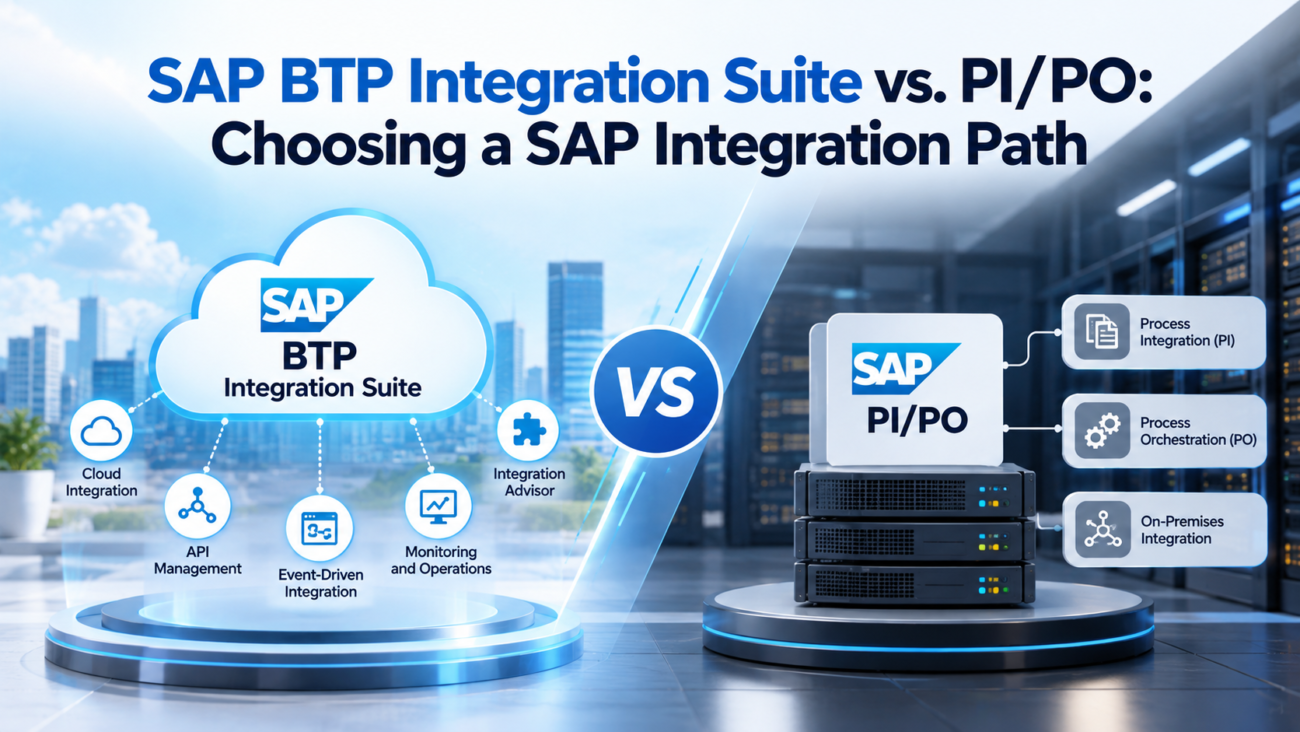
SAP integration teams now have a time-bound architecture decision. SAP Process Integration and Process Orchestration 7.5 still run important production traffic in many companies, but their maintenance horizon is fixed. At the same time, SAP Integration Suite has become the main SAP platform for cloud, hybrid, API, event, and B2B integration work.
The choice is rarely a clean platform swap. Existing SAP Process Orchestration estates can contain years of mappings, adapter modules, partner connections, Java code, and BPM logic. Some interfaces can move with limited change. Others need a new design because the target runtime is different. A useful SAP Integration Suite vs PI/PO comparison must cover migration as well as product capabilities.
This guide explains where each platform fits, what changes when moving from PI/PO to SAP Integration Suite, which scenarios need closer review, and how to choose a path without turning the migration into a blind rewrite. It is written for teams planning an SAP PI/PO migration or deciding how new SAP integration work should be built while existing interfaces are still running.
TL;DR
SAP Integration Suite is the long-term SAP path for new integration work, while PI/PO 7.5 remains supported under SAP’s published maintenance window through the end of 2027 for mainstream maintenance, with optional extended maintenance through the end of 2030. That timeline makes migration planning necessary, but it doesn’t mean every interface should be moved in the same way. Start with an inventory, use SAP Migration Assessment to classify scenarios, separate direct migration candidates from redesign work, and decide where cloud runtime, Edge Integration Cell, APIs, events, or B2B capabilities add value. The best SAP Integration Suite vs PI/PO decision is usually a phased architecture plan rather than a single cutover date for the entire estate.
What the SAP Integration Suite vs PI/PO choice really means
The decision begins with product direction and support timing. SAP states that Process Integration and Process Orchestration 7.5 follow the SAP NetWeaver 7.5 maintenance timeline, with mainstream maintenance through the end of 2027 and optional extended maintenance through the end of 2030. The current SAP NetWeaver maintenance strategy gives teams a fixed planning horizon rather than an open-ended reason to keep new work on PI/PO. SAP’s October 7, 2026 clarification states that SAP NetWeaver AS Java 7.5 moves to customer-specific maintenance in 2031. SAP also says current Java support arrangements end in 2030, and customer-specific maintenance can’t replace those rights and support. A company can continue to operate PI/PO inside the published support window, but new integration decisions should account for the remaining lifetime of the platform.
SAP Integration Suite is a set of integration capabilities on SAP Business Technology Platform. It includes Cloud Integration for message-based integration and other capabilities for APIs, events, B2B relationships, migration assessment, and hybrid execution. The official SAP Integration Suite capability overview describes a broader integration platform with different runtime and governance choices than PI/PO.
That difference changes how an SAP PI/PO migration should be planned. A direct technical conversion may make sense for a stable interface that already follows a simple message-routing pattern. An API that will be reused across applications may belong in API Management. A business event may be better handled through an event broker. A B2B estate may need Trading Partner Management and Integration Advisor. The migration program should classify what each interface is trying to do before deciding how to rebuild it.
Architecture and runtime differences
PI/PO is an on-premises integration platform built on SAP NetWeaver technology. Its architecture is familiar to teams that have worked with the Enterprise Services Repository, Integration Directory, Adapter Engine, message mappings, Java mappings, and PI/PO monitoring tools. Process Orchestration can also include BPM and business rules use cases. The platform is commonly placed inside an enterprise network and managed as part of the customer’s SAP infrastructure estate.
SAP Integration Suite changes that operating model. Cloud Integration runs as a managed cloud service on SAP BTP, and integration developers work with integration packages and integration flows rather than the classic PI/PO design-time objects. SAP’s integration and API development guidance describes Cloud Integration as the message-processing layer for cloud, on-premises, and hybrid scenarios, while API Management handles API security and lifecycle controls. That division is useful when deciding whether an old PI/PO interface should remain a message flow or become a managed API.
With PI/PO, infrastructure teams manage the NetWeaver environment. With SAP BTP Integration Suite, SAP manages the cloud service platform while customers still own integration content, access, connectivity, certificates, monitoring, and application controls.
Runtime location changes failure paths. Cloud flows that reach on-premises systems depend on the chosen network connection, while local SAP Process Orchestration traffic may stay inside the enterprise network. Document which flows can use a cloud path and which require local processing.
A useful SAP Integration Suite vs PI/PO architecture review therefore maps each interface against runtime location, latency sensitivity, security boundary, protocol, and recovery needs. The answer may be different for an SFTP batch interface than for a plant-floor message or a public API. Treating every interface as the same kind of workload hides the very differences that should shape the target design.
Core capability comparison
The platforms overlap in message integration, but the surrounding capabilities differ. PI/PO can route and transform messages across many SAP and non-SAP systems. It also has long-standing support for common enterprise protocols and SAP-specific patterns. SAP Integration Suite keeps message integration through Cloud Integration while adding capabilities that were separate products, add-ons, or custom patterns in older landscapes.
| Decision Area | SAP PI/PO | SAP Integration Suite |
| Primary runtime | Customer-managed NetWeaver environment | SAP BTP cloud runtime with optional customer-managed Edge Integration Cell for supported scenarios |
| Message integration | Integration Engine and Adapter Engine patterns | Cloud Integration with integration flows |
| API lifecycle | Usually handled with separate tooling or custom controls | API Management capability within the suite |
| Event integration | Possible through connected messaging products and custom designs | Event Mesh and advanced event mesh options |
| B2B management | PI B2B add-on can support partner and EDI scenarios | Trading Partner Management with Integration Advisor and Cloud Integration |
| Migration support | Source platform | Migration Assessment and migration tooling support selected PI/PO objects |
| Platform operations | Customer manages NetWeaver infrastructure | SAP manages the cloud service platform while customers manage content and tenant operations |
| Maintenance direction | Mainstream maintenance ends in 2027 for 7.5 with optional extended maintenance to 2030 | Active SAP cloud service with continuing capability updates |
PI/PO can remain the current production system for stable interfaces during transition. An SAP Integration Suite migration still needs adapter, mapping, custom-code, throughput, and operations testing.
Capability breadth also changes governance. In PI/PO, an architecture team may have treated most integration work as an interface build inside one middleware product. SAP Integration Suite creates more explicit choices. A developer can build a Cloud Integration flow, expose or protect an API, publish events, or configure B2B partner behavior. That choice should be governed by architecture rules so different teams don’t solve the same pattern in incompatible ways.
Connectivity and hybrid deployment
Connectivity is one of the first areas to assess because it determines whether a proposed target design can reach the systems involved. Cloud Integration supports a range of adapters for SAP and non-SAP protocols, while on-premises access can use SAP Cloud Connector in supported patterns. SAP’s connectivity and communication security documentation also documents transport security options such as TLS and mutual TLS. This should be reviewed per interface rather than assumed from a generic BTP network diagram.
An SAP BTP Integration Suite design needs a connectivity inventory that is more specific than a list of source and target applications. Record protocol, direction, endpoint ownership, DNS and firewall dependencies, authentication method, certificate owner, expected volume, and recovery behavior. Include partner endpoints and managed file-transfer locations. These details often decide whether an interface can move early or must wait for network and security work.
Hybrid execution is especially relevant for teams comparing SAP Integration Suite vs PI/PO because some PI/PO traffic may be tightly tied to internal systems. SAP’s Edge Integration Cell documentation describes a customer-managed runtime that can run supported integration and API artifacts in a private landscape while design and management remain connected to SAP Integration Suite. That option can help when processing location or internal reachability is a hard requirement.
Edge Integration Cell isn’t a drop-in copy of PI/PO. Check its current feature scope and runtime requirements against each workload, including adapter support and the customer’s infrastructure duties.
For a phased SAP PI/PO migration, connectivity work should begin before interface conversion. Establish the BTP subaccounts, identity model, network path, certificate process, transport approach, and monitoring access early. A technically converted integration flow that can’t reach its endpoint is still a blocked migration.
APIs, events, and B2B are separate architecture choices
One of the biggest differences in an SAP Integration Suite vs PI/PO program is that message integration doesn’t have to carry every integration style. API Management can place authentication, authorization, traffic policies, and usage controls around APIs. SAP documents API security policies for mechanisms such as basic authentication, client certificates, OAuth, authorization checks, and API request validation. That makes API exposure a governed capability rather than a custom concern inside each integration flow.
API Management is useful when an interface represents a reusable business service or needs controlled consumption by several clients. It doesn’t mean every synchronous PI/PO interface should become an API product. Some point-to-point calls are still better represented as internal integration flows. During an SAP Integration Suite migration, classify interfaces by consumption model and ownership before redesigning them around APIs.
Events require a similar decision. Event-driven integration can reduce direct coupling when publishers shouldn’t wait for a consumer response or when several consumers need the same business event. SAP’s event-driven architecture guidance for Integration Suite distinguishes smaller event scenarios from larger event-mesh requirements and explains how SAP’s event capabilities fit an enterprise architecture. That is a different pattern from converting a PI/PO asynchronous message one-for-one.
B2B work needs separate analysis because partner profiles, agreements, protocol settings, acknowledgments, and EDI standards can create migration effort that isn’t visible in a simple interface count. SAP’s Trading Partner Management documentation explains how partner profiles and agreements work with Cloud Integration and Integration Advisor. If PI/PO currently uses the B2B add-on, treat partner configuration and operational procedures as migration objects in their own right.
A feature list can’t make these choices. The architecture team still has to match each business exchange to the right pattern and avoid using capabilities that add no operating value.
What Migration Assessment can and cannot tell you
SAP provides Migration Assessment to analyze connected PI/PO environments and classify scenarios by migration readiness. The process begins by connecting the source system and extracting the relevant landscape data. SAP’s Migration Assessment setup guidance explains how a Process Orchestration system is added so the service can analyze its scenarios. This is a strong starting point for an SAP PI/PO migration because it replaces part of the manual inventory work with system-derived evidence.
Assessment results still need interpretation. A ready-to-migrate status doesn’t mean zero work. Manual changes can still be required, so the project needs a separate estimate for testing, security, operations, and business validation.
The limits matter as much as the results. SAP’s Migration Assessment limitations state that B2B and BRM objects aren’t assessed in the same way, BPM logic isn’t analyzed internally, and dependencies inside Java mappings, XSLT, function libraries, or UDFs aren’t recursively examined. Custom adapters also need closer review. A large estate with these patterns can look simpler in an assessment dashboard than it will be during delivery.
For that reason, an SAP Integration Suite migration should combine tool output with repository analysis and runtime history. Remove interfaces that no longer run. Identify duplicate flows. Record actual message volume and peak size. Flag synchronous calls with tight response expectations. Map business owners to high-impact interfaces. This work turns the technical inventory into a migration portfolio.
The final classification should be actionable. Each interface should end up in a bucket such as retire, replace with standard content, migrate with limited change, redesign around a new pattern, or retain temporarily with a dated exit plan. Those categories help the team sequence delivery without pretending that one migration method fits the entire PI/PO landscape.
Migration tooling helps but does not remove redesign work
SAP also provides migration tooling inside Cloud Integration for selected PI/PO objects. The current migration tooling documentation states that supported scenarios can be converted into integration flows and identifies supported source versions and object types. At the time of writing, the documentation specifically lists Integrated Configuration Objects and Receiver Determination objects among the supported migration inputs. Teams should check the current support page before each migration wave because the capability can change over time.
Automated conversion can save mechanical rebuilding, but generated flows still need review for routing, naming, mapping, error handling, and endpoint design before they move through test environments.
Custom code is a common reason for manual work. PI/PO landscapes often contain Java mappings, adapter modules, function libraries, and user-defined functions written for a NetWeaver runtime. Some logic can be rewritten using mapping functions, XSLT, Groovy, supported adapters, or other Integration Suite features. Other logic may belong outside the integration layer. The right answer depends on what the code does, not on whether it can be copied.
BPM and BRM scenarios deserve their own workstream. A process that uses PI/PO orchestration may be implementing long-running state, approvals, business rules, or compensation logic. Rebuilding that behavior inside a message flow can create an awkward design. Review the business process first and decide whether the logic belongs in SAP Build Process Automation, an application service, Cloud Integration, or another approved platform component.
An SAP Integration Suite vs PI/PO migration plan should therefore measure success by verified business behavior rather than the percentage of artifacts converted automatically. The target interface has to meet the required function, security, performance, recoverability, and support model. Tooling reduces build work where it fits, but it doesn’t remove those acceptance criteria.
Security governance and transport need a new operating model
Security controls move with the architecture. PI/PO teams may already have mature certificate handling, service users, firewall rules, and change procedures. SAP BTP introduces subaccounts, role collections, service instances, destinations, cloud connectivity, and tenant-level responsibilities. The migration plan should map the old controls to the target controls rather than carry over only user accounts and certificates.
Start with identity and authorization. Separate platform administrators, integration developers, operators, API administrators, and read-only support users. Avoid broad roles that make migration easier but remain in place after production. Service users and technical credentials should have owners, renewal dates, and documented recovery steps. The same applies to partner certificates and keys used by B2B interfaces.
Transport is another governance change. PI/PO teams may be used to moving design objects through established NetWeaver transport practices or manual export and import steps. SAP Integration Suite can work with SAP Cloud Transport Management and other approved delivery methods depending on the landscape and service plan. Define how artifacts move from development to test and production before the first large migration wave, including who can approve deployment and how a failed release is rolled back.
Security testing belongs in each interface’s migration evidence. Check authentication, authorization, certificate trust, secret storage, encryption, and logging. Sensitive payloads shouldn’t remain visible in traces without a controlled reason.
A strong SAP Integration Suite migration also sets naming and ownership standards early. Package names, integration-flow names, API products, partner objects, credentials, and monitoring labels should make support easier. Governance should reduce ambiguity for the team that will run the platform after the migration program closes.
Monitoring and support change after the move
Operations teams need a new support model before migrated interfaces enter production. PI/PO support often centers on message monitoring, adapter status, queues, logs, Java stack health, and application-system checks. Cloud Integration has its own message-processing logs and monitoring views, while APIs, events, B2B scenarios, and edge runtimes can introduce additional monitoring surfaces.
SAP Cloud ALM can provide a wider monitoring layer for supported components. Its Integration and Exception Monitoring documentation describes message, exception, search, and alert views across configured managed components. That can help a support team build business-service views that span more than one technical runtime, but it still requires connection setup and clear alert ownership.
For every migrated interface, define what a failure looks like and who is expected to act. Record the monitoring location, alert condition, retry method, duplicate risk, business impact, and escalation path. A flow that is technically recoverable but has no owner can still create a long business outage.
Define production logging rules and ownership for certificate or credential failures. Detailed traces can expose payload data, so access and duration should be controlled.
The comparison between SAP Integration Suite vs PI/PO is therefore partly a comparison of operating practices. The technology changes, but the need for runbooks, ownership, incident records, and tested recovery doesn’t. Build those controls during migration rather than after the first production failure.
Cost and licensing should be modeled by workload
Cost comparisons are difficult when one side is an existing on-premises estate and the other is a subscription cloud service. A PI/PO environment may already have sunk license and hardware costs, but it still consumes infrastructure, database, patching, backup, monitoring, and specialist support effort. SAP Integration Suite shifts more of the platform layer to SAP while introducing subscription and usage terms that need to be modeled against expected workloads.
SAP publishes current list pricing and plan differences on its Integration Suite pricing page. The public U.S. page currently shows different monthly prices and included message volumes for starter, standard, and enhanced editions, plus charges for additional message blocks and some add-ons. Those figures can change by contract, region, commercial program, and date, so an architecture paper should use the current quote rather than freeze public list prices into a multi-year business case.
Model cost from workload, not interface count. Include average and peak traffic, large payloads, API and event use, B2B exchanges, tenant needs, and non-production environments.
Include migration labor and overlap in the business case. During a phased SAP PI/PO migration, both platforms may run together, which adds duplicate monitoring and support effort. Faster exit can reduce overlap, but rushing high-risk interfaces can create rework.
For SAP BTP Integration Suite, the cost model should be linked to architecture choices. API Management, event services, Edge Integration Cell, B2B capabilities, and transport tooling can affect entitlement needs. The goal is to understand the cost of the target operating model, not simply compare a cloud subscription with a server budget.
A practical decision framework
For SAP Integration Suite vs PI/PO, a decision framework works better than a platform-wide yes or no. Review each integration domain against a short set of questions and then choose the target pattern. This keeps the SAP Integration Suite vs PI/PO discussion tied to business and technical needs rather than product preference.
When PI/PO can still stay temporarily
A company may have valid reasons to keep selected PI/PO interfaces during a transition period. The key word is temporarily. A stable interface tied to a system that will be retired next year may not deserve a full redesign today. A plant or partner connection with a difficult network dependency may also need to stay until another infrastructure program finishes.
The SAP Integration Suite vs PI/PO decision should therefore allow a dated coexistence plan. Each retained PI/PO interface needs an owner, reason, dependency, target exit date, and support plan. That prevents temporary exceptions from becoming permanent because no one revisits them.
If an S/4HANA conversion or third-party replacement is already changing an interface, align the integration move with that program when it avoids rebuilding the same flow twice.
What shouldn’t happen is new strategic development on PI/PO merely because the team already knows the tool. The remaining maintenance window and future exit work should be considered in every new-interface decision. If a new project can be built on SAP Integration Suite with the required connectivity and controls, adding it to PI/PO creates another asset that will need a later move.
Retained PI/PO interfaces still need supported software, security fixes, certificates, backups, monitoring, and operating knowledge until the final dependency is removed.
Start with the application roadmap. If the source or target system is being retired soon, avoid unnecessary rebuild work. If it is moving to SAP S/4HANA Cloud or another SaaS platform, check whether SAP or the vendor provides supported APIs, events, or packaged integration content. Standard content can reduce custom maintenance, but it still needs fit testing.
Next, check the interaction style. Long-running files, transactional messages, reusable APIs, B2B documents, and business events should not all be forced into the same implementation pattern. Decide whether Cloud Integration, API Management, event services, Trading Partner Management, or another platform component owns the scenario.
Then review runtime constraints. Ask where data may be processed, whether an on-premises route is required, what latency is acceptable, and how a network outage affects the business process. Check whether Edge Integration Cell is relevant for supported workloads or whether the cloud runtime with approved connectivity is suitable.
Score migration effort against business criticality. Lower-complexity valuable interfaces make good early candidates, while high-risk flows fit later waves after monitoring, transport, support, and testing practices are proven.
A clear framework also improves funding decisions. Leaders can see why some flows are direct migrations while others are redesign projects. That makes the migration program easier to plan because effort is tied to interface characteristics rather than a flat cost per interface.
A phased SAP PI/PO migration path
For SAP Integration Suite vs PI/PO, a phased migration reduces the need for a single high-risk cutover. SAP’s reference architecture for moving from PI/PO to Integration Suite describes the transition as a structured move that begins with discovery and assessment before interfaces are shifted. The exact number of waves depends on estate size, business calendars, application programs, and the amount of custom logic involved.
Begin with discovery. Connect Migration Assessment where supported, export the PI/PO object inventory, review runtime statistics, and remove inactive or duplicate interfaces. Add business ownership and criticality. This becomes the baseline for planning and prevents the program from spending time on interfaces that no longer need to exist.
An SAP Integration Suite migration should build the target platform before large conversion waves. Set up the required BTP environments and prove roles, connectivity, certificates, transport, monitoring, alerting, and support ownership with a small production pilot.
Choose migration waves by pattern and risk. A first wave may contain straightforward file, IDoc, SOAP, or REST scenarios with limited custom code. Later waves can include B2B relationships, custom adapter logic, BPM-related processes, or interfaces that need event or API redesign. Keep common design patterns and reusable error handling under version control so teams don’t rebuild them differently in every wave.
Testing should compare business outcomes, not only message success. Validate mappings, headers, acknowledgments, duplicates, error recovery, authorization, throughput, and downstream effects. For synchronous interfaces, check response behavior under expected load. For asynchronous flows, confirm retry and dead-letter handling according to the chosen design.
Cut over by domain where possible. Keep a clear rollback point and prevent duplicate processing while both platforms are connected. After each wave, review production results before the next group starts. Decommission PI/PO only after the last dependency is confirmed gone.
Common mistakes that distort the platform choice
The first mistake is comparing feature lists alone. The same capability can behave differently enough to change design or operations. Check adapter support, protocol, security, payload size, delivery needs, and support conditions for each critical scenario.
The second mistake is assuming every PI/PO object should be recreated. Migration is a chance to remove dead interfaces and duplicate mappings. It is also a chance to replace custom point-to-point work with a supported API or packaged integration when the fit is good. Rebuilding unused complexity makes the target estate harder to run.
Another mistake is treating automated conversion as proof of readiness. Migration tooling can create a starting artifact, but the team still has to review logic and test the result. The acceptance standard should be the same for generated and manually built integration flows.
Teams also underestimate operations. An SAP BTP Integration Suite tenant without proven monitoring, transport controls, credential ownership, and support access can be harder to run than the PI/PO environment it replaces. Make operations part of each wave’s exit criteria.
The 2027 date shouldn’t become a panic deadline. Use the remaining maintenance window to finish discovery, prove target operations, move lower-risk domains, and reserve time for scenarios that need deeper review.
Conclusion
The SAP Integration Suite vs PI/PO decision is about moving an existing integration estate toward SAP’s current platform direction while protecting business processes that already work. PI/PO 7.5 still has a defined support window, which gives companies time to plan, but that window should be used to reduce migration uncertainty rather than postpone it.
A strong SAP Integration Suite migration starts with a verified inventory and classifies interfaces by business purpose, technical pattern, custom logic, and runtime needs. Migration tools help, but BPM, B2B, custom code, and operating controls still need direct review.
For new integration work, SAP BTP Integration Suite should be evaluated first when it meets the required connectivity and operating constraints. Existing PI/PO interfaces can then move in controlled waves based on risk and application roadmaps. That approach avoids a forced one-time rewrite while still giving the organization a clear exit path from SAP Process Orchestration.
FAQs
Is SAP Integration Suite replacing SAP PI/PO?
SAP Integration Suite is SAP’s current strategic integration platform. PI/PO 7.5 has mainstream maintenance through the end of 2027 and optional extended maintenance through the end of 2030. That makes SAP Integration Suite vs PI/PO a transition decision with a fixed planning horizon for SAP Process Orchestration estates.
What is the main difference between SAP Integration Suite and PI/PO?
PI/PO is a customer-managed NetWeaver middleware platform. SAP BTP Integration Suite is delivered as cloud services on SAP BTP and adds separate capabilities for APIs, events, B2B work, migration assessment, and hybrid execution. The change affects runtime ownership and integration design.
When does SAP PI/PO support end?
For SAP Process Integration and SAP Process Orchestration 7.5, SAP publishes mainstream maintenance through December 31, 2027, with optional extended maintenance through December 31, 2030. SAP clarified on October 7, 2026, that SAP NetWeaver AS Java 7.5 enters customer-specific maintenance in 2031, but current Java support arrangements end in 2030 and customer-specific maintenance can’t replace those rights and support. Confirm the installed release and the customer’s support terms before setting a final migration deadline.
Can PI/PO interfaces be migrated automatically?
Some interfaces can be converted with SAP migration tooling, but automation doesn’t cover every object or dependency. An SAP Integration Suite migration still needs manual review for custom adapters, Java logic, BPM or BRM behavior, B2B scenarios, and complex dependencies.
What does SAP Migration Assessment do?
Migration Assessment connects to SAP Process Orchestration and compares interface scenarios with SAP Integration Suite capabilities. It classifies migration readiness and flags areas that need adjustment or deeper review. It supports planning, but it doesn’t replace code analysis, testing, or a business impact review.
Is SAP CPI the same as SAP Integration Suite?
SAP Cloud Integration, often called CPI, is one capability within SAP Integration Suite. The wider suite also covers API management, event services, B2B capabilities, integration guidance, and migration tools. Using CPI as the name for the whole platform can hide important architecture choices.
Does SAP Integration Suite work with on-premises SAP systems?
Yes. Cloud Integration supports hybrid scenarios with on-premises SAP and non-SAP systems through supported connectivity methods such as SAP Cloud Connector. Edge Integration Cell can also support selected workloads that require a customer-managed private runtime.
Do we need Edge Integration Cell to replace PI/PO?
No. Many scenarios can run in the managed Cloud Integration runtime. Edge Integration Cell matters when a supported workload requires local processing or a customer-managed runtime. Check its current feature scope before using it as part of an SAP PI/PO migration plan.
How should we handle PI/PO Java mappings?
Review each Java mapping for its real purpose and dependencies. Some logic can move to message mappings, XSLT, Groovy scripts, or supported flow steps. Other logic may belong in an application service. Migration Assessment identifies Java mappings but doesn’t analyze every dependency recursively.
What happens to PI/PO BPM and BRM scenarios?
BPM and BRM scenarios need separate analysis. Some orchestration may fit Cloud Integration, while long-running workflows or human tasks may fit SAP Build Process Automation or another approved process service. Avoid copying process logic into an integration flow without checking the target design.
Is API Management required for every migrated interface?
No. API Management is useful when an API needs controlled exposure, reusable access, security policies, traffic controls, or consumer management. Internal message flows can remain Cloud Integration scenarios when an API lifecycle isn’t required by the SAP Integration Suite migration design.
How should B2B interfaces be migrated from PI/PO?
Treat B2B as a separate migration domain. Inventory partner agreements, EDI standards, protocols, certificates, acknowledgments, and support procedures. Trading Partner Management and Integration Advisor may fit the target, but partner-specific behavior still needs direct testing.
How long does an SAP PI/PO migration take?
Duration depends on custom mappings, adapters, BPM or B2B content, message volume, connectivity, testing needs, and application changes. Interface count alone isn’t a reliable estimate. Use assessment results and a pilot wave to estimate the wider program.
Should we migrate everything before 2027?
The maintenance timeline should drive planning, but each company should confirm its entitlement and choose a schedule that leaves room for difficult scenarios. SAP Integration Suite vs PI/PO planning should start early enough for redesign, partner testing, coexistence, and phased production moves.
What is the safest SAP integration path for a large PI/PO estate?
A phased path usually gives more control. Start with a verified inventory, retire unused interfaces, build the SAP BTP operating model, and run a lower-risk production wave. Platform decisions can then be made by business domain and interface complexity before SAP Process Orchestration is retired.
