
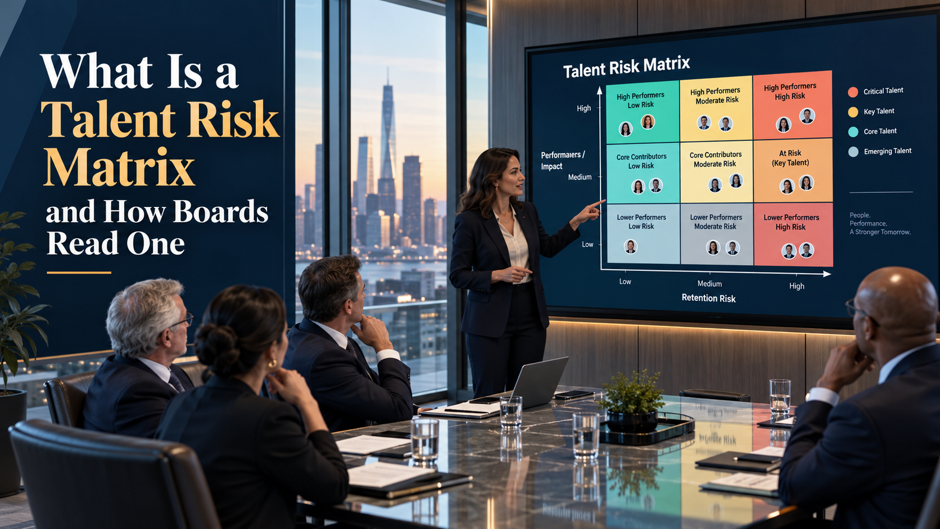
A CEO announces their resignation on a Tuesday. By Wednesday, the board is asking a question that a well-run organisation should already have an answer to: who is ready to step in, and how long has the company known this day might come? At companies with a functioning talent risk matrix, that question has an answer within the hour, backed by named successors, readiness timelines, and development history. At companies without one, the answer is improvised in a closed session, and the improvisation itself becomes the story investors and employees tell about how the company handles pressure.
A talent risk matrix is the instrument that turns succession from an assumption into a measured, auditable governance artefact. It maps critical roles against the people capable of filling them, rates how ready each potential successor actually is, and surfaces the gaps before they become emergencies. A structured succession planning process provides the underlying framework for identifying critical positions and preparing candidates for those roles. Three of the top 10 near-term risks identified in the 2026 Executive Perspectives report concern workforce issues, and boards increasingly treat talent continuity as a governance obligation rather than an HR housekeeping task. This guide explains what a talent risk matrix actually contains, how it’s built, and how directors are expected to read one in a board meeting.
TL;DR
| Element | What it captures |
| Critical role identification | Which positions create material disruption if vacated unexpectedly, based on impact rather than seniority alone |
| Key-person concentration | Whether critical knowledge, relationships, or authority sit with a single individual and cannot be transferred quickly |
| Successor readiness rating | Ready Now, Ready in 1 to 2 Years, or Ready in 3-plus Years for each named or unnamed successor against each critical role |
| Bench depth | How many viable successors exist per role, and whether that depth is concentrated in one function or spread across the organisation |
| Flight risk overlay | Whether the successors themselves are at risk of leaving before they’re needed, which quietly invalidates an otherwise solid plan |
| Development investment | What specific actions are underway to close readiness gaps for each named successor, with owners and timelines attached |
| Trend over time | Whether the matrix is improving, stagnant, or deteriorating release over release, which tells the board whether the plan is real or aspirational |
A board reading a talent risk matrix correctly isn’t looking for a green scorecard. It’s looking for evidence that the organisation has honestly assessed where it’s exposed and has a credible, resourced plan to close the gap, distinct from a document produced once a year to satisfy a compliance checkbox. The sections that follow walk through each of these elements in the depth a director actually needs: what data supports a credible rating, what questions separate a real plan from an aspirational one, and how the matrix should evolve as the organisation itself changes shape.
What a Talent Risk Matrix Actually Is
A talent risk matrix is a structured mapping of critical roles in an organisation against the depth, readiness, and risk profile of the people capable of filling those roles if they became vacant. It sits at the intersection of 2 disciplines that are often run separately: succession planning, which asks who could take over a role, and workforce planning, which helps organisations model future staffing needs, gaps, and organisational risk before those issues disrupt operations.
The matrix format varies by organisation, but the core structure is consistent. Rows list the critical roles: CEO, CFO, chief revenue officer, head of engineering, or any position whose sudden vacancy would materially disrupt operations, strategy, or investor confidence. Columns capture, for each role, the current incumbent’s tenure and flight risk, the named or unnamed successors and their readiness rating, the depth of the bench beyond the first successor, and any specific vulnerability such as a single point of institutional knowledge or an irreplaceable external relationship.
This differs from a general succession plan in scope and framing, even though the two are closely related and frequently confused in practice. Succession planning is the broader process: it identifies critical roles, develops potential successors, prepares emergency coverage, and plans leadership transitions for continuity. A talent risk matrix is an analytical governance view within that process: it clearly highlights critical-role exposure, successor readiness, bench depth, and gaps that may require board or senior leadership attention. The matrix can also inform decisions about compensation, retention investment, M&A diligence, and public-company disclosure considerations. Its audience is the board and senior leadership, and it helps answer a focused question within the broader succession process: if this specific person left tomorrow, what happens next, and how long would it take to recover.
Why Boards Care About This Specifically
Talent risk has moved from an HR agenda item to a board-level governance priority, and NACD’s succession planning guidance treats leadership transition planning as a core boardroom responsibility tied to organisational continuity and long-term stability. Four forces in particular explain why directors who might have skimmed a succession slide 5 years ago now expect a fully worked matrix with named individuals, evidenced ratings, and a documented trend line.
Investor and governance expectations are increasing.
Institutional investors and proxy advisors increasingly expect evidence of active succession planning as part of governance review. Companies may also choose to describe their succession processes in proxy materials, while material risks remain subject to applicable disclosure rules. These expectations do not create a universal requirement to publish a talent risk matrix or disclose every form of key-person exposure to outside investors.
Leadership churn has accelerated.
CEO turnover among S&P 500 companies in the top 3 performance quartiles rose from 7% in 2024 to 12% in 2025, and PwC’s 2026 work on CEO succession planning describes the need for boards to build readiness well before a transition becomes necessary. The pool of executives historically expected to move into senior roles has also thinned as organisational structures flatten and tenure patterns shift. Boards should therefore treat succession as a measured pipeline rather than assume transitions will happen organically.
M&A and private equity diligence can treat this as a valuation factor.
Buyers evaluating an acquisition may examine leadership concentration and succession risk during diligence, especially when critical knowledge, relationships, or decision authority sit with 1 person. Key-person dependency can influence valuation, earnouts, retention arrangements, transition requirements, and other deal terms, but the effect varies by transaction and should not be treated as an automatic or measurable multiple discount in practice.
The cost of getting it wrong is now well documented.
Organisations that assume readiness rather than measuring it experience stalled transitions, a heavier reliance on external hires under pressure, and a compounding governance risk that surfaces exactly when the organisation can least afford disruption. The quality of the underlying insight, not simply the existence of a plan on paper, is what separates organisations that navigate a sudden departure smoothly from those that don’t.
The Core Components of a Talent Risk Matrix
Critical Role Identification
Not every senior position is a critical role in the risk sense, and conflating seniority with criticality is one of the most common errors boards should watch for when a matrix is first presented to them. A critical role is defined by the impact of its sudden vacancy, not by its title, its compensation band, or its position on the organisational chart. SHRM’s modern succession planning framework similarly begins by identifying the knowledge, skills, abilities, and critical functions that the organisation must protect. A role several layers below the C-suite can carry more governance-relevant risk than a senior title that looks impressive on paper but is well-supported by a deep, documented team.
Questions that determine whether a role belongs on the matrix:
- Does the role hold unique regulatory, licensing, or compliance authority that cannot be delegated on short notice
- Does the role control relationships (a key customer, a key investor, a key regulator) that would be materially damaged by an abrupt, unmanaged transition
- Does the departure of this role trigger contractual, covenant, or disclosure obligations, such as change-of-control clauses tied to a named executive
- Would the role’s absence for 90 days measurably disrupt revenue, product delivery, or a major strategic initiative currently underway
- Is the institutional knowledge held by this role documented anywhere else, or does it exist only in one person’s head
A role that satisfies several of these criteria belongs on the matrix regardless of its formal seniority. A specialised systems architect with sole knowledge of a legacy platform that the business still depends on can carry more key-person risk than a senior vice president whose function is well-documented and broadly distributed across a team. This is precisely why the criticality exercise cannot be delegated to a single department working from an org chart alone; it requires input from people who understand where the actual operational dependencies sit, which is often quite different from where the formal reporting lines suggest they sit.
Key-Person Concentration Risk
Concentration risk measures how dependent a critical function is on a single individual rather than a resilient team structure. This is frequently expressed as a simple index or flag rather than a numeric score, but the underlying question is consistent across every methodology: if this person left with no notice, how many other people in the organisation could execute even 70% of what they do, and how quickly could that coverage be assembled without an extended period of degraded performance in the function they used to run.
| Concentration level | What it looks like | Typical board response |
| Severe | One person holds the role, the relationships, and the institutional knowledge with no documented backup | Immediate retention focus, urgent successor identification, knowledge transfer mandate |
| Moderate | A named successor exists but is not yet ready, or knowledge is partially documented | Structured development plan with a defined timeline and named accountability |
| Low | Multiple qualified internal candidates exist, knowledge is documented, and the role could transition within weeks | Standard monitoring cadence, no urgent intervention required |
Successor Readiness Ratings
Every named or potential successor against a critical role is typically rated on a 3-tier readiness scale, which gives the board a time-based view of exposure rather than a binary “has a successor or doesn’t.” A structured Talent Match process can help compare internal candidates against defined position competencies instead of relying only on informal management impressions. The time dimension is what makes the rating useful for planning purposes: a role with a strong Ready in 1-to-2-Years candidate is a materially different risk profile than one with nobody at any tier, even though both would show up as “has no immediate successor” under a cruder binary system.
Ready Now means the individual could assume the role within days to weeks with minimal transition support, typically because they already perform a substantial portion of the role’s responsibilities or have held an equivalent position elsewhere. Ready in 1 to 2 Years means the individual has the underlying capability but needs specific, identifiable development: broader P&L exposure, a missing technical credential, or experience managing at a larger scale. Bullseye’s talent development system connects development plans, employee profiles, goals, and progress tracking, which can make those readiness gaps easier to document over time. Ready in 3-Plus Years, or Pipeline means the individual shows the potential trajectory to eventually fill the role but requires sustained multi-year development, and should not be relied upon as a near-term mitigant for current risk.
A board reading the matrix should specifically look for roles where the only listed successor sits in the 3-plus-years category, because that effectively means the role currently has no real successor at all, regardless of what the document technically shows on its face. A name in a cell is not the same thing as coverage, and directors who treat any populated cell as reassuring are missing the distinction the readiness tier was specifically designed to surface.
Bench Depth and Distribution
Depth measures how many viable successors exist per critical role, and distribution measures whether that depth is spread across the organisation or dangerously concentrated in a single function or location. A company with 3 Ready Now candidates for the CFO role but zero for the chief revenue officer role has a lopsided bench that a single-number succession metric would hide entirely. Boards should ask for the matrix broken out by function specifically to catch this pattern, since an aggregate bench-strength score can look healthy while masking a critical hole in one part of the organisation.
Flight Risk Overlay
The single most consequential refinement to a talent risk matrix in recent years has been layering flight risk data onto the successor ratings. A Ready Now successor who is also flagged as a high flight risk represents a succession plan that could evaporate before it’s ever needed. This overlay typically draws on engagement survey data, compensation planning and market benchmarking, tenure patterns, and manager judgment about the individual’s satisfaction and career trajectory. Boards reviewing a matrix that shows strong readiness ratings but doesn’t address flight risk for those same successors should treat the plan as incomplete rather than reassuring.
Clear career visibility also matters because successors who cannot see where their development is leading may be easier to lose. Bullseye’s recent discussion of succession planning and career visibility connects succession pipelines with development plans, compensation decisions, and retention of high-potential employees. Boards should therefore read flight risk alongside readiness rather than as a separate HR metric.
How Boards Actually Read the Matrix in Practice
A board that receives a talent risk matrix once a year and files it without discussion has satisfied a governance formality without extracting any of the value the exercise is meant to produce. Effective board review follows a consistent set of questions rather than a passive read-through, and a Leadership Human Capital BI Dashboard can help directors review human capital KPIs, trends, and organisational risk in one place. The questions below reflect the pattern that experienced directors and governance advisors return to regardless of industry or company size.
The board asks whether the criticality assessment itself is credible.
Before evaluating readiness, directors should probe whether management has identified the right roles as critical, since a matrix built around an incomplete or politically convenient list of roles produces false confidence. A common failure pattern is a matrix that covers only the C-suite while ignoring a single-point-of-failure technical role several layers down the organisation.
The board looks for named individuals, not categories.
A matrix that says “strong bench” without naming who specifically fills that bench, and at what readiness level, is not auditable and should be treated with scepticism. Directors should expect to see actual names, actual readiness ratings, and actual development actions tied to each one.
The board checks the trend, not just the snapshot.
A single matrix tells the board where the organisation stands today. Comparing the current matrix against the version from 12 months earlier tells the board whether the situation is improving, stagnant, or quietly deteriorating, which is a materially more useful signal for governance purposes than any single point-in-time reading.
The board tests the concentration story against the org chart.
If the matrix shows low concentration risk for a founder-led business where the founder personally holds every major customer relationship, sales authority, and product decision, the matrix is understating the real exposure, and the board should push back on the underlying methodology rather than accepting the output at face value.
The board asks what happens in the next 90 days.
For any role rated Ready Now, the board should confirm there is a documented, rehearsed transition plan, not just a name on a spreadsheet. A person rated Ready Now who has never actually run a board update, signed off on a major contract, or represented the company to a key investor is not genuinely ready regardless of the label.
The board connects the matrix to compensation and retention decisions.
A named Ready Now successor who is underpaid relative to the market, or who hasn’t received any retention signal from the organisation, represents a governance gap between the talent strategy on paper and the compensation strategy in practice. Bullseye’s discussion of performance, succession, and pay integration shows why these processes increasingly need to connect rather than operate as separate cycles. Boards increasingly expect these two conversations to be explicitly linked rather than handled in separate committee silos.
Building the Matrix: A Practical Sequence
Organisations building their first talent risk matrix, or overhauling a stale one, tend to follow a consistent sequence regardless of size or industry. SHRM’s recent work on moving from leadership risk to succession readiness similarly emphasizes identifying key positions, aligning succession with strategy, and treating succession as a living system rather than a static list. Skipping steps in this sequence is the most common reason a first attempt produces a document that looks credible but doesn’t hold up under board scrutiny, because the shortcuts that save time in the short term are usually the same shortcuts that leave the underlying ratings unsupported by real evidence.
Step 1: Establish the critical role list with cross-functional input. The CHRO or talent lead shouldn’t build this list alone. Business unit leaders, the CFO, and often legal or compliance should weigh in, because criticality often hides in places HR doesn’t have full visibility into, such as a single engineer who maintains a legacy system nobody else understands, or a relationship manager who personally holds the company’s largest customer account.
Step 2: Gather evidence, not opinions, for each readiness rating. A readiness rating should be traceable to specific evidence: has this person run a board update, managed a P&L of comparable size, led through a crisis, or represented the company externally at the level the target role requires. Existing performance management data can contribute documented review history and competency evidence that supports these decisions. Ratings built purely on manager impression without underlying evidence are the single most common source of the “readiness assumed rather than measured” failure pattern described later in this guide.
Step 3: Calibrate across functions before presenting to the board. Individual managers plotting their own team members tend to rate generously, and different managers apply different standards. A calibration session, where cross-functional leaders review and challenge each other’s ratings before the matrix goes to the board, catches inconsistency before it reaches a governance audience and undermines credibility.
Step 4: Layer in flight risk and compensation data. Once readiness ratings are calibrated, the flight risk overlay and a compensation-versus-market check should be applied to every Ready Now and Ready in 1-to-2-Years successor. This is the step most frequently skipped in first-time matrices, and it’s the step that turns a static readiness snapshot into an actionable risk management tool.
Step 5: Present the matrix with a recommended action, not just data. A matrix presented to the board without a specific recommended action for each identified gap, such as an accelerated development plan, a retention adjustment, or an external search, puts the burden of interpretation entirely on directors who have far less operational context than management. The matrix is most useful when it arrives paired with management’s proposed response to each red flag it surfaces.
Step 6: Set the review cadence and stick to it. A matrix built once and never revisited decays in value quickly as people move, priorities shift, and readiness changes. NACD’s 2026 governance work identifies CEO succession and leadership capability as continuing board priorities, reinforcing the need for ongoing rather than event-driven review. Establishing a fixed cadence, typically a full annual refresh with lighter quarterly monitoring on the highest-risk roles, and holding to it even when other priorities compete for attention, is what separates organisations with a genuinely functioning risk management practice from those with a single well-produced document sitting in a board deck from 18 months ago.
How the Matrix Changes by Organisation Type
The core mechanics of a talent risk matrix stay consistent across contexts, but what a board should expect to see, and how urgently it should react to gaps, shifts meaningfully depending on the type of organisation involved. Applying a single generic template without accounting for these differences is a common reason a matrix feels disconnected from the actual governance conversation happening in the room.
Public companies face disclosure-adjacent expectations even where formal disclosure isn’t required.
Institutional investors and proxy advisors increasingly treat succession readiness as part of their broader governance assessment, and a board that cannot answer basic questions about CEO and CFO succession in a closed session is exposed reputationally even if no regulation technically compels the company to publish its matrix. Public company boards should expect the matrix to connect explicitly to any change-of-control provisions, key-person insurance arrangements, and the disclosure controls that govern what gets said publicly if a critical departure does occur.
Private equity-backed and founder-led businesses face a different pressure: concentrated leadership risk affects diligence.
For private equity-backed and founder-led businesses, the matrix can show where a transaction may depend on retaining, replacing, or transferring responsibilities from a small number of people. Diligence teams may test whether customer relationships, product decisions, operating knowledge, or approval authority can survive a leadership change. That analysis can shape retention packages, earnouts, transition support, management hiring, and the timing of a sale process. The practical value of the matrix is to expose those dependencies early enough for owners and boards to reduce them before a transaction formally begins.
Nonprofit and mission-driven organisations face structural constraints that corporate boards don’t.
Nonprofit talent risk should focus on the executive director or CEO and other mission-critical staff roles whose departure could disrupt funding, programs, donor relationships, compliance, or service delivery. The matrix should show successor readiness, knowledge concentration, interim coverage, and development needs for those positions. Board-director succession belongs in a separate board skills and succession matrix, where director tenure, committee needs, independence, competencies, and planned rotation can be reviewed under the organisation’s governance rules separately.
Family businesses carry a unique version of key-person concentration that a standard matrix template doesn’t always capture well.
Succession risk in a family business is frequently entangled with ownership succession, estate planning, and family dynamics that sit outside a conventional readiness rating, and the “successor” identified on the matrix may be constrained by family expectations that have nothing to do with actual capability. Boards advising family businesses should expect the matrix to be paired with a separate governance conversation about ownership transition, since treating the 2 as fully separable often produces a plan that looks sound on the readiness ratings but ignores the actual mechanism by which control will transfer.
Regulated industries add a compliance dimension on top of the standard risk assessment.
Financial services, healthcare, and other heavily regulated sectors often have specific licensing, registration, or fit-and-proper requirements attached to certain roles, meaning a successor’s readiness depends not just on capability but on whether they can be approved by a regulator within the timeframe the transition requires. Boards in these industries should confirm the matrix accounts for regulatory approval lead times explicitly, since a capable internal candidate who requires 6 months of regulatory clearance provides materially different protection than one who could step in immediately.
Common Failure Patterns That Weaken a Talent Risk Matrix
Even organisations that produce a talent risk matrix on a disciplined schedule can undermine its usefulness through a handful of recurring mistakes, each of which is common enough that boards should specifically probe for it rather than assuming a well-formatted document is automatically a reliable one. These patterns tend to recur across industries and company sizes because they stem from predictable human and organisational incentives rather than from any specific methodology being used.
The Hollow Middle describes a matrix showing plenty of high performers at the senior level and plenty of emerging talent at the junior level, but almost nobody positioned in the 1-to-2-year readiness bracket in between. This pattern signals a looming leadership vacuum several years out that isn’t visible from the current-state snapshot alone, and it requires the board to look at the age and tenure distribution beneath the readiness ratings, not just the ratings themselves.
The Silo Trap: successor depth can look healthy overall while one critical function remains exposed. The consequence is a misleading aggregate picture that hides where near-term coverage is actually weak. Correction: review the matrix by function, location, and role criticality, then require a specific action for uncovered areas instead of relying on one blended bench-strength score at board level in practice.
Readiness assumed rather than measured: a label can overstate coverage when evidence for the target role is thin. The consequence is false confidence during an actual transition. Correction: require each readiness rating to reference recent, role-relevant evidence and identify any untested responsibility that still matters before the person can credibly be treated as Ready Now by the board before the board relies on that rating operationally.
One-and-done documentation: a matrix becomes unreliable when people, roles, or risks change but the document does not. The consequence is outdated governance information that may direct attention to the wrong gaps. Correction: use the agreed review cadence, record material changes between formal reviews, and update high-risk roles promptly when successors leave, readiness shifts, or business priorities materially change without avoidable delay.
FAQs
How is a talent risk matrix different from a 9-box grid?
A 9-box grid plots individual employees on 2 axes, performance and potential, to guide development investment and identify the broader population of high-potential talent across the organisation. A talent risk matrix starts from the opposite direction: it begins with critical roles and asks who could fill them and how ready they are. The two tools are complementary and typically used in sequence. The 9-box surfaces the high-potential population; the talent risk matrix maps specific named individuals from that population against specific critical roles, producing the bench-readiness answer the 9-box alone doesn’t provide.
How often should a board expect to see an updated talent risk matrix?
Most governance frameworks recommend a full formal review at least annually, with lighter quarterly check-ins specifically for the highest-criticality roles and any successor flagged with elevated flight risk. A matrix reviewed only once a year with no interim monitoring risks becoming stale exactly when circumstances change fastest, such as after a reorganisation, a departure elsewhere in the leadership team, or a competitive counteroffer to a key successor.
Who is responsible for building and maintaining the talent risk matrix?
Ownership typically sits with the CHRO or head of talent, working closely with the CEO and the board’s nominating and governance committee, or compensation committee, depending on how the organisation structures its committee mandates. Individual business unit leaders are usually responsible for the accuracy of the readiness ratings within their own function, since they have the direct visibility needed to assess whether a specific successor has genuinely been tested against the responsibilities of the target role.
What’s the difference between succession planning and a talent risk matrix?
Succession planning is the broader ongoing process of identifying and developing future leaders across the organisation. A talent risk matrix is a specific analytical artefact within that process, focused narrowly on quantifying exposure for a defined list of critical roles and surfacing gaps for governance attention. An organisation can have succession planning activity happening informally without ever producing a formal talent risk matrix, but the matrix is what makes the exposure visible, comparable over time, and defensible in front of a board or an external party such as an acquirer or auditor.
Does a talent risk matrix apply to board directors themselves, or only to executives?
Board directors should normally be tracked separately from executive staff roles. A board skills and succession matrix maps directors against tenure, independence status, committee assignments, and competency domains like financial expertise, technology, or ESG, and it surfaces gaps created by term limits or planned retirements. Executive talent risk belongs in the operating-role matrix because board composition follows governance constraints, including independence requirements and diversity considerations that do not apply in the same way to executive roles.
What should a board do if the talent risk matrix reveals severe concentration risk with no viable successor?
The response depends on the timeline available and the nature of the role. For an immediate risk, such as a critical executive signalling intent to leave, the board typically accelerates either an internal readiness plan with intensive support or initiates a confidential external search in parallel. For a longer-term structural risk, such as a founder who personally holds every critical relationship in the business, the appropriate response is usually a multi-year plan combining deliberate relationship transfer, documentation of institutional knowledge, and a phased reduction in the founder’s personal concentration of authority, often tied to a broader leadership development or hiring initiative rather than a single quick fix.
How does flight risk data get incorporated into the matrix without breaching confidentiality?
Flight risk indicators are typically derived from aggregate and behavioural signals rather than disclosed personal information: engagement survey trends, compensation positioning relative to external market benchmarks, tenure patterns compared to historical attrition data, and manager observations documented through the regular talent review cycle. The specific underlying data sources are usually handled by HR and not detailed individually to the board; what the board sees is the resulting flag or rating applied to each successor, alongside the mitigation plan, rather than the raw personal data that informed the assessment.
