
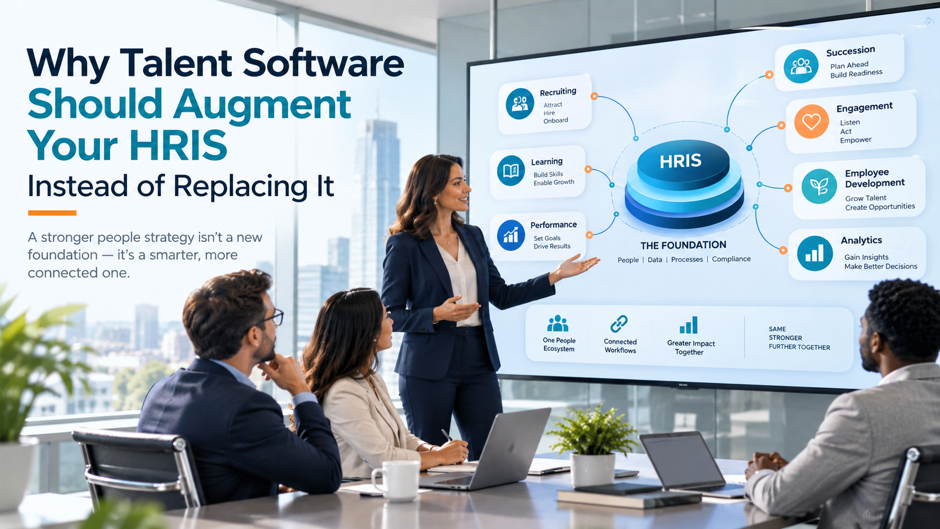
Every few years, a new wave of talent software arrives promising to be the single system that finally unifies HR: recruiting, performance, learning, succession, and analytics, all in one platform with one login and one employee record. The pitch is seductive precisely because the pain it addresses is real. Fragmented tools that don’t talk to each other, duplicate data entry, and a patchwork of spreadsheets bridging the gaps between systems are genuine, expensive problems. But the conclusion that follows, rip out the HRIS and replace it with the new suite, gets the fix backwards more often than it gets it right.
The HRIS is not just another HR tool sitting alongside the others. It’s the system of record: the single source of truth for who works at the company, what they’re paid, what their employment status is, and how their data flows into payroll, benefits, and compliance reporting. This guide uses talent software to mean a standalone or specialist talent tool layered onto an existing HRIS or HCM core. Major HCM suites can include both core HR and talent modules on one platform, so augmentation is one architecture choice, not a universal product-category boundary.
TL;DR
| Consideration | Why it favours augmentation over replacement |
| Data integrity | The HRIS holds payroll-connected, compliance-sensitive records; every migration introduces a window of risk that a well-integrated add-on avoids entirely |
| Specialisation | Specialist talent tools can provide deeper functionality when the HRIS or HCM suite’s native module does not meet the organisation’s requirements, when that added depth justifies integration and vendor-management effort. |
| Total cost of ownership | Compare licensing, implementation, integration, administration, training, support, vendor management, and switching costs instead of using employee count as a fixed architecture rule. |
| Replaceability | A best-of-breed stack lets you swap one underperforming tool without disrupting payroll, benefits, or the core employee record underneath it |
| Change management | Employees and managers already trust the HRIS for pay and personal data; asking them to re-trust a new system of record is a much bigger adoption lift than adding a connected tool |
| Implementation risk | HRIS replacement projects routinely run over budget and past deadline due to data migration and integration remapping; augmentation projects carry a fraction of that exposure |
| Vendor lock-in | A single suite vendor holding every HR function creates bargaining power that works against the buyer at renewal time |
The organisations that get the most value from talent technology treat the HRIS as a stable foundation and build a connected layer of specialised tools on top of it, rather than treating every capability gap as a reason to replace the foundation itself. The sections below unpack why this distinction matters in practice, what separates a genuinely additive vendor from one quietly angling to become the new system of record, and how to build the integration architecture that makes augmentation actually deliver on its promise rather than recreating the fragmentation it was meant to solve. A practical framework for deciding when replacement genuinely is the right call, because it sometimes is, closes out the guide.
What the HRIS Actually Does That Talent Software Shouldn’t Touch
Before deciding whether to augment or replace, it’s worth being precise about the scope here. This guide uses talent software to mean standalone or specialist tools layered onto an existing HRIS or HCM core. Some major HCM suites already combine core HR and talent modules on one platform, so the decision is not between 2 inherently separate product categories. The question is whether a specialist layer adds enough value to justify its integration and vendor-management requirements.
The System of Record Distinction
An HRIS or HCM core serves as the system of record for people data and administrative tasks: legal name, date of birth, Social Security or national ID number, employment status, compensation history, tax withholding elections, and benefits enrollment. This data feeds payroll runs, tax filings, benefits carriers, and compliance reporting, often through direct integrations that took significant engineering effort to build correctly the first time. Some HCM suites also include talent modules. In this guide, a talent management platform means a standalone or specialist layer used alongside the core when its capabilities better fit the organisation’s requirements.
Core administrative data and talent data often serve different workflows, but both can be sensitive and both need appropriate governance. HRIS records such as pay, tax, benefits, and employment status require strict controls. Talent records such as performance ratings, succession readiness, compensation planning inputs, and development notes can also be confidential. Each system should therefore have defined ownership, permissions, retention rules, and security controls that match the data it stores and the people who need access.
Why Replacing the System of Record Is a Different Risk Category
Replacing a talent tool that isn’t working is inconvenient. Replacing the HRIS is a business-critical transformation that touches every employee’s pay, benefits, and legal status simultaneously. Nearly 1 in 4 organisations reported that new HR technology implementations failed to meet adoption expectations. HRIS migrations specifically carry additional exposure around payroll accuracy, PTO balance integrity, benefits eligibility rules, and compliance reporting continuity that a talent-only implementation simply doesn’t carry. Objectives, data migration, and change management should instead be assessed separately.
A well-executed HRIS migration typically requires a full parallel payroll cycle before cutover, multiple rounds of test migration with record-count validation, and a named payroll owner signing off separately from general project sign-off, precisely because the cost of an undetected error is so much higher than it would be for a misconfigured performance review workflow. None of this caution is excessive; it reflects the genuine stakes involved when the system holding compensation and compliance data changes underneath an entire workforce at once.
The Case for a Best-of-Breed Talent Layer
Specialist talent tools can provide deeper functionality when an HRIS or HCM suite’s native module does not meet the organisation’s requirements. That can make augmentation the right call when the added capability justifies integration work and another vendor relationship. Suites can offer stronger data consistency and lower integration burden, while specialist products may offer more depth in a particular function. The right choice depends on the capability gap, operating requirements, and the cost of connecting another system in practice.
Why Specialisation Can Add Depth
A vendor building a dedicated performance management platform focuses their entire product and engineering roadmap on one problem: making performance conversations, goal tracking, and feedback genuinely useful. A vendor building a comprehensive HCM suite has to split development resources across payroll, benefits, time tracking, recruiting, learning, performance, and succession simultaneously, which means any single module, including the talent-focused ones, receives a fraction of the attention a dedicated vendor gives their one area of focus. This isn’t a criticism of suite vendors; it’s simply the mathematics of finite development resources spread across a much wider surface area.
The practical result shows up in feature depth, user experience quality, and how quickly the tool adapts to changing best practice in its specific domain. A dedicated learning platform typically ships new content formats, skills-mapping capability, and engagement features faster than the learning module bundled inside a broader suite, because that’s the entirety of what the dedicated vendor’s team works on every day.
The Cost Comparison by Operating Context
Organisation size can affect cost, but it does not create a reliable crossover point on its own. The better comparison looks at how many modules are needed, how complex the processes are, whether the company operates across multiple countries, what reporting must be combined, and how much internal capacity exists for integrations and vendor management. The table below uses those operating factors instead of fixed employee thresholds, because the same headcount can support very different technology economics depending on requirements and internal resources.
| Decision factor | Cost pattern | Why it matters |
| Integration capacity and module needs | Depends on internal ownership and required tool count | More specialist tools can add useful depth, but each connection needs ongoing maintenance, monitoring, and vendor coordination that should be priced explicitly. |
| Process complexity and global footprint | Depends on localisation, workflow, and reporting requirements | Complex processes or multiple countries can increase the value of suite consistency, while specialist tools may still fit areas where native modules fall short. |
| Reporting, vendor management, and switching | Depends on governance capacity and future change needs | Compare cross-system reporting effort, vendor relationships, contract management, data portability, and the cost of replacing one module or the core platform. |
Licensing is only one part of the total cost of ownership for HR technology. Implementation, integration maintenance, training, support, administration, and future switching work can materially change the comparison between a suite and a specialist stack. A thorough evaluation should price those items explicitly, along with the cost of unused bundled modules and the internal time required to manage vendors and data flows. Sticker price alone rarely shows the full economic picture, especially when one option creates more integration or migration work over the planned ownership period.
Replaceability as a Strategic Asset
A best-of-breed stack can make individual tools easier to replace because the core HRIS and other connected systems may remain in place while one specialist application changes. That flexibility still depends on clean interfaces, portable data, and manageable dependencies. Suite modules can have higher switching costs or be harder to replace independently when they share workflows and data structures, but changing one module does not normally require replacing the entire HCM suite. The practical question is how tightly the module is coupled, what integrations must be rebuilt, and whether the suite supports third-party applications alongside its native functionality.
Signs a Vendor Is Selling Replacement Disguised as Augmentation
Some talent platforms marketed as complementary additions are, in practice, designed to gradually pull core HRIS functionality into their own system, creating exactly the replacement risk this guide argues against, just spread out over a longer timeline instead of happening all at once. Recognising the pattern early matters because a gradual, unannounced shift toward becoming the primary system of record is harder to evaluate and reverse than a clearly proposed replacement decision made deliberately with full visibility into the tradeoffs involved.
- The vendor pushes to become the primary employee record rather than syncing with your existing one. Genuine augmentation tools read from and write back to your HRIS as the system of record. A tool that wants employees to update their core personal or employment data inside its own interface, rather than in the HRIS, is quietly positioning itself to become the record of truth over time.
- The integration ignores critical events or data ownership. A talent tool that receives only basic employee data but misses important lifecycle changes can drift from the HRIS. High-impact events may need event-based updates, while lower-risk fields can use scheduled synchronization. Write-back should occur only where the talent system legitimately owns the field or outcome, with the direction and timing documented for each data element.
- Pricing or roadmap conversations increasingly reference “consolidating your HR stack.” This is a legitimate long-term vendor strategy in some cases, but it’s worth naming explicitly and evaluating on its own terms rather than accepting it as an inevitable byproduct of adopting the tool for its narrower, original purpose.
- The vendor discourages maintaining a separate system of record “for simplicity.” Simplicity is a genuine value, but when it’s offered as a reason to collapse legally sensitive, payroll-connected data into a platform that wasn’t originally built or audited for that purpose, the simplicity argument is doing more work than it should.
- Support and implementation documentation increasingly assumes their platform is the primary HR system. A tool that started as a clearly scoped talent add-on but whose newer documentation, onboarding flows, and default configurations assume it’s the main HR system of record has likely shifted its actual product strategy, whether or not that shift has been communicated directly to existing customers.
None of these signs is automatically disqualifying on its own, since some vendors are genuinely transparent about a broader long-term ambition and let customers decide with full information. The problem arises when the shift happens gradually and implicitly, so that an organisation that deliberately chose augmentation discovers years later that it has, without ever making the decision explicitly, ended up dependent on a replacement it never actually evaluated on those terms.
The Integration Architecture That Makes Augmentation Work
Augmentation only delivers on its promise when the integration between the HRIS and the talent layer is built correctly. A poorly integrated add-on produces exactly the fragmentation and duplicate data entry problem that suite vendors correctly point to as a real risk, which means the quality of the integration work is not a minor implementation detail but the single factor that determines whether augmentation succeeds or simply recreates the original problem under a different name.
What a Well-Built Integration Requires
Synchronization based on data criticality, ownership, and process needs.
When someone is hired, terminated, promoted, or changes department, the update should reach talent workflows quickly enough for the business impact involved. High-impact lifecycle events may justify event-based or near-real-time updates, while lower-risk talent data can use scheduled synchronization. Data should flow back to the HRIS only when the talent system legitimately owns the field or outcome. The required cadence and direction should be documented for each integration rather than applied universally.
A clearly defined field-mapping document that specifies which system owns which data.
Legal name, compensation, and employment status should normally remain owned by the HRIS, with connected tools reading those fields rather than maintaining editable copies. Talent records such as performance ratings, development plans, or succession readiness may be owned by the talent platform when architecture assigns responsibility. Write-back should be limited to fields or outcomes the receiving process needs. Clear ownership and update rules reduce drift and avoid treating every data element as bidirectional by default.
An API-first HRIS that supports the integration depth talent platforms actually need.
Not every HRIS offers equally capable API access, and this is a legitimate selection criterion when choosing or evaluating the core system: an HRIS with a thin, limited API constrains every talent tool layered on top of it, regardless of how well-built the talent tool itself is.
Single sign-on and consistent identity management across the stack.
Employees and managers should not need to remember separate credentials for each connected tool, and a shared identity layer, typically through single sign-on tied to the company’s core identity provider, removes one of the most common sources of user friction and IT support burden in a multi-vendor environment.
What Breaks When Integration Is an Afterthought
Organisations that adopt a talent platform without investing properly in integration architecture tend to discover the gaps months later, usually at the worst possible moment: a terminated employee still shows as active in the performance platform and receives a review cycle notification, a newly promoted manager doesn’t get visibility into their new team’s development plans because the org hierarchy sync lagged behind the HRIS change, or compensation data referenced in a succession planning module is months out of date because the sync only runs weekly. None of these failures are inherent to the augmentation model; they’re the predictable result of treating integration as a one-time setup task rather than an ongoing operational responsibility with a named owner. A fourth common failure pattern worth naming explicitly: an employee on an approved leave of absence continues appearing in active development workflows because the leave status recorded in the HRIS was never mapped into the talent platform’s own status field, generating awkward automated check-in prompts during a period when the employee is legitimately away from work.
What Augmentation Looks Like by Talent Function
The augment-versus-replace question plays out differently across the different functions typically covered by talent software, and a single blanket answer rarely fits every category equally well. Breaking the decision down function by function makes the underlying pattern easier to see than trying to reason about talent software as one undifferentiated category, since recruiting, learning, and compensation planning carry meaningfully different levels of dependency on the HRIS underneath them.
| Talent function | Typical augmentation pattern | HRIS dependency |
| Recruiting and applicant tracking | A dedicated ATS handles requisitions through offers, then syncs the new hire record into the HRIS at the point of hire | Low during the hiring process itself; high at the handoff moment when a candidate becomes an employee |
| Onboarding | A specialised onboarding tool manages task checklists, document collection, and new-hire communication, feeding completion status back to the HRIS | Moderate; onboarding status often needs to be visible in the HRIS for compliance and reporting purposes |
| Performance management | A dedicated performance platform runs goal-setting, feedback, and review cycles, referencing org hierarchy and role data pulled from the HRIS | Moderate; needs accurate reporting-line data but generally doesn’t need to write back to core HRIS fields |
| Learning and development | A specialised LMS delivers and tracks training content, syncing completion records back for compliance reporting | Low to moderate; mostly needs employee identity and role data to assign relevant content |
| Succession and workforce planning | A dedicated succession tool combines performance history, readiness ratings, and org structure, all sourced from connected systems | High; this function depends on accurate, current data from performance, HRIS, and sometimes compensation systems simultaneously |
| Compensation planning | A specialised compensation tool models merit increases and bonus pools against budget, then pushes approved changes into the HRIS for execution | Very high; compensation changes must ultimately be reflected accurately and promptly in the HRIS since it drives payroll |
The pattern across every row is consistent: the specialised tool owns its functional domain and depends on the HRIS for identity, org structure, and status data, while writing back only the specific outcomes the HRIS genuinely needs to reflect, such as a completed onboarding milestone or an approved compensation change. None of these functions requires the specialised tool to become the system of record for core employee data, which is exactly the distinction that separates healthy augmentation from the slow-motion replacement pattern described earlier in this guide.
Compensation planning deserves particular attention because it sits closest to payroll and therefore carries the highest data-integrity stakes of any function on this list. A compensation planning tool that lets managers model scenarios and recommend increases is genuinely valuable, but the actual compensation change needs to flow into the HRIS through a controlled, auditable process rather than existing as a parallel, potentially conflicting record. Organisations that get this wrong typically discover the problem at the worst possible time, when payroll runs against one figure while the compensation tool shows a different, more recently approved number that never made it back into the system that actually pays people.
A Practical Framework for Deciding Augment vs. Replace
Not every situation calls for the same answer, and a structured framework for the decision produces better outcomes than defaulting to whichever approach the most persuasive vendor pitched most recently. The 5 steps below give a repeatable process that any organisation, regardless of size or current HR technology maturity, can apply consistently rather than re-litigating the augment-versus-replace question from scratch every time a new capability gap surfaces.
Start by categorising every HR function as either Core or Differentiator.
Payroll, benefits administration, and core employee records are typically Core: functions where stability, compliance accuracy, and continuity matter more than cutting-edge feature depth. Talent development, performance management, learning, and engagement are more often Differentiators: functions where the organisation’s specific approach to developing and retaining people genuinely benefits from best-in-class, purpose-built tools. This categorisation alone resolves a large share of augment-versus-replace decisions before any vendor conversation begins.
Audit the current HRIS’s API quality and integration track record honestly.
If the existing HRIS has a genuinely poor, limited, or unreliable API, that’s a legitimate reason to consider replacing the core system, but the decision should be driven by the HRIS’s own integration limitations, not by a talent vendor’s roadmap ambitions. A capable, API-first HRIS removes most of the practical arguments for consolidating everything into a single suite.
Map every spreadsheet currently bridging gaps between existing tools.
These spreadsheets are usually the clearest evidence of where a genuine capability gap exists, and they point toward what a new talent tool needs to solve, distinct from what the HRIS is already handling adequately. A capability gap is a reason to add a tool; it is rarely, on its own, a reason to replace the system of record underneath it.
Evaluate total cost of ownership across a 3-year horizon, not just first-year licensing.
Include integration build and maintenance cost, internal administrative overhead, training, and the switching cost if the chosen tool underperforms. A best-of-breed tool that looks marginally more expensive on a first-year license comparison frequently wins decisively once the full ownership picture, including the flexibility to swap it out later without disrupting anything else, is properly accounted for.
Weight data migration risk explicitly and proportionally to what’s actually moving.
Migrating performance review history carries meaningfully lower risk than migrating payroll and tax records, and treating every system change as carrying the same risk profile, whether it’s adding a learning platform or replacing the core HRIS, leads to either excessive caution on low-risk additions or, more dangerously, insufficient caution on a genuine system-of-record replacement.
FAQs
Isn’t a single unified platform always simpler for employees than multiple connected tools?
Simplicity depends more on integration quality than on vendor count. A well-integrated best-of-breed stack with single sign-on and consistent data sync can feel just as unified to an employee as a single suite, because the employee experiences a connected set of tools rather than the underlying vendor architecture. Conversely, a poorly integrated suite with modules that don’t share data cleanly can feel just as fragmented as disconnected point solutions. The vendor count is less predictive of employee experience than the quality of the integration work behind it.
When does it actually make sense to replace the HRIS itself, rather than augment it?
Replacement is the right call when the current HRIS has fundamental limitations that no amount of augmentation can solve: a genuinely poor or unavailable API that blocks integration with any modern talent tool, a vendor that’s stopped investing in the product, compliance or localisation gaps for new markets the organisation is entering, or core payroll and benefits functionality that no longer meets the organisation’s basic operational needs. These are HRIS-specific failures, distinct from a talent capability gap that a connected add-on tool could solve without touching the core system at all.
How much does a typical HRIS replacement project cost compared to adding a talent tool?
An HRIS replacement is a materially larger undertaking, typically involving data migration across every employee record, parallel payroll runs for validation, integration remapping for every connected system including benefits carriers and payroll processors, and a change management effort touching the entire workforce. A talent tool addition, by contrast, usually requires configuring one integration connection to the existing HRIS and training a smaller group of managers and employees on a single new workflow. The direct cost difference is significant, but the larger difference is in risk exposure and the duration of organisational disruption during the transition.
What’s the biggest mistake organisations make when integrating talent software with their HRIS?
Treating integration as a one-time implementation task rather than an ongoing operational responsibility is the most common and costly mistake. Integrations degrade over time as both systems update their APIs, as new fields get added, and as edge cases like rehires, leaves of absence, or international transfers surface behaviour the original integration design didn’t anticipate. Organisations that assign a named internal owner for the integration, who monitors sync health and addresses drift proactively, avoid the slow accumulation of data discrepancies that otherwise erodes trust in both systems over time. A practical safeguard many organisations adopt is a recurring reconciliation check, run monthly or quarterly, that compares employee counts and key status fields across both systems and flags any mismatch for investigation before it compounds into a larger discrepancy that’s harder to trace back to its original cause.
Can a growing company start with a single suite and move to best-of-breed later, or is that switch too disruptive?
It’s possible but genuinely harder than starting with a clean best-of-breed architecture from the outset, because unwinding a suite’s shared data model to extract individual modules later carries similar migration risk to any other HRIS-adjacent system change. Organisations that anticipate significant growth and expect to eventually need best-in-class talent capabilities are generally better served starting with an API-first HRIS and adding specialised tools as specific needs emerge, rather than starting with an all-in-one suite on the assumption that it can be easily disaggregated later if the bundled modules turn out to be inadequate. Early-stage companies that do start with a suite for simplicity should at minimum confirm the suite’s core HRIS component exposes a genuine API, so that the option to layer in specialised tools later remains open even if the full suite is never fully unwound.
How do we evaluate whether our current HRIS’s API is actually good enough to support a best-of-breed talent stack?
Look for well-documented REST or GraphQL APIs and support for the integration patterns your processes actually need. Webhooks or event notifications can matter for time-sensitive lifecycle changes, while scheduled exports may be adequate for lower-risk data. Ask prospective talent vendors about their existing integration experience with your specific HRIS, since repeated work with the platform can reveal practical limitations early. A capable API should support the required fields, events, permissions, and write-back paths for your design. It does not need every field to synchronize bidirectionally or in real time when ownership and business impact point to a simpler pattern.
Does augmentation create more security and compliance risk because sensitive data now lives in more places?
Augmentation changes the security risk profile rather than automatically reducing it. A well-scoped specialist tool can limit the sensitive data shared with that vendor, keeping information such as legal identifiers or core compensation records in the HRIS when the talent process does not need them. At the same time, adding vendors, APIs, service accounts, credentials, and integration points creates more third-party and operational surfaces that must be governed. The right approach is to define minimum necessary data, role-based access, vendor review, monitoring, retention, and incident responsibilities for every connected system. A suite concentrates more data with one provider, while a specialist stack distributes selected data across more providers. Neither architecture is inherently safer in every case, so security should be evaluated against the actual data flows, controls, and vendor responsibilities in the chosen design.
