
A payroll quote can look simple until you compare what it actually includes. One proposal may price the software per employee per month. Another may charge for each payroll run, while putting implementation or integration work on separate lines. The difference can change the annual bill even when the quoted unit rate looks similar. If you need hands-on help, Ignite HCM offers payroll compliance for teams in this position.
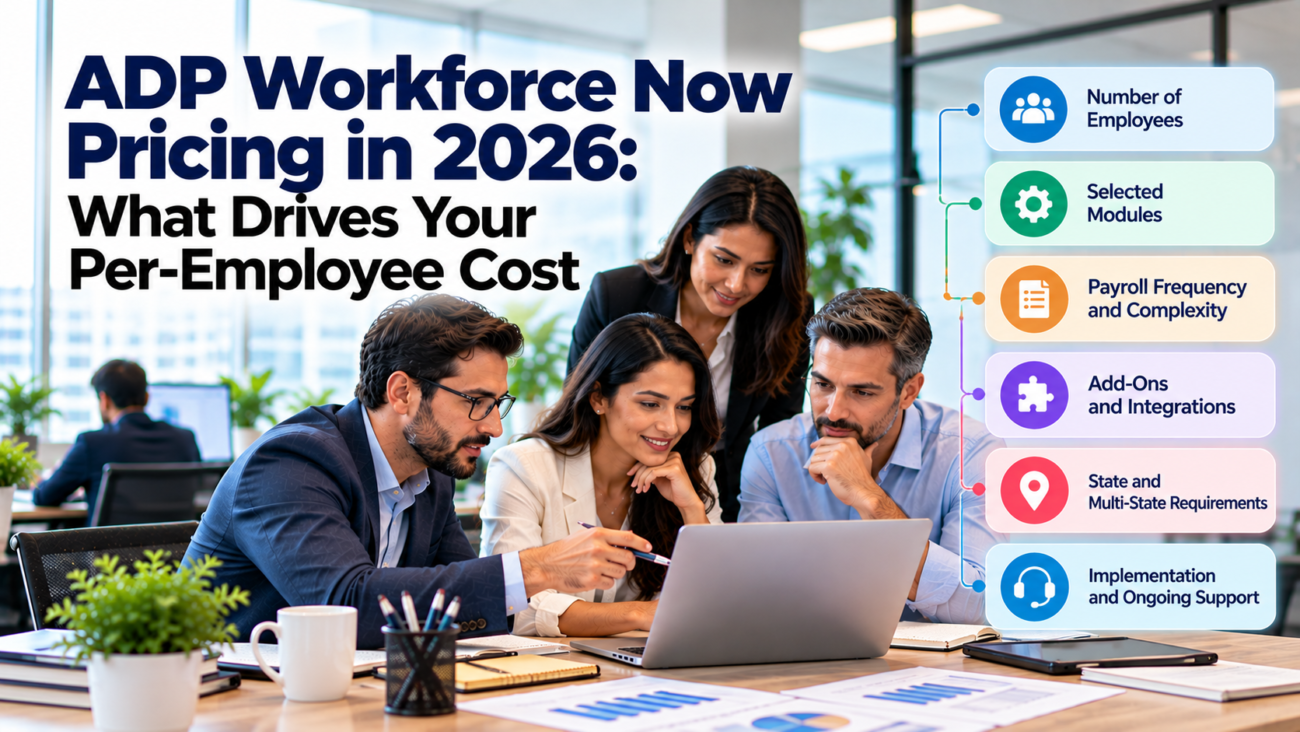
That is the problem with researching ADP Workforce Now Pricing from a single online estimate. ADP doesn’t publish a standard subscription rate for every Workforce Now customer. It asks employers to describe their size and needs before providing a quote. The product package, payroll schedule, employee mix, and services selected all affect what a buyer should expect to pay.
For a finance or HR team, the useful number is the annual service cost divided by the employees covered. The first-year figure should include setup expenses, while the recurring figure should exclude truly one-time work. This guide explains the 2026 packages, billing methods, fees worth checking, and calculations needed to review a real proposal without confusing outside estimates with official prices.
TL;DR:
ADP Workforce Now doesn’t have a public flat rate for its Select, Plus, and Premium packages. Your quote can change with workforce size, payroll frequency, benefits and time modules, tax complexity, integrations, and setup work. Ask whether each line uses per-employee-per-month or per-employee-per-payroll billing. Then calculate first-year and later-year costs separately using the same headcount and services for every quote. Any dollar amounts in the worked examples below are hypothetical unless clearly identified as a published third-party application price.
What ADP Workforce Now Pricing Covers
Workforce Now is a payroll and human capital management system aimed mainly at midsized employers. It brings payroll records and HR functions into a connected environment. Employers can select a core package and assess further capabilities according to their needs. ADP positions the product for businesses with roughly 50 or more employees, although a specific deal still depends on the buyer’s requirements.
The published ADP Workforce Now Pricing information is a guide to the structure of a purchase, not an online checkout rate card. ADP’s product material shows package names and functions, but asks buyers to request prices. That matters when a website publishes a supposed standard $20 or $30 monthly employee fee without naming the package, billing schedule, or underlying customer agreement.
A direct comparison starts with understanding what is being purchased. ADP’s package comparison lists Select, Plus, and Premium with different feature coverage. Buyers should use the current comparison to confirm included functions, then use their written quotation to establish the charge for their specific account.
ADP Workforce Now Pricing is also distinct from the total cost of employing staff. Payroll taxes, salaries, insurance premiums, and employer contributions remain workforce expenses. They aren’t automatically charges for ADP software. A budgeting worksheet that adds the full payroll amount to a SaaS fee without separating them will give a misleading per-employee software figure.
Searches for ADP Workforce Now Cost often mix subscription expenses with payroll administration costs. Keep those categories separate. The relevant price for this evaluation is what the employer pays for the platform, contracted services, applicable transaction charges, and setup or integration work. That gives finance an ADP Workforce Now Cost figure to compare with other payroll arrangements.
What the Select, Plus, and Premium Packages Include
The three named ADP Workforce Now Plans establish the starting scope. Select covers core payroll and HR work. Plus adds benefits administration. Premium builds on Plus with Time and Attendance. A detailed quote must show which services come with the chosen package and which require another purchase.
| Package | Published Core Scope | Common Buying Question |
| Select | Payroll and tax plus core HR tools | Does the company need benefits or time functions beyond its current systems? |
| Plus | Select capabilities with benefits administration | Which carrier connections and enrollment tasks are covered? |
| Premium | Plus capabilities with Time and Attendance | Are the required scheduling and time-capture functions included? |
Choosing Among ADP Workforce Now Plans
Select can make sense when a company already has a separate way to manage staff hours and benefits. But keeping those systems has a cost of its own. The team may still spend time moving employee changes between them and reconciling payroll deductions. Compare the whole operating arrangement rather than the Workforce Now invoice in isolation.
Plus deserves closer review when benefits are complex. An employer might need medical plan enrollment, changes after qualifying events, or connections to existing carriers. Ask which activities happen inside the included module and whether carrier setup needs extra work. Don’t assume that an item labeled benefits administration covers every broker or provider connection the company uses.
Premium deserves attention when hourly work, shifts, or absence records create payroll work. A company with many nonexempt employees may get practical value from an integrated time process. The timekeeping feature list still needs a careful check for the company’s clocks, mobile capture rules, approval levels, and scheduling needs. Those details can affect the quoted scope.
Payroll and benefits are closely related, as ADP’s HCM software guide explains, but they remain separate business requirements. Don’t upgrade solely because a higher package includes more features.
How Employee Count Changes the Price
Headcount affects ADP Workforce Now Pricing because the service is often charged against covered employees. The difficult question is which employees count. A company with 200 people on its HR roster might have fewer active people on payroll during a quiet season. For ADP Pricing Per Employee estimates, the billable count may differ when only certain workers use a module.
A useful ADP Pricing Per Employee calculation therefore begins with the contract’s headcount definition. Does a person become billable on the hire date, the first paid payroll, or another trigger? Does the count include employees on unpaid leave? Is a terminated employee included until month end? Written answers matter more than a general assurance that the price follows active employees.
Staff Changes During the Year
Consider an employer that has 120 employees in January and 170 by December. Calculating annual fees as if it had 170 employees all year may overstate the cost under true monthly billing. Using 120 all year may understate it. The clean approach is to calculate each month’s expected covered headcount and sum the charges, while checking for minimum billing commitments.
Temporary and seasonal work can produce sharper changes. A retail business may hire many short-term workers, while a professional services firm may have a stable payroll but frequent contractors. The contract should state whether contractors are counted and whether additional products apply to them. A contractor payment service isn’t automatically part of the regular employee charge.
Employee count affects annual budget forecasts, as ADP’s HCM pricing guidance confirms, along with payroll frequency and selected services. It doesn’t establish a universal volume discount. Any reduced rate for larger headcount must be documented in the buyer’s offer.
When reviewing ADP Workforce Now Cost, model the next 12 months of hires and departures. Ask what happens if the business crosses a pricing band, if a new location opens, or if enrollment in an optional module grows. A low starting price can become less attractive when the workforce changes in ways the quote doesn’t clearly address.
PEPM vs. PEPP and Payroll Frequency
ADP Workforce Now Pricing may use per employee per month (PEPM) or per employee per payroll (PEPP). These terms sound similar, but the billing calendars are different. PEPM normally follows 12 monthly periods. PEPP follows the number of chargeable payroll runs. A company paid weekly can therefore see a very different yearly bill from one paid twice monthly, even at the same unit rate.
The number of yearly processing periods matters because ADP’s 2026 payroll calendar lists the usual counts: 52 weekly, 26 biweekly, 24 semimonthly, or 12 monthly pay periods. Some biweekly schedules can produce 27 paydays in a particular year. The actual agreement determines whether and how that difference affects charges.
| Schedule | Typical Annual Runs | Illustrative PEPP Charge at $8 for 100 Employees |
| Monthly | 12 | $9,600 |
| Semimonthly | 24 | $19,200 |
| Biweekly | 26 | $20,800 |
| Weekly | 52 | $41,600 |
These amounts are math examples, not quoted ADP rates. They assume all 100 employees are billed on every run and that no base or minimum fee applies. A real payroll contract might charge different employee populations on separate schedules or set a monthly minimum. Ask for those details before relying on the calculation.
Mixed Payroll Schedules
A business may pay hourly staff weekly and salaried employees semimonthly. The right forecast separates the groups. For example, 80 weekly employees and 40 semimonthly employees generate a different PEPP total from 120 workers on one biweekly schedule. Off-cycle corrections and bonus runs may create still more billable events.
The ADP Workforce Now Cost comparison should identify whether the quote uses PEPM for platform access and another method for processing activity. Some pricing arrangements combine several fee types. A buyer who annualizes only the headline employee rate may miss a separate monthly base fee or processing charge.
The phrase ADP Pricing Per Employee is useful only when the period is stated. A $10 PEPM line and a $10 PEPP line aren’t directly comparable. Convert them both into an annual amount using the employer’s actual pay calendar. Then divide by a consistent covered-employee figure.
Payroll Tax Complexity and Special Processing
Payroll becomes harder to manage when employees work in different tax jurisdictions or receive several kinds of pay. Federal taxes apply broadly, but state and local withholding rules can vary. A growing company may also need distinct earnings codes, deductions, garnishments, and year-end reporting arrangements. Those requirements can change setup work and the services included in a quote.
ADP describes the main processing steps in its payroll processing guide, including wage calculation, tax withholding, payments, and recordkeeping. The guide helps define the work an employer needs covered, but doesn’t prove that every possible exception is included in every Workforce Now package. A buyer should compare those responsibilities with the service description in the agreement.
A company operating in 1 state with 1 regular pay schedule may have fewer configuration decisions than a business with employees across 12 states. The second organization should confirm which states and localities the quoted tax services support, how new registrations are handled, and whether adding a jurisdiction creates a one-time or recurring fee.
Corrections deserve a separate line of questioning. An off-cycle payroll may be required when an employee misses a regular payment or a bonus must be issued outside the normal run. Ask whether the agreement includes a number of extra runs and what triggers a charge. It would be inaccurate to claim that every off-cycle run always creates an ADP fee.
Year-end tasks also have costs and deadlines. The IRS employment tax overview explains obligations involving wage statements, tax deposits, and employment returns. Finance should confirm which form preparation, filing, and delivery services are in the quoted scope while keeping government taxes separate from vendor charges.
Even when a payroll service handles filings, the employer remains accountable for important tax obligations. That operational fact matters when pricing support. A low-cost package may still require an internal payroll specialist to review notices and resolve exceptions. Include that internal workload when estimating overall administration costs, but don’t disguise it as an ADP subscription charge.
How Benefits and Time Functions Affect the Quote
Optional HCM functions can change ADP Workforce Now Pricing more than small differences in core payroll fees. For some employers, benefits administration is essential. For others, the largest gap is time capture from stores or job sites. The right decision depends on the cost of current tools and the work required to connect them.
Capturing actual hours is important for variable shifts. ADP’s timekeeping software guide describes capabilities such as recording hours, schedules, absences, and overtime. Those are functions to evaluate, not a guarantee that every device or rule comes with the Premium package. A construction employer, for example, may require job codes that a regular office payroll does not use.
Benefits Administration Questions
Ask which parts of enrollment the Plus or Premium scope covers. Check carrier connections, eligibility rules, employee elections, life events, and deduction transfers to payroll. If the company uses an outside benefits broker, clarify who owns each connection and who handles failures. A benefit feature may be included while a custom connection needs separate work.
The ADP Workforce Now Plans comparison should also distinguish core HR onboarding from specialized third-party onboarding applications. Similar names don’t mean the same product. A buyer shouldn’t count the cost of an optional application as if it were the official base fee for every Workforce Now customer.
Time and Scheduling Questions
For time and attendance, document the employee groups that need the function. A 300-person employer may have 60 staff working fixed office hours and 240 rotating shifts. It might also use physical clocks at some sites and mobile capture elsewhere. Ask whether hardware, installation, and special rules are included in the requested configuration.
Federal wage and hour rules also affect payroll records. The US Department of Labor’s recordkeeping fact sheet lists required wage and hour records for covered nonexempt workers. Accurate records remain the employer’s responsibility regardless of the software purchased. A time module may help collect the information, but its price should be evaluated against the actual payroll process and compliance needs.
When comparing ADP Workforce Now Plans, ask for a feature-by-feature response instead of relying on package labels. The resulting proposal should identify the functions the business will use and the employee population assigned to each one.
What Implementation and Migration Can Cost
In ADP Workforce Now Pricing, implementation is a project cost, not the monthly service fee. Its scope depends on what the employer must move and how much must be configured before the first live payroll. An organization replacing a single clean payroll system may have less work than one combining records from acquisitions and disconnected time systems.
A successful launch depends on defined work and clear ownership. ADP’s HRIS implementation guide describes reviewing existing processes, gather data, prepare connections, and train users. A buyer should turn those tasks into a statement of work with named owners and acceptance checks. A quoted setup amount without a work description isn’t enough to judge value.
Define the Work Before Pricing It
The ADP Workforce Now Implementation Cost may include employee and tax data conversion, pay code mapping, benefits deductions, security roles, and parallel testing. It may also include administrator training. These are potential tasks, not an assertion that ADP always bills for each one separately.
A strong proposal states who cleans historical data before transfer. If the employer sends inconsistent records, the implementation team may need extra review cycles. Agree on the number of historical periods to be migrated and whether archived records will remain accessible through the old system. These decisions can affect project effort and transition risk.
The same contract should identify test payrolls and the approval process for going live. Finance should know who signs off on gross pay, deductions, taxes, and net pay. A rushed launch can create costs far greater than the disputed setup line. The ADP Workforce Now Implementation Cost therefore deserves its own budget and contingency allowance.
The ADP Workforce Now Implementation Cost estimate must also separate a one-time setup charge from recurring support. If a specialized connector needs annual maintenance, put that amount in the recurring column. Otherwise the second-year forecast will be artificially low.
Integration and Marketplace Expenses
ADP Workforce Now Pricing can also reflect connections with other tools. Accounting, benefits, recruiting, and workforce systems may all need employee updates. A connection can reduce manual reentry, but it also introduces setup, permission, and support questions. These should be evaluated separately from the price of running payroll.
The ADP Workforce Now Cost assessment should state which integration method the employer intends to use. A standard connector is different from a custom application using an API. Check who supports the connection when data fails to pass between systems, whether access has usage limits, and who can make changes after the original project ends.
For a real published price example, ADP Marketplace lists Nectar HR editions at $5 or $6 per employee per month with a $1,000 setup charge in the displayed configuration. Nectar is a separate third-party recognition application. Those figures are not prices for Select, Plus, Premium, or a required Workforce Now feature. They simply show how a voluntary connected application may add its own charges.
A second source of cost may be staff time. IT can spend hours on field mapping, error alerts, and account permissions. If a company uses an integration to send pay totals to a general ledger, it still needs to verify that the receiving system posts data to the correct accounts. This responsibility remains important even when the connector is working.
For ADP Pricing Per Employee, optional apps should be annualized only if the company plans to buy them. Adding every Marketplace product to an estimate would exaggerate the real cost. Omitting a required connector would understate it. The goal is to model the actual technology setup used by that employer.
Fees That May Sit Outside the Base Subscription
A base ADP Workforce Now Pricing figure rarely answers every billing question. Depending on the agreement, separate charges may apply to special processing, year-end work, employee payments, or additional support. The correct approach is to ask about those categories rather than state that ADP charges every customer for each one.
An invoice may include more than the subscription amount. ADP’s payroll cost guide identifies the ways payroll service prices can differ, including base fees, processing charges, and workforce-related requirements. It also discusses broader employment costs. Those broader costs should not be confused with the provider’s own invoice.
| Potential Charge | Question for the Written Quote |
| Additional payroll runs | Is there a per-run fee or an included allowance? |
| Year-end forms | Are W-2 and relevant 1099 services covered? |
| Payment delivery | Do checks, special delivery, or other methods cost more? |
| Garnishment handling | What administrative work is included? |
| New tax jurisdiction | Are registrations and ongoing filings included? |
| Special HR support | Does a named support service have a separate fee? |
| Added users or modules | Which functions or staff groups change the charge? |
Ask about minimum monthly invoices, price increases after a promotional period, and fees for late changes to payroll data. These may be material in a busy organization, even if they occur infrequently. Request the relevant schedule of fees as an attachment to the main agreement.
A budget can distinguish predictable recurring costs from event-based charges. Treat exception charges as a separate forecast based on actual prior usage. Don’t invent an average number of off-cycle runs merely to make competing quotes appear comparable.
Calculate Your Effective Per-Employee Cost
A reliable ADP Workforce Now Pricing calculation starts with every service charge for the same period. Add contracted subscription fees and the expected cost of chargeable processing. Include required recurring applications. Keep one-time implementation and migration charges separate until calculating the first year.
The phrase ADP Pricing Per Employee is often used without a unit. A report on ADP Pricing Per Employee should show recurring annual fees, effective monthly cost per covered employee, and first-year cost including setup. Those figures should also name the headcount assumption.
Recurring effective PEPM = annual recurring service fees ÷ (12 × average monthly billable employees).
First-year effective PEPM = (annual recurring service fees + one-time setup fees) ÷ (12 × average monthly billable employees).
For a stable company with 200 billable employees, annual recurring fees of $54,000 produce an effective recurring cost of $22.50 PEPM. Adding a hypothetical $8,000 one-time implementation charge makes the first-year cost $62,000, or about $25.83 PEPM. These are made-up budgeting figures for demonstration, not ADP prices.
If headcount changes each month, sum the monthly covered employee counts and use that total as the denominator rather than simply multiplying the final headcount by 12. This employee-month method better reflects a growing workforce. But first check if the contract has minimum charges that continue even when headcount falls.
Payroll setup involves decisions that affect the budget too. ADP’s payroll setup guidance explains why worker classification, deduction setup, and payroll schedules must be defined before a payroll program begins. They also affect what should appear in a realistic budget. A calculation can’t repair a quote based on the wrong workforce assumptions.
Sample Budgets for 100, 250, and 500 Employees
The following figures illustrate a budgeting method, not published ADP Workforce Now Pricing. Each example assumes a hypothetical $18 PEPM recurring platform charge, a separate hypothetical $2 PEPM required service, and a one-time setup fee. The common unit amounts make headcount effects easy to see, but real quotations may have different rates and minimums.
| Billable Staff | Annual Recurring Fees | Assumed Setup Fee | First-Year Total | First-Year Effective PEPM |
| 100 | $24,000 | $5,000 | $29,000 | $24.17 |
| 250 | $60,000 | $8,000 | $68,000 | $22.67 |
| 500 | $120,000 | $15,000 | $135,000 | $22.50 |
All numbers in this table are hypothetical and rounded to 2 decimal places where needed. They do not indicate market averages, an ADP discount curve, or a current price offer. They assume 12 billed months and a constant employee count; they exclude any event-based charges.
Notice that the example’s effective first-year PEPM falls as the setup charge is divided across more employees. That doesn’t mean an actual implementation will cost the same for businesses with different needs. A 500-person employer with complicated pay rules may spend more on setup than a simpler company of equal size.
The ADP Workforce Now Implementation Cost matters when a buyer compares the first year, but the business should also model renewal years. A larger setup fee may be acceptable if it is tied to migration work the organization genuinely needs. A lower setup fee doesn’t prove the long-term contract is cheaper.
When comparing ADP Workforce Now Plans, apply the same required feature list to each example. Buying Premium for 100 employees cannot be compared fairly with Select for 500 if the analysis ignores the difference in included time and benefits services.
How to Read and Compare a Written ADP Quote
An ADP Workforce Now Pricing review begins with an itemized proposal. The employer should request the selected package, expected employee count, payroll schedule, contract term, and every recurring service line. The quote should also identify setup work and any charges triggered by special events. A single total makes it hard to determine what will change later.
The choice should reflect actual HR and payroll needs. ADP’s HCM evaluation article recommends matching software decisions to actual business requirements and planning implementation before selection. This principle is particularly relevant to pricing. A low fee for the wrong product scope isn’t a useful saving.
A Practical Quote Review Checklist
· Confirm whether each line is PEPM, PEPP, a monthly base amount, or a one-time fee.
· Compare the same employee groups and payroll calendar across all scenarios.
· Get written confirmation of tax services, year-end work, and exception charges.
· Identify support hours, training allowances, and the process for service issues.
· Check renewal terms, price increases, minimum commitments, and cancellation notices.
· Define the data migration scope and who owns testing and final approval.
The ADP Workforce Now Implementation Cost should be presented as a statement of work, not a vague allowance. A proposal that includes 2 parallel payrolls, for example, is different from one that makes the employer responsible for all testing without implementation support. Ask what happens if go-live dates change because source data is incomplete.
For a clean ADP Workforce Now Cost comparison, request a 3-year view. Show recurring fees, renewal assumptions, and known setup charges in separate columns. Price increases should come from the contract or be labeled as scenarios. Avoid creating an unsupported forecast that ADP will raise prices by a certain percentage.
A buyer may negotiate the implementation scope, contract term, or timing of charges. But any concession should appear in the signed documents. Verbal statements about included functionality or future pricing won’t help finance reconcile later invoices.
What a Fair 2026 Pricing Decision Looks Like
A fair comparison uses a real service scope and the same annual calculation for every proposal. It doesn’t begin with an unsupported published average. That approach also helps explain a higher quote when the employer needs complex tax handling or many hourly employees using time tracking.
There is an important boundary to outsourcing. The IRS third-party payer guidance states that employers generally remain responsible for tax obligations when using payroll service providers or reporting agents. That responsibility should inform which internal approvals and support services the budget includes. Software and service features can support compliance without transferring every legal duty away from the employer.
ADP Workforce Now Pricing in 2026 is best judged as a full-year commitment for a specified workforce. The quote should say exactly which employees are covered, how payroll activity is billed, and which modules the organization will use. Implementation and required connections should be visible rather than absorbed into a vague unit price.
An accurate ADP Pricing Per Employee figure is therefore the result of a calculation, not an advertised universal rate. Finance can compare first-year and recurring costs once the service lines are clear. HR can then decide whether the package meets the needs of the people who will use it.
Frequently Asked Questions
How Much Does ADP Workforce Now Cost in 2026?
ADP doesn’t publish 1 standard Workforce Now subscription rate. Buyers request a quote based on their workforce, payroll schedule, package, and needed services. Published third-party estimates aren’t verified ADP rate cards, so use the written proposal for budgeting.
Does ADP Workforce Now Have a Fixed Price Per Employee?
No public fixed price applies to every customer. An agreement may use per-employee-per-month or per-employee-per-payroll charges, sometimes alongside other fees. The quoted unit, minimum commitments, and billable headcount definition determine the final cost.
What Are the 3 ADP Workforce Now Plans?
The ADP Workforce Now Plans are Select, Plus, and Premium. Select covers payroll and core HR. Plus adds benefits administration, while Premium adds Time and Attendance. Optional functions and individual contract terms still need to be confirmed.
Does Payroll Frequency Change Workforce Now Pricing?
It can, especially when a charge uses the PEPP model. Weekly, biweekly, and semimonthly schedules have different numbers of payroll runs. A contract may also apply separate monthly software fees, so the full quote needs review.
What Is the Difference Between PEPM and PEPP?
PEPM means per employee per month. PEPP means per employee per payroll. An identical numeric rate can produce very different annual totals because PEPP depends on how many chargeable payroll periods occur.
Are Payroll Taxes Part of the ADP Software Fee?
No. Employer payroll taxes and wage payments are workforce obligations, distinct from the software subscription and service fees. A provider may charge to handle some related administration, so the service scope should be itemized.
Is Benefits Administration Included With Select?
ADP’s published package comparison identifies benefits administration under Plus and Premium, not Select. Check the specific functions, carrier connections, and setup requirements included in the quote before choosing a package.
Does Premium Include Time Tracking?
ADP describes Premium as including Time and Attendance. The actual configuration may depend on employer requirements. Buyers should verify scheduling features, clocks, approvals, and any required third-party hardware or software.
How Much Is ADP Workforce Now Implementation Cost?
The ADP Workforce Now Implementation Cost isn’t a universal published amount. It depends on conversion work, payroll configuration, integration needs, and testing. Ask for an itemized implementation statement and separate one-time charges from recurring fees.
Are Integrations Included in the Subscription?
Some functions may connect through standard features, while other integrations or third-party applications may carry their own prices. Buyers need a written list of required connections, support arrangements, and any API or application fees.
Are Off-Cycle Payroll Runs Charged Separately?
That depends on the contract. Buyers should ask whether unscheduled processing is included, limited to an allowance, or billed as an exception. Don’t assume either that every off-cycle run is free or that it always costs extra.
How Can a Growing Company Estimate Annual Payroll Software Cost?
Forecast billable employee counts for each month, apply each contracted rate to its billing period, then add required recurring services. Keep one-time setup fees separate so later-year comparisons remain meaningful.
Are 2026 Online PEPM Estimates Official ADP Prices?
Generally, no. Unless the figure comes from an actual ADP quote for a defined service package, it should be treated as an outside estimate. Check its employee count, payroll frequency, and included modules before comparing it.
What Should a Workforce Now Quote Include?
It should identify the package, billing model, covered workforce, payroll frequency, support scope, implementation work, required integrations, and fees for exceptions. Renewal and cancellation terms should also be clear in writing.
What Is the Best Way to Compare Select, Plus, and Premium Costs?
Use the same workforce assumptions and required functions for every package. Calculate annual recurring fees and first-year costs separately. The lowest subscription amount may not be the lowest operating cost when other tools remain necessary.

One thought on “ADP Workforce Now Pricing in 2026: What Drives Your Per-Employee Cost”