
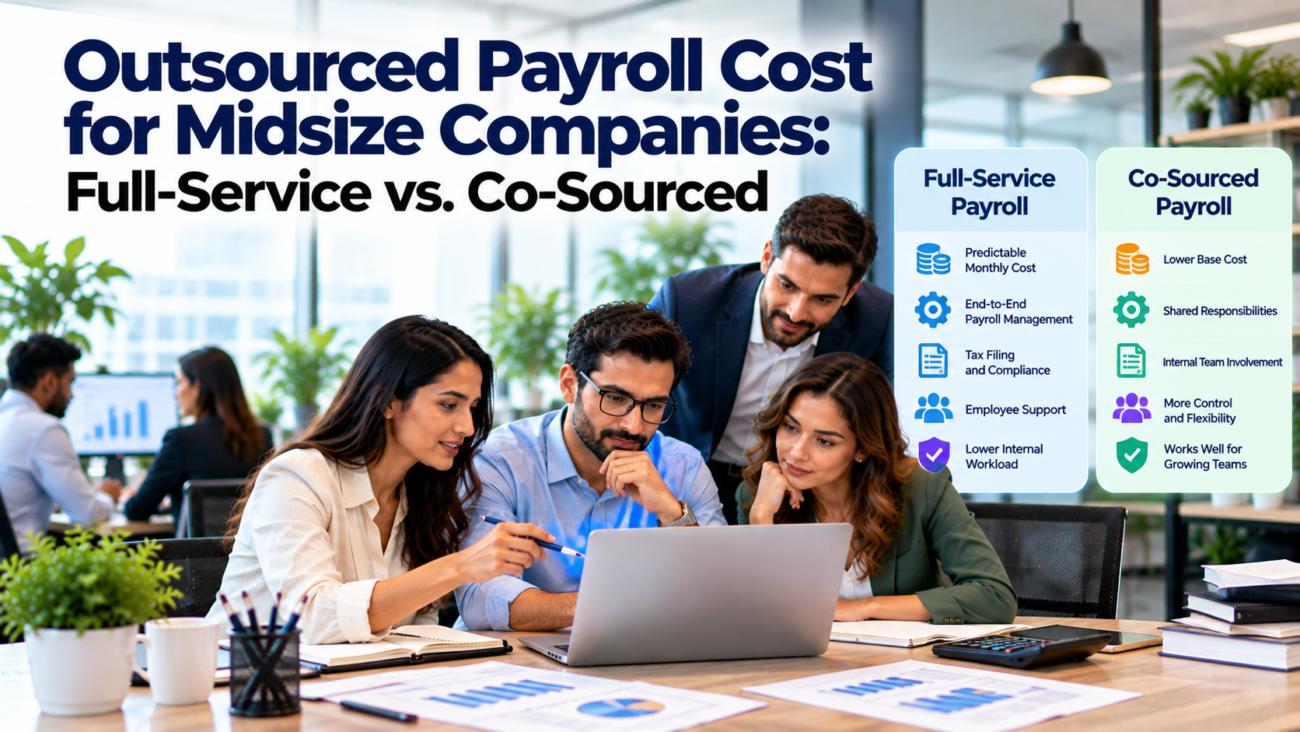
A payroll quote can look affordable until the finance team adds back the work employees still have to do. A provider may charge less per worker but expect the company to collect time records, research exceptions, approve taxes, and answer employee questions. Another provider may charge more and take on most recurring processing. The lower invoice doesn’t always mean the lower operating cost. If you need hands-on help, Ignite HCM offers payroll compliance for teams in this position.
For companies with roughly 100 to 1,000 employees, outsourced payroll cost depends on pay schedules, workforce mix, the number of states involved, and the duties covered by the contract. It also depends on what the business already owns: a payroll team, an HR system, and working integrations. A useful comparison must put those items beside the provider fee.
The choice between full-service and co-sourced payroll is therefore an operating decision with a price attached. This guide explains the difference, shows how to calculate both models, and identifies the contract terms that can change the answer after the first pay run.
TL;DR
Full-service payroll usually puts more recurring processing with an outside provider. Co-sourcing divides that work between the provider and an internal team. Neither label has a fixed service scope or a universal price. Compare provider fees, retained staff time, implementation, payroll changes, special runs, and exit costs over the same period. An illustrative lower co-sourced rate can cost more overall if the employer still needs substantial internal capacity. Tax filing duties may be performed by a provider, but ordinary payroll outsourcing generally doesn’t remove the employer’s federal tax liability. Ask for a task-by-task responsibility schedule before comparing quotes.
What Outsourced Payroll Cost Actually Includes
Outsourced payroll cost is the money a company spends to run payroll through a provider, plus the work that remains with its own staff. Vendors usually quote a recurring charge. Finance needs a broader figure: the annual cost of paying employees accurately and on time, managing tax obligations, resolving problems, and keeping the records needed for review.
A 300-person company that runs payroll twice a month has a different workload from a company with the same headcount paying hourly employees weekly. The second business may have more timesheet changes, overtime calculations, and corrections. Neither headcount nor the number of checks alone describes every service requirement.
It helps to separate the cost into 3 accounts. The first is the provider’s recurring invoice. The second is internal labor and systems the company still pays for. The third covers transition costs, unexpected work, and events that don’t occur every month. A decision based only on the first account will usually understate the true budget.
Another distinction is between a payroll software subscription and a managed service. A software package may calculate wages and support filings, while employees at the client still prepare the inputs and run the payroll. A managed service may include specialists who review exceptions and carry out agreed tasks. Public software prices shouldn’t be treated as a reliable benchmark for full-service managed contracts.
The right payroll outsourcing pricing comparison begins with a scope that every bidder has to price. Without it, 2 vendors may be quoting different products under the same description. The difference can remain hidden until the first complicated payroll cycle.
Full-Service and Co-Sourced Payroll Explained
Under full-service payroll outsourcing, the provider normally runs most routine processing. It may review inputs, calculate pay, prepare filings, handle agreed tax deposits, produce pay statements, and send reports. The employer still supplies correct HR decisions and funding information and usually approves payroll. The contract determines which exceptions the provider will resolve and which ones return to the client.
Under co-sourced payroll services, the internal payroll team and the provider divide responsibilities. For example, the company might own data preparation, attendance disputes, and pay approvals, while the provider handles payroll calculations and tax submissions. A different co-sourced contract could leave the calculations inside the company and outsource only tax filing support. The model isn’t standardized across vendors.
The practical difference is described in PayrollOrg’s delivery model discussion, which compares in-house, shared, and outsourced payroll arrangements. It notes that shared duties can preserve company control but introduce handoff delays and knowledge gaps. Those risks should be considered alongside the costs on the proposal.
| Task | Typical Full-Service Owner | Typical Co-Sourced Owner |
| Payroll policies and pay decisions | Client | Client |
| Employee changes and time records | Client supplies; provider checks as agreed | Often internal team |
| Recurring payroll calculations | Provider | Split by contract |
| Exception investigation | Provider for included cases | Often shared |
| Tax filing work | Commonly provider | Provider or shared |
| Final authorization and funding | Client | Client |
| Employee payroll questions | Depends on support package | Often client first |
| Controls and provider oversight | Client | Client |
This distinction matters when measuring outsourced payroll cost: a payroll processing contract and an employment-related service arrangement have different duties. Some buyers confuse full-service payroll with a professional employer organization. A PEO may provide broader employment-related services under a different legal structure. A certified PEO has special federal tax rules for defined arrangements. Those services and duties shouldn’t be assumed to be part of a conventional outsourced processing contract.
How Payroll Outsourcing Pricing Works
Payroll outsourcing pricing often combines a base charge with a volume measure. A quote might use a per-employee-per-month rate, a fee for each payslip, a rate per pay run, or a monthly minimum. Providers can combine these methods and add charges for optional tasks. There is no credible single national PEPM average that defines managed payroll for every midsize US employer.
With a per-employee-per-month model, the invoice changes with the number of billable workers. However, “employee” might mean an active worker, anyone paid in the month, or every person held in the system. A company with many seasonal employees should ask what happens in months when workers are inactive.
Per-payslip charging ties the fee to payroll outputs. That may be easier to compare when all workers follow the same schedule, but the company needs to confirm how off-cycle checks, voids, reversals, and retroactive corrections count. A provider may apply a base minimum even in months with few payments.
| Pricing Method | Main Calculation | Question to Ask |
| PEPM | Billable employees × rate | Who counts as billable? |
| Per payslip | Payslips issued × rate | Are corrected checks counted again? |
| Per pay run | Pay groups processed × rate | Are special runs included? |
| Monthly retainer | Fixed amount for stated scope | Where do volume limits begin? |
| Separate projects | Agreed one-time or hourly fees | What triggers new work? |
The payroll cost per employee can be reported monthly or annually, but the denominator must be clear. Dividing the total annual cost by average headcount and 12 gives an effective monthly figure. It doesn’t prove that the vendor itself charges that amount per worker. Internal labor and one-time costs can make the effective amount higher than the contract’s PEPM line.
An outsourced payroll cost estimate can change as headcount changes. A good procurement team requests the same volume forecast from every bidder. Include expected hires, exits, pay schedules, and peak headcount so a low initial rate doesn’t conceal charges that appear during normal growth.
What Full-Service Payroll Fees Cover
Full-service payroll outsourcing is often attractive when the company wants fewer recurring calculations and less daily processing work inside finance or HR. Typical service duties can include standard payroll cycles, agreed tax administration, pay statements, year-end forms, and reports. Some contracts include employee help channels and named payroll specialists. Others sell those as separate service levels.
The word “full” still needs boundaries. A provider may process data received from the employer but refuse to decide whether a commission plan has been interpreted correctly. A termination payment may need legal review by the employer. An unresolved timesheet can delay approval even when the provider runs the calculations. Those decisions remain connected to company policy and employment law.
When evaluating full-service payroll outsourcing, ask what happens during a difficult cycle. Does the provider investigate unusual variance from the prior pay period? Is there a cut-off time for corrected inputs? Can it rerun payroll after final approval, and at what cost? How quickly will it address a failed bank payment? These service commitments matter more than a generic list of features.
The provider’s service capacity should match the company’s cycle. Weekly payroll with frequent hourly changes needs different review coverage from a stable salaried payroll. Before selecting the higher service tier, the company should check whether those extra services replace actual internal work. Paying more for a service that payroll staff still duplicate won’t yield the expected savings.
The most useful outsourced payroll cost estimate for this model identifies the hours the internal team can stop spending on calculations, follow-ups, and routine reporting. Oversight time will remain. It should be counted rather than assumed away.
What Co-Sourced Fees Leave Inside the Company
Co-sourced payroll services usually cost less on the provider’s invoice when the client performs more processing work, but retained staff effort can erase that advantage. The business may still collect hours, check employee changes, explain deductions, review exceptions, and approve results. Those tasks need qualified employees with time available during every cycle.
Outsourced payroll cost can look low when the client already pays for specialist staff, but those retained hours still have value. A co-sourced arrangement can fit a company that already employs payroll specialists and doesn’t want to change its system. The provider may add expertise with tax calculations or cover a limited set of recurring processes. However, the contract should say whether the provider works in the company’s platform or imports data into its own. The two approaches have different support and access costs.
The strongest case for co-sourced payroll services is usually control over a complex internal process. An employer with frequent commission adjustments may prefer its finance team to verify those amounts before they reach the provider. A business with union or shift rules may want payroll knowledge retained internally. Outsourcing a selected technical task can help without changing those responsibilities.
Co-sourced payroll services work best when responsibilities and review deadlines are clear. Staffing assumptions need evidence. The Bureau of Labor Statistics’ financial clerks outlook reports a May 2025 median wage of $58,260 for payroll and timekeeping clerks. That figure is not a complete employment cost and does not represent every payroll manager’s salary. It is useful context, not a substitute for the company’s actual compensation and workload data.
A fair payroll cost per employee calculation should allocate only the internal work that remains necessary, using a reasonable loaded labor cost. Savings recorded as fractions of a person’s time are capacity gains unless the company can actually reduce spending, avoid a hire, or use those hours for another valuable task.
Payroll Cost Examples for 200, 500, and 800 Employees
The outsourced payroll cost in these illustrative scenarios is based on assumed provider rates and staffing needs, not surveyed US prices or actual vendor quotes. All values are in US dollars. Annual totals include provider fees and retained labor but initially exclude setup and occasional charges.
For a 200-person employer, suppose the full-service quote is $15 PEPM with 0.15 of an internal full-time equivalent needed for oversight. The co-sourced quote is $9 PEPM but needs 0.40 of an internal full-time equivalent. Assume a fully loaded internal payroll position costs $90,000 annually. The annual totals are $49,500 for full-service and $57,600 for co-sourcing.
For a 500-person company, assume full-service at $12 PEPM with 0.30 internal FTE. Co-sourcing costs $7 PEPM and retains 0.65 FTE. The annual totals are $99,000 and $100,500, respectively. The lower vendor fee produces almost no overall advantage once labor is added.
For 800 employees, assume full-service at $11 PEPM with 0.45 FTE and co-sourced at $6.50 PEPM with 0.85 FTE. Using the same assumed labor cost produces $146,100 for full-service and $138,900 for co-sourcing. Here the co-sourced model has a modest advantage before extra fees.
| Assumed Employees | Full-Service Annual Total | Co-Sourced Annual Total | Lower Model in This Scenario |
| 200 | $49,500 | $57,600 | Full-service by $8,100 |
| 500 | $99,000 | $100,500 | Full-service by $1,500 |
| 800 | $146,100 | $138,900 | Co-sourced by $7,200 |
These differences shouldn’t be presented as expected savings. The provider rates and labor allocations were selected to illustrate the formula. Real quotes may reverse every result. The examples also assume similar service quality, which would need to be tested in procurement.
Payroll outsourcing pricing needs a separate first-year view because setup fees can change the answer again. For example, if the 200-person full-service bid carries an assumed $18,000 setup charge and the co-sourced bid carries $5,000, the first-year totals become $67,500 and $62,600. The operating winner and first-year winner are now different.
An effective payroll cost per employee for year 1 can be calculated by dividing the full first-year expense by average headcount and 12. This is useful for budgeting, but the result must be labeled as a total-cost measure, not an observed vendor rate.
How to Calculate Total Cost and Break-Even
A disciplined outsourced payroll cost model uses the same formula for both delivery choices. That prevents the full-service option from carrying internal oversight costs while the co-sourced option is judged only on its provider quote. It also prevents one-time implementation costs from disappearing into a footnote.
Annual operating cost = 12 × monthly provider fees + retained internal payroll labor + recurring extras.
Year-1 total cost = annual operating cost + implementation and transition costs.
Three-year total cost = implementation and transition costs + operating costs for all 3 years + expected exit or system changes.
A straightforward break-even test examines the extra work co-sourcing retains. Let the full-service annual provider charge be $80,000 and the co-sourced charge be $48,000. The vendor difference is $32,000. If co-sourcing needs $40,000 more internal labor annually, it is $8,000 more expensive before other differences. If it needs only $20,000 more labor, the shared model is $12,000 cheaper on that measure.
The payroll cost per employee can then be compared across both years and scenarios, but it should not replace the actual annual total. An employer paying workers weekly may have a different effective cost than one paying monthly even with identical headcount. Staff workload and service quality matter beyond the ratio.
For payroll outsourcing pricing, sensitivity testing is often more useful than debating a single quote. Calculate what happens if headcount rises by 15%, internal exception time doubles, or an integration requires additional support. A model that changes dramatically under ordinary business events needs a stronger contract or a larger budget allowance.
Also separate cash savings from capacity released. If a payroll professional remains employed at the same salary, the company hasn’t reduced salary expense merely because processing takes fewer hours. That freed time may support other finance work, which has value, but the financial case should state the difference clearly.
Implementation and Hidden Payroll Costs
Implementation can consume a large share of the first-year budget, especially when a midsize employer has old balances or several pay groups. Work can include importing employee records, mapping earnings codes, setting tax registrations, connecting timekeeping tools, and testing bank funding. A provider should distinguish its own implementation fee from the client’s internal project work. This is where payroll outsourcing pricing can hide important costs.
During migration, payroll cost per employee can be higher than in later years because testing requires extra work. A team may run an old process alongside the new one for agreed periods and compare gross-to-net outcomes, taxes, deductions, and general ledger totals. These extra hours should appear in the project plan. A rushed cutover that produces pay errors is not a genuine saving.
For accurate outsourced payroll cost estimates, check what occurs outside routine cycles. Off-cycle checks, voids, reversals, garnishments, bonus runs, year-end corrections, and custom reports may each create charges. A quote with unlimited ordinary runs can still bill for special activity. The pricing schedule should describe what counts as an event and whether it triggers an additional minimum.
| Extra Cost | What to Confirm Before Signing |
| Setup | Per entity, location, or project? |
| Data conversion | Which historical records are imported? |
| Parallel testing | How many cycles are included? |
| Timekeeping connection | Standard connector or custom work? |
| Off-cycle payments | Charged per run, check, or incident? |
| Tax amendments | Who fixes historical filing errors? |
| Employee support | Included channels and hours? |
| Contract exit | Data export and transition assistance? |
A reasonable payroll outsourcing pricing comparison also states the assumed start date and whether the first billing month covers a partial period. Price escalation rules and minimum commitments belong in the total-cost model, not only in the legal appendix.
How Workforce Complexity Changes the Quote
Headcount matters, but it cannot explain outsourced payroll cost by itself. A 500-person company can contain several different payroll operations. Salaried staff may need routine calculations. Hourly teams may submit shift differentials, tips, overtime, or changing schedules. Commission-heavy roles can require adjustments after sales close. Each distinct earning rule increases the work that someone must configure and check.
Geography matters too. Employers with staff in multiple US states may need different registrations, pay-frequency rules, and local withholding work. The Labor Department’s payday reference illustrates the variation among states, but its displayed table was last revised in January 2023. Buyers should verify current rules with the relevant state agency rather than treat the table as a live legal checklist.
Multiple legal entities introduce another layer. The company may need separate tax registrations and reports while still combining payroll figures for management. A provider should explain whether it charges separately by entity and which consolidated views it can produce. Entity-level changes may also affect the data conversion process.
Co-sourced payroll services can suit complex work when the internal team knows the business rules well. That advantage depends on documented handoffs. If a payroll specialist spends hours correcting a provider’s misunderstanding of commissions every month, the model is adding work instead of sharing it.
By contrast, full-service payroll outsourcing may handle recurring complexity well when the provider is contracted to own the relevant exception process. The buyer needs evidence in the service schedule, not a general assurance. Complexity premiums should be connected to named tasks, service levels, or transaction types.
The resulting payroll cost per employee may increase as payroll becomes harder even when headcount stays stable. Compare like-for-like populations when using PEPM benchmarks. A firm with mostly salaried office staff should not expect its costs to match a business with weekly hourly payroll across many locations.
Payroll Tax Liability and Provider Risk
Taxes are the area where loose language about outsourcing becomes dangerous. The Internal Revenue Service’s outsourcing guidance states that employers using ordinary payroll service providers generally remain responsible for federal employment tax deposits and payments. If a provider fails to pay, the employer may face unpaid tax, penalties, and interest. A full-service contract should not be presented as a blanket transfer of legal liability.
Different third-party legal arrangements carry different duties. The IRS’s arrangement explanation distinguishes payroll service providers, reporting agents, section 3504 agents, and certified professional employer organizations. A reporting agent can perform authorized filing and deposit tasks without relieving the client of its employment tax responsibilities. A section 3504 agent has a different authorized relationship and potential joint liability.
A certified PEO is a separate category. IRS CPEO customer guidance describes circumstances in which the CPEO is generally solely liable for federal employment taxes on wages it pays to defined worksite employees under a qualifying contract. Different treatment can apply to other workers. A buyer shouldn’t assume that every PEO, much less every payroll processor, has this status.
A buyer comparing tax responsibilities can consult the IRS’s third-party arrangement chart to see how forms, filing methods, and liability differ. Contracts should identify the actual legal arrangement and authorizations rather than relying on the vendor’s sales label.
For tax deposit oversight, the IRS’s employment tax guidance explains the electronic deposit methods and filing requirements. The employer should be able to verify timely deposits and reconcile tax liabilities with reports. Full-service payroll outsourcing doesn’t remove that basic financial review. This oversight has a staffing cost under both models and should not be omitted from the budget.
To see how this affects actual quarterly returns, the current Form 941 instructions also distinguish ordinary third-party payers from CPEO arrangements in their employment tax discussion. A provider’s tax promise needs to be checked against the applicable arrangement and the filings the company actually uses.
A lower outsourced payroll cost cannot be evaluated separately from this risk. It may be worthwhile to pay for better tax support and reporting, but the company still needs evidence of deposits, deadlines, and who handles notices. Service quality and legal liability are separate issues.
Payroll Records, Security, and Controls
A midsize employer needs reliable records even when an outside party operates payroll. The Labor Department’s recordkeeping factsheet explains that covered employers must keep specified wage and hours information for nonexempt employees. Under the Fair Labor Standards Act, core payroll records generally need to be retained for at least 3 years, and supporting wage-computation records for at least 2 years.
Federal employment tax records have their own retention duties. The IRS’s tax record guidance generally calls for employment tax records to be kept at least 4 years after filing the fourth-quarter return for the year. Some specific tax-credit records can require longer periods. The provider’s storage policy must support the employer’s actual obligations.
Ask where employee information is stored and who can see it. Payroll files contain Social Security numbers, bank details, and compensation information. A provider should explain access controls, subcontractor access, incident notification, and recovery procedures. These questions belong in procurement even when the contract focuses mainly on processing fees.
For a structured review of security duties, NIST’s supplier-risk guide suggests defining security requirements for outside parties and examining those risks before entering contracts. It doesn’t certify a payroll vendor or guarantee that pay will be calculated correctly. It gives a useful structure for questions about supplier security and accountability.
Comparing Quotes and Contracts on Equal Terms
The best outsourced payroll cost comparison starts with 1 detailed workload description sent to all prospective providers. Include average and peak headcount, pay groups, states, entities, expected off-cycle activity, and the systems that must exchange data. List who will approve payroll, who handles employee questions, and what reporting finance needs. Ask vendors to mark each task as included, optional, excluded, or client-owned. That makes payroll cost per employee figures more comparable.
Full-service payroll outsourcing should be compared against the same target outcome as co-sourced payroll services. If one bid includes first-line employee support and the other does not, add the internal cost of that support to the second option. If one bid excludes tax amendments or year-end corrections, price those expected events separately. The winner should not change simply because a service was left off the page.
For year-end wage reports, the Social Security Administration’s W-2 filing update notes the federal electronic-filing threshold of 10 information returns, subject to applicable waivers or exemptions. For a midsize employer, year-end filing capability and responsibility need explicit treatment. Confirm who prepares, submits, reconciles, and corrects wage statements under each proposal.
For payroll outsourcing pricing, ask whether quoted prices rise with headcount, pay groups, entities, or contract anniversaries. Record minimum fees, notice periods, and what happens if the company acquires another business. Those facts often have more practical value than a supplier’s broad claims about saving payroll time.
A clear contract should include the service calendar, data handoff times, error response process, employee support arrangements, tax responsibilities, reporting access, and termination assistance. The company should leave procurement knowing exactly which work comes back to its own employees.
Which Model Makes Financial Sense?
The right model depends on the internal team and the work the business wants to keep. Co-sourced payroll services can be a good fit when experienced payroll employees already handle complex policies and the company needs selected outside help. It may preserve internal knowledge and avoid replacing a working system. Its cost advantage disappears when shared processing creates repeated checking or frequent handoff delays.
Full-service payroll outsourcing may suit a company whose finance or HR team is spending too much time on recurring execution. A provider can take over agreed processing tasks, but the employer still needs timely approvals and oversight. The higher provider bill can be worthwhile when the released internal capacity is real and the service meets the company’s requirements.
Industry experience supports making the decision by operating model rather than by labels. PayrollOrg’s 2025 survey results report substantial use of hybrid in-house and outsourced payroll delivery among its global survey respondents. That result isn’t a midsize US pricing benchmark, but it reinforces that mixed delivery is an established option rather than an unusual compromise.
To reach a decision, finance should compare annual provider fees and internal labor under identical assumptions, then add transition work and likely extras. It should examine the first year separately from steady operation and test what happens as the company grows. The best choice is the arrangement that meets payroll obligations at a supportable total cost, without hiding responsibility in vague service terms.
Frequently Asked Questions
How Much Does Outsourced Payroll Cost per Employee?
There is no single reliable rate for managed midsize payroll. Quotes vary by service scope, employee count, payroll frequency, states, and included support. Compare the complete annual expense and divide by average headcount and 12 if you need an effective monthly amount. Keep that total-cost figure separate from the provider’s quoted PEPM rate.
What Is the Difference Between Full-Service and Co-Sourced Payroll?
Full-service generally places most recurring payroll processing with the vendor. Co-sourcing splits tasks between the provider and an internal team. Both models still need client decisions and oversight. The contract should define who prepares inputs, resolves exceptions, authorizes payments, and handles tax tasks.
Is Co-Sourced Payroll Always Cheaper?
No. A co-sourced provider may have a lower invoice while the company keeps more payroll staff time. A lower fee can be offset by corrections, shared reviews, or duplicated work. Calculate internal labor alongside the provider charge to compare the models fairly.
What Does Full-Service Payroll Outsourcing Usually Include?
It often includes routine calculations, agreed payroll processing, pay statements, reports, and certain tax tasks. Employee help, complex corrections, and special pay runs may be priced separately. A contract’s responsibility schedule matters more than the label because service packages differ.
Which Tasks Usually Stay In-House Under Co-Sourcing?
Companies commonly retain payroll policy, employee changes, time approvals, exception review, and final authorization. The provider may handle calculations, filings, or technical processing. The work can be divided differently, so both teams should have documented duties and cut-off times.
How Do Payroll Providers Calculate Their Fees?
Providers may charge per employee per month, per payslip, per pay run, or through a fixed retainer. Some combine methods. Ask who counts as a billable worker, whether minimums apply, and which events trigger extra charges.
Is Payroll Priced per Run or per Employee?
Either model is possible. A PEPM agreement links charges to the defined billable headcount, while a per-run or per-payslip agreement links them to processing activity. The fair comparison uses actual pay schedules and any separate fees for corrections or special checks.
Are Payroll Tax Filings Included in Full-Service Fees?
Often they are part of an agreed managed package, but inclusion isn’t universal. The contract must identify covered taxes, jurisdictions, registrations, returns, deposit work, and amendments. Special tax notices or past-period corrections may require separate fees.
Does Outsourcing Payroll Remove Employer Tax Liability?
Generally, no. Ordinary payroll processors and reporting agents don’t eliminate the employer’s federal employment tax obligations. Certain authorized arrangements, including qualifying CPEO contracts for defined workers, have different rules. The actual legal arrangement matters more than the sales description.
Which Hidden Fees Should Midsize Companies Expect?
Common possibilities include implementation, record conversion, parallel testing, integrations, off-cycle payments, tax amendments, custom reporting, and employee support. They aren’t charged by every provider. Ask bidders to identify inclusions, exclusions, and unit prices for expected events.
Does Multistate Payroll Increase Outsourcing Costs?
It can. Different tax registrations, local rules, and reporting needs may increase setup or ongoing work. The effect depends on the provider’s included service and the employer’s locations. Compare the actual jurisdiction list rather than adding an assumed multistate surcharge.
Can Outsourcing Eliminate an Internal Payroll Position?
Sometimes it can reduce enough recurring work to change staffing needs, but oversight and employee decisions remain. If a team member stays employed at the same salary, the released hours aren’t immediate cash savings. The financial model should distinguish lower spending from capacity used elsewhere.
How Much Does Switching Payroll Providers Cost?
There is no standard migration charge. The expense depends on data conversion, integrations, system configuration, historical balances, parallel testing, and internal project hours. Ask for a fixed scope where possible and model the first year separately from later operating years.
How Should a Company Compare Payroll Outsourcing Quotes?
Give each bidder the same workforce assumptions and task list. Compare recurring fees, retained labor, likely extras, transition costs, and exit terms. Also check service deadlines and who resolves payroll errors. A quote is comparable only when the covered work is comparable.
When Is Co-Sourcing the Better Choice for a Midsize Employer?
Co-sourcing may fit a business with a capable payroll team and complex rules it wants to keep inside. It works best when outside help removes specific tasks without causing duplicate review. If the company wants to reduce internal payroll execution more substantially, full-service deserves close comparison.
